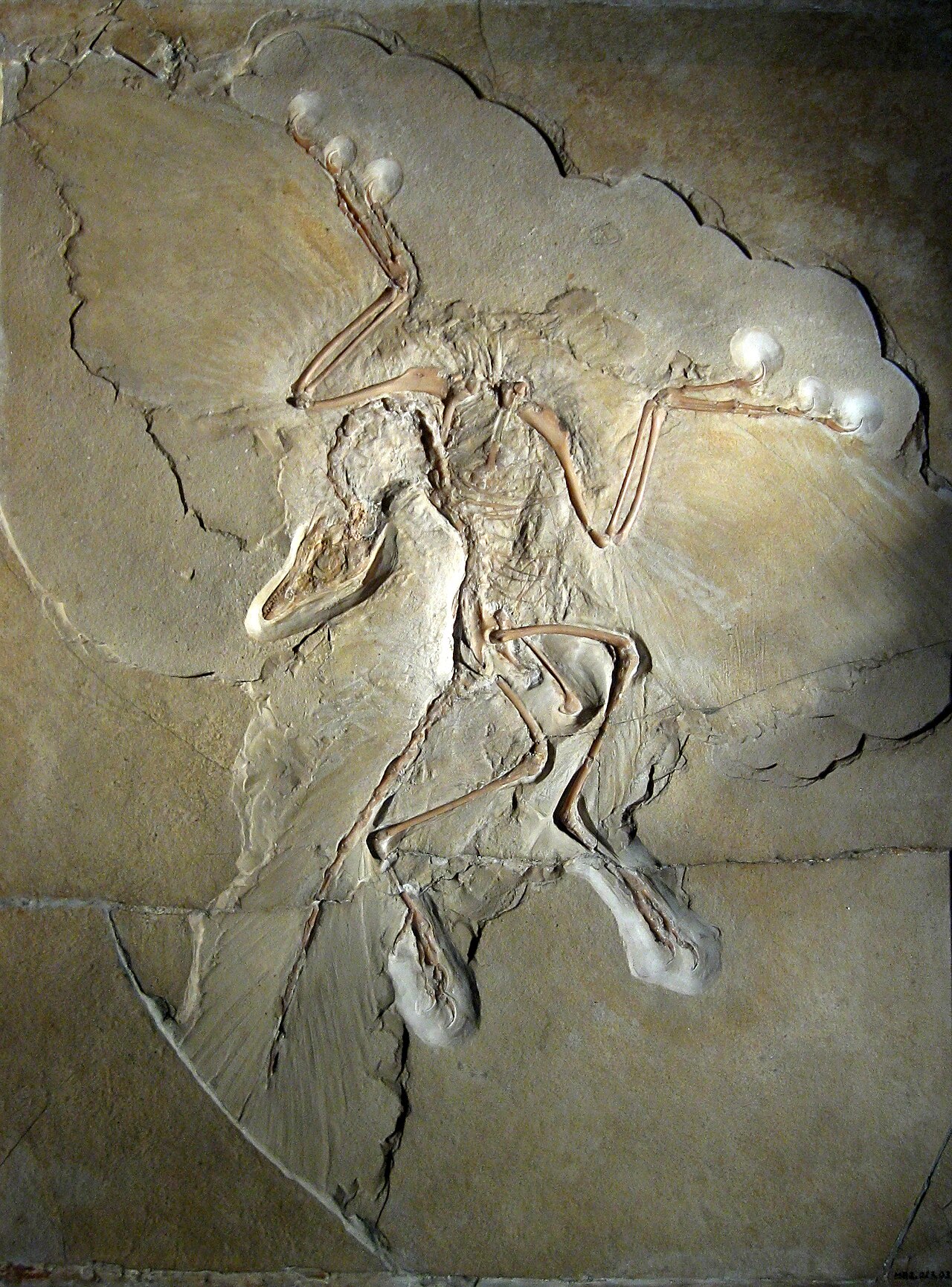

There are dinosaurs in our gardens.
This is not a figure of speech, nor an exaggeration meant to grab attention. It is what scientific classification says today, and the verb matters:
birds do not descend from dinosaurs. They are dinosaurs.
Why “are” and not “descend from”
For some thirty years, living things have been classified according to a precise rule: a group contains all the descendants of a common ancestor. No exceptions, no way out.
If birds descend from theropod dinosaurs, then they are in the dinosaur group. They cannot be taken out of it without breaking the rule.1
Specialists use a comparison that makes this obvious: just as humans are mammals, birds are dinosaurs.
Nobody says “humans descend from mammals”. We say they are mammals. The same applies here.
Beware of the opposite error: this does not mean that dinosaurs are all birds. The inclusion works only one way. All tomatoes are fruits; not all fruits are tomatoes.
A major consequence
We are generally taught that the dinosaurs died out sixty-six million years ago.
That is wrong.
One lineage survived. It came through the crisis, it diversified, and today it is outside our windows.
How we got here
This idea is not new. In 1860, a fossil feather was found in limestone in Germany; in 1861, Archaeopteryx was described — barely two years after the publication of Darwin’s book. A kinship between birds and dinosaurs was proposed as early as the nineteenth century.2
But it long remained contested. It was above all Chinese fossils found in the late 1990s in Liaoning Province, preserved in very fine lake-bed sediments — dinosaurs such as Sinosauropteryx, whose skin bore structures that could provide information about the origin of feathers — that supplied the decisive intermediate forms.3
The argument that changes everything
One might expect a specialist to defend this idea by lining up skeletal similarities. There are many, and they matter.
But the decisive argument lies elsewhere:
If the hypothesis were wrong, we would today be as uncertain about the origin of birds as we were thirty years ago.
Yet the opposite has happened. New fossils fit into it. Things that nobody was trying to explain fall into place of their own accord.4
An example: why do birds fly with their forelimbs alone? Because they inherited their bipedalism from theropods: their hind legs were already busy walking.5
Nobody built the hypothesis to explain that. It comes as a bonus.
“Bird brain”
It is an insult. It rests on an accurate observation: a bird’s brain really is very small.
A tit has a brain that weighs less than one gram. A crow, about fifteen grams. A chimpanzee, about four hundred.
And yet.
What was counted in 2016
A study did something nobody had done: count the neurons, in twenty-eight bird species.6
The authors frame the problem rigorously: small brains should process less information. That is what theory predicts. Yet some birds achieve primate-like performance. So there was something to explain.7
The result of the count: the brains of parrots and songbirds contain on average twice as many neurons as primate brains of the same mass.8
Twice as many, in the same weight. Avian neurons are simply smaller and more tightly packed.9
A second effect adds to the first: in corvids and parrots, a much larger share of these neurons is located in the front part of the brain — the part associated with the most complex functions — than in primates or other mammals.10
The two effects combined lead to the sentence that concludes the study: large parrots and corvids have, in this part of the brain, as many neurons as, or more than, monkeys with much larger brains.11
The count has since been extended. A 2022 study estimated neuron numbers in one hundred and eleven species across twenty-four families, and linked these numbers to the ability to invent new behaviours. Twenty-eight species were enough to establish the fact; one hundred and eleven make it possible to say what it corresponds to.12
What these birds can do
A review comparing many tasks concluded that corvids often perform on par with primates, and that corvids and parrots perform similarly.13
With a brain of one to twenty-five grams, compared with about four hundred.
A New Caledonian crow can solve problems in which it must use one tool to obtain another tool, which will then be used to reach the food. Two indirect steps before the reward.14
Unprecedented energy efficiency
Bird neurons consume about a third as much sugar as those of mammals, according to a measurement made on pigeons in 2022.15
Smaller, more tightly packed, less hungry. It is not the same solution as ours — it is another solution to the same problem.
All this is a reason to be wary of any conclusion drawn from an animal’s size alone.
The necessary caveat
The researchers themselves point out that the comparison between the front areas of the brain in birds and those in mammals has its limits: these structures have a common origin, but they are not organised in the same way — in layers in mammals, in clusters of neurons in birds.16
Another result of the study deserves mention, because it tempers the enthusiasm: in birds, gaining neurons is costly in volume. Multiplying the number of neurons by ten multiplies brain mass by fourteen or seventeen, depending on the group. Density therefore has a limit.17
What the insult really said
“Bird brain” did not describe birds. It described a bias: the belief that a capacity can be judged by the size of an organ alone.
The observation was right. The conclusion was wrong.
What is still debated
This needs to be said, or this page would be too tidy.
Within the consensus, the exact sequence of events is disputed. From which precise group did birds arise? How did flight begin — by leaping from branches, by running, some other way?18
These questions are not settled. This is not an admission of weakness: it is the difference between “we know that” and “we know how”. One can be sure of the first while still debating the second.
Yet another box, yet more blurred edges
“Birds are dinosaurs” has the same logical form as “humans are apes” or “the tomato is a fruit”. Each time, classification puts something where everyday language would not have put it.
The surprise always comes from the same place: we had built our boxes before we knew the kinships.
Note 1
Using proper terminology, birds are avian dinosaurs; other dinosaurs are non-avian dinosaurs, and (strange as it may sound) birds are technically considered reptiles. […] In fact, the evidence is overwhelmingly in favor of birds being the descendants of a maniraptoran dinosaur, probably something similar (but not identical) to a small dromaeosaur.
University of California Museum of Paleontology, “Are Birds Really Dinosaurs?”, page consulted on 28 October 2026
Note 2
Archaeopteryx lithographica (Vogel-Feder) und Pterodactylus von Solnhofen
Archaeopteryx lithographica (bird feather) and Pterodactylus from Solnhofen
Meyer, Hermann von, notice sur Archaeopteryx, Neues Jahrbuch für Mineralogie, 1861
Note 3
Two spectacular fossilized dinosaur skeletons were recently discovered in Liaoning in northeastern China. […] Both specimens have interesting integumentary structures that could provide information about the origin of feathers.
Chen, Pei-ji, Dong, Zhi-ming and Zhen, Shuo-nan, “An Exceptionally Well-Preserved Theropod Dinosaur from the Yixian Formation of China”, Nature, vol. 391, 1998, p. 147-152
Note 4
The ever-growing fossil record of early birds and their closest dinosaurian relatives, which can be placed in a well-resolved family tree (Figure 1), allow unprecedented insight […]
Brusatte, Stephen L., O’Connor, Jingmai K. and Jarvis, Erich D., “The Origin and Diversification of Birds”, Current Biology, vol. 25, 2015, p. R888-R898
Note 5
Birds evolved from and are phylogenetically recognized as members of the theropod dinosaurs; […] The ancestors of birds were bipedal, terrestrial, agile, cursorial and carnivorous or omnivorous.
Padian, Kevin and Chiappe, Luis M., “The Origin and Early Evolution of Birds”, Biological Reviews, vol. 73, 1998, p. 1-42
Note 6
We investigated the cellular composition of the brains of 28 avian species
Olkowicz, Seweryn et al., “Birds Have Primate-like Numbers of Neurons in the Forebrain”, Proceedings of the National Academy of Sciences, vol. 113, no. 26, 2016, p. 7255-7260
Note 7
Some birds achieve primate-like levels of cognition, even though their brains tend to be much smaller in absolute size. This poses a fundamental problem […] because small brains are expected to have a lower information-processing capacity.
Olkowicz, Seweryn et al., “Birds Have Primate-like Numbers of Neurons in the Forebrain”, Proceedings of the National Academy of Sciences, vol. 113, no. 26, 2016, p. 7255-7260
Note 8
the brains of parrots and songbirds contain on average twice as many neurons as primate brains of the same mass
Olkowicz, Seweryn et al., “Birds Have Primate-like Numbers of Neurons in the Forebrain”, Proceedings of the National Academy of Sciences, vol. 113, no. 26, 2016, p. 7255-7260
Note 9
indicating that avian brains have higher neuron packing densities than mammalian brains […] Avian brains seem to consist of small, tightly packed neurons
Olkowicz, Seweryn et al., “Birds Have Primate-like Numbers of Neurons in the Forebrain”, Proceedings of the National Academy of Sciences, vol. 113, no. 26, 2016, p. 7255-7260
Note 10
corvids and parrots have much higher proportions of brain neurons located in the pallial telencephalon compared with primates or other mammals and birds
Olkowicz, Seweryn et al., “Birds Have Primate-like Numbers of Neurons in the Forebrain”, Proceedings of the National Academy of Sciences, vol. 113, no. 26, 2016, p. 7255-7260
Note 11
large-brained parrots and corvids have forebrain neuron counts equal to or greater than primates with much larger brains
Olkowicz, Seweryn et al., “Birds Have Primate-like Numbers of Neurons in the Forebrain”, Proceedings of the National Academy of Sciences, vol. 113, no. 26, 2016, p. 7255-7260
Note 12
Using estimation data on neuron numbers in 111 bird species across 24 families, the authors show that number of neurons is positively associated with innovation propensity and encephalization. […] On the basis of estimations of neuron numbers for 111 bird species, we show here that the number of neurons in the pallial telencephalon is positively associated with a major expression of intelligence: innovation propensity.
Sol, Daniel et al., “Neuron Numbers Link Innovativeness with Both Absolute and Relative Brain Size in Birds”, Nature Ecology & Evolution, 2022
Note 13
in many of which corvids perform on par with primates […] different corvid and parrot species indeed perform similarly in a range of cognitive tasks
Lambert, Megan L., Jacobs, Ivo, Osvath, Mathias et von Bayern, Auguste M. P., “Birds of a Feather? Parrot and Corvid Cognition Compared”, Behaviour, vol. 156, no. 5-8, 2019, p. 505-594
Note 14
Here we provide experimental evidence that New Caledonian crows can spontaneously solve a demanding metatool task in which a short tool is used to extract a longer tool that can then be used to obtain meat.
Taylor, Alex H. et al., “Spontaneous Metatool Use by New Caledonian Crows”, Current Biology, vol. 17, 2007, p. 1504-1507
Note 15
We found that neural tissue in the pigeon consumes […] in an awake state, which translates into a surprisingly low neuronal energy budget of 1.86 x 10(-9) +/- 0.2 x 10(-9) μmol glucose per neuron per minute. This is approximately 3 times lower than the rate in the average mammalian neuron.
von Eugen, Kaya et al., “Avian Neurons Consume Three Times Less Glucose than Mammalian Neurons”, Current Biology, vol. 32, no. 19, 2022, p. 4306-4313.e4
Note 16
Superficially, the architecture of the avian brain appears very different from that of mammals, but recent work demonstrates that, despite a lack of layered neocortex, large areas of the avian forebrain are homologous to mammalian cortex […] the nuclear architecture of the avian brain appears to exhibit more efficient packing of neurons and their interconnections than the layered architecture of the mammalian neocortex.
Olkowicz, Seweryn et al., “Birds Have Primate-like Numbers of Neurons in the Forebrain”, Proceedings of the National Academy of Sciences, vol. 113, no. 26, 2016, p. 7255-7260
Note 17
a 10-fold increase in the number of neurons results in a 16.9- and 14.0-fold larger brain in songbirds and parrots, respectively
Olkowicz, Seweryn et al., “Birds Have Primate-like Numbers of Neurons in the Forebrain”, Proceedings of the National Academy of Sciences, vol. 113, no. 26, 2016, p. 7255-7260
Note 18
Thus, there is current debate about whether dromaeosaurids and troodontids form their own clade of close bird relatives, or whether one of them is more closely related to birds than the other [2,5,24]. […] These debates will likely continue […] Whether these wings were capable of flight, or perhaps used for other functions, such as egg brooding or display [60], is difficult to answer at present, although there is some emerging evidence for multiple uses.
Brusatte, Stephen L., O’Connor, Jingmai K. and Jarvis, Erich D., “The Origin and Diversification of Birds”, Current Biology, vol. 25, 2015, p. R888-R898
Notes and sources
- ↑
Passage If birds descend from theropod dinosaurs, then they are in the dinosaur group.
Using proper terminology, birds are avian dinosaurs; other dinosaurs are non-avian dinosaurs, and (strange as it may sound) birds are technically considered reptiles. […] In fact, the evidence is overwhelmingly in favor of birds being the descendants of a maniraptoran dinosaur, probably something similar (but not identical) to a small dromaeosaur.
Source University of California Museum of Paleontology, “Are Birds Really Dinosaurs?”, page consulted on 28 October 2026, 1st paragraph (“Ask your average paleontologist who…”).
Open access open the source · checked on 27 October 2026
- ↑
Passage In 1860, a fossil feather was found in limestone in Germany; in 1861, Archaeopteryx was described
Archaeopteryx lithographica (Vogel-Feder) und Pterodactylus von Solnhofen
Editors’ translation Archaeopteryx lithographica (bird feather) and Pterodactylus from Solnhofen
Source Meyer, Hermann von, notice sur Archaeopteryx, Neues Jahrbuch für Mineralogie, 1861, 1861 notice.
Public domain open the source · checked on 9 September 2026
- ↑
Passage Chinese fossils found in the late 1990s in Liaoning Province […] dinosaurs such as Sinosauropteryx, whose skin bore structures that could provide information about the origin of feathers
Two spectacular fossilized dinosaur skeletons were recently discovered in Liaoning in northeastern China. […] Both specimens have interesting integumentary structures that could provide information about the origin of feathers.
Source Chen, Pei-ji, Dong, Zhi-ming and Zhen, Shuo-nan, “An Exceptionally Well-Preserved Theropod Dinosaur from the Yixian Formation of China”, Nature, vol. 391, 1998, p. 147-152, abstract (opening paragraph), p. 147.
Paywalled · checked on 25 October 2026
- ↑
Passage New fossils fit into it.
The ever-growing fossil record of early birds and their closest dinosaurian relatives, which can be placed in a well-resolved family tree (Figure 1), allow unprecedented insight […]
Source Brusatte, Stephen L., O’Connor, Jingmai K. and Jarvis, Erich D., “The Origin and Diversification of Birds”, Current Biology, vol. 25, 2015, p. R888-R898, p. R891, § “The Assembly of the Bird Body Plan and Classic Avian Behaviors”, 1st paragraph, 1st sentence.
Open access open the source · checked on 27 October 2026
- ↑
Passage they inherited their bipedalism from theropods: their hind legs were already busy walking
Birds evolved from and are phylogenetically recognized as members of the theropod dinosaurs; […] The ancestors of birds were bipedal, terrestrial, agile, cursorial and carnivorous or omnivorous.
Source Padian, Kevin and Chiappe, Luis M., “The Origin and Early Evolution of Birds”, Biological Reviews, vol. 73, 1998, p. 1-42, abstract, first and third sentences.
Paywalled · checked on 25 October 2026
- ↑
Passage count the neurons, in twenty-eight bird species
We investigated the cellular composition of the brains of 28 avian species
Source Olkowicz, Seweryn et al., “Birds Have Primate-like Numbers of Neurons in the Forebrain”, Proceedings of the National Academy of Sciences, vol. 113, no. 26, 2016, p. 7255-7260, “Significance” box.
Paywalled open the source · checked on 9 September 2026
- ↑
Passage small brains should process less information […] Yet some birds achieve primate-like performance.
Some birds achieve primate-like levels of cognition, even though their brains tend to be much smaller in absolute size. This poses a fundamental problem […] because small brains are expected to have a lower information-processing capacity.
Source Olkowicz, Seweryn et al., “Birds Have Primate-like Numbers of Neurons in the Forebrain”, Proceedings of the National Academy of Sciences, vol. 113, no. 26, 2016, p. 7255-7260, abstract.
Paywalled open the source · checked on 9 September 2026
- ↑
Passage the brains of parrots and songbirds contain on average twice as many neurons as primate brains of the same mass
the brains of parrots and songbirds contain on average twice as many neurons as primate brains of the same mass
Source Olkowicz, Seweryn et al., “Birds Have Primate-like Numbers of Neurons in the Forebrain”, Proceedings of the National Academy of Sciences, vol. 113, no. 26, 2016, p. 7255-7260, abstract.
Paywalled open the source · checked on 9 September 2026
- ↑
Passage Avian neurons are simply smaller and more tightly packed.
indicating that avian brains have higher neuron packing densities than mammalian brains […] Avian brains seem to consist of small, tightly packed neurons
Source Olkowicz, Seweryn et al., “Birds Have Primate-like Numbers of Neurons in the Forebrain”, Proceedings of the National Academy of Sciences, vol. 113, no. 26, 2016, p. 7255-7260, abstract; introduction.
Paywalled open the source · checked on 9 September 2026
- ↑
Passage in corvids and parrots, a much larger share of these neurons is located in the front part of the brain […] than in primates or other mammals
corvids and parrots have much higher proportions of brain neurons located in the pallial telencephalon compared with primates or other mammals and birds
Source Olkowicz, Seweryn et al., “Birds Have Primate-like Numbers of Neurons in the Forebrain”, Proceedings of the National Academy of Sciences, vol. 113, no. 26, 2016, p. 7255-7260, abstract.
Paywalled open the source · checked on 9 September 2026
- ↑
Passage large parrots and corvids have, in this part of the brain, as many neurons as, or more than, monkeys with much larger brains
large-brained parrots and corvids have forebrain neuron counts equal to or greater than primates with much larger brains
Source Olkowicz, Seweryn et al., “Birds Have Primate-like Numbers of Neurons in the Forebrain”, Proceedings of the National Academy of Sciences, vol. 113, no. 26, 2016, p. 7255-7260, abstract.
Paywalled open the source · checked on 9 September 2026
- ↑
Passage A 2022 study estimated neuron numbers in one hundred and eleven species across twenty-four families, and linked these numbers to the ability to invent new behaviours.
Using estimation data on neuron numbers in 111 bird species across 24 families, the authors show that number of neurons is positively associated with innovation propensity and encephalization. […] On the basis of estimations of neuron numbers for 111 bird species, we show here that the number of neurons in the pallial telencephalon is positively associated with a major expression of intelligence: innovation propensity.
Source Sol, Daniel et al., “Neuron Numbers Link Innovativeness with Both Absolute and Relative Brain Size in Birds”, Nature Ecology & Evolution, 2022, publisher’s standfirst (page description); abstract.
Paywalled open the source · checked on 9 September 2026
- ↑
Passage corvids often perform on par with primates, and that corvids and parrots perform similarly
in many of which corvids perform on par with primates […] different corvid and parrot species indeed perform similarly in a range of cognitive tasks
Source Lambert, Megan L., Jacobs, Ivo, Osvath, Mathias et von Bayern, Auguste M. P., “Birds of a Feather? Parrot and Corvid Cognition Compared”, Behaviour, vol. 156, no. 5-8, 2019, p. 505-594, abstract.
Paywalled open the source · checked on 25 October 2026
- ↑
Passage A New Caledonian crow can solve problems in which it must use one tool to obtain another tool
Here we provide experimental evidence that New Caledonian crows can spontaneously solve a demanding metatool task in which a short tool is used to extract a longer tool that can then be used to obtain meat.
Source Taylor, Alex H. et al., “Spontaneous Metatool Use by New Caledonian Crows”, Current Biology, vol. 17, 2007, p. 1504-1507, abstract (summary).
Open access · checked on 24 October 2026
- ↑
Passage Bird neurons consume about a third as much sugar as those of mammals
We found that neural tissue in the pigeon consumes […] in an awake state, which translates into a surprisingly low neuronal energy budget of 1.86 x 10(-9) +/- 0.2 x 10(-9) μmol glucose per neuron per minute. This is approximately 3 times lower than the rate in the average mammalian neuron.
Source von Eugen, Kaya et al., “Avian Neurons Consume Three Times Less Glucose than Mammalian Neurons”, Current Biology, vol. 32, no. 19, 2022, p. 4306-4313.e4, abstract (Summary).
Open access open the source · checked on 25 October 2026
- ↑
Passage these structures have a common origin, but they are not organised in the same way
Superficially, the architecture of the avian brain appears very different from that of mammals, but recent work demonstrates that, despite a lack of layered neocortex, large areas of the avian forebrain are homologous to mammalian cortex […] the nuclear architecture of the avian brain appears to exhibit more efficient packing of neurons and their interconnections than the layered architecture of the mammalian neocortex.
Source Olkowicz, Seweryn et al., “Birds Have Primate-like Numbers of Neurons in the Forebrain”, Proceedings of the National Academy of Sciences, vol. 113, no. 26, 2016, p. 7255-7260, introduction, second paragraph; discussion, second paragraph.
Paywalled open the source · checked on 25 October 2026
- ↑
Passage gaining neurons is costly in volume. Multiplying the number of neurons by ten multiplies brain mass by fourteen or seventeen, depending on the group.
a 10-fold increase in the number of neurons results in a 16.9- and 14.0-fold larger brain in songbirds and parrots, respectively
Source Olkowicz, Seweryn et al., “Birds Have Primate-like Numbers of Neurons in the Forebrain”, Proceedings of the National Academy of Sciences, vol. 113, no. 26, 2016, p. 7255-7260, results, section “Total Numbers of Neurons”.
Paywalled open the source · checked on 9 September 2026
- ↑
Passage From which precise group did birds arise? How did flight begin
Thus, there is current debate about whether dromaeosaurids and troodontids form their own clade of close bird relatives, or whether one of them is more closely related to birds than the other [2,5,24]. […] These debates will likely continue […] Whether these wings were capable of flight, or perhaps used for other functions, such as egg brooding or display [60], is difficult to answer at present, although there is some emerging evidence for multiple uses.
Source Brusatte, Stephen L., O’Connor, Jingmai K. and Jarvis, Erich D., “The Origin and Diversification of Birds”, Current Biology, vol. 25, 2015, p. R888-R898, p. R889, § “Where Birds Nest in the Dinosaur Family Tree”, 3rd and 4th paragraphs; p. R891, § “The Assembly of the Bird Body Plan and Classic Avian Behaviors”, paragraph “In many derived non-bird dinosaurs…”.
Open access open the source · checked on 27 October 2026
Bibliography
12
- Brusatte, Stephen L., O’Connor, Jingmai K. and Jarvis, Erich D., “The Origin and Diversification of Birds”, Current Biology, vol. 25, 2015, p. R888-R898, open access (the consensus, what is still debated, the Liaoning fossils).
- Chen, Pei-ji, Dong, Zhi-ming and Zhen, Shuo-nan, “An Exceptionally Well-Preserved Theropod Dinosaur from the Yixian Formation of China”, Nature, vol. 391, 1998, p. 147-152, paywalled (the first feathered dinosaur to be described).
- Emery, Nathan J. and Clayton, Nicola S., “The Mentality of Crows: Convergent Evolution of Intelligence in Corvids and Apes”, Science, vol. 306, 2004, p. 1903-1907, paywalled (corvids and great apes: complex abilities that arose several times).
- Gauthier, Jacques, “Saurischian Monophyly and the Origin of Birds”, Memoirs of the California Academy of Sciences, vol. 8, 1986, p. 1-55, in libraries (the analysis that places birds within the theropods).
- Lambert, Megan L., Jacobs, Ivo, Osvath, Mathias et von Bayern, Auguste M. P., “Birds of a Feather? Parrot and Corvid Cognition Compared”, Behaviour, vol. 156, no. 5-8, 2019, p. 505-594, paywalled (corvids and parrots compared task by task, and with primates).
- Meyer, Hermann von, notice sur Archaeopteryx, Neues Jahrbuch für Mineralogie, 1861, public domain (the fossil feather and the name given to the animal).
- Olkowicz, Seweryn et al., “Birds Have Primate-like Numbers of Neurons in the Forebrain”, Proceedings of the National Academy of Sciences, vol. 113, no. 26, 2016, p. 7255-7260, paywalled (twenty-eight species; twice as many neurons as primates of the same mass; the higher density; the concentration in the forebrain; the cost in volume; the limits of the comparison). https://doi.org/10.1073/pnas.1517131113
- Padian, Kevin and Chiappe, Luis M., “The Origin and Early Evolution of Birds”, Biological Reviews, vol. 73, 1998, p. 1-42, paywalled (the inherited bipedalism and flight using the forelimbs).
- Sol, Daniel et al., “Neuron Numbers Link Innovativeness with Both Absolute and Relative Brain Size in Birds”, Nature Ecology & Evolution, 2022, paywalled (the estimates for 111 species across 24 families, and their link with the invention of new behaviours). https://doi.org/10.1038/s41559-022-01815-x
- Taylor, Alex H. et al., “Spontaneous Metatool Use by New Caledonian Crows”, Current Biology, vol. 17, 2007, p. 1504-1507, open access (the use of one tool to obtain another tool).
- University of California Museum of Paleontology, “Are Birds Really Dinosaurs?”, page consulted on 28 October 2026, open access (birds as avian dinosaurs, descended from a maniraptoran dinosaur; the support of Gauthier’s cladistic analyses). https://ucmp.berkeley.edu/diapsids/avians.html
- von Eugen, Kaya et al., “Avian Neurons Consume Three Times Less Glucose than Mammalian Neurons”, Current Biology, vol. 32, no. 19, 2022, p. 4306-4313.e4, open access (the measurement of energy consumption in the pigeon). https://doi.org/10.1016/j.cub.2022.07.070
Spotted an error or have a doubt? Write to us.