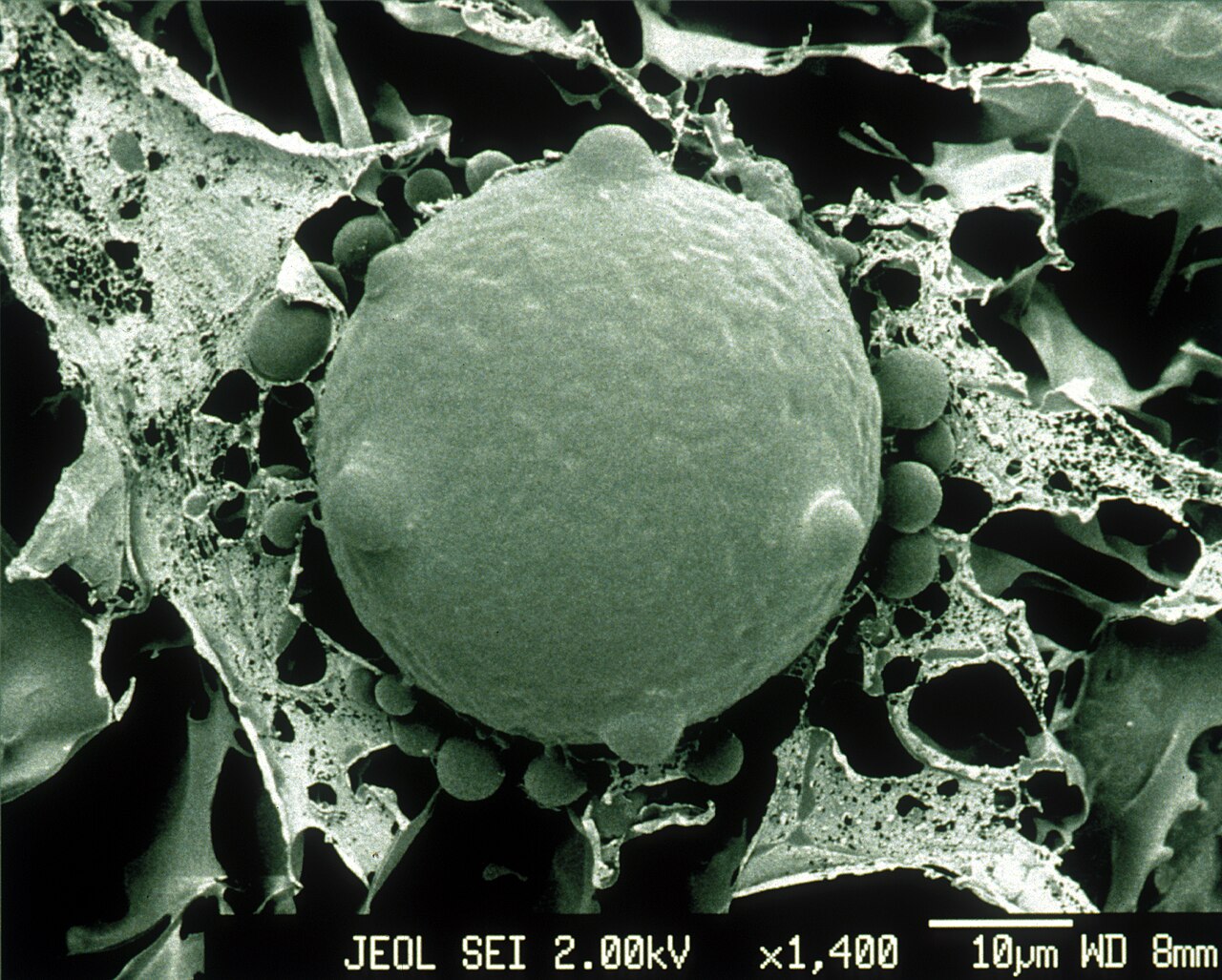

Five hundred and one species of frogs, toads and salamanders have declined because of a single fungus. Ninety are probably extinct.
The authors of the study that established these figures write that this is the greatest loss of biodiversity ever attributed to a disease.1
Other researchers dispute this figure. This page tells both sides.
The fungus
It is called Batrachochytrium dendrobatidis, it attacks the skin of amphibians, and it was identified in the late 1990s.2
Until then, the phenomenon had remained baffling. Frogs were disappearing in intact forests, with no deforestation, no visible pollution, no introduced species that might have eaten them. Biologists searched for a cause and found none.
It was a disease. It had not been seen because no one was looking for it.
Where it comes from, and how it travelled
Its origin is East Asia — the Korean peninsula, according to the most comprehensive genetic analysis, published in 2018. One clue had pointed there: it is the only place in the world where no decline is observed. Where a pathogen is ancient, animals have had time to adapt to it.3
Elsewhere, it arrived recently, and amphibians had no defence.
How did it get elsewhere? The researchers give the answer in the very first sentence of their article: human trade and development have broken down the barriers that prevented species from dispersing — and, with them, their diseases.4
In 2019, researchers reported it in more than sixty countries.5
Why this one did so much damage
Most pathogens are specialised: they attack one species, or one family.
This one is a generalist. It infects frogs in general — and there are more than seven thousand species of them.
The figures, and the challenge to them
The study published in 2019 establishes the following.
At least 501 species have declined in half a century, of which ninety are presumed extinct.6
The declines peaked in the 1980s. Since then, only 12% of the affected species show signs of recovery, while 39% are still declining.7
The study also specifies which ones suffered most: large-bodied, range-restricted frogs living in the wet climates of the Americas and Australia. Three traits that, combined, leave no refuge.8
An earlier estimate, in 2007, spoke of about two hundred species. The new figure is two and a half times higher.9
The challenge
A comment published in the same journal the following year disputes this figure. Its authors re-examined the study and judge that the data and methods attributing the decline of these 501 species to the fungus are insufficient.10
Their main criticism concerns how the list was built: it was drawn up by consulting experts, and half of the 501 species are found in only four countries. Yet all the study’s analyses — on the size of the animals, altitude, life history — depend on which species are included in it.11
They add a sentence worth remembering: which species are affected, and how many, remains an open question — an important one, because protection requires public support and robust science.12
Both camps agree on one point: amphibians are in a bad way. It is estimated that more than 40% of species are threatened with extinction, all causes combined. The disagreement concerns the share attributable to this fungus.13
A frog drinks through its skin
It does not drink with its mouth. It absorbs water through an area of skin located under the belly and thighs, known as the pelvic patch.14
This skin is not merely a barrier: it lets water and salts through, and even takes part in breathing.
It is a remarkable solution. It is also a vulnerability, and the two are inseparable.
The price to pay
Bringing water and salts in through the skin costs energy. Salts are transported by molecular pumps, and the order of magnitude is telling: absorbing eighteen sodium ions uses roughly as much as one molecule of oxygen.15
There is one particularly delicate moment: moulting.
Depending on the species and conditions, an amphibian moults anywhere from every twelve hours to every twelve days. While it is shedding its skin, the skin becomes temporarily more permeable — the animal compensates by increasing its transport activity.
Each moult is a moment of fragility, and it goes through one very often.
Why a fungus can kill
The fungus increases the permeability of the skin and impairs the working of the salt transporters.
The animal therefore loses its salts without being able to replace them. The concentration of sodium in its blood falls. This fall eventually causes heart failure.16
What makes the case exemplary
The infected animal reacts by moulting more often — which might seem a good strategy against a fungus lodged in the skin. Yet moulting does not drive back the infection.
And these more frequent moults could further hinder the passage of water and salts through the skin.17
The defence could even make the problem worse.
One last factor: the smallest individuals are the most affected. For the same mass, a small animal has proportionally much more surface area than a large one — and so more skin through which to lose them.
The lesson of the case
This is not the story of a fragile animal.
It is the story of a solution that worked very well, and of an agent that happened to attack exactly the place where it worked. Skin that lets things through is an advantage — until the day something exploits precisely that passage.
Nothing in the living world is an advantage in absolute terms. Everything depends on what comes along.
Fear and snakes
As with sharks, our perception of snakes is distorted by an asymmetry of attention. The fear they provoke is universal, but the statistical reality shows major regional and health disparities.
According to global data, bites from venomous snakes cause between 81,000 and 138,000 deaths a year, mainly in rural areas of South Asia, South-East Asia and sub-Saharan Africa.18
The problem is not only the toxicity of the venom: it is access to care.
In Europe or North America, mortality is almost zero thanks to the availability of antivenoms and fast-responding medical infrastructure. Where deaths number in the tens of thousands, the tragedy lies in the lack of access to treatment, the cost of antivenoms and geographical isolation.
What can be done, and the safeguards
There is no treatment for the fungus in the wild.
What researchers recommend is therefore of a different kind: regulatory safeguards.
The main vector for the spread of amphibian diseases remains the exotic pet trade and wildlife trafficking. Without strict health controls at borders and without firm regulation of this market, the dispersal of new pathogens is inevitable.
The cause is known, the mechanism is understood, the vector is identified — and the remedy is not medical. It is regulatory.
Not every scientific question has a scientific answer.
Another box, and a shaky one
A word on the title of this page.
If a group contains all the descendants of a common ancestor — the rule we explain elsewhere — then something is wrong with the word “reptile”.
Crocodiles are more closely related to birds than they are to turtles or lizards.19
In strict classificatory terms, then, birds are reptiles, and the “reptile” box as it is used every day — scaly, cold-blooded, crawling — corresponds to no natural group.
It is a box of everyday language, not a box of kinship. Like “fish”. Like “algae”. Like “tree”.
They are convenient. They are not wrong. They simply do not mean what we think.
Note 1
The chytridiomycosis panzootic represents the greatest recorded loss of biodiversity attributable to a disease.
Scheele, Ben C. et al., “Amphibian Fungal Panzootic Causes Catastrophic and Ongoing Loss of Biodiversity”, Science, vol. 363, 2019, p. 1459-1463
Note 2
Epidermal changes caused by a chytridiomycete fungus (Chytridiomycota; Chytridiales) were found in sick and dead adult anurans collected from montane rain forests in Queensland (Australia) and Panama during mass mortality events associated with significant population declines.
Berger, Lee et al., “Chytridiomycosis Causes Amphibian Mortality Associated with Population Declines in the Rain Forests of Australia and Central America”, Proceedings of the National Academy of Sciences, vol. 95, 1998, p. 9031-9036
Histologic examination of test frogs revealed that the pure culture infected the skin of test frogs, whereas the skin of control frogs remained free of infection. The fungus is described as Batrachochytrium dendrobatidis gen. et sp. nov.
Longcore, Joyce E., Pessier, Allan P. and Nichols, Donald K., “*Batrachochytrium dendrobatidis* gen. et sp. nov., a Chytrid Pathogenic to Amphibians”, Mycologia, vol. 91, 1999, p. 219-227
Note 3
Scheele et al. found that the fungus has caused declines in amphibian populations everywhere except at its origin in Asia (see the Perspective by Greenberg and Palen).
Scheele, Ben C. et al., “Amphibian Fungal Panzootic Causes Catastrophic and Ongoing Loss of Biodiversity”, Science, vol. 363, 2019, p. 1459-1463
We used whole-genome sequencing to solve the spatiotemporal origins of the most devastating panzootic to date, caused by the fungus Batrachochytrium dendrobatidis, a proximate driver of global amphibian declines. We traced the source of B. dendrobatidis to the Korean peninsula, where one lineage, BdASIA-1, exhibits the genetic hallmarks of an ancestral population that seeded the panzootic.
O’Hanlon, Simon J. et al., “Recent Asian Origin of Chytrid Fungi Causing Global Amphibian Declines”, Science, vol. 360, 2018, p. 621-627
Note 4
Anthropogenic trade and development have broken down dispersal barriers, facilitating the spread of diseases that threaten Earth's biodiversity.
Scheele, Ben C. et al., “Amphibian Fungal Panzootic Causes Catastrophic and Ongoing Loss of Biodiversity”, Science, vol. 363, 2019, p. 1459-1463
Note 5
Human trade and development have helped spread chytridiomycosis to more than 60 countries
Cornell Chronicle, “Study: Fungal disease decimates amphibians worldwide”, 28 March 2019
Note 6
its role in the decline of at least 501 amphibian species over the past half-century, including 90 presumed extinctions
Scheele, Ben C. et al., “Amphibian Fungal Panzootic Causes Catastrophic and Ongoing Loss of Biodiversity”, Science, vol. 363, 2019, p. 1459-1463
Note 7
Declines peaked in the 1980s, and only 12% of declined species show signs of recovery, whereas 39% are experiencing ongoing decline.
Scheele, Ben C. et al., “Amphibian Fungal Panzootic Causes Catastrophic and Ongoing Loss of Biodiversity”, Science, vol. 363, 2019, p. 1459-1463
Note 8
The effects of chytridiomycosis have been greatest in large-bodied, range-restricted anurans in wet climates in the Americas and Australia.
Scheele, Ben C. et al., “Amphibian Fungal Panzootic Causes Catastrophic and Ongoing Loss of Biodiversity”, Science, vol. 363, 2019, p. 1459-1463
Note 9
The global emergence and spread of the pathogenic, virulent, and highly transmissible fungus Batrachochytrium dendrobatidis, resulting in the disease chytridiomycosis, has caused the decline or extinction of up to about 200 species of frogs.
Skerratt, Lee F. et al., “Spread of Chytridiomycosis Has Caused the Rapid Global Decline and Extinction of Frogs”, EcoHealth, vol. 4, 2007, p. 125-134
Note 10
However, the data and methods implicating the disease chytridiomycosis in 501 amphibian species declines are deficient.
Lambert, Max R. et al., “Comment on "Amphibian Fungal Panzootic Causes Catastrophic and Ongoing Loss of Biodiversity"”, Science, vol. 367, eaay1838, 2020
Note 11
The authors generated "an expert-curated list" of 501 amphibian species (50% of which occur in only four countries)
Lambert, Max R. et al., “Comment on "Amphibian Fungal Panzootic Causes Catastrophic and Ongoing Loss of Biodiversity"”, Science, vol. 367, eaay1838, 2020
Scheele et al.'s analyses linking chytridiomycosis to amphibian traits (e.g., taxonomy, elevation, life history) hinge on which species were included in their analysis.
Lambert, Max R. et al., “Comment on "Amphibian Fungal Panzootic Causes Catastrophic and Ongoing Loss of Biodiversity"”, Science, vol. 367, eaay1838, 2020
Note 12
Which species are affected, and how many, remains a critical unanswered question. Amphibians are imperiled; protective actions require public support and robust science.
Lambert, Max R. et al., “Comment on "Amphibian Fungal Panzootic Causes Catastrophic and Ongoing Loss of Biodiversity"”, Science, vol. 367, eaay1838, 2020
Note 13
It is estimated that more than 40% of amphibian species face extinction
Lambert, Max R. et al., “Comment on "Amphibian Fungal Panzootic Causes Catastrophic and Ongoing Loss of Biodiversity"”, Science, vol. 367, eaay1838, 2020
Note 14
Regions of specialization for water absorption across the skin of Bufonid and Ranid anurans were identified by immunohistochemistry and Western blot analysis, using antibodies raised against arginine vasotocin (AVT)-stimulated aquaporins (AQPs) that are specific to absorbing regions of Hyla japonica. In Bufo marinus, labeling for Hyla urinary bladder-type AQP (AQP-h2), which is also localized in the urinary bladder, occurred in the ventral surface of the hindlimb, pelvic, and pectoral regions.
Ogushi, Yuji et al., “The Water-Absorption Region of Ventral Skin of Several Semiterrestrial and Aquatic Anuran Amphibians Identified by Aquaporins”, American Journal of Physiology – Regulatory, Integrative and Comparative Physiology, vol. 299, no. 5, 2010, p. R1150-R1162
Note 15
Values of dNa/dO2 in 10 skins varied significantly, ranging from 7.1 to 30.9 (as compared with Zerahn's and Leaf and Renshaw's values of about 18).
Vieira, F. L., Caplan, S. R. and Essig, A., “Energetics of Sodium Transport in Frog Skin: I. Oxygen Consumption in the Short-Circuited State”, Journal of General Physiology, vol. 59, no. 1, 1972, p. 60-76
Note 16
In diseased individuals, electrolyte transport across the epidermis was inhibited by >50%, plasma sodium and potassium concentrations were respectively reduced by ~20% and ~50%, and asystolic cardiac arrest resulted in death.
Voyles, Jamie et al., “Pathogenesis of Chytridiomycosis, a Cause of Catastrophic Amphibian Declines”, Science, vol. 326, 2009, p. 582-585
Note 17
We found that sloughing rate increased with Bd infection load in infected frogs, but sloughing itself did not affect Bd load on the ventral skin surface. […] Although an increased sloughing rate might be considered advantageous for Bd-infected animals, it does not appear to curb the progression of disease and may actually contribute to the loss of physiological homoeostasis seen in terminally ill frogs by further inhibiting water and electrolyte transport across the skin.
Ohmer, Michel E. B. et al., “Skin Sloughing Rate Increases with Chytrid Fungus Infection Load in a Susceptible Amphibian”, Functional Ecology, vol. 29, 2015, p. 674-682
Note 18
Chaque année, entre 81 410 et 137 880 personnes décèdent suite à une morsure de serpent, […] C’est dans les pays dont le système de santé est fragile et qui disposent de peu de ressources médicales que la charge de morbidité est la plus élevée.
Each year, between 81,410 and 137,880 people die following a snakebite, […] It is in countries with fragile health systems and few medical resources that the burden of disease is highest.
Organisation mondiale de la santé, “Envenimation par morsure de serpent”, aide-mémoire
Note 19
Crown group Archosauria, which includes birds, dinosaurs, crocodylomorphs, and several extinct Mesozoic groups, is a primary division of the vertebrate tree of life.
Brusatte, Stephen L. et al., “The Higher-Level Phylogeny of Archosauria”, Journal of Systematic Palaeontology, vol. 8, 2010, p. 3-47
Notes and sources
- ↑
Passage this is the greatest loss of biodiversity ever attributed to a disease
The chytridiomycosis panzootic represents the greatest recorded loss of biodiversity attributable to a disease.
Source Scheele, Ben C. et al., “Amphibian Fungal Panzootic Causes Catastrophic and Ongoing Loss of Biodiversity”, Science, vol. 363, 2019, p. 1459-1463, abstract.
Paywalled open the source · checked on 9 September 2026
- ↑
Passage it attacks the skin of amphibians, and it was identified in the late 1990s
Epidermal changes caused by a chytridiomycete fungus (Chytridiomycota; Chytridiales) were found in sick and dead adult anurans collected from montane rain forests in Queensland (Australia) and Panama during mass mortality events associated with significant population declines.
Source Berger, Lee et al., “Chytridiomycosis Causes Amphibian Mortality Associated with Population Declines in the Rain Forests of Australia and Central America”, Proceedings of the National Academy of Sciences, vol. 95, 1998, p. 9031-9036, abstract, first sentence; PNAS, 21 July 1998.
Open access · checked on 24 October 2026
Passage Batrachochytrium dendrobatidis
Histologic examination of test frogs revealed that the pure culture infected the skin of test frogs, whereas the skin of control frogs remained free of infection. The fungus is described as Batrachochytrium dendrobatidis gen. et sp. nov.
Source Longcore, Joyce E., Pessier, Allan P. and Nichols, Donald K., “*Batrachochytrium dendrobatidis* gen. et sp. nov., a Chytrid Pathogenic to Amphibians”, Mycologia, vol. 91, 1999, p. 219-227, abstract (last two sentences).
Paywalled · checked on 25 October 2026
- ↑
Passage Its origin is East Asia […] it is the only place in the world where no decline is observed.
Scheele et al. found that the fungus has caused declines in amphibian populations everywhere except at its origin in Asia (see the Perspective by Greenberg and Palen).
Source Scheele, Ben C. et al., “Amphibian Fungal Panzootic Causes Catastrophic and Ongoing Loss of Biodiversity”, Science, vol. 363, 2019, p. 1459-1463, editors’ summary in Science (“The demise of amphibians?”).
Paywalled open the source · checked on 9 September 2026
Passage the Korean peninsula, according to the most comprehensive genetic analysis
We used whole-genome sequencing to solve the spatiotemporal origins of the most devastating panzootic to date, caused by the fungus Batrachochytrium dendrobatidis, a proximate driver of global amphibian declines. We traced the source of B. dendrobatidis to the Korean peninsula, where one lineage, BdASIA-1, exhibits the genetic hallmarks of an ancestral population that seeded the panzootic.
Source O’Hanlon, Simon J. et al., “Recent Asian Origin of Chytrid Fungi Causing Global Amphibian Declines”, Science, vol. 360, 2018, p. 621-627, abstract.
Paywalled · checked on 25 October 2026
- ↑
Passage human trade and development have broken down the barriers that prevented species from dispersing — and, with them, their diseases
Anthropogenic trade and development have broken down dispersal barriers, facilitating the spread of diseases that threaten Earth's biodiversity.
Source Scheele, Ben C. et al., “Amphibian Fungal Panzootic Causes Catastrophic and Ongoing Loss of Biodiversity”, Science, vol. 363, 2019, p. 1459-1463, abstract.
Paywalled open the source · checked on 9 September 2026
- ↑
Passage In 2019, researchers reported it in more than sixty countries.
Human trade and development have helped spread chytridiomycosis to more than 60 countries
Source Cornell Chronicle, “Study: Fungal disease decimates amphibians worldwide”, 28 March 2019, paragraph 2.
Open access open the source · checked on 26 October 2026
- ↑
Passage At least 501 species have declined in half a century, of which ninety are presumed extinct.
its role in the decline of at least 501 amphibian species over the past half-century, including 90 presumed extinctions
Source Scheele, Ben C. et al., “Amphibian Fungal Panzootic Causes Catastrophic and Ongoing Loss of Biodiversity”, Science, vol. 363, 2019, p. 1459-1463, abstract.
Paywalled open the source · checked on 9 September 2026
- ↑
Passage The declines peaked in the 1980s. Since then, only 12% of the affected species show signs of recovery, while 39% are still declining.
Declines peaked in the 1980s, and only 12% of declined species show signs of recovery, whereas 39% are experiencing ongoing decline.
Source Scheele, Ben C. et al., “Amphibian Fungal Panzootic Causes Catastrophic and Ongoing Loss of Biodiversity”, Science, vol. 363, 2019, p. 1459-1463, abstract.
Paywalled open the source · checked on 9 September 2026
- ↑
Passage large-bodied, range-restricted frogs living in the wet climates of the Americas and Australia
The effects of chytridiomycosis have been greatest in large-bodied, range-restricted anurans in wet climates in the Americas and Australia.
Source Scheele, Ben C. et al., “Amphibian Fungal Panzootic Causes Catastrophic and Ongoing Loss of Biodiversity”, Science, vol. 363, 2019, p. 1459-1463, abstract.
Paywalled open the source · checked on 9 September 2026
- ↑
Passage An earlier estimate, in 2007, spoke of about two hundred species.
The global emergence and spread of the pathogenic, virulent, and highly transmissible fungus Batrachochytrium dendrobatidis, resulting in the disease chytridiomycosis, has caused the decline or extinction of up to about 200 species of frogs.
Source Skerratt, Lee F. et al., “Spread of Chytridiomycosis Has Caused the Rapid Global Decline and Extinction of Frogs”, EcoHealth, vol. 4, 2007, p. 125-134, abstract.
Paywalled · checked on 25 October 2026
- ↑
Passage Its authors re-examined the study and judge that the data and methods attributing the decline of these 501 species to the fungus are insufficient.
However, the data and methods implicating the disease chytridiomycosis in 501 amphibian species declines are deficient.
Source Lambert, Max R. et al., “Comment on "Amphibian Fungal Panzootic Causes Catastrophic and Ongoing Loss of Biodiversity"”, Science, vol. 367, eaay1838, 2020, abstract of the comment.
Paywalled open the source · checked on 9 September 2026
- ↑
Passage it was drawn up by consulting experts, and half of the 501 species are found in only four countries
The authors generated "an expert-curated list" of 501 amphibian species (50% of which occur in only four countries)
Source Lambert, Max R. et al., “Comment on "Amphibian Fungal Panzootic Causes Catastrophic and Ongoing Loss of Biodiversity"”, Science, vol. 367, eaay1838, 2020, body of the comment.
Paywalled open the source · checked on 9 September 2026
Passage all the study’s analyses — on the size of the animals, altitude, life history — depend on which species are included in it
Scheele et al.'s analyses linking chytridiomycosis to amphibian traits (e.g., taxonomy, elevation, life history) hinge on which species were included in their analysis.
Source Lambert, Max R. et al., “Comment on "Amphibian Fungal Panzootic Causes Catastrophic and Ongoing Loss of Biodiversity"”, Science, vol. 367, eaay1838, 2020, body of the comment.
Paywalled open the source · checked on 9 September 2026
- ↑
Passage which species are affected, and how many, remains an open question — an important one, because protection requires public support and robust science
Which species are affected, and how many, remains a critical unanswered question. Amphibians are imperiled; protective actions require public support and robust science.
Source Lambert, Max R. et al., “Comment on "Amphibian Fungal Panzootic Causes Catastrophic and Ongoing Loss of Biodiversity"”, Science, vol. 367, eaay1838, 2020, abstract of the comment.
Paywalled open the source · checked on 9 September 2026
- ↑
Passage It is estimated that more than 40% of species are threatened with extinction, all causes combined
It is estimated that more than 40% of amphibian species face extinction
Source Lambert, Max R. et al., “Comment on "Amphibian Fungal Panzootic Causes Catastrophic and Ongoing Loss of Biodiversity"”, Science, vol. 367, eaay1838, 2020, body of the comment.
Paywalled open the source · checked on 9 September 2026
- ↑
Passage It absorbs water through an area of skin located under the belly and thighs
Regions of specialization for water absorption across the skin of Bufonid and Ranid anurans were identified by immunohistochemistry and Western blot analysis, using antibodies raised against arginine vasotocin (AVT)-stimulated aquaporins (AQPs) that are specific to absorbing regions of Hyla japonica. In Bufo marinus, labeling for Hyla urinary bladder-type AQP (AQP-h2), which is also localized in the urinary bladder, occurred in the ventral surface of the hindlimb, pelvic, and pectoral regions.
Source Ogushi, Yuji et al., “The Water-Absorption Region of Ventral Skin of Several Semiterrestrial and Aquatic Anuran Amphibians Identified by Aquaporins”, American Journal of Physiology – Regulatory, Integrative and Comparative Physiology, vol. 299, no. 5, 2010, p. R1150-R1162, abstract, 1st and 2nd sentences (UNLV institutional repository record).
Open access open the source · checked on 27 October 2026
- ↑
Passage absorbing eighteen sodium ions uses roughly as much as one molecule of oxygen
Values of dNa/dO2 in 10 skins varied significantly, ranging from 7.1 to 30.9 (as compared with Zerahn's and Leaf and Renshaw's values of about 18).
Source Vieira, F. L., Caplan, S. R. and Essig, A., “Energetics of Sodium Transport in Frog Skin: I. Oxygen Consumption in the Short-Circuited State”, Journal of General Physiology, vol. 59, no. 1, 1972, p. 60-76, abstract.
Open access open the source · checked on 27 October 2026
- ↑
Passage The animal therefore loses its salts without being able to replace them […] This fall eventually causes heart failure.
In diseased individuals, electrolyte transport across the epidermis was inhibited by >50%, plasma sodium and potassium concentrations were respectively reduced by ~20% and ~50%, and asystolic cardiac arrest resulted in death.
Source Voyles, Jamie et al., “Pathogenesis of Chytridiomycosis, a Cause of Catastrophic Amphibian Declines”, Science, vol. 326, 2009, p. 582-585, abstract.
Paywalled · checked on 25 October 2026
- ↑
Passage The infected animal reacts by moulting more often […] And these more frequent moults could further hinder the passage of water and salts through the skin.
We found that sloughing rate increased with Bd infection load in infected frogs, but sloughing itself did not affect Bd load on the ventral skin surface. […] Although an increased sloughing rate might be considered advantageous for Bd-infected animals, it does not appear to curb the progression of disease and may actually contribute to the loss of physiological homoeostasis seen in terminally ill frogs by further inhibiting water and electrolyte transport across the skin.
Source Ohmer, Michel E. B. et al., “Skin Sloughing Rate Increases with Chytrid Fungus Infection Load in a Susceptible Amphibian”, Functional Ecology, vol. 29, 2015, p. 674-682, abstract, points 4 and 5.
Open access · checked on 24 October 2026
- ↑
Passage bites from venomous snakes cause between 81,000 and 138,000 deaths a year […] The problem is not only the toxicity of the venom: it is access to care.
Chaque année, entre 81 410 et 137 880 personnes décèdent suite à une morsure de serpent, […] C’est dans les pays dont le système de santé est fragile et qui disposent de peu de ressources médicales que la charge de morbidité est la plus élevée.
Editors’ translation Each year, between 81,410 and 137,880 people die following a snakebite, […] It is in countries with fragile health systems and few medical resources that the burden of disease is highest.
Source Organisation mondiale de la santé, “Envenimation par morsure de serpent”, aide-mémoire, “Key facts” (1st sentence) then “Overview”.
Open access open the source · checked on 24 October 2026
- ↑
Passage Crocodiles are more closely related to birds than they are to turtles or lizards.
Crown group Archosauria, which includes birds, dinosaurs, crocodylomorphs, and several extinct Mesozoic groups, is a primary division of the vertebrate tree of life.
Source Brusatte, Stephen L. et al., “The Higher-Level Phylogeny of Archosauria”, Journal of Systematic Palaeontology, vol. 8, 2010, p. 3-47, abstract.
Paywalled · checked on 25 October 2026
Bibliography
14
- Berger, Lee et al., “Chytridiomycosis Causes Amphibian Mortality Associated with Population Declines in the Rain Forests of Australia and Central America”, Proceedings of the National Academy of Sciences, vol. 95, 1998, p. 9031-9036, open access (the identification of the fungus).
- Brusatte, Stephen L. et al., “The Higher-Level Phylogeny of Archosauria”, Journal of Systematic Palaeontology, vol. 8, 2010, p. 3-47, paywalled (crocodiles and birds, closer to each other than to turtles and lizards).
- Cornell Chronicle, “Study: Fungal disease decimates amphibians worldwide”, 28 March 2019, open access (the presentation of the 2019 study; more than sixty countries affected). https://news.cornell.edu/node/308841
- Hillman, Stanley S., Withers, Philip C., Drewes, Robert C. and Hillyard, Stanley D., Ecological and Environmental Physiology of Amphibians, Oxford University Press, 2008, in libraries (the pelvic patch, sodium pumps and their energy cost).
- Lambert, Max R. et al., “Comment on "Amphibian Fungal Panzootic Causes Catastrophic and Ongoing Loss of Biodiversity"”, Science, vol. 367, eaay1838, 2020, paywalled (the re-examination of the study: evidence judged insufficient, list drawn up by consulting experts, concentration in four countries, question left open). https://doi.org/10.1126/science.aay1838
- Longcore, Joyce E., Pessier, Allan P. and Nichols, Donald K., “*Batrachochytrium dendrobatidis* gen. et sp. nov., a Chytrid Pathogenic to Amphibians”, Mycologia, vol. 91, 1999, p. 219-227, paywalled (the description and the name).
- O’Hanlon, Simon J. et al., “Recent Asian Origin of Chytrid Fungi Causing Global Amphibian Declines”, Science, vol. 360, 2018, p. 621-627, paywalled (the origin in East Asia and the spread through trade).
- Ogushi, Yuji et al., “The Water-Absorption Region of Ventral Skin of Several Semiterrestrial and Aquatic Anuran Amphibians Identified by Aquaporins”, American Journal of Physiology – Regulatory, Integrative and Comparative Physiology, vol. 299, no. 5, 2010, p. R1150-R1162, abstract open access (the regions of ventral skin specialised for water absorption: ventral surface of the hindlimbs, pelvic region). https://oasis.library.unlv.edu/dental_fac_articles/44/
- Ohmer, Michel E. B. et al., “Skin Sloughing Rate Increases with Chytrid Fungus Infection Load in a Susceptible Amphibian”, Functional Ecology, vol. 29, 2015, p. 674-682, open access (more frequent moulting in infected animals).
- Organisation mondiale de la santé, “Envenimation par morsure de serpent”, aide-mémoire, open access (the annual number of deaths and the question of access to care). https://www.who.int/fr/news-room/fact-sheets/detail/snakebite-envenoming
- Scheele, Ben C. et al., “Amphibian Fungal Panzootic Causes Catastrophic and Ongoing Loss of Biodiversity”, Science, vol. 363, 2019, p. 1459-1463, paywalled (the 501 species and the 90 presumed extinctions; the peak in the 1980s; 12% recovering and 39% declining; the traits of the most affected species; the role of trade and development; the greatest loss of biodiversity attributed to a disease). https://doi.org/10.1126/science.aav0379
- Skerratt, Lee F. et al., “Spread of Chytridiomycosis Has Caused the Rapid Global Decline and Extinction of Frogs”, EcoHealth, vol. 4, 2007, p. 125-134, paywalled (the earlier estimate of about two hundred species).
- Vieira, F. L., Caplan, S. R. and Essig, A., “Energetics of Sodium Transport in Frog Skin: I. Oxygen Consumption in the Short-Circuited State”, Journal of General Physiology, vol. 59, no. 1, 1972, p. 60-76, open access (the ratio of sodium transported to oxygen consumed, about 18 in the classic measurements, 7.1 to 30.9 depending on the skin). https://doi.org/10.1085/jgp.59.1.60
- Voyles, Jamie et al., “Pathogenesis of Chytridiomycosis, a Cause of Catastrophic Amphibian Declines”, Science, vol. 326, 2009, p. 582-585, paywalled (the loss of sodium through the skin and cardiac arrest).
Spotted an error or have a doubt? Write to us.