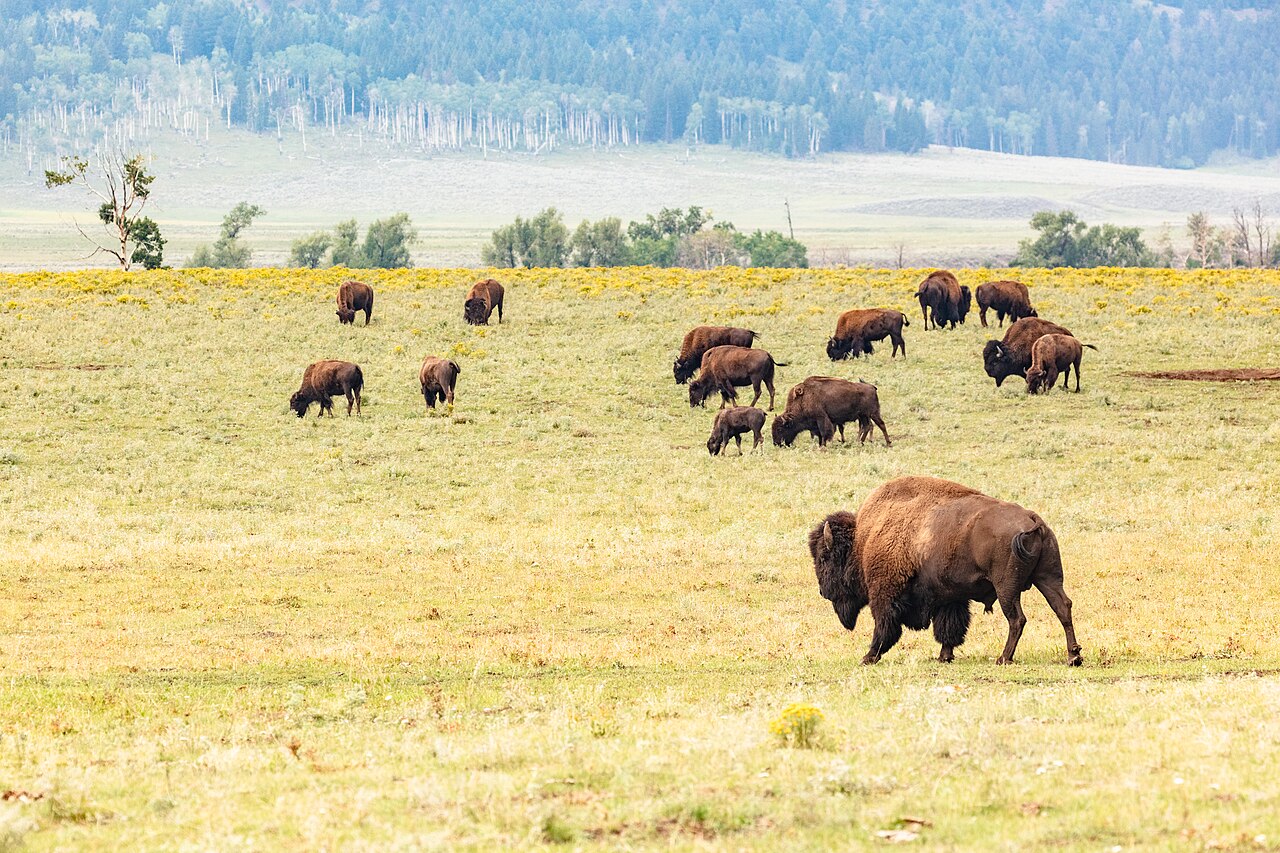

A landscape deprived of its large herbivores does not become wild again. It becomes another landscape, and a poorer one.
In Europe, the end of grazing has a name and can be measured — scrub encroachment. Habitats close up, and the plants and insects of open spaces die out locally.
Eating grass is a technical problem
Grass is everywhere, nobody competes for it, and yet very few animals can live on it. The reason comes down to one word: cellulose. This material, which forms the walls of plant cells, makes up most of a blade of grass — and no mammal possesses the enzyme capable of breaking it down.1
The solution adopted by evolution is always the same: outsourcing. Herbivores host in their digestive tract billions of bacteria and protozoa which, unlike the animal itself, can digest cellulose. The animal does not digest its grass; it feeds a population that digests it on its behalf, and recovers what that population produces.2
There are two ways of going about it, which have led to two distinct body plans.
- Ruminants — cows, sheep, deer, giraffes, antelopes — have a stomach with several compartments. The grass ferments for a long time in the first one, the rumen, then comes back up into the mouth to be chewed again: this is rumination. The process is slow but extracts almost everything.
- Hindgut fermenters — horses, zebras, rhinoceroses, tapirs, and also elephants, even though they are not ungulates — ferment their food in an enlarged portion of the intestine, after the stomach. The process is faster and less complete, but it allows zebras to use taller and more fibrous grass than wildebeest usually select. This is one of the reasons why zebras and wildebeest can share the same savanna.3
What “ungulate” means
An ungulate is a mammal that walks on hooves — that is, on the tips of its digits, protected by thick horn. The word comes from the Latin ungula, nail.
The group divides according to a simple, visible criterion: the number of digits bearing the weight.
- Artiodactyls, with an even number: two digits for cattle, sheep, deer, giraffes and wild boar.
- Perissodactyls, with an odd number: a single digit for the horse, three for the rhinoceros and the tapir.
This anatomical detail matches the mode of digestion: ruminants are all artiodactyls, and all perissodactyls are hindgut fermenters. The converse is false, and that is precisely what makes the classification instructive: the elephant is also a hindgut fermenter without being a perissodactyl — it is not even an ungulate, and its closest relative is the manatee. Two characters that apparently have nothing to do with each other — a foot and a stomach — tell the same story of kinship. This is the kind of cross-check on which the whole classification of living things rests.
A clarification is needed, because modern classification holds surprises: cetaceans — whales and dolphins — are, genetically, artiodactyls. Their closest living relative is the hippopotamus.
Animals that shape landscapes
A large herbivore does more than eat:
- It browses, which prevents young trees from becoming established.
- It tramples, creating paths and bare ground.
- It sometimes fells branches or whole trees.
- It carries seeds in its coat and its droppings, sometimes over several kilometres.4
See also: our page on grasslands and savannas details the other key factor maintaining these habitats: fire, deliberately lit by humans for millennia.
The two mechanisms are inseparable: an open habitat is the direct result of the species that live in it, herbivores and human communities alike.
Population figures: methodological rigour required
One might expect to find elephant numbers here: how many there are, how many there were, what bans on the ivory trade have changed.
We do not give these figures, and that is a choice.
Counting elephants on a continental scale involves divergent methodologies (aerial surveys, ground counts, statistical modelling) over different time frames, producing considerable discrepancies.5
It is the same situation as for sharks, where simplified estimates repeated in the media differ by a factor of more than eight from scientific studies.
Giving a single figure without saying how it was obtained, for which year and over what area, would amount to producing a figure that looks solid and is worth nothing — the flaw that this site keeps taking apart elsewhere.
A page may refuse to answer. It must then say why, and that is what this one does.
The ecological impact of large herbivores
Received wisdom has it that large herbivores “open up” habitats by eating tree shoots. The accurate term is “vary”.
Scientific research has identified two major mechanisms:
- The creation of vegetation heterogeneity: Feeding takes place unevenly, producing a mosaic of closely cropped areas, untouched patches, trampled corridors and deposits of organic matter. The result is not simply an open habitat, but a diversified landscape matrix.
- Zoochorous dispersal: The passive or digestive transport of seeds allows many plant species to colonise areas beyond their natural reach.6
Consequences of their disappearance
In Europe, the decline of pastoralism and natural grazing has led to a measurable phenomenon: scrub encroachment.7
Without herbivore pressure, habitats close up, which disadvantages species that prefer open areas.
An abandoned landscape does not spontaneously become “wild” again: it turns into a different ecosystem, hosting a distinct biodiversity.
The complex interaction with fire
Elephants break trees; fire destroys them. Far from adding up in a linear way, their impacts reinforce each other: the presence of elephants increases tree mortality during fires compared with the action of each factor alone — this is what a study in Kruger National Park, South Africa, on trees stripped of their bark by elephants showed.8
Conversely, intense grazing produces the opposite effect. By consuming dry biomass and reducing ground vegetation cover, herbivores deprive fire of fuel, thus limiting the spread of fires.9
So the same biological category can promote or suppress fire depending on grazing intensity and the ecosystem context.
Impact on carbon storage
Research on forest elephants reveals a counter-intuitive mechanism, which is worth describing step by step.
As they move about and browse, elephants reduce the number of trunks in the forest. Fewer trunks means less competition for light, water and space. The remaining trees therefore grow fewer, but larger — and with denser wood.10
And dense wood stores more carbon. The result: in the long term, a forest with elephants contains more biomass than a forest without them.11
Put the other way round by the researchers, the question becomes striking: if forest elephants disappeared, the forests of Central Africa would lose about 7% of their aboveground biomass.12
Finally, the study has the honesty not to hide the downside: these dense-wood forests produce less — growth there is slower. What is gained in stock is lost in production. The authors themselves describe it as a trade-off.13
An animal that damages vegetation can therefore increase the carbon stored in a forest.
Methodological limits and caveats
⚠ Scientific caveat: Exclusion experiments, often small and short-lived, capture only part of the effects of large herbivores on vegetation at the landscape scale. The clearest impacts are observed at large scales, where establishing strict causal links remains complex because of confounding variables.
Moreover, some plant species historically dependent on megafauna have survived its disappearance, contradicting simple predictive models.14
This question remains open. This article documents measured states without making management recommendations. The question of reintroducing large herbivores is a matter of political and societal choices that it is not an encyclopaedia’s role to settle.
The impact of domestication
The history of domestication highlights two established facts:
- The emergence of at least eleven independent centres of domestication across the globe, without intercontinental contact.
- A repeated osteological finding: the skeletons of the first farmers and herders frequently show a smaller stature and lower weight compared with their hunter-gatherer predecessors.15
Besides their labour, these species have been sources of essential raw materials: wool, leather, sinew, horn and bone.
Note 1
This represents an enormous source of energy, yet vertebrate cells do not produce the cellulases necessary to break down this abundant material.
Colorado State University, VIVO Pathophysiology, “Digestive Physiology of Herbivores”
Note 2
Each milliliter of rumen content contains roughly 10 to 50 billion bacteria, 1 million protozoa and variable numbers of yeasts and fungi. […] Some of the major groups, each of which contain multiple genera and species, are: […] Cellulolytic (digest cellulose) […] In general, protozoa utilize the same set of substrates as bacteria and, as with bacteria, different populations of protozoa show distinctive substrate preferences.
Colorado State University, VIVO Pathophysiology, “Fermentation Microbiology and Ecology”
Note 3
While the hindgut digestion of zebra enables them to utilize taller and more fibrous grass than is generally selected by wildebeest, zebra also exploit short grass within the height and quality range favored by wildebeest (Voeten and Prins 1998, Arsenault and Owen-Smith 2008, 2011, Kleynhans et al. 2011). […] Hence spatially nested resource partitioning of this form contributes to the coexistence of these two grazers, and may be a mechanism enabling niche separation among other species.
Owen-Smith, Norman, Martin, Jodie and Yoganand, K., “Spatially Nested Niche Partitioning between Syntopic Grazers at Foraging Arena Scale within Overlapping Home Ranges”, Ecosphere, vol. 6, no. 9, 2015, p. 1-17
Note 4
Ground-dwelling browsers control woody plants mainly by increasing mortality in early life stages […] Grazers can suppress woody plants through trampling or occasional feeding
Bakker, Elisabeth S. et al., “Combining Paleo-Data and Modern Exclosure Experiments to Assess the Impact of Megafauna Extinctions on Woody Vegetation”, Proceedings of the National Academy of Sciences, vol. 113, 2016, p. 847-855
maximal endozoochorous dispersal distances varying from 2.0 km for roe deer to 3.5 km for red deer […] Here diaspores are consumed, undergo complete gut passage and are defecated. […] Here diaspores become attached to the fur of passing ungulates.
Baltzinger, C., Karimi, S. and Shukla, U., “Plants on the Move: Hitch-Hiking with Ungulates Distributes Diaspores across Landscapes”, Frontiers in Ecology and Evolution, vol. 7, article 38, 2019, open access
Note 5
As a result, elephant population data is collected by a variety of agencies and individuals, often without any direct linkage to one another and using a variety of different techniques. […] Repeated surveys of the same area may use different techniques or cover different areas, so the results are not directly comparable between different time periods.
Thouless, Chris R. et al., African Elephant Status Report 2016: An Update from the African Elephant Database, Occasional Paper of the IUCN Species Survival Commission no. 60, Gland, UICN, 2016
Note 6
The resulting variation in the local intensity of herbivory can create spatial mosaics of herbaceous plants, shrubs, and trees.
Bakker, Elisabeth S. et al., “Combining Paleo-Data and Modern Exclosure Experiments to Assess the Impact of Megafauna Extinctions on Woody Vegetation”, Proceedings of the National Academy of Sciences, vol. 113, 2016, p. 847-855
Note 7
Natural succession on abandoned farmland and pastures often leads to scrubland and sometimes at a later stage, to forest. […] One of the strategies to manage fire regimes is to maintain open spaces in the landscape, minimizing also the impacts of revegetation on species that prefer open areas (Figure 2).
Navarro, Laetitia M. and Pereira, Henrique M., “Rewilding Abandoned Landscapes in Europe”, Ecosystems, vol. 15, 2012, p. 900-912
Note 8
In addition, each factor can modulate the other’s subsequent impacts: trees debarked or toppled by elephants are more likely to die by fire […]
Pringle, Robert M. et al., “Synergistic Effects of Fire and Elephants on Arboreal Animals in an African Savanna”, Journal of Animal Ecology, vol. 84, 2015, p. 1637-1645
The role of bark removal in increasing the vulnerability of large trees to fire and the mechanism through which fire damage is mediated were investigated in Kruger National Park, South Africa, […] An increasing probability of mortality was associated with increasing amounts of bark removal but only if trees were burned. […] These results indicate that bark removal by elephants increases the vulnerability of stems to fire, resulting in mortality of large stems otherwise protected from fire.
Moncrieff, Glenn R., Kruger, Laurence M. and Midgley, Jeremy J., “Stem Mortality of Acacia nigrescens Induced by the Synergistic Effects of Elephants and Fire in Kruger National Park, South Africa”, Journal of Tropical Ecology, vol. 24, no. 6, 2008, p. 655-662
Note 9
White Rhino removals affected fire by increasing fuel loads and fuel continuity. This resulted in larger, less patchy fires.
Waldram, Matthew S., Bond, William J. and Stock, William D., “Ecological Engineering by a Mega-Grazer: White Rhino Impacts on a South African Savanna”, Ecosystems, vol. 11, 2008, p. 101-112
Note 10
the reduction of forest stem density due to the presence of elephants leads to changes in the competition for light, water and space among trees
Berzaghi, Fabio et al., “Carbon Stocks in Central African Forests Enhanced by Elephant Disturbance”, Nature Geoscience, vol. 12, 2019, p. 725-729
These changes favour the emergence of fewer and larger trees with higher wood density.
Berzaghi, Fabio et al., “Carbon Stocks in Central African Forests Enhanced by Elephant Disturbance”, Nature Geoscience, vol. 12, 2019, p. 725-729
Note 11
Such a shift in African's rainforest structure and species composition increases the long-term equilibrium of aboveground biomass.
Berzaghi, Fabio et al., “Carbon Stocks in Central African Forests Enhanced by Elephant Disturbance”, Nature Geoscience, vol. 12, 2019, p. 725-729
Note 12
the extinction of forest elephants would result in a 7% decrease in the aboveground biomass in central African rainforests
Berzaghi, Fabio et al., “Carbon Stocks in Central African Forests Enhanced by Elephant Disturbance”, Nature Geoscience, vol. 12, 2019, p. 725-729
Note 13
The shift also reduces the forest net primary productivity, given the trade-off between productivity and wood density.
Berzaghi, Fabio et al., “Carbon Stocks in Central African Forests Enhanced by Elephant Disturbance”, Nature Geoscience, vol. 12, 2019, p. 725-729
Note 14
Because woody species have long generation times and spatial heterogeneity in landscape structure is a key feature of wooded habitats under herbivory, small-scale and short-term exclosures may capture only part of the resulting woody plant dynamics at the landscape scale.
Bakker, Elisabeth S. et al., “Combining Paleo-Data and Modern Exclosure Experiments to Assess the Impact of Megafauna Extinctions on Woody Vegetation”, Proceedings of the National Academy of Sciences, vol. 113, 2016, p. 847-855
When over 15 genera of Central American large herbivores became extinct roughly 10,000 years ago, seed dispersal and subsequent distributions of many plant species were altered. Introduction of horses and cattle may have in part restored the local ranges of such trees as jicaro (Crescentia alata) and guanacaste (Enterolobium cyclocarpum) that had large mammals as dispersal agents.
Janzen, Daniel H. and Martin, Paul S., “Neotropical Anachronisms: The Fruits the Gomphotheres Ate”, Science, vol. 215, 1982, p. 19-27
Note 15
At least 11 regions of the Old and New World were involved as independent centers of origin, encompassing geographically isolated regions on most continents
Larson, Greger et al., “Current Perspectives and the Future of Domestication Studies”, Proceedings of the National Academy of Sciences, vol. 111, 2014, p. 6139-6146
Results document significantly reduced mean stature, body mass, and crural index in Neolithic agriculturalists relative both to Late Mesolithic hunter-gatherer-fishers and to later farming populations.
Macintosh, Alison A., Pinhasi, Ron and Stock, Jay T., “Early Life Conditions and Physiological Stress following the Transition to Farming in Central/Southeast Europe: Skeletal Growth Impairment and 6000 Years of Gradual Recovery”, PLOS ONE, vol. 11, no. 2, e0148468, 2016
Notes and sources
- ↑
Passage no mammal possesses the enzyme capable of breaking it down
This represents an enormous source of energy, yet vertebrate cells do not produce the cellulases necessary to break down this abundant material.
Source Colorado State University, VIVO Pathophysiology, “Digestive Physiology of Herbivores”, 1st paragraph, last sentence.
Open access open the source · checked on 27 October 2026
- ↑
Passage Herbivores host in their digestive tract billions of bacteria and protozoa which, unlike the animal itself, can digest cellulose.
Each milliliter of rumen content contains roughly 10 to 50 billion bacteria, 1 million protozoa and variable numbers of yeasts and fungi. […] Some of the major groups, each of which contain multiple genera and species, are: […] Cellulolytic (digest cellulose) […] In general, protozoa utilize the same set of substrates as bacteria and, as with bacteria, different populations of protozoa show distinctive substrate preferences.
Source Colorado State University, VIVO Pathophysiology, “Fermentation Microbiology and Ecology”, “Fermentation Microbiology and Ecology” page, paragraphs on bacteria (list of major groups) and on protozoa.
Open access open the source · checked on 27 October 2026
- ↑
Passage it allows zebras to use taller and more fibrous grass than wildebeest usually select. This is one of the reasons why zebras and wildebeest can share the same savanna.
While the hindgut digestion of zebra enables them to utilize taller and more fibrous grass than is generally selected by wildebeest, zebra also exploit short grass within the height and quality range favored by wildebeest (Voeten and Prins 1998, Arsenault and Owen-Smith 2008, 2011, Kleynhans et al. 2011). […] Hence spatially nested resource partitioning of this form contributes to the coexistence of these two grazers, and may be a mechanism enabling niche separation among other species.
Source Owen-Smith, Norman, Martin, Jodie and Yoganand, K., “Spatially Nested Niche Partitioning between Syntopic Grazers at Foraging Arena Scale within Overlapping Home Ranges”, Ecosphere, vol. 6, no. 9, 2015, p. 1-17, p. 3, introduction, paragraph “Particularly perplexing…”; p. 1, abstract, last sentence.
Open access open the source · checked on 27 October 2026
- ↑
Passage It browses […] It tramples
Ground-dwelling browsers control woody plants mainly by increasing mortality in early life stages […] Grazers can suppress woody plants through trampling or occasional feeding
Source Bakker, Elisabeth S. et al., “Combining Paleo-Data and Modern Exclosure Experiments to Assess the Impact of Megafauna Extinctions on Woody Vegetation”, Proceedings of the National Academy of Sciences, vol. 113, 2016, p. 847-855, p. 2, section “Impact of Large-Herbivore Assemblages on Woody Plant Abundance”.
Open access open the source · checked on 25 October 2026
Passage It carries seeds in its coat and its droppings, sometimes over several kilometres
maximal endozoochorous dispersal distances varying from 2.0 km for roe deer to 3.5 km for red deer […] Here diaspores are consumed, undergo complete gut passage and are defecated. […] Here diaspores become attached to the fur of passing ungulates.
Source Baltzinger, C., Karimi, S. and Shukla, U., “Plants on the Move: Hitch-Hiking with Ungulates Distributes Diaspores across Landscapes”, Frontiers in Ecology and Evolution, vol. 7, article 38, 2019, open access, p. 2 (introduction); p. 3, sections “Endozoochory and Secondary Dispersal by Dung Beetles” and “Fur-Epizoochory Including Transfer-Epizoochory”.
Open access open the source · checked on 25 October 2026
- ↑
Passage Counting elephants on a continental scale involves divergent methodologies […] producing considerable discrepancies.
As a result, elephant population data is collected by a variety of agencies and individuals, often without any direct linkage to one another and using a variety of different techniques. […] Repeated surveys of the same area may use different techniques or cover different areas, so the results are not directly comparable between different time periods.
Source Thouless, Chris R. et al., African Elephant Status Report 2016: An Update from the African Elephant Database, Occasional Paper of the IUCN Species Survival Commission no. 60, Gland, UICN, 2016, introductory parts on data and methods (around pp. 16 and 20-21 of the PDF).
Open access · checked on 24 October 2026
- ↑
Passage Feeding takes place unevenly, producing a mosaic of closely cropped areas, untouched patches, trampled corridors
The resulting variation in the local intensity of herbivory can create spatial mosaics of herbaceous plants, shrubs, and trees.
Source Bakker, Elisabeth S. et al., “Combining Paleo-Data and Modern Exclosure Experiments to Assess the Impact of Megafauna Extinctions on Woody Vegetation”, Proceedings of the National Academy of Sciences, vol. 113, 2016, p. 847-855, section “Spatially Structured Landscapes”.
Open access · checked on 24 October 2026
- ↑
Passage In Europe, the decline of pastoralism and natural grazing has led to a measurable phenomenon: scrub encroachment […] which disadvantages species that prefer open areas
Natural succession on abandoned farmland and pastures often leads to scrubland and sometimes at a later stage, to forest. […] One of the strategies to manage fire regimes is to maintain open spaces in the landscape, minimizing also the impacts of revegetation on species that prefer open areas (Figure 2).
Source Navarro, Laetitia M. and Pereira, Henrique M., “Rewilding Abandoned Landscapes in Europe”, Ecosystems, vol. 15, 2012, p. 900-912, sections “Defining Rewilding” and “Limits to Ecological Resilience”.
Open access · checked on 24 October 2026
- ↑
Passage the presence of elephants increases tree mortality during fires
In addition, each factor can modulate the other’s subsequent impacts: trees debarked or toppled by elephants are more likely to die by fire […]
Source Pringle, Robert M. et al., “Synergistic Effects of Fire and Elephants on Arboreal Animals in an African Savanna”, Journal of Animal Ecology, vol. 84, 2015, p. 1637-1645, p. 1637, introduction, 3rd paragraph.
Open access open the source · checked on 27 October 2026
Passage this is what a study in Kruger National Park, South Africa, on trees stripped of their bark by elephants showed.
The role of bark removal in increasing the vulnerability of large trees to fire and the mechanism through which fire damage is mediated were investigated in Kruger National Park, South Africa, […] An increasing probability of mortality was associated with increasing amounts of bark removal but only if trees were burned. […] These results indicate that bark removal by elephants increases the vulnerability of stems to fire, resulting in mortality of large stems otherwise protected from fire.
Source Moncrieff, Glenn R., Kruger, Laurence M. and Midgley, Jeremy J., “Stem Mortality of Acacia nigrescens Induced by the Synergistic Effects of Elephants and Fire in Kruger National Park, South Africa”, Journal of Tropical Ecology, vol. 24, no. 6, 2008, p. 655-662, abstract, 3rd, 5th and last sentences.
Abstract open access open the source · checked on 27 October 2026
- ↑
Passage herbivores deprive fire of fuel, thus limiting the spread of fires
White Rhino removals affected fire by increasing fuel loads and fuel continuity. This resulted in larger, less patchy fires.
Source Waldram, Matthew S., Bond, William J. and Stock, William D., “Ecological Engineering by a Mega-Grazer: White Rhino Impacts on a South African Savanna”, Ecosystems, vol. 11, 2008, p. 101-112, abstract.
Paywalled · checked on 25 October 2026
- ↑
Passage elephants reduce the number of trunks in the forest. Fewer trunks means less competition for light, water and space.
the reduction of forest stem density due to the presence of elephants leads to changes in the competition for light, water and space among trees
Source Berzaghi, Fabio et al., “Carbon Stocks in Central African Forests Enhanced by Elephant Disturbance”, Nature Geoscience, vol. 12, 2019, p. 725-729, abstract.
Paywalled open the source · checked on 9 September 2026
Passage The remaining trees therefore grow fewer, but larger — and with denser wood.
These changes favour the emergence of fewer and larger trees with higher wood density.
Source Berzaghi, Fabio et al., “Carbon Stocks in Central African Forests Enhanced by Elephant Disturbance”, Nature Geoscience, vol. 12, 2019, p. 725-729, abstract.
Paywalled open the source · checked on 9 September 2026
- ↑
Passage in the long term, a forest with elephants contains more biomass than a forest without them
Such a shift in African's rainforest structure and species composition increases the long-term equilibrium of aboveground biomass.
Source Berzaghi, Fabio et al., “Carbon Stocks in Central African Forests Enhanced by Elephant Disturbance”, Nature Geoscience, vol. 12, 2019, p. 725-729, abstract.
Paywalled open the source · checked on 9 September 2026
- ↑
Passage if forest elephants disappeared, the forests of Central Africa would lose about 7% of their aboveground biomass
the extinction of forest elephants would result in a 7% decrease in the aboveground biomass in central African rainforests
Source Berzaghi, Fabio et al., “Carbon Stocks in Central African Forests Enhanced by Elephant Disturbance”, Nature Geoscience, vol. 12, 2019, p. 725-729, abstract.
Paywalled open the source · checked on 9 September 2026
- ↑
Passage these dense-wood forests produce less — growth there is slower […] as a trade-off
The shift also reduces the forest net primary productivity, given the trade-off between productivity and wood density.
Source Berzaghi, Fabio et al., “Carbon Stocks in Central African Forests Enhanced by Elephant Disturbance”, Nature Geoscience, vol. 12, 2019, p. 725-729, abstract.
Paywalled open the source · checked on 9 September 2026
- ↑
Passage Exclusion experiments, often small and short-lived, capture only part of the effects of large herbivores on vegetation at the landscape scale.
Because woody species have long generation times and spatial heterogeneity in landscape structure is a key feature of wooded habitats under herbivory, small-scale and short-term exclosures may capture only part of the resulting woody plant dynamics at the landscape scale.
Source Bakker, Elisabeth S. et al., “Combining Paleo-Data and Modern Exclosure Experiments to Assess the Impact of Megafauna Extinctions on Woody Vegetation”, Proceedings of the National Academy of Sciences, vol. 113, 2016, p. 847-855, section “Perspectives for Future Research”, subsection “Experiments”.
Open access · checked on 24 October 2026
Passage some plant species historically dependent on megafauna have survived its disappearance
When over 15 genera of Central American large herbivores became extinct roughly 10,000 years ago, seed dispersal and subsequent distributions of many plant species were altered. Introduction of horses and cattle may have in part restored the local ranges of such trees as jicaro (Crescentia alata) and guanacaste (Enterolobium cyclocarpum) that had large mammals as dispersal agents.
Source Janzen, Daniel H. and Martin, Paul S., “Neotropical Anachronisms: The Fruits the Gomphotheres Ate”, Science, vol. 215, 1982, p. 19-27, abstract.
Paywalled · checked on 25 October 2026
- ↑
Passage at least eleven independent centres of domestication
At least 11 regions of the Old and New World were involved as independent centers of origin, encompassing geographically isolated regions on most continents
Source Larson, Greger et al., “Current Perspectives and the Future of Domestication Studies”, Proceedings of the National Academy of Sciences, vol. 111, 2014, p. 6139-6146, section “Spatial and Temporal Patterns of Domestication”.
Open access · checked on 25 October 2026
Passage the skeletons of the first farmers and herders frequently show a smaller stature and lower weight
Results document significantly reduced mean stature, body mass, and crural index in Neolithic agriculturalists relative both to Late Mesolithic hunter-gatherer-fishers and to later farming populations.
Source Macintosh, Alison A., Pinhasi, Ron and Stock, Jay T., “Early Life Conditions and Physiological Stress following the Transition to Farming in Central/Southeast Europe: Skeletal Growth Impairment and 6000 Years of Gradual Recovery”, PLOS ONE, vol. 11, no. 2, e0148468, 2016, abstract.
Open access open the source · checked on 25 October 2026
Bibliography
16
- Bakker, Elisabeth S. et al., “Combining Paleo-Data and Modern Exclosure Experiments to Assess the Impact of Megafauna Extinctions on Woody Vegetation”, Proceedings of the National Academy of Sciences, vol. 113, 2016, p. 847-855, open access (the heterogeneity created by large herbivores; browsed young trees and trampling; the limits of exclusion experiments).
- Baltzinger, C., Karimi, S. and Shukla, U., “Plants on the Move: Hitch-Hiking with Ungulates Distributes Diaspores across Landscapes”, Frontiers in Ecology and Evolution, vol. 7, article 38, 2019, open access (seeds carried by ungulates in their digestive tract and attached to their coat; distances of a few kilometres). https://doi.org/10.3389/fevo.2019.00038
- Berzaghi, Fabio et al., “Carbon Stocks in Central African Forests Enhanced by Elephant Disturbance”, Nature Geoscience, vol. 12, 2019, p. 725-729, paywalled (the fall in trunk density, the altered competition, fewer trees with denser wood; the 7% of aboveground biomass lost in the event of their disappearance; the trade-off between stock and production). https://doi.org/10.1038/s41561-019-0395-6
- Colorado State University, VIVO Pathophysiology, “Digestive Physiology of Herbivores”, open access (vertebrates do not produce cellulases). https://vivo.colostate.edu/hbooks/pathphys/digestion/herbivores/index.html
- Colorado State University, VIVO Pathophysiology, “Fermentation Microbiology and Ecology”, open access (10 to 50 billion bacteria and one million protozoa per millilitre of rumen content; cellulolytic bacteria). https://vivo.colostate.edu/hbooks/pathphys/digestion/herbivores/microbes.html
- Dublin, Holly T., Sinclair, Anthony R. E. and McGlade, Jacqueline, “Elephants and Fire as Causes of Multiple Stable States in the Serengeti-Mara Woodlands”, Journal of Animal Ecology, vol. 59, 1990, p. 1147-1164, paywalled (the interaction between elephants and fire on tree mortality).
- Janis, Christine M., “The Evolutionary Strategy of the Equidae and the Origins of Rumen and Cecal Digestion”, Evolution, vol. 30, no. 4, 1976, p. 757-774, paywalled (the comparison of the two digestive strategies and their ecological consequences). https://doi.org/10.1111/j.1558-5646.1976.tb00957.x
- Janzen, Daniel H. and Martin, Paul S., “Neotropical Anachronisms: The Fruits the Gomphotheres Ate”, Science, vol. 215, 1982, p. 19-27, paywalled (plants dependent on a vanished megafauna that survived).
- Larson, Greger et al., “Current Perspectives and the Future of Domestication Studies”, Proceedings of the National Academy of Sciences, vol. 111, 2014, p. 6139-6146, open access (the independent centres of domestication; see Entry 2.9).
- Macintosh, Alison A., Pinhasi, Ron and Stock, Jay T., “Early Life Conditions and Physiological Stress following the Transition to Farming in Central/Southeast Europe: Skeletal Growth Impairment and 6000 Years of Gradual Recovery”, PLOS ONE, vol. 11, no. 2, e0148468, 2016, open access (the reduced stature and body mass of the first farmers; see Entry 2.9). https://doi.org/10.1371/journal.pone.0148468
- Moncrieff, Glenn R., Kruger, Laurence M. and Midgley, Jeremy J., “Stem Mortality of Acacia nigrescens Induced by the Synergistic Effects of Elephants and Fire in Kruger National Park, South Africa”, Journal of Tropical Ecology, vol. 24, no. 6, 2008, p. 655-662, abstract open access (bark removal by elephants and tree mortality after fire, by experiment and field survey). https://doi.org/10.1017/S0266467408005476
- Navarro, Laetitia M. and Pereira, Henrique M., “Rewilding Abandoned Landscapes in Europe”, Ecosystems, vol. 15, 2012, p. 900-912, open access (scrub encroachment after the abandonment of pastoralism and its effects on species of open habitats).
- Owen-Smith, Norman, Martin, Jodie and Yoganand, K., “Spatially Nested Niche Partitioning between Syntopic Grazers at Foraging Arena Scale within Overlapping Home Ranges”, Ecosphere, vol. 6, no. 9, 2015, p. 1-17, open access (zebra and blue wildebeest in Kruger National Park: the zebra’s hindgut digestion lets it use taller, more fibrous grass; a partitioning of resources that contributes to their coexistence). https://doi.org/10.1890/ES14-00487.1
- Pringle, Robert M. et al., “Synergistic Effects of Fire and Elephants on Arboreal Animals in an African Savanna”, Journal of Animal Ecology, vol. 84, 2015, p. 1637-1645, open access. https://tpyoung.ucdavis.edu/sites/g/files/dgvnsk4821/files/inline-files/synergistic%20effects%20of%20fire%20and%20herbivory--.pdf
- Thouless, Chris R. et al., African Elephant Status Report 2016: An Update from the African Elephant Database, Occasional Paper of the IUCN Species Survival Commission no. 60, Gland, UICN, 2016, open access (counting methods and the discrepancies they produce).
- Waldram, Matthew S., Bond, William J. and Stock, William D., “Ecological Engineering by a Mega-Grazer: White Rhino Impacts on a South African Savanna”, Ecosystems, vol. 11, 2008, p. 101-112, paywalled (intense grazing that deprives fire of fuel).
⚠ Data subject to annual revision.
Spotted an error or have a doubt? Write to us.