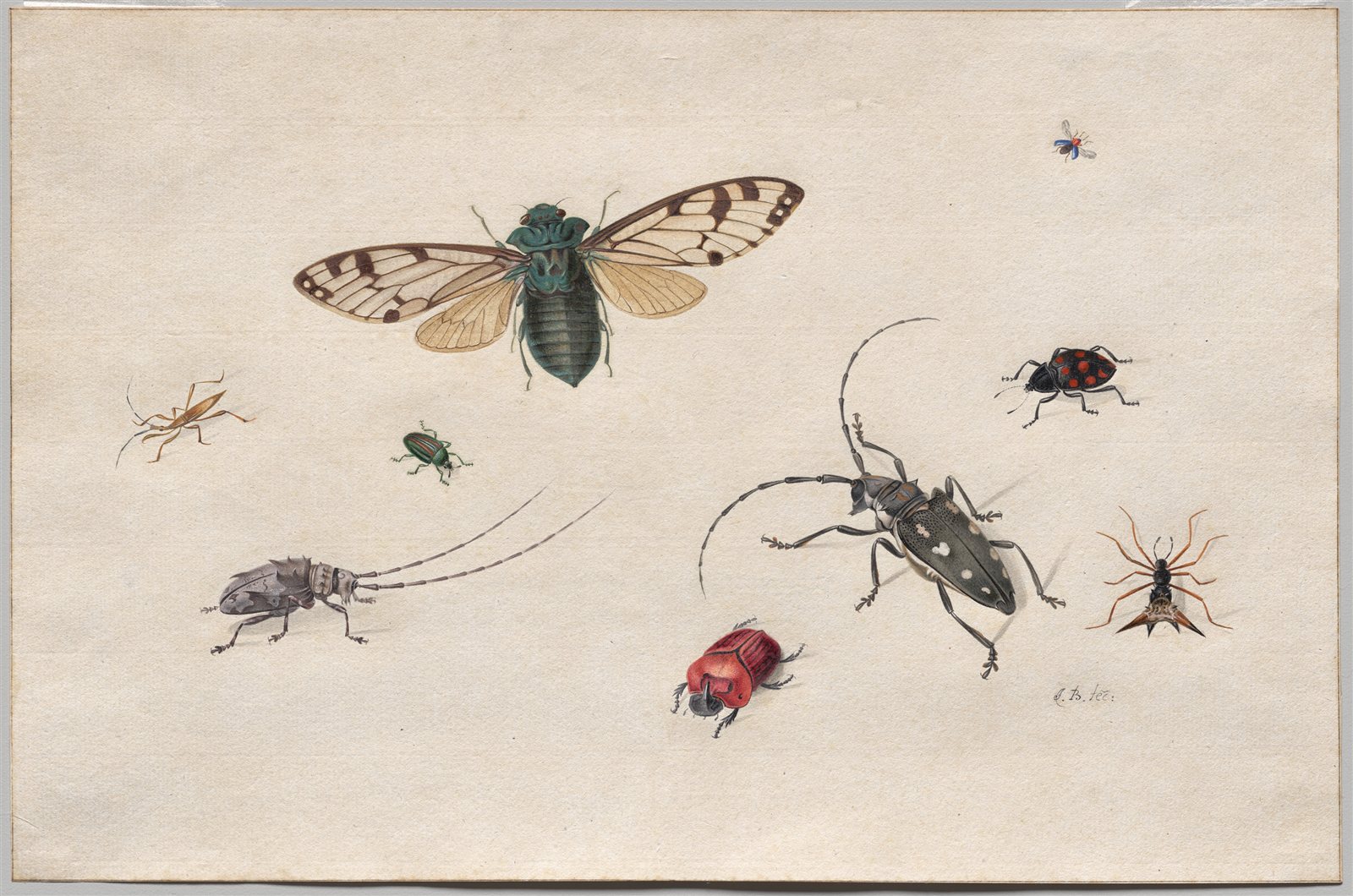
If an encyclopaedia followed the number of species, most of its pages would go to six-legged animals.
Books do not do this. Neither does science.
This page exists to correct that.
The real proportions
Our page on classification (5.1) establishes a fact documented by the biologist Robert May: the worldwide effort to describe species is divided roughly equally among three large groups — vertebrates, plants and invertebrates.1
Yet:
- Plants number about ten times more known species than vertebrates.
- Invertebrates, about a hundred times more.
A third of the research budget and time for each group, even though one of them is a hundred times larger than the others.
Why this bias exists
This is not an interpretation: it is the researchers’ explicit finding. Mammals and birds are better studied because their features resemble our own.2
We have eyes, they have eyes. We have a mouth in roughly the same place. They show attitudes that we recognise: fear, hunger, attention. A spider or a millipede has none of this in a form familiar to us.
We study first what we recognise.
This is not a moral failing. It is a cognitive and institutional bias: a leaning that steers research without researchers always being aware of it.
“An inordinate fondness for beetles”
A famous retort is attributed to the British biologist J.B.S. Haldane. Asked by theologians what the study of nature had taught him about the Creator, he is said to have replied that the Creator must have “an inordinate fondness for beetles”.
Here is what the history of science can establish about it:
- The substance is sound: Haldane expressed this idea on several occasions; the palaeontologist Stephen Jay Gould traced it back in 1993.
- The exact wording varies: The word-for-word quotations circulating in popular literature derive from later, secondary transcriptions.
- The setting is probably apocryphal: The scene with theologians comes from a paper by the ecologist G. Evelyn Hutchinson, who himself presents it as possibly apocryphal.3
The fact behind the quip
At the time Haldane was speaking, about one in four described animal species was a beetle.
Today, the orders of magnitude remain striking. Insects are the most diverse group of animals on the planet: about one million named species — compared with some 6,500 species of mammals.4
On their own, they account for 85% of arthropod species, two thirds of animal species, and nearly half of all species known on Earth.5
Beetles, the subject of the quip, account for around 40% of described arthropod species — insects, spiders and millipedes included.6
What the counts hide
A large proportion of catalogued insect species are known from very few specimens, sometimes from a single specimen kept in a museum. Most of the inventory rests on observations that have not been repeated.7
What we have counted depends on where we have looked.
And how many are there really?
Estimates have shifted a great deal, and in a direction worth noting. A few decades ago, thirty million insect species or more were put forward, based on reasoning about the number of insects specific to each plant species.8
Recent work considers these figures highly unlikely. By combining several independent methods, a 2018 synthesis converges on about 5.5 million insect species — including one and a half million beetles — and seven million terrestrial arthropods in total.9
With one million named species, this means that 80% of insects remain to be discovered.10
The direction of the revision is worth remembering: here, the estimate was divided by five. A figure that moves is not necessarily a figure that rises.
Three groups named in the title
This page has three names in its title. It would be paradoxical to deplore the invisibility of these animals without ever saying what they are.
All three belong to the same large group, the arthropods: animals with an external, jointed skeleton that has to be shed in order to grow. None of them grows gradually as we do. They moult — they climb out of a shell that has become too small, and the new one hardens in the air.11
| Legs | Body | Antennae | Wings | |
|---|---|---|---|---|
| Insects | 6 | 3 parts | 1 pair | often |
| Arachnids | 8 | 2 parts | none | never |
| Myriapods | many | numerous rings | 1 pair | never |
Sources for the table12
Counting the legs is enough to tell them apart in almost every case. A spider is not an insect, and neither is a millipede.
A millipede never has a thousand legs. Depending on the species, they number from a few dozen to just over seven hundred. The name is an old exaggeration that has stayed in the language — like the catfish, which is not a cat.
Two lives in one
This is what makes insects so hard to compare with the rest of the animal world.
In many of them, the young animal and the adult look nothing alike. A caterpillar and a butterfly are the same individual. So are a white grub in the soil and a beetle.
Between the two, a profound reorganisation of the body: this is metamorphosis.13
This is not a mere curiosity. It changes the way the species occupies the world:
- The caterpillar eats leaves; the butterfly drinks nectar.
- The larva lives in water; the adult flies.
- The two forms do not compete for the same food or the same space.
A single animal exploits two environments in the course of its life, without ever competing with itself. This is one of the explanations put forward for their extraordinary diversity.
Not all species work this way: in grasshoppers or true bugs, the young already resembles a smaller version of the adult and changes through successive moults, without upheaval.14
They flew first
One last fact, which puts things back in proportion as surely as the counts at the beginning of this page.
Insects conquered the air perhaps ninety million years before the first flying vertebrate. When the flying reptiles appeared, the air had been occupied for a very long time.15
So these are not small animals added at the margins of a world of vertebrates. They were there before, in greater numbers, and in more places.
Why this matters
What we learn about the living world shapes the idea we form of it. If popular imagery shows only furred or feathered animals, we build the illusion of a world populated by large animals, in which insects are mere background scenery.
That world does not exist.
This bias has concrete consequences for conservation choices, research funding and the perception of collapses in biodiversity. We protect only what we see.16
Correcting a proportion is not an exercise in bookkeeping: it is realigning our picture with reality.
Note 1
Part of the problem is that taxonomic effort is approximately divided 1∶1∶1 among vertebrates, plants, and invertebrates, whereas plant species are roughly 10 times, and invertebrates 100 times, more numerous than vertebrates […]
May, Robert M., “Why Worry about How Many Species and Their Loss?”, PLoS Biology, vol. 9, no. 8, e1001130, 2011
Note 2
Mammals and birds are the best known, again reflecting our narcissism: their features are akin to our own.
May, Robert M., “Why Worry about How Many Species and Their Loss?”, PLoS Biology, vol. 9, no. 8, e1001130, 2011
Note 3
Many have looked for the origins of the quotation, and everyone agrees that he uttered a sentiment like the quotation on several occasions, but no one has confirmed that he ever actually stated it just this way. […] Haldane was purportedly asked by a theologically-minded audience what could be inferred about God from a study of His creation.
Ashworth, William B., Jr., “J. B. S. Haldane”, Scientist of the Day, Linda Hall Library, 5 November 2018
Gould's essay, entitled "A Special Fondness for Beetles" (Gould, 1995), cites, from one of Hutchinson's papers, the following paragraph: "There is a story, perhaps apocryphal, of the distinguished British biologist, J.B.S. Haldane, who found himself in the company of a group of theologians.
Bonatti, Enrico, “Hutchinson’s Tree”, Journal of Limnology, vol. 80, no. 3, 2021
There is a story, perhaps apocryphal, of the distinguished British biologist, J.B.S. Haldane, who found himself in the company of a group of theologians. On being asked what one could conclude as to the nature of the Creator from a study of his creation, Haldane is said to have answered "An inordinate fondness for beetles!".
Bonatti, Enrico, “Hutchinson’s Tree”, Journal of Limnology, vol. 80, no. 3, 2021
Note 4
Insects are the most diverse group of organisms on Earth with 952,794 described species
Hébert, Christian, “Forest Arthropod Diversity”, dans Forest Entomology and Pathology, Springer, 2023, p. 45-90
We found 6,495 species of currently recognized mammals (96 recently extinct, 6,399 extant), compared to 5,416 in MSW3 (75 extinct, 5,341 extant)—an increase of 1,079 species in about 13 years, including 11 species newly described as having gone extinct in the last 500 years.
Burgin, Connor J. et al., “How Many Species of Mammals Are There?”, Journal of Mammalogy, vol. 99, no. 1, 2018, p. 1-14, open access ; et Mammal Diversity Database, American Society of Mammalogists
Note 5
They account for 85% of arthropod species, 67% of animal species and 47% of all species currently known on the planet
Hébert, Christian, “Forest Arthropod Diversity”, dans Forest Entomology and Pathology, Springer, 2023, p. 45-90
Note 6
which focused on the species richness of beetles and argued that because this taxon accounts for around 40% of all described species of arthropods
Stork, Nigel E., “How Many Species of Insects and Other Terrestrial Arthropods Are There on Earth?”, Annual Review of Entomology, vol. 63, 2018, p. 31-45
Note 7
Recent reviews suggest that in tropical arthropod samples, 30% of all species are represented by only one specimen […] Here, we first demonstrate that rare species are similarly common in specimen samples used for taxonomic research
Lim, Gwynne S., Balke, Michael and Meier, Rudolf, “Determining Species Boundaries in a World Full of Rarity”, Systematic Biology, vol. 61, 2012, p. 165-169
Note 8
Previous estimates of 30 million species or more based on the host specificity of insects to plants now seem extremely unlikely.
Stork, Nigel E., “How Many Species of Insects and Other Terrestrial Arthropods Are There on Earth?”, Annual Review of Entomology, vol. 63, 2018, p. 31-45
Note 9
Taking the mean of most of these new estimates indicates that globally there are approximately 1.5 million, 5.5 million, and 7 million species of beetles, insects, and terrestrial arthropods, respectively.
Stork, Nigel E., “How Many Species of Insects and Other Terrestrial Arthropods Are There on Earth?”, Annual Review of Entomology, vol. 63, 2018, p. 31-45
Note 10
With 1 million insect species named, this suggests that 80% remain to be discovered
Stork, Nigel E., “How Many Species of Insects and Other Terrestrial Arthropods Are There on Earth?”, Annual Review of Entomology, vol. 63, 2018, p. 31-45
Note 11
The arthropods, one of the most successful taxonomic groups on the planet, are coelomate organisms characterized by a hard exoskeleton and jointed appendages. […] In order to grow, the arthropod must shed the exoskeleton during a process called ecdysis (“to strip off”) […]
Rye, Connie, Wise, Robert, Jurukovski, Vladimir, DeSaix, Jean, Choi, Jung and Avissar, Yael, Biology, OpenStax, 2016, chapter 28, § 28.4 “Superphylum Ecdysozoa”
Note 12
The body of an adult insect has three parts: the head, the thorax and the abdomen. […] The body of an arachnid generally has two parts: the cephalothorax (a combined head and thorax) and the abdomen. […] Arachnids do not have antennae. […] Adult insects have a pair of antennae usually located between or in front of the compound eyes. […] Spiders, mites, and ticks (Arachnids) have eight legs while adult insects have six legs.
Dombroskie, Jason J., Gabriel, Steve and Brewer, Lori, “Basic Entomology for Identification”, factsheet, Cornell University (Cornell Cooperative Extension), January 2013
Subphylum Myriapoda comprises arthropods with numerous legs. […] Although the name is misleading, suggesting that thousands of legs are present in these invertebrates, the number of legs typically varies from 10 to 750. […] Millipedes have two pairs of legs per segment, positioned under the body, as compared to centipedes, who have one pair per segment, positioned laterally to the body (Figure 28.40b).
Clark, Mary Ann, Douglas, Matthew and Choi, Jung, Biology 2e, OpenStax, 2018, section 28.6 “Superphylum Ecdysozoa: Arthropods”
Note 13
resting stage during which tissues are reorganized from larval form to adult form. The pupa is the third body form in the life cycle of insects that undergo complete metamorphosis (like caterpillars).
Dr. Biology, “Complete Metamorphosis”, Ask A Biologist, Arizona State University, School of Life Sciences
Note 14
Those which have immature stages similar in shape to the adult minus the wings are called 'hemimetabolous', meaning they undergo partial or incomplete (hemi = part) change. […] Typical hemimetabolous insects are the Hemiptera (Scales, Aphids, Whitefly, Cicadas, Leafhoppers and True Bugs), Orthoptera (Grasshoppers and Crickets), […]
Britton, David, “Metamorphosis: A Remarkable Change”, Australian Museum, updated 20 November 2019
Note 15
Insects were the first animals to evolve powered flight and did so perhaps 90 million years before the first flight among vertebrates.
Knecht, Richard J., Engel, Michael S. and Benner, Jacob S., “Late Carboniferous Paleoichnology Reveals the Oldest Full-body Impression of a Flying Insect”, Proceedings of the National Academy of Sciences, vol. 108, 2011, p. 6515-6519
Major sections cover the relationships and evolution of each order of hexapod. The book also chronicles major episodes in the evolutionary history of insects: their modest beginnings in the Devonian, the origin of wings hundreds of millions of years before pterosaurs and birds, […]
Grimaldi, David and Engel, Michael S., Evolution of the Insects, Cambridge University Press, 2005, front matter (publisher’s description and table of contents)
Paleozoic myriapods include possibly the earliest land animals
Shear, William A. and Kukalová-Peck, Jarmila, “The Ecology of Paleozoic Terrestrial Arthropods”, Canadian Journal of Zoology, vol. 68, 1990, p. 1807-1834
Note 16
Conservation efforts have largely been focused on charismatic megafauna, especially birds and mammals, with little thought on ecosystem connectivity […] Partly to blame for these biases is a lack of capacity and data, which, in the view of policymakers, leads to a lack of funding, which in turn, feeds back into lack of capacity and data, in a continuous cycle.
Cardoso, Pedro et al., “Scientists’ Warning to Humanity on Insect Extinctions”, Biological Conservation, vol. 242, 108426, 2020
Notes and sources
- ↑
Passage the worldwide effort to describe species is divided roughly equally among three large groups
Part of the problem is that taxonomic effort is approximately divided 1∶1∶1 among vertebrates, plants, and invertebrates, whereas plant species are roughly 10 times, and invertebrates 100 times, more numerous than vertebrates […]
Source May, Robert M., “Why Worry about How Many Species and Their Loss?”, PLoS Biology, vol. 9, no. 8, e1001130, 2011, third paragraph of the body of the article (“Part of the problem…”).
Open access · checked on 24 October 2026
- ↑
Passage Mammals and birds are better studied because their features resemble our own.
Mammals and birds are the best known, again reflecting our narcissism: their features are akin to our own.
Source May, Robert M., “Why Worry about How Many Species and Their Loss?”, PLoS Biology, vol. 9, no. 8, e1001130, 2011, third paragraph of the body of the article.
Open access · checked on 24 October 2026
- ↑
Passage Haldane expressed this idea on several occasions […] The setting is probably apocryphal
Many have looked for the origins of the quotation, and everyone agrees that he uttered a sentiment like the quotation on several occasions, but no one has confirmed that he ever actually stated it just this way. […] Haldane was purportedly asked by a theologically-minded audience what could be inferred about God from a study of His creation.
Source Ashworth, William B., Jr., “J. B. S. Haldane”, Scientist of the Day, Linda Hall Library, 5 November 2018, paragraph on the beetles quotation (“But to most biologists, Haldane is best known…”), 2nd and 4th sentences.
Open access open the source · checked on 27 October 2026
Passage The scene with theologians comes from a paper by the ecologist G. Evelyn Hutchinson, who himself presents it as possibly apocryphal.
Gould's essay, entitled "A Special Fondness for Beetles" (Gould, 1995), cites, from one of Hutchinson's papers, the following paragraph: "There is a story, perhaps apocryphal, of the distinguished British biologist, J.B.S. Haldane, who found himself in the company of a group of theologians.
Source Bonatti, Enrico, “Hutchinson’s Tree”, Journal of Limnology, vol. 80, no. 3, 2021, first page of the article (p. 242), 1st paragraph.
Open access open the source · checked on 27 October 2026
Passage The scene with theologians […] who himself presents it as possibly apocryphal.
There is a story, perhaps apocryphal, of the distinguished British biologist, J.B.S. Haldane, who found himself in the company of a group of theologians. On being asked what one could conclude as to the nature of the Creator from a study of his creation, Haldane is said to have answered "An inordinate fondness for beetles!".
Source Bonatti, Enrico, “Hutchinson’s Tree”, Journal of Limnology, vol. 80, no. 3, 2021, abstract.
Open access open the source · checked on 27 October 2026
- ↑
Passage Insects are the most diverse group of animals on the planet: about one million named species
Insects are the most diverse group of organisms on Earth with 952,794 described species
Source Hébert, Christian, “Forest Arthropod Diversity”, dans Forest Entomology and Pathology, Springer, 2023, p. 45-90, § 3.1 Introduction.
Open access open the source · checked on 9 September 2026
Passage compared with some 6,500 species of mammals
We found 6,495 species of currently recognized mammals (96 recently extinct, 6,399 extant), compared to 5,416 in MSW3 (75 extinct, 5,341 extant)—an increase of 1,079 species in about 13 years, including 11 species newly described as having gone extinct in the last 500 years.
Source Burgin, Connor J. et al., “How Many Species of Mammals Are There?”, Journal of Mammalogy, vol. 99, no. 1, 2018, p. 1-14, open access ; et Mammal Diversity Database, American Society of Mammalogists, Burgin et al. 2018, abstract.
Open access open the source · checked on 24 October 2026
- ↑
Passage they account for 85% of arthropod species, two thirds of animal species, and nearly half of all species known on Earth
They account for 85% of arthropod species, 67% of animal species and 47% of all species currently known on the planet
Source Hébert, Christian, “Forest Arthropod Diversity”, dans Forest Entomology and Pathology, Springer, 2023, p. 45-90, § 3.1 Introduction.
Open access open the source · checked on 9 September 2026
- ↑
Passage Beetles, the subject of the quip, account for around 40% of described arthropod species — insects, spiders and millipedes included.
which focused on the species richness of beetles and argued that because this taxon accounts for around 40% of all described species of arthropods
Source Stork, Nigel E., “How Many Species of Insects and Other Terrestrial Arthropods Are There on Earth?”, Annual Review of Entomology, vol. 63, 2018, p. 31-45, p. 37.
Paywalled open the source · checked on 9 September 2026
- ↑
Passage A large proportion of catalogued insect species are known from very few specimens, sometimes from a single specimen
Recent reviews suggest that in tropical arthropod samples, 30% of all species are represented by only one specimen […] Here, we first demonstrate that rare species are similarly common in specimen samples used for taxonomic research
Source Lim, Gwynne S., Balke, Michael and Meier, Rudolf, “Determining Species Boundaries in a World Full of Rarity”, Systematic Biology, vol. 61, 2012, p. 165-169, opening extract (open access on the publisher’s page).
Paywalled · checked on 9 September 2026
- ↑
Passage A few decades ago, thirty million insect species or more were put forward, based on reasoning about the number of insects specific to each plant species. Recent work considers these figures highly unlikely.
Previous estimates of 30 million species or more based on the host specificity of insects to plants now seem extremely unlikely.
Source Stork, Nigel E., “How Many Species of Insects and Other Terrestrial Arthropods Are There on Earth?”, Annual Review of Entomology, vol. 63, 2018, p. 31-45, abstract.
Paywalled open the source · checked on 9 September 2026
- ↑
Passage a 2018 synthesis converges on about 5.5 million insect species — including one and a half million beetles — and seven million terrestrial arthropods in total
Taking the mean of most of these new estimates indicates that globally there are approximately 1.5 million, 5.5 million, and 7 million species of beetles, insects, and terrestrial arthropods, respectively.
Source Stork, Nigel E., “How Many Species of Insects and Other Terrestrial Arthropods Are There on Earth?”, Annual Review of Entomology, vol. 63, 2018, p. 31-45, abstract.
Paywalled open the source · checked on 9 September 2026
- ↑
Passage With one million named species, this means that 80% of insects remain to be discovered.
With 1 million insect species named, this suggests that 80% remain to be discovered
Source Stork, Nigel E., “How Many Species of Insects and Other Terrestrial Arthropods Are There on Earth?”, Annual Review of Entomology, vol. 63, 2018, p. 31-45, abstract.
Paywalled open the source · checked on 9 September 2026
- ↑
Passage animals with an external, jointed skeleton that has to be shed in order to grow […] They moult
The arthropods, one of the most successful taxonomic groups on the planet, are coelomate organisms characterized by a hard exoskeleton and jointed appendages. […] In order to grow, the arthropod must shed the exoskeleton during a process called ecdysis (“to strip off”) […]
Source Rye, Connie, Wise, Robert, Jurukovski, Vladimir, DeSaix, Jean, Choi, Jung and Avissar, Yael, Biology, OpenStax, 2016, chapter 28, § 28.4 “Superphylum Ecdysozoa”, § 28.4 “Superphylum Ecdysozoa”, subsection “Phylum Nematoda”, 2nd paragraph; subsection “Phylum Arthropoda”, heading “Morphology”.
Open access open the source · checked on 27 October 2026
- ↑
Passage Insects […] 6 […] 3 parts […] 1 pair […] Arachnids […] 8 […] 2 parts […] none
The body of an adult insect has three parts: the head, the thorax and the abdomen. […] The body of an arachnid generally has two parts: the cephalothorax (a combined head and thorax) and the abdomen. […] Arachnids do not have antennae. […] Adult insects have a pair of antennae usually located between or in front of the compound eyes. […] Spiders, mites, and ticks (Arachnids) have eight legs while adult insects have six legs.
Source Dombroskie, Jason J., Gabriel, Steve and Brewer, Lori, “Basic Entomology for Identification”, factsheet, Cornell University (Cornell Cooperative Extension), January 2013, factsheet, p. 1 (“Body Parts”, head and antennae) and p. 2 (legs).
Open access open the source · checked on 27 October 2026
Passage Myriapods […] numerous rings
Subphylum Myriapoda comprises arthropods with numerous legs. […] Although the name is misleading, suggesting that thousands of legs are present in these invertebrates, the number of legs typically varies from 10 to 750. […] Millipedes have two pairs of legs per segment, positioned under the body, as compared to centipedes, who have one pair per segment, positioned laterally to the body (Figure 28.40b).
Source Clark, Mary Ann, Douglas, Matthew and Choi, Jung, Biology 2e, OpenStax, 2018, section 28.6 “Superphylum Ecdysozoa: Arthropods”, section 28.6, subsection “Subphylum Myriapoda”, 1st and 2nd paragraphs.
Open access open the source · checked on 27 October 2026
- ↑
Passage Between the two, a profound reorganisation of the body: this is metamorphosis
resting stage during which tissues are reorganized from larval form to adult form. The pupa is the third body form in the life cycle of insects that undergo complete metamorphosis (like caterpillars).
Source Dr. Biology, “Complete Metamorphosis”, Ask A Biologist, Arizona State University, School of Life Sciences, “Words to know” glossary, entry “Pupa”.
Open access open the source · checked on 27 October 2026
- ↑
Passage in grasshoppers or true bugs, the young already resembles a smaller version of the adult
Those which have immature stages similar in shape to the adult minus the wings are called 'hemimetabolous', meaning they undergo partial or incomplete (hemi = part) change. […] Typical hemimetabolous insects are the Hemiptera (Scales, Aphids, Whitefly, Cicadas, Leafhoppers and True Bugs), Orthoptera (Grasshoppers and Crickets), […]
Source Britton, David, “Metamorphosis: A Remarkable Change”, Australian Museum, updated 20 November 2019, “What is Metamorphosis?”, 2nd paragraph; “Hemimetabolous (incomplete metamorphosis)”, 1st paragraph.
Open access open the source · checked on 27 October 2026
- ↑
Passage Insects conquered the air perhaps ninety million years before the first flying vertebrate.
Insects were the first animals to evolve powered flight and did so perhaps 90 million years before the first flight among vertebrates.
Source Knecht, Richard J., Engel, Michael S. and Benner, Jacob S., “Late Carboniferous Paleoichnology Reveals the Oldest Full-body Impression of a Flying Insect”, Proceedings of the National Academy of Sciences, vol. 108, 2011, p. 6515-6519, abstract, 1st sentence.
Open access open the source · checked on 27 October 2026
Passage the origin of flight in insects; the evolutionary history of the orders
Major sections cover the relationships and evolution of each order of hexapod. The book also chronicles major episodes in the evolutionary history of insects: their modest beginnings in the Devonian, the origin of wings hundreds of millions of years before pterosaurs and birds, […]
Source Grimaldi, David and Engel, Michael S., Evolution of the Insects, Cambridge University Press, 2005, front matter (publisher’s description and table of contents), front matter, description of the book (first page, before the title page), 6th and 7th sentences; see also the table of contents, p. vii (ch. 6 “Insects Take to the Skies”, ch. 5 to 13 devoted to the orders).
Open access open the source · checked on 27 October 2026
Passage myriapods, perhaps among the first land animals
Paleozoic myriapods include possibly the earliest land animals
Source Shear, William A. and Kukalová-Peck, Jarmila, “The Ecology of Paleozoic Terrestrial Arthropods”, Canadian Journal of Zoology, vol. 68, 1990, p. 1807-1834, abstract.
Paywalled · checked on 9 September 2026
- ↑
Passage This bias has concrete consequences for conservation choices, research funding
Conservation efforts have largely been focused on charismatic megafauna, especially birds and mammals, with little thought on ecosystem connectivity […] Partly to blame for these biases is a lack of capacity and data, which, in the view of policymakers, leads to a lack of funding, which in turn, feeds back into lack of capacity and data, in a continuous cycle.
Source Cardoso, Pedro et al., “Scientists’ Warning to Humanity on Insect Extinctions”, Biological Conservation, vol. 242, 108426, 2020, Section 5 “We need immediate action”.
Open access · checked on 24 October 2026
Bibliography
19
- Ashworth, William B., Jr., “J. B. S. Haldane”, Scientist of the Day, Linda Hall Library, 5 November 2018, open access (an idea expressed by Haldane on several occasions, its exact wording unconfirmed; the question “purportedly” put by a theologically minded audience). https://www.lindahall.org/about/news/scientist-of-the-day/j-b-s-haldane/
- Bonatti, Enrico, “Hutchinson’s Tree”, Journal of Limnology, vol. 80, no. 3, 2021, open access (Hutchinson’s story: Haldane among a group of theologians, a story “perhaps apocryphal”). https://www.jlimnol.it/jlimnol/article/view/2034
- Britton, David, “Metamorphosis: A Remarkable Change”, Australian Museum, updated 20 November 2019, open access (hemimetabolous insects, whose young resemble the adult minus the wings: true bugs, grasshoppers, crickets). https://australian.museum/learn/animals/insects/metamorphosis-a-remarkable-change/
- Burgin, Connor J. et al., “How Many Species of Mammals Are There?”, Journal of Mammalogy, vol. 99, no. 1, 2018, p. 1-14, open access ; et Mammal Diversity Database, American Society of Mammalogists, open access (the number of mammal species). https://www.mammaldiversity.org/
- Cardoso, Pedro et al., “Scientists’ Warning to Humanity on Insect Extinctions”, Biological Conservation, vol. 242, 108426, 2020, open access (the link between representation bias and conservation choices).
- Clark, Mary Ann, Douglas, Matthew and Choi, Jung, Biology 2e, OpenStax, 2018, section 28.6 “Superphylum Ecdysozoa: Arthropods”, open access (myriapods, with numerous legs — from 10 to 750 —, one or two pairs per body segment). https://openstax.org/books/biology-2e/pages/28-6-superphylum-ecdysozoa-arthropods
- Dombroskie, Jason J., Gabriel, Steve and Brewer, Lori, “Basic Entomology for Identification”, factsheet, Cornell University (Cornell Cooperative Extension), January 2013, open access (six legs, three body parts and one pair of antennae in the adult insect; eight legs, two parts and no antennae in arachnids). https://dlc.cce.cornell.edu/pluginfile.php/344687/mod_lesson/page_contents/6946/Factsheet%20Basic%20Entomology%20for%20Identification%20%5B2%20pgs%5D.pdf
- Dr. Biology, “Complete Metamorphosis”, Ask A Biologist, Arizona State University, School of Life Sciences, open access (the reorganisation of tissues during the pupal stage). https://askabiologist.asu.edu/complete-metamorphosis
- Gould, Stephen Jay, “A Special Fondness for Beetles”, Natural History, January 1993 ; repris dans Dinosaur in a Haystack, Harmony, 1995, in libraries (the investigation into Haldane’s quotation: the 1951 record, the variants, the apocryphal dinner).
- Grimaldi, David and Engel, Michael S., Evolution of the Insects, Cambridge University Press, 2005, in libraries (the origin of flight in insects; the evolutionary history of the orders).
- Gullan, Penelope J. and Cranston, Peter S., The Insects: An Outline of Entomology, Wiley-Blackwell, 2014, in libraries (the structure of the three groups, moulting, and the two types of development).
- Hébert, Christian, “Forest Arthropod Diversity”, dans Forest Entomology and Pathology, Springer, 2023, p. 45-90, open access (insects as the most diverse group, according to the Catalogue of Life: their share of arthropods, of animals and of all known species). https://doi.org/10.1007/978-3-031-11553-0_3
- Hutchinson, G. Evelyn, “Homage to Santa Rosalia or Why Are There So Many Kinds of Animals?”, The American Naturalist, vol. 93, 1959, p. 145-159, paywalled (the version of the dinner with the theologians, which fixed the anecdote).
- Knecht, Richard J., Engel, Michael S. and Benner, Jacob S., “Late Carboniferous Paleoichnology Reveals the Oldest Full-body Impression of a Flying Insect”, Proceedings of the National Academy of Sciences, vol. 108, 2011, p. 6515-6519, open access (insects as the first animals to fly).
- Lim, Gwynne S., Balke, Michael and Meier, Rudolf, “Determining Species Boundaries in a World Full of Rarity”, Systematic Biology, vol. 61, 2012, p. 165-169, paywalled (the share of species known from a single specimen).
- May, Robert M., “Why Worry about How Many Species and Their Loss?”, PLoS Biology, vol. 9, no. 8, e1001130, 2011, open access (the description effort split into three thirds and the bias towards species that resemble us).
- Rye, Connie, Wise, Robert, Jurukovski, Vladimir, DeSaix, Jean, Choi, Jung and Avissar, Yael, Biology, OpenStax, 2016, open access (the exoskeleton and jointed appendages of arthropods; the moult needed for growth). https://openstax.org/books/biology/pages/28-4-superphylum-ecdysozoa
- Shear, William A. and Kukalová-Peck, Jarmila, “The Ecology of Paleozoic Terrestrial Arthropods”, Canadian Journal of Zoology, vol. 68, 1990, p. 1807-1834, paywalled (myriapods, perhaps among the first land animals).
- Stork, Nigel E., “How Many Species of Insects and Other Terrestrial Arthropods Are There on Earth?”, Annual Review of Entomology, vol. 63, 2018, p. 31-45, paywalled (the revised estimates: about 1.5 million beetles, 5.5 million insects and 7 million terrestrial arthropods; the abandonment of the thirty-million estimates; the share of beetles among described arthropods; the 80% still to be discovered). https://doi.org/10.1146/annurev-ento-020117-043348
Spotted an error or have a doubt? Write to us.