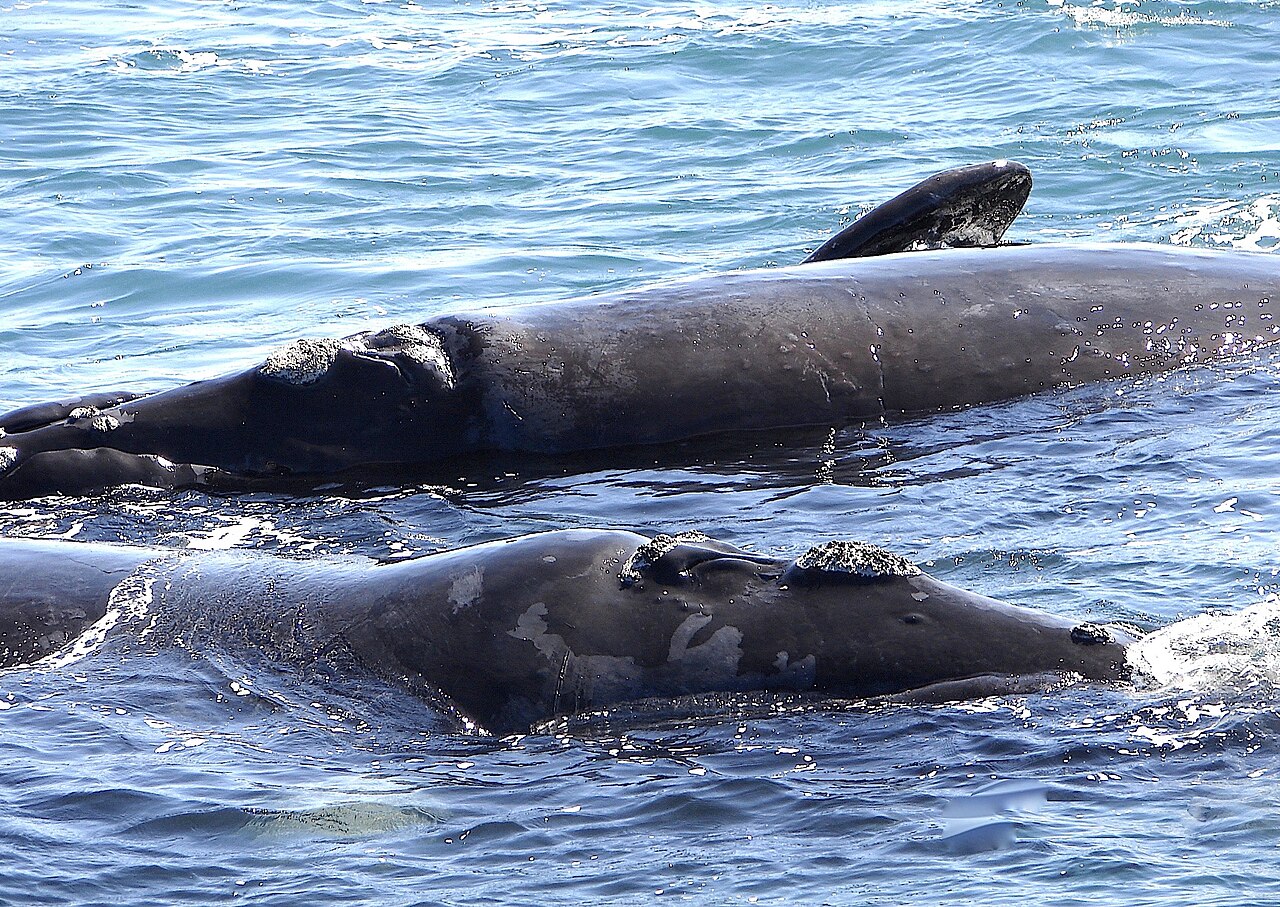

Figures revised in autumn 2026. Covers all the groups, cultural transmission, acoustic threats and demographic analysis.
In 1830, there were about twenty-seven thousand of them in the western South Atlantic. By the mid-1950s, four hundred and fifty remained.1
In 2019, there were once again about twenty-five thousand.
This page tells the story of how we know this — and why the figure has changed twice, once without the whales having anything to do with it. It also explains why protection sometimes succeeds spectacularly, and why it fails when the nature of the threat has changed.
The range of life: several returns to the water
Before turning to hunting and figures, we need to widen our view. When we say “marine mammals”, we think first of whales. This is a distorted perspective: adaptation to marine life occurred at least four times independently in the course of evolution.
Marine mammals comprise four distinct major groups:
- Cetaceans (whales, dolphins, porpoises, sperm whales): fully aquatic, they never leave the water and have lost their hind limbs over tens of millions of years.
- Pinnipeds (seals, sea lions, walruses): semi-aquatic, they keep their four limbs, transformed into swimming paddles, and return to land or ice to give birth and moult.
- Sirenians (dugongs and manatees): the only strictly herbivorous marine mammals. They graze tropical and coastal seagrass beds, acting as gardeners of the seabed.
- Recent marine carnivores (sea otters and polar bears): the sea otter has the densest fur of any mammal (up to 140,000 hairs per cm²) to make up for the lack of an insulating layer of fat.2
Ecosystem engineers
Each of these groups shapes its environment. The sea otter is the textbook example: by eating sea urchins, it prevents kelp forests (giant algae) from being grazed bare. Where otters disappear, sea urchins proliferate, the kelp collapses, and with it the entire coastal fish nursery.3
For their part, the great whales act as a “nutrient pump”: they feed at depth and defecate at the surface, supplying iron and nitrogen essential to phytoplankton, which produces a major share of the planet’s oxygen.4
The collapse and the industrial machine
Modern industrial whaling arrived in the South Atlantic in 1904, when the first whalers set up in South Georgia. Alexandre Zerbini, who led the reconstruction of this history, reports what the whalers found at the time: the waters were full of them.5
They went first for humpback whales, because they live close to the coast and are therefore easy to reach.
By the end of the 1920s, the ships were finding only a few dozen a year.
What happened next, and what explains everything else
The whaling stations did not close.
They switched species. After the humpbacks, the blue whales. Then the fin whales. Then the sei whales. Finally, the minke whales.
This point goes far beyond the case of whales:
Exhausting a species does not stop an industry. It moves it.
The very same mechanism appears in our page on fishing. This is no coincidence: it is the same logic of exploitation in successive cascades.
Protection, and the result
International protection measures appeared in the 1960s. Then, in 1982, the International Whaling Commission (IWC) decreed a moratorium on commercial whaling, which came into force during the 1985-1986 season.6
In 2019, the western South Atlantic humpback whale population was estimated at 93% of its pre-exploitation level.7
This, incidentally, is how an honest researcher gives a figure: not “93%”, but “93% (95% PI = 73–100%)”. The range matters as much as the number.8
It is a major success for conservation biology. It has been measured, dated and published.
The fall in detail, year by year
The model allows the collapse to be followed closely, and it was brutal.
In 1904, when the whalers arrived, the population numbered about 24,700 individuals. Twenty-two years later, in 1926, about 700 remained. In that interval, more than twenty-five thousand humpback whales were killed.9
The low point was reached around 1958: about 440 animals, or 1.6% of the original population.10
Finally, one detail shows how fragile a recovery is: an upturn began in the early 1960s, then 190 whales were killed in 1967 by illegally operating Soviet fleets — and the population fell again. It was not until 1972 that all whaling ceased.11
The heart of this story
Only a few years ago, an official assessment concluded that this population had recovered only 30% of its original level.12
The 2019 reassessment gives 93%.
It was not the whales that multiplied their rate of reproduction. It was the counting that became more refined.
The researchers built a model that brings together three kinds of data: catch records, abundance estimates, and information on the genetics and biology of the species.13
They did something more, which deserves mention: they ran the model with different assumptions — other data, other computational assumptions — to see how much the result moved. This is what is called testing the sensitivity of a model. We ask not only what result we obtain, but how much that result depends on our choices.14
Among these uncertainties, one in particular: the “struck and lost” whales.
These are the harpooned whales that escaped mortally wounded and sank or died further away. They appeared in no official catch record, since they had never been brought ashore or aboard the factory ships. By incorporating these estimates into the historical record, two things became clear:15
- The starting population was larger than had been thought.
- Its capacity to rebuild once the pressure was removed was markedly greater than forecast.
How do you put a figure on whales that, by definition, were never counted? By reading the whalers’ logbooks. A study published in 2021 went through nearly twenty thousand days of voyages in the southwestern Atlantic, recording every harpoon strike that missed or was lost.16
What the official records left out, the logbooks noted. The authors conclude that the scale of historical whaling may have been seriously underestimated.17
Those that did not come back
The story of the blue whale is readily told: hunted to the brink of extinction, protected, then recovered from about two thousand individuals to somewhere between ten thousand and twenty-five thousand.
That is true. If this page stopped there, it would be dishonest.
The North Atlantic right whale
It has been protected since 1935. Nine decades.18
It never came back.19
The latest published estimate (for the year 2024) gives about 384 individuals — after a low of about 360 in 2020. A slight rise, then, but from numbers so low that it does not change the diagnosis.20
Only about seventy females capable of breeding remain.21
Why legal protection is not enough
Because hunting is no longer the main threat.
Every year, monitoring networks record new cases of entanglement in fishing gear (lobster traps, gillnets) and collisions with vessels.22
In a population of barely 380 animals, every individual lost counts double. We stopped what used to kill them (the harpoon). We have not stopped what kills them now (shipping traffic and fishing gear).23
The most worrying demographic detail
Females are declining faster than males.
Repeated entanglements do not always kill outright: they cause chronic stress, deep wounds and a colossal expenditure of energy spent dragging lengths of rope over thousands of kilometres. For biologists, this is one of the reasons why the interval between two births for a female has increased from 3 years to 7 to 10 years on average.24
This means that reproductive potential collapses even before the total population figure drops sharply. The number of living individuals can give the illusion of relative stability while the species’ capacity to renew itself is already broken.
Counting the animals is therefore not enough. We have to count who they are.
A shared phenomenon
- The North Pacific right whale (Eubalaena japonica) now numbers only about thirty individuals in its eastern stock.
- The Mediterranean monk seal (Monachus monachus) numbers only about 450 to 600 adults, taking refuge in sea caves because of tourist pressure and urbanised coastlines.
- Of the fourteen large whale species, seven remain classified as endangered or vulnerable.25
The new threats: noise, plastic and invisible traps
To understand the contemporary marine world, we have to realise that the sea is no longer silent or free of obstacles. Current threats fall into three broad categories:
1. Underwater noise pollution
Marine mammals live in a world of sound waves. Visibility underwater rarely exceeds a few tens of metres; sound, on the other hand, travels more than four times faster there than in air, and over thousands of kilometres.
Cargo ship engines, seismic oil exploration (air guns) and low-frequency military sonar saturate the ocean. This permanent background noise:26
- Masks communication calls between mothers and calves or between breeding partners.
- Disorients the acoustic navigation of toothed whales (dolphins, sperm whales), causing mass strandings during military exercises.
- Induces chronic acoustic stress, impairing their immune system.
2. Bycatch and ghost nets
Industrial fishing deploys kilometres of lines and nets. Dolphins and seals get caught in trawls (such as common dolphins in the Bay of Biscay). Unable to surface to breathe, they drown within minutes.
“Ghost nets” — lost or abandoned at sea — go on fishing blindly for decades, trapping pinnipeds, turtles and cetaceans indiscriminately.
3. Chemical bioaccumulation
Because they are at the top of the food chain and live a long time, marine mammals concentrate organochlorine pollutants (PCBs), flame retardants and heavy metals (mercury) in their fat. In some populations of resident killer whales in the North Pacific or the Mediterranean, the mother’s milk is so loaded with toxins that the first-born receives a massive dose during nursing.27
Songs and cultural transmission
It was long believed that culture — the transmission of learned behaviours from generation to generation without a genetic basis — was unique to humans. The study of marine mammals has swept away that certainty.
The humpback whales’ “top 50”
Among humpback whales, all the males of a given population sing the same complex song at any one time. But this song is constantly evolving.
Researchers have discovered a fascinating phenomenon of cultural spread from west to east in the Pacific Ocean: a new melody starting in the western South Pacific spreads rapidly eastward, from population to population, as far as the central South Pacific. The whales abandon their old song to adopt the new acoustic “fashion” within a few months.28
Dialects among sperm whales and killer whales
- Female sperm whales express themselves through series of clicks called codas. Each social clan has its own repertoire of codas, forming a true acoustic dialect. Two clans living in the same geographical area keep their distinct dialects and do not mix.
- Killer whales probably pass on through social learning not only their vocalisations but also, according to most researchers, their highly specialised hunting techniques: deliberate stranding on the beaches of Patagonia to catch sea lions, or creating synchronised waves to tip seals off ice floes in Antarctica.29
Consequence for conservation: When a population of killer whales or whales disappears, it is not only a genetic heritage that dies out; it is also accumulated cultural knowledge, a memory of migration routes and a language that vanish for ever.
What the researchers add: the global ecosystem
The scientific article announcing the recovery of the humpback whale in the South Atlantic also contains caveats. Here they are:
This growing population eats krill (Euphausia superba) — it is estimated to consume between 1.5 and 2.6 million tonnes of it per season. It therefore competes directly with penguins (Adélie, chinstrap) and seals (crabeater seal), which depend on the same resource.
Krill itself is weakened by warming waters and the melting of winter sea ice, beneath which grow the algae that krill larvae feed on.
The authors write that continued monitoring remains essential.30
A success is not an end. It is a state measured on a given date, which needs to be measured again.
This is exactly what our page on the ozone layer says. Two different cases, the same lesson.
A word on the evolutionary trajectory
Whales, seals, sea otters and dugongs are all mammals. They breathe air with lungs, suckle their young, are warm-blooded, and their common ancestors lived on dry land.
They therefore returned to the water.
This fact deserves emphasis, because it contradicts a very widespread misconception: evolution does not climb a ladder. A lineage that had left the aquatic environment much earlier gradually returned to it 50 million years ago for cetaceans and sirenians, and more recently for pinnipeds. This made them neither more nor less “evolved” than their land-dwelling cousins.31
Evolution has no favoured direction. It has only opportunities and circumstances to adapt to.
Note 1
They declined from nearly 27 000 […] individuals in 1830 to only 450 […] whales in the mid-1950s.
Zerbini, Alexandre N. et al., “Assessing the Recovery of an Antarctic Predator from Historical Exploitation”, Royal Society Open Science, vol. 6, 190368, 2019
Note 2
The pelage (fur) of sea otters is the densest of any mammal (850,000 to one million hairs per square inch).
National Park Service, “Sea Otter”, Channel Islands National Park
Note 3
Sea otters control herbivorous invertebrate populations. Removal of sea otters causes increased herbivory and ultimately results in the destruction of macrophyte associations.
Estes, James A. and Palmisano, John F., “Sea Otters: Their Role in Structuring Nearshore Communities”, Science, vol. 185, 1974, p. 1058-1060
Note 4
Studies in the Gulf of Maine show that cetaceans and other marine mammals deliver large amounts of N to the photic zone by feeding at or below the thermocline and then excreting urea and metabolic fecal N near the surface (Roman and McCarthy 2010).
Roman, Joe et al., “Whales as Marine Ecosystem Engineers”, Frontiers in Ecology and the Environment, vol. 12, 2014, p. 377-385
Note 5
The first Southern Ocean shore-based whaling station was established by the Norwegian Carl Anton Larsen at Grytviken, South Georgia, in 1904, marking the onset of industrial whaling in the Southern Ocean. […] The first species to be hunted to commercial extinction at South Georgia was the humpback whale Megaptera novaeangliae […] From 1913, focus moved to blue whales Balaenoptera musculus.
Calderan, Susannah V. et al., “South Georgia Blue Whales Five Decades after the End of Whaling”, Endangered Species Research, vol. 43, 2020, p. 359-373
Note 6
In 1982 the IWC decided that there should be a pause in commercial whaling on all whale species and populations from the 1985/1986 season onwards.
Commission baleinière internationale, “Commercial Whaling”, site officiel de la CBI, open access
Note 7
the current population is estimated to be at 93% […] of its pre-exploitation size
Zerbini, Alexandre N. et al., “Assessing the Recovery of an Antarctic Predator from Historical Exploitation”, Royal Society Open Science, vol. 6, 190368, 2019
Note 8
93% (95% PI = 73–100%)
Zerbini, Alexandre N. et al., “Assessing the Recovery of an Antarctic Predator from Historical Exploitation”, Royal Society Open Science, vol. 6, 190368, 2019
Note 9
The population dropped from a median value of 24 700 (in 1904) to about 700 individuals (in 1926) during a period of 22 years when more than 25 000 humpbacks were killed.
Zerbini, Alexandre N. et al., “Assessing the Recovery of an Antarctic Predator from Historical Exploitation”, Royal Society Open Science, vol. 6, 190368, 2019
Note 10
The median date of lowest abundance was 1958, when only approximately 440 individuals […] were left in the population. This indicates that just about 1.6% […] of the original population
Zerbini, Alexandre N. et al., “Assessing the Recovery of an Antarctic Predator from Historical Exploitation”, Royal Society Open Science, vol. 6, 190368, 2019
Note 11
the removal of 190 whales in 1967 by illegally operating Soviet fleets led to reduced population abundance. No whaling occurred after 1972
Zerbini, Alexandre N. et al., “Assessing the Recovery of an Antarctic Predator from Historical Exploitation”, Royal Society Open Science, vol. 6, 190368, 2019
Note 12
The assessment of Breeding Stocks A, D and G was completed at the end of the IWC annual meeting in 2006 (IWC, 2007). […] The Committee concluded that this population was at nearly 30% of its pre-exploitation size.
Commission baleinière internationale, Journal of Cetacean Research and Management, numéro spécial 3, “Humpback Whales: Status in the Southern Hemisphere”, 2011, éditorial, p. iii
Note 13
a Bayesian population model integrates catch data, estimates of abundance, and information on genetics and biology
Zerbini, Alexandre N. et al., “Assessing the Recovery of an Antarctic Predator from Historical Exploitation”, Royal Society Open Science, vol. 6, 190368, 2019
Note 14
Modelling scenarios evaluated the sensitivity of model outputs resulting from the use of different data, different model assumptions and uncertainty in catch allocation
Zerbini, Alexandre N. et al., “Assessing the Recovery of an Antarctic Predator from Historical Exploitation”, Royal Society Open Science, vol. 6, 190368, 2019
Note 15
uncertainty […] in accounting for whales killed but not landed
Zerbini, Alexandre N. et al., “Assessing the Recovery of an Antarctic Predator from Historical Exploitation”, Royal Society Open Science, vol. 6, 190368, 2019
Note 16
Here, we extract detailed records of 19875 days of activity in the southwestern Atlantic Ocean from 255 logbooks of offshore whaling voyages.
Vighi, Morgana, Borrell, Asunción, Jackson, Jennifer A. et al., “The Missing Whales: Relevance of "Struck and Lost" Rates for the Impact Assessment of Historical Whaling in the Southwestern Atlantic Ocean”, ICES Journal of Marine Science, vol. 78, no. 1, 2021, p. 14-24
Note 17
an unknown proportion of hunted whales were struck, wounded, eventually killed, but lost, and not included in these records, suggesting that whaling impact may be critically underestimated
Vighi, Morgana, Borrell, Asunción, Jackson, Jennifer A. et al., “The Missing Whales: Relevance of "Struck and Lost" Rates for the Impact Assessment of Historical Whaling in the Southwestern Atlantic Ocean”, ICES Journal of Marine Science, vol. 78, no. 1, 2021, p. 14-24
Note 18
All right whales have been protected from commercial whaling since 1935, and further protected under the International Whaling Commission (IWC) since 1949.
Government of Canada, “North Atlantic Right Whale (Eubalaena glacialis) Recovery Strategy: Chapter 5”, Species at Risk Public Registry, Environment and Climate Change Canada, 2009
Note 19
Whaling is no longer a threat, but they have never recovered to pre-whaling numbers […]
NOAA Fisheries, “North Atlantic Right Whale”, species page, updated 29 July 2026
Note 20
The Pace model estimate for 2024 (December 2023-November 2024) is 384 whales (95% credible interval +10/-9)
Pettis, Heather M. and Hamilton, P. K., North Atlantic Right Whale Consortium 2025 Annual Report Card, North Atlantic Right Whale Consortium, 2026
Note 21
The most recent abundance estimate for the population is approximately 380 whales—an increase of approximately 20 individuals since 2020—and marks the third consecutive year that the population has shown signs of increasing. We still estimate there to be only about 70 reproductively active females.
NOAA Fisheries, “North Atlantic Right Whale”, species page, updated 29 July 2026
Note 22
Number of detected entanglement and vessel strike injuries by year.
Pettis, Heather M. and Hamilton, P. K., North Atlantic Right Whale Consortium 2025 Annual Report Card, North Atlantic Right Whale Consortium, 2026
Entanglement in fishing gear and vessel strikes are the leading causes of North Atlantic right whale mortality. […] trap/pot and gillnet […] lobster and Jonah crab trap/pot fisheries
NOAA Fisheries, “North Atlantic Right Whale”, species page, updated 29 July 2026
Note 23
The most recent abundance estimate for the population is approximately 380 whales
NOAA Fisheries, “North Atlantic Right Whale”, species page, updated 29 July 2026
Note 24
Fishing gear can cut into a whale’s body, cause serious injuries, and result in infections and mortality. Even if gear is shed or removed through disentanglement efforts, the time spent entangled can severely stress a whale, weaken it, prevent it from feeding, and sap the energy it needs to swim, feed, and reproduce.
NOAA Fisheries, “North Atlantic Right Whale”, species page, updated 29 July 2026
Three years is considered a normal or healthy interval between right whale births. But now, on average, females are having calves every 7 to 10 years. Biologists believe that the additional stress caused by entanglement is one of the reasons that females are calving less often.
NOAA Fisheries, “North Atlantic Right Whale”, species page, updated 29 July 2026
Note 25
Vulnerable D1 […] Date assessed: 27 June 2023 […] Number of mature individuals: 444-600
UICN, Liste rouge des espèces menacées
Note 26
The documented effects include behavioral and acoustic responses, auditory masking, and stress. […] Tennessen and Parks (2016) modeled the communication space of mother-calf pair up-calls in the vicinity of container vessels and found that an up-call would only be detected when the receiving whale was 25 km from the moving vessel and within 320 m of the transmitting whale.
Erbe, Christine et al., “The Effects of Ship Noise on Marine Mammals — A Review”, Frontiers in Marine Science, vol. 6, 606, 2019
Note 27
Overall, females exhibit lower blubber PCB levels than males due to maternal sequestration to young during foetal development and lactation
Desforges, Jean-Pierre et al., “Predicting Global Killer Whale Population Collapse from PCB Pollution”, Science, vol. 361, 2018, p. 1373-1376, paywalled; accepted manuscript open access
“Nursing mothers pass on PCBs in their fat-rich milk, so calves can have some of the highest concentrations found in these populations.” The study also found that first-born calves receive a larger dose of PCBs than their siblings
Trent University, “Environmental Model Developed by Trent University Researcher Shows That Killer Whales Retain High Concentrations of PCBs”, press release on the study by Brendan Hickie et al. published in Environmental Science & Technology, 9 October 2007
Note 28
Here we present a striking pattern of horizontal transmission: multiple song types spread rapidly and repeatedly in a unidirectional manner, like cultural ripples, eastward through the populations in the western and central South Pacific over an 11-year period.
Garland, Ellen C. et al., “Dynamic Horizontal Cultural Transmission of Humpback Whale Song at the Ocean Basin Scale”, Current Biology, vol. 21, 2011, p. 687-691
Note 29
Codas are patterns of clicks used by female sperm whales in social circumstances. The coda repertoires of all known social units […] can be reliably allocated into six acoustic 'clans', five in the Pacific and one in the Caribbean.
Rendell, Luke and Whitehead, Hal, “Vocal Clans in Sperm Whales (Physeter macrocephalus)”, Proceedings of the Royal Society B, vol. 270, 2003, p. 225-231
These results lend support to the hypothesis that the vocal variants observed in natural populations of this species can be socially learned by imitation.
Zamorano-Abramson, José, Michon, Maëva, Hernández-Lloreda, Ma Victoria and Aboitiz, Francisco, “Multimodal Imitative Learning and Synchrony in Cetaceans: A Model for Speech and Singing Evolution”, Frontiers in Psychology, vol. 14, 1061381, 2023, open access
Additional examples are the orcas’ intentional beaching (Lopez and Lopez, 1985; Guinet, 1991; Guinet and Bouvier, 1995), the “carousel feeding” technique (Similä and Ugarte, 1993), or the “cooperative wave-washing behaviour” to take seals off the ice floe (Visser et al., 2008; Pitman and Durban, 2012) among others. Although most of the authors are inclined to believe that these behaviors, reported in the wild, could be largely scaffolded by social learning processes including motor and vocal imitation […] other scholars have argued that the evidence for imitation is weak at best
Zamorano-Abramson, José, Michon, Maëva, Hernández-Lloreda, Ma Victoria and Aboitiz, Francisco, “Multimodal Imitative Learning and Synchrony in Cetaceans: A Model for Speech and Singing Evolution”, Frontiers in Psychology, vol. 14, 1061381, 2023, open access
Note 30
The recovery of WSA humpback whales may result in large removals of their primary prey, the Antarctic krill […] Continued monitoring is needed
Zerbini, Alexandre N. et al., “Assessing the Recovery of an Antarctic Predator from Historical Exploitation”, Royal Society Open Science, vol. 6, 190368, 2019
Note 31
Cetaceans (whales, dolphins, and porpoises) are an order of mammals that originated about 50 million years ago in the Eocene epoch. […] Cetaceans originated from land mammals (Thewissen and Williams 2002; Fordyce and Muizon 2001).
Thewissen, J. G. M. et al., “From Land to Water: The Origin of Whales, Dolphins, and Porpoises”, Evolution: Education and Outreach, vol. 2, 2009, p. 272-288
Cetaceans (whales, dolphins, and porpoises) are an order of mammals that originated about 50 million years ago in the Eocene epoch. […] Cetaceans originated from land mammals (Thewissen and Williams 2002; Fordyce and Muizon 2001).
Thewissen, J. G. M. et al., “From Land to Water: The Origin of Whales, Dolphins, and Porpoises”, Evolution: Education and Outreach, vol. 2, 2009, p. 272-288, open access
Notes and sources
- ↑
Passage In 1830, there were about twenty-seven thousand of them in the western South Atlantic. By the mid-1950s, four hundred and fifty remained.
They declined from nearly 27 000 […] individuals in 1830 to only 450 […] whales in the mid-1950s.
Source Zerbini, Alexandre N. et al., “Assessing the Recovery of an Antarctic Predator from Historical Exploitation”, Royal Society Open Science, vol. 6, 190368, 2019, abstract.
Open access open the source · checked on 9 September 2026
- ↑
Passage the sea otter has the densest fur of any mammal
The pelage (fur) of sea otters is the densest of any mammal (850,000 to one million hairs per square inch).
Source National Park Service, “Sea Otter”, Channel Islands National Park, body of the page.
Open access open the source · checked on 9 September 2026
- ↑
Passage by eating sea urchins, it prevents kelp forests (giant algae) from being grazed bare
Sea otters control herbivorous invertebrate populations. Removal of sea otters causes increased herbivory and ultimately results in the destruction of macrophyte associations.
Source Estes, James A. and Palmisano, John F., “Sea Otters: Their Role in Structuring Nearshore Communities”, Science, vol. 185, 1974, p. 1058-1060, abstract.
Paywalled · checked on 9 September 2026
- ↑
Passage the great whales act as a “nutrient pump”: they feed at depth and defecate at the surface
Studies in the Gulf of Maine show that cetaceans and other marine mammals deliver large amounts of N to the photic zone by feeding at or below the thermocline and then excreting urea and metabolic fecal N near the surface (Roman and McCarthy 2010).
Source Roman, Joe et al., “Whales as Marine Ecosystem Engineers”, Frontiers in Ecology and the Environment, vol. 12, 2014, p. 377-385, section “Whales as vectors of nutrient and material flux”, p. 380.
Open access open the source · checked on 24 October 2026
- ↑
Passage Modern industrial whaling arrived in the South Atlantic in 1904 […] They switched species.
The first Southern Ocean shore-based whaling station was established by the Norwegian Carl Anton Larsen at Grytviken, South Georgia, in 1904, marking the onset of industrial whaling in the Southern Ocean. […] The first species to be hunted to commercial extinction at South Georgia was the humpback whale Megaptera novaeangliae […] From 1913, focus moved to blue whales Balaenoptera musculus.
Source Calderan, Susannah V. et al., “South Georgia Blue Whales Five Decades after the End of Whaling”, Endangered Species Research, vol. 43, 2020, p. 359-373, p. 360, § 1 (“Introduction”).
Open access open the source · checked on 27 October 2026
- ↑
Passage in 1982, the International Whaling Commission (IWC) decreed a moratorium on commercial whaling, which came into force during the 1985-1986 season
In 1982 the IWC decided that there should be a pause in commercial whaling on all whale species and populations from the 1985/1986 season onwards.
Source Commission baleinière internationale, “Commercial Whaling”, site officiel de la CBI, open access, “Commercial Whaling” page, section “The ’Moratorium’”, first sentence.
Open access open the source · checked on 24 October 2026
- ↑
Passage the western South Atlantic humpback whale population was estimated at 93% of its pre-exploitation level
the current population is estimated to be at 93% […] of its pre-exploitation size
Source Zerbini, Alexandre N. et al., “Assessing the Recovery of an Antarctic Predator from Historical Exploitation”, Royal Society Open Science, vol. 6, 190368, 2019, abstract.
Open access open the source · checked on 9 September 2026
- ↑
Passage 93% (95% PI = 73–100%)
93% (95% PI = 73–100%)
Source Zerbini, Alexandre N. et al., “Assessing the Recovery of an Antarctic Predator from Historical Exploitation”, Royal Society Open Science, vol. 6, 190368, 2019, abstract.
Open access open the source · checked on 9 September 2026
- ↑
Passage In 1904 […] about 24,700 individuals. Twenty-two years later, in 1926, about 700 remained. In that interval, more than twenty-five thousand humpback whales were killed.
The population dropped from a median value of 24 700 (in 1904) to about 700 individuals (in 1926) during a period of 22 years when more than 25 000 humpbacks were killed.
Source Zerbini, Alexandre N. et al., “Assessing the Recovery of an Antarctic Predator from Historical Exploitation”, Royal Society Open Science, vol. 6, 190368, 2019, § 3.1, p. 9.
Open access open the source · checked on 9 September 2026
- ↑
Passage The low point was reached around 1958: about 440 animals, or 1.6% of the original population.
The median date of lowest abundance was 1958, when only approximately 440 individuals […] were left in the population. This indicates that just about 1.6% […] of the original population
Source Zerbini, Alexandre N. et al., “Assessing the Recovery of an Antarctic Predator from Historical Exploitation”, Royal Society Open Science, vol. 6, 190368, 2019, § 3.1, p. 9.
Open access open the source · checked on 9 September 2026
- ↑
Passage 190 whales were killed in 1967 by illegally operating Soviet fleets — and the population fell again. It was not until 1972 that all whaling ceased.
the removal of 190 whales in 1967 by illegally operating Soviet fleets led to reduced population abundance. No whaling occurred after 1972
Source Zerbini, Alexandre N. et al., “Assessing the Recovery of an Antarctic Predator from Historical Exploitation”, Royal Society Open Science, vol. 6, 190368, 2019, § 3.1, p. 9-10.
Open access open the source · checked on 9 September 2026
- ↑
Passage an official assessment concluded that this population had recovered only 30% of its original level
The assessment of Breeding Stocks A, D and G was completed at the end of the IWC annual meeting in 2006 (IWC, 2007). […] The Committee concluded that this population was at nearly 30% of its pre-exploitation size.
Source Commission baleinière internationale, Journal of Cetacean Research and Management, numéro spécial 3, “Humpback Whales: Status in the Southern Hemisphere”, 2011, éditorial, p. iii, Journal of Cetacean Research and Management, special issue 3 (2011), “Humpback Whales: Status in the Southern Hemisphere”, editorial, p. iii (“this population” = Breeding Stock A, east coast of South America).
Open access open the source · checked on 24 October 2026
- ↑
Passage a model that brings together three kinds of data: catch records, abundance estimates, and information on the genetics and biology
a Bayesian population model integrates catch data, estimates of abundance, and information on genetics and biology
Source Zerbini, Alexandre N. et al., “Assessing the Recovery of an Antarctic Predator from Historical Exploitation”, Royal Society Open Science, vol. 6, 190368, 2019, abstract.
Open access open the source · checked on 9 September 2026
- ↑
Passage ran the model with different assumptions […] to see how much the result moved
Modelling scenarios evaluated the sensitivity of model outputs resulting from the use of different data, different model assumptions and uncertainty in catch allocation
Source Zerbini, Alexandre N. et al., “Assessing the Recovery of an Antarctic Predator from Historical Exploitation”, Royal Society Open Science, vol. 6, 190368, 2019, abstract.
Open access open the source · checked on 9 September 2026
- ↑
Passage the “struck and lost” whales […] the harpooned whales that escaped mortally wounded
uncertainty […] in accounting for whales killed but not landed
Source Zerbini, Alexandre N. et al., “Assessing the Recovery of an Antarctic Predator from Historical Exploitation”, Royal Society Open Science, vol. 6, 190368, 2019, abstract.
Open access open the source · checked on 9 September 2026
- ↑
Passage A study published in 2021 went through nearly twenty thousand days of voyages in the southwestern Atlantic
Here, we extract detailed records of 19875 days of activity in the southwestern Atlantic Ocean from 255 logbooks of offshore whaling voyages.
Source Vighi, Morgana, Borrell, Asunción, Jackson, Jennifer A. et al., “The Missing Whales: Relevance of "Struck and Lost" Rates for the Impact Assessment of Historical Whaling in the Southwestern Atlantic Ocean”, ICES Journal of Marine Science, vol. 78, no. 1, 2021, p. 14-24, abstract.
Open access open the source · checked on 9 September 2026
- ↑
Passage the scale of historical whaling may have been seriously underestimated
an unknown proportion of hunted whales were struck, wounded, eventually killed, but lost, and not included in these records, suggesting that whaling impact may be critically underestimated
Source Vighi, Morgana, Borrell, Asunción, Jackson, Jennifer A. et al., “The Missing Whales: Relevance of "Struck and Lost" Rates for the Impact Assessment of Historical Whaling in the Southwestern Atlantic Ocean”, ICES Journal of Marine Science, vol. 78, no. 1, 2021, p. 14-24, abstract.
Open access open the source · checked on 9 September 2026
- ↑
Passage It has been protected since 1935
All right whales have been protected from commercial whaling since 1935, and further protected under the International Whaling Commission (IWC) since 1949.
Source Government of Canada, “North Atlantic Right Whale (Eubalaena glacialis) Recovery Strategy: Chapter 5”, Species at Risk Public Registry, Environment and Climate Change Canada, 2009, § 1.1.2 (“Global”), “International status” heading.
Open access open the source · checked on 27 October 2026
- ↑
Passage It never came back.
Whaling is no longer a threat, but they have never recovered to pre-whaling numbers […]
Source NOAA Fisheries, “North Atlantic Right Whale”, species page, updated 29 July 2026, “About the Species”, 3rd paragraph (“By the early 1890s…”).
Open access open the source · checked on 27 October 2026
- ↑
Passage The latest published estimate (for the year 2024) gives about 384 individuals
The Pace model estimate for 2024 (December 2023-November 2024) is 384 whales (95% credible interval +10/-9)
Source Pettis, Heather M. and Hamilton, P. K., North Atlantic Right Whale Consortium 2025 Annual Report Card, North Atlantic Right Whale Consortium, 2026, 2025 edition (published in 2026), p. 4 (numbers, “Right Whale Species Estimate 2024”); table 1, p. 5, for the revised 1990-2024 series.
Open access open the source · checked on 25 October 2026
- ↑
Passage after a low of about 360 in 2020 […] Only about seventy females capable of breeding remain.
The most recent abundance estimate for the population is approximately 380 whales—an increase of approximately 20 individuals since 2020—and marks the third consecutive year that the population has shown signs of increasing. We still estimate there to be only about 70 reproductively active females.
Source NOAA Fisheries, “North Atlantic Right Whale”, species page, updated 29 July 2026, “About the Species”, subsection “Population Status”.
Open access open the source · checked on 25 October 2026
- ↑
Passage Every year, monitoring networks record new cases of entanglement in fishing gear […] and collisions with vessels
Number of detected entanglement and vessel strike injuries by year.
Source Pettis, Heather M. and Hamilton, P. K., North Atlantic Right Whale Consortium 2025 Annual Report Card, North Atlantic Right Whale Consortium, 2026, 2025 edition (published in 2026), p. 9, section “Vessel Strikes, Entanglements, and Entrapments”, caption of figure 4.
Open access open the source · checked on 25 October 2026
Passage entanglement in fishing gear (lobster traps, gillnets) and collisions with vessels
Entanglement in fishing gear and vessel strikes are the leading causes of North Atlantic right whale mortality. […] trap/pot and gillnet […] lobster and Jonah crab trap/pot fisheries
Source NOAA Fisheries, “North Atlantic Right Whale”, species page, updated 29 July 2026, “About the Species”; caption of the illustration on entanglements (“Threats” heading); box “Species in the Spotlight”, “Recommendations to Reduce Entanglement”.
Open access open the source · checked on 25 October 2026
- ↑
Passage In a population of barely 380 animals, every individual lost counts double.
The most recent abundance estimate for the population is approximately 380 whales
Source NOAA Fisheries, “North Atlantic Right Whale”, species page, updated 29 July 2026, “About the Species”, subsection “Population Status”.
Open access open the source · checked on 25 October 2026
- ↑
Passage Repeated entanglements do not always kill outright: they cause chronic stress, deep wounds and a colossal expenditure of energy
Fishing gear can cut into a whale’s body, cause serious injuries, and result in infections and mortality. Even if gear is shed or removed through disentanglement efforts, the time spent entangled can severely stress a whale, weaken it, prevent it from feeding, and sap the energy it needs to swim, feed, and reproduce.
Source NOAA Fisheries, “North Atlantic Right Whale”, species page, updated 29 July 2026, “Threats”, subsection “Entanglements”.
Open access open the source · checked on 25 October 2026
Passage For biologists, this is one of the reasons why the interval between two births for a female has increased from 3 years to 7 to 10 years on average.
Three years is considered a normal or healthy interval between right whale births. But now, on average, females are having calves every 7 to 10 years. Biologists believe that the additional stress caused by entanglement is one of the reasons that females are calving less often.
Source NOAA Fisheries, “North Atlantic Right Whale”, species page, updated 29 July 2026, “About the Species”, subsection “Lifespan & Reproduction”.
Open access open the source · checked on 25 October 2026
- ↑
Passage The North Pacific right whale […] Mediterranean monk seal (Monachus monachus) numbers only about 450 to 600 adults
Vulnerable D1 […] Date assessed: 27 June 2023 […] Number of mature individuals: 444-600
Source UICN, Liste rouge des espèces menacées, “Monachus monachus” entry, global assessment of 27 June 2023, “Assessment Information” and “Population” headings.
Open access open the source · checked on 24 October 2026
- ↑
Passage This permanent background noise […] Masks communication calls
The documented effects include behavioral and acoustic responses, auditory masking, and stress. […] Tennessen and Parks (2016) modeled the communication space of mother-calf pair up-calls in the vicinity of container vessels and found that an up-call would only be detected when the receiving whale was 25 km from the moving vessel and within 320 m of the transmitting whale.
Source Erbe, Christine et al., “The Effects of Ship Noise on Marine Mammals — A Review”, Frontiers in Marine Science, vol. 6, 606, 2019, abstract; section “Mysticetes”.
Open access open the source · checked on 9 September 2026
- ↑
Passage the mother’s milk is so loaded with toxins
Overall, females exhibit lower blubber PCB levels than males due to maternal sequestration to young during foetal development and lactation
Source Desforges, Jean-Pierre et al., “Predicting Global Killer Whale Population Collapse from PCB Pollution”, Science, vol. 361, 2018, p. 1373-1376, paywalled; accepted manuscript open access, accepted manuscript, p. 4.
Open access (accepted manuscript) open the source · checked on 27 October 2026
Passage the first-born receives a massive dose during nursing
“Nursing mothers pass on PCBs in their fat-rich milk, so calves can have some of the highest concentrations found in these populations.” The study also found that first-born calves receive a larger dose of PCBs than their siblings
Source Trent University, “Environmental Model Developed by Trent University Researcher Shows That Killer Whales Retain High Concentrations of PCBs”, press release on the study by Brendan Hickie et al. published in Environmental Science & Technology, 9 October 2007, press release of 9 October 2007, on the study by Brendan Hickie et al. (Environmental Science & Technology, 2007) of the northern and southern resident killer whales (British Columbia and Washington State).
Open access open the source · checked on 27 October 2026
- ↑
Passage a new melody starting in the western South Pacific spreads rapidly eastward, from population to population, as far as the central South Pacific
Here we present a striking pattern of horizontal transmission: multiple song types spread rapidly and repeatedly in a unidirectional manner, like cultural ripples, eastward through the populations in the western and central South Pacific over an 11-year period.
Source Garland, Ellen C. et al., “Dynamic Horizontal Cultural Transmission of Humpback Whale Song at the Ocean Basin Scale”, Current Biology, vol. 21, 2011, p. 687-691, abstract (Summary).
Open access open the source · checked on 24 October 2026
- ↑
Passage Female sperm whales express themselves through series of clicks called codas. Each social clan has its own repertoire
Codas are patterns of clicks used by female sperm whales in social circumstances. The coda repertoires of all known social units […] can be reliably allocated into six acoustic 'clans', five in the Pacific and one in the Caribbean.
Source Rendell, Luke and Whitehead, Hal, “Vocal Clans in Sperm Whales (Physeter macrocephalus)”, Proceedings of the Royal Society B, vol. 270, 2003, p. 225-231, abstract.
Open access open the source · checked on 9 September 2026
Passage Killer whales probably pass on through social learning not only their vocalisations
These results lend support to the hypothesis that the vocal variants observed in natural populations of this species can be socially learned by imitation.
Source Zamorano-Abramson, José, Michon, Maëva, Hernández-Lloreda, Ma Victoria and Aboitiz, Francisco, “Multimodal Imitative Learning and Synchrony in Cetaceans: A Model for Speech and Singing Evolution”, Frontiers in Psychology, vol. 14, 1061381, 2023, open access, § 3.2.2 (“Vocal imitation”), passage on killer whales.
Open access open the source · checked on 27 October 2026
Passage according to most researchers, their highly specialised hunting techniques: deliberate stranding on the beaches of Patagonia to catch sea lions, or creating synchronised waves to tip seals off ice floes in Antarctica
Additional examples are the orcas’ intentional beaching (Lopez and Lopez, 1985; Guinet, 1991; Guinet and Bouvier, 1995), the “carousel feeding” technique (Similä and Ugarte, 1993), or the “cooperative wave-washing behaviour” to take seals off the ice floe (Visser et al., 2008; Pitman and Durban, 2012) among others. Although most of the authors are inclined to believe that these behaviors, reported in the wild, could be largely scaffolded by social learning processes including motor and vocal imitation […] other scholars have argued that the evidence for imitation is weak at best
Source Zamorano-Abramson, José, Michon, Maëva, Hernández-Lloreda, Ma Victoria and Aboitiz, Francisco, “Multimodal Imitative Learning and Synchrony in Cetaceans: A Model for Speech and Singing Evolution”, Frontiers in Psychology, vol. 14, 1061381, 2023, open access, section 3.1 “Evidence from ecological observations in the wild”.
Open access open the source · checked on 27 October 2026
- ↑
Passage This growing population eats krill […] The authors write that continued monitoring remains essential.
The recovery of WSA humpback whales may result in large removals of their primary prey, the Antarctic krill […] Continued monitoring is needed
Source Zerbini, Alexandre N. et al., “Assessing the Recovery of an Antarctic Predator from Historical Exploitation”, Royal Society Open Science, vol. 6, 190368, 2019, abstract.
Open access open the source · checked on 9 September 2026
- ↑
Passage They therefore returned to the water […] 50 million years ago for cetaceans
Cetaceans (whales, dolphins, and porpoises) are an order of mammals that originated about 50 million years ago in the Eocene epoch. […] Cetaceans originated from land mammals (Thewissen and Williams 2002; Fordyce and Muizon 2001).
Source Thewissen, J. G. M. et al., “From Land to Water: The Origin of Whales, Dolphins, and Porpoises”, Evolution: Education and Outreach, vol. 2, 2009, p. 272-288, abstract (first sentence); introduction.
Open access · checked on 24 October 2026
Passage A lineage that had left the aquatic environment much earlier gradually returned to it 50 million years ago for cetaceans
Cetaceans (whales, dolphins, and porpoises) are an order of mammals that originated about 50 million years ago in the Eocene epoch. […] Cetaceans originated from land mammals (Thewissen and Williams 2002; Fordyce and Muizon 2001).
Source Thewissen, J. G. M. et al., “From Land to Water: The Origin of Whales, Dolphins, and Porpoises”, Evolution: Education and Outreach, vol. 2, 2009, p. 272-288, open access, abstract (first sentence); introduction.
Open access · checked on 24 October 2026
Bibliography
24
- Calderan, Susannah V. et al., “South Georgia Blue Whales Five Decades after the End of Whaling”, Endangered Species Research, vol. 43, 2020, p. 359-373, open access (the first station at Grytviken in 1904; the humpback whale, the first species depleted, then blue whales from 1913). https://doi.org/10.3354/esr01077
- Commission baleinière internationale, “Commercial Whaling”, site officiel de la CBI, open access (the moratorium decided in 1982, applied from the 1985-1986 season). https://iwc.int/management-and-conservation/whaling/commercial
- Commission baleinière internationale, Journal of Cetacean Research and Management, numéro spécial 3, “Humpback Whales: Status in the Southern Hemisphere”, 2011, éditorial, p. iii, open access (the 2006 assessment: nearly 30% of the pre-whaling population). https://journal.iwc.int/index.php/jcrm/issue/download/13/15
- Desforges, Jean-Pierre et al., “Predicting Global Killer Whale Population Collapse from PCB Pollution”, Science, vol. 361, 2018, p. 1373-1376, paywalled; accepted manuscript open access (bioaccumulation and the transfer of PCBs from mother to calf through milk). https://research-repository.st-andrews.ac.uk/handle/10023/16189
- Erbe, Christine et al., “The Effects of Ship Noise on Marine Mammals — A Review”, Frontiers in Marine Science, vol. 6, 606, 2019, open access (ship noise masks the calls of marine mammals). https://doi.org/10.3389/fmars.2019.00606
- Estes, James A. and Palmisano, John F., “Sea Otters: Their Role in Structuring Nearshore Communities”, Science, vol. 185, 1974, p. 1058-1060, paywalled (otters, sea urchins and kelp forests).
- Garland, Ellen C. et al., “Dynamic Horizontal Cultural Transmission of Humpback Whale Song at the Ocean Basin Scale”, Current Biology, vol. 21, 2011, p. 687-691, open access (the west-to-east spread of songs in the Pacific).
- Government of Canada, “North Atlantic Right Whale (Eubalaena glacialis) Recovery Strategy: Chapter 5”, Species at Risk Public Registry, Environment and Climate Change Canada, 2009, open access (all right whales protected from commercial whaling since 1935). https://www.canada.ca/en/environment-climate-change/services/species-risk-public-registry/recovery-strategies/north-atlantic-right-whale-proposed/chapter-5.html
- Kraus, Scott D. and Rolland, Rosalind M. (ed.), The Urban Whale: North Atlantic Right Whales at the Crossroads, Harvard University Press, 2007, in libraries (the long-standing protection and why it was not enough).
- Kuhn, Rachel A., Ansorge, Hermann, Godynicki, Szymon and Meyer, Wilfried, “Hair Density in the Eurasian Otter Lutra lutra and the Sea Otter Enhydra lutris”, Acta Theriologica, vol. 55, no. 3, 2010, p. 211-222, paywalled, open-access abstract. https://doi.org/10.4098/j.at.0001-7051.014.2009
- National Park Service, “Sea Otter”, Channel Islands National Park, open access (the densest fur of any mammal). https://www.nps.gov/chis/learn/nature/sea-otter.htm
- NOAA Fisheries, “North Atlantic Right Whale”, species page, updated 29 July 2026, open access (about 380 whales, some twenty more than in 2020; only about 70 females of breeding age). https://www.fisheries.noaa.gov/species/north-atlantic-right-whale
- Pettis, Heather M. and Hamilton, P. K., North Atlantic Right Whale Consortium 2025 Annual Report Card, North Atlantic Right Whale Consortium, 2026, open access (the population estimate for 2024: 384 whales; births, the interval between births, entanglements and collisions in 2025). https://www.narwc.org/uploads/1/1/6/6/116623219/2025reportcardfinal.pdf
- Rendell, Luke and Whitehead, Hal, “Vocal Clans in Sperm Whales (Physeter macrocephalus)”, Proceedings of the Royal Society B, vol. 270, 2003, p. 225-231, open access (codas and clans). https://doi.org/10.1098/rspb.2002.2239
- Roman, Joe et al., “Whales as Marine Ecosystem Engineers”, Frontiers in Ecology and the Environment, vol. 12, 2014, p. 377-385, open access (the “nutrient pump”).
- Southall, Brandon L. et al., “Marine Mammal Noise Exposure Criteria”, Aquatic Mammals, vol. 45, 2019, p. 125-232, open access.
- Thewissen, J. G. M. et al., “From Land to Water: The Origin of Whales, Dolphins, and Porpoises”, Evolution: Education and Outreach, vol. 2, 2009, p. 272-288, open access (the return of cetaceans to the water).
- Tønnessen, Johan N. and Johnsen, Arne O., The History of Modern Whaling, University of California Press, 1982, in libraries (the establishment in South Georgia, the succession of species hunted, the moratorium).
- Trent University, “Environmental Model Developed by Trent University Researcher Shows That Killer Whales Retain High Concentrations of PCBs”, press release on the study by Brendan Hickie et al. published in Environmental Science & Technology, 9 October 2007, open access (first-born calves receive a larger dose of PCBs than their siblings). https://www.trentu.ca/newsevents/newsreleases_071009orca.php
- UICN, Liste rouge des espèces menacées, open access (blue whale, North Pacific right whale, Mediterranean monk seal). https://www.iucnredlist.org/
- Vighi, Morgana, Borrell, Asunción, Jackson, Jennifer A. et al., “The Missing Whales: Relevance of "Struck and Lost" Rates for the Impact Assessment of Historical Whaling in the Southwestern Atlantic Ocean”, ICES Journal of Marine Science, vol. 78, no. 1, 2021, p. 14-24, open access (the logbooks examined over nearly twenty thousand days of voyages; the impact of whaling possibly greatly underestimated). https://doi.org/10.1093/icesjms/fsaa205
- Whitehead, Hal and Rendell, Luke, The Cultural Lives of Whales and Dolphins, University of Chicago Press, 2015, in libraries (hunting techniques passed on among killer whales; culture as a conservation issue).
- Zamorano-Abramson, José, Michon, Maëva, Hernández-Lloreda, Ma Victoria and Aboitiz, Francisco, “Multimodal Imitative Learning and Synchrony in Cetaceans: A Model for Speech and Singing Evolution”, Frontiers in Psychology, vol. 14, 1061381, 2023, open access (killer whales’ vocal variants, probably learned by imitation; their intentional beaching and wave-washing, attributed by most authors to social learning, with the evidence for imitation judged weak by others). https://doi.org/10.3389/fpsyg.2023.1061381
- Zerbini, Alexandre N. et al., “Assessing the Recovery of an Antarctic Predator from Historical Exploitation”, Royal Society Open Science, vol. 6, 190368, 2019, open access (27,000 in 1830 and 450 in the mid-1950s; 93% with a range of 73 to 100%; 24,700 in 1904 and 700 in 1926; the 1958 low at 1.6%; the 190 whales killed illegally in 1967; the end of whaling in 1972; the model and its sensitivity tests; struck and lost whales; krill consumption and the call for continued monitoring). https://doi.org/10.1098/rsos.190368
Spotted an error or have a doubt? Write to us.