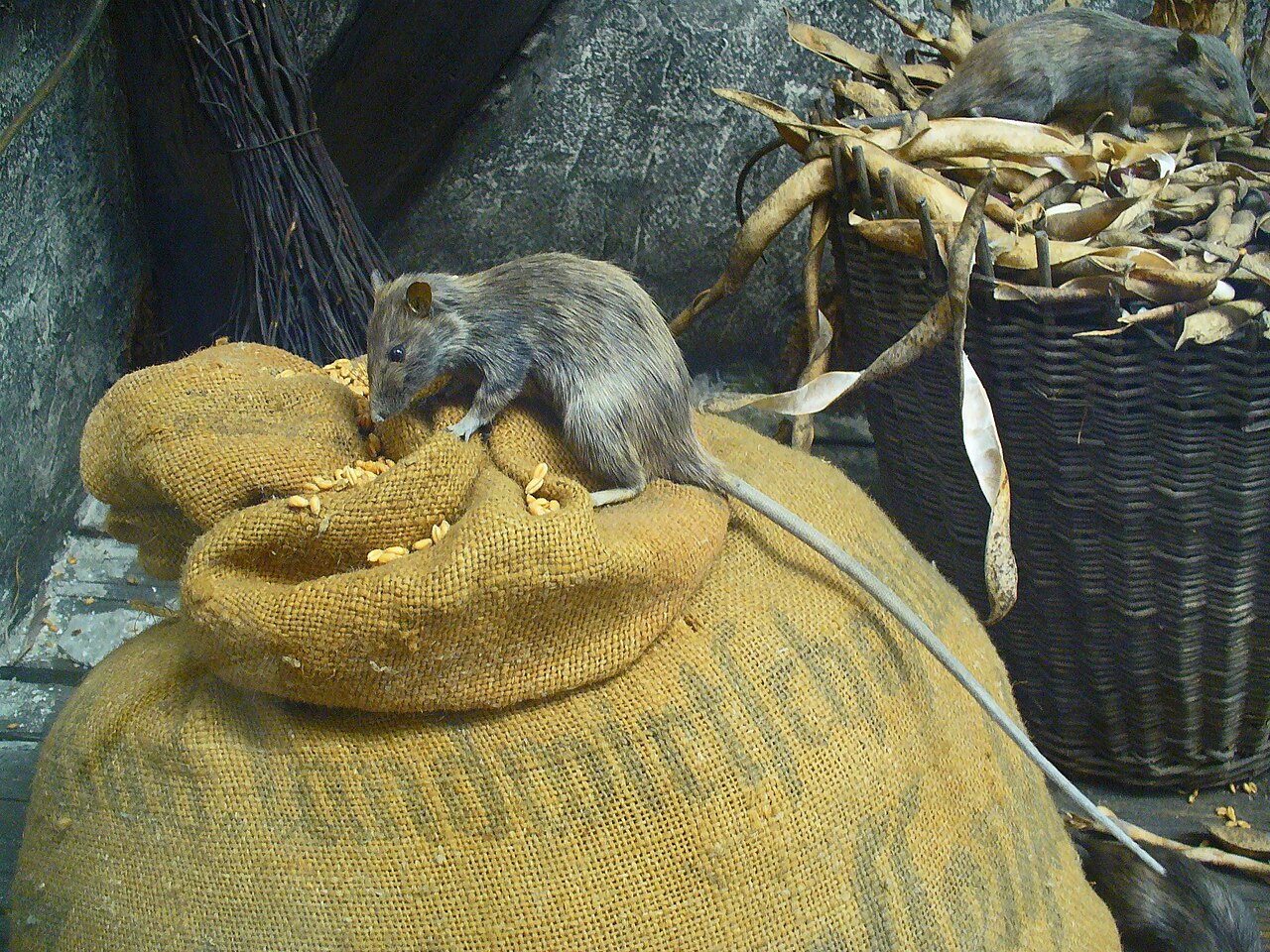

Did rats spread the Black Death? Everyone believes so; yet researchers are still debating it today.
This page explains why, and above all how a six-century-old scientific question gets reopened.
What makes a rodent
A rodent is defined neither by its size, nor by its tail, nor by its way of life. It is defined by its teeth.
Every rodent has, in the upper and lower jaw alike, a pair of incisors that never stop growing. They have enamel only on the front surface; the back, which is softer, wears down faster, so that the tooth sharpens itself into a bevel with every use. Behind these incisors comes a wide empty space, with no canine at all — zoologists call it the diastema — then the molars that grind at the back.1
This architecture has two direct consequences. It makes it possible to gnaw anything — wood, hard seeds, plastic, electric cables — without ever blunting the tool. It also imposes an obligation: if a rodent stops gnawing, its incisors keep growing until they prevent it from feeding, and in extreme cases until they pierce its own jaw. The tool is also a constraint.
This single dental innovation explains the group’s success. It opens up access to resources that almost no one else can exploit — hard-shelled seeds, wood, roots — and it works just as well for a thirty-gram mouse as for a sixty-kilogram capybara.
“Small mammals” is not a group
The other half of this page’s title calls for a word of caution. “Small mammals” denotes no kinship: it is a linguistic convenience that brings together animals of comparable size from very distant families.
- Shrews and moles are not rodents but eulipotyphlans. A shrew looks like a mouse, but it is as distant from one as a dog is from a horse.
- Rabbits and hares are not rodents either: they are lagomorphs, recognisable by a second pair of small incisors hidden behind the first.
- Bats, the second-largest group of mammals by number of species, have nothing to do with the previous ones.2
What these animals have in common lies in what we make of them, not in what they are. They are grouped together because they are small, inconspicuous and often seen as pests — and it is precisely this mixture that, for six centuries, complicated the question posed by this page: which animal, exactly, carried the plague?
What is under discussion
The classic explanation follows a three-link chain: the rat, the rat flea, then the human.3
More recent work proposes another route: human-to-human transmission, through parasites that live on the body and in clothing — the human flea and the body louse.4
No one disputes the existence of the bacillus. What is under discussion is how it spread.
How to settle such a question
It is impossible to go back to the fourteenth century to observe the rats. So in 2018 a team proceeded differently, using a method worth describing.
It built three models of spread: one through rat fleas, one through pneumonic contagion from human to human, one through human parasites. Then it tested each against the mortality curves recorded during nine European epidemics, from 1348 to 1813, in cities where registers had been kept.5
The question then becomes measurable: which model best reproduces the actual shape of the curves?
The authors’ answer: the human-parasite model, for seven of the nine epidemics; for the other two, it is impossible to decide between them.6
The challenge, published the same year
Another team replied in the same journal that this result is only weakly supported. Its argument: showing that one model outperforms two others does not prove that it is the right one, because a mixed scenario was not tested — rats and pneumonic contagion acting together.7
The original authors responded. Their reply is a model of caution, and is worth quoting as written: human parasites are a plausible and likely vector — but they remain open to alternative scenarios that could similarly explain the facts.8
The wording is revealing. They do not say “we have proved”. They say “our explanation holds, and we are listening to others”.
To a first approximation, all mammals are rodents
This mammalogists’ saying is accurate: rodents account for about 40 to 42% of all mammal species.9
By way of comparison, our own family (the Hominids) has numbered eight living species since the description of a third orangutan, in 2017, or about 0.1% of all mammals.10
Forty-two per cent against one tenth of one per cent.
The statistical illusion
The word “mammal” instinctively brings to mind a lion, an elephant or a dolphin.
Statistically, these are exceptions. The rule among mammals is a small animal that gnaws.
Three large groups alone account for more than 70% of mammal species:
- Rodents (Rodentia): ~40%
- Bats (Chiroptera): ~22%
- Insectivores/eulipotyphlans (hedgehogs, shrews): ~9%
Primates account for about 8%, carnivores 5%, and elephants barely 0.05% (three living species).
Concentration within the order
Even within the order of rodents, diversity is very unevenly distributed. Of some thirty recorded families, a few concentrate most of the species: the murids (Old World rats and mice) and the cricetids (hamsters, voles, New World rats and mice) alone account for more than half.11
A note on the unit of measurement
Saying that rodents form “the largest order of mammals” is true in terms of the number of identified species.
This does not necessarily mean that they also lead in absolute number of individuals, or in total biomass (mass of living matter). A scientific superlative always depends on what is being counted.
The keys to evolutionary success
The diversification of rodents rests on three combined biological traits:
- A small body size making it possible to exploit micro-habitats.
- A rapid reproductive cycle with many offspring.
- A capacity for dietary adaptation (continuously growing teeth dedicated to gnawing).
Their range of size is spectacular: it extends from the pygmy mouse (~5 grams) to the capybara (more than 60 kilograms). They occupy every continent except Antarctica.12
What this teaches us
Beyond zoology and history, this case illustrates a central epistemological principle:
The age of an idea or how deeply it is rooted in culture measures how widely it has spread, not its scientific validity.
At the end of the nineteenth century, it was discovered that the rat flea transmits the plague of its time. This rat theory was then applied retroactively to the Black Death, by analogy — and it became textbook knowledge that no one questioned any more.13
Replacing a received idea does not always require new excavations. Sometimes all it takes is a new method of analysis, capable of testing what we thought we already knew.
Let us be clear about where this page stands: the question is not settled. What has changed is not the answer — it is that we now know how to ask it.14
A note on vocabulary
This site deals with animal species without anthropomorphism or ethical judgement:
- The term “pest” is set aside: it does not describe a biological property of the animal, but a conflict of interests arising in a particular human context.
- Notions of hygiene or epidemiology are approached from a strictly ecological and functional point of view.
Note 1
Constantly growing, elongated rodent incisors show adaptations and optimizations that exceed those of human teeth. Rodent incisors can be recognized by their orange-brown color and their specific architecture, in which hard enamel selectively covers only the labial surface of the incisors, making them a self-sharpening device.
Max Planck Institute for Solid State Research, Microstructure Property Synergy in Functional Materials group, “Rodent Teeth: Ingenious Architecture of Natural Functional Materials to Inspire Human Dentistry”, research page
Although morphologically diverse, universal characters include one upper and one lower, ever-growing incisor on each side, always separated by a diastema from the cheek teeth; there are no canines (Fig. 1).
University of Texas at El Paso, UTEP Biodiversity Collections (Arthur H. Harris’s site on the Pleistocene vertebrates of New Mexico), “Rodentia”, updated 21 November 2008
Note 2
Family: Soricidae (487 species - shrews) […] Family: Talpidae (62 species - moles, desmans, shrew-moles) […] Family: Leporidae (68 species - rabbits, hares)
University of Glasgow, School of Biodiversity, One Health & Veterinary Medicine, Hunterian Taxonomy, “Order - Eulipotyphla” and “Order - Lagomorpha”, classification based on the Catalogue of Life (March 2025)
Note 3
While it is commonly assumed that rats and their fleas spread plague during the Second Pandemic, there is little historical and archaeological support for such a claim. […] Bubonic plague is typically transmitted to humans from wild or commensal rodents (3), […]
Dean, Katharine R. et al., “Human Ectoparasites and the Spread of Plague in Europe during the Second Pandemic”, Proceedings of the National Academy of Sciences, vol. 115, no. 6, 2018, p. 1304-1309
Note 4
human ectoparasite vectors, such as human fleas (Pulex irritans) or body lice (Pediculus humanus humanus)
Dean, Katharine R. et al., “Human Ectoparasites and the Spread of Plague in Europe during the Second Pandemic”, Proceedings of the National Academy of Sciences, vol. 115, no. 6, 2018, p. 1304-1309
Our results support that human ectoparasites were primary vectors for plague during the Second Pandemic, including the Black Death (1346-1353), ultimately challenging the assumption that plague in Europe was predominantly spread by rats.
Dean, Katharine R. et al., “Human Ectoparasites and the Spread of Plague in Europe during the Second Pandemic”, Proceedings of the National Academy of Sciences, vol. 115, no. 6, 2018, p. 1304-1309
Note 5
We used Bayesian MCMC and the mortality data to fit the three transmission models: human ectoparasite plague (EP), pneumonic plague (PP), and rat-borne plague (RP) (Fig. 1).
Dean, Katharine R. et al., “Human Ectoparasites and the Spread of Plague in Europe during the Second Pandemic”, Proceedings of the National Academy of Sciences, vol. 115, no. 6, 2018, p. 1304-1309
for nine plague outbreaks: (A) Givry, France (1348), (B) Florence, Italy (1400), (C) Barcelona, Spain (1490), (D) London, England (1563), (E) Eyam, England (1665), (F) Gdansk, Poland (1709), (G) Stockholm, Sweden (1710), (H) Moscow, Russia (1772), and (I) Island of Malta, Malta (1813).
Dean, Katharine R. et al., “Human Ectoparasites and the Spread of Plague in Europe during the Second Pandemic”, Proceedings of the National Academy of Sciences, vol. 115, no. 6, 2018, p. 1304-1309
Note 6
we found that this model fits mortality curves from nine outbreaks in Europe better than models for pneumonic or rodent transmission […] the human ectoparasite model had the lowest BIC value for all outbreaks, except Eyam and Givry […] For Eyam and Givry, the difference between the human ectoparasite model and another model was less than 10
Dean, Katharine R. et al., “Human Ectoparasites and the Spread of Plague in Europe during the Second Pandemic”, Proceedings of the National Academy of Sciences, vol. 115, no. 6, 2018, p. 1304-1309
Note 7
Human ectoparasite transmission of the plague during the Second Pandemic is only weakly supported by proposed mathematical models […] In particular, the authors’ model provides no evidence that human ectoparasite transmission was more likely to have driven the plague patterns than a highly plausible combination of pneumonic and rat-flea transmission.
Park, Sang Woo et al., “Human Ectoparasite Transmission of the Plague during the Second Pandemic Is Only Weakly Supported by Proposed Mathematical Models”, Proceedings of the National Academy of Sciences, vol. 115, no. 34, 2018, p. E7892-E7893
First, Park et al. (1) state that our study cannot provide evidence that human ectoparasite transmission was more likely than a mixed pneumonic and rat-flea transmission. […] we did not model mixed transmission routes
Dean, Katharine R. et al., “Reply to Park et al.: Human Ectoparasite Transmission of Plague during the Second Pandemic Is Still Plausible”, Proceedings of the National Academy of Sciences, vol. 115, no. 34, 2018, p. E7894-E7895
Note 8
Our results support our conclusion that human ectoparasites are a plausible and likely vector […] However, we are open to alternative scenarios that could similarly explain the epidemiology of plague
Dean, Katharine R. et al., “Reply to Park et al.: Human Ectoparasite Transmission of Plague during the Second Pandemic Is Still Plausible”, Proceedings of the National Academy of Sciences, vol. 115, no. 34, 2018, p. E7894-E7895
Note 9
“Rodents and bats together make up almost two-thirds of mammal diversity,” Upham said, about 41% rodents and 22% bats.
Harrod, Gabriela, “Thousands of Mammals and Counting: The Planet’s Hidden Diversity Keeps Growing”, ASU News, Arizona State University, 5 November 2025, open access
Note 10
Six extant species of non-human great apes are currently recognized: Sumatran and Bornean orangutans, eastern and western gorillas, and chimpanzees and bonobos […] The new species, Pongo tapanuliensis, encompasses the Batang Toru population
Nater, Alexander et al., “Morphometric, Behavioral, and Genomic Evidence for a New Orangutan Species”, Current Biology, vol. 27, no. 22, 2017, p. 3487-3498
Note 11
As a result rodents represent nearly half of the current mammalian diversity with more than 2,261 species organized into 474 genera. […] Most shifts in diversification rates (Table 1, Figure 2) are located within the two most speciose muroid families: the Cricetidae (681 species) and the Muridae (728 species).
Fabre, Pierre-Henri et al., “A Glimpse on the Pattern of Rodent Diversification: A Phylogenetic Approach”, BMC Evolutionary Biology, vol. 12, 88, 2012
Note 12
The adults of this species have a total length of about 97 mm, with tails of 41 mm and a mass of 5.5 g (Skinner & Chimimba 2005).
South African National Biodiversity Institute (SANBI), “Pygmy Mouse (Mus minutoides)”, Red List of South African Species
Capybaras are the largest of rodents, weighing from 35 to 66 kg and standing up to 0.6 meters at the shoulder, […]
Frens, Kathryn, “*Hydrochoerus hydrochaeris* (capybara)”, Animal Diversity Web, University of Michigan Museum of Zoology, 2009
Note 13
La puce paraît être l'intermédiaire habituel de la transmission ; toutefois, de nouvelles recherches sont nécessaires avant de pouvoir lui attribuer un rôle exclusif. […] 7° La puce qui a absorbé du sang septique sur un animal pestiféré conserve, pendant une durée encore indéterminée, le microbe en culture dans le tube digestif, et l'inoculation au rat du contenu intestinal peut lui donner la peste ;
The flea appears to be the usual intermediary of transmission; however, further research is needed before an exclusive role can be attributed to it. […] 7. The flea that has absorbed septic blood from a plague-infected animal retains, for a period as yet undetermined, the microbe in culture in its digestive tract, and inoculating the rat with the intestinal contents can give it plague;
Simond, Paul-Louis, “La propagation de la peste”, Annales de l’Institut Pasteur, vol. 12, 1898, p. 625-687
Note 14
Only a few of the archaeological finds from medieval harbour towns in Norway contain rat bones. There are no finds of black rats from the many archaeological excavations in rural areas or from the inland town of Hamar.
Hufthammer, Anne Karin and Walløe, Lars, “Rats Cannot Have Been Intermediate Hosts for Yersinia pestis during Medieval Plague Epidemics in Northern Europe”, Journal of Archaeological Science, vol. 40, 2013, p. 1752-1759
Notes and sources
- ↑
Passage a pair of incisors that never stop growing. They have enamel only on the front surface […] the tooth sharpens itself
Constantly growing, elongated rodent incisors show adaptations and optimizations that exceed those of human teeth. Rodent incisors can be recognized by their orange-brown color and their specific architecture, in which hard enamel selectively covers only the labial surface of the incisors, making them a self-sharpening device.
Source Max Planck Institute for Solid State Research, Microstructure Property Synergy in Functional Materials group, “Rodent Teeth: Ingenious Architecture of Natural Functional Materials to Inspire Human Dentistry”, research page, opening paragraph of the page.
Open access open the source · checked on 27 October 2026
Passage empty space, with no canine at all — zoologists call it the diastema
Although morphologically diverse, universal characters include one upper and one lower, ever-growing incisor on each side, always separated by a diastema from the cheek teeth; there are no canines (Fig. 1).
Source University of Texas at El Paso, UTEP Biodiversity Collections (Arthur H. Harris’s site on the Pleistocene vertebrates of New Mexico), “Rodentia”, updated 21 November 2008, 2nd paragraph (“Although morphologically diverse”).
Open access open the source · checked on 27 October 2026
- ↑
Passage Shrews and moles are not rodents but eulipotyphlans […] Rabbits and hares […] are lagomorphs
Family: Soricidae (487 species - shrews) […] Family: Talpidae (62 species - moles, desmans, shrew-moles) […] Family: Leporidae (68 species - rabbits, hares)
Source University of Glasgow, School of Biodiversity, One Health & Veterinary Medicine, Hunterian Taxonomy, “Order - Eulipotyphla” and “Order - Lagomorpha”, classification based on the Catalogue of Life (March 2025), “Order - Eulipotyphla” page, list of families; “Order - Lagomorpha” page, list of families (classification based on the Catalogue of Life, March 2025).
Open access open the source 1 open the source 2 · checked on 27 October 2026
- ↑
Passage The classic explanation follows a three-link chain: the rat, the rat flea, then the human.
While it is commonly assumed that rats and their fleas spread plague during the Second Pandemic, there is little historical and archaeological support for such a claim. […] Bubonic plague is typically transmitted to humans from wild or commensal rodents (3), […]
Source Dean, Katharine R. et al., “Human Ectoparasites and the Spread of Plague in Europe during the Second Pandemic”, Proceedings of the National Academy of Sciences, vol. 115, no. 6, 2018, p. 1304-1309, p. 1304, “Significance” box; introduction, 2nd paragraph.
Open access open the source · checked on 27 October 2026
- ↑
Passage the human flea and the body louse
human ectoparasite vectors, such as human fleas (Pulex irritans) or body lice (Pediculus humanus humanus)
Source Dean, Katharine R. et al., “Human Ectoparasites and the Spread of Plague in Europe during the Second Pandemic”, Proceedings of the National Academy of Sciences, vol. 115, no. 6, 2018, p. 1304-1309, abstract.
Open access open the source · checked on 9 September 2026
Passage More recent work proposes another route: human-to-human transmission
Our results support that human ectoparasites were primary vectors for plague during the Second Pandemic, including the Black Death (1346-1353), ultimately challenging the assumption that plague in Europe was predominantly spread by rats.
Source Dean, Katharine R. et al., “Human Ectoparasites and the Spread of Plague in Europe during the Second Pandemic”, Proceedings of the National Academy of Sciences, vol. 115, no. 6, 2018, p. 1304-1309, abstract.
Open access open the source · checked on 9 September 2026
- ↑
Passage three models of spread: one through rat fleas, one through pneumonic contagion from human to human, one through human parasites
We used Bayesian MCMC and the mortality data to fit the three transmission models: human ectoparasite plague (EP), pneumonic plague (PP), and rat-borne plague (RP) (Fig. 1).
Source Dean, Katharine R. et al., “Human Ectoparasites and the Spread of Plague in Europe during the Second Pandemic”, Proceedings of the National Academy of Sciences, vol. 115, no. 6, 2018, p. 1304-1309, Results, “Model Fit and Selection”.
Open access open the source · checked on 9 September 2026
Passage mortality curves recorded during nine European epidemics, from 1348 to 1813
for nine plague outbreaks: (A) Givry, France (1348), (B) Florence, Italy (1400), (C) Barcelona, Spain (1490), (D) London, England (1563), (E) Eyam, England (1665), (F) Gdansk, Poland (1709), (G) Stockholm, Sweden (1710), (H) Moscow, Russia (1772), and (I) Island of Malta, Malta (1813).
Source Dean, Katharine R. et al., “Human Ectoparasites and the Spread of Plague in Europe during the Second Pandemic”, Proceedings of the National Academy of Sciences, vol. 115, no. 6, 2018, p. 1304-1309, caption of Figure 1.
Open access open the source · checked on 9 September 2026
- ↑
Passage the human-parasite model, for seven of the nine epidemics
we found that this model fits mortality curves from nine outbreaks in Europe better than models for pneumonic or rodent transmission […] the human ectoparasite model had the lowest BIC value for all outbreaks, except Eyam and Givry […] For Eyam and Givry, the difference between the human ectoparasite model and another model was less than 10
Source Dean, Katharine R. et al., “Human Ectoparasites and the Spread of Plague in Europe during the Second Pandemic”, Proceedings of the National Academy of Sciences, vol. 115, no. 6, 2018, p. 1304-1309, abstract; Results, “Model Fit and Selection” (p. 5 of the PDF).
Open access open the source · checked on 9 September 2026
- ↑
Passage Another team replied in the same journal that this result is only weakly supported.
Human ectoparasite transmission of the plague during the Second Pandemic is only weakly supported by proposed mathematical models […] In particular, the authors’ model provides no evidence that human ectoparasite transmission was more likely to have driven the plague patterns than a highly plausible combination of pneumonic and rat-flea transmission.
Source Park, Sang Woo et al., “Human Ectoparasite Transmission of the Plague during the Second Pandemic Is Only Weakly Supported by Proposed Mathematical Models”, Proceedings of the National Academy of Sciences, vol. 115, no. 34, 2018, p. E7892-E7893, Park et al., letter to PNAS: title, then body of the letter (p. E7892).
Open access open the source · checked on 24 October 2026
Passage a mixed scenario was not tested — rats and pneumonic contagion acting together
First, Park et al. (1) state that our study cannot provide evidence that human ectoparasite transmission was more likely than a mixed pneumonic and rat-flea transmission. […] we did not model mixed transmission routes
Source Dean, Katharine R. et al., “Reply to Park et al.: Human Ectoparasite Transmission of Plague during the Second Pandemic Is Still Plausible”, Proceedings of the National Academy of Sciences, vol. 115, no. 34, 2018, p. E7894-E7895, authors’ reply, first point.
Open access open the source · checked on 9 September 2026
- ↑
Passage human parasites are a plausible and likely vector — but they remain open to alternative scenarios
Our results support our conclusion that human ectoparasites are a plausible and likely vector […] However, we are open to alternative scenarios that could similarly explain the epidemiology of plague
Source Dean, Katharine R. et al., “Reply to Park et al.: Human Ectoparasite Transmission of Plague during the Second Pandemic Is Still Plausible”, Proceedings of the National Academy of Sciences, vol. 115, no. 34, 2018, p. E7894-E7895, authors’ reply, conclusion.
Open access open the source · checked on 9 September 2026
- ↑
Passage rodents account for about 40 to 42% of all mammal species.
“Rodents and bats together make up almost two-thirds of mammal diversity,” Upham said, about 41% rodents and 22% bats.
Source Harrod, Gabriela, “Thousands of Mammals and Counting: The Planet’s Hidden Diversity Keeps Growing”, ASU News, Arizona State University, 5 November 2025, open access, article of 5 November 2025, remarks by Nathan Upham (“one of the scientists leading this database”, i.e. the Mammal Diversity Database).
Open access open the source · checked on 27 October 2026
- ↑
Passage our own family (the Hominids) has numbered eight living species since the description of a third orangutan, in 2017
Six extant species of non-human great apes are currently recognized: Sumatran and Bornean orangutans, eastern and western gorillas, and chimpanzees and bonobos […] The new species, Pongo tapanuliensis, encompasses the Batang Toru population
Source Nater, Alexander et al., “Morphometric, Behavioral, and Genomic Evidence for a New Orangutan Species”, Current Biology, vol. 27, no. 22, 2017, p. 3487-3498, abstract.
Paywalled open the source · checked on 26 October 2026
- ↑
Passage a few concentrate most of the species: the murids […] and the cricetids […] alone account for more than half
As a result rodents represent nearly half of the current mammalian diversity with more than 2,261 species organized into 474 genera. […] Most shifts in diversification rates (Table 1, Figure 2) are located within the two most speciose muroid families: the Cricetidae (681 species) and the Muridae (728 species).
Source Fabre, Pierre-Henri et al., “A Glimpse on the Pattern of Rodent Diversification: A Phylogenetic Approach”, BMC Evolutionary Biology, vol. 12, 88, 2012, Background; Results, “Imbalance and shifts in diversification rate within rodents”.
Open access open the source · checked on 9 September 2026
- ↑
Passage from the pygmy mouse (~5 grams)
The adults of this species have a total length of about 97 mm, with tails of 41 mm and a mass of 5.5 g (Skinner & Chimimba 2005).
Source South African National Biodiversity Institute (SANBI), “Pygmy Mouse (Mus minutoides)”, Red List of South African Species, Mus minutoides account, habitat and ecology part, paragraph beginning “The colloquial name is appropriate”.
Open access open the source · checked on 27 October 2026
Passage to the capybara (more than 60 kilograms)
Capybaras are the largest of rodents, weighing from 35 to 66 kg and standing up to 0.6 meters at the shoulder, […]
Source Frens, Kathryn, “*Hydrochoerus hydrochaeris* (capybara)”, Animal Diversity Web, University of Michigan Museum of Zoology, 2009, “Physical Description” section.
Open access open the source · checked on 27 October 2026
- ↑
Passage At the end of the nineteenth century, it was discovered that the rat flea transmits the plague of its time.
La puce paraît être l'intermédiaire habituel de la transmission ; toutefois, de nouvelles recherches sont nécessaires avant de pouvoir lui attribuer un rôle exclusif. […] 7° La puce qui a absorbé du sang septique sur un animal pestiféré conserve, pendant une durée encore indéterminée, le microbe en culture dans le tube digestif, et l'inoculation au rat du contenu intestinal peut lui donner la peste ;
Editors’ translation The flea appears to be the usual intermediary of transmission; however, further research is needed before an exclusive role can be attributed to it. […] 7. The flea that has absorbed septic blood from a plague-infected animal retains, for a period as yet undetermined, the microbe in culture in its digestive tract, and inoculating the rat with the intestinal contents can give it plague;
Source Simond, Paul-Louis, “La propagation de la peste”, Annales de l’Institut Pasteur, vol. 12, 1898, p. 625-687, end of the article: discussion of the role of parasites, then conclusions (7°) (views 53 and 55 of the archive.org scan of issue no. 10, Oct. 1898).
Public domain · checked on 24 October 2026
- ↑
For this whole section
Passage the absence of rats in medieval Northern Europe
Only a few of the archaeological finds from medieval harbour towns in Norway contain rat bones. There are no finds of black rats from the many archaeological excavations in rural areas or from the inland town of Hamar.
Source Hufthammer, Anne Karin and Walløe, Lars, “Rats Cannot Have Been Intermediate Hosts for Yersinia pestis during Medieval Plague Epidemics in Northern Europe”, Journal of Archaeological Science, vol. 40, 2013, p. 1752-1759, abstract.
Paywalled · checked on 25 October 2026
Bibliography
18
- Benedictow, Ole J., The Black Death, 1346-1353: The Complete History, Boydell Press, 2004, in libraries (the classic rat thesis, defended).
- Burgin, Connor J. et al., “How Many Species of Mammals Are There?”, Journal of Mammalogy, vol. 99, no. 1, 2018, p. 1-14, open access ; et Mammal Diversity Database, American Society of Mammalogists, open access (the proportions of species by order). https://www.mammaldiversity.org/
- Cox, Philip G. and Hautier, Lionel (ed.), Evolution of the Rodents, Cambridge University Press, 2015, in libraries (continuously growing incisors, enamel limited to the front surface, self-sharpening, the diastema).
- Dean, Katharine R. et al., “Human Ectoparasites and the Spread of Plague in Europe during the Second Pandemic”, Proceedings of the National Academy of Sciences, vol. 115, no. 6, 2018, p. 1304-1309, open access (the three models compared on nine European epidemics; the human flea and the body louse; the conclusion in favour of human parasites). https://doi.org/10.1073/pnas.1715640115
- Dean, Katharine R. et al., “Reply to Park et al.: Human Ectoparasite Transmission of Plague during the Second Pandemic Is Still Plausible”, Proceedings of the National Academy of Sciences, vol. 115, no. 34, 2018, p. E7894-E7895, open access (the objection of the untested mixed scenario, acknowledged; human parasites as a plausible and likely vector, without ruling out other scenarios). https://doi.org/10.1073/pnas.1810221115
- Fabre, Pierre-Henri et al., “A Glimpse on the Pattern of Rodent Diversification: A Phylogenetic Approach”, BMC Evolutionary Biology, vol. 12, 88, 2012, open access (the very uneven distribution of species among rodent families). https://doi.org/10.1186/1471-2148-12-88
- Frens, Kathryn, “*Hydrochoerus hydrochaeris* (capybara)”, Animal Diversity Web, University of Michigan Museum of Zoology, 2009, open access (the capybara, largest of rodents, 35 to 66 kg). https://animaldiversity.org/accounts/Hydrochoerus_hydrochaeris/
- Harrod, Gabriela, “Thousands of Mammals and Counting: The Planet’s Hidden Diversity Keeps Growing”, ASU News, Arizona State University, 5 November 2025, open access (the share of rodents, about 41%, and of bats, 22%, in the updated Mammal Diversity Database). https://news.asu.edu/20251105-science-and-technology-thousands-mammals-and-counting-hidden-biodiversity-growing
- Hufthammer, Anne Karin and Walløe, Lars, “Rats Cannot Have Been Intermediate Hosts for Yersinia pestis during Medieval Plague Epidemics in Northern Europe”, Journal of Archaeological Science, vol. 40, 2013, p. 1752-1759, paywalled (the argument of the absence of rats in medieval Northern Europe).
- Kingdon, Jonathan et al. (ed.), Mammals of Africa, Bloomsbury, 2013, in libraries ; et Moreira, José R. et al. (dir.), Capybara, Springer, 2013, in libraries (the extremes of size among rodents).
- Max Planck Institute for Solid State Research, Microstructure Property Synergy in Functional Materials group, “Rodent Teeth: Ingenious Architecture of Natural Functional Materials to Inspire Human Dentistry”, research page, open access (constantly growing incisors, enamel on the labial surface only, self-sharpening). https://fkf.mpg.de/8401030/rodent-teeth
- Nater, Alexander et al., “Morphometric, Behavioral, and Genomic Evidence for a New Orangutan Species”, Current Biology, vol. 27, no. 22, 2017, p. 3487-3498, paywalled (the description of a third orangutan species, which brings the Hominids to eight living species). https://doi.org/10.1016/j.cub.2017.09.047
- Park, Sang Woo et al., “Human Ectoparasite Transmission of the Plague during the Second Pandemic Is Only Weakly Supported by Proposed Mathematical Models”, Proceedings of the National Academy of Sciences, vol. 115, no. 34, 2018, p. E7892-E7893, open access (the objection: a mixed scenario was not tested). https://doi.org/10.1073/pnas.1809775115
- Simond, Paul-Louis, “La propagation de la peste”, Annales de l’Institut Pasteur, vol. 12, 1898, p. 625-687, public domain (the discovery of the role of the rat flea).
- South African National Biodiversity Institute (SANBI), “Pygmy Mouse (Mus minutoides)”, Red List of South African Species, open access (the mass of the pygmy mouse, 5.5 g). https://speciesstatus.sanbi.org/taxa/detail/2142/
- University of Glasgow, School of Biodiversity, One Health & Veterinary Medicine, Hunterian Taxonomy, “Order - Eulipotyphla” and “Order - Lagomorpha”, classification based on the Catalogue of Life (March 2025), open access (shrews and moles among the eulipotyphlans; rabbits and hares among the lagomorphs). https://www.gla.ac.uk/schools/bohvm/taxonomy/chordata/vertebrata/mammalia/eulipotyphla/
- University of Texas at El Paso, UTEP Biodiversity Collections (Arthur H. Harris’s site on the Pleistocene vertebrates of New Mexico), “Rodentia”, updated 21 November 2008, open access (the diastema between incisors and cheek teeth; the absence of canines). https://www.utep.edu/LEB/PleistNM/taxaMamm/rodentia.htm
- Wilson, Don E. and Reeder, DeeAnn M. (ed.), Mammal Species of the World, Johns Hopkins University Press, 2005, in libraries (the taxonomic reference for mammals).
Spotted an error or have a doubt? Write to us.