
Around 1242, a physician born near Damascus described the passage of blood through the lungs. Europe would not read his text for nearly seven centuries.
Nobody stole his text, as far as we know. Almost nobody read it.
It is a way of being erased that nobody ever thinks about, and it is perhaps the most common one.
The blood’s circuit
Blood does not wander around the body: it follows a closed circuit, always the same, driven by a pump that never stops.
The heart is that pump. It is the size of a fist and has four chambers: two atria at the top, which receive the incoming blood, and two ventricles at the bottom, more muscular, which expel it. Between the chambers, valves open and close in one direction only — it is mainly their closing that is heard as the heartbeat, more than the muscle. They close with every beat, more than one hundred thousand times a day, without interruption, for a whole lifetime.1
Three kinds of vessel carry this blood, and their form matches their work.
- Arteries leave the heart. They withstand high pressure and have thick, elastic walls.
- Veins return to it. The pressure in them is low, the walls thinner, and many contain small valves that stop the blood from flowing back down when we are standing.
- Capillaries connect the two. They are vessels so fine that a red blood cell has to pass through them in single file, one at a time, and their wall is only one cell thick. This is where, for the most part, exchanges with the cells take place — the rest of the network serves mainly for transport.2
The circuit has two loops, and this is the point that took longest to be understood. The small loop sends blood from the heart to the lungs, where it takes on oxygen and gets rid of carbon dioxide, then brings it back to the heart. The large loop then sends it through all the rest of the body, where the capillaries deliver oxygen and collect waste, before returning it to the heart. Two circuits for one complete round trip.3
The blood itself carries more than oxygen: nutrients from the gut, hormones, defence cells, heat, and waste to be taken to the kidneys and liver.
It is the small loop, and it alone, that is described by the text this page is about — three centuries before it was rediscovered in Europe.
What had been taught for a thousand years
Galen, a physician of Antiquity, held that blood passed from the right side of the heart to the left by crossing invisible pores in the wall that separates them.4
His authority lasted more than a thousand years.
⚠ Important note: a large part of his anatomical observations was made on animals, not on humans. So for a millennium, a description of the human body established elsewhere was taught.
What Ibn al-Nafis wrote around 1242
A physician born near Damascus, trained at the Nuri hospital, settled in Egypt from 1236, writes a commentary on a great treatise of medicine.5
He is twenty-nine years old.6
In it he rejects Galen’s pores, and he does so in a way that deserves to be read:
There is no passage between these two cavities; for the substance of the heart is solid in this region and has neither a visible passage, as was thought by some persons, nor an invisible one.7
The double negation is worth noting. Galen had proposed invisible pores — a convenient hypothesis, since one cannot show that an invisible thing does not exist. Ibn al-Nafis rejects both at once.
Then he describes the real route: the blood of the right chamber must reach the left, but with no direct passage. So it travels through the pulmonary artery to the lungs, is mixed with air there, and returns to the heart through the pulmonary vein.8
This is the first known description of what is today called the pulmonary circulation.
About three hundred years before the European authors to whom it is attributed.
He predicted something he could not see
This is the most impressive detail, and the entry would have been wrong to leave it out.
If blood passes from the pulmonary artery to the pulmonary vein through the lung, there must be a passage between the two. Ibn al-Nafis states it: there must be small channels connecting one to the other.9
He never saw them. The microscope did not exist.
These channels — the pulmonary capillaries — were observed four hundred years later.10
The approach is a familiar one: announce what must exist for the reasoning to hold, then wait for the instrument to arrive. This is what Mendeleev does with his empty boxes, and Darwin and then Wallace with the moth of Madagascar.11
Here, the wait lasted four centuries.
One last detail: this text, written nearly eight hundred years ago, can still be read today by anyone who knows Arabic.12
What happened next
Nothing.
He wrote in Arabic, and before the invention of printing. His manuscript stayed in libraries. European medicine, as far as can be established, did not make use of it: nothing proves that it read it.
The heart is not ordered to beat
A surprising and fully established fact deserves to be highlighted.
Heart muscle contracts on its own. It waits for no signal from the brain.
The rhythm is produced inside the heart itself, by a small group of specialised cells that fire regularly, without being asked to do anything.13
The nervous system does not command: it moderates. It speeds the rhythm up during a run and slows it down during sleep. It adjusts a movement that already existed without it.14
This is why we speak of cardiac automaticity: the beat originates in the heart. The rhythm is in the muscle, not in the command.
How to check it
Not by guessing: by isolating.
Deprived of all nervous or hormonal control, this small group of cells, the sinoatrial node, would still start the beats, at about eighty to one hundred per minute.15
Remove the supposed command, and the phenomenon continues. It is the soundest reasoning there is: to know whether something is the cause, you have to remove it and observe.
What this says about the whole body
This is the fourth time, in this domain, that a part of the body acts without the brain having ordered it.
The hand pulls away from a burn before the pain is felt (see Entry 8.5). Gut bacteria do part of the work of digestion. The immune system sorts cells without consulting anyone. The heart beats by itself.16
The body is much less commanded than we think.
This is not worrying; it is even reassuring. A body that needed an order for every beat would be a very fragile body — a single interruption would be enough for everything to stop.
What keeps us alive is not only a conductor. It is also a set of things that each work on their own, and that the brain brings into tune.
The rediscovery, a story in itself
In 1924, an Egyptian physician, Muhyi al-Din al-Tatawi, is studying the history of Arabic medicine at a German faculty.
He works at the Prussian State Library in Berlin. There he finds the manuscript, until then unknown in the West.17
An orientalist, Max Meyerhof, then made translations of it himself into English, French and German.18
The question that must be left open
There remains the point on which this site refuses to come down on one side — and it needs explaining why.
Another work by Ibn al-Nafis, on compound remedies, was translated into Latin in 1547. Michael Servetus published his description of the pulmonary circulation in 1553. Colombo, his pupil Valverde and Vesalius, in the same years.19
Had the Europeans read it, then?
Specialists disagree.
Some believe that the European authors took this concept over in their “rediscovery”.
Another asks whether they knew of it and chose not to cite it.
Others stress that there is no proof that Servetus knew of it.
This site has a rule, and it applies here: faced with an origin attributed elsewhere, ask whether it has been shown or assumed.
This rule applies in both directions. Writing “Europe stole it” would be committing exactly the fault we criticise others for elsewhere. Writing “he had no influence” would be committing it in reverse.
Transmission is possible, plausible, and not established. That is what should be written.20
A matter of fairness
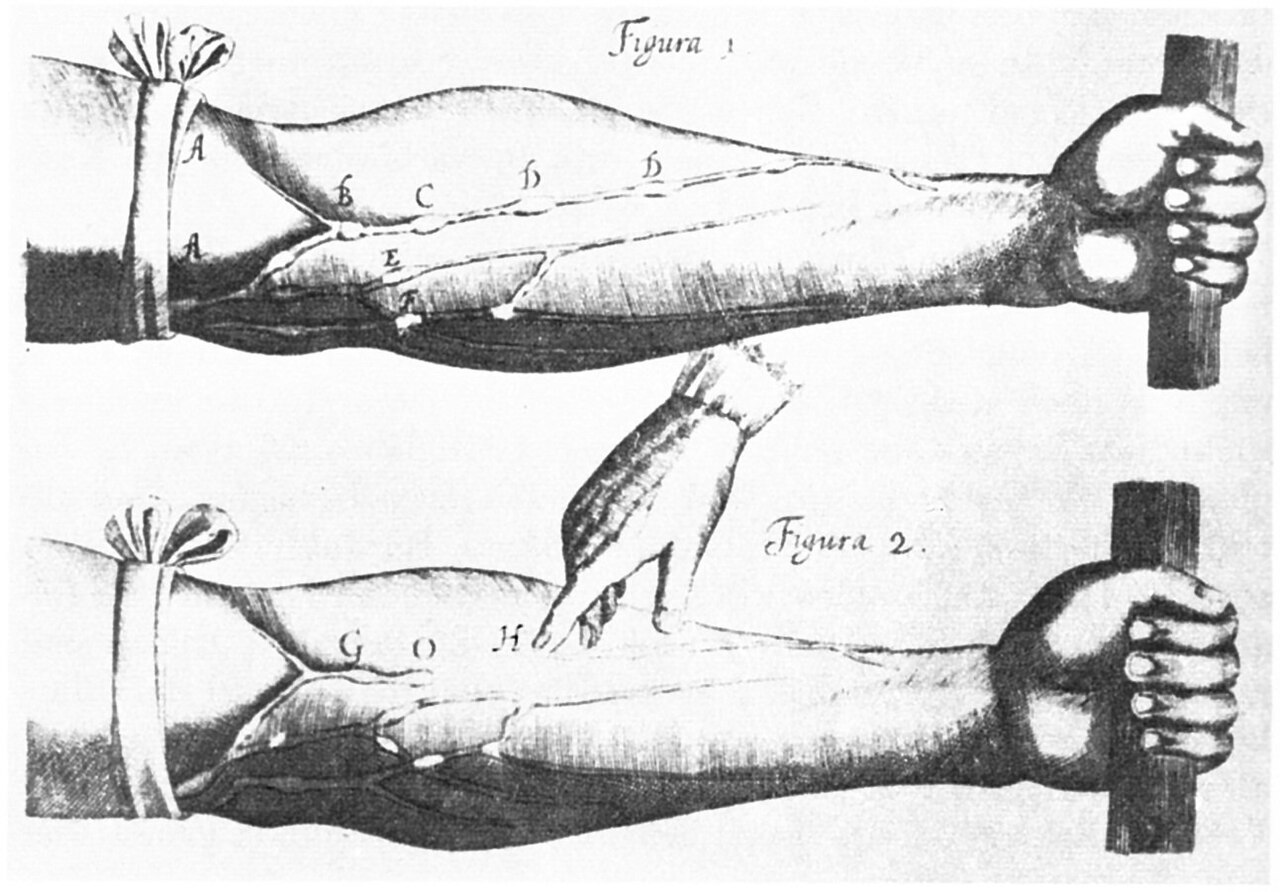
Establishing that Ibn al-Nafis was the first to describe the pulmonary circulation takes nothing away from William Harvey, whose work, four centuries later, concerned the general circulation of the blood throughout the body, and rested on measurements.21
It is not the same discovery.
We make the same remark in our page on the great centres of learning: correcting an attribution does not mean taking from one to give to another. It means saying who did what.
⚠ Michael Servetus was burned along with his book in Geneva in 1553, for heresy — essentially for having denied the Trinity and infant baptism. His description of the pulmonary circulation, slipped into this theological work, was not the cause of his condemnation; it nevertheless almost disappeared along with nearly all copies of the book, which were burned too.
Note 1
The human heart consists of four chambers: The left side and the right side each have one atrium and one ventricle.
Betts, J. Gordon et al., Anatomy and Physiology, OpenStax, Rice University
A typical heart is approximately the size of your fist […] a human heart would contract approximately 108,000 times in one day
Betts, J. Gordon et al., Anatomy and Physiology, OpenStax, Rice University
Note 2
Exchange of gases and other substances occurs between the blood in capillaries and the surrounding cells and their tissue fluid (interstitial fluid). The diameter of a capillary lumen ranges from 5–10 micrometers; the smallest are just barely wide enough for an erythrocyte to squeeze through.
Betts, J. Gordon et al., Anatomy and Physiology, OpenStax, Rice University
Note 3
The pulmonary circuit transports blood to and from the lungs, where it picks up oxygen and delivers carbon dioxide for exhalation. The systemic circuit transports oxygenated blood to virtually all of the tissues of the body and returns relatively deoxygenated blood and carbon dioxide to the heart to be sent back to the pulmonary circulation.
Betts, J. Gordon et al., Anatomy and Physiology, OpenStax, Rice University
Note 4
Prior to Ibn Nafis' discovery, the accepted contemporary understanding was that of Galen. He had theorised that the blood reaching the right side of the heart passed through invisible pores in the cardiac septum to the left side of the heart […]
Al-Ghazal, Sharif Kaf and Zubairi, Rumaisa, “Ibn Al-Nafis – The First who Described the Pulmonary Blood Circulation”, Journal of the British Islamic Medical Association, 2022
Note 5
was born in 1213 CE in Damascus. […] He was educated at Bimaristan Al-Noori, the medical college hospital founded by Noor al-Din l-Zingi. […] In 1236, Ibn Al Nafis moved to Egypt
Al-Ghazal, Sharif Kaf and Zubairi, Rumaisa, “Ibn Al-Nafis – The First who Described the Pulmonary Blood Circulation”, Journal of the British Islamic Medical Association, 2022
Note 6
When he was only 29, he published his most important work, the Commentary on Anatomy in Avicenna's Canon
West, John B., “Ibn al-Nafis, the Pulmonary Circulation, and the Islamic Golden Age”, Journal of Applied Physiology, vol. 105, no. 6, 2008, p. 1877-1880
Note 7
but there is no passage between these two cavities; for the substance of the heart is solid in this region and has neither a visible passage, as was thought by some persons, nor an invisible one
West, John B., “Ibn al-Nafis, the Pulmonary Circulation, and the Islamic Golden Age”, Journal of Applied Physiology, vol. 105, no. 6, 2008, p. 1877-1880
Note 8
blood from the venous circulation had to be directed through the pulmonary artery through the lungs to be "mixed with air" and drained back to the left side of the heart through the pulmonary vein
West, John B., “Ibn al-Nafis, the Pulmonary Circulation, and the Islamic Golden Age”, Journal of Applied Physiology, vol. 105, no. 6, 2008, p. 1877-1880
Note 9
He also stated that there must be small communications or pores (manafidh in Arabic) between the pulmonary artery and vein
West, John B., “Ibn al-Nafis, the Pulmonary Circulation, and the Islamic Golden Age”, Journal of Applied Physiology, vol. 105, no. 6, 2008, p. 1877-1880
Note 10
a prediction that preceded by 400 years the discovery of the pulmonary capillaries by Marcello Malpighi
West, John B., “Ibn al-Nafis, the Pulmonary Circulation, and the Islamic Golden Age”, Journal of Applied Physiology, vol. 105, no. 6, 2008, p. 1877-1880
Note 11
entrées 4.3 et 6.2
Entries 4.3 and 6.2
The facts concerning Mendeleev, the prediction of the Madagascar moth, the withdrawal reflex, the gut microbiota and the immune system are established in Entries 4.3, 6.2, 8.5, 8.10 and 8.12, with their sources
Note 12
although it was written nearly 800 years ago it can be read by people familiar with Arabic today
West, John B., “Ibn al-Nafis, the Pulmonary Circulation, and the Islamic Golden Age”, Journal of Applied Physiology, vol. 105, no. 6, 2008, p. 1877-1880
Note 13
This property is known as autorhythmicity.
Betts, J. Gordon et al., Anatomy and Physiology, OpenStax, Rice University
Note 14
Even though cardiac muscle has autorhythmicity, heart rate is modulated by the endocrine and nervous systems.
Betts, J. Gordon et al., Anatomy and Physiology, OpenStax, Rice University
Note 15
The SA node, without nervous or endocrine control, would initiate a heart impulse approximately 80–100 times per minute.
Betts, J. Gordon et al., Anatomy and Physiology, OpenStax, Rice University
Note 16
entrées 8.5, 8.10 et 8.12
Entries 8.5, 8.10 and 8.12
The facts concerning Mendeleev, the prediction of the Madagascar moth, the withdrawal reflex, the gut microbiota and the immune system are established in Entries 4.3, 6.2, 8.5, 8.10 and 8.12, with their sources
Note 17
A fascinating sidelight on Ibn al-Nafis is how the manuscript Commentary on Anatomy in Avicenna's Canon was made known to the Western world only about 80 years ago.
West, John B., “Ibn al-Nafis, the Pulmonary Circulation, and the Islamic Golden Age”, Journal of Applied Physiology, vol. 105, no. 6, 2008, p. 1877-1880
In 1924 an Egyptian physician, Dr. Muhyo Al-Deen Altatawi, discovered a manuscript entitled
Al-Ghazal, Sharif Kaf and Zubairi, Rumaisa, “Ibn Al-Nafis – The First who Described the Pulmonary Blood Circulation”, Journal of the British Islamic Medical Association, 2022
Note 18
Max Meyrhof, an orientalist in Cairo came to know of Dr Tatawi's and took it upon himself to make translations in English, French and German.
Al-Ghazal, Sharif Kaf and Zubairi, Rumaisa, “Ibn Al-Nafis – The First who Described the Pulmonary Blood Circulation”, Journal of the British Islamic Medical Association, 2022
took it upon himself to make translations in English, French and German.
Al-Ghazal, Sharif Kaf and Zubairi, Rumaisa, “Ibn Al-Nafis – The First who Described the Pulmonary Blood Circulation”, Journal of the British Islamic Medical Association, 2022
Note 19
Andrea Alpago of Belluno translated some of Ibn Al-Nafis' writings into Latin in 1547
Al-Ghazal, Sharif Kaf and Zubairi, Rumaisa, “Ibn Al-Nafis – The First who Described the Pulmonary Blood Circulation”, Journal of the British Islamic Medical Association, 2022
The translation was made by Andrea Alpago of Belluno
West, John B., “Ibn al-Nafis, the Pulmonary Circulation, and the Islamic Golden Age”, Journal of Applied Physiology, vol. 105, no. 6, 2008, p. 1877-1880
Round this volume, the “Christianismi Restitutio,” or Restoration of Christianity, published in 1553, and that of the two smaller works by the same author, and also commented on, arose an ecclesiastical conflict of an almost unparalleled nature, one which brought the author to a martyred end. […] A portion of the “Christianismi Restitutio,” it is true, deals with the pulmonary circulation of the blood.
Cuthbertson, David, A Tragedy of the Reformation, Being the Authentic Narrative of the History and Burning of the “Christianismi Restitutio”, 1553, Edinburgh and London, Oliphant, Anderson & Ferrier, 1912
Later, the same ideas were expressed by Realdus Columbus, his student Juan Valverde
West, John B., “Ibn al-Nafis, the Pulmonary Circulation, and the Islamic Golden Age”, Journal of Applied Physiology, vol. 105, no. 6, 2008, p. 1877-1880
Another similar description was given by Realdus Colombo in 1559 […] Andreas Vesalius described the pulmonary circulation in his book
Al-Ghazal, Sharif Kaf and Zubairi, Rumaisa, “Ibn Al-Nafis – The First who Described the Pulmonary Blood Circulation”, Journal of the British Islamic Medical Association, 2022
Note 20
might suggest that the latter was aware of the earlier work
West, John B., “Ibn al-Nafis, the Pulmonary Circulation, and the Islamic Golden Age”, Journal of Applied Physiology, vol. 105, no. 6, 2008, p. 1877-1880
Note 21
Let us consider, arbitrarily or by experiment, that the left ventricle of the heart when filled in diastole, contains two or three ounces, or only an ounce and a half. In a cadaver I have found it holding more than three ounces. […] It must therefore be concluded that the blood in the animal body moves around in a circle continuously, and that the action or function of the heart is to accomplish this by pumping.
Harvey, William, Exercitatio Anatomica de Motu Cordis et Sanguinis in Animalibus, Francfort, 1628
Notes and sources
- ↑
Passage two atria at the top […] two ventricles at the bottom […] valves open and close in one direction only
The human heart consists of four chambers: The left side and the right side each have one atrium and one ventricle.
Source Betts, J. Gordon et al., Anatomy and Physiology, OpenStax, Rice University, section 19.1, anatomy of the heart.
Open access open the source · checked on 24 October 2026
Passage It is the size of a fist […] They close with every beat, more than one hundred thousand times a day
A typical heart is approximately the size of your fist […] a human heart would contract approximately 108,000 times in one day
Source Betts, J. Gordon et al., Anatomy and Physiology, OpenStax, Rice University, section 19.1, anatomy of the heart.
Open access open the source · checked on 24 October 2026
- ↑
Passage They are vessels so fine that a red blood cell has to pass through them in single file […] This is where, for the most part, exchanges with the cells take place
Exchange of gases and other substances occurs between the blood in capillaries and the surrounding cells and their tissue fluid (interstitial fluid). The diameter of a capillary lumen ranges from 5–10 micrometers; the smallest are just barely wide enough for an erythrocyte to squeeze through.
Source Betts, J. Gordon et al., Anatomy and Physiology, OpenStax, Rice University, section 20.1, subsection “Capillaries”, 1st paragraph.
Open access open the source · checked on 27 October 2026
- ↑
Passage The small loop sends blood from the heart to the lungs […] The large loop then sends it through all the rest of the body
The pulmonary circuit transports blood to and from the lungs, where it picks up oxygen and delivers carbon dioxide for exhalation. The systemic circuit transports oxygenated blood to virtually all of the tissues of the body and returns relatively deoxygenated blood and carbon dioxide to the heart to be sent back to the pulmonary circulation.
Source Betts, J. Gordon et al., Anatomy and Physiology, OpenStax, Rice University, section 19.1, subsection “Chambers and Circulation through the Heart”, 2nd paragraph.
Open access open the source · checked on 27 October 2026
- ↑
Passage Galen […] held that blood passed from the right side of the heart to the left by crossing invisible pores
Prior to Ibn Nafis' discovery, the accepted contemporary understanding was that of Galen. He had theorised that the blood reaching the right side of the heart passed through invisible pores in the cardiac septum to the left side of the heart […]
Source Al-Ghazal, Sharif Kaf and Zubairi, Rumaisa, “Ibn Al-Nafis – The First who Described the Pulmonary Blood Circulation”, Journal of the British Islamic Medical Association, 2022, section “Discovery of the Pulmonary Circulation”.
Open access open the source · checked on 27 October 2026
- ↑
Passage A physician born near Damascus, trained at the Nuri hospital, settled in Egypt from 1236
was born in 1213 CE in Damascus. […] He was educated at Bimaristan Al-Noori, the medical college hospital founded by Noor al-Din l-Zingi. […] In 1236, Ibn Al Nafis moved to Egypt
Source Al-Ghazal, Sharif Kaf and Zubairi, Rumaisa, “Ibn Al-Nafis – The First who Described the Pulmonary Blood Circulation”, Journal of the British Islamic Medical Association, 2022, biography.
Open access open the source · checked on 24 October 2026
- ↑
Passage He is twenty-nine years old.
When he was only 29, he published his most important work, the Commentary on Anatomy in Avicenna's Canon
Source West, John B., “Ibn al-Nafis, the Pulmonary Circulation, and the Islamic Golden Age”, Journal of Applied Physiology, vol. 105, no. 6, 2008, p. 1877-1880, presentation of the work.
Open access open the source · checked on 9 September 2026
- ↑
Passage There is no passage between these two cavities; for the substance of the heart is solid in this region and has neither a visible passage, as was thought by some persons, nor an invisible one.
but there is no passage between these two cavities; for the substance of the heart is solid in this region and has neither a visible passage, as was thought by some persons, nor an invisible one
Source West, John B., “Ibn al-Nafis, the Pulmonary Circulation, and the Islamic Golden Age”, Journal of Applied Physiology, vol. 105, no. 6, 2008, p. 1877-1880, translation of folio 46 r.
Open access open the source · checked on 9 September 2026
- ↑
Passage So it travels through the pulmonary artery to the lungs, is mixed with air there, and returns to the heart through the pulmonary vein.
blood from the venous circulation had to be directed through the pulmonary artery through the lungs to be "mixed with air" and drained back to the left side of the heart through the pulmonary vein
Source West, John B., “Ibn al-Nafis, the Pulmonary Circulation, and the Islamic Golden Age”, Journal of Applied Physiology, vol. 105, no. 6, 2008, p. 1877-1880, presentation of the work.
Open access open the source · checked on 9 September 2026
- ↑
Passage there must be small channels connecting one to the other
He also stated that there must be small communications or pores (manafidh in Arabic) between the pulmonary artery and vein
Source West, John B., “Ibn al-Nafis, the Pulmonary Circulation, and the Islamic Golden Age”, Journal of Applied Physiology, vol. 105, no. 6, 2008, p. 1877-1880, abstract.
Open access open the source · checked on 9 September 2026
- ↑
Passage These channels — the pulmonary capillaries — were observed four hundred years later.
a prediction that preceded by 400 years the discovery of the pulmonary capillaries by Marcello Malpighi
Source West, John B., “Ibn al-Nafis, the Pulmonary Circulation, and the Islamic Golden Age”, Journal of Applied Physiology, vol. 105, no. 6, 2008, p. 1877-1880, abstract.
Open access open the source · checked on 9 September 2026
- ↑
Passage This is what Mendeleev does with his empty boxes, and Darwin and then Wallace with the moth of Madagascar.
entrées 4.3 et 6.2
Editors’ translation Entries 4.3 and 6.2
Source The facts concerning Mendeleev, the prediction of the Madagascar moth, the withdrawal reflex, the gut microbiota and the immune system are established in Entries 4.3, 6.2, 8.5, 8.10 and 8.12, with their sources, facts established elsewhere, with their sources.
Established in other articles, with their sources · checked on 24 October 2026
- ↑
Passage this text, written nearly eight hundred years ago, can still be read today by anyone who knows Arabic
although it was written nearly 800 years ago it can be read by people familiar with Arabic today
Source West, John B., “Ibn al-Nafis, the Pulmonary Circulation, and the Islamic Golden Age”, Journal of Applied Physiology, vol. 105, no. 6, 2008, p. 1877-1880, figure caption.
Open access open the source · checked on 9 September 2026
- ↑
Passage The rhythm is produced inside the heart itself, by a small group of specialised cells
This property is known as autorhythmicity.
Source Betts, J. Gordon et al., Anatomy and Physiology, OpenStax, Rice University, section 19.2, electrical activity of cardiac muscle.
Open access open the source · checked on 24 October 2026
- ↑
Passage The nervous system does not command: it moderates.
Even though cardiac muscle has autorhythmicity, heart rate is modulated by the endocrine and nervous systems.
Source Betts, J. Gordon et al., Anatomy and Physiology, OpenStax, Rice University, section 19.2, electrical activity of cardiac muscle.
Open access open the source · checked on 24 October 2026
- ↑
Passage Deprived of all nervous or hormonal control, this small group of cells, the sinoatrial node, would still start the beats, at about eighty to one hundred per minute.
The SA node, without nervous or endocrine control, would initiate a heart impulse approximately 80–100 times per minute.
Source Betts, J. Gordon et al., Anatomy and Physiology, OpenStax, Rice University, section 19.2, electrical activity of cardiac muscle.
Open access open the source · checked on 24 October 2026
- ↑
Passage The hand pulls away from a burn before the pain is felt […] Gut bacteria do part of the work of digestion. The immune system sorts cells
entrées 8.5, 8.10 et 8.12
Editors’ translation Entries 8.5, 8.10 and 8.12
Source The facts concerning Mendeleev, the prediction of the Madagascar moth, the withdrawal reflex, the gut microbiota and the immune system are established in Entries 4.3, 6.2, 8.5, 8.10 and 8.12, with their sources, facts established elsewhere, with their sources.
Established in other articles, with their sources · checked on 24 October 2026
- ↑
Passage There he finds the manuscript, until then unknown in the West.
A fascinating sidelight on Ibn al-Nafis is how the manuscript Commentary on Anatomy in Avicenna's Canon was made known to the Western world only about 80 years ago.
Source West, John B., “Ibn al-Nafis, the Pulmonary Circulation, and the Islamic Golden Age”, Journal of Applied Physiology, vol. 105, no. 6, 2008, p. 1877-1880, section “Pulmonary Circulation”.
Open access open the source · checked on 27 October 2026
Passage In 1924, an Egyptian physician, Muhyi al-Din al-Tatawi […] There he finds the manuscript, until then unknown in the West.
In 1924 an Egyptian physician, Dr. Muhyo Al-Deen Altatawi, discovered a manuscript entitled
Source Al-Ghazal, Sharif Kaf and Zubairi, Rumaisa, “Ibn Al-Nafis – The First who Described the Pulmonary Blood Circulation”, Journal of the British Islamic Medical Association, 2022, on the rediscovery.
Open access open the source · checked on 27 October 2026
- ↑
Passage An orientalist, Max Meyerhof, then made translations of it himself
Max Meyrhof, an orientalist in Cairo came to know of Dr Tatawi's and took it upon himself to make translations in English, French and German.
Source Al-Ghazal, Sharif Kaf and Zubairi, Rumaisa, “Ibn Al-Nafis – The First who Described the Pulmonary Blood Circulation”, Journal of the British Islamic Medical Association, 2022, section “Discovery of the Pulmonary Circulation”.
Open access open the source · checked on 27 October 2026
Passage An orientalist, Max Meyerhof, then made translations of it himself into English, French and German.
took it upon himself to make translations in English, French and German.
Source Al-Ghazal, Sharif Kaf and Zubairi, Rumaisa, “Ibn Al-Nafis – The First who Described the Pulmonary Blood Circulation”, Journal of the British Islamic Medical Association, 2022, on the rediscovery.
Open access open the source · checked on 24 October 2026
- ↑
Passage Another work by Ibn al-Nafis, on compound remedies, was translated into Latin in 1547.
Andrea Alpago of Belluno translated some of Ibn Al-Nafis' writings into Latin in 1547
Source Al-Ghazal, Sharif Kaf and Zubairi, Rumaisa, “Ibn Al-Nafis – The First who Described the Pulmonary Blood Circulation”, Journal of the British Islamic Medical Association, 2022, on transmission to Europe; West 2008 specifies that this translation concerns the Commentary on compound remedies.
Open access open the source · checked on 24 October 2026
Passage Another work by Ibn al-Nafis, on compound remedies, was translated into Latin in 1547.
The translation was made by Andrea Alpago of Belluno
Source West, John B., “Ibn al-Nafis, the Pulmonary Circulation, and the Islamic Golden Age”, Journal of Applied Physiology, vol. 105, no. 6, 2008, p. 1877-1880, on the 1547 Latin translation of another book by Ibn al-Nafis.
Open access open the source · checked on 24 October 2026
Passage Michael Servetus published his description of the pulmonary circulation in 1553.
Round this volume, the “Christianismi Restitutio,” or Restoration of Christianity, published in 1553, and that of the two smaller works by the same author, and also commented on, arose an ecclesiastical conflict of an almost unparalleled nature, one which brought the author to a martyred end. […] A portion of the “Christianismi Restitutio,” it is true, deals with the pulmonary circulation of the blood.
Source Cuthbertson, David, A Tragedy of the Reformation, Being the Authentic Narrative of the History and Burning of the “Christianismi Restitutio”, 1553, Edinburgh and London, Oliphant, Anderson & Ferrier, 1912, preface, p. 9 (scan image 17) and p. 57 (scan image 87).
Public domain open the source · checked on 27 October 2026
Passage Colombo, his pupil Valverde and Vesalius, in the same years.
Later, the same ideas were expressed by Realdus Columbus, his student Juan Valverde
Source West, John B., “Ibn al-Nafis, the Pulmonary Circulation, and the Islamic Golden Age”, Journal of Applied Physiology, vol. 105, no. 6, 2008, p. 1877-1880, on the sixteenth-century European authors.
Open access open the source · checked on 24 October 2026
Passage Colombo, his pupil Valverde and Vesalius, in the same years.
Another similar description was given by Realdus Colombo in 1559 […] Andreas Vesalius described the pulmonary circulation in his book
Source Al-Ghazal, Sharif Kaf and Zubairi, Rumaisa, “Ibn Al-Nafis – The First who Described the Pulmonary Blood Circulation”, Journal of the British Islamic Medical Association, 2022, on the sixteenth-century European authors.
Open access open the source · checked on 24 October 2026
- ↑
Passage Specialists disagree. […] Transmission is possible, plausible, and not established.
might suggest that the latter was aware of the earlier work
Source West, John B., “Ibn al-Nafis, the Pulmonary Circulation, and the Islamic Golden Age”, Journal of Applied Physiology, vol. 105, no. 6, 2008, p. 1877-1880, on the resemblance between the texts of Servetus and Ibn al-Nafis, presented as a clue and not as proof.
Open access open the source · checked on 24 October 2026
- ↑
Passage William Harvey, whose work […] concerned the general circulation of the blood throughout the body, and rested on measurements
Let us consider, arbitrarily or by experiment, that the left ventricle of the heart when filled in diastole, contains two or three ounces, or only an ounce and a half. In a cadaver I have found it holding more than three ounces. […] It must therefore be concluded that the blood in the animal body moves around in a circle continuously, and that the action or function of the heart is to accomplish this by pumping.
Source Harvey, William, Exercitatio Anatomica de Motu Cordis et Sanguinis in Animalibus, Francfort, 1628, chapters IX and XIV, English translation by C. D. Leake bound with the facsimile (Springfield, Thomas, 1928), scan images 173-174 and 205.
Public domain open the source · checked on 27 October 2026
Bibliography
11
- Al-Ghazal, Sharif Kaf and Zubairi, Rumaisa, “Ibn Al-Nafis – The First who Described the Pulmonary Blood Circulation”, Journal of the British Islamic Medical Association, 2022, open access (the biographical details, the Latin translation of 1547, the sixteenth-century European authors, the rediscovery of 1924, Meyerhof’s translations). https://jbima.com/?p=3077
- Betts, J. Gordon et al., Anatomy and Physiology, OpenStax, Rice University, open access (the anatomy of the heart and vessels; the double circulation; exchanges limited to the capillaries; the automaticity of the sinoatrial node). https://openstax.org/details/books/anatomy-and-physiology
- Cuthbertson, David, A Tragedy of the Reformation, Being the Authentic Narrative of the History and Burning of the “Christianismi Restitutio”, 1553, Edinburgh and London, Oliphant, Anderson & Ferrier, 1912, public domain (the publication of the Christianismi Restitutio in 1553 and its passage on the pulmonary circulation). https://archive.org/details/tragedyofreforma00cuthrich
- Furley, David J. and Wilkie, James S. (trad.), Galen on Respiration and the Arteries, Princeton University Press, 1984, in libraries (Galen’s septal pores and their origin in animal dissection).
- Haddad, Sami I. and Khairallah, Amin A., “A Forgotten Chapter in the History of the Circulation of the Blood”, Annals of Surgery, vol. 104, no. 1, 1936, p. 1-8, open access (one of the first Western articles to make the 1924 discovery known).
- Harvey, William, Exercitatio Anatomica de Motu Cordis et Sanguinis in Animalibus, Francfort, 1628, public domain (the general circulation demonstrated by measurement).
- Ibn al-Nafis, Sharh Tashrih al-Qanun [Commentaire sur l’anatomie du Canon d’Avicenne], vers 1242, manuscrit de la Bibliothèque d’État de Prusse, Berlin, in libraries (the original text, rediscovered in 1924).
- The facts concerning Mendeleev, the prediction of the Madagascar moth, the withdrawal reflex, the gut microbiota and the immune system are established in Entries 4.3, 6.2, 8.5, 8.10 and 8.12, with their sources.
- Meyerhof, Max, “Ibn An-Nafis (XIIIth Cent.) and His Theory of the Lesser Circulation”, Isis, vol. 23, no. 1, 1935, p. 100-120, paywalled (the work of translation and dissemination).
- Servet, Michel, Christianismi Restitutio, 1553, public domain (the theological work containing the description of the pulmonary circulation).
- West, John B., “Ibn al-Nafis, the Pulmonary Circulation, and the Islamic Golden Age”, Journal of Applied Physiology, vol. 105, no. 6, 2008, p. 1877-1880, open access (the author’s age; the simultaneous rejection of visible and invisible passages; the prediction of small channels between the pulmonary artery and vein, four hundred years before the capillaries were observed; the manuscript found in Berlin, until then unknown in the West; the readability of the Arabic text today). https://pmc.ncbi.nlm.nih.gov/articles/PMC2612469/
Spotted an error or have a doubt? Write to us.