In 1951, cells were taken from Henrietta Lacks and then used for research, without either her or her family being consulted.
This site tells the stories of people whose work was attributed to others.
This page raises another kind of question, which must be carefully distinguished: it is not a question of merit, but a question of permission.
Two questions that look alike
The first: to whom does the credit for a piece of work belong?
This is the question raised by our entries on Lise Meitner, Marie Tharp, Mary Anning or Onesimus. Someone made a major advance, and another person signed it, was cited for it or went down in history in their place.
The second: who had the right to decide?
It is not about merit or intellectual authorship. It is about consent — that is, having been fully informed, having understood, and having given one’s express agreement.
These two questions look alike, but they are not of the same nature: the first concerns a work; the second concerns a person.
Confusing them leads to the wrong kind of redress. When it is a matter of credit — Meitner, Tharp, Anning — redress consists in restoring authorship of the work, citing the person, writing them into the history of science. When it is a matter of consent, naming the person redresses nothing: she was not seeking to publish or to contribute; her body was used without her knowledge. What she was owed was not recognition after the fact, but a request beforehand.
Credit can be restored. Consent, however, cannot be made up for.
Consent and cell culture
During the twentieth century, cells taken from patients without their knowledge or without prior information were cultured, multiplied and distributed to laboratories around the world, serving as the basis for enormous biomedical advances.
In several emblematic cases — such as that of the cells of Henrietta Lacks (HeLa cells) — neither the person nor her family had been consulted.1
- The legal framework of the time: in 1951, no American federal rule governed the use of patients’ cells in research; the Nuremberg Code dates from 1947, the Declaration of Helsinki from 1964.
- What has changed: the Declaration of Helsinki, revised in 2024, requires free and informed consent to collect and store biological material for research; otherwise, an ethics committee must authorise it.2
What the 2013 agreement says, and what it admits
In 2013, sixty-two years after the sample was taken in 1951, an agreement was reached between the American public research body and the Lacks family.3
It created a committee of six people, including two family members, tasked with reviewing requests for access to the genetic data derived from these cells. The body’s director states that he met the family three times in four months before reaching it.4
What makes this agreement interesting is what the body itself acknowledges.
Through its deputy director, it declares itself fully aware that the data already published could be pieced together, and that any sufficiently equipped laboratory could obtain the entire sequence without any funding from it.5
The agreement therefore prevents nothing technically. It binds only those who agree to abide by it.
Sixty-two years on, what can be redressed is therefore not access to the cells, but the place given to the family in decisions. The missing consent cannot be made up for; it is only possible to stop deciding without them.
- Editorial treatment: A full analysis of the legal proceedings and of the recent agreements reached by the rights holders is the subject of a dedicated update, written with respect for the people concerned and their families.
The man who named the cell thought he was naming holes
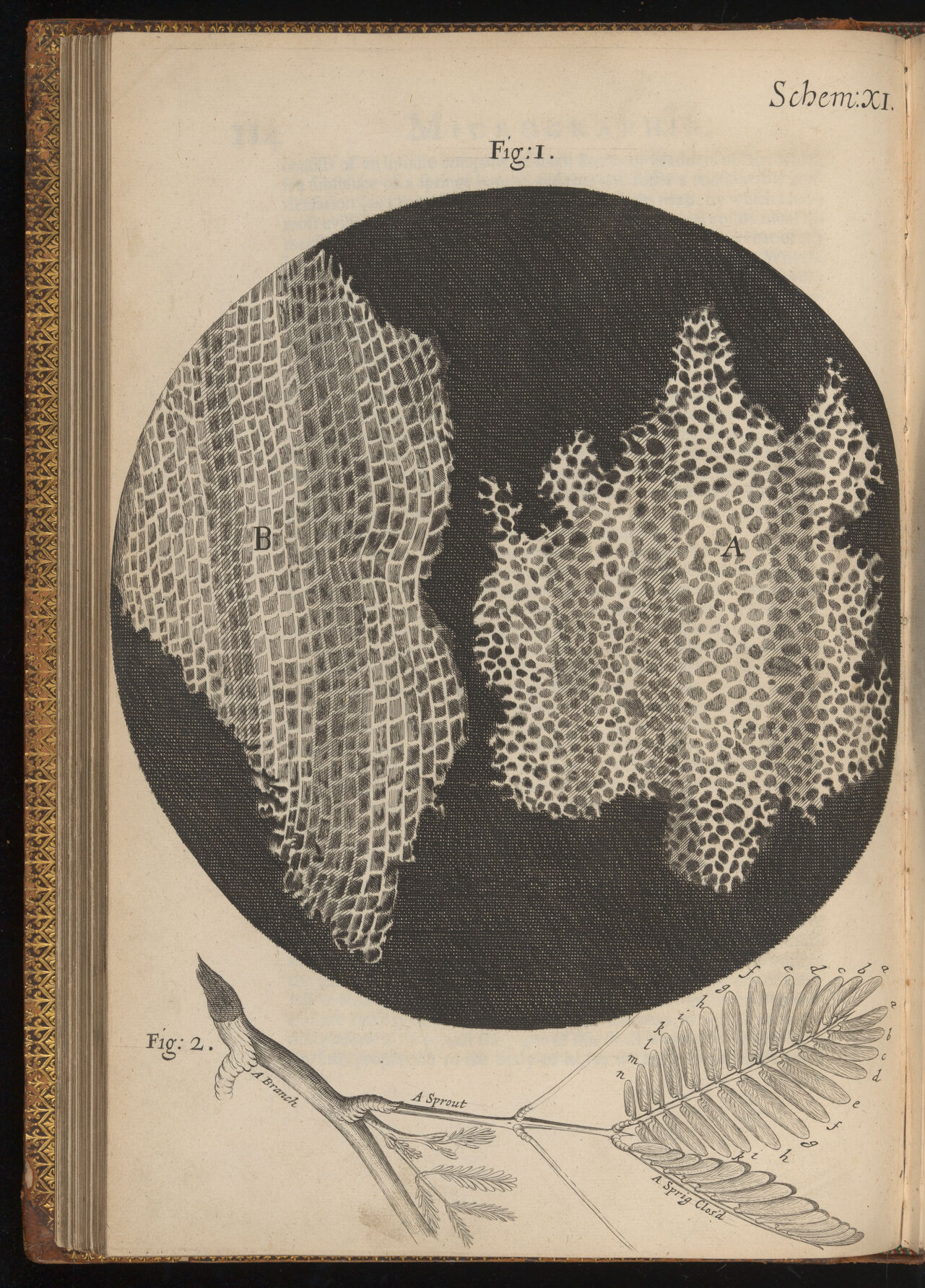
In 1665, the English scientist Robert Hooke published Micrographia, a collection of observations made with a microscope. Examining a thin slice of cork, he saw a honeycomb-like structure made up of small irregular cavities bounded by walls.6
He named them “cells” — a word that then referred to the small rooms of monasteries, but also the compartments of a honeycomb. And it was indeed to a honeycomb that he compared what he saw.7
He grasped the significance of his observation, and wrote it down: these were, he said, the first microscopic pores he had ever seen, and perhaps the first ever seen — he had found no author before him who mentioned them.8
The initial error: cork is dead plant tissue. What Hooke was observing was not the living contents, but the empty wall left behind by the cells that had disappeared. He named holes.
What must nevertheless be acknowledged
It is often repeated that he never saw a living cell. That is not accurate, and he said so himself in the same observation.
Examining plants while still green, he stated that with the microscope he had very clearly made out these same cells or pores, this time filled with juices.9
So he did perceive the difference between a full cell and an empty cell. What he lacked was not the observation, but the idea that this small room was the unit of which all living things are made. Seeing is not understanding — that is precisely the subject of the rest of this page.
The trilogy of knowledge
| Step | Who | What was done |
|---|---|---|
| 1. Naming | Robert Hooke (1665) | Describes a honeycomb-like structure in dead cork and gives it its name. He also observes, in green plants, these same cells filled with juices. |
| 2. Observing | Antoni van Leeuwenhoek | Is the first to see living micro-organisms, with a single lens magnifying more than 250 times. |
| 3. Understanding | Schleiden and Schwann (1839) | State that the cell is the fundamental unit of life. |
Antoni van Leeuwenhoek: seeing without naming
A few years later, in the Netherlands, Antoni van Leeuwenhoek designed microscopes with a single, highly convex lens, reducing optical aberrations. With an unprecedented magnification of more than 250 times, he observed microscopic life for the first time:10
- 1674: Discovery of protozoa and single-celled organisms.
- 1676: First observation of bacteria.
- 1677: Observation of spermatozoa.11
Lacking the modern theoretical vocabulary, he simply called them, in Dutch, “diertgens” — little beasts.12
One misconception deserves to be pointed out. It is repeated everywhere that he named them “animalcules”. This word is not his: it is not even Dutch. It was his translator in London who introduced it, by Latinising his vocabulary.13
Leeuwenhoek described what he saw in everyone’s words; he has been credited with those of a scholar.
When a sentence crosses into another language, it does not only lose words: it sometimes changes tone.
Discovering, naming, understanding
The history of the cell illustrates a general principle: discovering, naming and understanding are three distinct acts, often carried out by different people at different times.
- Hooke named a structure, first seen empty in dead material.
- Leeuwenhoek observed living things without being able to categorise them.
- It was not until 1839 (with Matthias Schleiden and Theodor Schwann) that cell theory established that every living being is made up of cells.14
Words keep the memory of the concepts of their time: the term “cell” continues to designate the unit of life, even though it was chosen with the image of empty cavities in mind.
What a cell is
All living organisms are made up of cells, whether they are unicellular (bacteria, yeasts) or multicellular (plants, animals, fungi). This is what is called the unity of life.
Contemporary molecular and cellular analyses have made it possible to redefine phylogeny: the comparison of protein sequences shows, for example, that fungi are closer to animals than to plants.15
Biological relationships are not understood by observing the outward appearance of living beings, but by analysing their internal structure.
Note 1
Doctors extracted cells from her tumor sample without her knowledge or consent for further research. […] “We were often in the dark regarding the use of her cells, we usually found out after the fact, through the media,” said David Lacks.
Haughey, Marie, “NIH–Lacks Family Partnership Gives Henrietta Lacks’ Descendants a Seat at the Table”, The Poster, NCI at Frederick (National Cancer Institute), 28 September 2017
Note 2
At the time, there were no federal regulations or restrictions on the use of patients' cells in research.
National Institutes of Health, communiqué du 7 August 2013 sur l’accord conclu avec la famille Lacks concernant l’accès aux données génomiques
On August 19, 1947, the judges of the tribunal delivered their verdict. […] The trial's verdict of August 19 reiterated almost all of these points in a section entitled "Permissible Medical Experiments." It also revised the original six points into ten, and these ten points became known as the "Nuremberg Code."
Tribunal militaire américain de Nuremberg (procès des médecins), Code de Nuremberg, August 1947
Adopted by the 18th WMA General Assembly, Helsinki, Finland, June 1964
Association médicale mondiale, Déclaration d’Helsinki, adoptée en 1964 et révisée depuis
Physicians or other qualified individuals must obtain free and informed consent from research participants for the collection, processing, storage, and foreseeable secondary use of biological material […] Where consent is impossible or impracticable to obtain, secondary research on stored data or biological material may be done only after consideration and approval of a research ethics committee.
Association médicale mondiale, Déclaration d’Helsinki, adoptée en 1964 et révisée depuis
Note 3
was being treated for cervical cancer at Baltimore's Johns Hopkins Hospital in 1951
National Institutes of Health, communiqué du 7 August 2013 sur l’accord conclu avec la famille Lacks concernant l’accès aux données génomiques
Note 4
two representatives of the Lacks family will serve on NIH's newly formed, six-member working group that will review proposals for access to the HeLa full genome sequence data
National Institutes of Health, communiqué du 7 August 2013 sur l’accord conclu avec la famille Lacks concernant l’accès aux données génomiques
To understand the family's perspectives, we met with them face to face three times over four months, and listened carefully to their concerns.
National Institutes of Health, communiqué du 7 August 2013 sur l’accord conclu avec la famille Lacks concernant l’accès aux données génomiques
Note 5
fully aware […] pieced together […] any lab with the right equipment could derive the whole sequence at any point without NIH funds
Proffitt, Allison, “The Henrietta Compromise: NIH Announces HeLa Data Use Agreement”, Bio-IT World, 7 August 2013
Note 6
I could exceeding plainly perceive it to be all perforated and porous, much like a Honey-comb, but that the pores of it were not regular
Hooke, Robert, Micrographia: or Some Physiological Descriptions of Minute Bodies Made by Magnifying Glasses, Royal Society, Londres, 1665, observation XVIII
MICROGRAPHIA: OR SOME Physiological Descriptions OF MINUTE BODIES MADE BY MAGNIFYING GLASSES WITH OBSERVATIONS and INQUIRIES thereupon. By R. HOOKE, Fellow of the ROYAL SOCIETY. […] LONDON, Printed by Jo. Martyn, and Ja. Allestry, Printers to the ROYAL SOCIETY, and are to be sold at their Shop at the Bell in S. Paul's Church-yard. M DC LX V.
Hooke, Robert, Micrographia: or Some Physiological Descriptions of Minute Bodies Made by Magnifying Glasses, Royal Society, Londres, 1665, observation XVIII, public domain
Note 7
[…] I could exceeding plainly perceive it to be all perforated and porous, much like a Honey-comb, but that the pores of it were not regular; yet it was not unlike a Honey-comb in these particulars. First, in that it had a […] Next, in that these pores, or cells, were not very deep, but consisted of a great many little Boxes, […]
Hooke, Robert, Micrographia: or Some Physiological Descriptions of Minute Bodies Made by Magnifying Glasses, Royal Society, Londres, 1665, observation XVIII
a single room (as in a convent or prison) usually for one person […] one of the compartments of a honeycomb […] a small religious house dependent on a monastery or convent
Merriam-Webster, “cell”, Merriam-Webster.com Dictionary
Note 8
I no sooner discern'd these (which were indeed the first microscopical pores I ever saw, and perhaps, that were ever seen, for I had not met with any Writer or Person, that had made any mention of them before this)
Hooke, Robert, Micrographia: or Some Physiological Descriptions of Minute Bodies Made by Magnifying Glasses, Royal Society, Londres, 1665, observation XVIII
Note 9
for, in several of those Vegetables, whil'st green, I have with my Microscope, plainly enough discover'd these Cells or Pores fill'd with juices
Hooke, Robert, Micrographia: or Some Physiological Descriptions of Minute Bodies Made by Magnifying Glasses, Royal Society, Londres, 1665, observation XVIII
Note 10
Leeuwenhoek first courted controversy in a letter of September 1674. Describing a nearby lake, Berkelse Mere, he noted that its water was very clear in winter […] Then came Leeuwenhoek's first mention of little animals: 'among these streaks there were besides very many little animalcules
Lane, Nick, “The Unseen World: Reflections on Leeuwenhoek (1677) “Concerning Little Animals””, Philosophical Transactions of the Royal Society B, vol. 370, no. 1666, 20140344, 2015, open access
The magnification of the lens in this microscope makes it the strongest of the suviving eleven, though the eleventh, measured at 248x is very close behind.
Anderson, Douglas, Lens on Leeuwenhoek, ressource documentaire en ligne, open access
Sandwiched between the plates was a small bi-convex lens capable of magnifications ranging from 70x to over 250x, depending upon the lens quality. […] These incredible lenses had a thickness of about one millimeter and a radius of curvature of 0.75 millimeter. They had superior magnification and resolution when compared to the other microscopes of the time. […] The Utrecht museum has one of Leeuwenhoek's microscopes in its collection. This incredible instrument has a magnification factor of about 275x (even considering a scratch on the lens)
Davidson, Michael W., “Museum of Microscopy: The Leeuwenhoek Microscope”, Molecular Expressions Microscopy Primer, Florida State University, open access
Note 11
Leeuwenhoek is universally acknowledged as the father of microbiology. He discovered both protists and bacteria [1]. […] Leeuwenhoek first courted controversy in a letter of September 1674. […] Then came Leeuwenhoek's first mention of little animals: […] Leeuwenhoek wrote his eighteenth letter to the Royal Society, dated October 1676, […] his calculation puts the length of his ‘very wee animals' at less than 3 µm. Bacteria.
Lane, Nick, “The Unseen World: Reflections on Leeuwenhoek (1677) “Concerning Little Animals””, Philosophical Transactions of the Royal Society B, vol. 370, no. 1666, 20140344, 2015, open access
Wrote Letter L-060 of 1677-11-09 to William Brouncker about sperm and their movements in fresh human semen […] It is the first detailed description, but it indicates no understanding of its function.
Anderson, Douglas, Lens on Leeuwenhoek, ressource documentaire en ligne, open access
Note 12
Most often, Leeuwenhoek used dierken; frequently, he used diertgens or diertjes. Dier is animal and the -ken, -gen, or -je endings are the most common form of diminutive in Dutch, then and now.
Anderson, Douglas, Lens on Leeuwenhoek, ressource documentaire en ligne
Note 13
It is not a Dutch word […] Oldenburg translated the early letters, and he was the one who first translated dierkens as "animalcules".
Anderson, Douglas, Lens on Leeuwenhoek, ressource documentaire en ligne
Note 14
Das Hauptresultat der Untersuchung ist, […] ein gemeinsames Entwicklungsprinzip allen einzelnen Elementartheilen aller Organismen zum Grunde liegt, ungefähr so wie alle Krystalle trotz der Verschiedenheit ihrer Form sich doch nach denselben Gesetzen bilden. […] so zeigt sich, daſs alle diese manchfaltigen Formen ebenfalls nur aus Zellen entstehn und zwar aus Zellen, die durchaus den Pflanzenzellen analog […]
The main result of the investigation is […] that a common principle of development underlies all the individual elementary parts of all organisms, much as all crystals, despite the diversity of their form, are nevertheless formed according to the same laws. […] it becomes apparent that all these manifold forms likewise arise solely from cells, and indeed from cells entirely analogous to plant cells […]
Schleiden, Matthias Jakob, “Beiträge zur Phytogenesis”, Archiv für Anatomie, Physiologie und wissenschaftliche Medicin, 1838, p. 137-176 ; et Schwann, Theodor, Mikroskopische Untersuchungen über die Uebereinstimmung in der Struktur und dem Wachsthum der Thiere und Pflanzen, Sander, Berlin, 1839
Note 15
This congruence among multiple lines of evidence strongly suggests, in contrast to traditional and current classification, that animals and fungi are sister groups while plants constitute an independent evolutionary lineage.
Baldauf, Sandra L. and Palmer, Jeffrey D., “Animals and Fungi Are Each Other’s Closest Relatives: Congruent Evidence from Multiple Proteins”, Proceedings of the National Academy of Sciences, vol. 90, no. 24, 1993, p. 11558-11562
Notes and sources
- ↑
Passage In several emblematic cases — such as that of the cells of Henrietta Lacks (HeLa cells) — neither the person nor her family had been consulted.
Doctors extracted cells from her tumor sample without her knowledge or consent for further research. […] “We were often in the dark regarding the use of her cells, we usually found out after the fact, through the media,” said David Lacks.
Source Haughey, Marie, “NIH–Lacks Family Partnership Gives Henrietta Lacks’ Descendants a Seat at the Table”, The Poster, NCI at Frederick (National Cancer Institute), 28 September 2017, 7th paragraph, then 5th paragraph (words of David Lacks).
Open access open the source · checked on 27 October 2026
- ↑
Passage in 1951, no American federal rule governed the use of patients’ cells in research
At the time, there were no federal regulations or restrictions on the use of patients' cells in research.
Source National Institutes of Health, communiqué du 7 August 2013 sur l’accord conclu avec la famille Lacks concernant l’accès aux données génomiques, press release of 7 August 2013.
Open access open the source · checked on 24 October 2026
Passage the Nuremberg Code dates from 1947
On August 19, 1947, the judges of the tribunal delivered their verdict. […] The trial's verdict of August 19 reiterated almost all of these points in a section entitled "Permissible Medical Experiments." It also revised the original six points into ten, and these ten points became known as the "Nuremberg Code."
Source Tribunal militaire américain de Nuremberg (procès des médecins), Code de Nuremberg, August 1947, article “The Nuremberg Code” in the Holocaust Encyclopedia (USHMM), section “Medical Ethics” (paragraphs “On December 9, 1946…” then “As a result, on April 17, 1947…”).
Public domain open the source · checked on 24 October 2026
Passage the Declaration of Helsinki from 1964
Adopted by the 18th WMA General Assembly, Helsinki, Finland, June 1964
Source Association médicale mondiale, Déclaration d’Helsinki, adoptée en 1964 et révisée depuis, Heading of the Declaration (adoption line, before the preamble).
Open access open the source · checked on 24 October 2026
Passage the Declaration of Helsinki, revised in 2024, requires free and informed consent to collect and store biological material for research; otherwise, an ethics committee must authorise it
Physicians or other qualified individuals must obtain free and informed consent from research participants for the collection, processing, storage, and foreseeable secondary use of biological material […] Where consent is impossible or impracticable to obtain, secondary research on stored data or biological material may be done only after consideration and approval of a research ethics committee.
Source Association médicale mondiale, Déclaration d’Helsinki, adoptée en 1964 et révisée depuis, paragraph 32 (October 2024 revision).
Open access open the source · checked on 24 October 2026
- ↑
Passage In 2013, sixty-two years after the sample was taken in 1951
was being treated for cervical cancer at Baltimore's Johns Hopkins Hospital in 1951
Source National Institutes of Health, communiqué du 7 August 2013 sur l’accord conclu avec la famille Lacks concernant l’accès aux données génomiques, press release of 7 August 2013.
Open access open the source · checked on 24 October 2026
- ↑
Passage It created a committee of six people, including two family members, tasked with reviewing requests for access to the genetic data
two representatives of the Lacks family will serve on NIH's newly formed, six-member working group that will review proposals for access to the HeLa full genome sequence data
Source National Institutes of Health, communiqué du 7 August 2013 sur l’accord conclu avec la famille Lacks concernant l’accès aux données génomiques, announcement of 7 August 2013.
Open access open the source · checked on 9 September 2026
Passage The body’s director states that he met the family three times in four months
To understand the family's perspectives, we met with them face to face three times over four months, and listened carefully to their concerns.
Source National Institutes of Health, communiqué du 7 August 2013 sur l’accord conclu avec la famille Lacks concernant l’accès aux données génomiques, announcement of 7 August 2013.
Open access open the source · checked on 9 September 2026
- ↑
Passage Through its deputy director, it declares itself fully aware that the data already published could be pieced together, and that any sufficiently equipped laboratory could obtain the entire sequence without any funding from it.
fully aware […] pieced together […] any lab with the right equipment could derive the whole sequence at any point without NIH funds
Source Proffitt, Allison, “The Henrietta Compromise: NIH Announces HeLa Data Use Agreement”, Bio-IT World, 7 August 2013, remarks of Kathy Hudson, deputy director of the NIH, press conference of 7 August 2013.
Open access open the source · checked on 24 October 2026
- ↑
Passage Examining a thin slice of cork, he saw a honeycomb-like structure made up of small irregular cavities
I could exceeding plainly perceive it to be all perforated and porous, much like a Honey-comb, but that the pores of it were not regular
Source Hooke, Robert, Micrographia: or Some Physiological Descriptions of Minute Bodies Made by Magnifying Glasses, Royal Society, Londres, 1665, observation XVIII.
Public domain open the source · checked on 9 September 2026
Passage In 1665, the English scientist Robert Hooke published Micrographia
MICROGRAPHIA: OR SOME Physiological Descriptions OF MINUTE BODIES MADE BY MAGNIFYING GLASSES WITH OBSERVATIONS and INQUIRIES thereupon. By R. HOOKE, Fellow of the ROYAL SOCIETY. […] LONDON, Printed by Jo. Martyn, and Ja. Allestry, Printers to the ROYAL SOCIETY, and are to be sold at their Shop at the Bell in S. Paul's Church-yard. M DC LX V.
Source Hooke, Robert, Micrographia: or Some Physiological Descriptions of Minute Bodies Made by Magnifying Glasses, Royal Society, Londres, 1665, observation XVIII, public domain, title page.
Open access open the source · checked on 24 October 2026
- ↑
Passage And it was indeed to a honeycomb that he compared what he saw.
[…] I could exceeding plainly perceive it to be all perforated and porous, much like a Honey-comb, but that the pores of it were not regular; yet it was not unlike a Honey-comb in these particulars. First, in that it had a […] Next, in that these pores, or cells, were not very deep, but consisted of a great many little Boxes, […]
Source Hooke, Robert, Micrographia: or Some Physiological Descriptions of Minute Bodies Made by Magnifying Glasses, Royal Society, Londres, 1665, observation XVIII, observation XVIII (“Of the Schematisme or Texture of Cork”), first paragraph.
Public domain open the source · checked on 27 October 2026
Passage a word that then referred to the small rooms of monasteries, but also the compartments of a honeycomb
a single room (as in a convent or prison) usually for one person […] one of the compartments of a honeycomb […] a small religious house dependent on a monastery or convent
Source Merriam-Webster, “cell”, Merriam-Webster.com Dictionary, entry “cell”, senses 1a, 4a and 9.
Open access open the source · checked on 27 October 2026
- ↑
Passage these were, he said, the first microscopic pores he had ever seen, and perhaps the first ever seen — he had found no author before him who mentioned them
I no sooner discern'd these (which were indeed the first microscopical pores I ever saw, and perhaps, that were ever seen, for I had not met with any Writer or Person, that had made any mention of them before this)
Source Hooke, Robert, Micrographia: or Some Physiological Descriptions of Minute Bodies Made by Magnifying Glasses, Royal Society, Londres, 1665, observation XVIII.
Public domain open the source · checked on 9 September 2026
- ↑
Passage Examining plants while still green, he stated that with the microscope he had very clearly made out these same cells or pores, this time filled with juices.
for, in several of those Vegetables, whil'st green, I have with my Microscope, plainly enough discover'd these Cells or Pores fill'd with juices
Source Hooke, Robert, Micrographia: or Some Physiological Descriptions of Minute Bodies Made by Magnifying Glasses, Royal Society, Londres, 1665, observation XVIII.
Public domain open the source · checked on 9 September 2026
- ↑
Passage he observed microscopic life for the first time
Leeuwenhoek first courted controversy in a letter of September 1674. Describing a nearby lake, Berkelse Mere, he noted that its water was very clear in winter […] Then came Leeuwenhoek's first mention of little animals: 'among these streaks there were besides very many little animalcules
Source Lane, Nick, “The Unseen World: Reflections on Leeuwenhoek (1677) “Concerning Little Animals””, Philosophical Transactions of the Royal Society B, vol. 370, no. 1666, 20140344, 2015, open access, text of the article, between figures 1 and 2.
Open access open the source · checked on 25 October 2026
Passage Antoni van Leeuwenhoek designed microscopes with a single, highly convex lens […] an unprecedented magnification of more than 250 times
The magnification of the lens in this microscope makes it the strongest of the suviving eleven, though the eleventh, measured at 248x is very close behind.
Source Anderson, Douglas, Lens on Leeuwenhoek, ressource documentaire en ligne, open access, entry “266x brass” (single-lens brass microscope, 266x magnification given in the title and the table, Utrecht University Museum).
Open access open the source · checked on 25 October 2026
Passage Antoni van Leeuwenhoek designed microscopes with a single, highly convex lens […] an unprecedented magnification of more than 250 times
Sandwiched between the plates was a small bi-convex lens capable of magnifications ranging from 70x to over 250x, depending upon the lens quality. […] These incredible lenses had a thickness of about one millimeter and a radius of curvature of 0.75 millimeter. They had superior magnification and resolution when compared to the other microscopes of the time. […] The Utrecht museum has one of Leeuwenhoek's microscopes in its collection. This incredible instrument has a magnification factor of about 275x (even considering a scratch on the lens)
Source Davidson, Michael W., “Museum of Microscopy: The Leeuwenhoek Microscope”, Molecular Expressions Microscopy Primer, Florida State University, open access, page “The Leeuwenhoek Microscope”: description of the instrument, manufacture of the lenses, then paragraph on the example in the Utrecht museum.
Open access open the source · checked on 25 October 2026
- ↑
Passage 1674: Discovery of protozoa […] 1676: First observation of bacteria
Leeuwenhoek is universally acknowledged as the father of microbiology. He discovered both protists and bacteria [1]. […] Leeuwenhoek first courted controversy in a letter of September 1674. […] Then came Leeuwenhoek's first mention of little animals: […] Leeuwenhoek wrote his eighteenth letter to the Royal Society, dated October 1676, […] his calculation puts the length of his ‘very wee animals' at less than 3 µm. Bacteria.
Source Lane, Nick, “The Unseen World: Reflections on Leeuwenhoek (1677) “Concerning Little Animals””, Philosophical Transactions of the Royal Society B, vol. 370, no. 1666, 20140344, 2015, open access, introduction (first paragraph), then text of the article between figures 1 and 3.
Open access open the source · checked on 25 October 2026
Passage 1677: Observation of spermatozoa
Wrote Letter L-060 of 1677-11-09 to William Brouncker about sperm and their movements in fresh human semen […] It is the first detailed description, but it indicates no understanding of its function.
Source Anderson, Douglas, Lens on Leeuwenhoek, ressource documentaire en ligne, open access, entry for letter L-060 of 9 November 1677 (title and summary).
Open access open the source · checked on 25 October 2026
- ↑
Passage he simply called them, in Dutch, “diertgens” — little beasts
Most often, Leeuwenhoek used dierken; frequently, he used diertgens or diertjes. Dier is animal and the -ken, -gen, or -je endings are the most common form of diminutive in Dutch, then and now.
Source Anderson, Douglas, Lens on Leeuwenhoek, ressource documentaire en ligne, entry “Animalcules”.
Open access open the source · checked on 9 September 2026
- ↑
Passage This word is not his: it is not even Dutch. It was his translator in London who introduced it, by Latinising his vocabulary.
It is not a Dutch word […] Oldenburg translated the early letters, and he was the one who first translated dierkens as "animalcules".
Source Anderson, Douglas, Lens on Leeuwenhoek, ressource documentaire en ligne, entry “Animalcules”.
Open access open the source · checked on 9 September 2026
- ↑
Passage It was not until 1839 […] that cell theory established that every living being is made up of cells.
Das Hauptresultat der Untersuchung ist, […] ein gemeinsames Entwicklungsprinzip allen einzelnen Elementartheilen aller Organismen zum Grunde liegt, ungefähr so wie alle Krystalle trotz der Verschiedenheit ihrer Form sich doch nach denselben Gesetzen bilden. […] so zeigt sich, daſs alle diese manchfaltigen Formen ebenfalls nur aus Zellen entstehn und zwar aus Zellen, die durchaus den Pflanzenzellen analog […]
Editors’ translation The main result of the investigation is […] that a common principle of development underlies all the individual elementary parts of all organisms, much as all crystals, despite the diversity of their form, are nevertheless formed according to the same laws. […] it becomes apparent that all these manifold forms likewise arise solely from cells, and indeed from cells entirely analogous to plant cells […]
Source Schleiden, Matthias Jakob, “Beiträge zur Phytogenesis”, Archiv für Anatomie, Physiologie und wissenschaftliche Medicin, 1838, p. 137-176 ; et Schwann, Theodor, Mikroskopische Untersuchungen über die Uebereinstimmung in der Struktur und dem Wachsthum der Thiere und Pflanzen, Sander, Berlin, 1839, Schwann 1839, preface (“Vorrede”), p. V, 2nd paragraph; then introduction (“Einleitung”), about p. 2.
Public domain open the source · checked on 27 October 2026
- ↑
Passage the comparison of protein sequences shows, for example, that fungi are closer to animals than to plants
This congruence among multiple lines of evidence strongly suggests, in contrast to traditional and current classification, that animals and fungi are sister groups while plants constitute an independent evolutionary lineage.
Source Baldauf, Sandra L. and Palmer, Jeffrey D., “Animals and Fungi Are Each Other’s Closest Relatives: Congruent Evidence from Multiple Proteins”, Proceedings of the National Academy of Sciences, vol. 90, no. 24, 1993, p. 11558-11562, summary (abstract), last sentence, p. 11558.
Open access open the source · checked on 24 October 2026
Bibliography
13
- Anderson, Douglas, Lens on Leeuwenhoek, ressource documentaire en ligne, open access (the original Dutch vocabulary — dierken, diertgens, diertjes — and its translation by Henry Oldenburg as “animalcula” then “animalcules”, a Latin word absent from Leeuwenhoek’s letters; the single-lens microscope kept in Utrecht, which magnifies 266 times; the letter of 9 November 1677 on spermatozoa). https://lensonleeuwenhoek.net/content/animalcules
- Association médicale mondiale, Déclaration d’Helsinki, adoptée en 1964 et révisée depuis, dernière révision en October 2024, open access (the ethical principles of research involving human beings; consent for biological material, § 32). https://www.wma.net/policies-post/wma-declaration-of-helsinki/
- Baldauf, Sandra L. and Palmer, Jeffrey D., “Animals and Fungi Are Each Other’s Closest Relatives: Congruent Evidence from Multiple Proteins”, Proceedings of the National Academy of Sciences, vol. 90, no. 24, 1993, p. 11558-11562, open access (see entry 6.3). https://doi.org/10.1073/pnas.90.24.11558
- Davidson, Michael W., “Museum of Microscopy: The Leeuwenhoek Microscope”, Molecular Expressions Microscopy Primer, Florida State University, open access (the small biconvex lens clamped between two plates; the microscope in the Utrecht museum, which magnifies about 275 times). https://micro.magnet.fsu.edu/primer/museum/leeuwenhoek.html
- Haughey, Marie, “NIH–Lacks Family Partnership Gives Henrietta Lacks’ Descendants a Seat at the Table”, The Poster, NCI at Frederick (National Cancer Institute), 28 September 2017, open access (Henrietta Lacks’s cells taken without her knowledge or consent; the family kept in the dark about their use). https://ncifrederick.cancer.gov/about/theposter/content/nih-lacks-family-partnership-gives-henrietta-lacks-descendants-seat-table
- Hooke, Robert, Micrographia: or Some Physiological Descriptions of Minute Bodies Made by Magnifying Glasses, Royal Society, Londres, 1665, observation XVIII, public domain (cork compared to a honeycomb; the word “cell”; the first microscopic pores he had ever seen, and perhaps ever seen; the cells filled with juices observed in green plants). https://www.gutenberg.org/ebooks/15491
- Lane, Nick, “The Unseen World: Reflections on Leeuwenhoek (1677) “Concerning Little Animals””, Philosophical Transactions of the Royal Society B, vol. 370, no. 1666, 20140344, 2015, open access (the letter of September 1674: the “little animals” in the water of the lake Berkelse Mere, the first mention of microscopic life; the letter of October 1676 and its “very wee animals”, bacteria). https://doi.org/10.1098/rstb.2014.0344
- Merriam-Webster, “cell”, Merriam-Webster.com Dictionary, open access (the older senses of the word: a room in a convent, a religious house dependent on a monastery, a compartment of a honeycomb). https://www.merriam-webster.com/dictionary/cell
- National Institutes of Health, communiqué du 7 August 2013 sur l’accord conclu avec la famille Lacks concernant l’accès aux données génomiques, open access (the 1951 sampling; the absence of any federal rule at the time; the six-person committee; the three meetings with the family). https://www.sciencedaily.com/releases/2013/08/130807134010.htm
- Proffitt, Allison, “The Henrietta Compromise: NIH Announces HeLa Data Use Agreement”, Bio-IT World, 7 August 2013, open access (the remarks of Kathy Hudson, deputy director of the NIH, at the press conference of 7 August 2013: the published data could already be pieced together). https://www.bio-itworld.com/news/2013/08/07/the-henrietta-compromise-nih-announces-hela-data-use-agreement
- Schleiden, Matthias Jakob, “Beiträge zur Phytogenesis”, Archiv für Anatomie, Physiologie und wissenschaftliche Medicin, 1838, p. 137-176 ; et Schwann, Theodor, Mikroskopische Untersuchungen über die Uebereinstimmung in der Struktur und dem Wachsthum der Thiere und Pflanzen, Sander, Berlin, 1839, public domain (cell theory).
- Skloot, Rebecca, The Immortal Life of Henrietta Lacks, Crown Publishers, 2010, in libraries (the story of the HeLa cells and the absence of consent). French translation: La Vie immortelle d’Henrietta Lacks, Calmann-Lévy, 2011.
- Tribunal militaire américain de Nuremberg (procès des médecins), Code de Nuremberg, August 1947, public domain (the ten principles of consent in medical research, arising from the verdict of 19 August 1947). https://encyclopedia.ushmm.org/content/en/article/the-nuremberg-code
Spotted an error or have a doubt? Write to us.