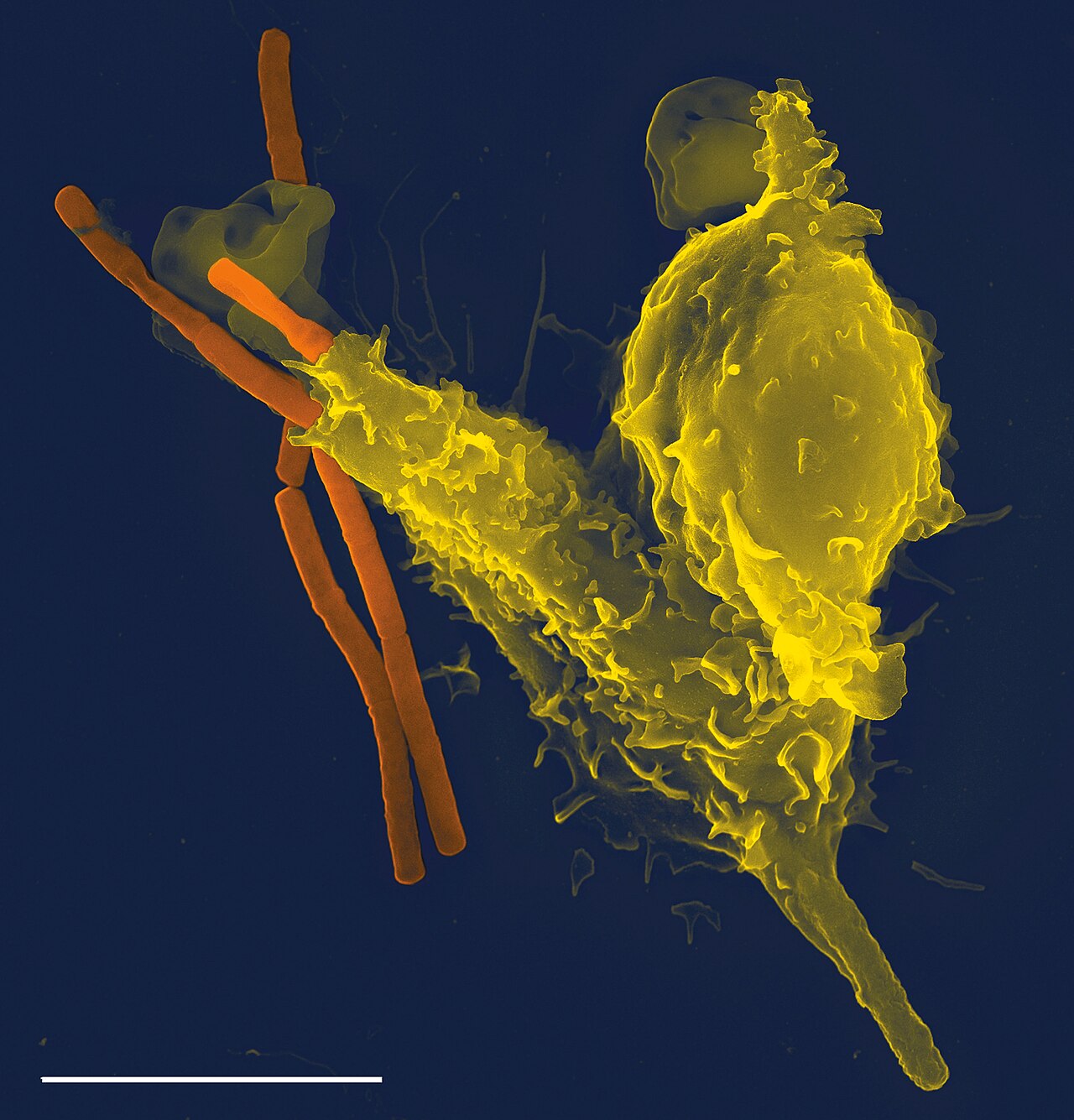

“Boost your natural defences” is an advertising slogan, not a medical term.
Everyone has read this phrase hundreds of times, on boxes, in advertisements, on labels.
What defends the body, and how
The immune system is not an organ. It is a set of cells, molecules and tissues spread throughout the body, whose job is to distinguish what belongs to it from what does not, and then to eliminate the latter.
It works along three lines, which do not come into play at the same moment.
The first line prevents entry. The skin forms a barrier that very few microbes cross as long as it is intact. Tears, saliva and the acidity of the stomach destroy part of what gets through. The airways are lined with mucus and cilia that carry intruders back up towards the throat. These barriers are part of innate immunity, and they act all the time — silently, without our ever knowing anything about it.1
The second line reacts quickly, without targeting a specific intruder. This is the other side of innate immunity: present from birth, it recognises signals shared by many microbes and sets itself up within a few minutes to a few hours. Its workers are white blood cells capable of swallowing and digesting a bacterium. It is what causes inflammation — redness, heat, swelling, pain. These four signs do not come from the microbe itself: they are the traces of the work under way, the influx of blood and cells towards the place under attack — even though excessive or prolonged inflammation can also do harm.2
The third line is slow, precise, and it learns. This is adaptive immunity. It relies on lymphocytes, specialised white blood cells, which recognise one specific molecule on the surface of the intruder — its antigen. Some make antibodies, proteins that bind to this antigen and neutralise it or flag it to other cells. It may take a few days to get going the first time. Afterwards, it keeps a trace of the encounter, and the next response is much faster.3
It is this trace that makes vaccination possible: the body is presented with a harmless version of the intruder, or of one of its parts, so that it builds its response before it needs it. It is this trace that the rest of this page is about — because the word used to name it, “memory”, is misleading.
A system is not a muscle
The image this phrase conjures up is that of a muscle: the more you train it, the stronger it gets, and the better protected you are. An immune system does not work like that.
It is not brute strength to be increased, but a set of complex mechanisms that recognise — or fail to recognise — what enters the body, and that learn from what they have already encountered.
In Europe, moreover, health claims made on foods are strictly regulated: only those that appear on an official list are, in principle, permitted. For immunity, they are limited to saying that certain nutrients contribute to the “normal function” of the immune system.4
A vaccine does not add strength. It teaches a shape.
Why this page names no brands
In other pages, this site has examined a practice that one needs to be able to recognise: an interested party itself producing the information about what it sells. Our page on chemical reactions tells how this played out for lead in petrol, and our page on climate shows it measured, with figures to back it up.
The field of health lends itself to this particularly well, because the promise there touches on the intimate and verification is difficult for an individual.
So we describe the mechanism, and never the brands. Naming products would amount to advertising them, even when criticising them — and it would date the page within a few months.
What does not go out of date is the question to ask: who produced the information, and has it been compared with a control group?
Immune memory is not a recollection
When the body has encountered a pathogen, it reacts faster and more effectively the next time. People commonly say that it “remembers” it.
That is not at all what happens, and the real mechanism is far more fascinating than the metaphor.
How the body finds the right key
The immune system makes receptors at random. An immense variety of different shapes, without knowing in advance what it will need to neutralise.5
When an intruder turns up, most of these receptors prove ineffective. A few, by chance, manage to cling to it weakly.
The B lymphocytes that carry them multiply. Meanwhile, their antibody genes mutate — in structures dedicated to this, the germinal centres.6
One figure gives the measure of it: in those genes, the mutation rate is about a million times higher than in the rest of their genome.7
The body does not suffer these errors: it makes them on purpose, in one precise place, and almost only there.
The new versions are then selected on their performance: those that bind best survive and reproduce, the others are eliminated.
Then the cycle starts again.
A recently discovered refinement
Work published in 2025, carried out in mice, shows that this mutation rate is not the same for all cells.8
The problem is this: mutating at random produces damage more often than improvements. The better the antibody a cell already makes, the more it has to lose by continuing to mutate.9
What is observed: the cells that produce the best-performing antibodies divide more, but mutate less with each division.10
The system protects what already works. It does not merely sort after the fact: it adjusts the amount of chance it allows itself, according to what it has already found.11
The mechanism of evolution at the cellular scale
This is exactly the principle of natural selection: random variation, selection on performance, reproduction of the winners.
With one difference, and it is a dizzying one: this takes place in a few days to a few weeks, inside a single organism.
It is like finding the heat source in a dark room, with a single thermometer that has no memory: you cannot see the room, so you have to grope your way, keep to the direction that gets a little warmer, and repeat the operation.
What “memory” hides
What the body keeps after an infection is not a piece of computer data or a written note.
It is a population of surviving cells — the descendants of those that were retained by selection.
Nothing has been recorded. Something has been selected.
That is why the metaphor of recollection is misleading. A recollection can be filed away and read again. In the body, there is no file: there are surviving cell lineages.
Trained immunity
The scientific picture continues to evolve. Some cells of so-called innate immunity (such as macrophages or NK cells) — which were thought to be entirely without memory — develop epigenetic modifications after a first contact. This is what is called trained immunity.12
The boundary between innate and adaptive immunity is now becoming more fluid, confirming that research remains dynamic.
Military vocabulary
People commonly speak of an army of cells, of a war against microbes, of invaders, of barriers or of defence.
These metaphors make popularisation easier, but they mask an essential reality.
They suggest that every micro-organism that gets in is an enemy. Yet the majority of micro-organisms are not pathogenic: only a small share of species can make humans ill.13
They suggest a logic of systematic confrontation, whereas the main task of the immune system is above all the recognition of self and non-self, as well as the tolerance of what is harmless.
Note 1
Innate immunity can be viewed as comprising four types of defensive barriers: anatomic (skin and mucous membrane), physiologic (temperature, low pH and chemical mediators), endocytic and phagocytic, and inflammatory. […] Mechanical barrier retards entry of microbes […] Cilia propel microbes out of body […] Acidic pH of stomach kills most undigested microbes
Marshall, Jean S., Warrington, Richard, Watson, Wade and Kim, Harold L., “An Introduction to Immunology and Immunopathology”, Allergy, Asthma & Clinical Immunology, vol. 14, suppl. 2, article 49, 2018
Note 2
Innate, or nonspecific, immunity is the defense system with which you were born.
“Immune response”, MedlinePlus Medical Encyclopedia, U.S. National Library of Medicine, reviewed 20 January 2026
Innate immunity to pathogens relies on pattern recognition receptors (PRRs) which allow a limited range of immune cells to detect and respond rapidly to a wide range of pathogens that share common structures, known as pathogen associated molecular patterns (PAMPs). […] This immune response is rapid, occurring minutes or hours after aggression and is mediated by numerous cells including phagocytes, mast cells, basophils and eosinophils, as well as the complement system.
Marshall, Jean S., Warrington, Richard, Watson, Wade and Kim, Harold L., “An Introduction to Immunology and Immunopathology”, Allergy, Asthma & Clinical Immunology, vol. 14, suppl. 2, article 49, 2018
Classical features of inflammation are heat, redness, swelling and pain. Inflammation can be part of the normal host response to infection and a required process to rid the body of pathogens, or it may become uncontrolled and lead to chronic inflammatory disease. […] Additional mediators produced by recruited and activated immune cells induce changes in vascular permeability and pain sensitivity.
Marshall, Jean S., Warrington, Richard, Watson, Wade and Kim, Harold L., “An Introduction to Immunology and Immunopathology”, Allergy, Asthma & Clinical Immunology, vol. 14, suppl. 2, article 49, 2018
Note 3
It may take a few days for the adaptive immune system to respond the first time it comes into contact with the germ […]
Institute for Quality and Efficiency in Health Care (IQWiG), “In brief: The innate and adaptive immune systems”, InformedHealth.org, Cologne, updated 14 August 2023
Note 4
En application de l’article 10, paragraphe 1, du règlement (CE) no 1924/2006, les allégations de santé portant sur les denrées alimentaires sont interdites, sauf si elles sont autorisées par la Commission conformément audit règlement et inscrites sur une liste d’allégations autorisées. […] Le cuivre contribue au fonctionnement normal du système immunitaire […] Le fer contribue au fonctionnement normal du système immunitaire
Pursuant to Article 10(1) of Regulation (EC) No 1924/2006, health claims made on foods are prohibited unless they are authorised by the Commission in accordance with that Regulation and included in a list of permitted claims. […] Copper contributes to the normal function of the immune system […] Iron contributes to the normal function of the immune system
Commission européenne, Règlement (UE) no. 432/2012 de la Commission du 16 May 2012 établissant une liste des allégations de santé autorisées portant sur les denrées alimentaires, autres que celles faisant référence à la réduction du risque de maladie ainsi qu’au développement et à la santé infantiles, Journal officiel de l’Union européenne
Les allégations de santé sont interdites sauf si elles sont conformes aux prescriptions générales du chapitre II et aux exigences spécifiques du présent chapitre et si elles sont autorisées conformément au présent règlement et figurent sur les listes d'allégations autorisées visées aux articles 13 et 14.
Health claims shall be prohibited unless they comply with the general requirements in Chapter II and the specific requirements in this Chapter and are authorised in accordance with this Regulation and included in the lists of authorised claims provided for in Articles 13 and 14.
Union européenne, Règlement (CE) no. 1924/2006 concernant les allégations nutritionnelles et de santé portant sur les denrées alimentaires, Journal officiel de l’Union européenne, L 404
Note 5
Burnet hypothesised that the immune system produces millions of immune cells, each capable of recognising only a single type of foreign material, and able to produce one type of antibody to that foreign material. […] The essence of clonal selection theory is that antibody pattern is produced by genetic processes in the cells as they develop during embryonic life. When the foreign antigen enters the body, one can picture millions of antigen molecules in regions where there are millions of these randomly patterned cells.
Walter and Eliza Hall Institute of Medical Research (WEHI), “1957 Burnet’s Theory Revolutionizes Immunology”, institute history page
Note 6
Somatic hypermutation (SHM) of immunoglobulin (Ig) genes plays a key role in antibody mediated immunity. […] Somatic hypermutation (SHM) occurs in antigen-activated germinal center B cells and contributes to antibody affinity maturation (1–8).
Pilzecker, Bas and Jacobs, Heinz, “Mutating for Good: DNA Damage Responses During Somatic Hypermutation”, Frontiers in Immunology, vol. 10, 2019, article 438
Note 7
a million-fold higher than the non-AID targeted genome of B cells
Pilzecker, Bas and Jacobs, Heinz, “Mutating for Good: DNA Damage Responses During Somatic Hypermutation”, Frontiers in Immunology, vol. 10, 2019, article 438
Note 8
cells that express higher-affinity antibodies divide more but mutate less per division
Merkenschlager, Julia et al. (dont Nussenzweig, Michel C.), “Regulated Somatic Hypermutation Enhances Antibody Affinity Maturation”, Nature, vol. 641, no. 8062, 2025, p. 495-502
Note 9
the probability of acquiring deleterious mutations outweighs the probability of acquiring affinity-enhancing mutations
Merkenschlager, Julia et al. (dont Nussenzweig, Michel C.), “Regulated Somatic Hypermutation Enhances Antibody Affinity Maturation”, Nature, vol. 641, no. 8062, 2025, p. 495-502
Note 10
cells that express higher-affinity antibodies divide more but mutate less per division
Merkenschlager, Julia et al. (dont Nussenzweig, Michel C.), “Regulated Somatic Hypermutation Enhances Antibody Affinity Maturation”, Nature, vol. 641, no. 8062, 2025, p. 495-502
Note 11
safeguard high-affinity B cell lineages
Merkenschlager, Julia et al. (dont Nussenzweig, Michel C.), “Regulated Somatic Hypermutation Enhances Antibody Affinity Maturation”, Nature, vol. 641, no. 8062, 2025, p. 495-502
Note 12
The concept of trained immunity describes the long-term functional reprogramming of innate immune cells, which is evoked by exogenous or endogenous insults and which leads to an altered response towards a second challenge after the return to a non-activated state. […] Trained immunity involves epigenetic and metabolic reprogramming of the innate immune cells […]
Netea, Mihai G. et al., “Defining Trained Immunity and Its Role in Health and Disease”, Nature Reviews Immunology, vol. 20, 2020, p. 375-388
Note 13
Our planet is populated by at least a trillion species of microorganisms. Every life form is sustained by them and they make the planet habitable. Only a minority of them, about 1400 species, cause infectious diseases that are responsible for human morbidity, mortality, pandemics and the resulting huge economic losses.
Rappuoli, R., Young, P., Ron, E., Pecetta, S. and Pizza, M., “Save the Microbes to Save the Planet. A Call to Action of the International Union of the Microbiological Societies (IUMS)”, One Health Outlook, vol. 5, article 5, 2023
Notes and sources
- ↑
Passage The first line prevents entry […] These barriers are part of innate immunity
Innate immunity can be viewed as comprising four types of defensive barriers: anatomic (skin and mucous membrane), physiologic (temperature, low pH and chemical mediators), endocytic and phagocytic, and inflammatory. […] Mechanical barrier retards entry of microbes […] Cilia propel microbes out of body […] Acidic pH of stomach kills most undigested microbes
Source Marshall, Jean S., Warrington, Richard, Watson, Wade and Kim, Harold L., “An Introduction to Immunology and Immunopathology”, Allergy, Asthma & Clinical Immunology, vol. 14, suppl. 2, article 49, 2018, § “Innate immunity”, 1st paragraph; Table 1 (rows “Skin”, “Mucous membrane”, “Low pH”).
Open access open the source · checked on 27 October 2026
- ↑
Passage present from birth
Innate, or nonspecific, immunity is the defense system with which you were born.
Source “Immune response”, MedlinePlus Medical Encyclopedia, U.S. National Library of Medicine, reviewed 20 January 2026, section “Innate immunity”.
Open access open the source · checked on 27 October 2026
Passage it recognises signals shared by many microbes and sets itself up within a few minutes to a few hours
Innate immunity to pathogens relies on pattern recognition receptors (PRRs) which allow a limited range of immune cells to detect and respond rapidly to a wide range of pathogens that share common structures, known as pathogen associated molecular patterns (PAMPs). […] This immune response is rapid, occurring minutes or hours after aggression and is mediated by numerous cells including phagocytes, mast cells, basophils and eosinophils, as well as the complement system.
Source Marshall, Jean S., Warrington, Richard, Watson, Wade and Kim, Harold L., “An Introduction to Immunology and Immunopathology”, Allergy, Asthma & Clinical Immunology, vol. 14, suppl. 2, article 49, 2018, section “Innate immunity”, 1st paragraph; then the summary paragraph following the “Immunodeficiency” subsection (end of the article).
Open access open the source · checked on 27 October 2026
Passage These four signs do not come from the microbe itself: they are the traces of the work under way
Classical features of inflammation are heat, redness, swelling and pain. Inflammation can be part of the normal host response to infection and a required process to rid the body of pathogens, or it may become uncontrolled and lead to chronic inflammatory disease. […] Additional mediators produced by recruited and activated immune cells induce changes in vascular permeability and pain sensitivity.
Source Marshall, Jean S., Warrington, Richard, Watson, Wade and Kim, Harold L., “An Introduction to Immunology and Immunopathology”, Allergy, Asthma & Clinical Immunology, vol. 14, suppl. 2, article 49, 2018, § “Hypersensitivity reactions”, paragraph beginning “Poorly regulated inflammatory responses” (3rd, 4th and 6th sentences).
Open access open the source · checked on 27 October 2026
- ↑
Passage It may take a few days to get going the first time.
It may take a few days for the adaptive immune system to respond the first time it comes into contact with the germ […]
Source Institute for Quality and Efficiency in Health Care (IQWiG), “In brief: The innate and adaptive immune systems”, InformedHealth.org, Cologne, updated 14 August 2023, section “The adaptive immune system: Fighting the germs directly”.
Open access open the source · checked on 27 October 2026
- ↑
Passage only those that appear on an official list are, in principle, permitted. For immunity, they are limited to saying that certain nutrients contribute to the “normal function” of the immune system.
En application de l’article 10, paragraphe 1, du règlement (CE) no 1924/2006, les allégations de santé portant sur les denrées alimentaires sont interdites, sauf si elles sont autorisées par la Commission conformément audit règlement et inscrites sur une liste d’allégations autorisées. […] Le cuivre contribue au fonctionnement normal du système immunitaire […] Le fer contribue au fonctionnement normal du système immunitaire
Editors’ translation Pursuant to Article 10(1) of Regulation (EC) No 1924/2006, health claims made on foods are prohibited unless they are authorised by the Commission in accordance with that Regulation and included in a list of permitted claims. […] Copper contributes to the normal function of the immune system […] Iron contributes to the normal function of the immune system
Source Commission européenne, Règlement (UE) no. 432/2012 de la Commission du 16 May 2012 établissant une liste des allégations de santé autorisées portant sur les denrées alimentaires, autres que celles faisant référence à la réduction du risque de maladie ainsi qu’au développement et à la santé infantiles, Journal officiel de l’Union européenne, recital 1; annex, entries “Copper” and “Iron”.
Open access open the source · checked on 27 October 2026
Passage In Europe, moreover, health claims made on foods are strictly regulated
Les allégations de santé sont interdites sauf si elles sont conformes aux prescriptions générales du chapitre II et aux exigences spécifiques du présent chapitre et si elles sont autorisées conformément au présent règlement et figurent sur les listes d'allégations autorisées visées aux articles 13 et 14.
Editors’ translation Health claims shall be prohibited unless they comply with the general requirements in Chapter II and the specific requirements in this Chapter and are authorised in accordance with this Regulation and included in the lists of authorised claims provided for in Articles 13 and 14.
Source Union européenne, Règlement (CE) no. 1924/2006 concernant les allégations nutritionnelles et de santé portant sur les denrées alimentaires, Journal officiel de l’Union européenne, L 404, Art. 10 (“Specific conditions”), paragraph 1.
Open access open the source · checked on 27 October 2026
- ↑
Passage The immune system makes receptors at random.
Burnet hypothesised that the immune system produces millions of immune cells, each capable of recognising only a single type of foreign material, and able to produce one type of antibody to that foreign material. […] The essence of clonal selection theory is that antibody pattern is produced by genetic processes in the cells as they develop during embryonic life. When the foreign antigen enters the body, one can picture millions of antigen molecules in regions where there are millions of these randomly patterned cells.
Source Walter and Eliza Hall Institute of Medical Research (WEHI), “1957 Burnet’s Theory Revolutionizes Immunology”, institute history page, introduction of the page; then Burnet’s quotation under the subheading “Essence of a revolutionary theory”.
Open access open the source · checked on 27 October 2026
- ↑
Passage their antibody genes mutate — in structures dedicated to this, the germinal centres
Somatic hypermutation (SHM) of immunoglobulin (Ig) genes plays a key role in antibody mediated immunity. […] Somatic hypermutation (SHM) occurs in antigen-activated germinal center B cells and contributes to antibody affinity maturation (1–8).
Source Pilzecker, Bas and Jacobs, Heinz, “Mutating for Good: DNA Damage Responses During Somatic Hypermutation”, Frontiers in Immunology, vol. 10, 2019, article 438, abstract, 1st sentence; introduction, 1st sentence.
Open access open the source · checked on 27 October 2026
- ↑
Passage in those genes, the mutation rate is about a million times higher than in the rest of their genome
a million-fold higher than the non-AID targeted genome of B cells
Source Pilzecker, Bas and Jacobs, Heinz, “Mutating for Good: DNA Damage Responses During Somatic Hypermutation”, Frontiers in Immunology, vol. 10, 2019, article 438, abstract.
Open access open the source · checked on 24 October 2026
- ↑
Passage Work published in 2025, carried out in mice, shows that this mutation rate is not the same for all cells.
cells that express higher-affinity antibodies divide more but mutate less per division
Source Merkenschlager, Julia et al. (dont Nussenzweig, Michel C.), “Regulated Somatic Hypermutation Enhances Antibody Affinity Maturation”, Nature, vol. 641, no. 8062, 2025, p. 495-502, abstract.
Paywalled open the source · checked on 24 October 2026
- ↑
Passage mutating at random produces damage more often than improvements
the probability of acquiring deleterious mutations outweighs the probability of acquiring affinity-enhancing mutations
Source Merkenschlager, Julia et al. (dont Nussenzweig, Michel C.), “Regulated Somatic Hypermutation Enhances Antibody Affinity Maturation”, Nature, vol. 641, no. 8062, 2025, p. 495-502, abstract.
Paywalled open the source · checked on 9 September 2026
- ↑
Passage the cells that produce the best-performing antibodies divide more, but mutate less with each division
cells that express higher-affinity antibodies divide more but mutate less per division
Source Merkenschlager, Julia et al. (dont Nussenzweig, Michel C.), “Regulated Somatic Hypermutation Enhances Antibody Affinity Maturation”, Nature, vol. 641, no. 8062, 2025, p. 495-502, abstract.
Paywalled open the source · checked on 9 September 2026
- ↑
Passage The system protects what already works.
safeguard high-affinity B cell lineages
Source Merkenschlager, Julia et al. (dont Nussenzweig, Michel C.), “Regulated Somatic Hypermutation Enhances Antibody Affinity Maturation”, Nature, vol. 641, no. 8062, 2025, p. 495-502, abstract.
Paywalled open the source · checked on 24 October 2026
- ↑
Passage Some cells of so-called innate immunity […] develop epigenetic modifications after a first contact.
The concept of trained immunity describes the long-term functional reprogramming of innate immune cells, which is evoked by exogenous or endogenous insults and which leads to an altered response towards a second challenge after the return to a non-activated state. […] Trained immunity involves epigenetic and metabolic reprogramming of the innate immune cells […]
Source Netea, Mihai G. et al., “Defining Trained Immunity and Its Role in Health and Disease”, Nature Reviews Immunology, vol. 20, 2020, p. 375-388, section “Defining trained immunity”; then Figure 1 caption.
Paywalled; full text freely readable in PubMed Central (permission granted for the duration of the COVID-19 pandemic) open the source · checked on 27 October 2026
- ↑
Passage the majority of micro-organisms are not pathogenic: only a small share of species can make humans ill.
Our planet is populated by at least a trillion species of microorganisms. Every life form is sustained by them and they make the planet habitable. Only a minority of them, about 1400 species, cause infectious diseases that are responsible for human morbidity, mortality, pandemics and the resulting huge economic losses.
Source Rappuoli, R., Young, P., Ron, E., Pecetta, S. and Pizza, M., “Save the Microbes to Save the Planet. A Call to Action of the International Union of the Microbiological Societies (IUMS)”, One Health Outlook, vol. 5, article 5, 2023, abstract, first 3 sentences.
Open access open the source · checked on 27 October 2026
Bibliography
13
- Burnet, Frank Macfarlane, The Clonal Selection Theory of Acquired Immunity, Vanderbilt University Press, 1959, in libraries (the founding theory of clonal selection).
- Commission européenne, Règlement (UE) no. 432/2012 de la Commission du 16 May 2012 établissant une liste des allégations de santé autorisées portant sur les denrées alimentaires, autres que celles faisant référence à la réduction du risque de maladie ainsi qu’au développement et à la santé infantiles, Journal officiel de l’Union européenne, open access (the list of health claims permitted for foods, including those on the normal function of the immune system). https://eur-lex.europa.eu/eli/reg/2012/432/oj/fra
- “Immune response”, MedlinePlus Medical Encyclopedia, U.S. National Library of Medicine, reviewed 20 January 2026, open access (innate immunity, present from birth). https://medlineplus.gov/ency/article/000821.htm
- Institute for Quality and Efficiency in Health Care (IQWiG), “In brief: The innate and adaptive immune systems”, InformedHealth.org, Cologne, updated 14 August 2023, open access on NCBI Bookshelf (the few days that the first adaptive response takes). https://www.ncbi.nlm.nih.gov/books/NBK279396/
- Marshall, Jean S., Warrington, Richard, Watson, Wade and Kim, Harold L., “An Introduction to Immunology and Immunopathology”, Allergy, Asthma & Clinical Immunology, vol. 14, suppl. 2, article 49, 2018, open access (the distinction between innate and adaptive immunity; their respective time frames; barriers and inflammation). https://doi.org/10.1186/s13223-018-0278-1
- Merkenschlager, Julia et al. (dont Nussenzweig, Michel C.), “Regulated Somatic Hypermutation Enhances Antibody Affinity Maturation”, Nature, vol. 641, no. 8062, 2025, p. 495-502, paywalled (cells producing the highest-affinity antibodies divide more but mutate less per division; the preservation of high-performing lineages). https://doi.org/10.1038/s41586-025-08728-2
- Murphy, Kenneth and Weaver, Casey, Janeway’s Immunobiology, Garland Science, 2022, in libraries (clonal selection, somatic hypermutation in germinal centres, affinity maturation).
- Netea, Mihai G. et al., “Defining Trained Immunity and Its Role in Health and Disease”, Nature Reviews Immunology, vol. 20, 2020, p. 375-388, paywalled (trained immunity in cells of the innate immune system).
- Pilzecker, Bas and Jacobs, Heinz, “Mutating for Good: DNA Damage Responses During Somatic Hypermutation”, Frontiers in Immunology, vol. 10, 2019, article 438, open access (a mutation rate about a million times higher than that of the rest of the B-lymphocyte genome). https://doi.org/10.3389/fimmu.2019.00438
- Rappuoli, R., Young, P., Ron, E., Pecetta, S. and Pizza, M., “Save the Microbes to Save the Planet. A Call to Action of the International Union of the Microbiological Societies (IUMS)”, One Health Outlook, vol. 5, article 5, 2023, open access (at least a trillion species of micro-organisms, of which a minority, about 1,400, cause human disease). https://doi.org/10.1186/s42522-023-00077-2
- Taylor, Louise H., Latham, Sophia M. and Woolhouse, Mark E. J., “Risk Factors for Human Disease Emergence”, Philosophical Transactions of the Royal Society B, vol. 356, 2001, p. 983-989, open access (the count of species pathogenic to humans; see Entry 6.14). https://doi.org/10.1098/rstb.2001.0888
- Union européenne, Règlement (CE) no. 1924/2006 concernant les allégations nutritionnelles et de santé portant sur les denrées alimentaires, Journal officiel de l’Union européenne, L 404, 30 December 2006, p. 9, open access (the framework for health claims on foods).
- Walter and Eliza Hall Institute of Medical Research (WEHI), “1957 Burnet’s Theory Revolutionizes Immunology”, institute history page, open access (the clonal selection theory in Burnet’s words: randomly patterned cells, the right one being selected by the antigen). https://www.wehi.edu.au/about/history/clonal-selection-theory/
See also: the historical experiment of 1721 in Boston is described in detail in Entry 8.11, with its sources; micro-organisms in Entry 6.14; the parallel with natural selection in Entry 5.1.
Spotted an error or have a doubt? Write to us.