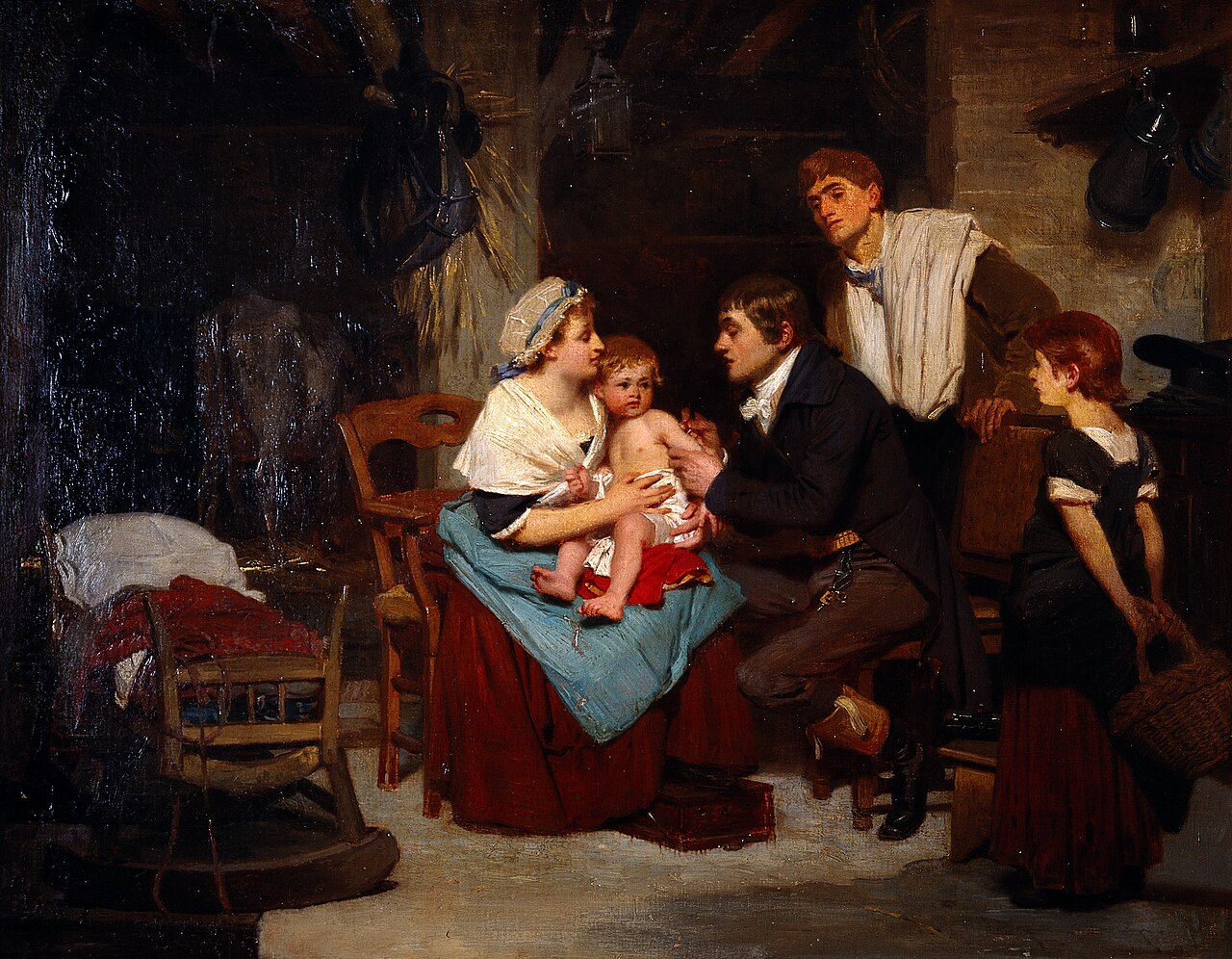

In 1721, an enslaved man explains in Boston how to protect oneself from smallpox. The scholar who listens to him is mocked.
Yet the method divides the observed mortality by nearly six.
Then the historians of medicine write the story, and his name often disappears from it.
Diseases, epidemics, contagion
An infectious disease is caused by a pathogen that enters the body and multiplies there: a bacterium, a virus, a fungus, a parasite. This is what distinguishes it from non-communicable diseases — a cancer, diabetes, a heart disease — which do not pass from one person to another.
These organisms travel by a small number of routes, and knowing them helps in understanding most public health measures:
- through the air, in the droplets and fine particles given off when coughing, sneezing or speaking — influenza, tuberculosis, smallpox;
- through contaminated water or food — cholera, typhoid;
- through contact with a person (including through blood or sexual intercourse), an animal or a soiled object;
- through an animal vector that carries the agent without always suffering from it — the mosquito for malaria, the flea for plague.
The word epidemic does not denote a serious disease, but a disease that spreads more than expected in a given population, at a given time. A disease that affects as many people as usual remains at its expected level; if it affects markedly more, it is an epidemic. When the phenomenon reaches several countries or continents, it is called a pandemic. When a disease is permanently present in a region, at a roughly stable level, it is endemic there.1
Endemic and epidemic are defined by each other, and this is what makes the matter delicate. The endemic level is the expected level; the epidemic is what exceeds it. One must therefore know what is usual before being able to say that things have departed from it — and this is why health surveillance counts the sick even when nothing is happening.
Against all this, medicine has three families of means, and they do not act at the same moment. Preventing infection — hygiene, clean water, vaccination. Treating the infected person — antibiotics against bacteria, antivirals against certain viruses, antiparasitics, antifungals, and supportive care. Breaking the chain of transmission — isolation of the sick, contact tracing, mosquito control.
Several of these means were used before anyone knew what they were fighting. This is the case in the two stories this page tells. In Boston in 1721, people inoculate without knowing anything about viruses. In London in 1854, the handle of a pump is removed without anything being known about bacteria. In both cases, the intuition is right — and takes decades to be accepted.
What he knew
The method is called variolation. It consists, most often, of taking matter from the pustules of a sick person and introducing it under the skin of a healthy person through a slight incision.
Originating in Asia, this technique was already practised in 1700 in Africa, India and the Ottoman Empire.2
Caution: This practice was not without risk. The National Library of Medicine (United States) points out that the person operated on could die from it, and pass the disease on to those around them.34
Onesimus
Around 1707, in Boston, the congregation of the minister Cotton Mather gave him an enslaved African man. Mather called him Onesimus.5
Mather asked him whether he had ever had smallpox. His answer, as Mather reports it in a letter:
He answered, both, Yes, and No; and then told me, that he had undergone an Operation, which had given him something of the Small-Pox, and would forever preserve him from it; adding, that it was often used among the Guramantese, and whoever had the Courage to use it, was forever free from the Fear of the Contagion.6
Yes, and No. An answer that makes no sense within the framework of thought of the man he is speaking to — and that is exactly what makes it interesting.
Then comes a sentence that changes the nature of the exchange:
He described the Operation to me, and showed me in his Arm the Scar.7
Onesimus did not merely tell. He produced evidence. A physical, observable mark that could be checked — and he knew what it demonstrated.
Mather then checked with other African captives in Boston, who confirmed how common this practice was in their regions of origin. He also read reports of similar procedures being used in Turkey.8
Meanwhile, in 1717, Lady Mary Wortley Montagu discovered this technique in Constantinople.9
The knowledge was there for all to see
The most troubling fact in this case is the following.
Slave traders knew how to recognise these inoculation scars — and they raised the price. A person immune to smallpox was worth more.10
In other words: the knowledge was visible on the bodies, and its commercial value was acknowledged.
People looked at the scar. They did not listen to the person.
Mather asked the question. That is the only thing he did differently — and it was enough.
The 1721 epidemic
Smallpox struck Boston, a town of about 11,000 inhabitants. More than 6,000 cases were reported — over half the population. 844 deaths were recorded, or about 1 in 7 of those infected.11
Mather tried to persuade the town’s physicians to apply inoculation. Only one agreed: Zabdiel Boylston. He began with his young son and two people he held in slavery, Jack and Moll, then several hundred inhabitants — the sources give from 242 to 287 people inoculated, of whom six died.12
The figures
- Among those inoculated: about 1 death in 40 (1 in 46 in the count Boylston published in 1726, which includes more inoculees).
- Among all those infected in the town: 1 death in 7.
- Efficacy ratio: Mortality divided by six to seven.13
In 1721, well before the formalisation of the modern experimental method, this intervention offers a numerical comparison between two groups — an imperfect one, since the inoculated had not been chosen at random.
A mortality of 1 in 40 to 1 in 46 (2.2 to 2.5%) remains a high rate. Its efficacy can be judged only in comparison with the rate of about 1 in 7 (nearly 15%) observed among the non-inoculated cases.14
Why it was rejected
The documents of the time reveal three grounds for opposition, and they do not carry the same weight:
- Medical: the fear of creating new outbreaks by inoculating healthy people.
- Theological: the idea that intervening amounted to thwarting divine providence.
- Racial: the refusal to validate knowledge passed on by an enslaved man.15
The hostility was not limited to words: Mather’s house was the target of an attempted grenade attack.16
Little is known of his life. In 1716, he had obtained a partial freedom from Mather, by paying a sum towards the purchase of another slave, and still owed him chores. He was married and had children.17
The Soho pump: the rest of the story
In London, in the Soho district in 1854, 500 people died of cholera in ten days.18
Dr John Snow challenged the miasma theory (“bad air”) and put forward the hypothesis of waterborne transmission. He mapped the deaths and found them concentrated around the Broad Street water pump. He obtained the removal of the pump’s handle. The epidemic then stopped — but it was already receding before the removal, and the map that made the investigation famous was published only afterwards. The gesture became a symbol; it probably did not, on its own, end the epidemic.19
The board of health’s rejection of the theory
The local authorities removed the handle, but rejected Snow’s scientific explanation.
Snow set out his thesis in the expanded edition of his book, published in 1855, without winning the support of the scientific community. It was not until 1884 that Robert Koch isolated the cholera bacillus (Vibrio cholerae) in pure culture; the Italian Filippo Pacini had, however, observed it under the microscope as early as 1854.20
The convergence of sanitary measures
The sanitary reform of the nineteenth century drew on both theories:
- Supporters of miasma advocated the treatment of sewage, the ventilation of housing and refuse collection.
- Supporters of infectious transmission targeted the contamination of water supplies.
A mistaken theory thus contributed to the implementation of adequate public health measures.
Other measures that took time to convince
In 1847 in Vienna, Ignaz Semmelweis showed that handwashing in a chlorinated solution by medical staff drastically reduced maternal mortality from puerperal fever. His 1861 publication met with clear institutional rejection before being validated later.21
What these stories have in common
- Acting before understanding: a protective measure can be applied, sometimes under compulsion, without agreement on why it works.
- What convinces: figures are not always enough to convince as long as one cannot see what is happening inside the body.
- Incomplete ideas: a false or incomplete explanation can still lead to measures that genuinely protect.
Historiographical clarifications
- On Edward Jenner: Jenner did not discover the principle of actively induced immunisation. He refined the procedure in 1796 by using cowpox (vaccinia), thereby making the procedure much safer.
- On the transmission of knowledge: Cotton Mather names Onesimus and says what he owes him: it was through him that he learned of this practice, and he wrote so as early as 1716.22
Timeline of eradication
| Year | Event |
|---|---|
| 1721 | Inoculation in Boston by Zabdiel Boylston following information from Onesimus. |
| 1796 | Development of the smallpox vaccine by Edward Jenner from cowpox. |
| 1977 | Last natural case of smallpox in the world, in Somalia, in October. |
| 1980 | On 8 May, the World Health Assembly officially declared that “the world and all its peoples have won freedom from smallpox”. |
Sources for the table23
Note 1
Epidemic refers to an increase, often sudden, in the number of cases of a disease above what is normally expected
Centers for Disease Control and Prevention, Principles of Epidemiology in Public Health Practice
Note 2
In Asia, practitioners developed the technique of variolation—the deliberate infection with smallpox. […] By 1700, variolation had spread to Africa, India and the Ottoman Empire.
U.S. National Library of Medicine, exposition en ligne “Smallpox: A Great and Terrible Scourge”
Note 3
Variolation was never risk-free. […] Not only could the patient die from the procedure […] the mild form of the disease which the patient contracted could spread, causing an epidemic.
U.S. National Library of Medicine, exposition en ligne “Smallpox: A Great and Terrible Scourge”
Note 4
The earliest known descriptions of the practice in sub-Saharan Africa were given by African slaves in colonial America in the early and mid-eighteenth century. Subsequently it is mentioned in accounts from widely scattered parts of the continent. It seems to have been most extensively used in the Western and Central Sudan, Ethiopia and Southern Africa.
Herbert, Eugenia W., “Smallpox Inoculation in Africa”, The Journal of African History, vol. 16, no. 4, 1975, p. 539-559
Note 5
was gifted an enslaved African man by his congregation in 1707 […] Onesimus, as Mather called him
Wheeler, Rowan, “Onesimus Mather and the Origins of Inoculation in Boston”, Paul Revere House, 22 August 2020
Note 6
he answered, both, Yes, and No; and then told me, that he had undergone an Operation, which had given him something of the Small-Pox, and would forever preserve him from it
Mather, Cotton, lettre à la Royal Society de Londres, 1716
was often used among the Guramantese
Wheeler, Rowan, “Onesimus Mather and the Origins of Inoculation in Boston”, Paul Revere House, 22 August 2020
whoever had the Courage to use it, was forever free from the Fear of the Contagion
Mather, Cotton, lettre à la Royal Society de Londres, 1716
Note 7
He described the Operation to me, and showed me in his Arm the Scar.
Mather, Cotton, lettre à la Royal Society de Londres, 1716
Note 8
reports of similar procedures being used in Turkey
Wheeler, Rowan, “Onesimus Mather and the Origins of Inoculation in Boston”, Paul Revere House, 22 August 2020
Note 9
In 1717, Lady Mary Wortley Montagu, the wife of the British ambassador, learned about variolation in Constantinople.
U.S. National Library of Medicine, exposition en ligne “Smallpox: A Great and Terrible Scourge”
Note 10
Minardi, Margot, “The Boston Inoculation Controversy of 1721-1722: An Incident in the History of Race”, The William and Mary Quarterly, vol. 61, no. 1, 2004, p. 47-76
Note 11
The 1721 epidemic killed around 844 of Boston’s 11,000 residents, or about 7.6% of the total citizenry.
Gault, Edward S., “Smallpox in Boston: Inoculation and the Revere Family”, Paul Revere House, 6 April 2020
Out of a population of 11,000, over 6000 cases were reported with 850 dying from the disease.
Niederhuber, Matthew, “The Fight Over Inoculation During the 1721 Boston Smallpox Epidemic”, Science in the News, Harvard University, 31 December 2014
Note 12
As the epidemic worsened, Cotton Mather reached out to the medical community of Boston, imploring them to use the inoculation method. One physician, Zabdiel Boylston, heeded his call, but most other doctors were hostile to the idea.
Niederhuber, Matthew, “The Fight Over Inoculation During the 1721 Boston Smallpox Epidemic”, Science in the News, Harvard University, 31 December 2014
Only one doctor listened and heeded Mather's arguments
Wheeler, Rowan, “Onesimus Mather and the Origins of Inoculation in Boston”, Paul Revere House, 22 August 2020
testing the procedure on his young son and on two of his enslaved persons, Jack and Moll […] 242 recorded inoculations […] Only six of Boylston's patients died
Wheeler, Rowan, “Onesimus Mather and the Origins of Inoculation in Boston”, Paul Revere House, 22 August 2020
Of 287 inoculation patients, only six died.
Gershon, Livia, “The Hellfire Preacher Who Promoted Inoculation”, JSTOR Daily, 7 March 2021
Note 13
And that out of 274, fix died […] then the Proportion that dies under Inoculation may be one in 4<5, or thereabout. […] fo that the Proportion that died of the natural Small-Pox there, appears to be one in fix, or between that of fix and feven.
Boylston, Zabdiel, An Historical Account of the Small-Pox Inoculated in New England, London, S. Chandler, 1726
just six, or about one in 40, succumbed to the illness. […] Citywide the death toll approached 850, or a mortality rate of one in seven out of the entire infected population.
Accardo, Peter X., “Three Bostonians and the Smallpox Epidemic of 1721”, Houghton Library Blog, Harvard University, 4 June 2020
Note 14
Boylston, who had personally inoculated some 287 people, recorded that of those inoculated only 2% had died. […] In comparison, the mortality rate of the naturally occurring disease during that year was 14.8%
Niederhuber, Matthew, “The Fight Over Inoculation During the 1721 Boston Smallpox Epidemic”, Science in the News, Harvard University, 31 December 2014
Note 15
The criticism of Boylston and Mather relied on anti-Black sentiment. […] Dr. Douglass criticized Mather’s suggestions, claiming that trusting only word-of-mouth accounts without scientific trials was dangerous, especially when that knowledge came from enslaved people he personally deemed incapable of rational thought.
Wheeler, Rowan, “Onesimus Mather and the Origins of Inoculation in Boston”, Paul Revere House, 22 August 2020
Note 16
Around three o’clock on the morning of November 14, a crude grenade made of black powder and turpentine sailed through a window of Cotton Mather’s house in Boston. It landed in Mather’s guest room but failed to explode, thus sparing the life of his nephew.
O’Brien, Frederic D., “1721: Two Hundred Seventy-Five Years Ago”, American Heritage, vol. 47, no. 7, November 1996
Note 17
a Summ, towards the purchase of a Negro-Lad […] including shoveling snow and chopping wood for fuel […] was married with children
Wheeler, Rowan, “Onesimus Mather and the Origins of Inoculation in Boston”, Paul Revere House, 22 August 2020
Note 18
Within two hundred and fifty yards of the spot where Cambridge Street joins Broad Street, there were upwards of five hundred fatal attacks of cholera in ten days.
Snow, John, On the Mode of Communication of Cholera, John Churchill, Londres, 1855
Note 19
On proceeding to the spot, I found that nearly all the deaths had taken place within a short distance of the pump. […] The deaths which occurred during this fatal outbreak of cholera are indicated in the accompanying map […]
Snow, John, On the Mode of Communication of Cholera, John Churchill, Londres, 1855
In consequence of what I said, the handle of the pump was removed on the following day. The number of attacks of cholera had been diminished before this measure was adopted, but whether they had diminished in a greater proportion than might be accounted for by the flight of the great bulk of the population I am unable to say. […] For the 1854 cholera outbreak in London's Broad Street region, he presented two maps. The first was shown on December 4, 1854 at a meeting of the Epidemiological Society of London. Several months later he published this map in his book, On the Mode of Communication of Cholera, 2nd Edition.
Snow, John, letter to the editor of the Medical Times and Gazette, 23 September 1854, public domain, reproduced on the “Cholera in St. James” website (Michigan State University); and UCLA Fielding School of Public Health, Department of Epidemiology, “Map, Myth and Error Making in BS Pump Outbreak”, online dossier on John Snow
Note 20
The first edition of this work, which was published in August 1849, was only a slender pamphlet. I have, since that time, written various papers on the same subject, which have been read at the Medical Societies, and published in the medical journals. The present edition contains the substance of all these articles, together with much new matter, the greater part of which is derived from my own recent inquiries.
Snow, John, On the Mode of Communication of Cholera, John Churchill, Londres, 1855
Snow’s empirically plausible explanation of a waterborne ‘cholera poison’ was rejected in 1855 by the Committee for Scientific Inquiries […] Snow’s idea of a waterborne poison did not catch on.
Dean, Michael Emmans, “Selective Suppression by the Medical Establishment of Unwelcome Research Findings: The Cholera Treatment Evaluation by the General Board of Health, London 1854”, Journal of the Royal Society of Medicine, vol. 109, no. 5, 2016, p. 200-205
[…] in dem Bericht über die Konferenz ist die Art und Weise, in welcher die Kommabazillen zu isolieren und in Reinkulturen zu züchten sind, ganz genau beschrieben.
[…] in the report on the conference, the way in which the comma bacilli are to be isolated and grown in pure culture is described in full detail.
Koch, Robert, “Über die Cholerabakterien”, Deutsche Medizinische Wochenschrift, vol. 10, 1884, p. 725-728 (reprinted in Koch, Robert, Gesammelte Werke, vol. II, Georg Thieme, Leipzig, 1912)
looked through his powerful gifted microscope at a previously unknown organism, Vibrio cholerae […] On January 7, 1884, Koch announced in a dispatch that he had successfully isolated the bacillus in pure culture.
UCLA Fielding School of Public Health, Department of Epidemiology, “First Discoverer of Vibrio Cholerae”, dossier en ligne consacré à John Snow
Note 21
Um die an der Hand klebenden Cadavertheile zu zerstören, benützte ich, ohne mich jedoch des Tages zu erinnern, beiläufig von Mitte Mai 1847 angefangen, die Chlorina liquida, mit welcher ich und jeder Schüler vor der Untersuchung seine Hände waschen musste. […] Im Jahre 1847, wo gegen Mitte Mai die Chlorwaschungen eingeführt wurden, starben an der ersten Abtheilung von 3490 verpflegten Wöchnerinnen 176 […]. Im Jahre 1848, wo das ganze Jahr hindurch die Chlorwaschungen emsig geübt wurden, starben von 3556 Wöchnerinnen 45 […]
Semmelweis, Ignaz, Die Ätiologie, der Begriff und die Prophylaxis des Kindbettfiebers, Pest-Vienne-Leipzig, 1861
Note 22
One of the first methods for controlling smallpox was variolation, a process named after the virus that causes smallpox (variola virus). During variolation, people who had never had smallpox were exposed to material from smallpox sores (pustules) by scratching the material into their arm or inhaling it through the nose. […] Jenner also knew about variolation and guessed that exposure to cowpox could be used to protect against smallpox.
Centers for Disease Control and Prevention, “History of Smallpox”, page reviewed 23 October 2024
In Massachusetts, Cotton Mather learned about the practice from his slave, Onesimus.
U.S. National Library of Medicine, exposition en ligne “Smallpox: A Great and Terrible Scourge”
The basis for vaccination began in 1796 when the English doctor Edward Jenner noticed that milkmaids who had gotten cowpox were protected from smallpox. Jenner also knew about variolation and guessed that exposure to cowpox could be used to protect against smallpox. To test his theory, Dr. Jenner took material from a cowpox sore on milkmaid Sarah Nelmes' hand and inoculated it into the arm of James Phipps, the 8-year-old son of Jenner's gardener.
Centers for Disease Control and Prevention, “History of Smallpox”, page reviewed 23 October 2024
Note 23
The world and all its peoples have won freedom from smallpox
Organisation mondiale de la santé, résolution WHA33.3 de la trente-troisième Assemblée mondiale de la santé, 8 May 1980
In October, 1977, Ali Maow Maalin of Somalia contracted variola minor […] becoming the last person in the world to contract smallpox naturally
U.S. National Library of Medicine, exposition en ligne “Smallpox: A Great and Terrible Scourge”
Notes and sources
- ↑
Passage The word epidemic does not denote a serious disease, but a disease that spreads more than expected […] The endemic level is the expected level
Epidemic refers to an increase, often sudden, in the number of cases of a disease above what is normally expected
Source Centers for Disease Control and Prevention, Principles of Epidemiology in Public Health Practice, lesson 1, section 11.
Open access open the source · checked on 24 October 2026
- ↑
Passage Originating in Asia, this technique was already practised in 1700 in Africa, India and the Ottoman Empire.
In Asia, practitioners developed the technique of variolation—the deliberate infection with smallpox. […] By 1700, variolation had spread to Africa, India and the Ottoman Empire.
Source U.S. National Library of Medicine, exposition en ligne “Smallpox: A Great and Terrible Scourge”, “Variolation” page — https://www.nlm.nih.gov/exhibition/smallpox/sp_variolation.html.
Open access open the source · checked on 24 October 2026
- ↑
Passage the person operated on could die from it, and pass the disease on to those around them
Variolation was never risk-free. […] Not only could the patient die from the procedure […] the mild form of the disease which the patient contracted could spread, causing an epidemic.
Source U.S. National Library of Medicine, exposition en ligne “Smallpox: A Great and Terrible Scourge”, “Variolation” page — https://www.nlm.nih.gov/exhibition/smallpox/sp_variolation.html.
Open access open the source · checked on 24 October 2026
- ↑
For this whole section
Passage the practice of inoculation in sub-Saharan Africa
The earliest known descriptions of the practice in sub-Saharan Africa were given by African slaves in colonial America in the early and mid-eighteenth century. Subsequently it is mentioned in accounts from widely scattered parts of the continent. It seems to have been most extensively used in the Western and Central Sudan, Ethiopia and Southern Africa.
Source Herbert, Eugenia W., “Smallpox Inoculation in Africa”, The Journal of African History, vol. 16, no. 4, 1975, p. 539-559, abstract (publisher’s page).
Paywalled, open-access abstract open the source · checked on 27 October 2026
- ↑
Passage Around 1707, in Boston, the congregation of the minister Cotton Mather gave him an enslaved African man. Mather called him Onesimus.
was gifted an enslaved African man by his congregation in 1707 […] Onesimus, as Mather called him
Source Wheeler, Rowan, “Onesimus Mather and the Origins of Inoculation in Boston”, Paul Revere House, 22 August 2020, beginning of the article.
Open access open the source · checked on 24 October 2026
- ↑
Passage He answered, both, Yes, and No; and then told me, that he had undergone an Operation, which had given him something of the Small-Pox, and would forever preserve him from it
he answered, both, Yes, and No; and then told me, that he had undergone an Operation, which had given him something of the Small-Pox, and would forever preserve him from it
Source Mather, Cotton, lettre à la Royal Society de Londres, 1716, 1716 letter.
Public domain · checked on 9 September 2026
Passage adding, that it was often used among the Guramantese
was often used among the Guramantese
Source Wheeler, Rowan, “Onesimus Mather and the Origins of Inoculation in Boston”, Paul Revere House, 22 August 2020, quotation from Mather’s letter.
Open access open the source · checked on 24 October 2026
Passage whoever had the Courage to use it, was forever free from the Fear of the Contagion
whoever had the Courage to use it, was forever free from the Fear of the Contagion
Source Mather, Cotton, lettre à la Royal Society de Londres, 1716, 1716 letter.
Public domain · checked on 9 September 2026
- ↑
Passage He described the Operation to me, and showed me in his Arm the Scar.
He described the Operation to me, and showed me in his Arm the Scar.
Source Mather, Cotton, lettre à la Royal Society de Londres, 1716, 1716 letter.
Public domain · checked on 9 September 2026
- ↑
Passage He also read reports of similar procedures being used in Turkey.
reports of similar procedures being used in Turkey
Source Wheeler, Rowan, “Onesimus Mather and the Origins of Inoculation in Boston”, Paul Revere House, 22 August 2020, paragraph on Mather’s research.
Open access open the source · checked on 24 October 2026
- ↑
Passage Meanwhile, in 1717, Lady Mary Wortley Montagu discovered this technique in Constantinople.
In 1717, Lady Mary Wortley Montagu, the wife of the British ambassador, learned about variolation in Constantinople.
Source U.S. National Library of Medicine, exposition en ligne “Smallpox: A Great and Terrible Scourge”, “Variolation” page — https://www.nlm.nih.gov/exhibition/smallpox/sp_variolation.html.
Open access open the source · checked on 24 October 2026
- ↑
Passage Slave traders knew how to recognise these inoculation scars — and they raised the price. A person immune to smallpox was worth more.
Source Minardi, Margot, “The Boston Inoculation Controversy of 1721-1722: An Incident in the History of Race”, The William and Mary Quarterly, vol. 61, no. 1, 2004, p. 47-76.
Paywalled · checked on 9 September 2026
- ↑
Passage Smallpox struck Boston, a town of about 11,000 inhabitants […] 844 deaths were recorded
The 1721 epidemic killed around 844 of Boston’s 11,000 residents, or about 7.6% of the total citizenry.
Source Gault, Edward S., “Smallpox in Boston: Inoculation and the Revere Family”, Paul Revere House, 6 April 2020, paragraph on Boylston’s results (sentence preceding the mention of his 247 inoculees).
Open access open the source · checked on 27 October 2026
Passage More than 6,000 cases were reported — over half the population
Out of a population of 11,000, over 6000 cases were reported with 850 dying from the disease.
Source Niederhuber, Matthew, “The Fight Over Inoculation During the 1721 Boston Smallpox Epidemic”, Science in the News, Harvard University, 31 December 2014, section “The Boston Epidemic”, 1st paragraph, 2nd sentence.
Open access open the source · checked on 27 October 2026
- ↑
Passage Only one agreed: Zabdiel Boylston.
As the epidemic worsened, Cotton Mather reached out to the medical community of Boston, imploring them to use the inoculation method. One physician, Zabdiel Boylston, heeded his call, but most other doctors were hostile to the idea.
Source Niederhuber, Matthew, “The Fight Over Inoculation During the 1721 Boston Smallpox Epidemic”, Science in the News, Harvard University, 31 December 2014, paragraph on Mather’s appeal to the Boston physicians.
Open access open the source · checked on 27 October 2026
Passage Mather tried to persuade the town’s physicians to apply inoculation. Only one agreed: Zabdiel Boylston.
Only one doctor listened and heeded Mather's arguments
Source Wheeler, Rowan, “Onesimus Mather and the Origins of Inoculation in Boston”, Paul Revere House, 22 August 2020, paragraph on the 1721 epidemic.
Open access open the source · checked on 24 October 2026
Passage He began with his young son and two people he held in slavery, Jack and Moll, then several hundred inhabitants — the sources give from 242 to 287 people inoculated, of whom six died.
testing the procedure on his young son and on two of his enslaved persons, Jack and Moll […] 242 recorded inoculations […] Only six of Boylston's patients died
Source Wheeler, Rowan, “Onesimus Mather and the Origins of Inoculation in Boston”, Paul Revere House, 22 August 2020, paragraphs on Boylston’s campaign.
Open access open the source · checked on 24 October 2026
Passage the sources give from 242 to 287 people inoculated, of whom six died
Of 287 inoculation patients, only six died.
Source Gershon, Livia, “The Hellfire Preacher Who Promoted Inoculation”, JSTOR Daily, 7 March 2021, paragraph on the end of the epidemic.
Open access open the source · checked on 26 October 2026
- ↑
Passage Among those inoculated: about 1 death in 40 (1 in 46 in the count Boylston published in 1726, which includes more inoculees). […] Among all those infected in the town: 1 death in 7.
And that out of 274, fix died […] then the Proportion that dies under Inoculation may be one in 4<5, or thereabout. […] fo that the Proportion that died of the natural Small-Pox there, appears to be one in fix, or between that of fix and feven.
Source Boylston, Zabdiel, An Historical Account of the Small-Pox Inoculated in New England, London, S. Chandler, 1726, OCR text of the Wellcome scan (long s read as “f”; “4<5” is 46 in the print, i.e. 274/6), passage on the proportion of deaths; the count of 274 inoculees precedes it.
Public domain open the source · checked on 27 October 2026
Passage Among those inoculated: about 1 death in 40 […] Among all those infected in the town: 1 death in 7.
just six, or about one in 40, succumbed to the illness. […] Citywide the death toll approached 850, or a mortality rate of one in seven out of the entire infected population.
Source Accardo, Peter X., “Three Bostonians and the Smallpox Epidemic of 1721”, Houghton Library Blog, Harvard University, 4 June 2020, whole post.
Open access open the source · checked on 27 October 2026
- ↑
Passage A mortality of 1 in 40 to 1 in 46 (2.2 to 2.5%) remains a high rate. Its efficacy can be judged only in comparison with the rate of about 1 in 7 (nearly 15%) observed among the non-inoculated cases.
Boylston, who had personally inoculated some 287 people, recorded that of those inoculated only 2% had died. […] In comparison, the mortality rate of the naturally occurring disease during that year was 14.8%
Source Niederhuber, Matthew, “The Fight Over Inoculation During the 1721 Boston Smallpox Epidemic”, Science in the News, Harvard University, 31 December 2014, paragraph on Boylston’s results.
Open access open the source · checked on 27 October 2026
- ↑
Passage the refusal to validate knowledge passed on by an enslaved man
The criticism of Boylston and Mather relied on anti-Black sentiment. […] Dr. Douglass criticized Mather’s suggestions, claiming that trusting only word-of-mouth accounts without scientific trials was dangerous, especially when that knowledge came from enslaved people he personally deemed incapable of rational thought.
Source Wheeler, Rowan, “Onesimus Mather and the Origins of Inoculation in Boston”, Paul Revere House, 22 August 2020, 9th paragraph of the article (no subheading).
Open access open the source · checked on 27 October 2026
- ↑
Passage Mather’s house was the target of an attempted grenade attack
Around three o’clock on the morning of November 14, a crude grenade made of black powder and turpentine sailed through a window of Cotton Mather’s house in Boston. It landed in Mather’s guest room but failed to explode, thus sparing the life of his nephew.
Source O’Brien, Frederic D., “1721: Two Hundred Seventy-Five Years Ago”, American Heritage, vol. 47, no. 7, November 1996, 1st paragraph, 1st and 2nd sentences.
Open access open the source · checked on 27 October 2026
- ↑
Passage In 1716, he had obtained a partial freedom from Mather, by paying a sum towards the purchase of another slave, and still owed him chores. He was married and had children.
a Summ, towards the purchase of a Negro-Lad […] including shoveling snow and chopping wood for fuel […] was married with children
Source Wheeler, Rowan, “Onesimus Mather and the Origins of Inoculation in Boston”, Paul Revere House, 22 August 2020, paragraphs on the 1716 emancipation and Onesimus’s family.
Open access open the source · checked on 24 October 2026
- ↑
Passage In London, in the Soho district in 1854, 500 people died of cholera in ten days
Within two hundred and fifty yards of the spot where Cambridge Street joins Broad Street, there were upwards of five hundred fatal attacks of cholera in ten days.
Source Snow, John, On the Mode of Communication of Cholera, John Churchill, Londres, 1855, p. 38, 1st paragraph of the chapter “The cholera near Golden Square”.
Public domain open the source · checked on 27 October 2026
- ↑
Passage He mapped the deaths and found them concentrated around the Broad Street water pump.
On proceeding to the spot, I found that nearly all the deaths had taken place within a short distance of the pump. […] The deaths which occurred during this fatal outbreak of cholera are indicated in the accompanying map […]
Source Snow, John, On the Mode of Communication of Cholera, John Churchill, Londres, 1855, p. 39 (chapter “The cholera near Golden Square”) and p. 45 (opening of the explanation of the map).
Public domain open the source · checked on 27 October 2026
Passage it was already receding before the removal, and the map that made the investigation famous was published only afterwards
In consequence of what I said, the handle of the pump was removed on the following day. The number of attacks of cholera had been diminished before this measure was adopted, but whether they had diminished in a greater proportion than might be accounted for by the flight of the great bulk of the population I am unable to say. […] For the 1854 cholera outbreak in London's Broad Street region, he presented two maps. The first was shown on December 4, 1854 at a meeting of the Epidemiological Society of London. Several months later he published this map in his book, On the Mode of Communication of Cholera, 2nd Edition.
Source Snow, John, letter to the editor of the Medical Times and Gazette, 23 September 1854, public domain, reproduced on the “Cholera in St. James” website (Michigan State University); and UCLA Fielding School of Public Health, Department of Epidemiology, “Map, Myth and Error Making in BS Pump Outbreak”, online dossier on John Snow, Snow’s letter, 3rd paragraph (MSU page); then UCLA page, 1st paragraph (“Mapping the Broad Street Pump Outbreak”).
Public domain open the source 1 open the source 2 · checked on 27 October 2026
- ↑
Passage Snow set out his thesis in the expanded edition of his book, published in 1855
The first edition of this work, which was published in August 1849, was only a slender pamphlet. I have, since that time, written various papers on the same subject, which have been read at the Medical Societies, and published in the medical journals. The present edition contains the substance of all these articles, together with much new matter, the greater part of which is derived from my own recent inquiries.
Source Snow, John, On the Mode of Communication of Cholera, John Churchill, Londres, 1855, preface, 1st paragraph.
Public domain open the source · checked on 27 October 2026
Passage without winning the support of the scientific community
Snow’s empirically plausible explanation of a waterborne ‘cholera poison’ was rejected in 1855 by the Committee for Scientific Inquiries […] Snow’s idea of a waterborne poison did not catch on.
Source Dean, Michael Emmans, “Selective Suppression by the Medical Establishment of Unwelcome Research Findings: The Cholera Treatment Evaluation by the General Board of Health, London 1854”, Journal of the Royal Society of Medicine, vol. 109, no. 5, 2016, p. 200-205, p. 201 (section “Scientific inquiries”, which begins on p. 200) and p. 204 (conclusion).
Open access open the source · checked on 27 October 2026
Passage It was not until 1884 that Robert Koch isolated the cholera bacillus (Vibrio cholerae) in pure culture
[…] in dem Bericht über die Konferenz ist die Art und Weise, in welcher die Kommabazillen zu isolieren und in Reinkulturen zu züchten sind, ganz genau beschrieben.
Editors’ translation […] in the report on the conference, the way in which the comma bacilli are to be isolated and grown in pure culture is described in full detail.
Source Koch, Robert, “Über die Cholerabakterien”, Deutsche Medizinische Wochenschrift, vol. 10, 1884, p. 725-728 (reprinted in Koch, Robert, Gesammelte Werke, vol. II, Georg Thieme, Leipzig, 1912), image 84 of the scan of the Gesammelte Werke, vol. II (article “Über die Cholerabakterien”, which begins at image 81 with the note “Aus Deutsche Medizinische Wochenschrift, 1884”).
Public domain open the source · checked on 27 October 2026
Passage It was not until 1884 that Robert Koch isolated the cholera bacillus (Vibrio cholerae) in pure culture; the Italian Filippo Pacini had, however, observed it under the microscope as early as 1854.
looked through his powerful gifted microscope at a previously unknown organism, Vibrio cholerae […] On January 7, 1884, Koch announced in a dispatch that he had successfully isolated the bacillus in pure culture.
Source UCLA Fielding School of Public Health, Department of Epidemiology, “First Discoverer of Vibrio Cholerae”, dossier en ligne consacré à John Snow, paragraphs on Pacini (1854) and on Koch (1883-1884).
Open access open the source · checked on 24 October 2026
- ↑
Passage Ignaz Semmelweis showed that handwashing in a chlorinated solution […] drastically reduced maternal mortality
Um die an der Hand klebenden Cadavertheile zu zerstören, benützte ich, ohne mich jedoch des Tages zu erinnern, beiläufig von Mitte Mai 1847 angefangen, die Chlorina liquida, mit welcher ich und jeder Schüler vor der Untersuchung seine Hände waschen musste. […] Im Jahre 1847, wo gegen Mitte Mai die Chlorwaschungen eingeführt wurden, starben an der ersten Abtheilung von 3490 verpflegten Wöchnerinnen 176 […]. Im Jahre 1848, wo das ganze Jahr hindurch die Chlorwaschungen emsig geübt wurden, starben von 3556 Wöchnerinnen 45 […]
Source Semmelweis, Ignaz, Die Ätiologie, der Begriff und die Prophylaxis des Kindbettfiebers, Pest-Vienne-Leipzig, 1861, p. 55 (image 63: handwashing with Chlorina liquida) and p. 56 (image 64: 1847 and 1848 mortality in the First Division) of the Wellcome scan.
Public domain open the source · checked on 27 October 2026
Passage In 1847 in Vienna, Ignaz Semmelweis showed that handwashing in a chlorinated solution by medical staff drastically reduced maternal mortality from puerperal fever. His 1861 publication
Um die an der Hand klebenden Cadavertheile zu zerstören, benützte ich, ohne mich jedoch des Tages zu erinnern, beiläufig von Mitte Mai 1847 angefangen, die Chlorina liquida, mit welcher ich und jeder Schüler vor der Untersuchung seine Hände waschen musste. […] Im Jahre 1847, wo gegen Mitte Mai die Chlorwaschungen eingeführt wurden, starben an der ersten Abtheilung von 3490 verpflegten Wöchnerinnen 176 […]. Im Jahre 1848, wo das ganze Jahr hindurch die Chlorwaschungen emsig geübt wurden, starben von 3556 Wöchnerinnen 45 […]
Source Semmelweis, Ignaz, Die Ätiologie, der Begriff und die Prophylaxis des Kindbettfiebers, Pest-Vienne-Leipzig, 1861, p. 55 (image 63: handwashing with Chlorina liquida) and p. 56 (image 64: 1847 and 1848 mortality in the First Division) of the Wellcome scan.
Public domain open the source · checked on 27 October 2026
- ↑
Passage Jenner did not discover the principle of actively induced immunisation.
One of the first methods for controlling smallpox was variolation, a process named after the virus that causes smallpox (variola virus). During variolation, people who had never had smallpox were exposed to material from smallpox sores (pustules) by scratching the material into their arm or inhaling it through the nose. […] Jenner also knew about variolation and guessed that exposure to cowpox could be used to protect against smallpox.
Source Centers for Disease Control and Prevention, “History of Smallpox”, page reviewed 23 October 2024, section “Early control efforts”, paragraphs on variolation and on Jenner.
Open access open the source · checked on 27 October 2026
Passage Cotton Mather names Onesimus and says what he owes him: it was through him that he learned of this practice, and he wrote so as early as 1716.
In Massachusetts, Cotton Mather learned about the practice from his slave, Onesimus.
Source U.S. National Library of Medicine, exposition en ligne “Smallpox: A Great and Terrible Scourge”, “Variolation” page — https://www.nlm.nih.gov/exhibition/smallpox/sp_variolation.html.
Open access open the source · checked on 24 October 2026
Passage He refined the procedure in 1796 by using cowpox (vaccinia)
The basis for vaccination began in 1796 when the English doctor Edward Jenner noticed that milkmaids who had gotten cowpox were protected from smallpox. Jenner also knew about variolation and guessed that exposure to cowpox could be used to protect against smallpox. To test his theory, Dr. Jenner took material from a cowpox sore on milkmaid Sarah Nelmes' hand and inoculated it into the arm of James Phipps, the 8-year-old son of Jenner's gardener.
Source Centers for Disease Control and Prevention, “History of Smallpox”, page reviewed 23 October 2024, section “Early control efforts”, paragraph on Jenner.
Open access open the source · checked on 27 October 2026
- ↑
Passage On 8 May, the World Health Assembly officially declared that “the world and all its peoples have won freedom from smallpox”.
The world and all its peoples have won freedom from smallpox
Source Organisation mondiale de la santé, résolution WHA33.3 de la trente-troisième Assemblée mondiale de la santé, 8 May 1980, resolution WHA33.3.
Open access open the source · checked on 9 September 2026
Passage 1977 […] Last natural case of smallpox in the world, in Somalia, in October.
In October, 1977, Ali Maow Maalin of Somalia contracted variola minor […] becoming the last person in the world to contract smallpox naturally
Source U.S. National Library of Medicine, exposition en ligne “Smallpox: A Great and Terrible Scourge”, “Success” page — https://www.nlm.nih.gov/exhibition/smallpox/sp_success.html.
Open access open the source · checked on 24 October 2026
Bibliography
24
- Accardo, Peter X., “Three Bostonians and the Smallpox Epidemic of 1721”, Houghton Library Blog, Harvard University, 4 June 2020, open access (the mortality among the inoculated and among all the sick). https://sites.harvard.edu/houghton-library/2020/06/04/three-bostonians-and-the-smallpox-epidemic-of-1721
- Blake, John B., “The Inoculation Controversy in Boston: 1721-1722”, The New England Quarterly, vol. 25, no. 4, 1952, p. 489-506, paywalled (the figures of the epidemic, the attack on Mather’s house).
- Boylston, Zabdiel, An Historical Account of the Small-Pox Inoculated in New England, London, S. Chandler, 1726, public domain (274 inoculees and six deaths, “one in 46, or thereabout”; among those with natural smallpox, between one in six and one in seven). https://iiif.wellcomecollection.org/pdf/b30541608
- Centers for Disease Control and Prevention, Principles of Epidemiology in Public Health Practice, open access (the definitions of endemic, epidemic and pandemic; the expected level as a reference). https://archive.cdc.gov/www_cdc_gov/csels/dsepd/ss1978/lesson1/section11.html
- Centers for Disease Control and Prevention, “History of Smallpox”, page reviewed 23 October 2024, open access. https://www.cdc.gov/smallpox/about/history.html
- Dean, Michael Emmans, “Selective Suppression by the Medical Establishment of Unwelcome Research Findings: The Cholera Treatment Evaluation by the General Board of Health, London 1854”, Journal of the Royal Society of Medicine, vol. 109, no. 5, 2016, p. 200-205, open access (the rejection of Snow’s waterborne explanation by the Committee for Scientific Inquiries in 1855; an idea that did not catch on). https://doi.org/10.1177/0141076816645057
- Fenn, Elizabeth A., Pox Americana: The Great Smallpox Epidemic of 1775-82, Hill and Wang, 2001, in libraries (the North American context of inoculation).
- Gault, Edward S., “Smallpox in Boston: Inoculation and the Revere Family”, Paul Revere House, 6 April 2020, open access. https://www.paulreverehouse.org/inoculation-and-the-revere-family/
- Gershon, Livia, “The Hellfire Preacher Who Promoted Inoculation”, JSTOR Daily, 7 March 2021, open access (the number of people inoculated in 1721-1722 and of their deaths). https://daily.jstor.org/the-hellfire-preacher-who-promoted-inoculation/
- Herbert, Eugenia W., “Smallpox Inoculation in Africa”, The Journal of African History, vol. 16, no. 4, 1975, p. 539-559, paywalled, open-access abstract (the practice of inoculation in sub-Saharan Africa). https://doi.org/10.1017/S0021853700014547
- Johnson, Steven, The Ghost Map, Riverhead Books, 2006, in libraries (the full account of the Soho epidemic and the controversy with the board of health).
- Koch, Robert, “Über die Cholerabakterien”, Deutsche Medizinische Wochenschrift, vol. 10, 1884, p. 725-728, public domain (the identification of Vibrio cholerae).
- Mather, Cotton, lettre à la Royal Society de Londres, 1716, public domain (Onesimus’s testimony in his own text: the answer “yes and no”, the description of the operation, and the scar shown on the arm); et An Account of the Method and Success of Inoculating the Small-Pox in Boston in New-England, Londres, 1722, public domain (the account of the campaign, in which Onesimus is credited by name).
- Minardi, Margot, “The Boston Inoculation Controversy of 1721-1722: An Incident in the History of Race”, The William and Mary Quarterly, vol. 61, no. 1, 2004, p. 47-76, paywalled (the racial dimension of the opposition; the market value attached to immune people and to inoculation scars).
- Niederhuber, Matthew, “The Fight Over Inoculation During the 1721 Boston Smallpox Epidemic”, Science in the News, Harvard University, 31 December 2014, open access (2% deaths among Boylston’s inoculees, 14.8% for natural smallpox). https://sites.harvard.edu/sitn/2014/12/31/the-fight-over-inoculation-during-the-1721-boston-smallpox-epidemic
- O’Brien, Frederic D., “1721: Two Hundred Seventy-Five Years Ago”, American Heritage, vol. 47, no. 7, November 1996, open access (the grenade of black powder and turpentine thrown into Mather’s house, which failed to explode). https://www.americanheritage.com/1721-two-hundred-seventy-five-years-ago
- Organisation mondiale de la santé, résolution WHA33.3 de la trente-troisième Assemblée mondiale de la santé, 8 May 1980, open access (the declaration of eradication and its wording: the world and all its peoples have won freedom from smallpox). https://www.who.int/publications/i/item/WHA33-3
- Semmelweis, Ignaz, Die Ätiologie, der Begriff und die Prophylaxis des Kindbettfiebers, Pest-Vienne-Leipzig, 1861, public domain (the demonstration of handwashing).
- Snow, John, On the Mode of Communication of Cholera, John Churchill, Londres, 1855, public domain (the waterborne thesis and the Broad Street map).
- Snow, John, letter to the editor of the Medical Times and Gazette, 23 September 1854, public domain, reproduced on the “Cholera in St. James” website (Michigan State University) (the removal of the handle the day after his interview with the Board of Guardians; cases already falling before the removal). https://johnsnow.matrix.msu.edu/broadstpump/snow-the-pump-handle/
- U.S. National Library of Medicine, exposition en ligne “Smallpox: A Great and Terrible Scourge”, open access (variolation born in Asia and spread to Africa, India and the Ottoman Empire, and its risks; Lady Mary Wortley Montagu in Constantinople in 1717; Onesimus, Mather’s source; the last natural case, in Somalia in 1977). https://www.nlm.nih.gov/exhibition/smallpox/
- UCLA Fielding School of Public Health, Department of Epidemiology, “First Discoverer of Vibrio Cholerae”, dossier en ligne consacré à John Snow, open access (the observation of Vibrio cholerae by Filippo Pacini in 1854; the isolation of the bacillus in pure culture by Robert Koch in 1884). https://epi-snow.ph.ucla.edu/Stream5_additionalitems_g.html
- UCLA Fielding School of Public Health, Department of Epidemiology, “Map, Myth and Error Making in BS Pump Outbreak”, online dossier on John Snow, open access (the map shown on 4 December 1854, then published a few months later in the 2nd edition of On the Mode of Communication of Cholera). https://epi-snow.ph.ucla.edu/Stream2_BSPoutbreak_f.html
- Wheeler, Rowan, “Onesimus Mather and the Origins of Inoculation in Boston”, Paul Revere House, 22 August 2020, open access (Onesimus’s arrival in Mather’s household, his answer about the Guramantese, his partial emancipation in 1716, his family; Boylston’s first inoculees and the number of his patients who died). https://www.paulreverehouse.org/onesimus-mather-and-the-origins-of-inoculation-in-boston/
Spotted an error or have a doubt? Write to us.