
Even upside down, swallowed food reaches the stomach.
Nothing needs to fall through the digestive tract: everything is pushed along it, muscle after muscle, over several metres.
What is in a food
Before seeing how the body takes food apart, we need to know what it is looking for in it. Foods provide, in varying proportions, six major types of component, which do not serve the same purpose.
Three of them are counted in large quantities and supply matter and energy.
- Carbohydrates — sugars, starchy foods, cereals, potatoes. They are the most direct fuel: the body converts them into glucose, which cells burn or store. The brain, in particular, consumes it without interruption.
- Proteins — meat, fish, eggs, pulses, dairy products. Their main use is not to provide energy but materials: muscles, skin, hair, enzymes and antibodies are made of proteins. The body cuts them up into amino acids and then reassembles them in its own way.
- Lipids — oils, butter, meat fats, nuts. They make up the densest energy reserve, form part of every cell membrane, and carry certain vitamins.
The other three provide no energy; vitamins and mineral salts are needed only in very small quantities, and yet their absence causes diseases.
- Vitamins, molecules that the body does not make, or not enough of, and must therefore find in food.
- Mineral salts — iron, calcium, iodine, magnesium — which play a part in building bones and in the functioning of cells.
- Water, which accounts for up to 60% of the body mass of an adult (about 55% in women) and without which the body’s chemical reactions cannot take place.1
To these are added fibres, which the body does not digest at all. They pass through it, and that is precisely their use: they regulate transit and feed a population that the second part of this page deals with.
No food contains everything. This is a matter of chemistry, not of morality: the list above cannot be filled with a single product.
How the body retrieves them
Eating means taking apart. What is swallowed is made of pieces far too large to pass into the blood. To digest is to break them down until nutrients are obtained that are small enough for cells to use.
1. Mechanical processing
Before any chemistry, food must be reduced to pieces:
- In the mouth: the teeth grind the food. The tongue mixes it with saliva to form the bolus, a paste that is easy to swallow.
- Along the oesophagus: it is involuntary contractions — peristalsis — that push the food towards the stomach.
- In the stomach: this muscular organ acts like a cement mixer. Its walls contract to churn the food for several hours and reduce it to a thick liquid called chyme.2
2. Chemical processing
The fine cutting falls to the digestive fluids, which contain enzymes: specialised proteins that act like molecular scissors.
- Saliva begins to cut up complex carbohydrates as soon as chewing starts.
- The gastric juices of the stomach, which are highly acidic, denature proteins and kill much of the bacteria swallowed along the way.
- Bile (produced by the liver and stored in the gallbladder) separates fats into fine droplets in the small intestine, which allows the pancreatic enzymes to chop them up.3
3. Absorption in the small intestine
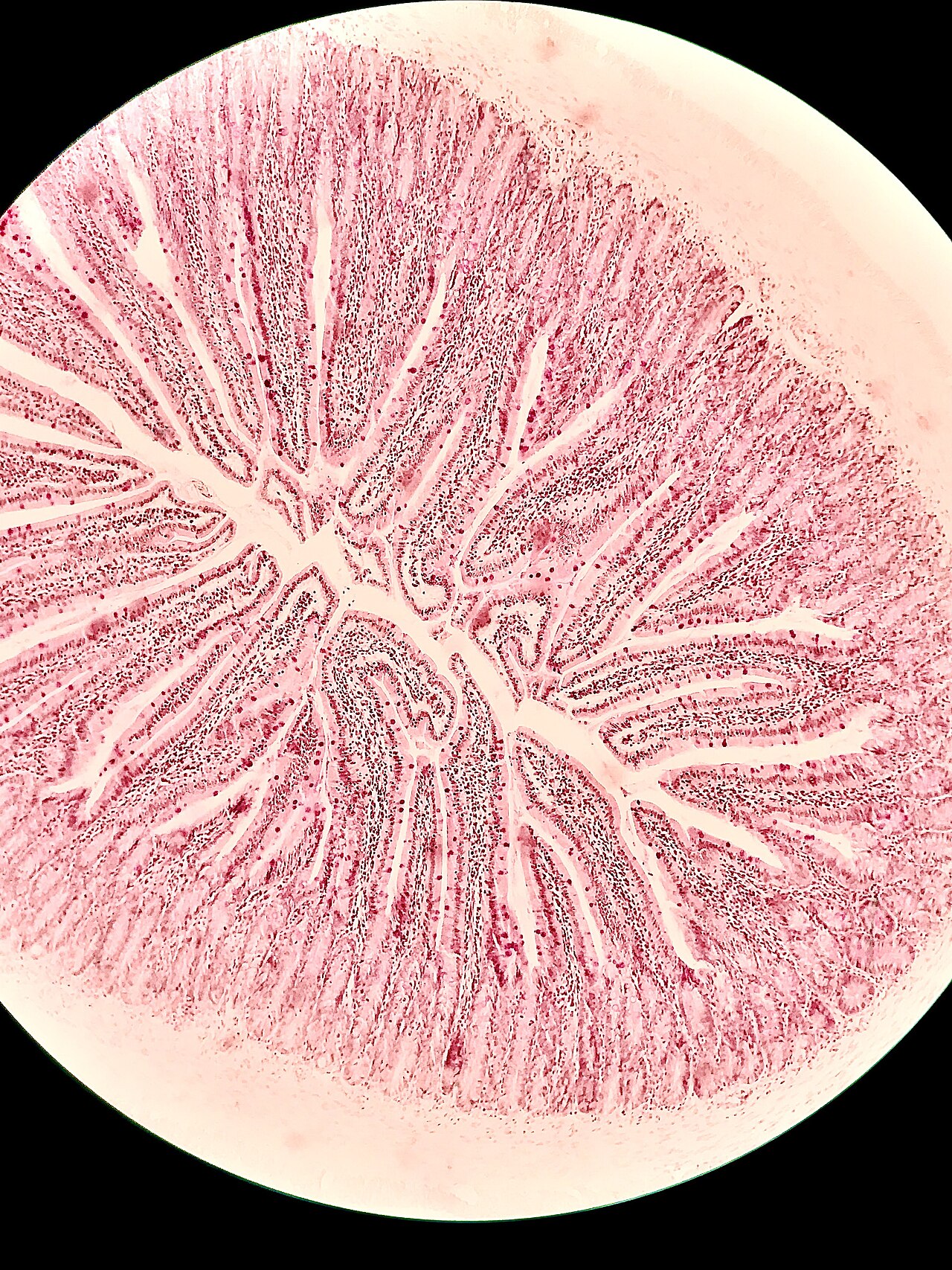
The small intestine is a folded tube several metres long. Its inner wall is not smooth: it is covered with millions of tiny finger-like projections, the intestinal villi.4
- This structure provides a considerable exchange surface in a confined space.
A figure to correct, and it is an exemplary case.
Almost everywhere one reads that this surface is equivalent to a tennis court — two to three hundred square metres. The image appears in the greatest textbooks of medicine and physiology: at least six reference textbooks repeat it.
A 2014 reassessment arrived at about thirty-two square metres for the whole digestive tract, of which thirty are in the small intestine alone. Six to ten times less than had been claimed.
The reason for the error is instructive. The earlier measurements had been made on bodies after death, or during abdominal operations — that is, when the intestine is relaxed and stretches. Measured in a living person, by imaging, the small intestine is about three metres long: roughly half of what was recorded in the operating theatre.
A supple tissue measured when relaxed appears longer than it is. Nobody had cheated; the measurements had been taken in poor conditions, and the result was then copied for decades.
It is closer to half a badminton court than the size of a tennis court. That is still immense for a tube folded inside the abdomen — and the point of the page stands: what counts is the surface, not the volume.5
- It is through this wall that the simple nutrients (amino acids, fatty acids, simple sugars, vitamins, mineral salts and water) cross the biological barrier to enter the blood and lymphatic vessels.
- The blood then carries most of these elements to the liver (fats first pass through the lymph), which sorts, stores or redistributes the resources to the whole body.
4. Waste elimination
Everything that the body can neither cut up nor absorb continues on its way:
- The large intestine (colon): the unassimilable residues (notably plant fibres) arrive there in liquid form. The colon reabsorbs much of their water, which compacts the remaining matter.
- Defecation: the undigested residues, mixed with water and a very large number of bacteria, make up the faeces, which are stored in the rectum and then expelled through the anus.
- Urinary excretion: in parallel, the waste products of the internal workings of the body’s cells (such as urea) are carried by the blood to the kidneys. The kidneys filter the blood continuously, make urine and send it to the bladder to be eliminated.
Part of the work handed to others
Part of the chemical processing is taken on by the gut microbiota: tens of trillions of micro-organisms (bacteria, yeasts, viruses and other microbes) settled mainly in the large intestine.
For the most part, they are not intruders but partners:
- They carry out chemical reactions of which human cells are incapable, notably by fermenting the dietary fibre that the body cannot break down.
- This fermentation produces fatty acids that are useful to the health of the intestinal wall; these microbes also make certain vitamins (such as vitamin K), part of which can be absorbed.6
An example of scientific revision
This field provides a famous case of data correction:
- For more than forty years it was repeated that a human body contained ten times more bacteria than human cells. This round figure stemmed from a quick estimate made in 1972.
- It was revised in 2016: researchers recalculated the quantity of bacteria in the colon and the number of human cells, most of which are red blood cells. The ratio would instead be of the order of 1 to 1 (about 38,000 billion bacteria for 30,000 billion cells, in a 70 kg reference man).7
Where the rest is told
The subject of food and eating is explored from other angles in the rest of the encyclopaedia:
- What travels: our page on food traces the journey of the chilli pepper from the Americas to China, the slow introduction of the tomato into Europe, and analyses the scientific definition of food security.
- How we preserve: our dedicated page details the biology of fermentation, drying, salting and the history of preservation techniques.
- Agriculture: the history of the eleven independent centres of domestication of plants and animals across the globe.8
Note 1
Up to 60% of the human adult body is water. […] In adult women, fat makes up more of the body than men, so they have about 55% of their bodies made of water.
U.S. Geological Survey, “The Water in You: Water and the Human Body”, 22 May 2019
These nutrients are termed essential nutrients, meaning they must be eaten, and the body cannot produce them. […] Vitamins are another class of essential organic molecules that are required in small quantities for many enzymes to function and, for this reason, are considered to be coenzymes. […] Minerals, listed in Table 34.3, are inorganic essential nutrients that must be obtained from food.
Clark, Mary Ann, Douglas, Matthew and Choi, Jung, Biology 2e, OpenStax, section 34.2 “Nutrition and Energy Production”
Note 2
Deglutition includes the voluntary phase and two involuntary phases: the pharyngeal phase and the esophageal phase. […] Peristalsis propels the bolus through the esophagus and toward the stomach.
Betts, J. Gordon et al., Anatomy and Physiology 2e, OpenStax, Rice University, section 23.3 “The Mouth, Pharynx, and Esophagus”
Note 3
HCl is responsible for the high acidity (pH 1.5 to 3.5) of the stomach contents and is needed to activate the protein-digesting enzyme, pepsin. The acidity also kills much of the bacteria you ingest with food and helps to denature proteins, making them more available for enzymatic digestion.
Betts, J. Gordon et al., Anatomy and Physiology 2e, OpenStax, Rice University, section 23.4 “The Stomach”
Note 4
Millions of tiny finger-like structures called villi project inwards from the lining of the small intestine.
“Villi within the Small Intestine”, Science Learning Hub – Pokapū Akoranga Pūtaiao, University of Waikato, 2011, updated 26 August 2025
Note 5
Gastrointestinal surface area likened to tennis courts in medical literature
Rao, Amogh Ananda and Johncy, Smilee, “Tennis Courts in the Human Body: A Review of the Misleading Metaphor in Medical Literature”, Cureus, vol. 14, no. 1, e21474, 2022
the actual intestinal surface area is just around 32 m2, almost a 10-fold underestimation
Rao, Amogh Ananda and Johncy, Smilee, “Tennis Courts in the Human Body: A Review of the Misleading Metaphor in Medical Literature”, Cureus, vol. 14, no. 1, e21474, 2022
the total surface area in vivo of the human digestive tract, including the relatively small surfaces of oral cavity, the esophagus, and the stomach, was ~32 m²
Helander, Herbert F. and Fändriks, Lars, “Surface Area of the Digestive Tract Revisited”, Scandinavian Journal of Gastroenterology, vol. 49, no. 6, 2014, p. 681-689
Since the past measurements were carried out either during post mortems or during abdominal surgery, when the tissue is relaxed, it is easy to obtain misleading measurements.
Helander, Herbert F. and Fändriks, Lars, “Surface Area of the Digestive Tract Revisited”, Scandinavian Journal of Gastroenterology, vol. 49, no. 6, 2014, p. 681-689
radiological- and intubation-based assessments show the length of the small intestine to be around 300 cm, thus being roughly one-half of what has been recorded during abdominal surgery
Helander, Herbert F. and Fändriks, Lars, “Surface Area of the Digestive Tract Revisited”, Scandinavian Journal of Gastroenterology, vol. 49, no. 6, 2014, p. 681-689
concluded that the area is half the size of a badminton court and not that of a tennis lawn
Rao, Amogh Ananda and Johncy, Smilee, “Tennis Courts in the Human Body: A Review of the Misleading Metaphor in Medical Literature”, Cureus, vol. 14, no. 1, e21474, 2022
Note 6
The gut microbiota makes an important contribution to human metabolism by contributing enzymes that are not encoded by the human genome, for example, the breakdown of polysaccharides, polyphenols and synthesis of vitamins. […] A number of metagenomic studies have focused on so-called carbohydrate active enzymes (CAZymes) due to the critical role that the gut microorganisms play in the breakdown of dietary fibre and other non-absorbed carbohydrates in the gut. […] It has been known for over 40 years, via studies in germ-free and the conventional rodents and in human volunteers, that the gut microbiota can synthesize certain vitamins, notably vitamin K, and B group vitamins including biotin, cobalamin, folates, nicotinic acid, panthotenic acid, pyridoxine, riboflavin, and thiamine [52].
Rowland, Ian et al., “Gut Microbiota Functions: Metabolism of Nutrients and Other Food Components”, European Journal of Nutrition, vol. 57, 2018, p. 1-24
Note 7
We estimate the total number of bacteria in the 70 kg "reference man" to be 3.8·10¹³. […] revise past estimates to 3.0·10¹³ human cells.
Sender, Ron, Fuchs, Shai and Milo, Ron, “Revised Estimates for the Number of Human and Bacteria Cells in the Body”, PLOS Biology, vol. 14, no. 8, e1002533, 2016
The vast majority of the bacteria reside in the colon […] The cell count is dominated by red blood cells (84%).
Sender, Ron, Fuchs, Shai and Milo, Ron, “Revised Estimates for the Number of Human and Bacteria Cells in the Body”, PLOS Biology, vol. 14, no. 8, e1002533, 2016
all papers regarding the number of bacteria in the human gastrointestinal tract that gave reference to the value stated could be traced to a single back-of-the-envelope estimate
Sender, Ron, Fuchs, Shai and Milo, Ron, “Revised Estimates for the Number of Human and Bacteria Cells in the Body”, PLOS Biology, vol. 14, no. 8, e1002533, 2016
Note 8
entrées 2.9, 2.10 et 9.11
entries 2.9, 2.10 and 9.11
The facts relating to food, preservation techniques and agriculture are established in entries 2.9, 2.10 and 9.11, with their sources
Notes and sources
- ↑
Passage Water, which accounts for up to 60% of the body mass of an adult (about 55% in women)
Up to 60% of the human adult body is water. […] In adult women, fat makes up more of the body than men, so they have about 55% of their bodies made of water.
Source U.S. Geological Survey, “The Water in You: Water and the Human Body”, 22 May 2019, whole page.
Open access open the source · checked on 26 October 2026
Passage Vitamins, molecules that the body does not make, or not enough of […] Mineral salts — iron, calcium, iodine, magnesium
These nutrients are termed essential nutrients, meaning they must be eaten, and the body cannot produce them. […] Vitamins are another class of essential organic molecules that are required in small quantities for many enzymes to function and, for this reason, are considered to be coenzymes. […] Minerals, listed in Table 34.3, are inorganic essential nutrients that must be obtained from food.
Source Clark, Mary Ann, Douglas, Matthew and Choi, Jung, Biology 2e, OpenStax, section 34.2 “Nutrition and Energy Production”, section 34.2, subsection “Essential Nutrients”, 1st and 2nd paragraphs; Table 34.3 (list of minerals, including calcium, iron, iodine and magnesium).
Open access open the source · checked on 27 October 2026
- ↑
Passage it is involuntary contractions — peristalsis — that push the food towards the stomach
Deglutition includes the voluntary phase and two involuntary phases: the pharyngeal phase and the esophageal phase. […] Peristalsis propels the bolus through the esophagus and toward the stomach.
Source Betts, J. Gordon et al., Anatomy and Physiology 2e, OpenStax, Rice University, section 23.3 “The Mouth, Pharynx, and Esophagus”, section 23.3, caption of Figure 23.14 and subsection “The Esophageal Phase”.
Open access open the source · checked on 27 October 2026
- ↑
Passage The gastric juices of the stomach, which are highly acidic, denature proteins and kill much of the bacteria swallowed along the way.
HCl is responsible for the high acidity (pH 1.5 to 3.5) of the stomach contents and is needed to activate the protein-digesting enzyme, pepsin. The acidity also kills much of the bacteria you ingest with food and helps to denature proteins, making them more available for enzymatic digestion.
Source Betts, J. Gordon et al., Anatomy and Physiology 2e, OpenStax, Rice University, section 23.4 “The Stomach”, section 23.4, subsection “Histology”, paragraph on parietal cells.
Open access open the source · checked on 27 October 2026
- ↑
Passage it is covered with millions of tiny finger-like projections, the intestinal villi
Millions of tiny finger-like structures called villi project inwards from the lining of the small intestine.
Source “Villi within the Small Intestine”, Science Learning Hub – Pokapū Akoranga Pūtaiao, University of Waikato, 2011, updated 26 August 2025, image caption, 1st sentence.
Open access open the source · checked on 27 October 2026
- ↑
Passage Almost everywhere one reads that this surface is equivalent to a tennis court […] at least six reference textbooks repeat it.
Gastrointestinal surface area likened to tennis courts in medical literature
Source Rao, Amogh Ananda and Johncy, Smilee, “Tennis Courts in the Human Body: A Review of the Misleading Metaphor in Medical Literature”, Cureus, vol. 14, no. 1, e21474, 2022, title of table 2, which lists eight sources, including six textbooks (Vander, Guyton and Hall, Harrison, Boron, Abbas, Gleason).
Open access open the source · checked on 24 October 2026
Passage Six to ten times less than had been claimed.
the actual intestinal surface area is just around 32 m2, almost a 10-fold underestimation
Source Rao, Amogh Ananda and Johncy, Smilee, “Tennis Courts in the Human Body: A Review of the Misleading Metaphor in Medical Literature”, Cureus, vol. 14, no. 1, e21474, 2022, presentation of the 2014 revision.
Open access open the source · checked on 24 October 2026
Passage A 2014 reassessment arrived at about thirty-two square metres for the whole digestive tract, of which thirty are in the small intestine alone.
the total surface area in vivo of the human digestive tract, including the relatively small surfaces of oral cavity, the esophagus, and the stomach, was ~32 m²
Source Helander, Herbert F. and Fändriks, Lars, “Surface Area of the Digestive Tract Revisited”, Scandinavian Journal of Gastroenterology, vol. 49, no. 6, 2014, p. 681-689, p. 685-687.
Paywalled open the source · checked on 9 September 2026
Passage The earlier measurements had been made on bodies after death, or during abdominal operations — that is, when the intestine is relaxed and stretches.
Since the past measurements were carried out either during post mortems or during abdominal surgery, when the tissue is relaxed, it is easy to obtain misleading measurements.
Source Helander, Herbert F. and Fändriks, Lars, “Surface Area of the Digestive Tract Revisited”, Scandinavian Journal of Gastroenterology, vol. 49, no. 6, 2014, p. 681-689, presentation of the study.
Paywalled open the source · checked on 9 September 2026
Passage Measured in a living person, by imaging, the small intestine is about three metres long: roughly half of what was recorded in the operating theatre.
radiological- and intubation-based assessments show the length of the small intestine to be around 300 cm, thus being roughly one-half of what has been recorded during abdominal surgery
Source Helander, Herbert F. and Fändriks, Lars, “Surface Area of the Digestive Tract Revisited”, Scandinavian Journal of Gastroenterology, vol. 49, no. 6, 2014, p. 681-689, p. 684, table II.
Paywalled open the source · checked on 9 September 2026
Passage It is closer to half a badminton court than the size of a tennis court.
concluded that the area is half the size of a badminton court and not that of a tennis lawn
Source Rao, Amogh Ananda and Johncy, Smilee, “Tennis Courts in the Human Body: A Review of the Misleading Metaphor in Medical Literature”, Cureus, vol. 14, no. 1, e21474, 2022, on the 2014 revision.
Open access open the source · checked on 24 October 2026
- ↑
Passage by fermenting the dietary fibre that the body cannot break down […] these microbes also make certain vitamins (such as vitamin K)
The gut microbiota makes an important contribution to human metabolism by contributing enzymes that are not encoded by the human genome, for example, the breakdown of polysaccharides, polyphenols and synthesis of vitamins. […] A number of metagenomic studies have focused on so-called carbohydrate active enzymes (CAZymes) due to the critical role that the gut microorganisms play in the breakdown of dietary fibre and other non-absorbed carbohydrates in the gut. […] It has been known for over 40 years, via studies in germ-free and the conventional rodents and in human volunteers, that the gut microbiota can synthesize certain vitamins, notably vitamin K, and B group vitamins including biotin, cobalamin, folates, nicotinic acid, panthotenic acid, pyridoxine, riboflavin, and thiamine [52].
Source Rowland, Ian et al., “Gut Microbiota Functions: Metabolism of Nutrients and Other Food Components”, European Journal of Nutrition, vol. 57, 2018, p. 1-24, introduction; § “Omics approaches”; § “Vitamin synthesis”.
Open access open the source · checked on 27 October 2026
- ↑
Passage The ratio would instead be of the order of 1 to 1 (about 38,000 billion bacteria for 30,000 billion cells, in a 70 kg reference man).
We estimate the total number of bacteria in the 70 kg "reference man" to be 3.8·10¹³. […] revise past estimates to 3.0·10¹³ human cells.
Source Sender, Ron, Fuchs, Shai and Milo, Ron, “Revised Estimates for the Number of Human and Bacteria Cells in the Body”, PLOS Biology, vol. 14, no. 8, e1002533, 2016, abstract.
Open access open the source · checked on 24 October 2026
Passage researchers recalculated the quantity of bacteria in the colon and the number of human cells, most of which are red blood cells.
The vast majority of the bacteria reside in the colon […] The cell count is dominated by red blood cells (84%).
Source Sender, Ron, Fuchs, Shai and Milo, Ron, “Revised Estimates for the Number of Human and Bacteria Cells in the Body”, PLOS Biology, vol. 14, no. 8, e1002533, 2016, body of the article.
Open access open the source · checked on 24 October 2026
Passage For more than forty years it was repeated that a human body contained ten times more bacteria than human cells. This round figure stemmed from a quick estimate made in 1972.
all papers regarding the number of bacteria in the human gastrointestinal tract that gave reference to the value stated could be traced to a single back-of-the-envelope estimate
Source Sender, Ron, Fuchs, Shai and Milo, Ron, “Revised Estimates for the Number of Human and Bacteria Cells in the Body”, PLOS Biology, vol. 14, no. 8, e1002533, 2016, history of the 10:1 ratio; the original estimate is Luckey’s (1972).
Open access open the source · checked on 24 October 2026
- ↑
Passage our page on food traces the journey of the chilli pepper from the Americas to China […] the history of the eleven independent centres of domestication
entrées 2.9, 2.10 et 9.11
Editors’ translation entries 2.9, 2.10 and 9.11
Source The facts relating to food, preservation techniques and agriculture are established in entries 2.9, 2.10 and 9.11, with their sources, facts established elsewhere with their sources.
Established in other articles, with their sources · checked on 9 September 2026
Bibliography
12
- Betts, J. Gordon et al., Anatomy and Physiology 2e, OpenStax, Rice University, section 23.3 “The Mouth, Pharynx, and Esophagus”, open access (the involuntary phases of swallowing; peristalsis pushing the bolus towards the stomach). https://openstax.org/books/anatomy-and-physiology-2e/pages/23-3-the-mouth-pharynx-and-esophagus
- Betts, J. Gordon et al., Anatomy and Physiology 2e, OpenStax, Rice University, section 23.4 “The Stomach”, open access (the high acidity of the stomach contents, pH 1.5 to 3.5, which denatures proteins and kills much of the bacteria ingested). https://openstax.org/books/anatomy-and-physiology-2e/pages/23-4-the-stomach
- Clark, Mary Ann, Douglas, Matthew and Choi, Jung, Biology 2e, OpenStax, section 34.2 “Nutrition and Energy Production”, open access (vitamins and minerals as essential nutrients that the body does not produce and that must come from food). https://openstax.org/books/biology-2e/pages/34-2-nutrition-and-energy-production
- Guyton, Arthur C. and Hall, John E., Guyton and Hall Textbook of Medical Physiology, Elsevier, 2020, section sur le système digestif, in libraries (peristalsis, gastric juices, intestinal villi).
- Helander, Herbert F. and Fändriks, Lars, “Surface Area of the Digestive Tract Revisited”, Scandinavian Journal of Gastroenterology, vol. 49, no. 6, 2014, p. 681-689, paywalled (a total surface area of about 32 m², of which 30 is in the small intestine; the earlier measurements of 180 to 300 m²; the biases due to post-mortem or intraoperative measurements; a small-intestine length of about 300 cm by imaging, half that found in surgery). https://doi.org/10.3109/00365521.2014.898326
- Organisation mondiale de la santé and Organisation des Nations unies pour l’alimentation et l’agriculture, Vitamin and Mineral Requirements in Human Nutrition, 2004, open access (vitamin and mineral requirements, and the consequences of their absence). https://www.who.int/publications/i/item/9241546123
- Rao, Amogh Ananda and Johncy, Smilee, “Tennis Courts in the Human Body: A Review of the Misleading Metaphor in Medical Literature”, Cureus, vol. 14, no. 1, e21474, 2022, open access (the survey of works repeating the tennis-court analogy; the actual surface area of about 32 m²; the comparison with a badminton court). https://pmc.ncbi.nlm.nih.gov/articles/PMC8863270/
- Rowland, Ian et al., “Gut Microbiota Functions: Metabolism of Nutrients and Other Food Components”, European Journal of Nutrition, vol. 57, 2018, p. 1-24, open access (the fermentation of fibre, short-chain fatty acids, vitamin K).
- The facts relating to food, preservation techniques and agriculture are established in entries 2.9, 2.10 and 9.11, with their sources.
- Sender, Ron, Fuchs, Shai and Milo, Ron, “Revised Estimates for the Number of Human and Bacteria Cells in the Body”, PLOS Biology, vol. 14, no. 8, e1002533, 2016, open access (the origin of the ten-to-one ratio; about 38,000 billion bacteria for 30,000 billion human cells; see also entry 6.14). https://doi.org/10.1371/journal.pbio.1002533
- U.S. Geological Survey, “The Water in You: Water and the Human Body”, 22 May 2019, open access (the share of water in the adult body, in men and in women). https://www.usgs.gov/special-topics/water-science-school/science/water-you-water-and-human-body
- “Villi within the Small Intestine”, Science Learning Hub – Pokapū Akoranga Pūtaiao, University of Waikato, 2011, updated 26 August 2025, open access. https://www.sciencelearn.org.nz/images/2259-villi-in-the-small-intestine
Spotted an error or have a doubt? Write to us.