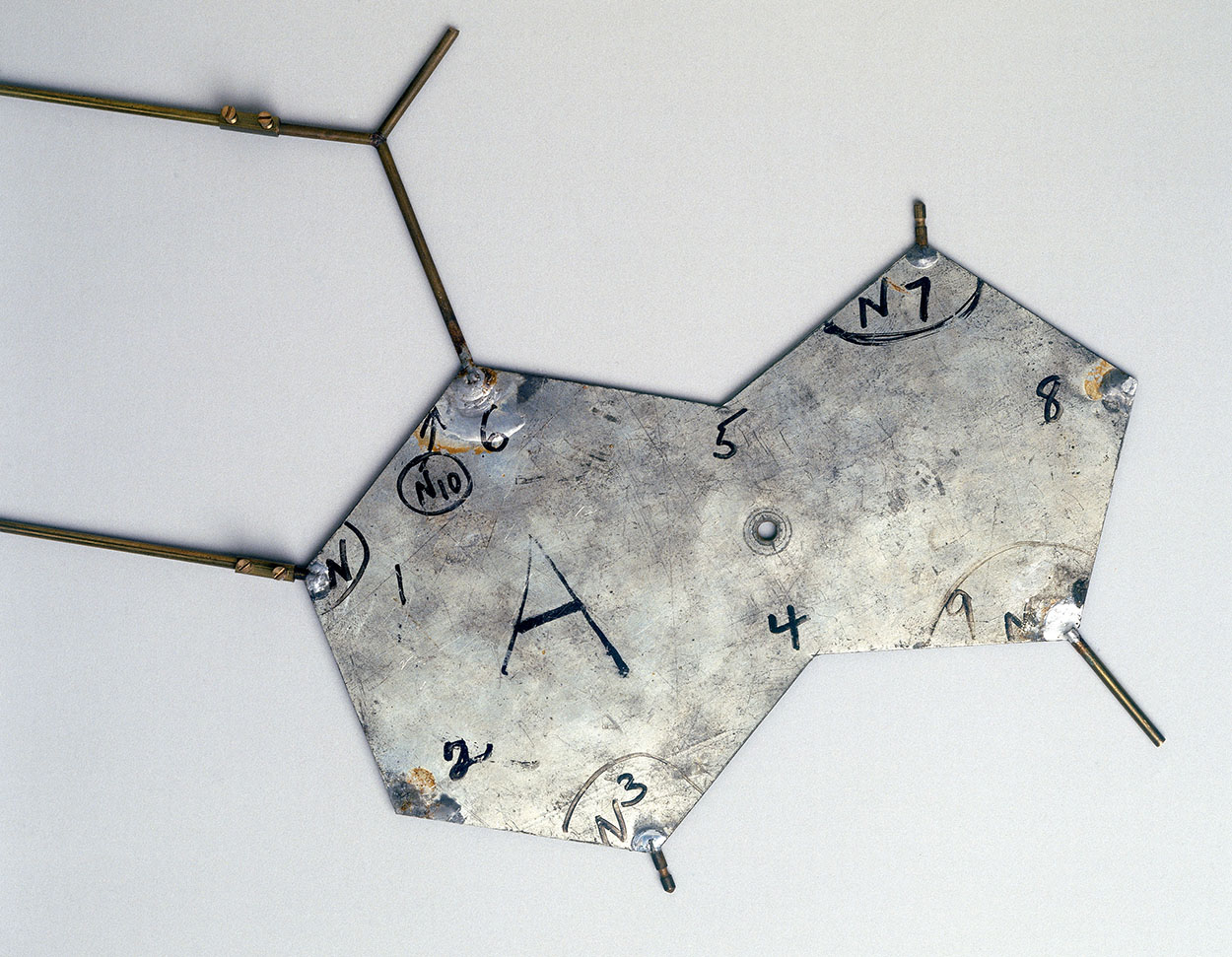

The story often told about the discovery of DNA is disputed.
What makes it interesting is this: the version meant to defend Rosalind Franklin is the one that does her the most harm.
From the cell to the gene
The human body is made up of about thirty trillion cells. Almost every one of them contains, in its nucleus, the same thing: forty-six chromosomes, arranged in pairs. A chromosome is a long molecule of DNA folded up on itself, associated with proteins that keep it organised.1
DNA carries information, and it carries it in a surprisingly simple form: a sequence of only four elements, written A, T, G and C, repeated billions of times. A gene is a segment of this sequence that gives a precise instruction — most often, the recipe for a protein. The proteins then do the work: they build, transport, repair, transmit signals.
The molecule has two strands facing each other, and each element of one strand can pair with only one element of the other: A with T, G with C. It is this rule that makes copying possible: if the molecule is split in two, each strand already contains everything needed to rebuild its missing partner. It is the structure itself that explains the copying — and the famous “Photo 51” helped to establish this helical structure.2
How it is passed on
Almost all the cells of the body have forty-six chromosomes; this is not the case for the reproductive cells, the egg in women and the spermatozoon in men, which have only twenty-three.
This is the key to the whole system. At fertilisation, one cell from each parent fuses: twenty-three plus twenty-three make forty-six, and the count is right for the new individual. Each child therefore receives roughly half of its DNA from each of its two biological parents.
But it does not receive the same half as its brothers and sisters. When the reproductive cells form, the pairs of chromosomes mix and exchange pieces, at random. Two children of the same parents receive different draws — which explains why they resemble each other without being identical. The only exceptions are identical twins, who come from a single egg split in two and share the same DNA.
This mechanism says what is passed on, and it also says what is not. Genes pass from one generation to the next; what each person does with their life is not written into them. A parent who learns the piano does not pass on the piano. It is an old error, and it keeps coming back in new forms — the rest of this page examines one of them.
The usual story
It is widely told.
Rosalind Franklin supposedly produced a diffraction image — the famous “Photo 51” — without understanding its significance. She supposedly kept it for months without making use of it. Then Watson supposedly saw it, understood it at a glance, and stole her discovery from her.
In 1968, one of the participants, James Watson, gave his personal account of it in a bestselling book.3
What two historians found in 2023
Two researchers were each working on a biography. Together they went through Franklin’s archives, at Churchill College, Cambridge, and went back over her notes.
There they found two overlooked documents:4
- A draft news article, written in 1953 in consultation with Franklin for an American magazine, and in the end never published.
- A letter sent to Crick by a colleague of Franklin’s.5
Both show the same thing: she knew perfectly well what her image implied.
The sentence that turns everything around
These two historians describe the problem with the usual story as follows:
In this telling, she is portrayed as a brilliant scientist, but one who was unable to decipher what her own data were telling her about DNA; Watson, for his part, supposedly grasped the significance of her image at a glance.6
In other words:
The story that presents her as a victim also presents her as unable to read her own work.
This is where their conclusion comes from: she did not fail to understand the structure of DNA. She was an equal contributor. The 1953 article would have presented her, with Maurice Wilkins, as one half of a team of four that articulated the question, took the first steps, provided crucial data and verified the result.7
The proof that the legend formed later
A dated fact supports the two historians’ case.
In June 1953, a few weeks after publication, one of the first public displays of the double helix took place at a Royal Society soirée.8
It was signed by the authors of the three papers. All of them.
At that moment, then, the discovery was seen not as a race won by two men, but as the outcome of a joint effort.9
For these two historians, the theft version does not correspond to what people thought in 1953. Watson’s book did not appear until 1968.
Fifteen years separate the event from this book. Another reading remains widespread: many believe that Watson saw an image taken by Franklin, without her permission or knowledge.10
A word almost always misunderstood
The word heritability is used everywhere, and it is one of the most misunderstood terms in genetics.
Its exact meaning is as follows.
When it is said that the heritability of height is 0.80, this means: in a given population, 80% of the differences in height between people are explained by genetic differences.11
It really is about the differences between people.
What it does not mean
It says nothing about any particular person.
It is impossible to say of a tall person that “their genes explain 80% of their height”. The sentence is meaningless.
Heritability describes variations within a group. It does not apportion the causes within an individual. It is a figure relating to a population, which does not carry over to a person.
The distinction that settles everything
One example makes it easy to remember.
Having two arms is entirely genetic. The programme that makes two arms is written in the DNA of all humans.
Yet the heritability of the number of arms is close to zero.
Why? Because the differences between people on this point come almost entirely from accidents — not from their genes.
A trait can be entirely genetic and have zero heritability. Two things must therefore be carefully distinguished:12
- a trait that is genetic, that is, produced by the programme;
- a trait that varies because of genes, that is, whose differences come from genes.
Heritability measures the second thing. Never the first.
Two further consequences
A high heritability does not make a trait fixed, nor the environment unimportant.
It is specific to a population and to a moment. If living conditions change — diet, health, schooling — heritability changes too, without a single gene having changed.13
It is a figure tied to a date and a place. Like almost all the figures on this site.
“The gene for” something
Headlines announce “the gene for” this or that.
It is almost always an inaccurate way of speaking, and the real figures are dizzying.
Complex traits are extremely polygenic: thousands of genetic variants, each with a tiny effect. For human height, one analysis estimates the number of variants involved at more than one hundred thousand.14
There is generally no common variant with a large effect. It takes hundreds or thousands of them, all small, to explain what is observed.
More troubling still
One piece of research puts it this way: for typical traits, most of the genetic effect appears to pass through genes that seem unrelated to the trait.15
The idea put forward is that very few genes act directly. All the others act indirectly, by altering the activity of the entire network — like a setting that shifts everything slightly.
So there is no “gene for” something to be found. There is a network to be understood.
What this page will not do
⚠ Two deliberate limits:
- It says nothing about any particular individual. A paper in statistical genetics bore an explicit title: High heritability does not imply accurate prediction under the small additive effects hypothesis. The shortcut between the heritability of a trait and what could be predicted about a person is criticised in the specialist literature itself.
- It does not deal with differences between human groups. That subject has its own entry (Entry 2.1).16
The thread to remember
This site has presented three quantities that share the same flaw:
- The effective dose (radiation protection, Entry 4.5), which does not quantify a person’s risk.
- The probability of rain (meteorology, Entry 7.9), which cannot be judged on a single day.
- Heritability (genetics, Entry 8.13), which speaks of variations within a group.
All three describe a series. All three are read as if they described a case.
It is perhaps the most frequent error that can be made with a number.
So where is the injustice?
It exists, but it lies somewhere other than where people look for it.
The two historians write that setting her story straight matters, and they say why:
She was up against not just the routine sexism of the day, but also more subtle forms embedded in science — some of which are still present today.17
The perspective is shifted as a result.
The theft story points to a culprit, a scene, a moment. It is comfortable: it happened in 1953, it was dreadful, it is over.
Reality is harder to grasp, and more relevant to today. It does not fit into a scene. It lies in the way teams are formed, the way credit is shared out, the way stories become fixed.
Correcting the legend therefore does not minimise the problem. It shifts it towards its real form — the one we do not see.
Two sentences not to write
- “Her discovery was stolen from her.” These two historians dispute it, even though many believe that her image was shown to Watson without her knowledge.
- “There was no injustice.” The same authors insist on the opposite.18
The two sentences appear on the same page, and that is precisely the point.
What this page does not do
This page does not talk about differences between humans.
That subject is dealt with elsewhere on this site (Entry 2.1), in a page that took a great deal of work. It explains what genetics really establishes about the diversity of humans, and where the word “race” comes from.
We do not repeat it here. We apply the rule that governs this whole domain: variation is the fact. The norm is an average.
Rosalind Franklin died in April 1958, at the age of thirty-seven.19
Note 1
For human cells, we identify the dominant role of the hematopoietic lineage to the total count (≈90%) and revise past estimates to 3.0·10¹³ human cells.
Sender, Ron, Fuchs, Shai and Milo, Ron, “Revised Estimates for the Number of Human and Bacteria Cells in the Body”, PLOS Biology, vol. 14, no. 8, e1002533, 2016
Note 2
It has not escaped our notice that the specific pairing we have postulated immediately suggests a possible copying mechanism for the genetic material.
Watson, James D. and Crick, Francis H. C., “Molecular Structure of Nucleic Acids”, Nature, vol. 171, 1953, p. 737-738 ; Wilkins, Maurice H. F., Stokes, Alexander R. et Wilson, Herbert R., “Molecular Structure of Deoxypentose Nucleic Acids”, ibid., p. 738-740 ; et Franklin, Rosalind E. et Gosling, Raymond G., “Molecular Configuration in Sodium Thymonucleate”, ibid., p. 740-741
Note 3
Franklin's work on DNA may have remained a quiet footnote in that story had Watson not caricatured her in his 1968 memoir, The Double Helix. […] His book proved very popular
U.S. National Library of Medicine, “Biographical Overview”, The Rosalind Franklin Papers, online collection Profiles in Science
Note 4
an overlooked letter from one of Franklin's colleagues to Crick
Université de Manchester, “Rosalind Franklin’s contribution to the discovery of DNA structure highlighted”, communiqué, 25 April 2023
Note 5
An overlooked letter and an unpublished news article, both written in 1953, reveal that she was an equal player. […] We also found a hitherto unstudied draft news article from 1953, written in consultation with Franklin and meant for Time, a US magazine with international reach — as well as an overlooked letter from one of Franklin's colleagues to Crick.
Cobb, Matthew and Comfort, Nathaniel, “What Rosalind Franklin Truly Contributed to the Discovery of DNA’s Structure”, Nature, vol. 616, 25 April 2023, p. 657-660
Note 6
In this telling, Franklin, who died of ovarian cancer in 1958 at just 37, is portrayed as a brilliant scientist, but one who was ultimately unable to decipher what her own data were telling her about DNA. She supposedly sat on the image for months without realizing its significance, only for Watson to understand it at a glance.
Cobb, Matthew and Comfort, Nathaniel, “What Rosalind Franklin Truly Contributed to the Discovery of DNA’s Structure”, Nature, vol. 616, 25 April 2023, p. 657-660
Note 7
She was an equal contributor to solving it. […] one, consisting of Wilkins and Franklin, gathering experimental evidence using X-ray analysis; […] Franklin would have been represented as an equal member of a quartet who solved the double helix, one half of the team that articulated the scientific question, took important early steps towards a solution, provided crucial data and verified the result
Cobb, Matthew and Comfort, Nathaniel, “What Rosalind Franklin Truly Contributed to the Discovery of DNA’s Structure”, Nature, vol. 616, 25 April 2023, p. 657-660
Note 8
one of the first public displays of the double helix, at the Royal Society Conversazione in June 1953, was signed by the authors of all three Nature papers
Cobb, Matthew and Comfort, Nathaniel, “What Rosalind Franklin Truly Contributed to the Discovery of DNA’s Structure”, Nature, vol. 616, 25 April 2023, p. 657-660
Note 9
In this early incarnation, the discovery of the structure of DNA was not seen as a race won by Watson and Crick, but as the outcome of a joint effort.
Cobb, Matthew and Comfort, Nathaniel, “What Rosalind Franklin Truly Contributed to the Discovery of DNA’s Structure”, Nature, vol. 616, 25 April 2023, p. 657-660
Note 10
Many believe the eureka moment came when Watson was shown an X-ray image of DNA taken by Franklin, without her permission or knowledge.
Université de Manchester, “Rosalind Franklin’s contribution to the discovery of DNA structure highlighted”, communiqué, 25 April 2023
Note 11
Heritability, the proportion of variation in a particular trait that is attributable to genetic factors, is a fundamental parameter in genetics.
Visscher, Peter M., Hill, William G. and Wray, Naomi R., “Heritability in the Genomics Era — Concepts and Misconceptions”, Nature Reviews Genetics, vol. 9, 2008, p. 255-266
Note 12
The classic example of the heritability coefficient defying intuition is the trait of having two arms. No one would argue against the development of arms being a biological, genetic process. But fraternal twins are just as similar for “two-armedness” as identical twins, resulting in a heritability coefficient of zero for the trait of having two arms.
Turkheimer, Eric, “The Nature-Nurture Question”, in Biswas-Diener, Robert and Diener, Ed (eds), Noba Textbook Series: Psychology, DEF Publishers, online
Note 13
Heritability is not necessarily constant in a population. Changes in the method of measurement, environmental change and the effects of migration, selection and inbreeding all can alter heritability.
Visscher, Peter M., Hill, William G. and Wray, Naomi R., “Heritability in the Genomics Era — Concepts and Misconceptions”, Nature Reviews Genetics, vol. 9, 2008, p. 255-266
Note 14
Putting the various lines of evidence together, we estimate that more than 100,000 SNPs exert independent causal effects on height, similar to an early estimate of 93,000 causal variants based on a different approach (Goldstein, 2009)(Supplemental Information).
Boyle, Evan A., Li, Yang I. and Pritchard, Jonathan K., “An Expanded View of Complex Traits: From Polygenic to Omnigenic”, Cell, vol. 169, no. 7, 2017, p. 1177-1186
Note 15
We propose that gene regulatory networks are sufficiently interconnected such that all genes expressed in disease-relevant cells are liable to affect the functions of core disease-related genes and that most heritability can be explained by effects on genes outside core pathways.
Boyle, Evan A., Li, Yang I. and Pritchard, Jonathan K., “An Expanded View of Complex Traits: From Polygenic to Omnigenic”, Cell, vol. 169, no. 7, 2017, p. 1177-1186
Note 16
These formulae clearly show that a high heritability does not imply an accurate prediction when p>n.
Frouin, Arthur, Dandine-Roulland, Claire, Pierre-Jean, Morgane, Deleuze, Jean-François, Ambroise, Christophe and Le Floch, Edith, “High heritability does not imply accurate prediction under the small additive effects hypothesis”, preprint arXiv:2007.05424, 2020
Note 17
She was up against not just the routine sexism of the day, but also more subtle forms embedded in science — some of which are still present today.
Cobb, Matthew and Comfort, Nathaniel, “What Rosalind Franklin Truly Contributed to the Discovery of DNA’s Structure”, Nature, vol. 616, 25 April 2023, p. 657-660
Note 18
an equal contributor — not a victim
Université de Manchester, “Rosalind Franklin’s contribution to the discovery of DNA structure highlighted”, communiqué, 25 April 2023
Note 19
Rosalind Elsie Franklin, the brilliant chemist whose x-ray diffraction studies provided crucial clues […] was born in London on July 25, 1920, the second of five children in a prominent Anglo-Jewish family. […] She died in London on April 16, 1958.
U.S. National Library of Medicine, “Biographical Overview”, The Rosalind Franklin Papers, online collection Profiles in Science
Notes and sources
- ↑
Passage The human body is made up of about thirty trillion cells.
For human cells, we identify the dominant role of the hematopoietic lineage to the total count (≈90%) and revise past estimates to 3.0·10¹³ human cells.
Source Sender, Ron, Fuchs, Shai and Milo, Ron, “Revised Estimates for the Number of Human and Bacteria Cells in the Body”, PLOS Biology, vol. 14, no. 8, e1002533, 2016, summary (abstract).
Open access open the source · checked on 24 October 2026
- ↑
Passage It is the structure itself that explains the copying
It has not escaped our notice that the specific pairing we have postulated immediately suggests a possible copying mechanism for the genetic material.
Source Watson, James D. and Crick, Francis H. C., “Molecular Structure of Nucleic Acids”, Nature, vol. 171, 1953, p. 737-738 ; Wilkins, Maurice H. F., Stokes, Alexander R. et Wilson, Herbert R., “Molecular Structure of Deoxypentose Nucleic Acids”, ibid., p. 738-740 ; et Franklin, Rosalind E. et Gosling, Raymond G., “Molecular Configuration in Sodium Thymonucleate”, ibid., p. 740-741, Watson and Crick, p. 737-738, penultimate paragraph of the text.
Paywalled · checked on 9 September 2026
- ↑
Passage In 1968, one of the participants, James Watson, gave his personal account of it in a bestselling book.
Franklin's work on DNA may have remained a quiet footnote in that story had Watson not caricatured her in his 1968 memoir, The Double Helix. […] His book proved very popular
Source U.S. National Library of Medicine, “Biographical Overview”, The Rosalind Franklin Papers, online collection Profiles in Science, “Biographical Overview” page, last paragraph of the text.
Open access open the source · checked on 27 October 2026
- ↑
Passage There they found two overlooked documents
an overlooked letter from one of Franklin's colleagues to Crick
Source Université de Manchester, “Rosalind Franklin’s contribution to the discovery of DNA structure highlighted”, communiqué, 25 April 2023, body of the press release.
Open access open the source · checked on 24 October 2026
- ↑
Passage A draft news article, written in 1953 […] A letter sent to Crick by a colleague of Franklin’s.
An overlooked letter and an unpublished news article, both written in 1953, reveal that she was an equal player. […] We also found a hitherto unstudied draft news article from 1953, written in consultation with Franklin and meant for Time, a US magazine with international reach — as well as an overlooked letter from one of Franklin's colleagues to Crick.
Source Cobb, Matthew and Comfort, Nathaniel, “What Rosalind Franklin Truly Contributed to the Discovery of DNA’s Structure”, Nature, vol. 616, 25 April 2023, p. 657-660, standfirst; body of the article.
Paywalled open the source · checked on 9 September 2026
- ↑
Passage In this telling, she is portrayed as a brilliant scientist, but one who was unable to decipher what her own data were telling her about DNA; Watson, for his part, supposedly grasped the significance of her image at a glance.
In this telling, Franklin, who died of ovarian cancer in 1958 at just 37, is portrayed as a brilliant scientist, but one who was ultimately unable to decipher what her own data were telling her about DNA. She supposedly sat on the image for months without realizing its significance, only for Watson to understand it at a glance.
Source Cobb, Matthew and Comfort, Nathaniel, “What Rosalind Franklin Truly Contributed to the Discovery of DNA’s Structure”, Nature, vol. 616, 25 April 2023, p. 657-660, introduction of the article.
Paywalled open the source · checked on 9 September 2026
- ↑
Passage She was an equal contributor. The 1953 article would have presented her, with Maurice Wilkins, as one half of a team of four that articulated the question, took the first steps, provided crucial data and verified the result.
She was an equal contributor to solving it. […] one, consisting of Wilkins and Franklin, gathering experimental evidence using X-ray analysis; […] Franklin would have been represented as an equal member of a quartet who solved the double helix, one half of the team that articulated the scientific question, took important early steps towards a solution, provided crucial data and verified the result
Source Cobb, Matthew and Comfort, Nathaniel, “What Rosalind Franklin Truly Contributed to the Discovery of DNA’s Structure”, Nature, vol. 616, 25 April 2023, p. 657-660, p. 657 and p. 660.
Paywalled open the source · checked on 9 September 2026
- ↑
Passage In June 1953 […] one of the first public displays of the double helix […] It was signed by the authors of the three papers.
one of the first public displays of the double helix, at the Royal Society Conversazione in June 1953, was signed by the authors of all three Nature papers
Source Cobb, Matthew and Comfort, Nathaniel, “What Rosalind Franklin Truly Contributed to the Discovery of DNA’s Structure”, Nature, vol. 616, 25 April 2023, p. 657-660, body of the article.
Paywalled open the source · checked on 9 September 2026
- ↑
Passage the discovery was seen not as a race won by two men, but as the outcome of a joint effort
In this early incarnation, the discovery of the structure of DNA was not seen as a race won by Watson and Crick, but as the outcome of a joint effort.
Source Cobb, Matthew and Comfort, Nathaniel, “What Rosalind Franklin Truly Contributed to the Discovery of DNA’s Structure”, Nature, vol. 616, 25 April 2023, p. 657-660, body of the article.
Paywalled open the source · checked on 9 September 2026
- ↑
Passage Another reading remains widespread: many believe that Watson saw an image taken by Franklin, without her permission or knowledge.
Many believe the eureka moment came when Watson was shown an X-ray image of DNA taken by Franklin, without her permission or knowledge.
Source Université de Manchester, “Rosalind Franklin’s contribution to the discovery of DNA structure highlighted”, communiqué, 25 April 2023, beginning of the press release.
Open access open the source · checked on 24 October 2026
- ↑
Passage in a given population, 80% of the differences in height between people are explained by genetic differences
Heritability, the proportion of variation in a particular trait that is attributable to genetic factors, is a fundamental parameter in genetics.
Source Visscher, Peter M., Hill, William G. and Wray, Naomi R., “Heritability in the Genomics Era — Concepts and Misconceptions”, Nature Reviews Genetics, vol. 9, 2008, p. 255-266, “Key points” box (article page).
Paywalled · checked on 25 October 2026
- ↑
Passage A trait can be entirely genetic and have zero heritability.
The classic example of the heritability coefficient defying intuition is the trait of having two arms. No one would argue against the development of arms being a biological, genetic process. But fraternal twins are just as similar for “two-armedness” as identical twins, resulting in a heritability coefficient of zero for the trait of having two arms.
Source Turkheimer, Eric, “The Nature-Nurture Question”, in Biswas-Diener, Robert and Diener, Ed (eds), Noba Textbook Series: Psychology, DEF Publishers, online, section “What Have We Learned About Nature–Nurture?”, paragraph on the trait of having two arms.
Open access open the source · checked on 27 October 2026
- ↑
Passage It is specific to a population and to a moment.
Heritability is not necessarily constant in a population. Changes in the method of measurement, environmental change and the effects of migration, selection and inbreeding all can alter heritability.
Source Visscher, Peter M., Hill, William G. and Wray, Naomi R., “Heritability in the Genomics Era — Concepts and Misconceptions”, Nature Reviews Genetics, vol. 9, 2008, p. 255-266, “Key points” box (article page).
Paywalled · checked on 25 October 2026
- ↑
Passage For human height, one analysis estimates the number of variants involved at more than one hundred thousand.
Putting the various lines of evidence together, we estimate that more than 100,000 SNPs exert independent causal effects on height, similar to an early estimate of 93,000 causal variants based on a different approach (Goldstein, 2009)(Supplemental Information).
Source Boyle, Evan A., Li, Yang I. and Pritchard, Jonathan K., “An Expanded View of Complex Traits: From Polygenic to Omnigenic”, Cell, vol. 169, no. 7, 2017, p. 1177-1186, p. 1179, section “Distribution of GWAS Signals across the Genome”.
Open access open the source · checked on 24 October 2026
- ↑
Passage for typical traits, most of the genetic effect appears to pass through genes that seem unrelated to the trait
We propose that gene regulatory networks are sufficiently interconnected such that all genes expressed in disease-relevant cells are liable to affect the functions of core disease-related genes and that most heritability can be explained by effects on genes outside core pathways.
Source Boyle, Evan A., Li, Yang I. and Pritchard, Jonathan K., “An Expanded View of Complex Traits: From Polygenic to Omnigenic”, Cell, vol. 169, no. 7, 2017, p. 1177-1186, p. 1177, summary (abstract).
Open access open the source · checked on 24 October 2026
- ↑
Passage A paper in statistical genetics bore an explicit title: High heritability does not imply accurate prediction under the small additive effects hypothesis.
These formulae clearly show that a high heritability does not imply an accurate prediction when p>n.
Source Frouin, Arthur, Dandine-Roulland, Claire, Pierre-Jean, Morgane, Deleuze, Jean-François, Ambroise, Christophe and Le Floch, Edith, “High heritability does not imply accurate prediction under the small additive effects hypothesis”, preprint arXiv:2007.05424, 2020, abstract of version 1 (submitted on 10 July 2020), whose title is “High heritability does not imply accurate prediction under the small additive effects hypothesis”.
Open access open the source · checked on 24 October 2026
- ↑
Passage not just the routine sexism of the day, but also more subtle forms embedded in science — some of which are still present today
She was up against not just the routine sexism of the day, but also more subtle forms embedded in science — some of which are still present today.
Source Cobb, Matthew and Comfort, Nathaniel, “What Rosalind Franklin Truly Contributed to the Discovery of DNA’s Structure”, Nature, vol. 616, 25 April 2023, p. 657-660, body of the article.
Paywalled open the source · checked on 9 September 2026
- ↑
Passage These two historians dispute it, even though many believe that her image was shown to Watson without her knowledge.
an equal contributor — not a victim
Source Université de Manchester, “Rosalind Franklin’s contribution to the discovery of DNA structure highlighted”, communiqué, 25 April 2023, body of the press release.
Open access open the source · checked on 24 October 2026
- ↑
Passage Rosalind Franklin died in April 1958, at the age of thirty-seven
Rosalind Elsie Franklin, the brilliant chemist whose x-ray diffraction studies provided crucial clues […] was born in London on July 25, 1920, the second of five children in a prominent Anglo-Jewish family. […] She died in London on April 16, 1958.
Source U.S. National Library of Medicine, “Biographical Overview”, The Rosalind Franklin Papers, online collection Profiles in Science, “Biographical Overview” page, 1st and 8th paragraphs.
Open access open the source · checked on 27 October 2026
Bibliography
10
- Boyle, Evan A., Li, Yang I. and Pritchard, Jonathan K., “An Expanded View of Complex Traits: From Polygenic to Omnigenic”, Cell, vol. 169, no. 7, 2017, p. 1177-1186, open access (the omnigenic model, the extreme polygenicity of human height, the effect passing through genes with no apparent connection).
- Cobb, Matthew and Comfort, Nathaniel, “What Rosalind Franklin Truly Contributed to the Discovery of DNA’s Structure”, Nature, vol. 616, 25 April 2023, p. 657-660, paywalled (the two archival documents: a 1953 draft news article and a letter to Crick; the usual portrait of a victim who supposedly did not understand her data; her status as an equal contributor within a quartet; the display signed by the authors of the three papers in June 1953; the reduction to the role of wronged heroine; the routine sexism and its more subtle forms embedded in science). https://doi.org/10.1038/d41586-023-01313-5
- Frouin, Arthur, Dandine-Roulland, Claire, Pierre-Jean, Morgane, Deleuze, Jean-François, Ambroise, Christophe and Le Floch, Edith, “High heritability does not imply accurate prediction under the small additive effects hypothesis”, preprint arXiv:2007.05424, 2020, open access (the explicit title on heritability and prediction); published version under the title “Exploring the Link Between Additive Heritability and Prediction Accuracy From a Ridge Regression Perspective”, Frontiers in Genetics, vol. 11, 2020, article 581594. https://arxiv.org/abs/2007.05424v1
- Sender, Ron, Fuchs, Shai and Milo, Ron, “Revised Estimates for the Number of Human and Bacteria Cells in the Body”, PLOS Biology, vol. 14, no. 8, e1002533, 2016, open access (the number of human cells; see entry 6.14). https://doi.org/10.1371/journal.pbio.1002533
- Turkheimer, Eric, “The Nature-Nurture Question”, in Biswas-Diener, Robert and Diener, Ed (eds), Noba Textbook Series: Psychology, DEF Publishers, online, open access (the classic example of the trait of having two arms, genetic yet with zero heritability, differences in arm number coming from accidents). https://nobaproject.com/modules/the-nature-nurture-question
- U.S. National Library of Medicine, “Biographical Overview”, The Rosalind Franklin Papers, online collection Profiles in Science, open access (Rosalind Franklin’s dates of birth and death: 25 July 1920 and 16 April 1958). https://profiles.nlm.nih.gov/spotlight/kr/feature/biographical-overview
- Université de Manchester, “Rosalind Franklin’s contribution to the discovery of DNA structure highlighted”, communiqué, 25 April 2023, open access (the common reading: Franklin’s image shown to Watson without her permission; the overlooked documents). https://www.manchester.ac.uk/about/news/rosalind-franklins-contribution-to-the-discovery-of-dna-structure-highlighted/
- Visscher, Peter M., Hill, William G. and Wray, Naomi R., “Heritability in the Genomics Era — Concepts and Misconceptions”, Nature Reviews Genetics, vol. 9, 2008, p. 255-266, paywalled (heritability as a population statistic and not one of individual prediction; the example of genetic traits with zero heritability; the dependence on population and moment).
- Watson, James D. and Crick, Francis H. C., “Molecular Structure of Nucleic Acids”, Nature, vol. 171, 1953, p. 737-738 ; Wilkins, Maurice H. F., Stokes, Alexander R. et Wilson, Herbert R., “Molecular Structure of Deoxypentose Nucleic Acids”, ibid., p. 738-740 ; et Franklin, Rosalind E. et Gosling, Raymond G., “Molecular Configuration in Sodium Thymonucleate”, ibid., p. 740-741, paywalled (the three papers published side by side on 25 April 1953).
- Watson, James D., The Double Helix: A Personal Account of the Discovery of the Structure of DNA, Atheneum, 1968, in libraries (Watson’s personal account, published in 1968).
See also: human diversity and population genetics are dealt with in entry 2.1, with its sources.
Spotted an error or have a doubt? Write to us.