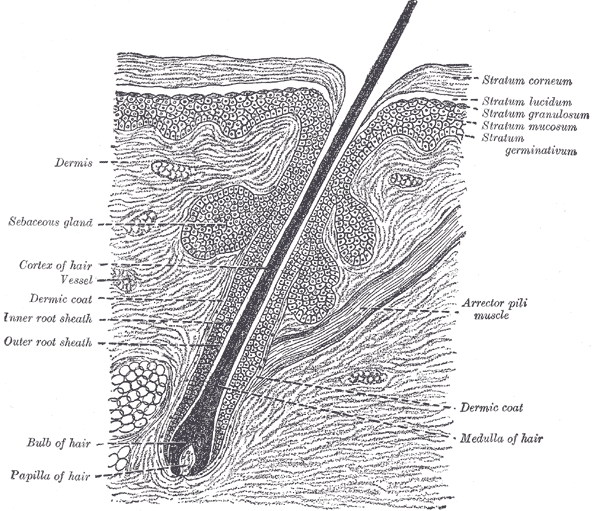

Shaving does not make hair grow back coarser: this was measured as early as 1928.
This page examines two received ideas about hair and nails, this one and another, older one. Both start from a correct observation that was misinterpreted — and their explanation is far more interesting than the myth itself.
What really happens
After death, the tissues retract: they lose their water and dry out.1
The skin surrounding the base of the nails and hairs draws back slightly. What was hidden beneath the epidermis then becomes visible.
A contrast effect adds to this: the soft tissues have shrunk, the nails and hair have not. The difference between the two makes the latter look longer than they were.2
The apparent lengthening is explained by a retraction of the skin, not by growth.3
Nothing has grown. What has changed is what we can see.
A forensic anthropologist quoted in the medical literature puts it in one sentence: it is a powerful, disturbing image, but it is pure moonshine. No such thing occurs.4
Two received ideas to take apart
“Hair and nails keep growing after death”
This claim is false — and yet the observation that produced it was correct.
As it dehydrates, the skin retracts around the nails and hair follicles, uncovering the hidden part of the hair shaft and of the nail plate.
The observation was accurate; the explanation was not. This is a common situation: one can observe a phenomenon correctly and be completely wrong about its cause.
A fundamental reason, moreover, makes this growth impossible: growing a hair or a nail requires living cells and regulation by hormones. All of this stops at death.5
How a false idea travels
This case is instructive because it lets us follow the routes the myth has taken.
It circulates through fiction: a great novel about the First World War describes a comrade’s fingernails growing in corkscrews after his burial.6
It circulates through humour. A famous American television host had made a joke of it: for three days after death hair and fingernails continue to grow, but phone calls taper off.7
A joke does not try to convince. That is precisely why it gets through without being examined. We laugh, we remember, we do not check.
“Shaving makes hair grow back thicker”
This, too, is a received idea.
Shaving cuts the hair at the level of the pore. It does not interfere with the root, which lies deeper and determines the thickness, the rate of growth and the pigmentation.8
This is no longer a matter of deduction, but of measurement. A 1928 study, since confirmed, established that shaving has no effect on either the rate of regrowth or the thickness of the hair.9
Three impressions, three simple explanations:
- Coarser? An unshaven hair tapers towards its tip. A cleanly cut hair no longer has this fine tip: it emerges at its full thickness, which makes it feel rougher to the touch.
- Stiffer? A short hair bends less than a long one. It is a question of length, not of nature.
- Darker? An old hair has been bleached by the sun. A new hair has not been yet.10
Here again, the sensations are real, but their interpretation is wrong.
The common pattern
These two beliefs share the same structure:
- An accurate observation is made.
- A plausible but false explanation is put forward.
- The false explanation is passed on and replaces the original observation.
Many false ideas do not come from people who saw nothing. They come from facts that were correctly observed but misinterpreted.
The skin: an organ in its own right
The skin is not just a protective envelope. It is a complete organ — the largest in the human body, covering about 1.5 to 2 m² of surface area in an adult.11
It performs vital functions:
- Protection against external aggressions and microbes.
- Thermoregulation through sweating and blood flow.
- Sensory perception (touch, temperature, pain).
- Continuous cell renewal.
The case of fingerprints
On the surface of the skin of the fingers, the papillary ridges form unique patterns. While the uniqueness of these patterns is widely accepted, the analysis of prints by human comparison remains a method with a margin of error, which calls for strict scientific rigour in expert examinations.12
Diversity and representations
Skin, hair and nails vary greatly from one individual to another (colour, texture, shape).
Biological variation is a natural fact: there is no “normal” body from which the others deviate.
Note: The mechanisms of skin pigmentation and the genetic origin of its variations are covered separately in the article devoted to human diversity (see links below).
Note 1
dehydration of the body after death and drying or desiccation may lead to retraction of the skin around the hair or nails
Vreeman, Rachel C. and Carroll, Aaron E., “Medical Myths”, BMJ, vol. 335, 2007, p. 1288-1289
Note 2
The skin's retraction can create an appearance of increased length or of greater prominence because of the optical illusion created by contrasting the shrunken soft tissues with the nails or hair.
Vreeman, Rachel C. and Carroll, Aaron E., “Medical Myths”, BMJ, vol. 335, 2007, p. 1288-1289
Note 3
The skin's retraction can create an appearance of increased length or of greater prominence because of the optical illusion created by contrasting the shrunken soft tissues with the nails or hair.
Vreeman, Rachel C. and Carroll, Aaron E., “Medical Myths”, BMJ, vol. 335, 2007, p. 1288-1289
Note 4
It is a powerful, disturbing image, but it is pure moonshine. No such thing occurs.
Vreeman, Rachel C. and Carroll, Aaron E., “Medical Myths”, BMJ, vol. 335, 2007, p. 1288-1289
Note 5
Hair and fingernail growth requires hormonal regulation that stops after someone dies.
Vreeman, Rachel C. and Carroll, Aaron E., “Medical Myths”, BMJ, vol. 335, 2007, p. 1288-1289
Note 6
In All Quiet on the Western Front, the author describes a friend's fingernails growing in corkscrews after the burial.
Vreeman, Rachel C. and Carroll, Aaron E., “Medical Myths”, BMJ, vol. 335, 2007, p. 1288-1289
Note 7
For three days after death hair and fingernails continue to grow, but phone calls taper off.
Vreeman, Rachel C. and Carroll, Aaron E., “Medical Myths”, BMJ, vol. 335, 2007, p. 1288-1289
Note 8
Shaving does not affect the hair follicle that rests in the deeper layer of the skin.
Vreeman, Rachel C. and Carroll, Aaron E., “Medical Myths”, BMJ, vol. 335, 2007, p. 1288-1289
Note 9
As early as 1928, a clinical trial showed that shaving had no effect on hair growth. […] More recent studies confirm that shaving does not affect the thickness or rate of hair regrowth. […]
Vreeman, Rachel C. and Carroll, Aaron E., “Medical Myths”, BMJ, vol. 335, 2007, p. 1288-1289
Note 10
shaved hair lacks the finer taper seen at the ends of unshaven hair, giving an impression of coarseness
Vreeman, Rachel C. and Carroll, Aaron E., “Medical Myths”, BMJ, vol. 335, 2007, p. 1288-1289
newly grown hair looks darker because the sun hasn't had a chance to bleach it
Vreeman, Rachel C. and Carroll, Aaron E., “Medical Myths”, BMJ, vol. 335, 2007, p. 1288-1289
Note 11
But it is still our heaviest and largest organ, making up about one seventh of our body weight: Depending on your height and body mass, it weighs between 3.5 and 10 kilograms (7.5 and 22 pounds) and has a surface area of 1.5 to 2 square meters.
Institute for Quality and Efficiency in Health Care (IQWiG), “How does skin work?”, InformedHealth.org, updated 22 April 2025
Note 12
But at the heart of the discipline is the fundamental principle that allows for conclusive determinations: the source of the impression, friction ridge skin, is unique and persistent.
Wertheim, Kasey, “Embryology and Morphology of Friction Ridge Skin”, chap. 3 in National Institute of Justice, The Fingerprint Sourcebook, U.S. Department of Justice, 2011
PCAST finds that latent fingerprint analysis is a foundationally valid subjective methodology—albeit with a false positive rate that is substantial and is likely to be higher than expected by many jurors based on longstanding claims about the infallibility of fingerprint analysis. The false-positive rate could be as high as 1 error in 306 cases based on the FBI study and 1 error in 18 cases based on a study by another crime laboratory.
President’s Council of Advisors on Science and Technology (États-Unis), Forensic Science in Criminal Courts: Ensuring Scientific Validity of Feature-Comparison Methods, September 2016
Notes and sources
- ↑
Passage After death, the tissues retract: they lose their water and dry out.
dehydration of the body after death and drying or desiccation may lead to retraction of the skin around the hair or nails
Source Vreeman, Rachel C. and Carroll, Aaron E., “Medical Myths”, BMJ, vol. 335, 2007, p. 1288-1289, body of the article.
Open access open the source · checked on 9 September 2026
- ↑
Passage the soft tissues have shrunk, the nails and hair have not. The difference between the two makes the latter look longer
The skin's retraction can create an appearance of increased length or of greater prominence because of the optical illusion created by contrasting the shrunken soft tissues with the nails or hair.
Source Vreeman, Rachel C. and Carroll, Aaron E., “Medical Myths”, BMJ, vol. 335, 2007, p. 1288-1289, body of the article.
Open access open the source · checked on 9 September 2026
- ↑
Passage The apparent lengthening is explained by a retraction of the skin, not by growth.
The skin's retraction can create an appearance of increased length or of greater prominence because of the optical illusion created by contrasting the shrunken soft tissues with the nails or hair.
Source Vreeman, Rachel C. and Carroll, Aaron E., “Medical Myths”, BMJ, vol. 335, 2007, p. 1288-1289, body of the article.
Open access open the source · checked on 27 October 2026
- ↑
Passage it is a powerful, disturbing image, but it is pure moonshine. No such thing occurs.
It is a powerful, disturbing image, but it is pure moonshine. No such thing occurs.
Source Vreeman, Rachel C. and Carroll, Aaron E., “Medical Myths”, BMJ, vol. 335, 2007, p. 1288-1289, quotation from William Maples.
Open access open the source · checked on 9 September 2026
- ↑
Passage growing a hair or a nail requires living cells and regulation by hormones […] All of this stops at death.
Hair and fingernail growth requires hormonal regulation that stops after someone dies.
Source Vreeman, Rachel C. and Carroll, Aaron E., “Medical Myths”, BMJ, vol. 335, 2007, p. 1288-1289, summary of the article.
Open access open the source · checked on 9 September 2026
- ↑
Passage a great novel about the First World War describes a comrade’s fingernails growing in corkscrews after his burial
In All Quiet on the Western Front, the author describes a friend's fingernails growing in corkscrews after the burial.
Source Vreeman, Rachel C. and Carroll, Aaron E., “Medical Myths”, BMJ, vol. 335, 2007, p. 1288-1289, body of the article.
Open access open the source · checked on 9 September 2026
- ↑
Passage for three days after death hair and fingernails continue to grow, but phone calls taper off
For three days after death hair and fingernails continue to grow, but phone calls taper off.
Source Vreeman, Rachel C. and Carroll, Aaron E., “Medical Myths”, BMJ, vol. 335, 2007, p. 1288-1289, joke quoted in the article.
Open access open the source · checked on 9 September 2026
- ↑
Passage Shaving cuts the hair at the level of the pore. It does not interfere with the root, which lies deeper
Shaving does not affect the hair follicle that rests in the deeper layer of the skin.
Source Vreeman, Rachel C. and Carroll, Aaron E., “Medical Myths”, BMJ, vol. 335, 2007, p. 1288-1289, body of the article.
Open access open the source · checked on 9 September 2026
- ↑
Passage A 1928 study, since confirmed, established that shaving has no effect on either the rate of regrowth or the thickness of the hair.
As early as 1928, a clinical trial showed that shaving had no effect on hair growth. […] More recent studies confirm that shaving does not affect the thickness or rate of hair regrowth. […]
Source Vreeman, Rachel C. and Carroll, Aaron E., “Medical Myths”, BMJ, vol. 335, 2007, p. 1288-1289, section “Shaving hair causes it to grow back faster, darker, or coarser” (reference markers w28, then w29 and w30, replaced by “[…]”).
Open access open the source · checked on 27 October 2026
- ↑
Passage A cleanly cut hair no longer has this fine tip: it emerges at its full thickness, which makes it feel rougher to the touch.
shaved hair lacks the finer taper seen at the ends of unshaven hair, giving an impression of coarseness
Source Vreeman, Rachel C. and Carroll, Aaron E., “Medical Myths”, BMJ, vol. 335, 2007, p. 1288-1289, body of the article.
Open access open the source · checked on 9 September 2026
Passage An old hair has been bleached by the sun. A new hair has not been yet.
newly grown hair looks darker because the sun hasn't had a chance to bleach it
Source Vreeman, Rachel C. and Carroll, Aaron E., “Medical Myths”, BMJ, vol. 335, 2007, p. 1288-1289, body of the article.
Open access open the source · checked on 9 September 2026
- ↑
Passage the largest in the human body, covering about 1.5 to 2 m² of surface area in an adult
But it is still our heaviest and largest organ, making up about one seventh of our body weight: Depending on your height and body mass, it weighs between 3.5 and 10 kilograms (7.5 and 22 pounds) and has a surface area of 1.5 to 2 square meters.
Source Institute for Quality and Efficiency in Health Care (IQWiG), “How does skin work?”, InformedHealth.org, updated 22 April 2025, introduction of the page (before the subheading “What does skin do?”).
Open access open the source · checked on 27 October 2026
- ↑
Passage the papillary ridges form unique patterns
But at the heart of the discipline is the fundamental principle that allows for conclusive determinations: the source of the impression, friction ridge skin, is unique and persistent.
Source Wertheim, Kasey, “Embryology and Morphology of Friction Ridge Skin”, chap. 3 in National Institute of Justice, The Fingerprint Sourcebook, U.S. Department of Justice, 2011, chap. 3, section 3.1, p. 3-3.
Open access open the source · checked on 27 October 2026
Passage the analysis of prints by human comparison remains a method with a margin of error
PCAST finds that latent fingerprint analysis is a foundationally valid subjective methodology—albeit with a false positive rate that is substantial and is likely to be higher than expected by many jurors based on longstanding claims about the infallibility of fingerprint analysis. The false-positive rate could be as high as 1 error in 306 cases based on the FBI study and 1 error in 18 cases based on a study by another crime laboratory.
Source President’s Council of Advisors on Science and Technology (États-Unis), Forensic Science in Criminal Courts: Ensuring Scientific Validity of Feature-Comparison Methods, September 2016, Executive Summary, section “Latent Fingerprint Analysis”, pp. 10-11.
Open access open the source · checked on 27 October 2026
Bibliography
8
- Institute for Quality and Efficiency in Health Care (IQWiG), “How does skin work?”, InformedHealth.org, updated 22 April 2025, open access (the skin, the heaviest and largest organ in the body, with a surface area of 1.5 to 2 m²). https://www.informedhealth.org/how-does-skin-work.html
- Locard, Edmond, Traité de criminalistique, tome 1, Desvigne, 1931, in libraries (the beginnings of fingerprint comparison).
- President’s Council of Advisors on Science and Technology (États-Unis), Forensic Science in Criminal Courts: Ensuring Scientific Validity of Feature-Comparison Methods, September 2016, open access (the margins of error of fingerprint comparison by human examiners).
- Tortora, Gerard J. and Derrickson, Bryan, Principes d’anatomie et de physiologie, De Boeck, 2017, chapitre sur le tégument, in libraries (the surface area of the skin and the functions of the skin).
- Trotter, Mildred, “Hair Growth and Shaving”, The Anatomical Record, vol. 37, no. 4, 1928, p. 373-379, paywalled (the experimental study of the effect of shaving on hair regrowth). https://doi.org/10.1002/ar.1090370405
- Vreeman, Rachel C. and Carroll, Aaron E., “Medical Myths”, BMJ, vol. 335, 2007, p. 1288-1289, open access (the seven beliefs reviewed; the need for hormonal regulation; the retraction of the skin and the resulting optical contrast; the forensic anthropologist’s quotation; the spread of the myth through the novel and through the joke; the absence of any measured effect of shaving and the explanation of the fine taper). https://pmc.ncbi.nlm.nih.gov/articles/PMC2151163/
- Wertheim, Kasey, “Embryology and Morphology of Friction Ridge Skin”, chap. 3 in National Institute of Justice, The Fingerprint Sourcebook, U.S. Department of Justice, 2011, open access (the uniqueness and persistence of friction ridge skin, the fundamental principle of fingerprint identification). https://www.ojp.gov/pdffiles1/nij/225323.pdf
- Wilson, Andrew S. and Tobin, Desmond J., “Hair after Death”, dans Trüeb, Ralph M. et Tobin, Desmond J. (dir.), Aging Hair, Springer, 2010, p. 249-261, paywalled (post-mortem changes to hair).
Spotted an error or have a doubt? Write to us.