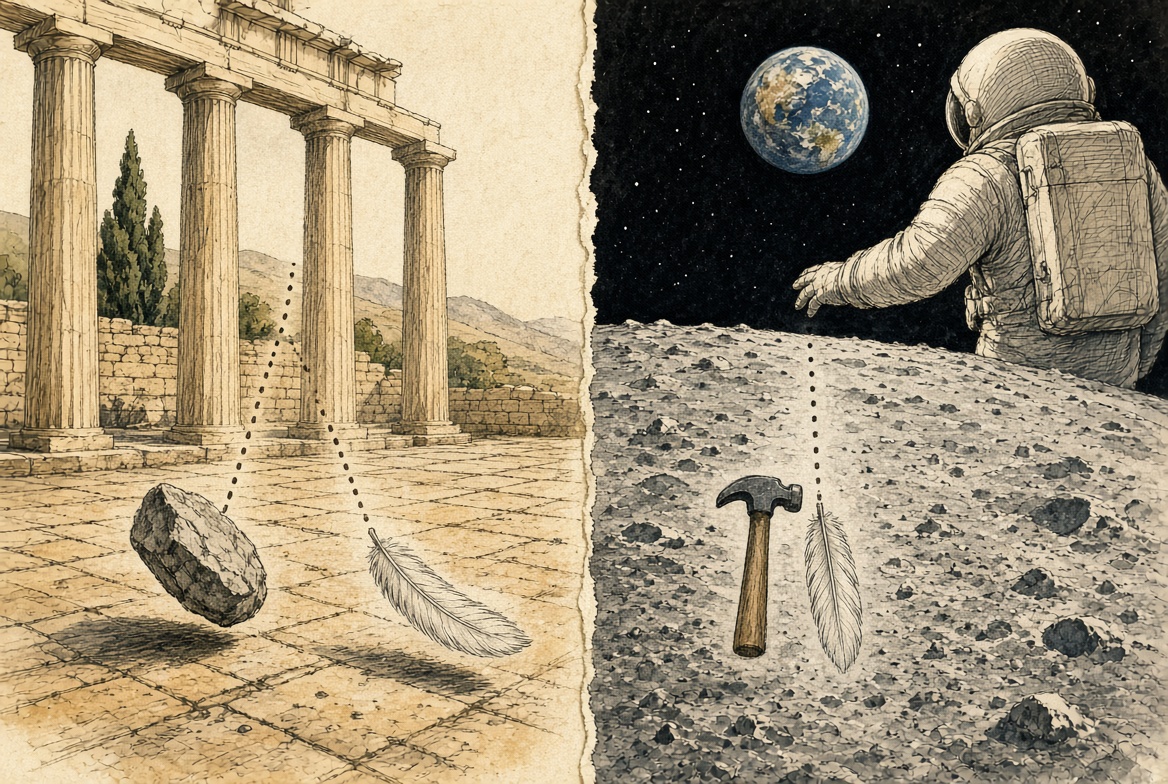
A false idea held for more than two thousand years, ever since the philosophers of ancient Greece — and such a reasonable one.
A heavy object falls faster than a light one. Everyone has seen it for themselves: if you drop a sheet of paper and a pebble, the pebble reaches the ground first.1
The observation is correct. The explanation is not.
Forces, motion, gravity
A force is whatever can change the motion of an object: set it going, stop it, make it turn, or deform it. It is measured in newtons. Putting a book down on a table, blowing on a candle, braking on a bicycle: three forces.
Three rules govern everything that moves, and they were set out together in 1687.2
- An object keeps its motion as long as no force changes it. At rest, it stays at rest; in motion, it carries on in a straight line at constant speed. This is inertia, and it is the least intuitive of the three rules: in our everyday experience, everything eventually stops. This is not because the motion runs out, but because a force opposes it — almost always friction.
- A force applied to an object makes it accelerate, and the heavier the object, the less it accelerates. Pushing an empty trolley and a full trolley equally hard does not give the same result.
- Every force acts in pairs. When you push a wall, the wall pushes back exactly as hard. This is what makes a rocket move forward: it ejects gas backwards, and the gas pushes it forwards. It needs nothing to push against — which is why it works in a vacuum.3
This idea took a long time to catch on. In the early twentieth century, when the engineer Robert Goddard wrote that a rocket could work in space, a major newspaper published an editorial mocking him, on the grounds that a rocket would need something to push against. The same newspaper published its correction almost half a century later, as Apollo 11 was setting off for the Moon.
Gravity is a special force: it acts between all the masses in the universe, without exception and without contact. The Earth attracts each of us, and each of us attracts the Earth exactly as much — but it is so massive that this attraction does not move it measurably. This force decreases rapidly with distance, without ever vanishing completely.4
Its strangest feature, the one this whole page is about, is this: gravity makes all objects fall in the same way, whatever their mass. A feather and a hammer dropped together in a vacuum hit the ground at the same time.5
It seems impossible, yet it has been filmed.
Where the mistake lies
What was really due to the air was put down to mass.
The sheet falls more slowly not because it is light, but because the air slows it down considerably — it offers a large surface area for very little matter. The pebble, by contrast, cuts through the air easily.6
The same pattern turns up elsewhere on this site, notably with the canals people thought they saw on Mars (1.14): the observation was real, but the interpretation was wrong.
It is the commonest trap of all: seeing something true, and being wrong about its cause.
The experiment, and the version you can watch
To decide between these two explanations, you need a place without air.
This has been possible since the seventeenth century: in a container from which the air has been removed, a bit of fine down and a piece of gold fall at exactly the same speed. It was performed in the vacuum of Robert Boyle’s air pump, and Newton mentions it in his Principia, from the 1713 edition onwards.7
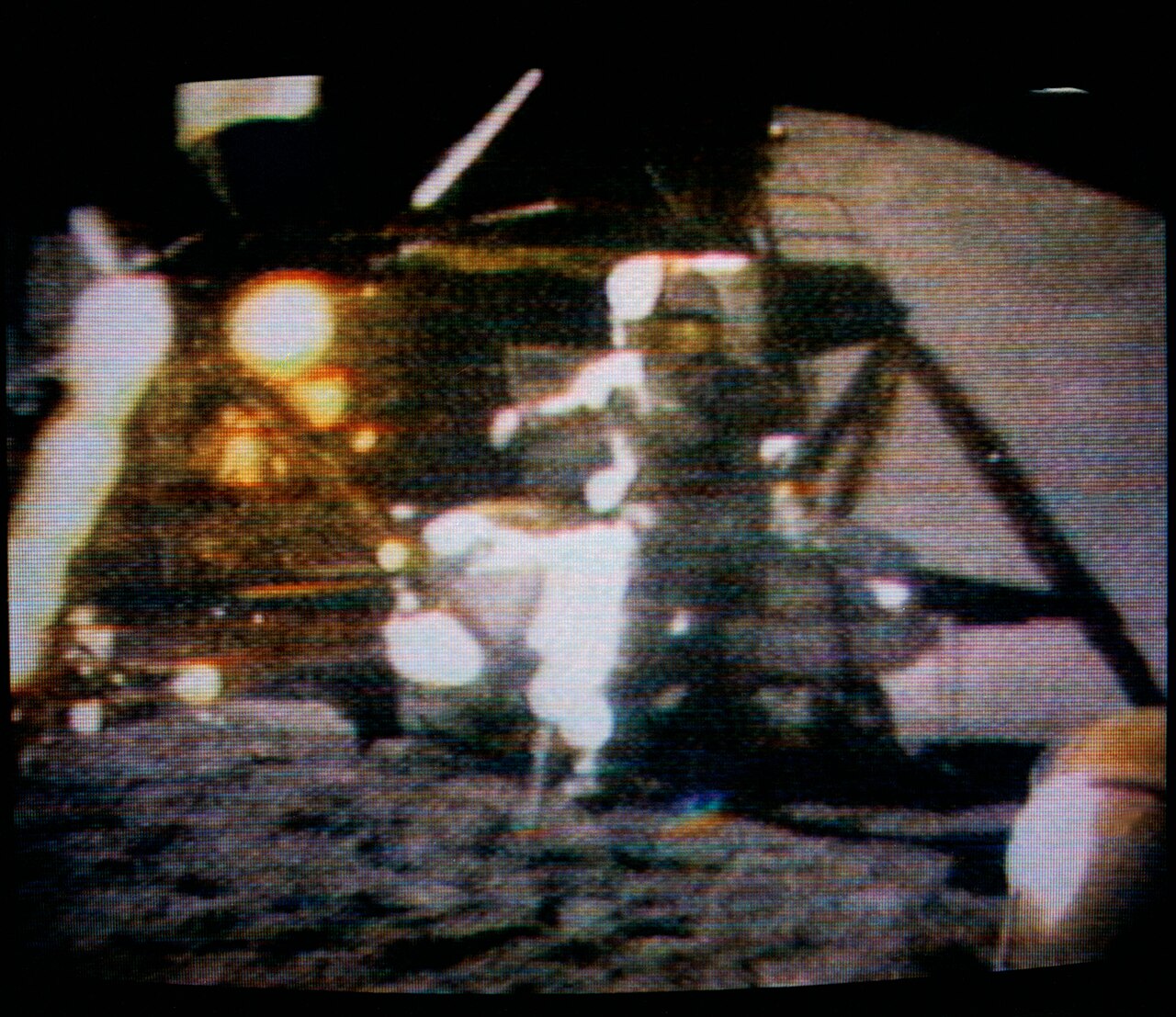
But the most striking version is much more recent. On 2 August 1971, in the final minutes of his third moonwalk, astronaut David Scott, commander of the Apollo 15 mission, stands in front of the camera set up outside. In one hand he holds a 1.32-kilogram aluminium geological hammer, and in the other a 30-gram falcon feather — a falcon, because the mission’s lunar module was called Falcon.8
He drops them from a height of about one metre sixty, at the same time.9
They hit the ground together. This is what is called free fall: motion under the action of gravity alone.10
Interactive
The hammer and the feather
On 2 August 1971, on the Moon, the astronaut David Scott stands in front of the camera and drops a hammer and a feather at the same time.
The question
Does a hammer fall faster than a feather?

What you do Choose where to drop the two objects — in air, in Boyle’s vacuum or on the Moon — then let them go.
Without JavaScript, here are the animation’s data.
| Where | What is dropped | What happens | Source |
|---|---|---|---|
| In air | a heavy object and a feather | the feather falls more slowly: the air slows it down | 1 |
| In a container emptied of air (Boyle) | a piece of gold and a bit of down | they fall at the same speed | 2 |
| On the Moon, with no air (Apollo 15) | a hammer and a feather | they hit the ground together | 3 |
| Detail | Value | Source |
|---|---|---|
| Date | 2 August 1971 | 4 |
| The objects | a 1.32 kg geological hammer; a 30 g falcon feather | 5 |
| Height of the drop | about 1.6 m | 6 |
The animation is in slow motion and does not keep to the real durations: it only shows which object lands first.
The takeaway Mass makes no difference to the fall. What holds the feather back is the air: without air, heavy and light fall together.
Photo credits 6
- Panorama taken on the Moon by the Apollo 15 crew on 1 August 1971: Mons Hadley and Mons Hadley Delta, the Lunar Module and the Lunar Roving Vehicle. NASA (Apollo 15), Public domain, source
- Robert Boyle’s air pump: engraving from his book New Experiments Physico-Mechanicall, Touching the Spring of the Air (1660). Robert Boyle, Public domain, source
- A claw hammer, photographed on a white background. It is an illustration: the Apollo 15 hammer was a geological hammer. Evan-Amos, Public domain, source
- A small Eurasian jay feather. It is an illustration: the Apollo 15 feather came from a falcon. T. Voekler, Public domain, source
- A 63.8-gram gold nugget from Alaska. Robert M. Lavinsky, CC BY-SA 3.0, source
- A rufous hornero down feather: digital illustration from the free OpenTaxa collection. YuriNikolai, CC BY-SA 4.0, source


Sources 6
Galilée, Discorsi e dimostrazioni matematiche intorno a due nuove scienze, Leyde, 1638, First Day, pp. 72-73 (Leiden, Elsevier edition, 1638).
Veduto come la differenza di velocità nei Mobili di grauità diuerse si troua esser sommamente maggiore ne i mezzi più e più resistenti […] veduto, dico, questo cascai in opinione, che se si leuasse totalmente la resistenza del mezzo, tutte le materie descenderebbero con eguali velocità.
Editors’ translation Having seen that the difference in speed between moving bodies of different weights is found to be enormously greater in more and more resistant media […] having seen this, I say, I came to the opinion that if the resistance of the medium were removed altogether, all materials would descend with equal speeds.
Public domain · checked on 27 October 2026
Newton, Isaac, The Mathematical Principles of Natural Philosophy, trad. Andrew Motte, Londres, Benjamin Motte, 1729, public domain, “General Scholium”, end of Book III (vol. 2, p. 387-393 of the 1729 edition; text added in 1713).
Withdraw the air, as is done in Mr. Boyle's vacuum, and the resistance ceases. For in this void a bit of fine down and a piece of solid gold descend with equal velocity.
Public domain open the source · checked on 24 October 2026
Barry, Caela, “The Apollo 15 Hammer-Feather Drop”, NASA Science, 16 July 2018, report by Joe Allen (NASA SP-289, p. 2-11), quoted on the page.
the objects were observed to undergo the same acceleration and strike the lunar surface simultaneously
Open access open the source · checked on 9 September 2026
NASA, Apollo 15 Lunar Surface Journal, section “The Hammer and the Feather”, open access, transcript at 167:18:43 (cancellation of the stamp, a few minutes before the experiment at 167:22); extract from the Apollo 15 Preliminary Science Report quoted in the section “The Hammer and the Feather”.
It says, "August the second, 1971, first day of issue". […] During the final minutes of the third extravehicular activity, a short demonstration experiment was conducted.
Open access · checked on 24 October 2026
Barry, Caela, “The Apollo 15 Hammer-Feather Drop”, NASA Science, 16 July 2018, report by Joe Allen (NASA SP-289, p. 2-11), quoted on the page.
A heavy object (a 1.32-kg aluminum geological hammer) and a light object (a 0.03-kg falcon feather)
Open access open the source · checked on 9 September 2026
Barry, Caela, “The Apollo 15 Hammer-Feather Drop”, NASA Science, 16 July 2018, report by Joe Allen (NASA SP-289, p. 2-11), quoted on the page.
were released simultaneously from approximately the same height (approximately 1.6 m)
Open access open the source · checked on 9 September 2026
Mission controller Joe Allen commented on the scene in the mission’s science report. The conclusion, he writes, was predicted by well-established theory — but it was nonetheless reassuring, for two reasons: the number of viewers who were watching, and the fact that the homeward journey depended on the validity of that very theory.11
The point is worth pausing on. These men were standing on the Moon. To get home, they would have to rely on the very laws they were now testing in front of a camera.
What school diagrams leave out: friction
A second false idea is just as old, and for the same reasons.
A book pushed across a table slides, then stops. We naturally conclude that a moving object always comes to rest in the end, and that a force is needed to keep it moving.
This is wrong. The book stops because the surface of the table slows it down: this is friction. On ice, it would slide much further. In the vacuum of space, it would never stop.12
Fundamental principle: A force is needed to change a motion (to start it, speed it up, slow it down or deflect it). None is needed to maintain it.
Friction is almost always missing from school diagrams, and yet it governs everyday life: thanks to it, shoes grip the ground, tyres hold the road and you can hold a glass without it slipping. It is precisely because of friction that the false idea seems so obvious.
Three other established facts
Gravity is a common thread on this site. Other chapters have established the following:
- Astronauts do not float because there is no gravity. At the altitude of the International Space Station, the Earth’s gravity is still about 90% as strong as at the surface. They float because they are in permanent free fall — and the station with them. The decisive test is simple: if there were no more gravity, the station would not stay in orbit around the Earth; it would fly off in a straight line (1.4).
- Tides are not caused by the Earth’s rotation. The presence of two bulges of water is explained by gravitational attraction; if the Earth stopped spinning on its axis, these two humps would still exist (1.6).
- The clocks on GPS satellites do not tick at the same rate as ours. They run fast by thirty-eight microseconds a day because of relativity. This offset had been predicted, calculated and corrected before the launch of the satellites (1.12).13
What these examples have in common
All these cases can be summed up as follows:
- The sheet of paper and the pebble.
- The book that stops sliding.
- The astronauts floating in orbit.
- The mechanism of the tides.
In each situation, there is an intuitive, satisfying… and completely wrong explanation. In each situation, it is refuted in the same way: by identifying the condition in which the two explanations make different predictions.
| Situation | Intuitive (wrong) explanation | Decisive test | Observed result |
|---|---|---|---|
| Falling bodies | Heavy objects fall faster | Remove the air (Moon / vacuum tube) | Hammer and feather fall at the same speed |
| Inertia | A force is required to maintain motion | Eliminate friction (space) | The motion continues indefinitely |
| Weightlessness | There is no more gravity in space | Observe the orbital trajectory | The station is held by gravity, in free fall |
| Tides | The Earth’s rotation creates the humps of water | Isolate the Moon/Earth gravitational effect | Two bulges of water exist independently |
This is the most powerful intellectual tool on this site, and it requires no equipment. It simply means asking one question: If the other explanation were the right one, what would be different?
And then to go and check.
Note 1
A given weight moves a given distance in a given time; a weight which is as great and more moves the same distance in a less time, the times being in inverse proportion to the weights.
Aristote, Physique, livre IV, et Du ciel, livre I
Note 2
AXIOMATA SIVE LEGES MOTUS. Lex. I. Corpus omne perseverare in statu suo quiescendi vel movendi uniformiter in directum, nisi quatenus a viribus impressis cogitur statum illum mutare. […] Lex. II. Mutationem motus proportionalem esse vi motrici impressæ, & fieri secundum lineam rectam qua vis illa imprimitur. […] Lex. III. Actioni contrariam semper & æqualem esse reactionem
AXIOMS, OR LAWS OF MOTION. Law I. Every body perseveres in its state of rest or of moving uniformly in a straight line, except insofar as it is compelled by impressed forces to change that state. […] Law II. The change of motion is proportional to the motive force impressed, and takes place along the straight line in which that force is impressed. […] Law III. To an action there is always an opposite and equal reaction
Newton, Isaac, Philosophiae Naturalis Principia Mathematica, Londres, 1687, public domain
Note 3
Every body perseveres in its state of rest, or of uniform motion in a right line, […] The alteration of motion is ever proportional to the motive force impressed; […] To every action there is always opposed an equal reaction;
Newton, Isaac, The Mathematical Principles of Natural Philosophy, trad. Andrew Motte, Londres, Benjamin Motte, 1729, public domain
Note 4
That there is a power of gravity tending to all bodies proportional to the several quantities of matter which they contain.
Newton, Isaac, The Mathematical Principles of Natural Philosophy, trad. Andrew Motte, Londres, Benjamin Motte, 1729, public domain
Note 5
Because they were essentially in a vacuum, there was no air resistance and the feather fell at the same rate as the hammer, as Galileo had concluded hundreds of years before - all objects released together fall at the same rate regardless of mass.
Barry, Caela, “The Apollo 15 Hammer-Feather Drop”, NASA Science, 16 July 2018
Note 6
Veduto come la differenza di velocità nei Mobili di grauità diuerse si troua esser sommamente maggiore ne i mezzi più e più resistenti […] veduto, dico, questo cascai in opinione, che se si leuasse totalmente la resistenza del mezzo, tutte le materie descenderebbero con eguali velocità.
Having seen that the difference in speed between moving bodies of different weights is found to be enormously greater in more and more resistant media […] having seen this, I say, I came to the opinion that if the resistance of the medium were removed altogether, all materials would descend with equal speeds.
Galilée, Discorsi e dimostrazioni matematiche intorno a due nuove scienze, Leyde, 1638
Note 7
Withdraw the air, as is done in Mr. Boyle's vacuum, and the resistance ceases. For in this void a bit of fine down and a piece of solid gold descend with equal velocity.
Newton, Isaac, The Mathematical Principles of Natural Philosophy, trad. Andrew Motte, Londres, Benjamin Motte, 1729, public domain
Note 8
Commander David Scott (pictured above) performed a live demonstration for the television cameras. […] During the final minutes of the third extravehicular activity, a short demonstration experiment was conducted.
Barry, Caela, “The Apollo 15 Hammer-Feather Drop”, NASA Science, 16 July 2018
A heavy object (a 1.32-kg aluminum geological hammer) and a light object (a 0.03-kg falcon feather)
Barry, Caela, “The Apollo 15 Hammer-Feather Drop”, NASA Science, 16 July 2018
The feather happens to be, appropriately, a falcon feather for our Falcon. […] And we had the (LM) Falcon.
NASA, Apollo 15 Lunar Surface Journal, section “The Hammer and the Feather”
It says, "August the second, 1971, first day of issue". […] During the final minutes of the third extravehicular activity, a short demonstration experiment was conducted.
NASA, Apollo 15 Lunar Surface Journal, section “The Hammer and the Feather”, open access
Note 9
were released simultaneously from approximately the same height (approximately 1.6 m)
Barry, Caela, “The Apollo 15 Hammer-Feather Drop”, NASA Science, 16 July 2018
Note 10
the objects were observed to undergo the same acceleration and strike the lunar surface simultaneously
Barry, Caela, “The Apollo 15 Hammer-Feather Drop”, NASA Science, 16 July 2018
Note 11
a result predicted by well-established theory, but a result nonetheless reassuring considering both the number of viewers that witnessed the experiment and the fact that the homeward journey was based critically on the validity of the particular theory being tested
Barry, Caela, “The Apollo 15 Hammer-Feather Drop”, NASA Science, 16 July 2018
Note 12
An object sliding across a table or floor slows down due to the net force of friction acting on the object.
Urone, Paul Peter and Hinrichs, Roger, College Physics 2e, OpenStax (Rice University), 2022, section 4.2 “Newton’s First Law of Motion: Inertia”
Note 13
entrées 1.4, 1.6 et 1.12
Entries 1.4, 1.6 and 1.12
The facts concerning astronauts, tides and GPS clocks are established in Entries 1.4, 1.6 and 1.12, with their sources
Notes and sources
- ↑
Passage A heavy object falls faster than a light one.
A given weight moves a given distance in a given time; a weight which is as great and more moves the same distance in a less time, the times being in inverse proportion to the weights.
Source Aristote, Physique, livre IV, et Du ciel, livre I, On the Heavens, Book I, chap. 6 (trans. J. L. Stocks, Internet Classics Archive).
Public domain open the source · checked on 9 September 2026
- ↑
Passage Three rules govern everything that moves, and they were set out together in 1687
AXIOMATA SIVE LEGES MOTUS. Lex. I. Corpus omne perseverare in statu suo quiescendi vel movendi uniformiter in directum, nisi quatenus a viribus impressis cogitur statum illum mutare. […] Lex. II. Mutationem motus proportionalem esse vi motrici impressæ, & fieri secundum lineam rectam qua vis illa imprimitur. […] Lex. III. Actioni contrariam semper & æqualem esse reactionem
Editors’ translation AXIOMS, OR LAWS OF MOTION. Law I. Every body perseveres in its state of rest or of moving uniformly in a straight line, except insofar as it is compelled by impressed forces to change that state. […] Law II. The change of motion is proportional to the motive force impressed, and takes place along the straight line in which that force is impressed. […] Law III. To an action there is always an opposite and equal reaction
Source Newton, Isaac, Philosophiae Naturalis Principia Mathematica, Londres, 1687, public domain, section “Axiomata sive leges motus” (before Book I, De motu corporum liber primus), p. 12 (Laws I and II) and p. 13 (Law III) of the 1687 edition.
Public domain · checked on 24 October 2026
- ↑
Passage An object keeps its motion as long as no force changes it […] A force applied to an object makes it accelerate […] Every force acts in pairs.
Every body perseveres in its state of rest, or of uniform motion in a right line, […] The alteration of motion is ever proportional to the motive force impressed; […] To every action there is always opposed an equal reaction;
Source Newton, Isaac, The Mathematical Principles of Natural Philosophy, trad. Andrew Motte, Londres, Benjamin Motte, 1729, public domain, “Axioms, or Laws of Motion”, Laws I to III.
Public domain open the source · checked on 24 October 2026
- ↑
Passage it acts between all the masses in the universe […] This force decreases rapidly with distance
That there is a power of gravity tending to all bodies proportional to the several quantities of matter which they contain.
Source Newton, Isaac, The Mathematical Principles of Natural Philosophy, trad. Andrew Motte, Londres, Benjamin Motte, 1729, public domain, Book III, Proposition VII (and Book III, Proposition V, Corollary 2: gravity towards a planet varies “reciprocally as the square of the distance of places from that planet’s centre”).
Public domain open the source · checked on 24 October 2026
- ↑
Passage gravity makes all objects fall in the same way, whatever their mass
Because they were essentially in a vacuum, there was no air resistance and the feather fell at the same rate as the hammer, as Galileo had concluded hundreds of years before - all objects released together fall at the same rate regardless of mass.
Source Barry, Caela, “The Apollo 15 Hammer-Feather Drop”, NASA Science, 16 July 2018, first paragraph of the page.
Open access open the source · checked on 9 September 2026
- ↑
Passage The sheet falls more slowly not because it is light, but because the air slows it down
Veduto come la differenza di velocità nei Mobili di grauità diuerse si troua esser sommamente maggiore ne i mezzi più e più resistenti […] veduto, dico, questo cascai in opinione, che se si leuasse totalmente la resistenza del mezzo, tutte le materie descenderebbero con eguali velocità.
Editors’ translation Having seen that the difference in speed between moving bodies of different weights is found to be enormously greater in more and more resistant media […] having seen this, I say, I came to the opinion that if the resistance of the medium were removed altogether, all materials would descend with equal speeds.
Source Galilée, Discorsi e dimostrazioni matematiche intorno a due nuove scienze, Leyde, 1638, First Day, pp. 72-73 (Leiden, Elsevier edition, 1638).
Public domain open the source · checked on 27 October 2026
- ↑
Passage in a container from which the air has been removed, a bit of fine down and a piece of gold fall at exactly the same speed
Withdraw the air, as is done in Mr. Boyle's vacuum, and the resistance ceases. For in this void a bit of fine down and a piece of solid gold descend with equal velocity.
Source Newton, Isaac, The Mathematical Principles of Natural Philosophy, trad. Andrew Motte, Londres, Benjamin Motte, 1729, public domain, “General Scholium”, end of Book III (vol. 2, p. 387-393 of the 1729 edition; text added in 1713).
Public domain open the source · checked on 24 October 2026
Passage It was performed in the vacuum of Robert Boyle’s air pump
Withdraw the air, as is done in Mr. Boyle's vacuum, and the resistance ceases. For in this void a bit of fine down and a piece of solid gold descend with equal velocity.
Source Newton, Isaac, The Mathematical Principles of Natural Philosophy, trad. Andrew Motte, Londres, Benjamin Motte, 1729, public domain, “General Scholium”, end of Book III, vol. 2, p. 388 of the 1729 edition.
Public domain open the source · checked on 27 October 2026
- ↑
Passage in the final minutes of his third moonwalk, astronaut David Scott […] stands in front of the camera
Commander David Scott (pictured above) performed a live demonstration for the television cameras. […] During the final minutes of the third extravehicular activity, a short demonstration experiment was conducted.
Source Barry, Caela, “The Apollo 15 Hammer-Feather Drop”, NASA Science, 16 July 2018, introduction and report by Joe Allen (NASA SP-289, p. 2-11), quoted on the page.
Open access open the source · checked on 9 September 2026
Passage a 1.32-kilogram aluminium geological hammer […] a 30-gram falcon feather
A heavy object (a 1.32-kg aluminum geological hammer) and a light object (a 0.03-kg falcon feather)
Source Barry, Caela, “The Apollo 15 Hammer-Feather Drop”, NASA Science, 16 July 2018, report by Joe Allen (NASA SP-289, p. 2-11), quoted on the page.
Open access open the source · checked on 9 September 2026
Passage the mission’s lunar module was called Falcon
The feather happens to be, appropriately, a falcon feather for our Falcon. […] And we had the (LM) Falcon.
Source NASA, Apollo 15 Lunar Surface Journal, section “The Hammer and the Feather”, transcript at 167:22:28 (David Scott) and Scott’s post-flight commentary, section “The Hammer and the Feather”.
Open access open the source · checked on 24 October 2026
Passage On 2 August 1971, in the final minutes of his third moonwalk
It says, "August the second, 1971, first day of issue". […] During the final minutes of the third extravehicular activity, a short demonstration experiment was conducted.
Source NASA, Apollo 15 Lunar Surface Journal, section “The Hammer and the Feather”, open access, transcript at 167:18:43 (cancellation of the stamp, a few minutes before the experiment at 167:22); extract from the Apollo 15 Preliminary Science Report quoted in the section “The Hammer and the Feather”.
Open access open the source · checked on 24 October 2026
- ↑
Passage He drops them from a height of about one metre sixty, at the same time.
were released simultaneously from approximately the same height (approximately 1.6 m)
Source Barry, Caela, “The Apollo 15 Hammer-Feather Drop”, NASA Science, 16 July 2018, report by Joe Allen (NASA SP-289, p. 2-11), quoted on the page.
Open access open the source · checked on 9 September 2026
- ↑
Passage They hit the ground together.
the objects were observed to undergo the same acceleration and strike the lunar surface simultaneously
Source Barry, Caela, “The Apollo 15 Hammer-Feather Drop”, NASA Science, 16 July 2018, report by Joe Allen (NASA SP-289, p. 2-11), quoted on the page.
Open access open the source · checked on 9 September 2026
- ↑
Passage The conclusion, he writes, was predicted by well-established theory — but it was nonetheless reassuring […] the number of viewers who were watching, and the fact that the homeward journey depended on the validity of that very theory
a result predicted by well-established theory, but a result nonetheless reassuring considering both the number of viewers that witnessed the experiment and the fact that the homeward journey was based critically on the validity of the particular theory being tested
Source Barry, Caela, “The Apollo 15 Hammer-Feather Drop”, NASA Science, 16 July 2018, report by Joe Allen (NASA SP-289, p. 2-11), quoted on the page.
Open access open the source · checked on 9 September 2026
- ↑
Passage The book stops because the surface of the table slows it down: this is friction.
An object sliding across a table or floor slows down due to the net force of friction acting on the object.
Source Urone, Paul Peter and Hinrichs, Roger, College Physics 2e, OpenStax (Rice University), 2022, section 4.2 “Newton’s First Law of Motion: Inertia”, section 4.2, paragraph on Newton’s first law.
Open access open the source · checked on 24 October 2026
- ↑
Passage They float because they are in permanent free fall […] Tides are not caused by the Earth’s rotation […] They run fast by thirty-eight microseconds a day
entrées 1.4, 1.6 et 1.12
Editors’ translation Entries 1.4, 1.6 and 1.12
Source The facts concerning astronauts, tides and GPS clocks are established in Entries 1.4, 1.6 and 1.12, with their sources, facts established elsewhere in the corpus with their sources.
Established in other articles, with their sources · checked on 9 September 2026
Bibliography
10
- Aristote, Physique, livre IV, et Du ciel, livre I, public domain (the speed of fall assumed to be proportional to weight). http://classics.mit.edu/Aristotle/heavens.1.i.html
- Barry, Caela, “The Apollo 15 Hammer-Feather Drop”, NASA Science, 16 July 2018, open access (all objects released together fall at the same rate, regardless of mass; Joe Allen’s account, taken from the report NASA SP-289, p. 2-11: the 1.32 kg hammer and the 0.03 kg feather released from about 1.6 m, the result predicted by theory and nonetheless reassuring). https://science.nasa.gov/resource/the-apollo-15-hammer-feather-drop/
- Boyle, Robert, New Experiments Physico-Mechanicall, Touching the Spring of the Air, Oxford, 1660, public domain (the air pump and falling in a vacuum).
- Galilée, Discorsi e dimostrazioni matematiche intorno a due nuove scienze, Leyde, 1638, public domain (the refutation by reasoning and by experiment on inclined planes). French translation: Discours concernant deux sciences nouvelles, PUF, 1995.
- NASA, Apollo 15 Lunar Surface Journal, section “The Hammer and the Feather”, open access (the transcript and video of the experiment). https://www.nasa.gov/history/alsj/a15/a15.clsout3.html
- NASA, Apollo 15 Preliminary Science Report, NASA SP-289, compte rendu de Joe Allen, open access. https://science.nasa.gov/resource/the-apollo-15-hammer-feather-drop/
- Newton, Isaac, Philosophiae Naturalis Principia Mathematica, Londres, 1687, public domain (the three laws of motion, universal gravitation; the fall of bodies in a vacuum is mentioned in the General Scholium, added in the 2nd edition of 1713). French translation: Émilie du Châtelet, 1759.
- Newton, Isaac, The Mathematical Principles of Natural Philosophy, trad. Andrew Motte, Londres, Benjamin Motte, 1729, public domain (the laws of motion; gravity proportional to the quantity of matter; the down and the piece of gold falling at the same speed in the vacuum of Boyle’s machine, “General Scholium”, vol. 2, p. 387-393). Transcription posted online by the University of Athens: https://eclass.uoa.gr/modules/document/file.php/PHS772/Newton-General%20Scholium.pdf
- Urone, Paul Peter and Hinrichs, Roger, College Physics 2e, OpenStax (Rice University), 2022, section 4.2 “Newton’s First Law of Motion: Inertia”, open access (an object sliding across a table slows down because of friction). https://openstax.org/books/college-physics-2e/pages/4-2-newtons-first-law-of-motion-inertia
- The facts concerning astronauts, tides and GPS clocks are established in Entries 1.4, 1.6 and 1.12, with their sources.
Spotted an error or have a doubt? Write to us.