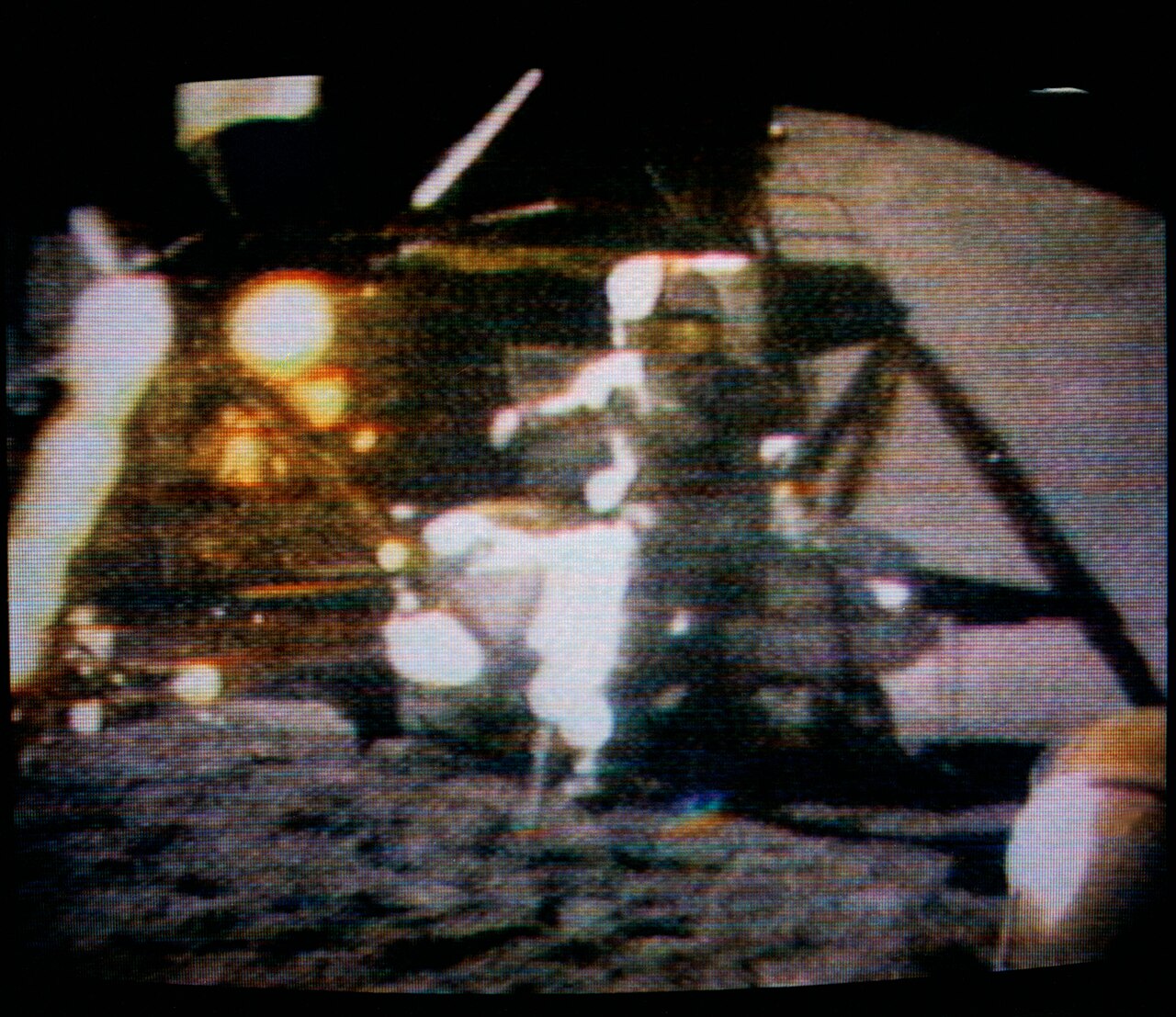
On 2 August 1971, on the Moon, the astronaut David Scott stands in front of the camera and drops a hammer and a feather at the same time.
The question
Does a hammer fall faster than a feather?

What you do Choose where to drop the two objects — in air, in Boyle’s vacuum or on the Moon — then let them go.
Without JavaScript, here are the animation’s data.
| Where | What is dropped | What happens | Source |
|---|---|---|---|
| In air | a heavy object and a feather | the feather falls more slowly: the air slows it down | 1 |
| In a container emptied of air (Boyle) | a piece of gold and a bit of down | they fall at the same speed | 2 |
| On the Moon, with no air (Apollo 15) | a hammer and a feather | they hit the ground together | 3 |
| Detail | Value | Source |
|---|---|---|
| Date | 2 August 1971 | 4 |
| The objects | a 1.32 kg geological hammer; a 30 g falcon feather | 5 |
| Height of the drop | about 1.6 m | 6 |
The animation is in slow motion and does not keep to the real durations: it only shows which object lands first.
The takeaway Mass makes no difference to the fall. What holds the feather back is the air: without air, heavy and light fall together.
Photo credits 6
- Panorama taken on the Moon by the Apollo 15 crew on 1 August 1971: Mons Hadley and Mons Hadley Delta, the Lunar Module and the Lunar Roving Vehicle. NASA (Apollo 15), Public domain, source
- Robert Boyle’s air pump: engraving from his book New Experiments Physico-Mechanicall, Touching the Spring of the Air (1660). Robert Boyle, Public domain, source
- A claw hammer, photographed on a white background. It is an illustration: the Apollo 15 hammer was a geological hammer. Evan-Amos, Public domain, source
- A small Eurasian jay feather. It is an illustration: the Apollo 15 feather came from a falcon. T. Voekler, Public domain, source
- A 63.8-gram gold nugget from Alaska. Robert M. Lavinsky, CC BY-SA 3.0, source
- A rufous hornero down feather: digital illustration from the free OpenTaxa collection. YuriNikolai, CC BY-SA 4.0, source


Sources 6
Galilée, Discorsi e dimostrazioni matematiche intorno a due nuove scienze, Leyde, 1638, First Day, pp. 72-73 (Leiden, Elsevier edition, 1638).
Veduto come la differenza di velocità nei Mobili di grauità diuerse si troua esser sommamente maggiore ne i mezzi più e più resistenti […] veduto, dico, questo cascai in opinione, che se si leuasse totalmente la resistenza del mezzo, tutte le materie descenderebbero con eguali velocità.
Editors’ translation Having seen that the difference in speed between moving bodies of different weights is found to be enormously greater in more and more resistant media […] having seen this, I say, I came to the opinion that if the resistance of the medium were removed altogether, all materials would descend with equal speeds.
Public domain · checked on 27 October 2026
Newton, Isaac, The Mathematical Principles of Natural Philosophy, trad. Andrew Motte, Londres, Benjamin Motte, 1729, public domain, “General Scholium”, end of Book III (vol. 2, p. 387-393 of the 1729 edition; text added in 1713).
Withdraw the air, as is done in Mr. Boyle's vacuum, and the resistance ceases. For in this void a bit of fine down and a piece of solid gold descend with equal velocity.
Public domain open the source · checked on 24 October 2026
Barry, Caela, “The Apollo 15 Hammer-Feather Drop”, NASA Science, 16 July 2018, report by Joe Allen (NASA SP-289, p. 2-11), quoted on the page.
the objects were observed to undergo the same acceleration and strike the lunar surface simultaneously
Open access open the source · checked on 9 September 2026
NASA, Apollo 15 Lunar Surface Journal, section “The Hammer and the Feather”, open access, transcript at 167:18:43 (cancellation of the stamp, a few minutes before the experiment at 167:22); extract from the Apollo 15 Preliminary Science Report quoted in the section “The Hammer and the Feather”.
It says, "August the second, 1971, first day of issue". […] During the final minutes of the third extravehicular activity, a short demonstration experiment was conducted.
Open access · checked on 24 October 2026
Barry, Caela, “The Apollo 15 Hammer-Feather Drop”, NASA Science, 16 July 2018, report by Joe Allen (NASA SP-289, p. 2-11), quoted on the page.
A heavy object (a 1.32-kg aluminum geological hammer) and a light object (a 0.03-kg falcon feather)
Open access open the source · checked on 9 September 2026
Barry, Caela, “The Apollo 15 Hammer-Feather Drop”, NASA Science, 16 July 2018, report by Joe Allen (NASA SP-289, p. 2-11), quoted on the page.
were released simultaneously from approximately the same height (approximately 1.6 m)
Open access open the source · checked on 9 September 2026