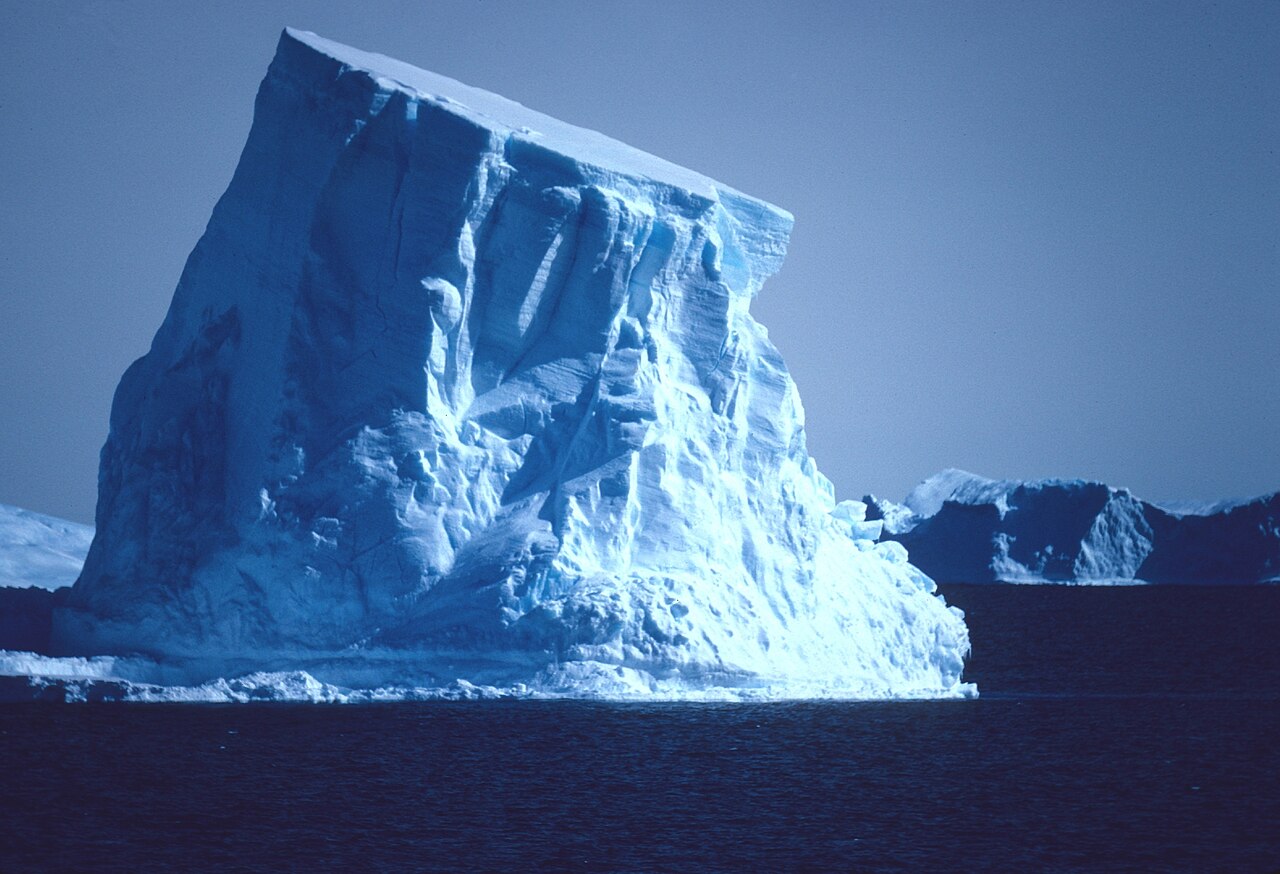

Ice floats. Almost nothing else does that.
Almost every substance contracts as it cools and becomes denser, and its solid form sinks in its liquid form. There are a few exceptions — silicon, bismuth, gallium — but they are rare.
Water is one of them, and it is an exception with enormous consequences.
The anomaly
As it cools, water contracts like everything else — up to a point.
Then, a little above zero, at around four degrees (3.98 °C to be exact), it starts to expand again. This is where fresh water is at its densest.1
If you keep cooling it, it freezes, and the ice takes up more room than the water that formed it — about a tenth more. That is why a full bottle bursts in the freezer.2
The result: ice is less dense than liquid water. It floats.
We know this from a measurement that is easy to repeat. Take a quantity of water, measure its volume precisely at different temperatures, and plot the curve: the volume decreases as the water cools, reaches a minimum at around four degrees, then rises again. A thermometer and a graduated container are enough. The Genevan Jean-André Deluc had noticed it; the Scot Thomas Charles Hope established it in 1805.3
A word about a phrase you often come across: water is not magic. The word closes the question instead of opening it, when in fact there is a mechanism — and this page sets it out. These properties are not there in order to make life possible: it is the other way round — life developed in a world where water behaves like this, and it took advantage of it.
Why
This behaviour has an explanation, and it requires no magic formula.
Water molecules attract one another, and they do so in a particular way: each one has specific places where it can hook on to its neighbours, rather like a jigsaw piece.
In liquid water, the molecules are constantly moving, hooking on, letting go, hooking on again: they are packed close together, in disorder.
In ice, they become still, and each one hooks on to its neighbours in every direction it can. This forms a regular lattice — and this lattice leaves gaps, like scaffolding. Neatly arranged, the whole takes up more room than in disorder.4
Nothing more. No magic: a molecular shape, and a way of hooking on.
What difference it makes
A lake freezes from the top.
In autumn, the surface water cools, becomes denser, and sinks. This continues until the whole lake is at around four degrees. Then the surface water, as it cools further, becomes less dense: it stays at the top, and that is where it freezes. The layer of ice insulates what lies beneath, and the water at the bottom stays liquid, at around four degrees. The creatures that live there survive the winter.5
If ice sank, it would build up on the bottom, where almost nothing would melt it. Lakes in cold regions would probably freeze from the bottom up, and never thaw completely.
One clarification, because the scope matters: this reasoning holds for fresh water. Seawater, because of the salt, does not have this density maximum at four degrees — it keeps getting denser until it freezes, at around minus two. Sea ice still floats, because ice is always less dense than water. But the sea does not behave exactly like the lake.6
The other properties of water
The way water molecules hook on to one another explains more than why ice floats. It explains almost everything water does, and it is a rare case where a single cause accounts for a long list of effects.
- Water dissolves a great many things. Each water molecule has a slightly positive side and a slightly negative side — it is said to be polar — which allows it to surround and separate the particles of a large number of substances. For this reason it is called the universal solvent, which is an overstatement: it dissolves neither oils nor fats, which are not polar. That is why a vinaigrette always separates.
- Water heats up and cools down slowly. It takes a lot of energy to raise its temperature, because part of it goes first into undoing the bonds between molecules. As a consequence, the oceans take a long time to warm up and a long time to cool down, which moderates the climate of coasts and delays the seasons by the sea.
- Water carries heat away as it evaporates. The molecules that leave are the fastest; those that remain are therefore colder. This is the principle behind sweating, and the reason you feel cold getting out of a swimming pool wet, even in full sunshine.
- Its surface behaves like a stretched skin. The molecules at the top are attracted by half as many neighbours as the others, and the surface pulls itself in as tightly as possible. This surface tension allows certain insects to walk on water and makes drops round.
- Water rises on its own in a thin tube. It clings to the walls — this is adhesion — and each molecule pulls the one behind it — this is cohesion. Together, the two produce capillarity.7
This is what allows sap to reach the top of a tree without any pump. Capillarity alone would not be enough; what really does the pulling is evaporation through the leaves. Each molecule that escapes from a leaf pulls the next one, and the column of water rises unbroken from the roots, sometimes over a hundred metres.
One and the same molecular peculiarity, six seemingly unrelated consequences. This is the kind of convergence that gives confidence in an explanation: it does not account for a single fact, but for many at once.
A case where researchers disagree
One claim is widely repeated: hot water sometimes freezes faster than cold water. It is called the Mpemba effect, after a Tanzanian school pupil who put it to a visiting university lecturer, with whom he published it in 1969 — but the question is much older: it can already be found in Aristotle.8
Researchers have tested this many times, and they disagree with one another.
One team repeated the experiment under carefully controlled conditions, examined the data published before them, and concluded — “somewhat sadly”, the authors write — that no convincing observation supports this effect. They note in passing that the question, put this way, is vague and imprecise: hot water can always be made to cool more quickly, by supplying it with more energy.9
Another researcher replied that the team had asked the wrong question: the Mpemba effect is not about the rate of cooling, but about when the water freezes. These are not the same measurements.10
One detail of the first team’s experiment explains why this disagreement has lasted so long. They found that the result depended on where they placed the thermometer: a difference of one centimetre in height could be enough to create a false impression of the Mpemba effect.11
The reason is simple and profound. In a cup that is cooling quickly, the water is not at the same temperature throughout. Talking about “the” temperature of the cup then has only an approximate meaning — and that is precisely what one is trying to measure.12
When a quantity has no single value, two careful teams can obtain two different results without either of them being wrong.
The question is a familiar one: what exactly does this figure measure?
So the right answer to give here is neither yes nor no. It is: researchers disagree, and here is what they disagree about. Such examples are rare, and they are valuable.
The authors’ phrase deserves notice: “somewhat sadly”. They would have preferred it to be true. That did not stop them publishing the opposite.
What this site has already established about water
The three facts that follow are established, with their sources, in Entries 1.7, 7.10 and 9.9.
On Venus, under a pressure ninety times greater than ours and at more than four hundred degrees, there is no liquid water: only traces of vapour (1.7). It is not the substance alone that decides: it is the conditions.
Water circulates: our page on the water cycle (7.10) explains that the total amount of water on Earth does not decrease. But it also explains that in a given place — an aquifer, a river — there may be much less of it left than before. “Running out of water” is about the place, not the planet.
Irrigating without draining damages the land: our page on managing water (9.9) tells the story of salinisation, the ancient techniques that avoided it, and an attribution that has never been proven.
Note 1
The density of pure water occurring at 3.98 °C, which is 1.0000 g cm-3, or 1000 kg m-3. Water when cooled down contracts normally until the temperature is 3.98 °C, after which it expands.
Observatoire de Paris, “Maximum density of water”, An Etymological Dictionary of Astronomy and Astrophysics (English-French-Persian)
This means that below 3.98 °C cooling results in the water molecules spacing out and both the liquid and the solid water below this temperature expand.
The Open University, “3.2 The density of fresh water and seawater”, The oceans, OpenLearn
Note 2
Upon freezing, the density of ice decreases by about 9 percent.
U.S. Geological Survey, “Water Density”, Water Science School
Note 3
Deluc discovered that water attains its maximum density at 39° F (4° C)
Encyclopaedia Britannica, “Jean-André Deluc”
the first to determine, in 1805, that water has its greatest density at about 39.5 degrees F
Linda Hall Library, “Thomas Charles Hope”, Scientist of the Day
Note 4
Ice has a very different structure than liquid water in that the molecules align themselves in a regular lattice rather than more randomly as in the liquid form. The lattice arrangement allows water molecules to be more spread out than in a liquid, and, thus, ice is less dense than water.
U.S. Geological Survey, “Water Density”, Water Science School
Note 5
In wintertime, the surface of lakes found in many northern regions is frozen. However, the water under the ice is slightly warmer, and the water at the bottom of the lake is warmer yet at 4 °C to 5 °C (39.2 °F to 41 °F). […] As air temperatures drop in the fall, the temperature of the lake water cools to 4 °C; therefore, this causes fall turnover as the heavy cold water sinks and displaces the water at the bottom.
Clark, Mary Ann, Douglas, Matthew and Choi, Jung, Biology 2e, OpenStax, section 44.2 “Biogeography”
In lakes and ponds, ice will form on the water's surface creating an insulating barrier that protects the animals and plant life in the pond from freezing.
Clark, Mary Ann, Douglas, Matthew and Choi, Jung, Biology 2e, OpenStax, section 2.2 “Water”
Note 6
Sea ice forms more slowly than freshwater ice for two main reasons. First, the freezing temperature of salt water is lower than freshwater; ocean temperatures must reach -1.8°C (28.8°F) to freeze. Secondly, in contrast to fresh water, the salt in ocean water causes the density of the water to increase as it nears the freezing point.
National Snow and Ice Data Center, “Science of Sea Ice”, Sea Ice section, NSIDC
Note 7
While there is no net charge to a water molecule, water's polarity creates a slightly positive charge on hydrogen and a slightly negative charge on oxygen, contributing to water’s properties of attraction.
Clark, Mary Ann, Douglas, Matthew and Choi, Jung, Biology 2e, OpenStax, chapitre “Water”
In contrast, nonpolar molecules such as oils and fats do not interact well with water, as Figure 2.13 shows. A good example of this is vinegar and oil salad dressing (an acidic water solution).
Clark, Mary Ann, Douglas, Matthew and Choi, Jung, Biology 2e, OpenStax, chapitre “Water”
Water’s high heat capacity is a property that hydrogen bonding among water molecules causes. Water has the highest specific heat capacity of any common liquid. […] It therefore takes water a long time to heat and a long time to cool. In fact, water's specific heat capacity is about five times more than that of sand. This explains why the land cools faster than the sea.
Clark, Mary Ann, Douglas, Matthew and Choi, Jung, Biology 2e, OpenStax, chapitre “Water”
Even when below its boiling point, water’s individual molecules acquire enough energy from other water molecules such that some surface water molecules can escape and vaporize: we call this process evaporation. […] As the water evaporates, energy is taken up by the process, cooling the environment where the evaporation is taking place.
Clark, Mary Ann, Douglas, Matthew and Choi, Jung, Biology 2e, OpenStax, chapitre “Water”
However, the molecules on the surface of a liquid are attracted only by about one-half as many molecules. Because of the unbalanced molecular attractions on the surface molecules, liquids contract to form a shape that minimizes the number of molecules on the surface—that is, the shape with the minimum surface area.
Flowers, Paul, Theopold, Klaus, Langley, Richard and Robinson, William R., Chemistry 2e, OpenStax, 2019, section 10.2 “Properties of Liquids”
In cohesion, water molecules are attracted to each other (because of hydrogen bonding), keeping the molecules together at the liquid-gas (water-air) interface, although there is no more room in the glass. […] These cohesive forces are related to water’s property of adhesion, or the attraction between water molecules and other molecules. […] This is because the water molecules are attracted to the capillary's charged glass walls more than they are to each other and therefore adhere to it.
Clark, Mary Ann, Douglas, Matthew and Choi, Jung, Biology 2e, OpenStax, chapitre “Water”
Note 8
The, now popular, adoption of the name ‘Mpemba effect’ is owed to the lack of freezer space at a Tanzanian school. […] another pupil, Mpemba, worried that he would not find space in the freezer and put his boiling mixture straight into the freezer without first allowing it to cool. Mpemba eventually asked a visiting lecturer from the University of Dar es Salaam to explain his observations. The open-minded Dr Osborne was intrigued by Mpemba’s observation and later began investigating the effect with his students, ultimately publishing a scientific paper with Mpemba on the observed effect8.
Burridge, Henry C. and Linden, Paul F., “Questioning the Mpemba Effect: Hot Water Does Not Cool More Quickly than Cold”, Scientific Reports, vol. 6, 37665, 2016
references to the effect go back at least to the writings of Aristotle
Burridge, Henry C. and Linden, Paul F., “Questioning the Mpemba Effect: Hot Water Does Not Cool More Quickly than Cold”, Scientific Reports, vol. 6, 37665, 2016
Note 9
We go on to examine the available evidence for the Mpemba effect and carry out our own experiments by cooling water in carefully controlled conditions. We conclude, somewhat sadly, that there is no evidence to support meaningful observations of the Mpemba effect.
Burridge, Henry C. and Linden, Paul F., “Questioning the Mpemba Effect: Hot Water Does Not Cool More Quickly than Cold”, Scientific Reports, vol. 6, 37665, 2016
The statement “hot water does not cool more quickly than cold” is vague and imprecise; hot water can be made to cool more quickly than cold by supplying more energy to the cooling of hot water, but it is under such a non-specific premise that the Mpemba effect has become an artefact in popular science.
Burridge, Henry C. and Linden, Paul F., “Questioning the Mpemba Effect: Hot Water Does Not Cool More Quickly than Cold”, Scientific Reports, vol. 6, 37665, 2016
Note 10
In a recent paper in Scientific Reports, Burridge & Linden misinterpret the Mpemba effect as a statement about the rate of cooling of liquid water, when it is in fact a statement about the rate of freezing of water.
Katz, Jonathan I., “Reply to Burridge & Linden: Hot Water May Freeze Sooner than Cold”, 2017
Note 11
They found that the readings depended on where they placed the thermometer. […] But if measurements were off by even a centimeter, they could produce false evidence of the Mpemba effect.
Mann, Adam, “Controversy Continues Over Whether Hot Water Freezes Faster Than Cold”, Quanta Magazine, 29 June 2022
Note 12
Temperature varies throughout a cup of rapidly cooling water because the water is out of equilibrium
Mann, Adam, “Controversy Continues Over Whether Hot Water Freezes Faster Than Cold”, Quanta Magazine, 29 June 2022
Notes and sources
- ↑
Passage a little above zero, at around four degrees (3.98 °C to be exact), it starts to expand again. This is where fresh water is at its densest.
The density of pure water occurring at 3.98 °C, which is 1.0000 g cm-3, or 1000 kg m-3. Water when cooled down contracts normally until the temperature is 3.98 °C, after which it expands.
Source Observatoire de Paris, “Maximum density of water”, An Etymological Dictionary of Astronomy and Astrophysics (English-French-Persian), entry “maximum density of water”, definition, 1st and 2nd sentences.
Open access open the source · checked on 27 October 2026
Passage at around four degrees (3.98 °C to be exact), it starts to expand again
This means that below 3.98 °C cooling results in the water molecules spacing out and both the liquid and the solid water below this temperature expand.
Source The Open University, “3.2 The density of fresh water and seawater”, The oceans, OpenLearn, section 3.2 (“The density of fresh water and seawater”), paragraph beginning “Usually when a liquid is heated” (10th paragraph, counting question and answer lines).
Open access open the source · checked on 27 October 2026
- ↑
Passage the ice takes up more room than the water that formed it — about a tenth more
Upon freezing, the density of ice decreases by about 9 percent.
Source U.S. Geological Survey, “Water Density”, Water Science School, section “Ice is less dense than water”.
Open access open the source · checked on 27 October 2026
- ↑
Passage The Genevan Jean-André Deluc had noticed it
Deluc discovered that water attains its maximum density at 39° F (4° C)
Source Encyclopaedia Britannica, “Jean-André Deluc”, biographical entry.
Open access open the source · checked on 27 October 2026
Passage the Scot Thomas Charles Hope established it in 1805.
the first to determine, in 1805, that water has its greatest density at about 39.5 degrees F
Source Linda Hall Library, “Thomas Charles Hope”, Scientist of the Day, article “Thomas Charles Hope”, Scientist of the Day, 21 July 2015.
Open access open the source · checked on 28 October 2026
- ↑
Passage In ice, they become still […] This forms a regular lattice — and this lattice leaves gaps
Ice has a very different structure than liquid water in that the molecules align themselves in a regular lattice rather than more randomly as in the liquid form. The lattice arrangement allows water molecules to be more spread out than in a liquid, and, thus, ice is less dense than water.
Source U.S. Geological Survey, “Water Density”, Water Science School, section “Ice is less dense than water”.
Open access open the source · checked on 27 October 2026
- ↑
Passage In autumn, the surface water cools, becomes denser, and sinks […] the water at the bottom stays liquid, at around four degrees.
In wintertime, the surface of lakes found in many northern regions is frozen. However, the water under the ice is slightly warmer, and the water at the bottom of the lake is warmer yet at 4 °C to 5 °C (39.2 °F to 41 °F). […] As air temperatures drop in the fall, the temperature of the lake water cools to 4 °C; therefore, this causes fall turnover as the heavy cold water sinks and displaces the water at the bottom.
Source Clark, Mary Ann, Douglas, Matthew and Choi, Jung, Biology 2e, OpenStax, section 44.2 “Biogeography”, section 44.2, subsection “Energy Sources” (paragraph on winter) and paragraph following Figure 44.10 (fall turnover).
Open access open the source · checked on 27 October 2026
Passage The layer of ice insulates what lies beneath
In lakes and ponds, ice will form on the water's surface creating an insulating barrier that protects the animals and plant life in the pond from freezing.
Source Clark, Mary Ann, Douglas, Matthew and Choi, Jung, Biology 2e, OpenStax, section 2.2 “Water”, section 2.2, paragraph “The lower density of ice, as Figure 2.14 depicts…” (before Figure 2.14).
Open access open the source · checked on 27 October 2026
- ↑
Passage Seawater, because of the salt, does not have this density maximum at four degrees — it keeps getting denser until it freezes, at around minus two.
Sea ice forms more slowly than freshwater ice for two main reasons. First, the freezing temperature of salt water is lower than freshwater; ocean temperatures must reach -1.8°C (28.8°F) to freeze. Secondly, in contrast to fresh water, the salt in ocean water causes the density of the water to increase as it nears the freezing point.
Source National Snow and Ice Data Center, “Science of Sea Ice”, Sea Ice section, NSIDC, section “How sea ice forms”, 2nd paragraph.
Open access open the source · checked on 27 October 2026
- ↑
Passage Each water molecule has a slightly positive side and a slightly negative side — it is said to be polar
While there is no net charge to a water molecule, water's polarity creates a slightly positive charge on hydrogen and a slightly negative charge on oxygen, contributing to water’s properties of attraction.
Source Clark, Mary Ann, Douglas, Matthew and Choi, Jung, Biology 2e, OpenStax, chapitre “Water”, section 2.2 “Water”, subsection “Water’s Polarity”, 1st paragraph.
Open access open the source · checked on 9 September 2026
Passage it dissolves neither oils nor fats, which are not polar
In contrast, nonpolar molecules such as oils and fats do not interact well with water, as Figure 2.13 shows. A good example of this is vinegar and oil salad dressing (an acidic water solution).
Source Clark, Mary Ann, Douglas, Matthew and Choi, Jung, Biology 2e, OpenStax, chapitre “Water”, section 2.2 “Water”, subsection “Water’s Polarity”, 2nd paragraph.
Open access open the source · checked on 9 September 2026
Passage It takes a lot of energy to raise its temperature […] the oceans take a long time to warm up and a long time to cool down
Water’s high heat capacity is a property that hydrogen bonding among water molecules causes. Water has the highest specific heat capacity of any common liquid. […] It therefore takes water a long time to heat and a long time to cool. In fact, water's specific heat capacity is about five times more than that of sand. This explains why the land cools faster than the sea.
Source Clark, Mary Ann, Douglas, Matthew and Choi, Jung, Biology 2e, OpenStax, chapitre “Water”, section 2.2 “Water”, subsection “Water’s High Heat Capacity”.
Open access open the source · checked on 9 September 2026
Passage The molecules that leave are the fastest; those that remain are therefore colder.
Even when below its boiling point, water’s individual molecules acquire enough energy from other water molecules such that some surface water molecules can escape and vaporize: we call this process evaporation. […] As the water evaporates, energy is taken up by the process, cooling the environment where the evaporation is taking place.
Source Clark, Mary Ann, Douglas, Matthew and Choi, Jung, Biology 2e, OpenStax, chapitre “Water”, section 2.2 “Water”, subsection “Water’s Heat of Vaporization”.
Open access open the source · checked on 9 September 2026
Passage The molecules at the top are attracted by half as many neighbours as the others, and the surface pulls itself in as tightly as possible.
However, the molecules on the surface of a liquid are attracted only by about one-half as many molecules. Because of the unbalanced molecular attractions on the surface molecules, liquids contract to form a shape that minimizes the number of molecules on the surface—that is, the shape with the minimum surface area.
Source Flowers, Paul, Theopold, Klaus, Langley, Richard and Robinson, William R., Chemistry 2e, OpenStax, 2019, section 10.2 “Properties of Liquids”, section 10.2 “Properties of Liquids”, paragraph on cohesive forces, after Table 10.2 and before Figure 10.16.
Open access open the source · checked on 9 September 2026
Passage It clings to the walls — this is adhesion — and each molecule pulls the one behind it — this is cohesion.
In cohesion, water molecules are attracted to each other (because of hydrogen bonding), keeping the molecules together at the liquid-gas (water-air) interface, although there is no more room in the glass. […] These cohesive forces are related to water’s property of adhesion, or the attraction between water molecules and other molecules. […] This is because the water molecules are attracted to the capillary's charged glass walls more than they are to each other and therefore adhere to it.
Source Clark, Mary Ann, Douglas, Matthew and Choi, Jung, Biology 2e, OpenStax, chapitre “Water”, section 2.2 “Water”, subsection “Cohesive and Adhesive Properties”.
Open access open the source · checked on 9 September 2026
- ↑
Passage It is called the Mpemba effect, after a Tanzanian school pupil who put it to a visiting university lecturer, with whom he published it in 1969
The, now popular, adoption of the name ‘Mpemba effect’ is owed to the lack of freezer space at a Tanzanian school. […] another pupil, Mpemba, worried that he would not find space in the freezer and put his boiling mixture straight into the freezer without first allowing it to cool. Mpemba eventually asked a visiting lecturer from the University of Dar es Salaam to explain his observations. The open-minded Dr Osborne was intrigued by Mpemba’s observation and later began investigating the effect with his students, ultimately publishing a scientific paper with Mpemba on the observed effect8.
Source Burridge, Henry C. and Linden, Paul F., “Questioning the Mpemba Effect: Hot Water Does Not Cool More Quickly than Cold”, Scientific Reports, vol. 6, 37665, 2016, section “More recent scientific investigations of the Mpemba effect”, 1st paragraph (note 8: Physics Education, 4(3), 172, 1969).
Open access open the source · checked on 27 October 2026
Passage the question is much older: it can already be found in Aristotle
references to the effect go back at least to the writings of Aristotle
Source Burridge, Henry C. and Linden, Paul F., “Questioning the Mpemba Effect: Hot Water Does Not Cool More Quickly than Cold”, Scientific Reports, vol. 6, 37665, 2016, abstract of the article.
Open access open the source · checked on 9 September 2026
- ↑
Passage One team repeated the experiment under carefully controlled conditions, examined the data published before them, and concluded — “somewhat sadly” […] that no convincing observation supports this effect.
We go on to examine the available evidence for the Mpemba effect and carry out our own experiments by cooling water in carefully controlled conditions. We conclude, somewhat sadly, that there is no evidence to support meaningful observations of the Mpemba effect.
Source Burridge, Henry C. and Linden, Paul F., “Questioning the Mpemba Effect: Hot Water Does Not Cool More Quickly than Cold”, Scientific Reports, vol. 6, 37665, 2016, abstract of the article.
Open access open the source · checked on 9 September 2026
Passage the question, put this way, is vague and imprecise: hot water can always be made to cool more quickly, by supplying it with more energy
The statement “hot water does not cool more quickly than cold” is vague and imprecise; hot water can be made to cool more quickly than cold by supplying more energy to the cooling of hot water, but it is under such a non-specific premise that the Mpemba effect has become an artefact in popular science.
Source Burridge, Henry C. and Linden, Paul F., “Questioning the Mpemba Effect: Hot Water Does Not Cool More Quickly than Cold”, Scientific Reports, vol. 6, 37665, 2016, introduction (text following the abstract, before the part “There is no clear universally accepted scientific definition”).
Open access open the source · checked on 9 September 2026
- ↑
Passage Another researcher replied that the team had asked the wrong question: the Mpemba effect is not about the rate of cooling, but about when the water freezes.
In a recent paper in Scientific Reports, Burridge & Linden misinterpret the Mpemba effect as a statement about the rate of cooling of liquid water, when it is in fact a statement about the rate of freezing of water.
Source Katz, Jonathan I., “Reply to Burridge & Linden: Hot Water May Freeze Sooner than Cold”, 2017, abstract (arXiv preprint 1701.03219v2).
Open access open the source · checked on 9 September 2026
- ↑
Passage the result depended on where they placed the thermometer: a difference of one centimetre in height could be enough to create a false impression of the Mpemba effect
They found that the readings depended on where they placed the thermometer. […] But if measurements were off by even a centimeter, they could produce false evidence of the Mpemba effect.
Source Mann, Adam, “Controversy Continues Over Whether Hot Water Freezes Faster Than Cold”, Quanta Magazine, 29 June 2022, 2022 report (passage on Burridge and Linden’s experiment).
Open access open the source · checked on 9 September 2026
- ↑
Passage In a cup that is cooling quickly, the water is not at the same temperature throughout.
Temperature varies throughout a cup of rapidly cooling water because the water is out of equilibrium
Source Mann, Adam, “Controversy Continues Over Whether Hot Water Freezes Faster Than Cold”, Quanta Magazine, 29 June 2022, 2022 report.
Open access open the source · checked on 9 September 2026
Bibliography
19
- Burridge, Henry C. and Linden, Paul F., “Questioning the Mpemba Effect: Hot Water Does Not Cool More Quickly than Cold”, Scientific Reports, vol. 6, 37665, 2016, open access (the age of the question, going back to Aristotle; the review of the published data; the absence of any convincing observation; the vagueness of the claim). https://doi.org/10.1038/srep37665
- Clark, Mary Ann, Douglas, Matthew and Choi, Jung, Biology 2e, OpenStax, chapitre “Water”, open access (polarity, specific heat, evaporative cooling, surface tension, cohesion and adhesion). https://openstax.org/details/books/biology-2e
- Clark, Mary Ann, Douglas, Matthew and Choi, Jung, Biology 2e, OpenStax, section 2.2 “Water”, open access. https://openstax.org/books/biology-2e/pages/2-2-water
- Clark, Mary Ann, Douglas, Matthew and Choi, Jung, Biology 2e, OpenStax, section 44.2 “Biogeography”, open access. https://openstax.org/books/biology-2e/pages/44-2-biogeography
- Deluc, Jean-André, Recherches sur les modifications de l’atmosphère, Genève, 1772, public domain. https://www.e-rara.ch/zut/doi/10.3931/e-rara-1330
- Encyclopaedia Britannica, “Jean-André Deluc”, open access (Deluc as discoverer of water’s density maximum at about 4 °C). https://www.britannica.com/print/article/156884
- Flowers, Paul, Theopold, Klaus, Langley, Richard and Robinson, William R., Chemistry 2e, OpenStax, 2019, section 10.2 “Properties of Liquids”, open access (the surface molecules, attracted by half as many neighbours; the surface that pulls itself in). https://openstax.org/books/chemistry-2e/pages/10-2-properties-of-liquids
- Franks, Felix, Water: A Matrix of Life, Royal Society of Chemistry, 2000, in libraries (the density maximum at around 4 °C, the structure of ice and its gaps, the bonds between molecules).
- Katz, Jonathan I., “Reply to Burridge & Linden: Hot Water May Freeze Sooner than Cold”, 2017, open access (the objection: the effect concerns when freezing occurs, not the rate of cooling). https://arxiv.org/abs/1701.03219
- Linda Hall Library, “Thomas Charles Hope”, Scientist of the Day, 21 July 2015, open access (Hope, the first to determine in 1805 the temperature of water’s density maximum). https://www.lindahall.org/about/news/scientist-of-the-day/thomas-charles-hope/
- Mann, Adam, “Controversy Continues Over Whether Hot Water Freezes Faster Than Cold”, Quanta Magazine, 29 June 2022, open access (the sensitivity of the measurements to the position of the thermometer; water out of equilibrium not having a single temperature). https://www.quantamagazine.org/does-hot-water-freeze-faster-than-cold-physicists-keep-asking-20220629/
- Mpemba, Erasto B. and Osborne, Denis G., “Cool?”, Physics Education, vol. 4, 1969, p. 172-175, paywalled (the original article, by a Tanzanian school pupil and a lecturer from Dar es Salaam).
- National Snow and Ice Data Center, “Science of Sea Ice”, Sea Ice section, NSIDC, open access. https://nsidc.org/learn/parts-cryosphere/sea-ice/science-sea-ice
- Observatoire de Paris, “Maximum density of water”, An Etymological Dictionary of Astronomy and Astrophysics (English-French-Persian), open access. https://dictionary.obspm.fr/terms/maximum-density-of-water/
- Petrenko, Victor F. and Whitworth, Robert W., Physics of Ice, Oxford University Press, 1999, in libraries (the hexagonal lattice of ordinary ice and its lower density than water).
- Talley, Lynne D. et al., Descriptive Physical Oceanography, Academic Press, 2011, in libraries (seawater: no density maximum above the freezing point beyond a certain salinity; freezing at around −1.9 °C).
- The Open University, “3.2 The density of fresh water and seawater”, The oceans, OpenLearn, open access (the density maximum of fresh water at 3.98 °C; the expansion of water cooled below that temperature). https://www.open.edu/openlearn/science-maths-technology/the-oceans/content-section-3.2
- U.S. Geological Survey, “Water Density”, Water Science School, open access (the density of ice, about 9 per cent lower than that of water; the regular lattice of molecules, more spread out than in the liquid). https://www.usgs.gov/special-topics/water-science-school/science/water-density
- Wetzel, Robert G., Limnology: Lake and River Ecosystems, Academic Press, 2001, in libraries (lakes freezing from the top and winter stratification).
Spotted an error or have a doubt? Write to us.