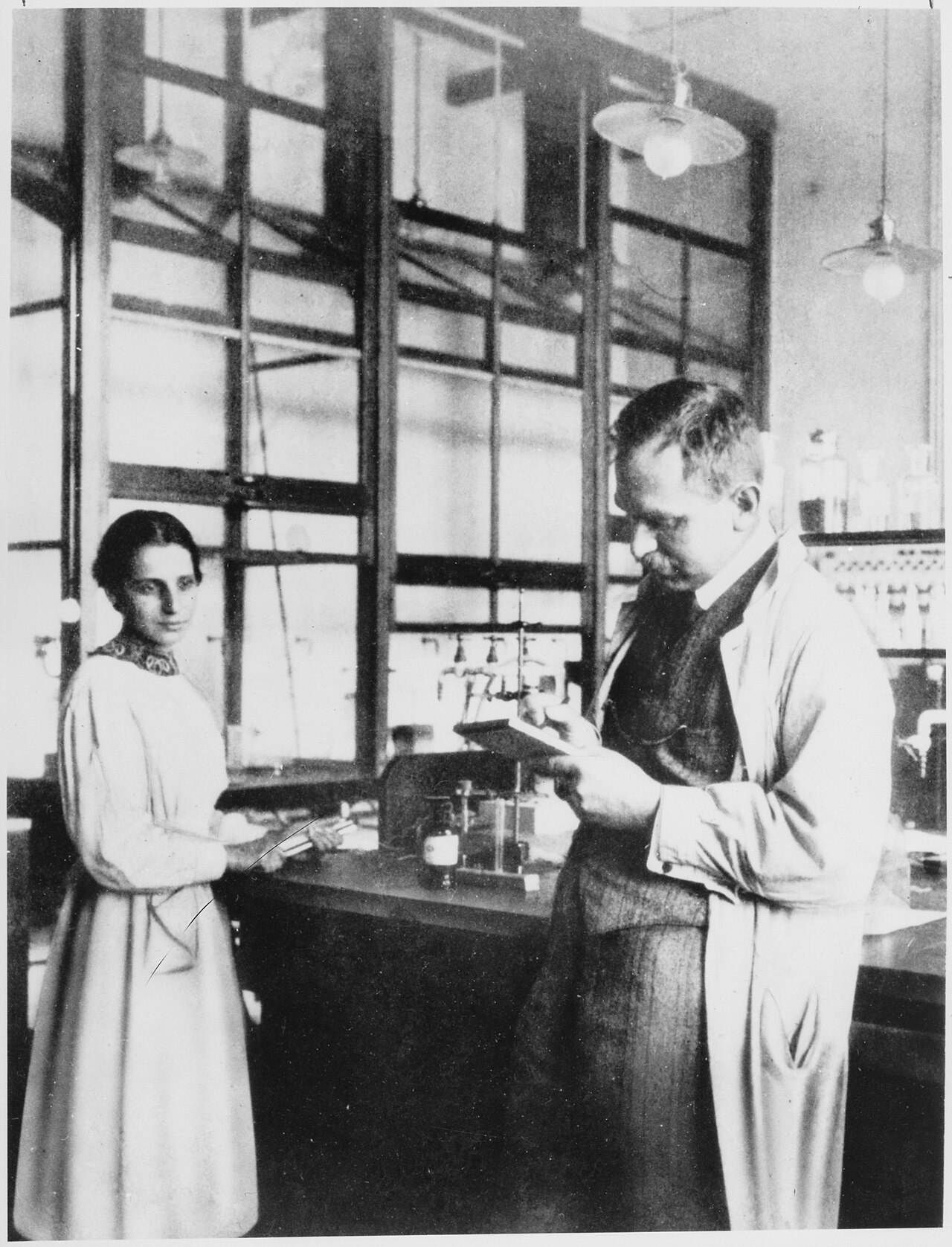

Christmas 1938, in Sweden. A woman walks in the snow with her nephew and understands, within a few hours, what will change the course of the century.
Her name is Lise Meitner. The Nobel Prize that will reward this fundamental discovery will be awarded seven years later — without her name on it. This is the story of a scientific revolution, and of the institutional injustice that followed it.
First, what is this about?
The heart of an atom, its nucleus, is made up of particles tightly bound together. In most elements, this nucleus is stable: it undergoes no transformation over time.
In others, the structure is unstable. An unstable nucleus eventually transforms spontaneously, at a moment that cannot be predicted, by ejecting a particle or an electromagnetic wave. This phenomenon is called radioactivity. Uranium is one of the best-known examples.
In 1934, in Berlin, a question was occupying the laboratories: what happens when a uranium nucleus is bombarded with a neutron?1
The work of a team
From the mid-1930s, three researchers worked together, each with a distinct contribution:
- Lise Meitner, physicist;
- Otto Hahn, seasoned chemist;
- Fritz Strassmann, chemist and laboratory assistant.
For several years, they bombarded uranium with neutrons, convinced that they were producing artificial elements heavier than uranium (the transuranium elements). They were on the wrong track, but at the time the whole scientific community shared this error.
The political rupture and exile
In July 1938, the political situation upended the collaboration.2
An Austrian of Jewish origin, Lise Meitner was directly threatened by the racial laws of the Nazi regime following the Anschluss. Her conversion to Protestantism thirty years earlier offered her no protection. With the crucial help of the Dutch physicist Dirk Coster, she fled Germany in secret and took refuge in Sweden.3
Note: Fritz Strassmann would also pay for his firm opposition to the Nazi regime: shut out of university posts, he would work for years on half pay, or even with no pay at all.4
The discovery by correspondence
The key explanation took shape over six crucial weeks:
- 13 November 1938 — Hahn and Meitner met secretly in Copenhagen. She suggested rigorous additional experimental protocols to him.
- December 1938 — In Berlin, Hahn and Strassmann carried out these tests and detected the presence of barium, an element roughly half as heavy as uranium. The result was incomprehensible: the physics of the time did not envisage that a nucleus could break in two.
- 19 December 1938 — Hahn wrote urgently to Meitner asking her to find a theoretical explanation, however outlandish.
- Christmas 1938 (Kungälv, Sweden) — Meitner and her nephew, the physicist Otto Frisch, went for a walk in the snow to discuss it: he on skis, she on foot. They sat down on a tree trunk to calculate.5
Meitner proposed seeing the nucleus as a drop of liquid. Frisch, who was better at picturing things, sketched what would happen: the drop, struck by a neutron, elongates, pinches in the middle, then splits in two. The two pieces, electrically charged, repel each other violently.6
- The energy calculation — One question remained, raised by Frisch: where would this energy come from? Meitner calculated from memory that the two daughter nuclei would, together, be lighter than the original nucleus by about one-fifth of the mass of a proton. This missing mass, entered into Einstein’s formula linking mass and energy, gives about 200 million electronvolts.7
The two calculations — that of the electrical repulsion and that of the missing mass — arrive at the same number. Everything fits.
- January 1939 — Frisch confirmed the experiment in the laboratory in Copenhagen. He adopted the term fission, after learning that biologists used this name for the division of a cell in two.8
In their article, Meitner and Frisch write that the uranium nucleus has only small stability of form, and that it may, after neutron capture, divide itself into two nuclei of roughly equal size — the precise ratio depending on finer structural features, and perhaps partly on chance.9
Two publications, unequal treatment
- 6 January 1939: Hahn and Strassmann published the chemical results in the journal Naturwissenschaften. Meitner’s name was left out.
- 11 February 1939: Meitner and Frisch published the fundamental physical interpretation in the journal Nature.
- November 1945: The 1944 Nobel Prize in Chemistry (awarded late) was announced for Otto Hahn alone. Yet the statutes of the Nobel Foundation allowed the prize to be awarded jointly to all three researchers.10
Three documented facts
- 49 nominations: Lise Meitner was nominated 49 times for the Nobel Prize (30 times in physics and 19 times in chemistry) without ever receiving it.
- What she said about it herself: her position is more nuanced than that of her defenders, and deserves to be quoted. “Surely Hahn fully deserved the Nobel Prize for chemistry. There is really no doubt about it. But I believe that Frisch and I contributed something not insignificant to the clarification of the process of uranium fission—how it originates and that it produces so much energy, and that was something very remote from Hahn.”11
She does not claim Hahn’s prize. She claims her own. Chemistry had found the barium; physics had explained why. Two prizes existed; only one was given.
- Late recognition: In 1966, the United States Atomic Energy Commission jointly awarded the prestigious Enrico Fermi Award to Hahn, Meitner and Strassmann — a distinction shared, this time, between chemistry and physics. The 1944 Nobel Prize, for its part, has remained Hahn’s alone.12
The aftermath of the discovery: from theory to history
The story does not end with this academic injustice: the discovery at Kungälv set off, at unprecedented speed, a chain of events on a global scale.
- The chain reaction — When a uranium nucleus breaks apart, it releases further neutrons, which can in turn split other neighbouring nuclei.
- The first reactor (1942) — In December 1942, in Chicago, Enrico Fermi’s team achieved the first controlled chain reaction (Chicago Pile-1).
- Military use (1945) — In August 1945, less than seven years after the walk in the snow, two atomic bombs destroyed Hiroshima and Nagasaki.
- Civil energy (1951-1954) — The first nuclear-generated electricity was produced in 1951 (EBR-I reactor, USA), and the first power station to supply electricity to a power grid was commissioned in 1954 at Obninsk (USSR).13
Methodological note on radioactivity measurements
When dealing with the impact of radioactivity, precision about units is essential to avoid any confusion:
- The becquerel (Bq): Measures raw activity, that is, the number of nuclear decays per second.
- The sievert (Sv): Assesses the biological impact of radiation on the human body.14
Caution with figures: The sievert represents an estimate of average risk calculated for a population. It does not predict an absolute individual outcome. Any figure on radioactivity published without its unit and its assessment context is scientifically unusable.
In memory
On Lise Meitner’s grave, in Bramley (England), her nephew Otto Frisch composed this epitaph:15
“Lise Meitner: a physicist who never lost her humanity.”
Note 1
Upon returning to Berlin she was made head of a physics section at the KWI, where she did research in nuclear physics. […] In 1934 Enrico Fermi bombarded uranium with neutrons, producing what he thought were the first elements heavier than uranium. […] Following Fermi’s work, Meitner and Hahn, along with chemist Fritz Strassmann, also began bombarding uranium and other elements with neutrons and identifying the series of decay products.
Chodos, Alan, “December 1938: Discovery of Nuclear Fission”, APS News, “This Month in Physics History”, 3 December 2007
Note 2
Meitner, who had Jewish ancestry, worked at the KWI until July 1938, when she was forced to flee from the Nazis.
Chodos, Alan, “December 1938: Discovery of Nuclear Fission”, APS News, “This Month in Physics History”, 3 December 2007
Note 3
Her influential work in the early 20th century made her a target of the Nazis […] Lise's parents were assimilated Viennese Jews, who did not practice Judaism. […] However, she held her paid position at the Kaiser Wilhelm Institute for Chemistry until the Third Reich's invasion of Austria in 1938 (the Anschluss) brought Austrians under German law. […] Dirk Coster, a Dutch physicist, secretly accompanied Meitner through the stressful train journey across Nazi borders into the Netherlands.
Rife, Patricia, “Lise Meitner”, Shalvi/Hyman Encyclopedia of Jewish Women, Jewish Women’s Archive, 27 February 2009
Note 4
‘Strassman is not someone who is going out throwing bombs or distributing leaflets, but he resigns his position in the German Chemical Society, which is massive,’ Chapman explains. ‘There is a level beyond PhD [in Germany] where you take your habilitation [degree], and he is not eligible any more to do that, and so he is throwing away essentially his career on a principled stance.’ Because Strassmann eschewed professional scientific organisations affiliated with the Nazi party, sustaining his employment as a scientist was difficult.
Trager, Rebecca, “Fritz Strassmann: the principled chemist who discovered nuclear fission”, Chemistry World, Royal Society of Chemistry
Note 5
it was impossible to separate those bodies from barium […] so that Hahn and Strassmann were forced to conclude that isotopes of barium (Z = 56) are formed as a consequence of the bombardment of uranium (Z = 92) with neutrons.
Meitner, Lise and Frisch, Otto R., “Disintegration of Uranium by Neutrons: A New Type of Nuclear Reaction”, Nature, vol. 143, 11 February 1939, p. 239-240
On December 24, she received a troubled letter from Hahn recounting a strange "bursting" he described as occurring to uranium, forming barium. Hahn begged his trusted colleague to interpret this process: "What would physics say about such bursting?"
Rife, Patricia, “Lise Meitner”, Shalvi/Hyman Encyclopedia of Jewish Women, Jewish Women’s Archive, 27 February 2009
Over the Christmas holiday, Meitner had a visit from her nephew, Otto Frisch, a physicist who worked in Copenhagen at Niels Bohr's institute. […] They went for a walk in the snow to talk about the matter, Frisch on skis, Meitner keeping up on foot.
Chodos, Alan, “December 1938: Discovery of Nuclear Fission”, APS News, “This Month in Physics History”, 3 December 2007
At that point we both sat down on a tree trunk … and started to calculate on scraps of paper.
Bernstein, Jeremy, “The Discovery of Nuclear Fission”, Inference, vol. 5, no. 1, December 2019
Note 6
Meitner suggested they view the nucleus like a liquid drop, following a model that had been proposed earlier by the Russian physicist George Gamow and then further promoted by Bohr.
Chodos, Alan, “December 1938: Discovery of Nuclear Fission”, APS News, “This Month in Physics History”, 3 December 2007
Frisch, who was better at visualizing things, drew diagrams showing how after being hit with a neutron, the uranium nucleus might, like a water drop, become elongated, then start to pinch in the middle, and finally split into two drops.
Chodos, Alan, “December 1938: Discovery of Nuclear Fission”, APS News, “This Month in Physics History”, 3 December 2007
These two nuclei will repel each other and should gain a total kinetic energy of c. 200 Mev., as calculated from nuclear radius and charge.
Meitner, Lise and Frisch, Otto R., “Disintegration of Uranium by Neutrons: A New Type of Nuclear Reaction”, Nature, vol. 143, 11 February 1939, p. 239-240
Note 7
Fortunately Lise Meitner remembered the empirical formula […] lighter than the original uranium nucleus by about one-fifth the mass of a proton
Bernstein, Jeremy, “The Discovery of Nuclear Fission”, Inference, vol. 5, no. 1, December 2019
Note 8
Using his own lab in Copenhagen, Frisch conducted several experiments with a simple ionization chamber and confirmed Hahn and Strassmann's results.
Atomic Heritage Foundation, “Nuclear Fission”, National Museum of Nuclear Science & History, 4 June 2014
Frisch named the new nuclear process "fission" after learning that the term "binary fission" was used by biologists to describe cell division.
Chodos, Alan, “December 1938: Discovery of Nuclear Fission”, APS News, “This Month in Physics History”, 3 December 2007
Note 9
It seems therefore possible that the uranium nucleus has only small stability of form, and may, after neutron capture, divide itself into two nuclei of roughly equal size (the precise ratio of sizes depending on finer structural features and perhaps partly on chance).
Meitner, Lise and Frisch, Otto R., “Disintegration of Uranium by Neutrons: A New Type of Nuclear Reaction”, Nature, vol. 143, 11 February 1939, p. 239-240
Note 10
The barium finding was published under the names of Hahn and Strassmann only—not, as Pearson's article implies, because Meitner failed to provide an explanation but because it would have been politically impossible for Hahn and Strassmann to include her, a Jew in exile, as a coauthor.
Sime, Ruth Lewin, “Lise Meitner and the discovery of fission”, lettre, Physics Today, vol. 68, no. 10, October 2015, p. 10
In November 1945, three months after the end of World War II, a narrow majority of the members of the Royal Swedish Academy of Sciences decided to award the 1944 Nobel Prize in Chemistry to Otto Hahn for the discovery of nuclear fission.
Crawford, Elisabeth, Sime, Ruth Lewin and Walker, Mark, “A Nobel Tale of Postwar Injustice”, Physics Today, vol. 50, no. 9, 1997, p. 26-32
Note 11
Lise Meitner […] Nominee in 49 nominations:
Fondation Nobel, Nomination Archive, entrée “Lise Meitner”
Surely Hahn fully deserved the Nobel Prize for chemistry. There is really no doubt about it. But I believe that Frisch and I contributed something not insignificant to the clarification of the process of uranium fission—how it originates and that it produces so much energy, and that was something very remote from Hahn.
Sime, Ruth Lewin, Lise Meitner: A Life in Physics, University of California Press, 1996
Nominee in 49 nominations:
Fondation Nobel, base de données des nominations au prix Nobel
Note 12
The Enrico Fermi award for 1966 was presented by the Atomic Energy Commission to Lise Meitner, Otto Hahn and Fritz Strassmann.
“AEC’s Fermi award”, Physics Today, vol. 19, no. 11, November 1966, p. 95
The award was and still remains controversial, primarily because Hahn's Berlin colleagues, the chemist Fritz Strassmann and the physicist Lise Meitner, were not included.
Crawford, Elisabeth, Sime, Ruth Lewin and Walker, Mark, “A Nobel Tale of Postwar Injustice”, Physics Today, vol. 50, no. 9, 1997, p. 26-32
Note 13
An abandoned rackets court underneath Stagg Field in the middle of the University of Chicago campus was chosen as the test site for the experiment. […] On December 2, 1942, Fermi and the other scientists watched from a balcony while the last scientist on the floor, George Weil, methodically pulled out the cadmium rods as instructed by Fermi. The cadmium rods absorbed neutrons and acted as a brake on the nuclear reaction. […] Sure enough, the pile went critical, creating the world’s first self-sustaining chain reaction.
Atomic Heritage Foundation, “Chicago Pile-1”, National Museum of Nuclear Science & History, 1 December 2016
The next break in the weather over Japan was due to appear just three days after the attack on Hiroshima, to be followed by at least five more days of prohibitive weather. […] At 3:47 a.m. on August 9, 1945, a B-29 named Bock's Car lifted off from Tinian […]. […] The yield of the explosion was later estimated at 21 kilotons, 40 percent greater than that of the Hiroshima bomb. […] Although the destruction at Nagasaki has generally received less worldwide attention than that at Hiroshima, it was extensive nonetheless.
U.S. Department of Energy, “The Atomic Bombing of Nagasaki, August 9, 1945”, The Manhattan Project: An Interactive History, Office of Scientific and Technical Information (OSTI)
Experimental Breeder Reactor 1 (EBR-I) produces the world's first usable amount of electricity from nuclear energy, lighting four electric light bulbs.
Argonne National Laboratory, “Argonne’s Major Nuclear Energy Milestones”
Fifty years ago, at 5:30 pm, 26 June 1954, in the town of Obninsk, near Moscow in the former USSR, the first nuclear power plant was connected to an electricity grid to provide power to residences and businesses.
Agence internationale de l’énergie atomique, “From Obninsk Beyond: Nuclear Power Conference Looks to Future”, 2004
Note 14
Effective dose will then be calculated using revised age- and sex-averaged tissue weighting factors, based on updated risk data and intended to apply as rounded values to a population of both sexes and all ages. Effective dose is calculated for a Reference Person and not for an individual. […] Activity, A The expectation value of the number of nuclear transformations occurring in a given quantity of material per unit time. The SI unit of activity is per second (s−1) and its special name is becquerel (Bq). […] Sievert (Sv) The special name for the SI unit of equivalent dose, effective dose, and operational dose quantities.
Commission internationale de protection radiologique, The 2007 Recommendations of the International Commission on Radiological Protection, publication 103, Annals of the ICRP, vol. 37, no. 2-4, 2007
Note 15
When Adolf Hitler rose to power in 1933, most Jewish scientists fled Germany, including Meitner’s own nephew, Otto Frisch. […] She died on October 27, 1968 at 89, and was buried near her younger brother, Walter, in Bramley, Hampshire. Her epitaph, composed by Frisch, simply reads: “Lise Meitner: a physicist who never lost her humanity.”
Lucibella, Michael, “February 1939: Meitner/Frisch Paper on Nuclear Fission”, APS News, “This Month in Physics History”, 1 February 2015
Notes and sources
- ↑
Passage In 1934, in Berlin, a question was occupying the laboratories
Upon returning to Berlin she was made head of a physics section at the KWI, where she did research in nuclear physics. […] In 1934 Enrico Fermi bombarded uranium with neutrons, producing what he thought were the first elements heavier than uranium. […] Following Fermi’s work, Meitner and Hahn, along with chemist Fritz Strassmann, also began bombarding uranium and other elements with neutrons and identifying the series of decay products.
Source Chodos, Alan, “December 1938: Discovery of Nuclear Fission”, APS News, “This Month in Physics History”, 3 December 2007, online article, paragraphs on Meitner’s career in Berlin and on the 1934 experiments.
Open access open the source · checked on 27 October 2026
- ↑
Passage In July 1938, the political situation upended the collaboration
Meitner, who had Jewish ancestry, worked at the KWI until July 1938, when she was forced to flee from the Nazis.
Source Chodos, Alan, “December 1938: Discovery of Nuclear Fission”, APS News, “This Month in Physics History”, 3 December 2007, 5th paragraph.
Open access open the source · checked on 27 October 2026
- ↑
Passage An Austrian of Jewish origin, Lise Meitner was directly threatened […] With the crucial help of the Dutch physicist Dirk Coster, she fled Germany in secret
Her influential work in the early 20th century made her a target of the Nazis […] Lise's parents were assimilated Viennese Jews, who did not practice Judaism. […] However, she held her paid position at the Kaiser Wilhelm Institute for Chemistry until the Third Reich's invasion of Austria in 1938 (the Anschluss) brought Austrians under German law. […] Dirk Coster, a Dutch physicist, secretly accompanied Meitner through the stressful train journey across Nazi borders into the Netherlands.
Source Rife, Patricia, “Lise Meitner”, Shalvi/Hyman Encyclopedia of Jewish Women, Jewish Women’s Archive, 27 February 2009, online article: “In Brief” box, paragraph on her family (1st sentence quoted), paragraph on the 1930s and the Anschluss, paragraph on the July 1938 escape.
Open access open the source · checked on 27 October 2026
- ↑
Passage Fritz Strassmann would also pay for his firm opposition to the Nazi regime
‘Strassman is not someone who is going out throwing bombs or distributing leaflets, but he resigns his position in the German Chemical Society, which is massive,’ Chapman explains. ‘There is a level beyond PhD [in Germany] where you take your habilitation [degree], and he is not eligible any more to do that, and so he is throwing away essentially his career on a principled stance.’ Because Strassmann eschewed professional scientific organisations affiliated with the Nazi party, sustaining his employment as a scientist was difficult.
Source Trager, Rebecca, “Fritz Strassmann: the principled chemist who discovered nuclear fission”, Chemistry World, Royal Society of Chemistry, two consecutive paragraphs: remark by the historian Kit Chapman, then the paragraph “Because Strassmann eschewed…”.
Open access open the source · checked on 27 October 2026
- ↑
Passage In Berlin, Hahn and Strassmann carried out these tests and detected the presence of barium
it was impossible to separate those bodies from barium […] so that Hahn and Strassmann were forced to conclude that isotopes of barium (Z = 56) are formed as a consequence of the bombardment of uranium (Z = 92) with neutrons.
Source Meitner, Lise and Frisch, Otto R., “Disintegration of Uranium by Neutrons: A New Type of Nuclear Reaction”, Nature, vol. 143, 11 February 1939, p. 239-240, third paragraph of the article.
Open access open the source · checked on 9 September 2026
Passage Hahn wrote urgently to Meitner asking her to find a theoretical explanation
On December 24, she received a troubled letter from Hahn recounting a strange "bursting" he described as occurring to uranium, forming barium. Hahn begged his trusted colleague to interpret this process: "What would physics say about such bursting?"
Source Rife, Patricia, “Lise Meitner”, Shalvi/Hyman Encyclopedia of Jewish Women, Jewish Women’s Archive, 27 February 2009, online article, paragraph on December 1938.
Open access open the source · checked on 27 October 2026
Passage Meitner and her nephew […] went for a walk in the snow to discuss it: he on skis, she on foot.
Over the Christmas holiday, Meitner had a visit from her nephew, Otto Frisch, a physicist who worked in Copenhagen at Niels Bohr's institute. […] They went for a walk in the snow to talk about the matter, Frisch on skis, Meitner keeping up on foot.
Source Chodos, Alan, “December 1938: Discovery of Nuclear Fission”, APS News, “This Month in Physics History”, 3 December 2007, 7th paragraph.
Open access open the source · checked on 27 October 2026
Passage They sat down on a tree trunk to calculate.
At that point we both sat down on a tree trunk … and started to calculate on scraps of paper.
Source Bernstein, Jeremy, “The Discovery of Nuclear Fission”, Inference, vol. 5, no. 1, December 2019, Frisch’s account (What Little I Remember, p. 116), quoted in the article.
Open access open the source · checked on 24 October 2026
- ↑
Passage Meitner proposed seeing the nucleus as a drop of liquid.
Meitner suggested they view the nucleus like a liquid drop, following a model that had been proposed earlier by the Russian physicist George Gamow and then further promoted by Bohr.
Source Chodos, Alan, “December 1938: Discovery of Nuclear Fission”, APS News, “This Month in Physics History”, 3 December 2007, 7th paragraph.
Open access open the source · checked on 27 October 2026
Passage Frisch, who was better at picturing things, sketched what would happen: the drop, struck by a neutron, elongates, pinches in the middle, then splits in two.
Frisch, who was better at visualizing things, drew diagrams showing how after being hit with a neutron, the uranium nucleus might, like a water drop, become elongated, then start to pinch in the middle, and finally split into two drops.
Source Chodos, Alan, “December 1938: Discovery of Nuclear Fission”, APS News, “This Month in Physics History”, 3 December 2007, 7th paragraph.
Open access open the source · checked on 27 October 2026
Passage The two pieces, electrically charged, repel each other violently.
These two nuclei will repel each other and should gain a total kinetic energy of c. 200 Mev., as calculated from nuclear radius and charge.
Source Meitner, Lise and Frisch, Otto R., “Disintegration of Uranium by Neutrons: A New Type of Nuclear Reaction”, Nature, vol. 143, 11 February 1939, p. 239-240, body of the article.
Open access open the source · checked on 9 September 2026
- ↑
Passage Meitner calculated from memory that the two daughter nuclei would, together, be lighter than the original nucleus by about one-fifth of the mass of a proton
Fortunately Lise Meitner remembered the empirical formula […] lighter than the original uranium nucleus by about one-fifth the mass of a proton
Source Bernstein, Jeremy, “The Discovery of Nuclear Fission”, Inference, vol. 5, no. 1, December 2019, Frisch’s account (What Little I Remember, p. 116), quoted in the article.
Open access open the source · checked on 24 October 2026
- ↑
Passage Frisch confirmed the experiment in the laboratory in Copenhagen.
Using his own lab in Copenhagen, Frisch conducted several experiments with a simple ionization chamber and confirmed Hahn and Strassmann's results.
Source Atomic Heritage Foundation, “Nuclear Fission”, National Museum of Nuclear Science & History, 4 June 2014, body of the page.
Open access open the source · checked on 9 September 2026
Passage He adopted the term fission, after learning that biologists used this name for the division of a cell in two.
Frisch named the new nuclear process "fission" after learning that the term "binary fission" was used by biologists to describe cell division.
Source Chodos, Alan, “December 1938: Discovery of Nuclear Fission”, APS News, “This Month in Physics History”, 3 December 2007, 10th paragraph.
Open access open the source · checked on 27 October 2026
- ↑
Passage the uranium nucleus has only small stability of form, and that it may, after neutron capture, divide itself into two nuclei of roughly equal size — the precise ratio depending on finer structural features, and perhaps partly on chance
It seems therefore possible that the uranium nucleus has only small stability of form, and may, after neutron capture, divide itself into two nuclei of roughly equal size (the precise ratio of sizes depending on finer structural features and perhaps partly on chance).
Source Meitner, Lise and Frisch, Otto R., “Disintegration of Uranium by Neutrons: A New Type of Nuclear Reaction”, Nature, vol. 143, 11 February 1939, p. 239-240, body of the article.
Open access open the source · checked on 9 September 2026
- ↑
Passage Hahn and Strassmann published the chemical results […] Meitner’s name was left out.
The barium finding was published under the names of Hahn and Strassmann only—not, as Pearson's article implies, because Meitner failed to provide an explanation but because it would have been politically impossible for Hahn and Strassmann to include her, a Jew in exile, as a coauthor.
Source Sime, Ruth Lewin, “Lise Meitner and the discovery of fission”, lettre, Physics Today, vol. 68, no. 10, October 2015, p. 10, letter from R. L. Sime (Readers’ Forum), 3rd paragraph.
Open access open the source · checked on 24 October 2026
Passage The 1944 Nobel Prize in Chemistry (awarded late) was announced for Otto Hahn alone.
In November 1945, three months after the end of World War II, a narrow majority of the members of the Royal Swedish Academy of Sciences decided to award the 1944 Nobel Prize in Chemistry to Otto Hahn for the discovery of nuclear fission.
Source Crawford, Elisabeth, Sime, Ruth Lewin and Walker, Mark, “A Nobel Tale of Postwar Injustice”, Physics Today, vol. 50, no. 9, 1997, p. 26-32, abstract.
Paywalled · checked on 25 October 2026
- ↑
Passage Lise Meitner was nominated 49 times for the Nobel Prize […] without ever receiving it.
Lise Meitner […] Nominee in 49 nominations:
Source Fondation Nobel, Nomination Archive, entrée “Lise Meitner”, “Lise Meitner” entry in the Nomination Archive (heading of the list of nominations: physics 1937-1967, chemistry 1924-1948).
Open access open the source · checked on 24 October 2026
Passage Hahn fully deserved the Nobel Prize for chemistry. There is really no doubt about it. But I believe that Frisch and I contributed something not insignificant to the clarification of the process of uranium fission
Surely Hahn fully deserved the Nobel Prize for chemistry. There is really no doubt about it. But I believe that Frisch and I contributed something not insignificant to the clarification of the process of uranium fission—how it originates and that it produces so much energy, and that was something very remote from Hahn.
Source Sime, Ruth Lewin, Lise Meitner: A Life in Physics, University of California Press, 1996, quoted by Ruth Lewin Sime, pp. 325-329.
In libraries · checked on 9 September 2026
Passage Lise Meitner was nominated 49 times for the Nobel Prize (30 times in physics and 19 times in chemistry)
Nominee in 49 nominations:
Source Fondation Nobel, base de données des nominations au prix Nobel, nominee entry for Lise Meitner (show_people.php?id=6097): list of the 49 nominations, 30 of them in physics and 19 in chemistry.
Open access open the source · checked on 24 October 2026
- ↑
Passage In 1966, the United States Atomic Energy Commission jointly awarded the prestigious Enrico Fermi Award to Hahn, Meitner and Strassmann
The Enrico Fermi award for 1966 was presented by the Atomic Energy Commission to Lise Meitner, Otto Hahn and Fritz Strassmann.
Source “AEC’s Fermi award”, Physics Today, vol. 19, no. 11, November 1966, p. 95, “Societies and Awards” section, entry “AEC’s Fermi award”, p. 95.
Open access open the source · checked on 9 September 2026
Passage The 1944 Nobel Prize, for its part, has remained Hahn’s alone.
The award was and still remains controversial, primarily because Hahn's Berlin colleagues, the chemist Fritz Strassmann and the physicist Lise Meitner, were not included.
Source Crawford, Elisabeth, Sime, Ruth Lewin and Walker, Mark, “A Nobel Tale of Postwar Injustice”, Physics Today, vol. 50, no. 9, 1997, p. 26-32, abstract.
Paywalled · checked on 25 October 2026
- ↑
Passage In December 1942, in Chicago, Enrico Fermi’s team achieved the first controlled chain reaction
An abandoned rackets court underneath Stagg Field in the middle of the University of Chicago campus was chosen as the test site for the experiment. […] On December 2, 1942, Fermi and the other scientists watched from a balcony while the last scientist on the floor, George Weil, methodically pulled out the cadmium rods as instructed by Fermi. The cadmium rods absorbed neutrons and acted as a brake on the nuclear reaction. […] Sure enough, the pile went critical, creating the world’s first self-sustaining chain reaction.
Source Atomic Heritage Foundation, “Chicago Pile-1”, National Museum of Nuclear Science & History, 1 December 2016, sections “Construction” and “Going Critical”.
Open access open the source · checked on 27 October 2026
Passage In August 1945 […] two atomic bombs destroyed Hiroshima and Nagasaki.
The next break in the weather over Japan was due to appear just three days after the attack on Hiroshima, to be followed by at least five more days of prohibitive weather. […] At 3:47 a.m. on August 9, 1945, a B-29 named Bock's Car lifted off from Tinian […]. […] The yield of the explosion was later estimated at 21 kilotons, 40 percent greater than that of the Hiroshima bomb. […] Although the destruction at Nagasaki has generally received less worldwide attention than that at Hiroshima, it was extensive nonetheless.
Source U.S. Department of Energy, “The Atomic Bombing of Nagasaki, August 9, 1945”, The Manhattan Project: An Interactive History, Office of Scientific and Technical Information (OSTI), page “The Atomic Bombing of Nagasaki, August 9, 1945”: paragraph on the weather, start of the account of the mission, paragraph on the bombing run (yield of the explosion), paragraph on the destruction.
Open access open the source · checked on 27 October 2026
Passage The first nuclear-generated electricity was produced in 1951
Experimental Breeder Reactor 1 (EBR-I) produces the world's first usable amount of electricity from nuclear energy, lighting four electric light bulbs.
Source Argonne National Laboratory, “Argonne’s Major Nuclear Energy Milestones”, entry for 20 December 1951.
Open access open the source · checked on 9 September 2026
Passage the first power station to supply electricity to a power grid was commissioned in 1954
Fifty years ago, at 5:30 pm, 26 June 1954, in the town of Obninsk, near Moscow in the former USSR, the first nuclear power plant was connected to an electricity grid to provide power to residences and businesses.
Source Agence internationale de l’énergie atomique, “From Obninsk Beyond: Nuclear Power Conference Looks to Future”, 2004, first paragraph.
Open access open the source · checked on 9 September 2026
- ↑
Passage The becquerel (Bq): Measures raw activity […] The sievert (Sv): Assesses the biological impact […] an estimate of average risk calculated for a population
Effective dose will then be calculated using revised age- and sex-averaged tissue weighting factors, based on updated risk data and intended to apply as rounded values to a population of both sexes and all ages. Effective dose is calculated for a Reference Person and not for an individual. […] Activity, A The expectation value of the number of nuclear transformations occurring in a given quantity of material per unit time. The SI unit of activity is per second (s−1) and its special name is becquerel (Bq). […] Sievert (Sv) The special name for the SI unit of equivalent dose, effective dose, and operational dose quantities.
Source Commission internationale de protection radiologique, The 2007 Recommendations of the International Commission on Radiological Protection, publication 103, Annals of the ICRP, vol. 37, no. 2-4, 2007, abstract, § (i); glossary, “Activity” and “Sievert (Sv)”.
Open access open the source · checked on 9 September 2026
- ↑
Passage On Lise Meitner’s grave, in Bramley (England), her nephew Otto Frisch composed this epitaph: […] “Lise Meitner: a physicist who never lost her humanity.”
When Adolf Hitler rose to power in 1933, most Jewish scientists fled Germany, including Meitner’s own nephew, Otto Frisch. […] She died on October 27, 1968 at 89, and was buried near her younger brother, Walter, in Bramley, Hampshire. Her epitaph, composed by Frisch, simply reads: “Lise Meitner: a physicist who never lost her humanity.”
Source Lucibella, Michael, “February 1939: Meitner/Frisch Paper on Nuclear Fission”, APS News, “This Month in Physics History”, 1 February 2015, 3rd paragraph (the nephew); penultimate paragraph (the grave and the epitaph).
Open access open the source · checked on 25 October 2026
Bibliography
22
- “AEC’s Fermi award”, Physics Today, vol. 19, no. 11, November 1966, p. 95, open access (the 1966 Enrico Fermi Award presented by the Atomic Energy Commission jointly to Meitner, Hahn and Strassmann). https://aip.brightspotcdn.com/PTO.v19.i11.95_1.online.pdf
- Agence internationale de l’énergie atomique, “From Obninsk Beyond: Nuclear Power Conference Looks to Future”, 2004, open access (Obninsk, the first power station connected to an electricity grid, on 26 June 1954). https://www.iaea.org/node/5713
- Argonne National Laboratory, “Argonne’s Major Nuclear Energy Milestones”, open access (EBR-I, the first usable nuclear-generated electricity, on 20 December 1951). https://www.anl.gov/nse/argonnes-major-nuclear-energy-milestones
- Atomic Heritage Foundation, “Chicago Pile-1”, National Museum of Nuclear Science & History, 1 December 2016, open access (the first self-sustaining chain reaction, on 2 December 1942, under Stagg Field at the University of Chicago, led by Fermi and his team, with cadmium rods acting as a brake). https://ahf.nuclearmuseum.org/ahf/history/chicago-pile-1/
- Atomic Heritage Foundation, “Nuclear Fission”, National Museum of Nuclear Science & History, 4 June 2014, open access (Frisch’s experimental confirmation, in his Copenhagen laboratory, with an ionisation chamber). https://ahf.nuclearmuseum.org/ahf/history/nuclear-fission
- Bernstein, Jeremy, “The Discovery of Nuclear Fission”, Inference, vol. 5, no. 1, December 2019, open access (Frisch’s account quoted from What Little I Remember, pp. 115-116: the tree trunk, the missing mass of about one-fifth of a proton). https://inference-review.com/article/the-discovery-of-nuclear-fission
- Chodos, Alan, “December 1938: Discovery of Nuclear Fission”, APS News, “This Month in Physics History”, 3 December 2007, open access (the walk in the snow, Frisch on skis and Meitner on foot; the liquid-drop model and Frisch’s diagrams; the word “fission” borrowed from biologists; Meitner’s escape in July 1938). https://www.aps.org/apsnews/2007/12/december-1938-discovery-nuclear-fission
- Commission internationale de protection radiologique, The 2007 Recommendations of the International Commission on Radiological Protection, publication 103, Annals of the ICRP, vol. 37, no. 2-4, 2007, open access for the summary and the glossary (the becquerel, the sievert and the notion of average risk). https://www.icrp.org/publication.asp?id=ICRP%20Publication%20103
- Crawford, Elisabeth, Sime, Ruth Lewin and Walker, Mark, “A Nobel Tale of Postwar Injustice”, Physics Today, vol. 50, no. 9, 1997, p. 26-32, paywalled (the Nobel committee archives opened after fifty years).
- Fondation Nobel, base de données des nominations au prix Nobel, open access (Lise Meitner’s 49 nominations: 30 in physics, 19 in chemistry). https://www.nobelprize.org/nomination/archive/
- Fondation Nobel, Nomination Archive, entrée “Lise Meitner”, open access (the count of nominations). https://www.nobelprize.org/nomination/archive/
- Frisch, Otto R., What Little I Remember, Cambridge University Press, 1979, in libraries (the account of the Kungälv walk, the skis, the tree trunk, and the origin of the word “fission”).
- Frisch, Otto R., “Physical Evidence for the Division of Heavy Nuclei under Neutron Bombardment”, Nature, vol. 143, 18 February 1939, p. 276, paywalled.
- Hahn, Otto and Strassmann, Fritz, “Über den Nachweis und das Verhalten der bei der Bestrahlung des Urans mittels Neutronen entstehenden Erdalkalimetalle”, Die Naturwissenschaften, vol. 27, 6 January 1939, p. 11-15, paywalled.
- Lucibella, Michael, “February 1939: Meitner/Frisch Paper on Nuclear Fission”, APS News, “This Month in Physics History”, 1 February 2015, open access (Otto Frisch, Lise Meitner’s nephew; her grave at Bramley and the epitaph composed by Frisch). https://www.aps.org/apsnews/2015/02/1939-meitner-frisch-nuclear-fission
- Meitner, Lise and Frisch, Otto R., “Disintegration of Uranium by Neutrons: A New Type of Nuclear Reaction”, Nature, vol. 143, 11 February 1939, p. 239-240, open access (Hahn and Strassmann’s detection of barium; the liquid-drop model; the division into two nuclei of roughly equal size, depending partly on chance; the 200 MeV calculated from the radius and charge of the nucleus, and from the missing mass). https://www.atomicarchive.com/resources/documents/beginnings/nature_meitner.html
- Rhodes, Richard, The Making of the Atomic Bomb, Simon & Schuster, 1986, in libraries (the chain reaction, Chicago, Hiroshima and Nagasaki).
- Rife, Patricia, “Lise Meitner”, Shalvi/Hyman Encyclopedia of Jewish Women, Jewish Women’s Archive, 27 February 2009, open access. https://jwa.org/encyclopedia/article/meitner-lise
- Sime, Ruth Lewin, “Lise Meitner and the discovery of fission”, lettre, Physics Today, vol. 68, no. 10, October 2015, p. 10, open access (the discovery of barium published under the names of Hahn and Strassmann alone, since Meitner, a Jew in exile, could not politically be included). https://aip.brightspotcdn.com/PTO.v68.i10.10_1.online.pdf
- Sime, Ruth Lewin, Lise Meitner: A Life in Physics, University of California Press, 1996, in libraries (the reference work: the chronology, the correspondence, the exile, the analysis of the exclusion).
- Trager, Rebecca, “Fritz Strassmann: the principled chemist who discovered nuclear fission”, Chemistry World, Royal Society of Chemistry, open access (his refusal of organisations affiliated with the Nazi party and his sacrificed career). https://www.chemistryworld.com/features/fritz-strassmann-the-principled-chemist-who-discovered-nuclear-fission/4023103.article
- U.S. Department of Energy, “The Atomic Bombing of Nagasaki, August 9, 1945”, The Manhattan Project: An Interactive History, Office of Scientific and Technical Information (OSTI), open access. https://www.osti.gov/opennet/manhattan-project-history/Events/1945/nagasaki.htm
Spotted an error or have a doubt? Write to us.