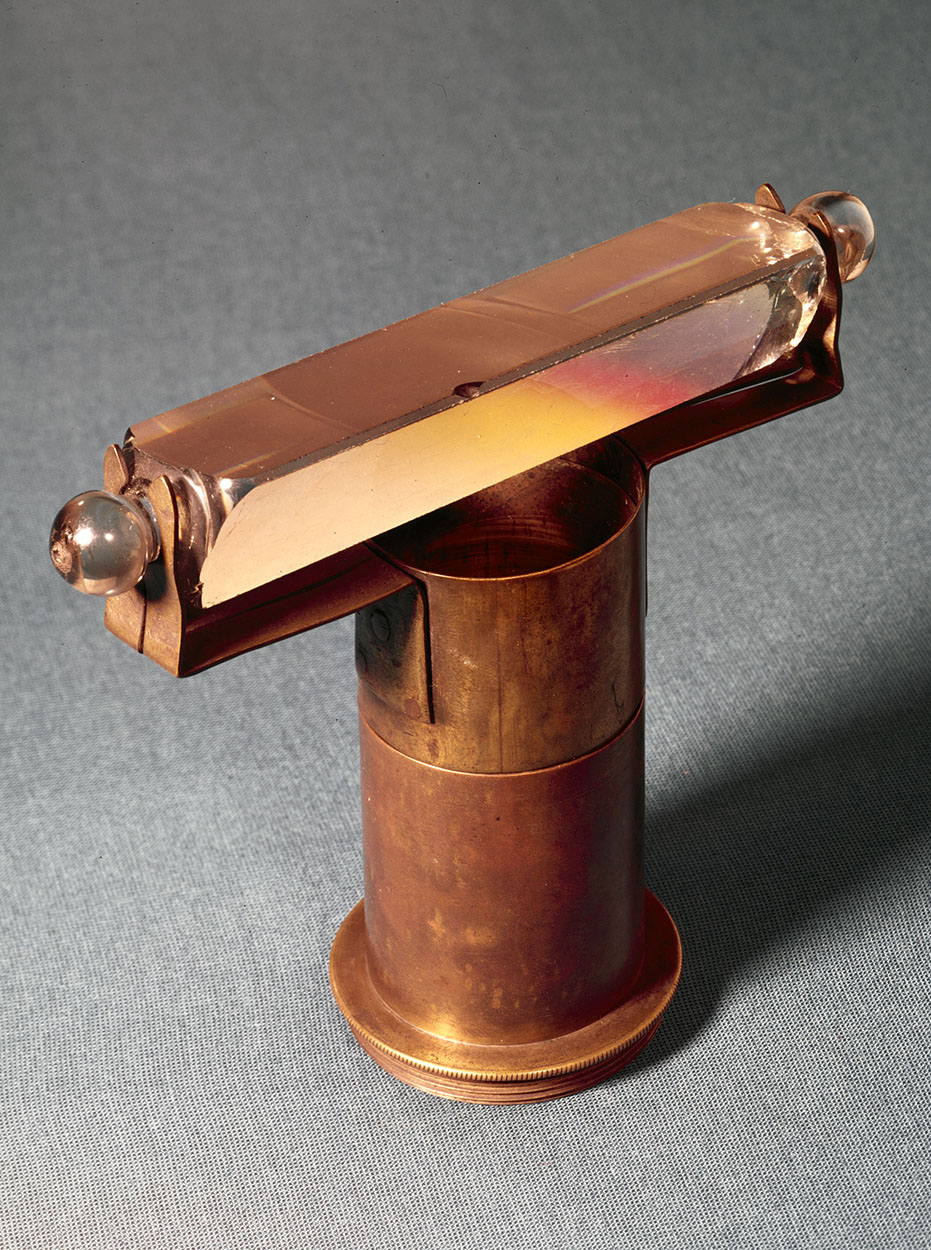

One day in 1800, an astronomer placed a thermometer where there was nothing to see. The mercury began to rise.1
It is one of the simplest experiments in the history of science. The story usually told about it is a little too tidy.
How it began
William Herschel was observing sunspots through a telescope. Looking at the Sun requires its light to be filtered very heavily, or the instrument will be destroyed — and the observer’s eye with it.2
While trying out various combinations of coloured glasses, he noticed something strange, and he wrote it down himself: with some of them, he felt a sensation of heat though he had but little light; with others, much light and scarcely any sensation of heat.3
What he made of this is a model of reasoning. Since the image of the Sun was also coloured differently depending on the glasses, it occurred to him that the power of heating might be very unequally distributed among the colours.4
Then he went one step further, and it is this step that counts: having judged it right to entertain a doubt on this point, it appeared to him equally proper to doubt in the same way with regard to light. If some colours heat better, others perhaps illuminate better.5
His conclusion: at all events, it would be proper to recur to experiments for a decision.6
The experiment
Herschel therefore split sunlight with a prism, then measured the temperature of each colour by placing mercury thermometers in it. He found that the heating power was indeed very unequally distributed, and that red was by far the strongest.7
He then carried out the second experiment, the one he had announced: he looked for where the illumination was greatest, by observing small objects under a microscope in each colour. The answer: in the brightest yellow, or palest green — not in the same place as the heat.8
The two maxima do not coincide. Then, going further, he placed a thermometer beyond the red, where the eye no longer perceives anything.9
Absolute safety rule: never look at the Sun, whether with the naked eye, through an instrument or through a filter. The prism projects the spectrum onto a neutral surface — a white sheet — and it is this surface that is observed. This is exactly how Herschel placed his thermometers.
The mercury rises. Even higher than in the red zone of the visible spectrum.
Herschel had just measured an invisible radiation: what we now call infrared.
The simplified version (and what it glosses over)
This experiment is often told as follows: Herschel supposedly placed this thermometer outside the spectrum by pure chance or simply as a control, to check that nothing was happening in the dark. On this account, the discovery was sheer coincidence.
This romanticised version is appealing, but it glosses over the real driving force of the scientific approach.
Herschel was not searching blindly. He had a precise reason to suspect that the heat did not follow the distribution of the colours: his coloured glasses had alerted him to it, and he wrote it down in black and white before he began.
This in no way diminishes the significance of his discovery. It makes it understandable — and shows that decisive experiments arise from an anomaly that an attentive mind refuses to ignore.
The simplified version also passes over a second crucial point. To say that “he had just discovered an invisible light” is our modern way of framing the event. Herschel himself first believed that heat and light were one and the same thing. The same year, in the second part of a long paper, he concluded the opposite: they are two distinct entities. His observation was rigorously accurate; the interpretation he drew from it differed profoundly from ours. He concluded — wrongly — that this radiation was probably not light. That is the most common situation in the history of science.10
What this discovery actually produced
This experiment is often taught as proof that our senses do not set the bounds of the world: there are physical realities that we do not perceive directly. That is true, and it is the meaning we give it today.
Yet in its own day, it served to support quite a different thesis.
At the time, the scientific community regarded heat as an invisible fluid: caloric (see our page 4.9 on heat). Light was then believed to be made of corpuscles. Discovering that heat travels through space in the same way therefore suggested that it, too, was made of particles: particles of caloric crossing the void.
Herschel’s experiment thus became an argument in favour of the caloric theory.11
In the 1820s, when physicists finally adopted the wave nature of light (thanks to work carried out over the two preceding decades), this argument collapsed. But the caloric theory itself survived for another twenty years or so.12
Beyond red, and much further still
Since Herschel’s discovery, physicists have established that visible light is only a tiny fraction of a vast family of radiation. All share the same nature — electromagnetic waves travelling at the speed of light (about 300,000 km/s in a vacuum) — and differ only in their wavelength (or their frequency).13
From the longest radiation to the shortest:
- Radio waves — Used for telecommunications, radio and mobile telephony.
- Microwaves — Put to work in household ovens, radar and Wi-Fi.
- Infrared — The thermal radiation discovered by Herschel, used notably in remote controls and thermal cameras.
- Visible light — The only band perceived by the human eye, from red to violet.
- Ultraviolet (UV) — More energetic radiation, responsible for tanning and sunburn.
- X-rays — Able to pass through soft tissue, widely used in medical imaging.
- Gamma rays — Extremely energetic radiation emitted by the decay of atomic nuclei and by violent cosmic events.
In everyday life we are bathed in several of these kinds of radiation while perceiving almost none of them. The visible band is only a minute slice of the whole: the infrared range alone is hundreds of times wider.
The lesson is the same in acoustics: we hear only a narrow band of vibrations (see page 4.11). Same principle, two different senses: our organs of perception do not define the limits of reality.
What this explains in the rest of the site
This page gives a direct answer to questions that arise when reading our chapters on astronomy:
- Why are the images from astronomical observatories described as translations (1.13)?
- Why is the colour given to the first image of a black hole the result of a deliberate choice (1.10)?
- Why do photographs of Neptune have to be enhanced by image processing (1.8)?
Because most of the signals picked up by modern telescopes are completely invisible. They are radio waves, infrared, ultraviolet or X-rays.
To make these data accessible to human vision, scientists assign visible colours to this invisible radiation. This is not falsification, but a visual translation — and like any translation, it must be explicitly documented.14
Note 1
Read April 24, 1800. […] went on to the next experiment, by withdrawing the stand, till the whole ball of No. 1 was completely out of the sun's visible rays
Herschel, William, “Experiments on the Refrangibility of the Invisible Rays of the Sun”, Philosophical Transactions of the Royal Society, vol. 90, 1800, p. 284-292
Note 2
During years of solar observations, he had used pieces of colored glass to reduce the amount of light and heat coming through the telescope.
American Physical Society, “Herschel Proposes the Existence of Invisible Light”
Note 3
What appeared remarkable was, that when I used some of them, I felt a sensation of heat, though I had but little light; while others gave me much light, with scarce any sensation of heat.
Herschel, William, “Investigation of the Powers of the Prismatic Colours to Heat and Illuminate Objects”, Philosophical Transactions of the Royal Society, vol. 90, 1800, p. 255-283
Note 4
it occurred to me, that the prismatic rays might have the power of heating bodies very unequally distributed among them
Herschel, William, “Investigation of the Powers of the Prismatic Colours to Heat and Illuminate Objects”, Philosophical Transactions of the Royal Society, vol. 90, 1800, p. 255-283
Note 5
as I judged it right in this respect to entertain a doubt, it appeared equally proper to admit the same with regard to light
Herschel, William, “Investigation of the Powers of the Prismatic Colours to Heat and Illuminate Objects”, Philosophical Transactions of the Royal Society, vol. 90, 1800, p. 255-283
Note 6
At all events, it would be proper to recur to experiments for a decision.
Herschel, William, “Investigation of the Powers of the Prismatic Colours to Heat and Illuminate Objects”, Philosophical Transactions of the Royal Society, vol. 90, 1800, p. 255-283
Note 7
the heating power of the prismatic colours, is very far from being equally divided, and that the red rays are chiefly eminent in that respect
Herschel, William, “Investigation of the Powers of the Prismatic Colours to Heat and Illuminate Objects”, Philosophical Transactions of the Royal Society, vol. 90, 1800, p. 255-283
Note 8
The microscope offered itself as the most convenient instrument for this investigation; and I thought it expedient to view only opaque objects […] I placed an object that had very minute parts, under a double microscope
Herschel, William, “Investigation of the Powers of the Prismatic Colours to Heat and Illuminate Objects”, Philosophical Transactions of the Royal Society, vol. 90, 1800, p. 255-283
The maximum of illumination lies in the brightest yellow, or palest green.
Herschel, William, “Investigation of the Powers of the Prismatic Colours to Heat and Illuminate Objects”, Philosophical Transactions of the Royal Society, vol. 90, 1800, p. 255-283
Note 9
Here the thermometer No. 1 rose […] degrees, in 10 minutes, when its centre was placed […] inch beyond visible light. […] It being now evident that there was a refraction of rays coming from the sun, which, though not fit for vision, were yet highly invested with a power of occasioning heat, I proceeded to examine its extent as follows. […] They are invested with a high power of heating bodies, but with none of illuminating objects
Herschel, William, “Experiments on the Refrangibility of the Invisible Rays of the Sun”, Philosophical Transactions of the Royal Society, vol. 90, 1800, p. 284-292
Note 10
it does not appear that nature is in the habit of using one and the same mechanism with any two of our senses […] Heat is evidently less refrangible than light; whether we take a mean refrangible ray of each, or, which I believe to be the better way of proceeding, whether we take the maximum of heat and light separately.
Herschel, William, “Experiments on the Solar, and on the Terrestrial Rays that Occasion Heat”, Philosophical Transactions of the Royal Society, vol. 90, 1800
he would experimentally investigate the question, rapidly produce three papers, and conclude — incorrectly — that the answer was probably no
American Physical Society, “Herschel Proposes the Existence of Invisible Light”
Note 11
Around 1800, Herschel discovered that on passing sunlight through a prism, and detecting the heat corresponding to the different colors, in fact there was heat transmitted beyond the red. This suggested that radiant heat was caloric particles streaming through space, and no doubt very similar in character to light.
Fowler, Michael, “Teaching Heat: The Rise and Fall of the Caloric Theory”, notes de cours, University of Virginia
Note 12
Before the 1820's, almost everyone believed, following Newton, that light was a stream of particles. […] But in the 1820's it was unambiguously established that light was really a wave.
Fowler, Michael, “Teaching Heat: The Rise and Fall of the Caloric Theory”, notes de cours, University of Virginia
Note 13
For example, radio waves from a mobile phone, X-rays used by dentists, the energy used to cook food in your microwave, the radiant heat from red-hot objects, and the light from your television screen are forms of electromagnetic radiation that all exhibit wavelike behavior. […] As Maxwell showed, electromagnetic waves consist of an electric field oscillating in step with a perpendicular magnetic field, both of which are perpendicular to the direction of travel. These waves can travel through a vacuum at a constant speed of 2.998 × 10⁸ m/s, the speed of light (denoted by c).
Flowers, Paul, Theopold, Klaus, Langley, Richard and Robinson, William R., Chemistry 2e, OpenStax, 2019, section 6.1 “Electromagnetic Energy”
However, radio waves, visible light, X-rays, and all the other parts of the electromagnetic spectrum are fundamentally the same. […] It is important to remember that the various kinds of electromagnetic radiation differ only in their wavelength and frequency. They are alike in all other respects.
NOAA Global Monitoring Laboratory, “Critical Thinking Activity: The Electromagnetic Spectrum”, student sheets, education resources (Louise Belnay)
For example, radio waves from a mobile phone, X-rays used by dentists, the energy used to cook food in your microwave, the radiant heat from red-hot objects, and the light from your television screen are forms of electromagnetic radiation that all exhibit wavelike behavior. […] As Maxwell showed, electromagnetic waves consist of an electric field oscillating in step with a perpendicular magnetic field, both of which are perpendicular to the direction of travel. These waves can travel through a vacuum at a constant speed of 2.998 × 10⁸ m/s, the speed of light (denoted by c). […] Each of the various colors of visible light has specific frequencies and wavelengths associated with them, and you can see that visible light makes up only a small portion of the electromagnetic spectrum.
Flowers, Paul, Theopold, Klaus, Langley, Richard and Robinson, William R., Chemistry 2e, OpenStax, 2019, section 6.1 “Electromagnetic Energy”
Note 14
Exposures made with different narrow filters, as in this case, are translated to a visible color where shorter wavelengths are assigned bluer and longer wavelengths assigned redder colors. This color scheme represents a "chromatically ordered" way of presenting the data rather than a natural color image.
NASA, Astronomy Picture of the Day, “Colorful Clouds of Carina”, 3 February 2000
Notes and sources
- ↑
Passage One day in 1800, an astronomer placed a thermometer where there was nothing to see
Read April 24, 1800. […] went on to the next experiment, by withdrawing the stand, till the whole ball of No. 1 was completely out of the sun's visible rays
Source Herschel, William, “Experiments on the Refrangibility of the Invisible Rays of the Sun”, Philosophical Transactions of the Royal Society, vol. 90, 1800, p. 284-292, p. 284 (date of reading) and account of the experiments, p. 284-292.
Public domain open the source · checked on 25 October 2026
- ↑
Passage William Herschel was observing sunspots through a telescope […] While trying out various combinations of coloured glasses
During years of solar observations, he had used pieces of colored glass to reduce the amount of light and heat coming through the telescope.
Source American Physical Society, “Herschel Proposes the Existence of Invisible Light”, presentation of the experiment.
Open access open the source · checked on 9 September 2026
- ↑
Passage with some of them, he felt a sensation of heat though he had but little light; with others, much light and scarcely any sensation of heat
What appeared remarkable was, that when I used some of them, I felt a sensation of heat, though I had but little light; while others gave me much light, with scarce any sensation of heat.
Source Herschel, William, “Investigation of the Powers of the Prismatic Colours to Heat and Illuminate Objects”, Philosophical Transactions of the Royal Society, vol. 90, 1800, p. 255-283.
Public domain open the source · checked on 9 September 2026
- ↑
Passage the power of heating might be very unequally distributed among the colours
it occurred to me, that the prismatic rays might have the power of heating bodies very unequally distributed among them
Source Herschel, William, “Investigation of the Powers of the Prismatic Colours to Heat and Illuminate Objects”, Philosophical Transactions of the Royal Society, vol. 90, 1800, p. 255-283.
Public domain open the source · checked on 9 September 2026
- ↑
Passage having judged it right to entertain a doubt on this point, it appeared to him equally proper to doubt in the same way with regard to light
as I judged it right in this respect to entertain a doubt, it appeared equally proper to admit the same with regard to light
Source Herschel, William, “Investigation of the Powers of the Prismatic Colours to Heat and Illuminate Objects”, Philosophical Transactions of the Royal Society, vol. 90, 1800, p. 255-283.
Public domain open the source · checked on 9 September 2026
- ↑
Passage it would be proper to recur to experiments for a decision
At all events, it would be proper to recur to experiments for a decision.
Source Herschel, William, “Investigation of the Powers of the Prismatic Colours to Heat and Illuminate Objects”, Philosophical Transactions of the Royal Society, vol. 90, 1800, p. 255-283, p. 256.
Public domain open the source · checked on 9 September 2026
- ↑
Passage measured the temperature of each colour by placing mercury thermometers in it […] red was by far the strongest
the heating power of the prismatic colours, is very far from being equally divided, and that the red rays are chiefly eminent in that respect
Source Herschel, William, “Investigation of the Powers of the Prismatic Colours to Heat and Illuminate Objects”, Philosophical Transactions of the Royal Society, vol. 90, 1800, p. 255-283.
Public domain open the source · checked on 9 September 2026
- ↑
Passage he looked for where the illumination was greatest, by observing small objects under a microscope in each colour
The microscope offered itself as the most convenient instrument for this investigation; and I thought it expedient to view only opaque objects […] I placed an object that had very minute parts, under a double microscope
Source Herschel, William, “Investigation of the Powers of the Prismatic Colours to Heat and Illuminate Objects”, Philosophical Transactions of the Royal Society, vol. 90, 1800, p. 255-283, p. 262.
Public domain open the source · checked on 9 September 2026
Passage in the brightest yellow, or palest green
The maximum of illumination lies in the brightest yellow, or palest green.
Source Herschel, William, “Investigation of the Powers of the Prismatic Colours to Heat and Illuminate Objects”, Philosophical Transactions of the Royal Society, vol. 90, 1800, p. 255-283.
Public domain open the source · checked on 9 September 2026
- ↑
Passage he placed a thermometer beyond the red, where the eye no longer perceives anything […] The mercury rises.
Here the thermometer No. 1 rose […] degrees, in 10 minutes, when its centre was placed […] inch beyond visible light. […] It being now evident that there was a refraction of rays coming from the sun, which, though not fit for vision, were yet highly invested with a power of occasioning heat, I proceeded to examine its extent as follows. […] They are invested with a high power of heating bodies, but with none of illuminating objects
Source Herschel, William, “Experiments on the Refrangibility of the Invisible Rays of the Sun”, Philosophical Transactions of the Royal Society, vol. 90, 1800, p. 284-292, p. 285 (thermometer placed beyond visible light), p. 286 (continuation of the experiments) and p. 290 (conclusion of the first four experiments).
Public domain open the source · checked on 25 October 2026
- ↑
Passage The same year, in the second part of a long paper, he concluded the opposite: they are two distinct entities.
it does not appear that nature is in the habit of using one and the same mechanism with any two of our senses […] Heat is evidently less refrangible than light; whether we take a mean refrangible ray of each, or, which I believe to be the better way of proceeding, whether we take the maximum of heat and light separately.
Source Herschel, William, “Experiments on the Solar, and on the Terrestrial Rays that Occasion Heat”, Philosophical Transactions of the Royal Society, vol. 90, 1800, Part II (vol. 90, p. 437-538), article VII “Whether Light and Heat be occasioned by the same, or by different Rays”, p. 507 then p. 509.
Public domain open the source · checked on 24 October 2026
Passage He concluded — wrongly — that this radiation was probably not light.
he would experimentally investigate the question, rapidly produce three papers, and conclude — incorrectly — that the answer was probably no
Source American Physical Society, “Herschel Proposes the Existence of Invisible Light”, presentation of the experiment.
Open access open the source · checked on 9 September 2026
- ↑
Passage Herschel’s experiment thus became an argument in favour of the caloric theory.
Around 1800, Herschel discovered that on passing sunlight through a prism, and detecting the heat corresponding to the different colors, in fact there was heat transmitted beyond the red. This suggested that radiant heat was caloric particles streaming through space, and no doubt very similar in character to light.
Source Fowler, Michael, “Teaching Heat: The Rise and Fall of the Caloric Theory”, notes de cours, University of Virginia, paragraph beginning “In fact, by this time”, 3rd and 4th sentences.
Open access open the source · checked on 27 October 2026
- ↑
Passage In the 1820s, when physicists finally adopted the wave nature of light
Before the 1820's, almost everyone believed, following Newton, that light was a stream of particles. […] But in the 1820's it was unambiguously established that light was really a wave.
Source Fowler, Michael, “Teaching Heat: The Rise and Fall of the Caloric Theory”, notes de cours, University of Virginia, paragraph beginning “In fact, by this time”, 2nd and 5th sentences.
Open access open the source · checked on 27 October 2026
- ↑
Passage All share the same nature — electromagnetic waves travelling at the speed of light (about 300,000 km/s in a vacuum)
For example, radio waves from a mobile phone, X-rays used by dentists, the energy used to cook food in your microwave, the radiant heat from red-hot objects, and the light from your television screen are forms of electromagnetic radiation that all exhibit wavelike behavior. […] As Maxwell showed, electromagnetic waves consist of an electric field oscillating in step with a perpendicular magnetic field, both of which are perpendicular to the direction of travel. These waves can travel through a vacuum at a constant speed of 2.998 × 10⁸ m/s, the speed of light (denoted by c).
Source Flowers, Paul, Theopold, Klaus, Langley, Richard and Robinson, William R., Chemistry 2e, OpenStax, 2019, section 6.1 “Electromagnetic Energy”, section 6.1, introduction (2nd paragraph) and subsection “Waves” (2nd paragraph).
Open access open the source · checked on 27 October 2026
Passage and differ only in their wavelength (or their frequency)
However, radio waves, visible light, X-rays, and all the other parts of the electromagnetic spectrum are fundamentally the same. […] It is important to remember that the various kinds of electromagnetic radiation differ only in their wavelength and frequency. They are alike in all other respects.
Source NOAA Global Monitoring Laboratory, “Critical Thinking Activity: The Electromagnetic Spectrum”, student sheets, education resources (Louise Belnay), Student Sheet 2, p. 2 of the PDF.
Open access open the source · checked on 27 October 2026
Passage visible light is only a tiny fraction of a vast family of radiation. All share the same nature — electromagnetic waves travelling at the speed of light (about 300,000 km/s in a vacuum)
For example, radio waves from a mobile phone, X-rays used by dentists, the energy used to cook food in your microwave, the radiant heat from red-hot objects, and the light from your television screen are forms of electromagnetic radiation that all exhibit wavelike behavior. […] As Maxwell showed, electromagnetic waves consist of an electric field oscillating in step with a perpendicular magnetic field, both of which are perpendicular to the direction of travel. These waves can travel through a vacuum at a constant speed of 2.998 × 10⁸ m/s, the speed of light (denoted by c). […] Each of the various colors of visible light has specific frequencies and wavelengths associated with them, and you can see that visible light makes up only a small portion of the electromagnetic spectrum.
Source Flowers, Paul, Theopold, Klaus, Langley, Richard and Robinson, William R., Chemistry 2e, OpenStax, 2019, section 6.1 “Electromagnetic Energy”, section 6.1, introduction (2nd paragraph) and subsection “Waves” (2nd and 5th paragraphs).
Open access open the source · checked on 27 October 2026
- ↑
Passage scientists assign visible colours to this invisible radiation […] a visual translation
Exposures made with different narrow filters, as in this case, are translated to a visible color where shorter wavelengths are assigned bluer and longer wavelengths assigned redder colors. This color scheme represents a "chromatically ordered" way of presenting the data rather than a natural color image.
Source NASA, Astronomy Picture of the Day, “Colorful Clouds of Carina”, 3 February 2000, text of the picture of 3 February 2000.
Open access open the source · checked on 9 September 2026
Bibliography
12
- American Physical Society, “Herschel Proposes the Existence of Invisible Light”, open access (the context of the solar filters, the sequence of the three papers, and the mistaken conclusion Herschel drew from them). https://www.aps.org/apsnews/2024/02/william-herschel-invisible-light
- Buchwald, Jed Z., The Rise of the Wave Theory of Light, University of Chicago Press, 1989, in libraries (the shift to wave optics at the beginning of the nineteenth century).
- Flowers, Paul, Theopold, Klaus, Langley, Richard and Robinson, William R., Chemistry 2e, OpenStax, 2019, section 6.1 “Electromagnetic Energy”, open access (radio waves, X-rays, microwaves, radiant heat and visible light as forms of the same electromagnetic radiation; their speed in a vacuum, 2.998 × 10⁸ m/s; visible light, a small portion of the spectrum). https://openstax.org/books/chemistry-2e/pages/6-1-electromagnetic-energy
- Fowler, Michael, “Teaching Heat: The Rise and Fall of the Caloric Theory”, notes de cours, University of Virginia, open access (the radiant heat discovered by Herschel read as a stream of caloric particles; the wave nature of light established in the 1820s). https://galileoandeinstein.phys.virginia.edu/more_stuff/TeachingHeat.htm
- Fox, Robert, The Caloric Theory of Gases from Lavoisier to Regnault, Clarendon Press, 1971, in libraries (how Herschel’s discovery strengthened the caloric theory, and the collapse of that argument).
- Hecht, Eugene, Optique, Pearson, 2005, in libraries (the electromagnetic spectrum, from radio waves to gamma rays).
- Herschel, William, “Investigation of the Powers of the Prismatic Colours to Heat and Illuminate Objects”, Philosophical Transactions of the Royal Society, vol. 90, 1800, p. 255-283, public domain (the coloured glasses and the sensation of heat without light; the doubt extended to light; the recourse to experiment; the maximum of heat in the red and the maximum of illumination in the yellow-green). https://royalsocietypublishing.org/rstl/article/doi/10.1098/rstl.1800.0014/121216/
- Herschel, William, “Experiments on the Refrangibility of the Invisible Rays of the Sun”, Philosophical Transactions of the Royal Society, vol. 90, 1800, p. 284-292, public domain (the thermometer placed beyond the red, outside visible light, and the heat it measures there). https://archive.org/details/jstor-107057
- Herschel, William, “Experiments on the Solar, and on the Terrestrial Rays that Occasion Heat”, Philosophical Transactions of the Royal Society, vol. 90, 1800, public domain (the reversal: heat and light held to be distinct).
- Lovell, D. J., “Herschel’s Dilemma in the Interpretation of Thermal Radiation”, Isis, vol. 59, no. 1, 1968, p. 46-60, paywalled.
- NASA, Astronomy Picture of the Day, “Colorful Clouds of Carina”, 3 February 2000, open access (the narrow filters translated into visible colours, from shortest to longest: an ordered presentation of the data and not a natural-colour image; see Entry 1.13). https://apod.nasa.gov/apod/ap000203.html
- NOAA Global Monitoring Laboratory, “Critical Thinking Activity: The Electromagnetic Spectrum”, student sheets, education resources (Louise Belnay), open access (radio waves, visible light and X-rays, fundamentally the same, differing only in wavelength and frequency). https://gml.noaa.gov/education/info_activities/pdfs/CTA_EMS.pdf
Spotted an error or have a doubt? Write to us.