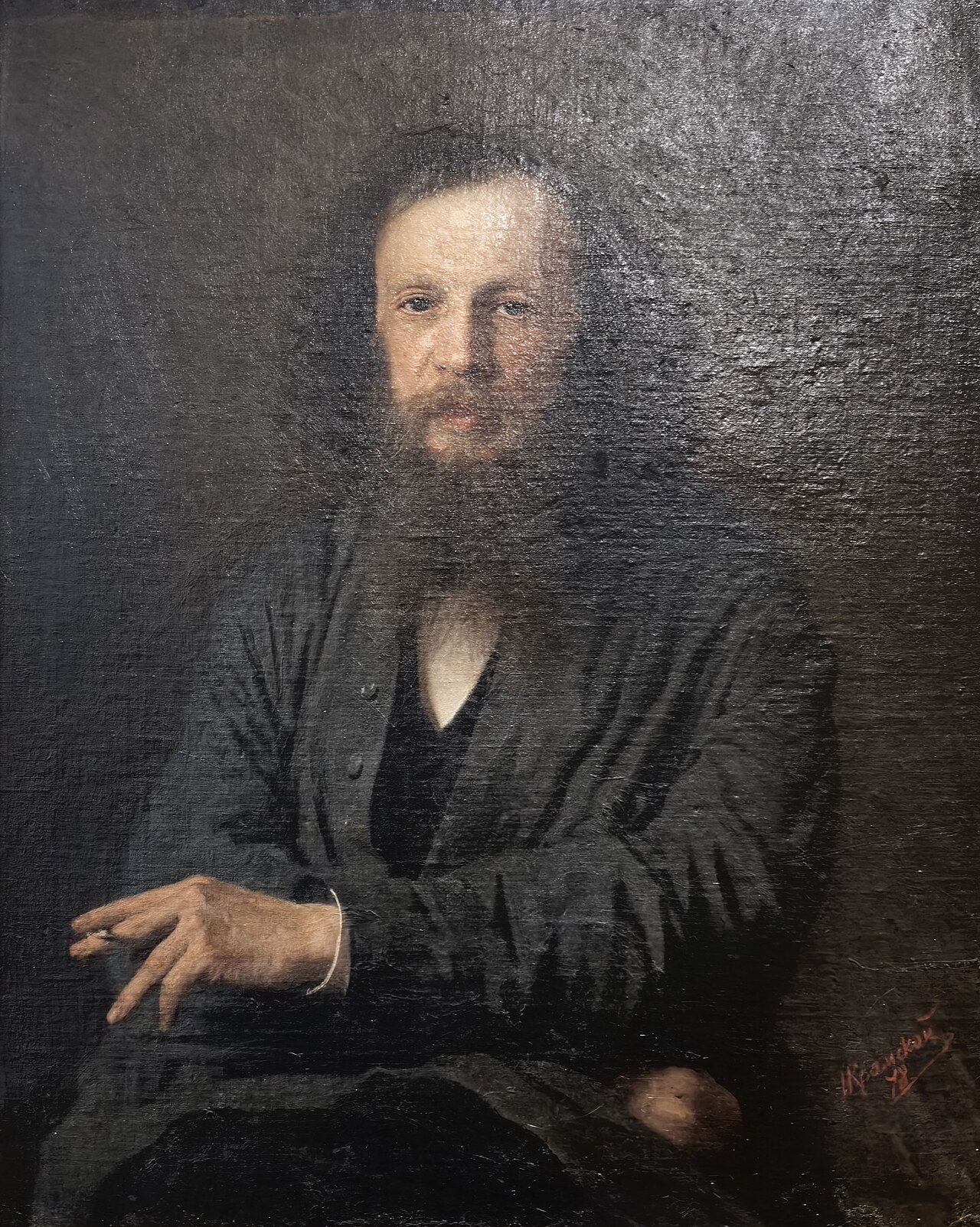

In 1869 and 1870, two chemists arranged the elements in the same way, less than a year apart, without having consulted each other.
One was Russian, the other German. They would argue for years over which of them came first.
It was not priority that settled the matter.
The two tables
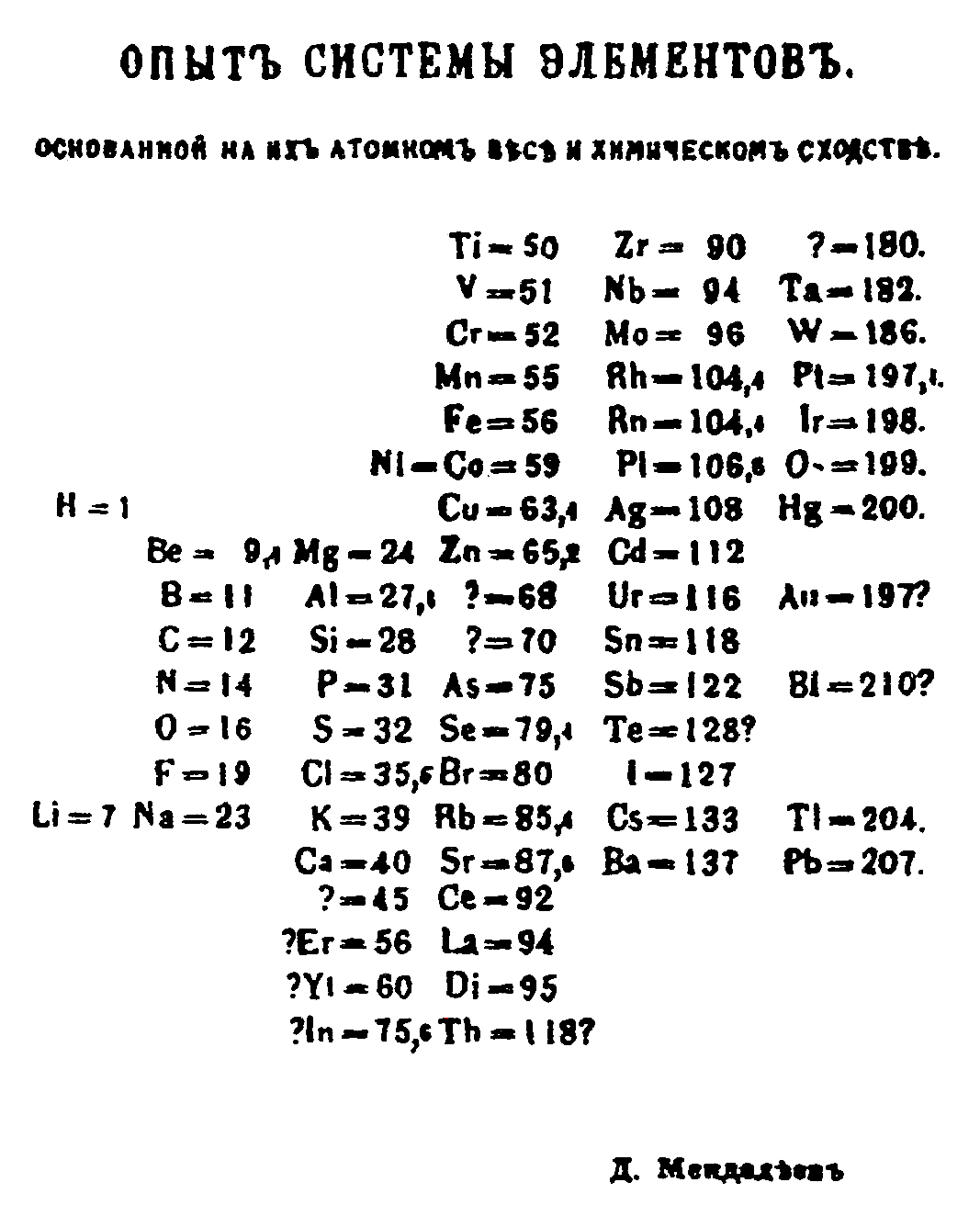
Dmitri Mendeleev published his table in March 1869. In it he arranged the known elements by increasing mass, and observed that their properties recurred at regular intervals, like a pattern.

Lothar Meyer, in Germany, had carried out very similar work. He had published a partial table of twenty-eight elements as early as 1864. By 1868 he had devised one of fifty-three — his best version. But that one he left to gather dust. It would not be made public until 1895, the year of his death. His complete table appeared in 1870, a few months after Mendeleev’s.1
The dispute broke out in the 1870s. Anyone who has read other pages of this site may smile: it turned partly on a word.
Mendeleev’s summary, written in Russian, had been translated into German with a word meaning “by degrees” (stufenweise) rather than “periodic”. The nuance was bitterly contested.2
A word that changes the scope of an affair: this mechanism turns up everywhere on this site. This time, it is the term that gives the table itself its name.
What really settled it
Mendeleev did not merely arrange what was already known.
He left empty boxes.
He did not stop at saying “something must be missing here”. For several of these boxes, he described what the unknown element should weigh, what its density should be, what formula its oxide would have and how it should react.3
He even gave them provisional names, with prefixes borrowed from Sanskrit: eka, dvi, tri — “one”, “two”, “three” — depending on whether the empty box lay one, two or three places below the known element in the same column. Eka-aluminium. Eka-boron. Eka-silicon.4
The significance of this move deserves a moment’s attention.
It was a public, written and falsifiable wager. If these elements never appeared, or appeared with quite different properties, his whole table would collapse in front of witnesses.
What happened next
1875. A French chemist, Paul-Émile Lecoq de Boisbaudran, detected a new metal by analysing the light it emits. He called it gallium. It was eka-aluminium.5
1879. A Swede, Lars Fredrik Nilson, found scandium. It was eka-boron.6
1886. A German, Clemens Winkler, found an unknown element in a silver ore. It was eka-silicon; he would call it germanium.7
A detail that shows that nothing is ever immediate: Winkler at first believed he had found eka-antimony. He had to establish that the element combines like silicon before he could understand which box it belonged in.8
For that one, here are the figures:
- Atomic mass: Mendeleev predicted about 72. The measurement gave 72.3.
- Density: he predicted about 5.5 g/cm³. The measurement gave 5.47.
- Chloride: he predicted a liquid boiling at around 100 °C, probably a little lower. The measurement gave 86 °C.
- Oxide: he predicted its formula and its density — about 4.7. The measurement gave 4.70. Everything checks out.9
Three predictions confirmed in seventeen years. A table that had merely arranged the known elements well would have remained one convenience among others.10
Yet how much these successes weighed in the table’s acceptance is still debated: the Royal Society had awarded its Davy Medal to Mendeleev and Lothar Meyer as early as 1882, before germanium, and some historians judge that the placing of the elements already known counted as much as the predictions.11
His mistakes
This page would be dishonest if it stopped there.
Mendeleev also predicted elements lighter than hydrogen. None exist.12
In the later editions of his table, he even reserved a box for an element supposed to explain an unknown green line observed in the Sun’s corona during an eclipse. That element does not exist either: the line came from a very highly ionised iron atom.13
He did not grasp that a whole family of elements — the lanthanides — fitted into the sixth row of his table, and several of his predictions failed for that reason: beneath these elements he had announced boxes that do not exist, and the discovery of hafnium in 1923 showed that zirconium’s neighbour was not where he expected it.14
It is often said that the table came to him in a dream. He is said to have told a friend so, but the story is doubtful. Serious sources describe years of methodical work, not a flash in the night.15
One point is to his credit, and it is never mentioned: several of the atomic masses measured in his day were wrong. He had to decide which ones to trust, and which ones to correct according to the place the element should logically occupy.16
That is not a calculation. It is a judgement. He made good ones and bad ones.
Interactive
Mendeleev’s wager
In 1869, Mendeleev left empty boxes in his table and described the elements that should fill them. Each box was a public wager.
The question
Did Mendeleev win all his bets?
What you do Press play: the years run from 1869 to 1923, and the boxes he announced fill up, or do not. Then compare what was predicted for germanium with what was measured.
Without JavaScript, here are the animation’s data.
| Box announced | What was found | Year | Wager | Source |
|---|---|---|---|---|
| Eka-aluminium, below aluminium | Gallium, detected by Paul-Émile Lecoq de Boisbaudran in the light it emits | 1875 | won | 1 |
| Eka-boron, below boron | Scandium, found by Lars Fredrik Nilson | 1879 | won | 2 |
| Eka-silicon, below silicon | Germanium, found by Clemens Winkler in a silver ore | 1886 | won | 3 |
| Zirconium’s neighbour | Hafnium, which was not where he expected it: he had not seen the lanthanide family | 1923 | lost | 4 |
| Elements lighter than hydrogen | Nothing: none exist | — | lost | 5 |
| An element for the green line in the Sun’s corona | Nothing: the line came from a very highly ionised iron atom | — | lost | 6 |
| Property | Predicted by Mendeleev | Measured in 1886 | Source |
|---|---|---|---|
| Atomic mass | about 72 | 72.3 | 7 |
| Density (g/cm³) | about 5.5 | 5.47 | 8 |
| Boiling point of the chloride (°C) | about 100, probably lower | 86 | 9 |
| Density of the oxide | about 4.7 | 4.70 | 10 |
The gaps between prediction and measurement are calculated from these figures.
The takeaway A theory convinces when it takes risks: written predictions that can be checked. Mendeleev won three, and lost others.
Photo credits 9
- Crystals of 99.999% pure gallium. foobar (English Wikipedia), CC BY-SA 3.0, source
- Lecoq de Boisbaudran, who discovered gallium, samarium and dysprosium. Unknown author, Public domain, source
- Sublimed dendritic scandium, 99.998% pure, with an argon-arc remelted 1 cm³ scandium cube for comparison. Alchemist-hp (www.pse-mendelejew.de), Free Art License, source
- Lars Fredrik Nilson (1840-1899). Unknown author, Public domain, source
- 12 grams of polycrystalline germanium (2 × 3 cm). Jurii, CC BY 3.0, source
- Clemens Alexander Winkler. Unknown author, Public domain, source
- Facsimile of the periodic table of the elements published by Dmitri Mendeleev in 1869. Dmitri Mendeleev, Public domain, source
- Pure hafnium: a melted piece, an ingot with an oxidised, iridescent surface, and a one-centimetre cube for comparison. Alchemist-hp, Free Art License, source
- The Sun’s corona during the 2008 eclipse. In green, the light given off by very highly ionised iron atoms, at 530.3 nanometres: the ’green line’. NASA (Habbal), Public domain, source


Sources 10
Lecoq de Boisbaudran, Paul-Émile, “Caractères chimiques et spectroscopiques d’un nouveau métal, le gallium”, Comptes rendus de l’Académie des sciences, t. 81, 1875, p. 493-495, title of the note (p. 493) and additional note (p. 494), session of Monday 20 September 1875.
Caractères chimiques et spectroscopiques d'un nouveau métal, le Gallium, découvert dans une blende de la mine de Pierrefitte, vallée d'Argelès (Pyrénées). […] Les expériences que j'ai exécutées depuis le 29 août me confirment dans la pensée que le corps observé doit être considéré comme un nouvel élément, auquel je propose de donner le nom de Gallium.
Editors’ translation Chemical and spectroscopic characteristics of a new metal, Gallium, discovered in a blende from the Pierrefitte mine, Argelès valley (Pyrenees). […] The experiments I have carried out since 29 August confirm me in the view that the substance observed must be regarded as a new element, to which I propose to give the name Gallium.
Public domain · checked on 24 October 2026
Nilson, Lars Fredrik, “Sur le scandium, élément nouveau”, Comptes rendus de l’Académie des sciences, t. 88, 1879, p. 645-648, note “Sur le scandium, élément nouveau”, last paragraph, p. 648.
Je termine cette Note en exprimant ma reconnaissance à M. Thalén, pour ses recherches spectrales exécutées sur les produits renfermant le scandium. N'ayant encore à ma disposition qu'une quantité très-faible de ce corps, […] je n'aurais pas pu, sans sa coopération puissante, arriver dès aujourd'hui à démontrer l'existence d'un élément nouveau.
Editors’ translation I end this Note by expressing my gratitude to Mr Thalén for the spectral analyses he carried out on the products containing scandium. Having as yet only a very small quantity of this substance at my disposal, […] I could not, without his powerful cooperation, have succeeded as early as today in demonstrating the existence of a new element.
Public domain open the source · checked on 27 October 2026
Winkler, Clemens, “Germanium, Ge, ein neues, nichtmetallisches Element”, Berichte der deutschen chemischen Gesellschaft, vol. 19, 1886, p. 210-211 ; et “Mittheilungen über das Germanium”, Journal für praktische Chemie, vol. 34, 1886, p. 177-229, « Mittheilungen über das Germanium », Journal für praktische Chemie, n. F., vol. 34, 1886, p. 177 (first paragraph), p. 183 and p. 185.
Im Februar dieses Jahres machte ich Mittheilung über die Auffindung eines neuen Elementes im Argyrodit von „Himmelsfürst Fundgrube“ bei Freiberg, doch vermochte ich zunächst nicht viel mehr zu melden, als die zweifellose Thatsache seiner Existenz. […] der Name des neuen Elementes, der Name Germanium, hat das unerwartete Schicksal gehabt, zum Stein des Anstosses zu werden. […] ein bisher nicht vorgekommenes Silbererz aufgefunden, welches A. Weisbach als eine neue Mineralspecies erkannte
Editors’ translation In February of this year I reported the discovery of a new element in the argyrodite of the “Himmelsfürst Fundgrube” mine near Freiberg, but at first I was able to report little more than the undoubted fact of its existence. […] the name of the new element, the name germanium, has met with the unexpected fate of becoming a stumbling block. […] a hitherto unknown silver ore was found, which A. Weisbach recognised as a new mineral species
Public domain open the source · checked on 24 October 2026
Lente, Gábor, “Where Mendeleev was wrong: predicted elements that have never been found”, ChemTexts, vol. 5, art. 17, 2019, abstract, 2nd sentence.
It is argued that most of these instances are connected to a general inability to place the rare earth metals correctly into the system.
Open access open the source · checked on 27 October 2026
Lente, Gábor, “Where Mendeleev was wrong: predicted elements that have never been found”, ChemTexts, vol. 5, art. 17, 2019, abstract, 1st and 3rd sentences (article title: “Where Mendeleev was wrong: predicted elements that have never been found”).
This contribution gives a detailed account of the element predictions Dmitri Ivanovich Mendeleev made after setting up the periodic table of the elements in 1869, with a special focus on those that turned out to be unsuccessful. […] Furthermore, details of conceiving the ideas for two lighter-than-hydrogen elements, newtonium and coronium, are discussed.
Open access open the source · checked on 27 October 2026
Mendeleïev, Dmitri, An Attempt Towards a Chemical Conception of the Ether, trad. George Kamensky, Longmans, Green and Co., Londres, 1904, pp. 25-27 (element y, in the first series of the zero group of the table on p. 26); p. 28 (coronium).
Let us first consider the element in the first series of the zero group. It is designated by y. […] Such an analogue of helium may perhaps be found in coronium, whose spectrum, clearly visible in the solar corona above (that is, further from the sun than) that of hydrogen, is simple like that of helium […] Young and Harkness independently observed the spectrum of this unknown element during the solar eclipse of 1869. It is characterised by a bright-green line […]
Public domain open the source · checked on 27 October 2026
Winkler, Clemens, “Germanium, Ge, ein neues, nichtmetallisches Element”, Berichte der deutschen chemischen Gesellschaft, vol. 19, 1886, p. 210-211 ; et “Mittheilungen über das Germanium”, Journal für praktische Chemie, vol. 34, 1886, p. 177-229, « Mittheilungen über das Germanium », pp. 196-197 (Mendeleev’s prediction quoted) and p. 203 (mean of the measurements).
Sein Atomgewicht wird ungefähr 72, sein specifisches Gewicht 5,5, sein Atomvolumen annähernd 13 sein. […] Mittel 72,32
Editors’ translation Its atomic weight will be about 72, its specific gravity 5.5, its atomic volume approximately 13. […] Mean 72.32
Public domain · checked on 9 September 2026
Winkler, Clemens, “Germanium, Ge, ein neues, nichtmetallisches Element”, Berichte der deutschen chemischen Gesellschaft, vol. 19, 1886, p. 210-211 ; et “Mittheilungen über das Germanium”, Journal für praktische Chemie, vol. 34, 1886, p. 177-229, « Mittheilungen über das Germanium », pp. 196-197 (prediction quoted) and p. 201 (measurement).
Sein Atomgewicht wird ungefähr 72, sein specifisches Gewicht 5,5, sein Atomvolumen annähernd 13 sein. […] Das spec. Gew. bestimmte Herr P. Mann bei 20,4° zu 5,469
Editors’ translation Its atomic weight will be about 72, its specific gravity 5.5, its atomic volume approximately 13. […] Mr P. Mann determined the specific gravity at 20.4° to be 5.469
Public domain · checked on 9 September 2026
Winkler, Clemens, “Germanium, Ge, ein neues, nichtmetallisches Element”, Berichte der deutschen chemischen Gesellschaft, vol. 19, 1886, p. 210-211 ; et “Mittheilungen über das Germanium”, Journal für praktische Chemie, vol. 34, 1886, p. 177-229, “Mittheilungen über das Germanium”, p. 198 (Mendeleev’s prediction quoted) and p. 206 (measurement by Nilson and Pettersson reported by Winkler).
Das Ekasiliciumchlorid EsCl4 wird dagegen eine bei 100° siedende (wahrscheinlich etwas niedriger) flüchtige Flüssigkeit sein […] Die Dampfdichte des bei 86° siedenden Chlorids GeCl4 betrug:
Editors’ translation Ekasilicon chloride EsCl4, on the other hand, will be a volatile liquid boiling at 100° (probably somewhat lower) […] The vapour density of the chloride GeCl4, boiling at 86°, was:
Public domain open the source · checked on 27 October 2026
Winkler, Clemens, “Germanium, Ge, ein neues, nichtmetallisches Element”, Berichte der deutschen chemischen Gesellschaft, vol. 19, 1886, p. 210-211 ; et “Mittheilungen über das Germanium”, Journal für praktische Chemie, vol. 34, 1886, p. 177-229, « Mittheilungen über das Germanium », pp. 196-197 (predictions quoted) and p. 212 (measurement).
Das Ekasilicium mit dem Oxyde EsO2 nimmt die Mittelstelle zwischen Ekaaluminium […] Das specifische Gewicht des Oxydes wird gegen 4,7 sein […] zu 4,703 bestimmt wurde.
Editors’ translation Eka-silicon, with the oxide EsO2, occupies the intermediate position between eka-aluminium […] The specific gravity of the oxide will be about 4.7 […] was determined to be 4.703.
Public domain · checked on 9 September 2026
The table since 2016
Since 28 November 2016, when the International Union of Pure and Applied Chemistry (IUPAC) approved the names of elements 113, 115, 117 and 118, the table has had one hundred and eighteen elements, all of them named. The outlined cells are the ones this page discusses: the three elements predicted by Mendeleev — gallium, scandium and germanium — and hafnium.17
What this site teaches, and what it owes its readers
This site spends a great deal of time on what makes a claim doubtful: the figure that is too round, the wording that recurs word for word, the attribution to a single person, the fact that suits the teller a little too well.
That is useful. But it is only half the job, and the less interesting half.
Here is the other half. Three things make a claim solid:
- Convergence. Thirteen distinct methods give the same number and thereby prove the existence of atoms (4.2).
- The risky prediction. One announces a figure before observing it, accepting that one may be wrong. Mendeleev and his germanium; the thirty-eight microseconds per day of the GPS clocks, calculated before launch (1.12).
- Organising against oneself. One deliberately builds a set-up capable of proving its designers wrong — four teams working blind for seven weeks before comparing their images of a black hole (1.10).
These three approaches have one thing in common: each gives the world a chance to contradict us.
That is what a proof is. Not a very confident claim, but a claim that took a risk and survived it.
Note 1
The book was finally published in July 1864 […] shortly after the term, on 11 April 1895, he died. […] The first included twenty-eight elements, which were grouped consequently with respect to their increasing atomic weights and valency. […] he drafted a new, more extensive table with 52 elements in 1868. But this system was not published in a timely manner. It was not until 1895 that Seubert published it on two pages
Boeck, Gisela, “Julius Lothar (von) Meyer (1830-1895) and the Periodic System”, Substantia, vol. 3, no. 2, suppl. 4, 2019, p. 13-25
Note 2
The word translated here as stepwise was rendered as stufenweise in the German abstract cited here, but in the Russian article from which the abstract was taken, the properties were said to display периодичность (periodicity).
Giunta, Carmen J. (trans. and annot.), “Mendeleev’s First Periodic Table”, in Elements and Atoms: Case Studies in the History of Chemistry, chap. 12, Le Moyne College
Note 3
[…] predicted three yet-to-be-discovered elements including eka-silicon and eka-boron. […] The most famous of these predictions was for eka-silicon (germanium) for which not only did he postulate its existence, but also its properties in its chloride and oxide combinations. […] Since the atomic weights of these latter are near 40, and since then in this row the element of group IV, titanium, Ti = 50, follows, then the atomic weight of the missing element should be nearly 45. […] thus the specific gravity of the metal should be close to 3.0, since its atomic weight 45. […] Ekaboron oxide, Eb2O3, should be a nonvolatile substance and probably should not fuse
Kak, Subhash, “Mendeleev and the Periodic Table of Elements”, preprint arXiv physics/0411080, 2004
Note 4
For his predicted eight elements, he used the prefixes of eka, dvi, and tri (Sanskrit one, two, three) in their naming.
Kak, Subhash, “Mendeleev and the Periodic Table of Elements”, preprint arXiv physics/0411080, 2004
Note 5
Caractères chimiques et spectroscopiques d'un nouveau métal, le Gallium, découvert dans une blende de la mine de Pierrefitte, vallée d'Argelès (Pyrénées). […] Les expériences que j'ai exécutées depuis le 29 août me confirment dans la pensée que le corps observé doit être considéré comme un nouvel élément, auquel je propose de donner le nom de Gallium.
Chemical and spectroscopic characteristics of a new metal, Gallium, discovered in a blende from the Pierrefitte mine, Argelès valley (Pyrenees). […] The experiments I have carried out since 29 August confirm me in the view that the substance observed must be regarded as a new element, to which I propose to give the name Gallium.
Lecoq de Boisbaudran, Paul-Émile, “Caractères chimiques et spectroscopiques d’un nouveau métal, le gallium”, Comptes rendus de l’Académie des sciences, t. 81, 1875, p. 493-495
Note 6
Je termine cette Note en exprimant ma reconnaissance à M. Thalén, pour ses recherches spectrales exécutées sur les produits renfermant le scandium. N'ayant encore à ma disposition qu'une quantité très-faible de ce corps, […] je n'aurais pas pu, sans sa coopération puissante, arriver dès aujourd'hui à démontrer l'existence d'un élément nouveau.
I end this Note by expressing my gratitude to Mr Thalén for the spectral analyses he carried out on the products containing scandium. Having as yet only a very small quantity of this substance at my disposal, […] I could not, without his powerful cooperation, have succeeded as early as today in demonstrating the existence of a new element.
Nilson, Lars Fredrik, “Sur le scandium, élément nouveau”, Comptes rendus de l’Académie des sciences, t. 88, 1879, p. 645-648
Note 7
Im Februar dieses Jahres machte ich Mittheilung über die Auffindung eines neuen Elementes im Argyrodit von „Himmelsfürst Fundgrube“ bei Freiberg, doch vermochte ich zunächst nicht viel mehr zu melden, als die zweifellose Thatsache seiner Existenz. […] der Name des neuen Elementes, der Name Germanium, hat das unerwartete Schicksal gehabt, zum Stein des Anstosses zu werden. […] ein bisher nicht vorgekommenes Silbererz aufgefunden, welches A. Weisbach als eine neue Mineralspecies erkannte
In February of this year I reported the discovery of a new element in the argyrodite of the “Himmelsfürst Fundgrube” mine near Freiberg, but at first I was able to report little more than the undoubted fact of its existence. […] the name of the new element, the name germanium, has met with the unexpected fate of becoming a stumbling block. […] a hitherto unknown silver ore was found, which A. Weisbach recognised as a new mineral species
Winkler, Clemens, “Germanium, Ge, ein neues, nichtmetallisches Element”, Berichte der deutschen chemischen Gesellschaft, vol. 19, 1886, p. 210-211 ; et “Mittheilungen über das Germanium”, Journal für praktische Chemie, vol. 34, 1886, p. 177-229
Note 8
dass er mit einem Worte das „Ekaantimon“ Mendelejeff's sein werde. […] denn die Vierwerthigkeit des Germaniums ist inmittelst zur unumstösslichen Thatsache geworden, und es kann keinem Zweifel mehr unterliegen, dass das neue Element nichts Anderes, als das vor fünfzehn Jahren von Mendelejeff prognosticirte „Ekasilicium“ ist.
that it would, in a word, be Mendeleev’s “eka-antimony”. […] for the tetravalence of germanium has meanwhile become an irrefutable fact, and there can no longer be any doubt that the new element is nothing other than the “eka-silicon” predicted by Mendeleev fifteen years ago.
Winkler, Clemens, “Germanium, Ge, ein neues, nichtmetallisches Element”, Berichte der deutschen chemischen Gesellschaft, vol. 19, 1886, p. 210-211 ; et “Mittheilungen über das Germanium”, Journal für praktische Chemie, vol. 34, 1886, p. 177-229
Note 9
Sein Atomgewicht wird ungefähr 72, sein specifisches Gewicht 5,5, sein Atomvolumen annähernd 13 sein. […] Mittel 72,32
Its atomic weight will be about 72, its specific gravity 5.5, its atomic volume approximately 13. […] Mean 72.32
Winkler, Clemens, “Germanium, Ge, ein neues, nichtmetallisches Element”, Berichte der deutschen chemischen Gesellschaft, vol. 19, 1886, p. 210-211 ; et “Mittheilungen über das Germanium”, Journal für praktische Chemie, vol. 34, 1886, p. 177-229
Sein Atomgewicht wird ungefähr 72, sein specifisches Gewicht 5,5, sein Atomvolumen annähernd 13 sein. […] Das spec. Gew. bestimmte Herr P. Mann bei 20,4° zu 5,469
Its atomic weight will be about 72, its specific gravity 5.5, its atomic volume approximately 13. […] Mr P. Mann determined the specific gravity at 20.4° to be 5.469
Winkler, Clemens, “Germanium, Ge, ein neues, nichtmetallisches Element”, Berichte der deutschen chemischen Gesellschaft, vol. 19, 1886, p. 210-211 ; et “Mittheilungen über das Germanium”, Journal für praktische Chemie, vol. 34, 1886, p. 177-229
Das Ekasiliciumchlorid EsCl4 wird dagegen eine bei 100° siedende (wahrscheinlich etwas niedriger) flüchtige Flüssigkeit sein […] Die Dampfdichte des bei 86° siedenden Chlorids GeCl4 betrug:
Ekasilicon chloride EsCl4, on the other hand, will be a volatile liquid boiling at 100° (probably somewhat lower) […] The vapour density of the chloride GeCl4, boiling at 86°, was:
Winkler, Clemens, “Germanium, Ge, ein neues, nichtmetallisches Element”, Berichte der deutschen chemischen Gesellschaft, vol. 19, 1886, p. 210-211 ; et “Mittheilungen über das Germanium”, Journal für praktische Chemie, vol. 34, 1886, p. 177-229
Das Ekasilicium mit dem Oxyde EsO2 nimmt die Mittelstelle zwischen Ekaaluminium […] Das specifische Gewicht des Oxydes wird gegen 4,7 sein […] zu 4,703 bestimmt wurde.
Eka-silicon, with the oxide EsO2, occupies the intermediate position between eka-aluminium […] The specific gravity of the oxide will be about 4.7 […] was determined to be 4.703.
Winkler, Clemens, “Germanium, Ge, ein neues, nichtmetallisches Element”, Berichte der deutschen chemischen Gesellschaft, vol. 19, 1886, p. 210-211 ; et “Mittheilungen über das Germanium”, Journal für praktische Chemie, vol. 34, 1886, p. 177-229
Note 10
Fifteen notable historians of science explore the impact of Mendeleev's discovery in eleven countries (and one region) central to chemical research, including Russia, Germany, the Czech lands, and Japan, one of the few nation-states outside the Western world to participate in the nineteenth-century scientific research. […] The collection, organized by nation-state, explores how local actors regarded the new discovery as law, classification, or theoretical interpretation.
Kaji, Masanori, Kragh, Helge and Palló, Gábor (ed.), Early Responses to the Periodic System, Oxford University Press, 2015, publisher’s description
Note 11
We readdress the issue through a detailed re-examination of a particular historical case that has often been discussed in connection with it-that of Mendeleev and the prediction by his periodic law of the three 'new' elements, gallium, scandium and germanium. We find little support for the standard story that these predictive successes were outstandingly important in the success of Mendeleev's scheme. […] Accommodations played an equal role-notably that of argon, the first of the 'noble gases' to be discovered;
Scerri, Eric R. and Worrall, John, “Prediction and the periodic table”, Studies in History and Philosophy of Science Part A, vol. 32, no. 3, 2001, p. 407-452
Copy letter from Walter White, Assistant Secretary of the Royal Society; to R. B. Bell […] Asks for the striking of 2 Davy Medals to Lothar Meyer and D. Mendelejeff
Royal Society, archives, “Copy letter from Walter White, Assistant Secretary of the Royal Society; to R. B. Bell”, 10 November 1882, MS/427/229, online catalogue
Note 12
This contribution gives a detailed account of the element predictions Dmitri Ivanovich Mendeleev made after setting up the periodic table of the elements in 1869, with a special focus on those that turned out to be unsuccessful. […] Furthermore, details of conceiving the ideas for two lighter-than-hydrogen elements, newtonium and coronium, are discussed.
Lente, Gábor, “Where Mendeleev was wrong: predicted elements that have never been found”, ChemTexts, vol. 5, art. 17, 2019
Note 13
Let us first consider the element in the first series of the zero group. It is designated by y. […] Such an analogue of helium may perhaps be found in coronium, whose spectrum, clearly visible in the solar corona above (that is, further from the sun than) that of hydrogen, is simple like that of helium […] Young and Harkness independently observed the spectrum of this unknown element during the solar eclipse of 1869. It is characterised by a bright-green line […]
Mendeleïev, Dmitri, An Attempt Towards a Chemical Conception of the Ether, trad. George Kamensky, Longmans, Green and Co., Londres, 1904
Note 14
It is argued that most of these instances are connected to a general inability to place the rare earth metals correctly into the system.
Lente, Gábor, “Where Mendeleev was wrong: predicted elements that have never been found”, ChemTexts, vol. 5, art. 17, 2019
In 1911, Georges Urbain reported the discovery of the missing element below zirconium in the periodic table […] It was finally discovered by George Charles de Hevesy and Dirk Coster at the University of Copenhagen in 1923.
Royal Society of Chemistry, “Hafnium”, Periodic Table, “History” section
Note 15
It came to him in a dream, Dmitri Mendeleev told a friend. He hadn’t slept for three days worrying how to classify the elements. Exhausted, he fell asleep and the answer came. Sadly, this may not be true.
“Discovery of the Periodic Table”, History Today, “Months Past” column, unsigned
Note 16
A few atomic weights will probably require correction; for example Te cannot have the atomic weight 128, but rather 123-126. […] The atomic weights of erbium, yttrium (standard symbol Y), indium, cerium, lanthanum, and thorium are wrong.
Giunta, Carmen J. (trans. and annot.), “Mendeleev’s First Periodic Table”, in Elements and Atoms: Case Studies in the History of Chemistry, chap. 12, Le Moyne College
Note 17
On 8 June 2016, IUPAC released the provisional names for the latest 4 elements 113, 115, 117, and 118 […] on 28 November 2016, IUPAC announced the approved names and symbols
International Union of Pure and Applied Chemistry (IUPAC), “Periodic Table of Elements”, table of 4 May 2022
Notes and sources
- ↑
Passage Lothar Meyer […] had published a partial table of twenty-eight elements as early as 1864. […] It would not be made public until 1895, the year of his death.
The book was finally published in July 1864 […] shortly after the term, on 11 April 1895, he died. […] The first included twenty-eight elements, which were grouped consequently with respect to their increasing atomic weights and valency. […] he drafted a new, more extensive table with 52 elements in 1868. But this system was not published in a timely manner. It was not until 1895 that Seubert published it on two pages
Source Boeck, Gisela, “Julius Lothar (von) Meyer (1830-1895) and the Periodic System”, Substantia, vol. 3, no. 2, suppl. 4, 2019, p. 13-25, pp. 15-18.
Open access open the source · checked on 9 September 2026
- ↑
Passage Mendeleev’s summary, written in Russian, had been translated into German with a word meaning “by degrees” (stufenweise) rather than “periodic”.
The word translated here as stepwise was rendered as stufenweise in the German abstract cited here, but in the Russian article from which the abstract was taken, the properties were said to display периодичность (periodicity).
Source Giunta, Carmen J. (trans. and annot.), “Mendeleev’s First Periodic Table”, in Elements and Atoms: Case Studies in the History of Chemistry, chap. 12, Le Moyne College, note [1] of the annotated translation, 2nd sentence.
Open access open the source · checked on 27 October 2026
- ↑
Passage For several of these boxes, he described what the unknown element should weigh, what its density should be, what formula its oxide would have
[…] predicted three yet-to-be-discovered elements including eka-silicon and eka-boron. […] The most famous of these predictions was for eka-silicon (germanium) for which not only did he postulate its existence, but also its properties in its chloride and oxide combinations. […] Since the atomic weights of these latter are near 40, and since then in this row the element of group IV, titanium, Ti = 50, follows, then the atomic weight of the missing element should be nearly 45. […] thus the specific gravity of the metal should be close to 3.0, since its atomic weight 45. […] Ekaboron oxide, Eb2O3, should be a nonvolatile substance and probably should not fuse
Source Kak, Subhash, “Mendeleev and the Periodic Table of Elements”, preprint arXiv physics/0411080, 2004, § 1 (“Introduction”) and § 2 (“Mendeleev’s 1869 Paper and later Work”: comment on eka-silicon, then quotation from the 1871 Russian paper, passage on eka-boron).
Open access open the source · checked on 27 October 2026
- ↑
Passage prefixes borrowed from Sanskrit: eka, dvi, tri — “one”, “two”, “three”
For his predicted eight elements, he used the prefixes of eka, dvi, and tri (Sanskrit one, two, three) in their naming.
Source Kak, Subhash, “Mendeleev and the Periodic Table of Elements”, preprint arXiv physics/0411080, 2004, section 3.
Open access open the source · checked on 9 September 2026
- ↑
Passage 1875. A French chemist, Paul-Émile Lecoq de Boisbaudran, detected a new metal by analysing the light it emits. He called it gallium.
Caractères chimiques et spectroscopiques d'un nouveau métal, le Gallium, découvert dans une blende de la mine de Pierrefitte, vallée d'Argelès (Pyrénées). […] Les expériences que j'ai exécutées depuis le 29 août me confirment dans la pensée que le corps observé doit être considéré comme un nouvel élément, auquel je propose de donner le nom de Gallium.
Editors’ translation Chemical and spectroscopic characteristics of a new metal, Gallium, discovered in a blende from the Pierrefitte mine, Argelès valley (Pyrenees). […] The experiments I have carried out since 29 August confirm me in the view that the substance observed must be regarded as a new element, to which I propose to give the name Gallium.
Source Lecoq de Boisbaudran, Paul-Émile, “Caractères chimiques et spectroscopiques d’un nouveau métal, le gallium”, Comptes rendus de l’Académie des sciences, t. 81, 1875, p. 493-495, title of the note (p. 493) and additional note (p. 494), session of Monday 20 September 1875.
Public domain · checked on 24 October 2026
- ↑
Passage 1879. A Swede, Lars Fredrik Nilson, found scandium.
Je termine cette Note en exprimant ma reconnaissance à M. Thalén, pour ses recherches spectrales exécutées sur les produits renfermant le scandium. N'ayant encore à ma disposition qu'une quantité très-faible de ce corps, […] je n'aurais pas pu, sans sa coopération puissante, arriver dès aujourd'hui à démontrer l'existence d'un élément nouveau.
Editors’ translation I end this Note by expressing my gratitude to Mr Thalén for the spectral analyses he carried out on the products containing scandium. Having as yet only a very small quantity of this substance at my disposal, […] I could not, without his powerful cooperation, have succeeded as early as today in demonstrating the existence of a new element.
Source Nilson, Lars Fredrik, “Sur le scandium, élément nouveau”, Comptes rendus de l’Académie des sciences, t. 88, 1879, p. 645-648, note “Sur le scandium, élément nouveau”, last paragraph, p. 648.
Public domain open the source · checked on 27 October 2026
- ↑
Passage Clemens Winkler, found an unknown element in a silver ore […] he would call it germanium
Im Februar dieses Jahres machte ich Mittheilung über die Auffindung eines neuen Elementes im Argyrodit von „Himmelsfürst Fundgrube“ bei Freiberg, doch vermochte ich zunächst nicht viel mehr zu melden, als die zweifellose Thatsache seiner Existenz. […] der Name des neuen Elementes, der Name Germanium, hat das unerwartete Schicksal gehabt, zum Stein des Anstosses zu werden. […] ein bisher nicht vorgekommenes Silbererz aufgefunden, welches A. Weisbach als eine neue Mineralspecies erkannte
Editors’ translation In February of this year I reported the discovery of a new element in the argyrodite of the “Himmelsfürst Fundgrube” mine near Freiberg, but at first I was able to report little more than the undoubted fact of its existence. […] the name of the new element, the name germanium, has met with the unexpected fate of becoming a stumbling block. […] a hitherto unknown silver ore was found, which A. Weisbach recognised as a new mineral species
Source Winkler, Clemens, “Germanium, Ge, ein neues, nichtmetallisches Element”, Berichte der deutschen chemischen Gesellschaft, vol. 19, 1886, p. 210-211 ; et “Mittheilungen über das Germanium”, Journal für praktische Chemie, vol. 34, 1886, p. 177-229, « Mittheilungen über das Germanium », Journal für praktische Chemie, n. F., vol. 34, 1886, p. 177 (first paragraph), p. 183 and p. 185.
Public domain open the source · checked on 24 October 2026
- ↑
Passage Winkler at first believed he had found eka-antimony. He had to establish that the element combines like silicon before he could understand which box it belonged in.
dass er mit einem Worte das „Ekaantimon“ Mendelejeff's sein werde. […] denn die Vierwerthigkeit des Germaniums ist inmittelst zur unumstösslichen Thatsache geworden, und es kann keinem Zweifel mehr unterliegen, dass das neue Element nichts Anderes, als das vor fünfzehn Jahren von Mendelejeff prognosticirte „Ekasilicium“ ist.
Editors’ translation that it would, in a word, be Mendeleev’s “eka-antimony”. […] for the tetravalence of germanium has meanwhile become an irrefutable fact, and there can no longer be any doubt that the new element is nothing other than the “eka-silicon” predicted by Mendeleev fifteen years ago.
Source Winkler, Clemens, “Germanium, Ge, ein neues, nichtmetallisches Element”, Berichte der deutschen chemischen Gesellschaft, vol. 19, 1886, p. 210-211 ; et “Mittheilungen über das Germanium”, Journal für praktische Chemie, vol. 34, 1886, p. 177-229, « Mittheilungen über das Germanium », p. 182.
Public domain · checked on 9 September 2026
- ↑
Passage Atomic mass: Mendeleev predicted about 72. The measurement gave 72.3.
Sein Atomgewicht wird ungefähr 72, sein specifisches Gewicht 5,5, sein Atomvolumen annähernd 13 sein. […] Mittel 72,32
Editors’ translation Its atomic weight will be about 72, its specific gravity 5.5, its atomic volume approximately 13. […] Mean 72.32
Source Winkler, Clemens, “Germanium, Ge, ein neues, nichtmetallisches Element”, Berichte der deutschen chemischen Gesellschaft, vol. 19, 1886, p. 210-211 ; et “Mittheilungen über das Germanium”, Journal für praktische Chemie, vol. 34, 1886, p. 177-229, « Mittheilungen über das Germanium », pp. 196-197 (Mendeleev’s prediction quoted) and p. 203 (mean of the measurements).
Public domain · checked on 9 September 2026
Passage Density: he predicted about 5.5 g/cm³. The measurement gave 5.47.
Sein Atomgewicht wird ungefähr 72, sein specifisches Gewicht 5,5, sein Atomvolumen annähernd 13 sein. […] Das spec. Gew. bestimmte Herr P. Mann bei 20,4° zu 5,469
Editors’ translation Its atomic weight will be about 72, its specific gravity 5.5, its atomic volume approximately 13. […] Mr P. Mann determined the specific gravity at 20.4° to be 5.469
Source Winkler, Clemens, “Germanium, Ge, ein neues, nichtmetallisches Element”, Berichte der deutschen chemischen Gesellschaft, vol. 19, 1886, p. 210-211 ; et “Mittheilungen über das Germanium”, Journal für praktische Chemie, vol. 34, 1886, p. 177-229, « Mittheilungen über das Germanium », pp. 196-197 (prediction quoted) and p. 201 (measurement).
Public domain · checked on 9 September 2026
Passage Chloride: he predicted a liquid boiling at around 100 °C, probably a little lower. The measurement gave 86 °C.
Das Ekasiliciumchlorid EsCl4 wird dagegen eine bei 100° siedende (wahrscheinlich etwas niedriger) flüchtige Flüssigkeit sein […] Die Dampfdichte des bei 86° siedenden Chlorids GeCl4 betrug:
Editors’ translation Ekasilicon chloride EsCl4, on the other hand, will be a volatile liquid boiling at 100° (probably somewhat lower) […] The vapour density of the chloride GeCl4, boiling at 86°, was:
Source Winkler, Clemens, “Germanium, Ge, ein neues, nichtmetallisches Element”, Berichte der deutschen chemischen Gesellschaft, vol. 19, 1886, p. 210-211 ; et “Mittheilungen über das Germanium”, Journal für praktische Chemie, vol. 34, 1886, p. 177-229, “Mittheilungen über das Germanium”, p. 198 (Mendeleev’s prediction quoted) and p. 206 (measurement by Nilson and Pettersson reported by Winkler).
Public domain open the source · checked on 27 October 2026
Passage Oxide: he predicted its formula and its density — about 4.7. The measurement gave 4.70.
Das Ekasilicium mit dem Oxyde EsO2 nimmt die Mittelstelle zwischen Ekaaluminium […] Das specifische Gewicht des Oxydes wird gegen 4,7 sein […] zu 4,703 bestimmt wurde.
Editors’ translation Eka-silicon, with the oxide EsO2, occupies the intermediate position between eka-aluminium […] The specific gravity of the oxide will be about 4.7 […] was determined to be 4.703.
Source Winkler, Clemens, “Germanium, Ge, ein neues, nichtmetallisches Element”, Berichte der deutschen chemischen Gesellschaft, vol. 19, 1886, p. 210-211 ; et “Mittheilungen über das Germanium”, Journal für praktische Chemie, vol. 34, 1886, p. 177-229, « Mittheilungen über das Germanium », pp. 196-197 (predictions quoted) and p. 212 (measurement).
Public domain · checked on 9 September 2026
- ↑
Passage the reception of the table country by country
Fifteen notable historians of science explore the impact of Mendeleev's discovery in eleven countries (and one region) central to chemical research, including Russia, Germany, the Czech lands, and Japan, one of the few nation-states outside the Western world to participate in the nineteenth-century scientific research. […] The collection, organized by nation-state, explores how local actors regarded the new discovery as law, classification, or theoretical interpretation.
Source Kaji, Masanori, Kragh, Helge and Palló, Gábor (ed.), Early Responses to the Periodic System, Oxford University Press, 2015, publisher’s description, publisher’s description (“Description”), 2nd and 3rd paragraphs.
Open access open the source · checked on 27 October 2026
- ↑
Passage Yet how much these successes weighed in the table’s acceptance is still debated […] some historians judge that the placing of the elements already known counted as much as the predictions.
We readdress the issue through a detailed re-examination of a particular historical case that has often been discussed in connection with it-that of Mendeleev and the prediction by his periodic law of the three 'new' elements, gallium, scandium and germanium. We find little support for the standard story that these predictive successes were outstandingly important in the success of Mendeleev's scheme. […] Accommodations played an equal role-notably that of argon, the first of the 'noble gases' to be discovered;
Source Scerri, Eric R. and Worrall, John, “Prediction and the periodic table”, Studies in History and Philosophy of Science Part A, vol. 32, no. 3, 2001, p. 407-452, abstract, 2nd, 3rd and 4th sentences.
Abstract open access open the source · checked on 28 October 2026
Passage the Royal Society had awarded its Davy Medal to Mendeleev and Lothar Meyer as early as 1882, before germanium
Copy letter from Walter White, Assistant Secretary of the Royal Society; to R. B. Bell […] Asks for the striking of 2 Davy Medals to Lothar Meyer and D. Mendelejeff
Source Royal Society, archives, “Copy letter from Walter White, Assistant Secretary of the Royal Society; to R. B. Bell”, 10 November 1882, MS/427/229, online catalogue, record MS/427/229, title and description (letter dated 10 November 1882).
Open access open the source · checked on 27 October 2026
- ↑
Passage Mendeleev also predicted elements lighter than hydrogen. None exist.
This contribution gives a detailed account of the element predictions Dmitri Ivanovich Mendeleev made after setting up the periodic table of the elements in 1869, with a special focus on those that turned out to be unsuccessful. […] Furthermore, details of conceiving the ideas for two lighter-than-hydrogen elements, newtonium and coronium, are discussed.
Source Lente, Gábor, “Where Mendeleev was wrong: predicted elements that have never been found”, ChemTexts, vol. 5, art. 17, 2019, abstract, 1st and 3rd sentences (article title: “Where Mendeleev was wrong: predicted elements that have never been found”).
Open access open the source · checked on 27 October 2026
- ↑
Passage a box for an element supposed to explain an unknown green line observed in the Sun’s corona during an eclipse
Let us first consider the element in the first series of the zero group. It is designated by y. […] Such an analogue of helium may perhaps be found in coronium, whose spectrum, clearly visible in the solar corona above (that is, further from the sun than) that of hydrogen, is simple like that of helium […] Young and Harkness independently observed the spectrum of this unknown element during the solar eclipse of 1869. It is characterised by a bright-green line […]
Source Mendeleïev, Dmitri, An Attempt Towards a Chemical Conception of the Ether, trad. George Kamensky, Longmans, Green and Co., Londres, 1904, pp. 25-27 (element y, in the first series of the zero group of the table on p. 26); p. 28 (coronium).
Public domain open the source · checked on 27 October 2026
- ↑
Passage He did not grasp that a whole family of elements — the lanthanides — fitted into the sixth row
It is argued that most of these instances are connected to a general inability to place the rare earth metals correctly into the system.
Source Lente, Gábor, “Where Mendeleev was wrong: predicted elements that have never been found”, ChemTexts, vol. 5, art. 17, 2019, abstract, 2nd sentence.
Open access open the source · checked on 27 October 2026
Passage the discovery of hafnium in 1923
In 1911, Georges Urbain reported the discovery of the missing element below zirconium in the periodic table […] It was finally discovered by George Charles de Hevesy and Dirk Coster at the University of Copenhagen in 1923.
Source Royal Society of Chemistry, “Hafnium”, Periodic Table, “History” section.
Open access open the source · checked on 27 October 2026
- ↑
Passage It is often said that the table came to him in a dream. He is said to have told a friend so, but the story is doubtful.
It came to him in a dream, Dmitri Mendeleev told a friend. He hadn’t slept for three days worrying how to classify the elements. Exhausted, he fell asleep and the answer came. Sadly, this may not be true.
Source “Discovery of the Periodic Table”, History Today, “Months Past” column, unsigned, opening of the article, 1st to 4th sentences.
Open access open the source · checked on 27 October 2026
- ↑
Passage several of the atomic masses measured in his day were wrong. He had to decide which ones to trust
A few atomic weights will probably require correction; for example Te cannot have the atomic weight 128, but rather 123-126. […] The atomic weights of erbium, yttrium (standard symbol Y), indium, cerium, lanthanum, and thorium are wrong.
Source Giunta, Carmen J. (trans. and annot.), “Mendeleev’s First Periodic Table”, in Elements and Atoms: Case Studies in the History of Chemistry, chap. 12, Le Moyne College, Mendeleev’s text, comment 7; annotator’s note [11].
Open access open the source · checked on 27 October 2026
- ↑
Passage Since 28 November 2016, when the International Union of Pure and Applied Chemistry (IUPAC) approved the names of elements 113, 115, 117 and 118, the table has had one hundred and eighteen elements, all of them named.
On 8 June 2016, IUPAC released the provisional names for the latest 4 elements 113, 115, 117, and 118 […] on 28 November 2016, IUPAC announced the approved names and symbols
Source International Union of Pure and Applied Chemistry (IUPAC), “Periodic Table of Elements”, table of 4 May 2022, whole page.
Open access open the source · checked on 26 October 2026
Bibliography
18
- Boeck, Gisela, “Julius Lothar (von) Meyer (1830-1895) and the Periodic System”, Substantia, vol. 3, no. 2, suppl. 4, 2019, p. 13-25, open access (the twenty-eight-element table of 1864; the 1868 table, published by Seubert only in 1895, the year of Meyer’s death). https://doi.org/10.13128/Substantia-503
- “Discovery of the Periodic Table”, History Today, “Months Past” column, unsigned, open access (the dream story, told by Mendeleev to a friend, and the reasons to doubt it). https://www.historytoday.com/archive/months-past/discovery-periodic-table
- Giunta, Carmen J. (trans. and annot.), “Mendeleev’s First Periodic Table”, in Elements and Atoms: Case Studies in the History of Chemistry, chap. 12, Le Moyne College, open access (the 1869 German abstract, which renders the “periodicity” of the Russian text as stufenweise). https://web.lemoyne.edu/GIUNTA/EA/MENDELEEVann.HTML
- Gordin, Michael D., A Well-Ordered Thing: Dmitrii Mendeleev and the Shadow of the Periodic Table, Princeton University Press, 2019, in libraries (the priority dispute, the word stufenweise, the analysis of the dream story).
- Kaji, Masanori, Kragh, Helge and Palló, Gábor (ed.), Early Responses to the Periodic System, Oxford University Press, 2015, in libraries (the reception of the table country by country).
- International Union of Pure and Applied Chemistry (IUPAC), “Periodic Table of Elements”, table of 4 May 2022, open access (the 118 elements; the names of elements 113, 115, 117 and 118 approved on 28 November 2016). https://iupac.org/what-we-do/periodic-table-of-elements/
- Kak, Subhash, “Mendeleev and the Periodic Table of Elements”, preprint arXiv physics/0411080, 2004, open access (the Sanskrit prefixes eka, dvi and tri of the predicted elements). https://arxiv.org/abs/physics/0411080
- Lecoq de Boisbaudran, Paul-Émile, “Caractères chimiques et spectroscopiques d’un nouveau métal, le gallium”, Comptes rendus de l’Académie des sciences, t. 81, 1875, p. 493-495, public domain (the discovery of gallium).
- Lente, Gábor, “Where Mendeleev was wrong: predicted elements that have never been found”, ChemTexts, vol. 5, art. 17, 2019, open access. https://doi.org/10.1007/s40828-019-0092-5
- Mendeleïev, Dmitri, An Attempt Towards a Chemical Conception of the Ether, trad. George Kamensky, Longmans, Green and Co., Londres, 1904, public domain (the hypothetical element y, placed in the first series of the zero group, which Mendeleev linked to coronium, known from a green line observed in the solar corona during the 1869 eclipse). https://archive.org/details/cu31924012371096
- Mendeleïev, Dmitri, “Die periodische Gesetzmässigkeit der chemischen Elemente”, Annalen der Chemie und Pharmacie, supplément 8, 1871, p. 133-229, public domain (the detailed predictions for eka-aluminium, eka-boron and eka-silicon: mass, density, oxide, chloride).
- Meyer, Lothar, Die modernen Theorien der Chemie, Maruschke & Berendt, 1864 ; “Die Natur der chemischen Elemente als Function ihrer Atomgewichte”, Annalen der Chemie und Pharmacie, supplément 7, 1870, p. 354-364 ; et Seubert, Karl (dir.), Das natürliche System der chemischen Elemente, Engelmann, 1895, public domain.
- Nilson, Lars Fredrik, “Sur le scandium, élément nouveau”, Comptes rendus de l’Académie des sciences, t. 88, 1879, p. 645-648, public domain (the discovery of scandium). https://archive.org/details/comptesrendusheb88acad
- Royal Society, archives, “Copy letter from Walter White, Assistant Secretary of the Royal Society; to R. B. Bell”, 10 November 1882, MS/427/229, open access (the striking of two Davy Medals for Lothar Meyer and Mendeleev). https://catalogues.royalsociety.org/CalmView/rdf/catalog/MS/427/229
- Royal Society of Chemistry, “Hafnium”, Periodic Table, “History” section, open access (the missing element below zirconium, discovered by de Hevesy and Coster in Copenhagen in 1923). https://periodic-table.rsc.org/element/72/hafnium
- Scerri, Eric R. and Worrall, John, “Prediction and the periodic table”, Studies in History and Philosophy of Science Part A, vol. 32, no. 3, 2001, p. 407-452, abstract open access (the debated weight of the predictions in the table’s success, compared with the placing of the known elements). https://dc2.philarchive.org/rec/EPAT
- Scerri, Eric R., The Periodic Table: Its Story and Its Significance, Oxford University Press, 2020, in libraries (Meyer and Mendeleev; the successful and failed predictions; hafnium; the elements lighter than hydrogen and the box reserved for a non-existent solar element).
- Winkler, Clemens, “Germanium, Ge, ein neues, nichtmetallisches Element”, Berichte der deutschen chemischen Gesellschaft, vol. 19, 1886, p. 210-211 ; et “Mittheilungen über das Germanium”, Journal für praktische Chemie, vol. 34, 1886, p. 177-229, public domain (the discovery in a silver ore, the initial eka-antimony hypothesis, the measurement of the atomic mass and the point-by-point comparison with the predictions).
Spotted an error or have a doubt? Write to us.