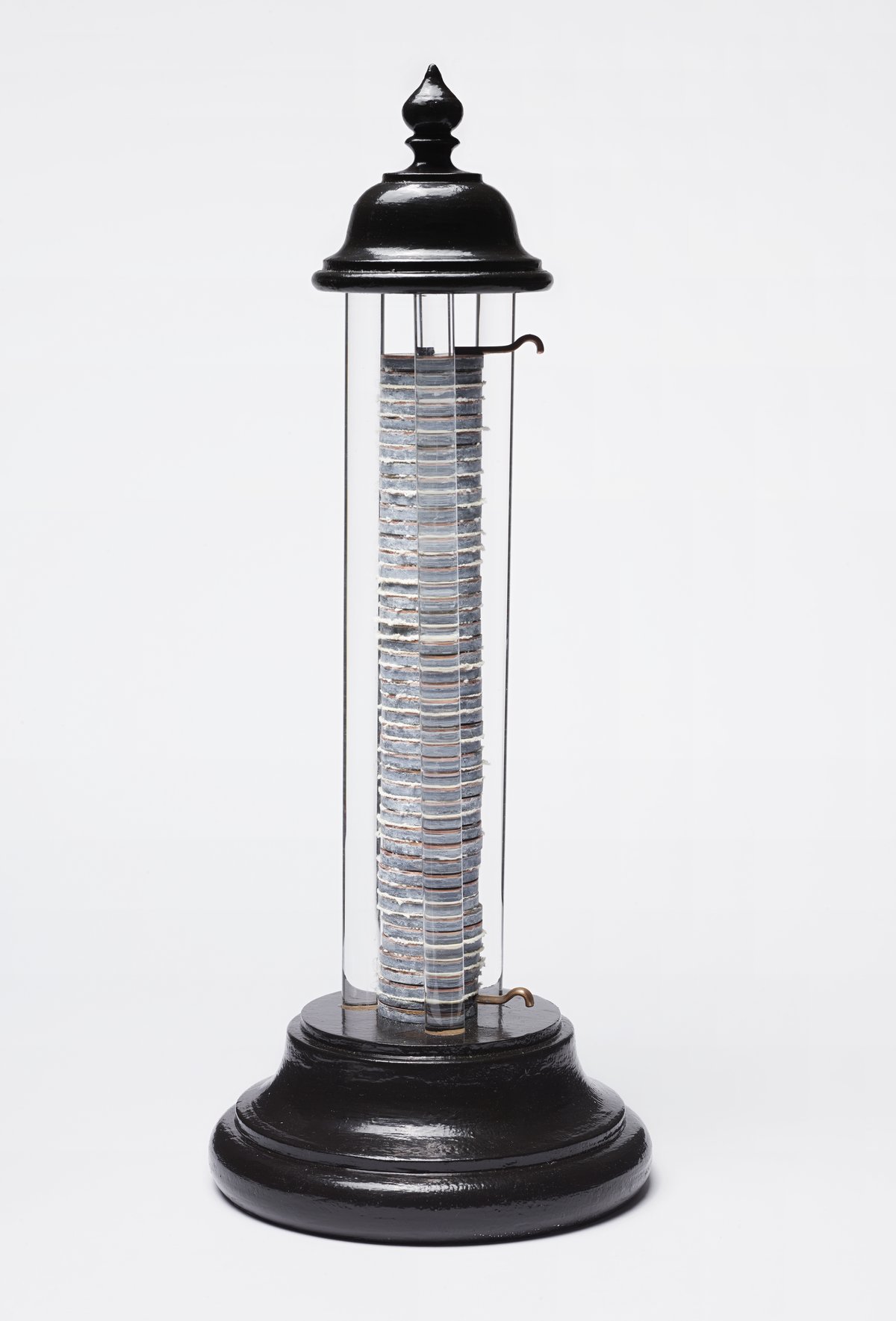
Electrons in a wire advance at barely four tenths of a millimetre per second. Yet the light comes on as soon as you press the switch.
The natural conclusion is that something has travelled through the wire very fast.
Something did indeed travel through the wire very fast. It was not the electrons.
The circuit, the current and what measures them
For a lamp to light up, a closed loop is needed: a wire that leaves one terminal of the battery or the socket, passes through the lamp, and comes back to the other terminal. If the loop is broken anywhere — which is what a switch does — everything stops, everywhere at once. Not only beyond the break: everywhere.
This detail is already a clue. If something “flowed” in the wire like water in a pipe, cutting the pipe ought to let whatever had already gone past carry on its way. But that is not what happens.
In a copper wire, what moves are electrons: tiny charged particles, far enough from the nucleus of their atom to be held by it no longer. They are called free — they are not attached to an atom, but move among the atoms as if in a sea.1
Yet they do not move in a straight line. They constantly collide with the atoms and the other electrons, and advance in a zigzag. What is called their speed is an average: the net result of billions of collisions.2
The three quantities we measure
Three words keep coming up whenever electricity is discussed. They refer to three different things, and confusing them is the most common mistake.
- Current, measured in amperes (A), counts the amount of charge passing a given point in the circuit each second. It is the flow rate.
- Voltage, measured in volts (V), measures the difference between the two terminals — what pushes the charges to move. A flat rectangular battery gives 4.5 V, a household socket 230 V in Europe.
- Resistance, measured in ohms (Ω), indicates how much the circuit holds back the flow. A copper wire offers little resistance; the filament of a bulb offers a great deal, and that is precisely why it heats up and gives off light.
The three are linked by a simple relation, established by Georg Ohm in 1827: voltage = resistance × current. At a fixed voltage, the greater the resistance, the less current flows.3
Conductors and insulators
A conducting material has electrons that are free to move: metals, salt water, the human body. An insulator has none: glass, dry wood, most plastics. That is the whole point of the coloured sheath around an electric wire — the copper conducts, the plastic blocks.
This distinction is not absolute. Dry wood insulates; wet, it conducts. Air insulates, until an enormous voltage passes through it all at once: that is lightning. An insulator is a material that resists as long as certain conditions are not exceeded, and that is why electrical safety instructions always talk about dry hands.
How fast they really move
There is no single figure, and that is to be expected: it depends entirely on the wire and the current. In a thicker wire, or with a weaker current, the electrons move more slowly. A figure given without its conditions means nothing.
A physics textbook works out the following case. A copper wire about two millimetres in diameter — the kind commonly found in the walls of a house — carrying the maximum current it can take: the electrons in it move at about four tenths of a millimetre per second.4
At this pace, they need some forty minutes to cover one metre.
This speed is called the drift velocity. It is slower than a snail: the holder of the snail-racing record sped along at a little over two millimetres per second — five times faster than the electron in the wire.5
So what is fast?
The signal.
It travels at a large fraction of the speed of light — often around two thirds in an ordinary cable.6
The textbook puts it in a way worth remembering: the signal moves about a trillion times faster than the charges that carry it.7
That is why a lamp lights up immediately even though the electrons are crawling along.
A useful image, and its limit
The most common image is that of a line of people standing still, pressed tightly against one another.
The last one pushes the one in front, who pushes the next, and so on. The push crosses the line almost instantly — at the speed of sound through the bodies, in fact — and yet nobody has walked the whole length. Each person has moved a few centimetres.8
The image is a good one, but its limit must be stated straight away, or else it too becomes a belief.
In a wire, what travels is not a mechanical push. What carries the energy passes around the wire, then enters it through the sides. We have to go further, and reality is stranger still.9
What this says about a word
On this site, we keep saying that a model does not deceive — it is silence about its status that deceives (4.2).
“The current flowing in the wire” is an excellent model. It allows us to calculate, to design a circuit, to understand why one bulb lights up and not the other. No one is proposing to abandon it.
It becomes false the moment it is taken for a description.
One detail shows this. On every diagram, the current is drawn as going from the “plus” terminal to the “minus” terminal. This convention was chosen in the eighteenth century, by Benjamin Franklin, long before electrons were discovered (1897). Yet electrons go the other way. The arrow has been kept back to front, because everyone had got used to it and the calculations work just as well. A convention is not a description: it is an agreement.10
One more point, which holds well beyond this chapter: the word “electrical” does not cover a single thing. It turns up again in connection with nerves (8.5), where the signal travels in yet another way — much more slowly, and by a different mechanism.11
One adjective, two distinct phenomena. This is exactly the kind of trap this site sets out to help readers spot.
Note 1
Some electrons are far enough away from the atomic nuclei that they do not experience the attraction of the nuclei as strongly as the inner electrons do. These are the free electrons. They are not bound to a single atom but can instead move freely among the atoms in a "sea" of electrons.
Ling, Samuel J., Sanny, Jeff and Moebs, William, University Physics, vol. 2, OpenStax, § 9.2 “Model of Conduction in Metals”
Note 2
they interact with and collide with atoms and other free electrons in the conductor. Thus, the electrons move in a zig-zag fashion and drift through the wire.
Ling, Samuel J., Sanny, Jeff and Moebs, William, University Physics, vol. 2, OpenStax, § 9.2 “Model of Conduction in Metals”
Note 3
Die Gröſse des Stromes in einer galvanischen Kette ist der Summe aller Spannungen direkt, und der ganzen reduzirten Länge der Kette umgekehrt proportional
The magnitude of the current in a galvanic circuit is directly proportional to the sum of all the voltages, and inversely proportional to the total reduced length of the circuit
Ohm, Georg Simon, Die galvanische Kette, mathematisch bearbeitet, Berlin, 1827
Note 4
Calculate the drift velocity of electrons in a copper wire with a diameter of 2.053 mm (12-gauge) carrying a 20.0-A current […] = -4.54 × 10⁻⁴ m/s
Ling, Samuel J., Sanny, Jeff and Moebs, William, University Physics, vol. 2, OpenStax, § 9.2 “Model of Conduction in Metals”
Household wiring often contains 12-gauge copper wire, and the maximum current allowed in such wire is usually 20.0 A.
Ling, Samuel J., Sanny, Jeff and Moebs, William, University Physics, vol. 2, OpenStax, § 9.2 “Model of Conduction in Metals”
Note 5
On 20 February 1990, a garden snail named Verne completed a 31-cm (12.2-in) course at West Middle School in Plymouth, Michigan, USA, in 2 min 13 sec at 0.233 cm/sec (0.09 in/sec).
Guinness World Records, “Fastest snail”
Note 6
Therefore, the phase velocity in an air-filled coaxial line is approximately equal to speed of propagation in free space, but is reduced in a coaxial line using a dielectric spacer. […] RG-59 is a very common type of coaxial line. […] The phase velocity of RG-59 is found to be […] which is about 67% of c.
Ellingson, Steven W., Electromagnetics, vol. 1, VT Publishing (Virginia Tech), 2018, § 3.10 “Coaxial Line”, reproduced on LibreTexts
Note 7
the small value for drift velocity […] confirms that the signal moves on the order of 10¹² times faster (about 10⁸ m/s) than the charges that carry it
Ling, Samuel J., Sanny, Jeff and Moebs, William, University Physics, vol. 2, OpenStax, § 9.2 “Model of Conduction in Metals”
Note 8
The person at the end of the line grows impatient and shoves the person in front of him. In turn, when each person in the line receives a shove from the person behind him, he shoves the person in front of him. The shove will therefore be passed along from person to person, forwards through the line. The shove will reach the restaurant doors long before the last person in line personally makes it to the doors. […] Based on this simple analogy, we would expect the signal velocity to be very fast, the individual velocity to be somewhat fast, and the drift velocity to be slow.
Baird, Christopher S., “What is the speed of electricity?”, Science Questions with Surprising Answers, West Texas A&M University, 19 February 2014
Note 9
So our “crazy” theory says that the electrons are getting their energy to generate heat because of the energy flowing into the wire from the field outside. […] The energy somehow flows from the distant charges into a wide area of space and then inward to the wire.
Feynman, Richard P., Leighton, Robert B. and Sands, Matthew, The Feynman Lectures on Physics, vol. II, chap. 27, 1964
therefore there is a Poynting vector directed radially inward, as shown in the figure. There is a flow of energy into the wire all around. […] The energy somehow flows from the distant charges into a wide area of space and then inward to the wire.
Feynman, Richard P., Leighton, Robert B. and Sands, Matthew, The Feynman Lectures on Physics, vol. II, chap. 27, 1964
Note 10
Hence have arisen some new terms among us: we say, B, (and bodies like circumstanced) is electrised positively ; A, negatively. Or rather, B is electrised plus; A, minus.
Franklin, Benjamin, Experiments and Observations on Electricity, Londres, 1751
Note 11
The method by which these electric currents are generated and transmitted is more complex than the simple movement of free charges in a conductor, but it can be understood with principles already discussed in this text. […] Thus the action potential stimulated at one location triggers a nerve impulse that moves slowly (about 1 m/s) along the cell membrane.
Urone, Paul Peter and Hinrichs, Roger, College Physics 2e, OpenStax (Rice University), 2022, section 20.7 “Nerve Conduction–Electrocardiograms”
Notes and sources
- ↑
Passage electrons […] far enough from the nucleus of their atom to be held by it no longer. They are called free — they are not attached to an atom, but move among the atoms as if in a sea.
Some electrons are far enough away from the atomic nuclei that they do not experience the attraction of the nuclei as strongly as the inner electrons do. These are the free electrons. They are not bound to a single atom but can instead move freely among the atoms in a "sea" of electrons.
Source Ling, Samuel J., Sanny, Jeff and Moebs, William, University Physics, vol. 2, OpenStax, § 9.2 “Model of Conduction in Metals”.
Open access open the source · checked on 9 September 2026
- ↑
Passage They constantly collide with the atoms and the other electrons, and advance in a zigzag.
they interact with and collide with atoms and other free electrons in the conductor. Thus, the electrons move in a zig-zag fashion and drift through the wire.
Source Ling, Samuel J., Sanny, Jeff and Moebs, William, University Physics, vol. 2, OpenStax, § 9.2 “Model of Conduction in Metals”.
Open access open the source · checked on 9 September 2026
- ↑
Passage The three are linked by a simple relation, established by Georg Ohm in 1827: voltage = resistance × current.
Die Gröſse des Stromes in einer galvanischen Kette ist der Summe aller Spannungen direkt, und der ganzen reduzirten Länge der Kette umgekehrt proportional
Editors’ translation The magnitude of the current in a galvanic circuit is directly proportional to the sum of all the voltages, and inversely proportional to the total reduced length of the circuit
Source Ohm, Georg Simon, Die galvanische Kette, mathematisch bearbeitet, Berlin, 1827, p. 36 (mathematical part, statement in words after the formula for the current).
Public domain open the source · checked on 24 October 2026
- ↑
Passage A copper wire about two millimetres in diameter […] carrying the maximum current it can take: the electrons in it move at about four tenths of a millimetre per second.
Calculate the drift velocity of electrons in a copper wire with a diameter of 2.053 mm (12-gauge) carrying a 20.0-A current […] = -4.54 × 10⁻⁴ m/s
Source Ling, Samuel J., Sanny, Jeff and Moebs, William, University Physics, vol. 2, OpenStax, § 9.2 “Model of Conduction in Metals”, § 9.2, example.
Open access open the source · checked on 9 September 2026
Passage the kind commonly found in the walls of a house
Household wiring often contains 12-gauge copper wire, and the maximum current allowed in such wire is usually 20.0 A.
Source Ling, Samuel J., Sanny, Jeff and Moebs, William, University Physics, vol. 2, OpenStax, § 9.2 “Model of Conduction in Metals”, § 9.2, example.
Open access open the source · checked on 9 September 2026
- ↑
Passage the holder of the snail-racing record sped along at a little over two millimetres per second
On 20 February 1990, a garden snail named Verne completed a 31-cm (12.2-in) course at West Middle School in Plymouth, Michigan, USA, in 2 min 13 sec at 0.233 cm/sec (0.09 in/sec).
Source Guinness World Records, “Fastest snail”, description of the record “Fastest snail (land snail)”.
Open access · checked on 24 October 2026
- ↑
Passage It travels at a large fraction of the speed of light — often around two thirds in an ordinary cable.
Therefore, the phase velocity in an air-filled coaxial line is approximately equal to speed of propagation in free space, but is reduced in a coaxial line using a dielectric spacer. […] RG-59 is a very common type of coaxial line. […] The phase velocity of RG-59 is found to be […] which is about 67% of c.
Source Ellingson, Steven W., Electromagnetics, vol. 1, VT Publishing (Virginia Tech), 2018, § 3.10 “Coaxial Line”, reproduced on LibreTexts, § 3.10, paragraph on phase velocity and Example 1 “RG-59 Coaxial Cable”.
Open access open the source · checked on 27 October 2026
- ↑
Passage the signal moves about a trillion times faster than the charges that carry it
the small value for drift velocity […] confirms that the signal moves on the order of 10¹² times faster (about 10⁸ m/s) than the charges that carry it
Source Ling, Samuel J., Sanny, Jeff and Moebs, William, University Physics, vol. 2, OpenStax, § 9.2 “Model of Conduction in Metals”.
Open access open the source · checked on 9 September 2026
- ↑
Passage The push crosses the line almost instantly […] and yet nobody has walked the whole length.
The person at the end of the line grows impatient and shoves the person in front of him. In turn, when each person in the line receives a shove from the person behind him, he shoves the person in front of him. The shove will therefore be passed along from person to person, forwards through the line. The shove will reach the restaurant doors long before the last person in line personally makes it to the doors. […] Based on this simple analogy, we would expect the signal velocity to be very fast, the individual velocity to be somewhat fast, and the drift velocity to be slow.
Source Baird, Christopher S., “What is the speed of electricity?”, Science Questions with Surprising Answers, West Texas A&M University, 19 February 2014, paragraph beginning “Consider this analogy”, 4th to 7th sentences and 10th sentence (“Based on this simple analogy”).
Open access open the source · checked on 27 October 2026
- ↑
Passage What carries the energy passes around the wire
So our “crazy” theory says that the electrons are getting their energy to generate heat because of the energy flowing into the wire from the field outside. […] The energy somehow flows from the distant charges into a wide area of space and then inward to the wire.
Source Feynman, Richard P., Leighton, Robert B. and Sands, Matthew, The Feynman Lectures on Physics, vol. II, chap. 27, 1964, § 27-5 “Examples of energy flow”, passage on the resistive wire.
Open access open the source · checked on 9 September 2026
Passage What carries the energy passes around the wire, then enters it through the sides.
therefore there is a Poynting vector directed radially inward, as shown in the figure. There is a flow of energy into the wire all around. […] The energy somehow flows from the distant charges into a wide area of space and then inward to the wire.
Source Feynman, Richard P., Leighton, Robert B. and Sands, Matthew, The Feynman Lectures on Physics, vol. II, chap. 27, 1964, § 27-5 “Examples of energy flow”.
Open access open the source · checked on 9 September 2026
- ↑
Passage This convention was chosen in the eighteenth century, by Benjamin Franklin, long before electrons were discovered
Hence have arisen some new terms among us: we say, B, (and bodies like circumstanced) is electrised positively ; A, negatively. Or rather, B is electrised plus; A, minus.
Source Franklin, Benjamin, Experiments and Observations on Electricity, Londres, 1751, Franklin, letter II to Peter Collinson (experiment with persons A, B and C).
Public domain · checked on 9 September 2026
- ↑
Passage It turns up again in connection with nerves (8.5), where the signal travels in yet another way — much more slowly, and by a different mechanism
The method by which these electric currents are generated and transmitted is more complex than the simple movement of free charges in a conductor, but it can be understood with principles already discussed in this text. […] Thus the action potential stimulated at one location triggers a nerve impulse that moves slowly (about 1 m/s) along the cell membrane.
Source Urone, Paul Peter and Hinrichs, Roger, College Physics 2e, OpenStax (Rice University), 2022, section 20.7 “Nerve Conduction–Electrocardiograms”, section 20.7, subsection “Nerve Conduction”, paragraphs “The method by which…” and “The action potential is a voltage pulse…”.
Open access open the source · checked on 27 October 2026
Bibliography
12
- Baird, Christopher S., “What is the speed of electricity?”, Science Questions with Surprising Answers, West Texas A&M University, 19 February 2014, open access (the image of the line of people: the shove passed from one to the next reaches the end long before the people do; signal speed and electron speed). https://www.wtamu.edu/~cbaird/sq/2014/02/19/what-is-the-speed-of-electricity/
- Ellingson, Steven W., Electromagnetics, vol. 1, VT Publishing (Virginia Tech), 2018, § 3.10 “Coaxial Line”, reproduced on LibreTexts, open access (the speed of the signal in a common coaxial cable, reduced by the insulator to about 67% of the speed of light). https://eng.libretexts.org/Bookshelves/Electrical_Engineering/Electro-Optics/Book%3A_Electromagnetics_I_%28Ellingson%29/03%3A_Transmission_Lines/3.10%3A__Coaxial_Line
- Feynman, Richard P., Leighton, Robert B. and Sands, Matthew, The Feynman Lectures on Physics, vol. II, chap. 27, 1964, open access (the flow of energy entering a resistive wire through its sides). https://www.feynmanlectures.caltech.edu/II_27.html
- Franklin, Benjamin, Experiments and Observations on Electricity, Londres, 1751, public domain (the convention of “positive” current) ; et Thomson, Joseph John, “Cathode Rays”, Philosophical Magazine, vol. 44, 1897, p. 293-316, public domain (the discovery of the electron).
- Galili, Igal and Goihbarg, Elisabetta, “Energy Transfer in Electrical Circuits: A Qualitative Account”, American Journal of Physics, vol. 73, no. 2, 2005, p. 141-144, paywalled (the limit of the line-of-people image).
- Guinness World Records, “Fastest snail”, open access (the speed record for a snail).
- Kandel, Eric R. et al. (ed.), Principles of Neural Science, McGraw-Hill, 2021, in libraries (the propagation of the nerve signal, which is of a different nature; see Entry 8.5).
- Ling, Samuel J., Sanny, Jeff and Moebs, William, University Physics, vol. 2, OpenStax, § 9.2 “Model of Conduction in Metals”, open access (free electrons and their zigzag path; the calculation of the drift velocity in a household wire; the ratio of about a trillion between the speed of the signal and that of the charges). https://openstax.org/books/university-physics-volume-2/pages/9-2-model-of-conduction-in-metals
- Ohm, Georg Simon, Die galvanische Kette, mathematisch bearbeitet, Berlin, 1827, public domain (the relation between voltage, current and resistance).
- Pozar, David M., Microwave Engineering, Wiley, 2012, in libraries (the propagation speed in a line and its dependence on the insulator).
- Sefton, Ian M., “Understanding Electricity and Circuits: What the Text Books Don’t Tell You”, University of Sydney, 2002, open access.
- Urone, Paul Peter and Hinrichs, Roger, College Physics 2e, OpenStax (Rice University), 2022, section 20.7 “Nerve Conduction–Electrocardiograms”, open access (nerve current, more complex than the simple movement of free charges in a conductor; the impulse that moves slowly, about 1 m/s, along the membrane). https://openstax.org/books/college-physics-2e/pages/20-7-nerve-conduction-electrocardiograms
Spotted an error or have a doubt? Write to us.