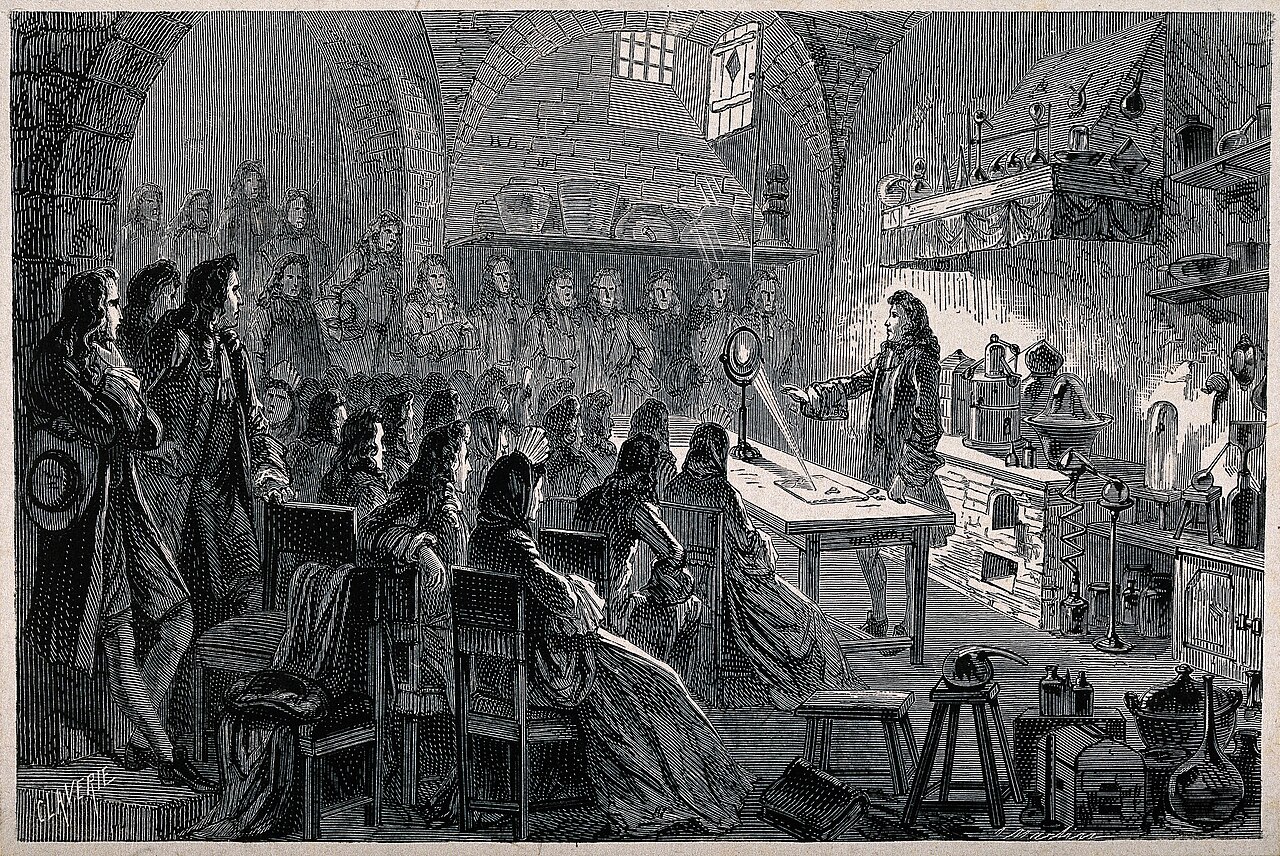

In 1666, a young man who had withdrawn to the family farm because of the plague designed an experiment capable of proving him wrong.
It had long been known that sunlight passing through a prism brings out colours, and many scholars were working on the question.
In 1666, one of them, a young man of twenty-three who had withdrawn to the family farm because of the plague that had closed his university, carried out one of the clearest experiments on this site.1
Its clarity lies not in what it showed, but in the way it was constructed: he designed it so that it could prove him wrong.
Light and its path
Light travels in a straight line as long as nothing deflects it. This explains shadows: an opaque object blocks the rays, and behind it its silhouette takes shape. A point source gives a shadow with sharp edges; a broad source gives one with blurred edges, because some points of the source still light the area that others no longer reach. This is why the shadow of a bird flying high is invisible: at that distance, the Sun is too broad.2
It moves at 300,000 kilometres per second in a vacuum — eight minutes to come from the Sun, a little over a second to come back from the Moon. Nothing goes faster. In water or glass, on the other hand, it slows down, and almost everything that follows stems from this slowing down.
On contact with matter, three phenomena can occur.
- Reflection. Light bounces off. On a smooth surface such as a mirror or calm water, it bounces off in an orderly way and forms an image; on a rough surface such as a wall, it scatters in all directions. This is why we see the wall without seeing ourselves in it.
- Refraction. On passing from one medium to another — from air to water, from air to glass — light changes speed, and therefore direction. This is what makes a spoon in a glass of water look broken in two, what makes spectacles, magnifying glasses and cameras work, and what spreads out the colours in a prism.
- Absorption. Matter retains part of the light and turns it into heat. Black fabric absorbs almost all of it; this is why it heats up in the sun.3
A transparent object lets light through, an opaque object stops it, a translucent object lets it through while scattering it — like frosted bathroom glass, which lets in light without showing anything.
These three phenomena are enough to explain what this page recounts. The prism experiment is a matter of refraction; the colour of an apple, a matter of absorption and reflection.
The explanation of the time
The common explanation was that the glass coloured the light — through an impurity, through a property of the material, it hardly mattered. Something in the prism added colour to what was white on the way in.
There is nothing ridiculous about this explanation; it is in fact reasonable: one sees white go in, colours come out, and between the two there is an object. The object must therefore be doing something.
A first precaution, before any idea
It is worth noting that Isaac Newton’s first move is to improve the set-up.
He begins by darkening his room and making a small hole in the shutter to let in just the right amount of sunlight. Then he places his prism in the path of the beam, so as to project the colours onto the opposite wall — and not onto a screen pressed close behind the glass, as others had done.4
At that distance, the colours separate clearly.
The first advance comes not from a new idea, but from a change of set-up. This is more often the case than the usual accounts suggest.
One detail Newton does not hide: he had bought his prism at a fair. It was a child’s toy. He made it into an instrument.5
The crucial experiment
Then comes the essential part. Newton does not seek to confirm his intuition. He builds the experiment that the opposing explanation demands.
His reasoning can be followed step by step:
If it is the prism that colours the light, then a second prism should colour it further.
The set-up is simple. Newton places two boards, each pierced with a small hole: the first just behind the prism, the second a few metres away. Only a thin portion of the spectrum — a single colour — manages to pass through both holes. That light then goes through a second prism.6
He adds a refinement: he takes the first prism in his hand and turns it gently, so as to make all the colours of the spectrum pass one after another through the hole in the second board. He can thus observe, colour by colour, where each one lands on the wall.7
Two results are possible, and they have opposite meanings:
- If the red comes out changed, then the prism does indeed colour the light, and Newton is wrong.
- If it comes out unchanged, then the prism has merely separated what was already there.
Each colour comes out deflected, and unchanged. Deflected — that is refraction, and every prism does it. But none is broken down any further.
Newton then observes something else, which is the heart of his thesis: the colours are not deflected in the same way. Each has its own angle. The colour of a ray and the way it bends are linked; they are two sides of one and the same property, which belongs to the ray itself.8
The symmetrical check
He could have stopped there. Instead, he carries out the reverse experiment.
With a second prism, he recombines the spectrum into white light.9
If the prism added colour, this recombination would be impossible: you do not get white by adding still more.
Two opposite paths, a single conclusion: the colours are in the light, not in the glass.
A point of attribution
This experiment bears a Latin name, experimentum crucis — the crucial experiment, the one that settles the question.
Two clarifications are called for, since this site is wary of stories with a single hero.
The expression is not Newton’s. It appears in Robert Hooke’s writings in 1665, the previous year, and is rooted in the work of Francis Bacon, who was already speaking of instantia crucis in 1620.10
An earlier experiment deserves the name. In 1648, Blaise Pascal wants to test a hypothesis: if air has weight, then a column of mercury in a tube should fall as one climbs higher. He does not carry out the experiment himself — he is in Paris. It is his brother-in-law, Florin Périer, who carries the tube up to the summit of the Puy de Dôme on 19 September 1648. The structure is exactly the same — a prediction, a place to go and look, and a result that could have refuted it.11
Newton did not invent the method. He provided its clearest example.
One last point, which matters for this site. This experiment did not win acceptance overnight. Criticised when it was published, in 1672, the theory it supported was accepted only gradually, over some thirty years — there were debates about the quality of the prisms, about how to repeat the test, about the conclusions to be drawn from it. That a demonstration is decisive does not mean that it convinces straight away.12
What colour is an apple?
If the colours are in the light, there remains the question of the colour of objects.
A red apple lit by daylight receives all the colours. Its skin absorbs most of them and sends back mainly the red. It is this reflected light that reaches the eye. Lit by a light lacking red — under certain street lamps, for example — the same apple looks dark, almost black.13
So “is” the apple red? It has a very real property: that of sending back one kind of light and absorbing another. This is not a matter of opinion. But the perceived colour also depends on the light that illuminates it. Colour is an encounter between the object, the light and the eye — not a paint applied to the object.14
As for the sky, one sometimes hears that it is blue because it reflects the sea. Not at all: the sky is just as blue above deserts. Air, too, does some sorting: it scatters the Sun’s blue light in all directions far more than the red. Wherever one looks in the sky, it is this scattered blue that reaches the eye. At sunset, the Sun’s light passes through so much air that the blue has been scattered elsewhere: only the red remains.15
Note 1
Isaac Newton was born here on Christmas Day 1642, in the tiny hamlet of Woolsthorpe in Lincolnshire. His father was an illiterate but prosperous farmer who lived with his wife Hannah, and on their 100-acre farm they raised sheep and cattle, and grew hay, oats and corn. […] By the summer of 1665 the plague had reached Cambridge, and the University closed its doors and sent everyone away. Newton returned to Lincolnshire and continued his investigations into mathematics, optics and gravity (as depicted here).
Flood, Raymond and Wilson, Robin, “Isaac Newton: life, labours and legacy”, lecture, Gresham College, 28 September 2020, transcript
Although by the calendar in use at the time of his birth he was born on Christmas Day 1642 […] his scientific genius had still not emerged, but it did so suddenly when the plague closed the University in the summer of 1665 and he had to return to Lincolnshire.
O’Connor, John J. and Robertson, Edmund F., “Isaac Newton”, MacTutor History of Mathematics, University of St Andrews, January 2000
in the beginning of the Year 1666 […] I procured me a Triangular glass-Prisme, to try therewith the celebrated Phænomena of Colours.
Newton, Isaac, “A Letter of Mr. Isaac Newton… Containing His New Theory about Light and Colors”, Philosophical Transactions of the Royal Society, vol. 6, no. 80, 1672, p. 3075-3087
Note 2
All of this light travels in a straight line until it hits something. […] The size of the light source can sharpen or blur the shadow. […] A small spotlight like a cellphone torch forms a more distinct shadow than an overhead room light, but the sharpness of the shadow changes when the torch moves away from the object.
Science Learning Hub, “Light and Shadows”
Note 3
Absorption occurs when photons from incident light hit atoms and molecules and cause them to vibrate. The more an object's molecules move and vibrate, the hotter it becomes. […] Some objects, such as darker colored objects, absorb more incident light energy than others.
NASA, Science Mission Directorate, “Wave Behaviors”, Tour of the Electromagnetic Spectrum, 2010
Note 4
having darkened my chamber, and made a small hole in my window-shuts, to let in a convenient quantity of the Suns light, I placed my Prisme at his entrance, that it might be thereby refracted to the opposite wall
Newton, Isaac, “A Letter of Mr. Isaac Newton… Containing His New Theory about Light and Colors”, Philosophical Transactions of the Royal Society, vol. 6, no. 80, 1672, p. 3075-3087
Note 5
Newton converted a prism, a child's plaything he had picked up at a local fair, into a sophisticated instrument
Fara, Patricia, “Newton Shows the Light: A Commentary on Newton (1672)”, Philosophical Transactions of the Royal Society A, vol. 373, 20140213, 2015
Note 6
I took two boards, and placed one of them close behind the Prisme at the window, so that the light might pass through a small hole […] and fall on the other board, which I placed at about 12 feet distance, having first made a small hole in it also
Newton, Isaac, “A Letter of Mr. Isaac Newton… Containing His New Theory about Light and Colors”, Philosophical Transactions of the Royal Society, vol. 6, no. 80, 1672, p. 3075-3087
Then I placed another Prisme behind this second board, so that the light, trajected through both the boards, might pass through that also, and be again refracted before it arrived at the wall.
Newton, Isaac, “A Letter of Mr. Isaac Newton… Containing His New Theory about Light and Colors”, Philosophical Transactions of the Royal Society, vol. 6, no. 80, 1672, p. 3075-3087
Note 7
I took the first Prisme in my hand, and turned it to and fro slowly about its Axis, so much as to make the several parts of the Image, cast on the second board, successively pass through the hole in it
Newton, Isaac, “A Letter of Mr. Isaac Newton… Containing His New Theory about Light and Colors”, Philosophical Transactions of the Royal Society, vol. 6, no. 80, 1672, p. 3075-3087
Note 8
demonstrating that the refrangibility of a ray is linked to its colour, hence arguing that colour is an intrinsic property of light and does not arise from passing through a medium
Fara, Patricia, “Newton Shows the Light: A Commentary on Newton (1672)”, Philosophical Transactions of the Royal Society A, vol. 373, 20140213, 2015
Note 9
[…] let the same be viewed through a Prism abc, held parallel to the Prism ABC, by whose refraction that Image was made, […] but if you recede from it, the Colours of the spectrum S will be contracted more and more, and at length vanish, that Spectrum S becoming perfectly round and white […]
Newton, Isaac, Opticks, Londres, 1704, livre I
Note 10
This Experiment therefore will prove such a one as our thrice excellent Verulam calls Experimentum Crucis, serving as a Guide or Land-mark, by which to direct our course […]
Hooke, Robert, Micrographia, Londres, 1665
Inter praerogativas instantiarum ponemus loco decimo quarto Instantias Crucis […] translato vocabulo a Crucibus, quae erectae in biviis indicant et signant viarum separationes.
Among the prerogative instances we shall place fourteenth the Instances of the Cross […] the term being borrowed from the crosses which, set up where roads fork, indicate and mark the separation of the ways.
Bacon, Francis, Novum Organum, Londres, 1620, livre II
Note 11
il me resta quelques difficultez, qui me firent grandement défier de la vérité de cette maxime, pour l'éclaircissement desquelles je meditay des lors l'expérience dont je faits voir icy le récit […] je priay Monsieur Perier, Conseiller en la Cour des Aydes d'Auvergne, mon beau-frere, de prendre la peine de l'y faire. […] le temps paroissant assez beau sur les cinq heures du matin, et le sommet du Puy de Domme se monstrant à descouvert, je me résolus d'y aller pour y faire l'expérience.
some difficulties remained for me, which made me greatly mistrust the truth of this maxim, and to clear them up I then devised the experiment whose account I present here […] I asked Monsieur Périer, Counsellor at the Cour des Aides of Auvergne, my brother-in-law, to take the trouble of carrying it out there. […] the weather seeming fine enough at about five in the morning, and the summit of the Puy de Dôme showing clear, I resolved to go there to carry out the experiment.
Pascal, Blaise, Récit de la grande expérience de l’équilibre des liqueurs, Paris, 1648
Note 12
I also present an alternative account of the acceptance of Newton's theory that shows that, despite criticism when it was first published in 1672, the theory, or parts of it, gradually came to be accepted by mathematical scientists—including Huygens and Leibniz—and Scottish natural philosophers by the time of the publication of the Opticks in 1704.
Shapiro, Alan E., “The Gradual Acceptance of Newton’s Theory of Light and Color, 1672-1727”, Perspectives on Science, vol. 4, 1996, p. 59-140
They were dissatisfied not only with the difficulties of replicating his results, but also with his methodological arguments […] he retorted that if his rivals could not replicate his work, they were using the wrong type of prism. But how do you define the right sort of prism?
Fara, Patricia, “Newton Shows the Light: A Commentary on Newton (1672)”, Philosophical Transactions of the Royal Society A, vol. 373, 20140213, 2015
Note 13
Objects appear different colours because they absorb some colours (wavelengths) and reflected or transmit other colours. […] For example, a red shirt looks red because the dye molecules in the fabric have absorbed the wavelengths of light from the violet/blue end of the spectrum. Red light is the only light that is reflected from the shirt.
Science Learning Hub – Pokapū Akoranga Pūtaiao, “Colours of light”, University of Waikato, 4 April 2012, updated 24 April 2019
Note 14
Colour is an event because it requires the participation of three components at a particular point in time to take place. In addition to the object, we require a light source and an observer. Only with the interaction of these three things — object, light, and observer — can we have a colour event or experience.
Martin, Alan, “Colour Science”, in Collins, Wayne, Hass, Alex, Jeffery, Ken, Martin, Alan, Medeiros, Roberto and Tomljanovic, Steve, Graphic Design and Print Production Fundamentals, BCcampus, 2015, section 4.2
Note 15
Blue light is scattered in all directions by the tiny molecules of air in Earth's atmosphere. Blue is scattered more than other colors because it travels as shorter, smaller waves. […] As the Sun gets lower in the sky, its light is passing through more of the atmosphere to reach you. Even more of the blue light is scattered, allowing the reds and yellows to pass straight through to your eyes.
NASA, “Why Is the Sky Blue?”, NASA Space Place, updated 29 August 2022
Notes and sources
- ↑
Passage a young man of twenty-three who had withdrawn to the family farm because of the plague that had closed his university
Isaac Newton was born here on Christmas Day 1642, in the tiny hamlet of Woolsthorpe in Lincolnshire. His father was an illiterate but prosperous farmer who lived with his wife Hannah, and on their 100-acre farm they raised sheep and cattle, and grew hay, oats and corn. […] By the summer of 1665 the plague had reached Cambridge, and the University closed its doors and sent everyone away. Newton returned to Lincolnshire and continued his investigations into mathematics, optics and gravity (as depicted here).
Source Flood, Raymond and Wilson, Robin, “Isaac Newton: life, labours and legacy”, lecture, Gresham College, 28 September 2020, transcript, transcript, p. 1, heading “Woolsthorpe Manor” (birth at Woolsthorpe, the family farm) and p. 4, heading “Back in Lincolnshire” (the plague closes the university, return to Lincolnshire).
Open access open the source · checked on 27 October 2026
Passage a young man of twenty-three who had withdrawn to the family farm because of the plague that had closed his university
Although by the calendar in use at the time of his birth he was born on Christmas Day 1642 […] his scientific genius had still not emerged, but it did so suddenly when the plague closed the University in the summer of 1665 and he had to return to Lincolnshire.
Source O’Connor, John J. and Robertson, Edmund F., “Isaac Newton”, MacTutor History of Mathematics, University of St Andrews, January 2000, biography, passages on his birth and on the year 1665 (aged 23 in 1666: calculated by the editors).
Open access open the source · checked on 27 October 2026
Passage In 1666, one of them
in the beginning of the Year 1666 […] I procured me a Triangular glass-Prisme, to try therewith the celebrated Phænomena of Colours.
Source Newton, Isaac, “A Letter of Mr. Isaac Newton… Containing His New Theory about Light and Colors”, Philosophical Transactions of the Royal Society, vol. 6, no. 80, 1672, p. 3075-3087, beginning of the letter.
Open access open the source · checked on 9 September 2026
- ↑
Passage Light travels in a straight line as long as nothing deflects it […] A point source gives a shadow with sharp edges; a broad source gives one with blurred edges
All of this light travels in a straight line until it hits something. […] The size of the light source can sharpen or blur the shadow. […] A small spotlight like a cellphone torch forms a more distinct shadow than an overhead room light, but the sharpness of the shadow changes when the torch moves away from the object.
Source Science Learning Hub, “Light and Shadows”, section “Light sources and shadows”.
Open access open the source · checked on 24 October 2026
- ↑
Passage Matter retains part of the light and turns it into heat.
Absorption occurs when photons from incident light hit atoms and molecules and cause them to vibrate. The more an object's molecules move and vibrate, the hotter it becomes. […] Some objects, such as darker colored objects, absorb more incident light energy than others.
Source NASA, Science Mission Directorate, “Wave Behaviors”, Tour of the Electromagnetic Spectrum, 2010, section “Absorption”, 1st, 2nd and 4th sentences.
Open access open the source · checked on 27 October 2026
- ↑
Passage He begins by darkening his room and making a small hole in the shutter […] so as to project the colours onto the opposite wall
having darkened my chamber, and made a small hole in my window-shuts, to let in a convenient quantity of the Suns light, I placed my Prisme at his entrance, that it might be thereby refracted to the opposite wall
Source Newton, Isaac, “A Letter of Mr. Isaac Newton… Containing His New Theory about Light and Colors”, Philosophical Transactions of the Royal Society, vol. 6, no. 80, 1672, p. 3075-3087, beginning of the letter.
Open access open the source · checked on 9 September 2026
- ↑
Passage he had bought his prism at a fair. It was a child’s toy.
Newton converted a prism, a child's plaything he had picked up at a local fair, into a sophisticated instrument
Source Fara, Patricia, “Newton Shows the Light: A Commentary on Newton (1672)”, Philosophical Transactions of the Royal Society A, vol. 373, 20140213, 2015, commentary on the article.
Open access open the source · checked on 9 September 2026
- ↑
Passage Newton places two boards, each pierced with a small hole: the first just behind the prism, the second a few metres away.
I took two boards, and placed one of them close behind the Prisme at the window, so that the light might pass through a small hole […] and fall on the other board, which I placed at about 12 feet distance, having first made a small hole in it also
Source Newton, Isaac, “A Letter of Mr. Isaac Newton… Containing His New Theory about Light and Colors”, Philosophical Transactions of the Royal Society, vol. 6, no. 80, 1672, p. 3075-3087, account of the experimentum crucis.
Open access open the source · checked on 9 September 2026
Passage That light then goes through a second prism.
Then I placed another Prisme behind this second board, so that the light, trajected through both the boards, might pass through that also, and be again refracted before it arrived at the wall.
Source Newton, Isaac, “A Letter of Mr. Isaac Newton… Containing His New Theory about Light and Colors”, Philosophical Transactions of the Royal Society, vol. 6, no. 80, 1672, p. 3075-3087, account of the experimentum crucis.
Open access open the source · checked on 9 September 2026
- ↑
Passage he takes the first prism in his hand and turns it gently, so as to make all the colours of the spectrum pass one after another through the hole in the second board
I took the first Prisme in my hand, and turned it to and fro slowly about its Axis, so much as to make the several parts of the Image, cast on the second board, successively pass through the hole in it
Source Newton, Isaac, “A Letter of Mr. Isaac Newton… Containing His New Theory about Light and Colors”, Philosophical Transactions of the Royal Society, vol. 6, no. 80, 1672, p. 3075-3087, account of the experimentum crucis.
Open access open the source · checked on 9 September 2026
- ↑
Passage the colours are not deflected in the same way. Each has its own angle. The colour of a ray and the way it bends are linked
demonstrating that the refrangibility of a ray is linked to its colour, hence arguing that colour is an intrinsic property of light and does not arise from passing through a medium
Source Fara, Patricia, “Newton Shows the Light: A Commentary on Newton (1672)”, Philosophical Transactions of the Royal Society A, vol. 373, 20140213, 2015, abstract.
Open access open the source · checked on 9 September 2026
- ↑
Passage With a second prism, he recombines the spectrum into white light.
[…] let the same be viewed through a Prism abc, held parallel to the Prism ABC, by whose refraction that Image was made, […] but if you recede from it, the Colours of the spectrum S will be contracted more and more, and at length vanish, that Spectrum S becoming perfectly round and white […]
Source Newton, Isaac, Opticks, Londres, 1704, livre I, Book I, Part II, Prop. V, Theor. IV, Experiment 11, p. 105 of the 1704 edition.
Public domain open the source · checked on 27 October 2026
- ↑
Passage The expression is not Newton’s. It appears in Robert Hooke’s writings in 1665
This Experiment therefore will prove such a one as our thrice excellent Verulam calls Experimentum Crucis, serving as a Guide or Land-mark, by which to direct our course […]
Source Hooke, Robert, Micrographia, Londres, 1665, Observation IX (“Of the Colours observable in Muscovy glass”), around p. 54 of the 1665 edition.
Public domain open the source · checked on 24 October 2026
Passage and is rooted in the work of Francis Bacon, who was already speaking of instantia crucis in 1620
Inter praerogativas instantiarum ponemus loco decimo quarto Instantias Crucis […] translato vocabulo a Crucibus, quae erectae in biviis indicant et signant viarum separationes.
Editors’ translation Among the prerogative instances we shall place fourteenth the Instances of the Cross […] the term being borrowed from the crosses which, set up where roads fork, indicate and mark the separation of the ways.
Source Bacon, Francis, Novum Organum, Londres, 1620, livre II, Book II, aphorism XXXVI, opening (ed. Thomas Fowler, Oxford, Clarendon Press, 1878, pp. 457-458).
Public domain open the source · checked on 27 October 2026
- ↑
Passage In 1648, Blaise Pascal wants to test a hypothesis […] It is his brother-in-law, Florin Périer, who carries the tube up to the summit of the Puy de Dôme
il me resta quelques difficultez, qui me firent grandement défier de la vérité de cette maxime, pour l'éclaircissement desquelles je meditay des lors l'expérience dont je faits voir icy le récit […] je priay Monsieur Perier, Conseiller en la Cour des Aydes d'Auvergne, mon beau-frere, de prendre la peine de l'y faire. […] le temps paroissant assez beau sur les cinq heures du matin, et le sommet du Puy de Domme se monstrant à descouvert, je me résolus d'y aller pour y faire l'expérience.
Editors’ translation some difficulties remained for me, which made me greatly mistrust the truth of this maxim, and to clear them up I then devised the experiment whose account I present here […] I asked Monsieur Périer, Counsellor at the Cour des Aides of Auvergne, my brother-in-law, to take the trouble of carrying it out there. […] the weather seeming fine enough at about five in the morning, and the summit of the Puy de Dôme showing clear, I resolved to go there to carry out the experiment.
Source Pascal, Blaise, Récit de la grande expérience de l’équilibre des liqueurs, Paris, 1648, foreword to the reader of the Récit (p. 366, scan image 386) and letter from Florin Périer to Pascal of 22 September 1648 (p. 352), in Œuvres de Blaise Pascal publiées suivant l’ordre chronologique, vol. II, 1925 edition.
Public domain open the source · checked on 27 October 2026
- ↑
Passage This experiment did not win acceptance overnight. Criticised when it was published, in 1672, the theory it supported was accepted only gradually, over some thirty years
I also present an alternative account of the acceptance of Newton's theory that shows that, despite criticism when it was first published in 1672, the theory, or parts of it, gradually came to be accepted by mathematical scientists—including Huygens and Leibniz—and Scottish natural philosophers by the time of the publication of the Opticks in 1704.
Source Shapiro, Alan E., “The Gradual Acceptance of Newton’s Theory of Light and Color, 1672-1727”, Perspectives on Science, vol. 4, 1996, p. 59-140, abstract.
Paywalled · checked on 25 October 2026
Passage there were debates about the quality of the prisms, about how to repeat the test
They were dissatisfied not only with the difficulties of replicating his results, but also with his methodological arguments […] he retorted that if his rivals could not replicate his work, they were using the wrong type of prism. But how do you define the right sort of prism?
Source Fara, Patricia, “Newton Shows the Light: A Commentary on Newton (1672)”, Philosophical Transactions of the Royal Society A, vol. 373, 20140213, 2015, section 4, “Sequel: consequences of Newton’s 1672 paper”.
Open access open the source · checked on 9 September 2026
- ↑
Passage Its skin absorbs most of them and sends back mainly the red
Objects appear different colours because they absorb some colours (wavelengths) and reflected or transmit other colours. […] For example, a red shirt looks red because the dye molecules in the fabric have absorbed the wavelengths of light from the violet/blue end of the spectrum. Red light is the only light that is reflected from the shirt.
Source Science Learning Hub – Pokapū Akoranga Pūtaiao, “Colours of light”, University of Waikato, 4 April 2012, updated 24 April 2019, subsection “Colour of objects”.
Open access open the source · checked on 27 October 2026
- ↑
Passage Colour is an encounter between the object, the light and the eye
Colour is an event because it requires the participation of three components at a particular point in time to take place. In addition to the object, we require a light source and an observer. Only with the interaction of these three things — object, light, and observer — can we have a colour event or experience.
Source Martin, Alan, “Colour Science”, in Collins, Wayne, Hass, Alex, Jeffery, Ken, Martin, Alan, Medeiros, Roberto and Tomljanovic, Steve, Graphic Design and Print Production Fundamentals, BCcampus, 2015, section 4.2, section 4.2 (“Colour Science”), subsection “The Colour Event”.
Open access open the source · checked on 27 October 2026
- ↑
Passage it scatters the Sun’s blue light in all directions far more than the red […] At sunset, the Sun’s light passes through so much air that the blue has been scattered elsewhere
Blue light is scattered in all directions by the tiny molecules of air in Earth's atmosphere. Blue is scattered more than other colors because it travels as shorter, smaller waves. […] As the Sun gets lower in the sky, its light is passing through more of the atmosphere to reach you. Even more of the blue light is scattered, allowing the reds and yellows to pass straight through to your eyes.
Source NASA, “Why Is the Sky Blue?”, NASA Space Place, updated 29 August 2022, sections “It’s easy to see that the sky is blue. Have you ever wondered why?” and “What makes a red sunset?”.
Open access open the source · checked on 27 October 2026
Bibliography
17
- Bacon, Francis, Novum Organum, Londres, 1620, livre II, public domain (the instantiae crucis).
- Bohren, Craig F. and Clothiaux, Eugene E., Fundamentals of Atmospheric Radiation, Wiley, 2006, in libraries (the scattering of light by air, the blue of the sky and the red of sunset).
- Fara, Patricia, “Newton Shows the Light: A Commentary on Newton (1672)”, Philosophical Transactions of the Royal Society A, vol. 373, 20140213, 2015, open access (the prism bought at the fair; the use of two successive prisms and of the pierced screen; the opponents targeted; the contested reception of the experiment). https://pmc.ncbi.nlm.nih.gov/articles/PMC4360081/
- Flood, Raymond and Wilson, Robin, “Isaac Newton: life, labours and legacy”, lecture, Gresham College, 28 September 2020, transcript, open access (birth at Woolsthorpe on Christmas Day 1642 and the family farm; the plague that closed Cambridge University in summer 1665 and the return to Lincolnshire). https://www.gresham.ac.uk/sites/default/files/2020-09-28_FloodWilson_Newton-T.pdf
- Hooke, Robert, Micrographia, Londres, 1665, public domain (the expression experimentum crucis).
- Martin, Alan, “Colour Science”, in Collins, Wayne, Hass, Alex, Jeffery, Ken, Martin, Alan, Medeiros, Roberto and Tomljanovic, Steve, Graphic Design and Print Production Fundamentals, BCcampus, 2015, section 4.2, open access (colour as an event that requires the meeting of object, light and observer). https://opentextbc.ca/graphicdesign/chapter/colour-science/
- NASA, Science Mission Directorate, “Wave Behaviors”, Tour of the Electromagnetic Spectrum, 2010, open access (absorption: absorbed light makes molecules vibrate and warms the object; dark objects absorb more). https://science.nasa.gov/ems/03_behaviors
- NASA, “Why Is the Sky Blue?”, NASA Space Place, updated 29 August 2022, open access (blue light scattered in all directions more than other colours; the red of sunset, when the light passes through more atmosphere). https://spaceplace.nasa.gov/blue-sky/en/
- Nassau, Kurt, The Physics and Chemistry of Color, Wiley, 2001, in libraries (the colour of objects as an encounter between light, matter and the eye).
- Newton, Isaac, “A Letter of Mr. Isaac Newton… Containing His New Theory about Light and Colors”, Philosophical Transactions of the Royal Society, vol. 6, no. 80, 1672, p. 3075-3087, open access (the darkened room and the hole in the shutter; the two pierced boards; the second prism; the rotation of the first prism to make the colours pass in turn; the link between colour and deflection). https://www.newtonproject.ox.ac.uk/view/texts/normalized/NATP00006
- Newton, Isaac, Opticks, Londres, 1704, livre I, public domain (the expanded version, with the drawings of the two prisms and the recombination of white). French translation: Optique, Christian Bourgois, 1989.
- O’Connor, John J. and Robertson, Edmund F., “Isaac Newton”, MacTutor History of Mathematics, University of St Andrews, January 2000, open access (his birth on Christmas Day 1642; the plague that closed the university in the summer of 1665 and his return to Lincolnshire). https://mathshistory.st-andrews.ac.uk/Biographies/Newton/
- Pascal, Blaise, Récit de la grande expérience de l’équilibre des liqueurs, Paris, 1648, public domain (the ascent of the Puy de Dôme by Florin Périer).
- Science Learning Hub, “Light and Shadows”, open access (rectilinear propagation and the formation of shadows). https://www.sciencelearn.org.nz/resources/2771-light-and-shadows
- Science Learning Hub – Pokapū Akoranga Pūtaiao, “Colours of light”, University of Waikato, 4 April 2012, updated 24 April 2019, open access (a red object absorbs the other wavelengths and sends back only red). https://www.sciencelearn.org.nz/resources/47-colours-of-light
- Shapiro, Alan E., “The Gradual Acceptance of Newton’s Theory of Light and Color, 1672-1727”, Perspectives on Science, vol. 4, 1996, p. 59-140, paywalled (why the experiment did not convince straight away).
- Westfall, Richard S., Never at Rest: A Biography of Isaac Newton, Cambridge University Press, 1980, in libraries (the plague years, the set-up, the debate with Hooke).
Spotted an error or have a doubt? Write to us.