
Salt poured into water disappears. The iron of a nail that rusts disappears too. Yet these are not at all the same thing.
This page explains that fundamental difference, then tells the story of a scientist who spent years cleaning an entire room... solely so that he could measure an invisible element.
1. Mixture or reaction?
Salt dissolved in a glass of water can no longer be seen, but it is still there: the water tastes salty. If the water is left to evaporate, the salt reappears at the bottom of the glass, completely intact. Nothing new has been created. It is a mixture, and it can be undone.
A nail left outside in the rain, on the other hand, becomes covered in rust after a few weeks. Rust is not hidden iron: it is another substance, formed by iron combined with oxygen from the air. It is not enough to “dry” the nail to get the iron back. It is a chemical reaction. The atoms have rearranged themselves into a new material.
From this follows a universal rule: nothing disappears, nothing goes away. The atoms reassemble differently, but they are all still there. In fact, the rusty nail weighs slightly more than the new one, because oxygen has become bound to it.
This fundamental rule is the key to the whole story that follows.
2. The measurement problem
In the 1950s, the geochemist Clair Patterson sought to calculate the age of the Earth by measuring the minute quantities of lead contained in very ancient rocks.1
But his results were inconsistent and kept varying.
The reason eventually became clear: all his samples were contaminated by outside lead. Not just the rocks: his instruments, the laboratory floor, the surrounding air and even his own clothes were bringing in lead without his knowledge.2
3. The invention of the clean room
To solve the problem, Patterson designed an ultra-clean laboratory of a standard never before achieved — what is now called a clean room.3
This room was designed not to be sterile in the medical sense, but to add nothing to the measurements. In an interview, Patterson would sum up the challenge perfectly: the mere lead dust in an experimenter’s hair is enough to distort the measurement.4
Thanks to this fully controlled environment, his measurements at last became reliable. In 1956, he established the age of the Earth at 4.55 billion years, to within 70 million years.5
The way he went about it deserves a moment’s attention, because the reasoning is elegant. Patterson could not date the Earth directly: surface rocks have been remelted and reworked too many times. So he made a wager — the Earth and the meteorites formed at the same time, from the same material. He measured the lead in several meteorites, checked that terrestrial lead was consistent with them, and concluded that the two had the same age.6
The value he obtained still stands, half a century and several lunar samples later. Measurements have been refined since, without really changing it.7
4. What this teaches us about science
This approach illustrates a key principle of scientific rigour: before measuring nature, you must eliminate what you bring to it yourself.
That is exactly what the scientific teams that reconstructed the very first image of a black hole did (Entry 1.10): they organised themselves to make sure that their own expectations did not influence the processing of the images. Patterson did the same thing, but with dust instead of ideas.
A measuring instrument that is not perfectly clean does not measure its object: it measures the experimenter.
5. An unexpected discovery along the way
Patterson was not looking for lead in the environment, but he ran into it everywhere. So he set out to understand where this ubiquitous pollution came from.
To go back in time, he took ice cores in Greenland and Antarctica. Because the ice there is laid down in successive annual layers, it preserves a record of the air of each period.
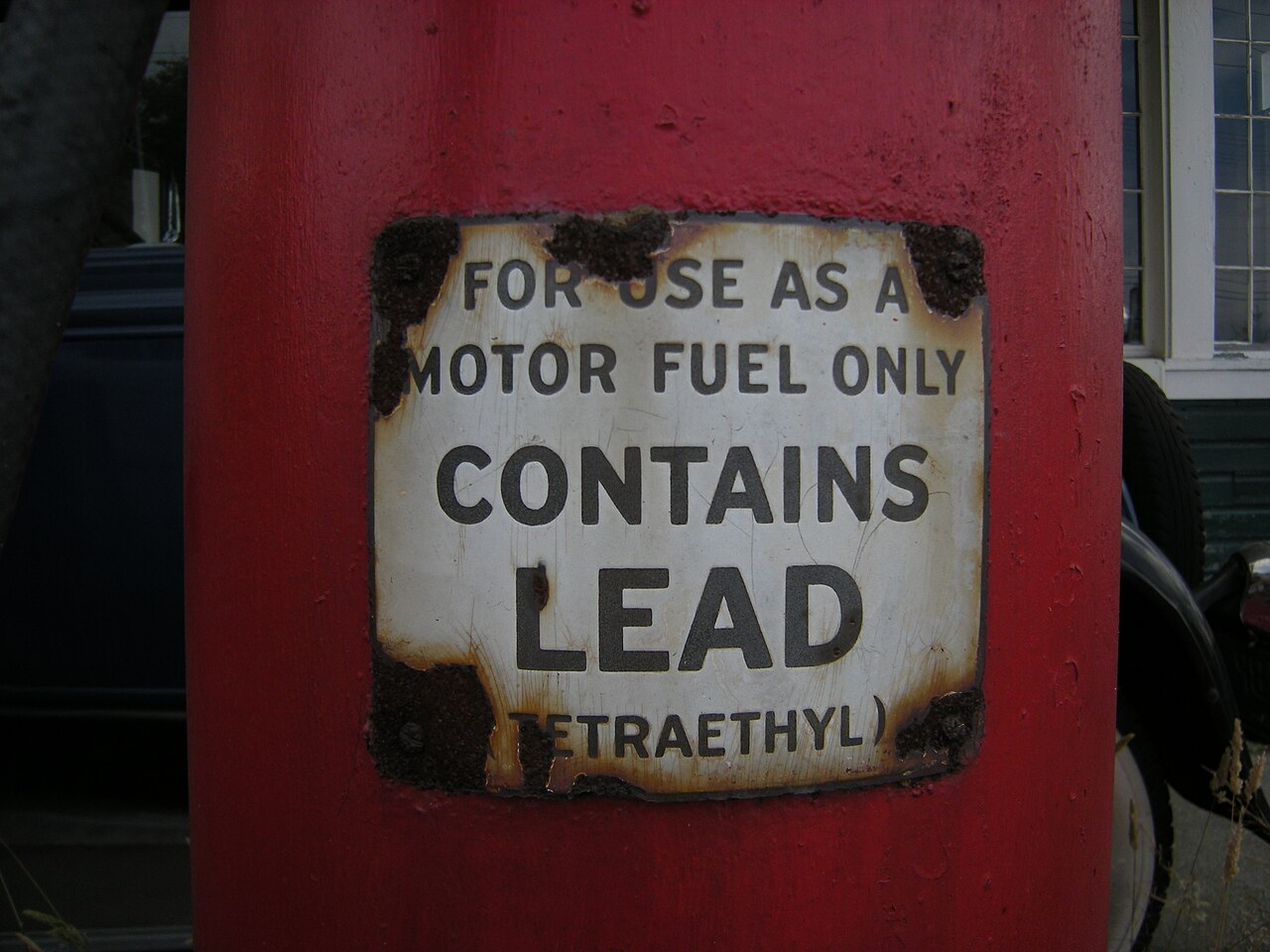
His finding was unequivocal: the amount of lead deposited soared during the twentieth century, with a marked acceleration from the moment people began adding lead to motor petrol.8
Here we find the rule of chemistry again: the lead added to petrol burned in engines and was transformed, but its atoms did not disappear. Expelled through exhaust pipes, they travelled through the atmosphere and settled even in the remote snows of Greenland.
6. The battle against industry
After his results were published, industry officials pressured Patterson to abandon his research, threatening his funding. He refused to give in.9
In 1966, hearings in the US Senate pitted him against Dr Robert Kehoe, a researcher funded by the petrol producers. Kehoe maintained that lead in the environment posed no danger, and that the levels measured in the human body were natural.10
The decisive point concerned the sources rather than the facts: Kehoe himself acknowledged before the senators that his own laboratory was the main source of information on the subject.11
That statement deserves to be weighed: it means that the man who asserted that lead was harmless was also the one producing almost all the data by which to judge it — and he was paid by those who had a stake in the answer.12
7. The responsibility of the public authorities
During his appearance before the senators, Patterson would take this line:
Letting industry investigate for itself the risks it poses to public health amounts, for the state, to a failure of its duty to prohibit and to protect.
This is his position as a committed expert. It is historically situated and attributed; it is up to each reader to assess its significance.
8. Two words of caution
- It should not be concluded that all sponsored research is corrupt. What allows a piece of work to be judged is not where its funding comes from: it is the publication of its methods and its data, which allows anyone else to redo the calculations and check.
- Patterson was not alone. Although history often remembers the struggle of an isolated individual, the definitive refutation of Kehoe’s theories required dozens of complementary studies carried out by many other researchers around the world.13
A single person can raise the alarm, but it is the scientific community that establishes the consensus.
9. The traces of a toxic legacy
Lead was gradually banned from petrol over the last decades of the twentieth century, and the last country to eliminate it did so in 2021 — which brought the era of leaded petrol to an end worldwide.14
However, the lead released over decades is still present in city soils. Because atoms never disappear. That is the rule from the beginning of this page, and that is how it ends.
Note 1
Patterson started lead measurements in 1948 in a very dusty laboratory in Kent Hall, one of the oldest buildings on campus. […] By 1953 he was finally able to carry out the definitive study, using the troilite (sulfide) phase of the Canyon Diablo iron meteorite to measure the isotopic composition of primordial lead, from which he determined an age for the Earth.
National Academy of Sciences, Biographical Memoirs, vol. 74, notice “Clair Cameron Patterson”, 1998
Note 2
Now, I tracked back and I found out there was lead coming from here, there was lead coming from there; there was lead in everything that I was using that came from industry. It was contamination of every conceivable source that people had never thought about before.
California Institute of Technology Archives, Interview with Clair C. Patterson, 1995
Note 3
Patterson accompanied him there and built facilities that set new standards for low-level lead work.
National Academy of Sciences, Biographical Memoirs, vol. 74, notice “Clair Cameron Patterson”, 1998
Note 4
The lead from your hair, when you walk into a superclean laboratory like mine, will contaminate the whole damn laboratory. Just from your hair. [Laughter] And lead's coming from your clothing and everything else.
California Institute of Technology Archives, Interview with Clair C. Patterson, 1995
Note 5
The most accurate method (Pb 207/Pb 206) gives an age of 4.55 ± 0.07 × 10⁹ yr
Patterson, Clair C., “Age of Meteorites and the Earth”, Geochimica et Cosmochimica Acta, vol. 10, 1956, p. 230-237
Note 6
Within experimental error, meteorites have one age as determined by three independent radiometric methods. […] Using certain assumptions which are apparently justified, one can define the isotopic evolution of lead for any meteoritic body. It is found that earth lead meets the requirements of this definition. It is therefore believed that the age for the earth is the same as for meteorites.
Patterson, Clair C., “Age of Meteorites and the Earth”, Geochimica et Cosmochimica Acta, vol. 10, 1956, p. 230-237
Note 7
The age that Patterson derived has stood the test of time, and is still the quoted value forty-four years later. In the meantime, there have been small changes in the accepted values for the uranium decay constants, improvements in chemical and mass spectrometric techniques, […] but these have not substantially changed the age Patterson first gave to us.
National Academy of Sciences, Biographical Memoirs, vol. 74, notice “Clair Cameron Patterson”, 1998
Note 8
Traveling to Greenland and Antarctica, Patterson drilled through ice laid in annual layers over thousands of years to gather more specimens, time machines for measuring lead levels at different points in history. His research revealed that the amount of lead in the atmosphere increased suddenly and dangerously beginning in about 1923.
Kelly, Jason, “Immeasurable”, The University of Chicago Magazine, May-June 2015
Arctic lead pollution rose rapidly during the industrial period, peaking in the 1960s, when leaded gasoline use was most prevalent. […] Clair Patterson and colleagues first noted large-scale increases in lead pollution in Greenland ice associated with leaded gasoline use (e.g. Murozumi et al. 1969).
Wensman, Sophia M., Morgan, J. D. and Keegan, K., “Ice-core records of human impacts on the environment”, PAGES Magazine, vol. 30, no. 2, 2022, p. 108-109
Note 9
Following Patterson’s 1963 Nature paper detailing the data, petroleum industry leaders pressured him to cease studying the question, threatening to withhold their financial support.
Kelly, Jason, “Immeasurable”, The University of Chicago Magazine, May-June 2015
Note 10
On October 7, 1965, he sent a communication similar to the Brown letter to Senator Muskie, chairman of the Subcommittee on Air and Water Pollution. In it he offered to appear before the committee. He was subsequently invited to a hearing held on June 15, 1966, in Washington. […] His views drew support from some of the public (e.g., Ralph Nader), but were once again strongly opposed by others, notably by R. A. Kehoe, the highly regarded authority on industrial poisoning. A battle line was drawn that was to last about two decades.
National Academy of Sciences, Biographical Memoirs, vol. 74, notice “Clair Cameron Patterson”, 1998
Kehoe believed that presence of lead in humans and other organisms was normal and that exposure to low lead levels was not harmful.
Bennettjones, Devhra, “But what about Robert Kehoe?”, LiBlog, University of Cincinnati Libraries (Winkler Center), 16 December 2016
Note 11
The bulk of the investigative work which bears on lead in the general environment of man has been carried out, under the financial sponsorship of the manufacturers and distributors of lead containing anti knock compounds in the United States, in the Kettering Laboratory,
U.S. Senate, Committee on Public Works, Air Pollution – 1966, auditions de June 1966, Washington
Note 12
While an instructor in the UC Department of Physiology in 1924, he was hired by Charles Kettering for General Motors to examine health issues related to tetraethyllead’s production. In 1925, Kehoe became the chief medical advisor of the Ethyl Corporation. […] In 1930, a new laboratory funded by the General Motors, Ethyl, and DuPont corporations, the Kettering Laboratory of Applied Physiology, opened at UC with Kehoe as its first director.
Bennettjones, Devhra, “But what about Robert Kehoe?”, LiBlog, University of Cincinnati Libraries (Winkler Center), 16 December 2016
Note 13
Reproducibility is strongly associated with transparency; a study’s data and code have to be available in order for others to reproduce and confirm results.
National Academies of Sciences, Engineering, and Medicine, Reproducibility and Replicability in Science, The National Academies Press, Washington, 2019
Note 14
When service stations in Algeria stopped providing leaded petrol in July, the use of leaded petrol ended globally.
Programme des Nations unies pour l’environnement, “Era of Leaded Petrol Over”, communiqué du 30 August 2021
Notes and sources
- ↑
Passage In the 1950s, the geochemist Clair Patterson sought to calculate the age of the Earth by measuring the minute quantities of lead contained in very ancient rocks.
Patterson started lead measurements in 1948 in a very dusty laboratory in Kent Hall, one of the oldest buildings on campus. […] By 1953 he was finally able to carry out the definitive study, using the troilite (sulfide) phase of the Canyon Diablo iron meteorite to measure the isotopic composition of primordial lead, from which he determined an age for the Earth.
Source National Academy of Sciences, Biographical Memoirs, vol. 74, notice “Clair Cameron Patterson”, 1998, pp. 270-271 of the memoir.
Open access open the source · checked on 24 October 2026
- ↑
Passage all his samples were contaminated by outside lead […] his instruments, the laboratory floor, the surrounding air and even his own clothes
Now, I tracked back and I found out there was lead coming from here, there was lead coming from there; there was lead in everything that I was using that came from industry. It was contamination of every conceivable source that people had never thought about before.
Source California Institute of Technology Archives, Interview with Clair C. Patterson, 1995, transcript of the interview (Shirley K. Cohen, March 1995), p. 18.
Open access open the source · checked on 24 October 2026
- ↑
Passage Patterson designed an ultra-clean laboratory of a standard never before achieved
Patterson accompanied him there and built facilities that set new standards for low-level lead work.
Source National Academy of Sciences, Biographical Memoirs, vol. 74, notice “Clair Cameron Patterson”, 1998, p. 271.
Open access open the source · checked on 9 September 2026
- ↑
Passage the mere lead dust in an experimenter’s hair is enough to distort the measurement
The lead from your hair, when you walk into a superclean laboratory like mine, will contaminate the whole damn laboratory. Just from your hair. [Laughter] And lead's coming from your clothing and everything else.
Source California Institute of Technology Archives, Interview with Clair C. Patterson, 1995, transcript of the interview (Shirley K. Cohen, March 1995), p. 20.
Open access open the source · checked on 24 October 2026
- ↑
Passage In 1956, he established the age of the Earth at 4.55 billion years, to within 70 million years.
The most accurate method (Pb 207/Pb 206) gives an age of 4.55 ± 0.07 × 10⁹ yr
Source Patterson, Clair C., “Age of Meteorites and the Earth”, Geochimica et Cosmochimica Acta, vol. 10, 1956, p. 230-237, abstract of the article.
Paywalled open the source · checked on 9 September 2026
- ↑
Passage the Earth and the meteorites formed at the same time, from the same material […] He measured the lead in several meteorites, checked that terrestrial lead was consistent with them
Within experimental error, meteorites have one age as determined by three independent radiometric methods. […] Using certain assumptions which are apparently justified, one can define the isotopic evolution of lead for any meteoritic body. It is found that earth lead meets the requirements of this definition. It is therefore believed that the age for the earth is the same as for meteorites.
Source Patterson, Clair C., “Age of Meteorites and the Earth”, Geochimica et Cosmochimica Acta, vol. 10, 1956, p. 230-237, abstract.
Paywalled open the source · checked on 9 September 2026
- ↑
Passage The value he obtained still stands […] Measurements have been refined since, without really changing it.
The age that Patterson derived has stood the test of time, and is still the quoted value forty-four years later. In the meantime, there have been small changes in the accepted values for the uranium decay constants, improvements in chemical and mass spectrometric techniques, […] but these have not substantially changed the age Patterson first gave to us.
Source National Academy of Sciences, Biographical Memoirs, vol. 74, notice “Clair Cameron Patterson”, 1998, p. 272 of the memoir.
Open access open the source · checked on 24 October 2026
- ↑
Passage he took ice cores in Greenland and Antarctica […] the amount of lead deposited soared during the twentieth century
Traveling to Greenland and Antarctica, Patterson drilled through ice laid in annual layers over thousands of years to gather more specimens, time machines for measuring lead levels at different points in history. His research revealed that the amount of lead in the atmosphere increased suddenly and dangerously beginning in about 1923.
Source Kelly, Jason, “Immeasurable”, The University of Chicago Magazine, May-June 2015, body of the article, part on atmospheric lead (paragraph after the one on the 1963 Nature paper).
Open access open the source · checked on 27 October 2026
Passage a marked acceleration from the moment people began adding lead to motor petrol
Arctic lead pollution rose rapidly during the industrial period, peaking in the 1960s, when leaded gasoline use was most prevalent. […] Clair Patterson and colleagues first noted large-scale increases in lead pollution in Greenland ice associated with leaded gasoline use (e.g. Murozumi et al. 1969).
Source Wensman, Sophia M., Morgan, J. D. and Keegan, K., “Ice-core records of human impacts on the environment”, PAGES Magazine, vol. 30, no. 2, 2022, p. 108-109, pp. 108-109, section “Human impacts on lead pollution”.
Open access open the source · checked on 27 October 2026
- ↑
Passage industry officials pressured Patterson to abandon his research, threatening his funding
Following Patterson’s 1963 Nature paper detailing the data, petroleum industry leaders pressured him to cease studying the question, threatening to withhold their financial support.
Source Kelly, Jason, “Immeasurable”, The University of Chicago Magazine, May-June 2015, body of the article, part on atmospheric lead.
Open access open the source · checked on 27 October 2026
- ↑
Passage In 1966, hearings in the US Senate pitted him against Dr Robert Kehoe
On October 7, 1965, he sent a communication similar to the Brown letter to Senator Muskie, chairman of the Subcommittee on Air and Water Pollution. In it he offered to appear before the committee. He was subsequently invited to a hearing held on June 15, 1966, in Washington. […] His views drew support from some of the public (e.g., Ralph Nader), but were once again strongly opposed by others, notably by R. A. Kehoe, the highly regarded authority on industrial poisoning. A battle line was drawn that was to last about two decades.
Source National Academy of Sciences, Biographical Memoirs, vol. 74, notice “Clair Cameron Patterson”, 1998, p. 276, end of the paragraph beginning “He had simultaneously started parallel actions at the national level” and the following paragraph (“There Patterson emphasized…”).
Open access open the source · checked on 27 October 2026
Passage Kehoe maintained that lead in the environment posed no danger, and that the levels measured in the human body were natural.
Kehoe believed that presence of lead in humans and other organisms was normal and that exposure to low lead levels was not harmful.
Source Bennettjones, Devhra, “But what about Robert Kehoe?”, LiBlog, University of Cincinnati Libraries (Winkler Center), 16 December 2016, online post, paragraph “The Winkler is the proud keeper of the Robert A. Kehoe Archives…” (6th paragraph, archival notice included).
Open access open the source · checked on 27 October 2026
- ↑
Passage Kehoe himself acknowledged before the senators that his own laboratory was the main source of information on the subject.
The bulk of the investigative work which bears on lead in the general environment of man has been carried out, under the financial sponsorship of the manufacturers and distributors of lead containing anti knock compounds in the United States, in the Kettering Laboratory,
Source U.S. Senate, Committee on Public Works, Air Pollution – 1966, auditions de June 1966, Washington, testimony of Dr Robert A. Kehoe, pp. 191-192 of the hearings volume.
Open access · checked on 24 October 2026
- ↑
Passage he was paid by those who had a stake in the answer
While an instructor in the UC Department of Physiology in 1924, he was hired by Charles Kettering for General Motors to examine health issues related to tetraethyllead’s production. In 1925, Kehoe became the chief medical advisor of the Ethyl Corporation. […] In 1930, a new laboratory funded by the General Motors, Ethyl, and DuPont corporations, the Kettering Laboratory of Applied Physiology, opened at UC with Kehoe as its first director.
Source Bennettjones, Devhra, “But what about Robert Kehoe?”, LiBlog, University of Cincinnati Libraries (Winkler Center), 16 December 2016, online post, paragraph beginning “While an instructor in the UC Department of Physiology in 1924” and paragraph beginning “In 1930, a new laboratory”.
Open access open the source · checked on 27 October 2026
- ↑
Passage What allows a piece of work to be judged […] it is the publication of its methods and its data
Reproducibility is strongly associated with transparency; a study’s data and code have to be available in order for others to reproduce and confirm results.
Source National Academies of Sciences, Engineering, and Medicine, Reproducibility and Replicability in Science, The National Academies Press, Washington, 2019, Executive Summary, passage on reproducibility.
Open access open the source · checked on 27 October 2026
- ↑
Passage the last country to eliminate it did so in 2021 — which brought the era of leaded petrol to an end worldwide
When service stations in Algeria stopped providing leaded petrol in July, the use of leaded petrol ended globally.
Source Programme des Nations unies pour l’environnement, “Era of Leaded Petrol Over”, communiqué du 30 August 2021, press release of 30 August 2021, body of the text.
Open access open the source · checked on 9 September 2026
Bibliography
15
- Bennettjones, Devhra, “But what about Robert Kehoe?”, LiBlog, University of Cincinnati Libraries (Winkler Center), 16 December 2016, open access. https://libapps.libraries.uc.edu/liblog/2016/12/but-what-about-robert-kehoe/
- California Institute of Technology Archives, Interview with Clair C. Patterson, 1995, open access (the contamination, the building of the clean laboratory, the dust from hair). https://oralhistories.library.caltech.edu/
- Kelly, Jason, “Immeasurable”, The University of Chicago Magazine, May-June 2015, open access (the drilling in the ice of Greenland and Antarctica; the sudden rise in atmospheric lead from about 1923; the pressure from the petroleum industry and the threat to his funding). https://mag.uchicago.edu/science-medicine/immeasurable
- Markowitz, Gerald and Rosner, David, Deceit and Denial: The Deadly Politics of Industrial Pollution, University of California Press, 2002, in libraries (the lead industry and control of the data).
- Murozumi, Masayo, Chow, Tsaihwa J. and Patterson, Clair C., “Chemical Concentrations of Pollutant Lead Aerosols, Terrestrial Dusts and Sea Salts in Greenland and Antarctic Snow Strata”, Geochimica et Cosmochimica Acta, vol. 33, 1969, p. 1247-1294, paywalled (the ice cores and the rise in lead in the twentieth century).
- National Academies of Sciences, Engineering, and Medicine, Reproducibility and Replicability in Science, The National Academies Press, Washington, 2019, open access (transparency of data and methods, the condition for others to reproduce and confirm a result). https://doi.org/10.17226/25303
- National Academy of Sciences, Biographical Memoirs, vol. 74, notice “Clair Cameron Patterson”, 1998, open access (the meteorite method, the value of 4.55 ± 0.07 billion years, the building of the clean laboratories). https://www.nationalacademies.org/read/6201/chapter/16
- Needleman, Herbert L., “Clair Patterson and Robert Kehoe: Two Views of Lead Toxicity”, Environmental Research, vol. 78, 1998, p. 79-85, paywalled (the opposition between the two researchers).
- Nriagu, Jerome O., “Clair Patterson and Robert Kehoe’s Paradigm of "Show Me the Data" on Environmental Lead Poisoning”, Environmental Research, vol. 78, no. 2, 1998, p. 71-78, paywalled (Kehoe’s position and his laboratory as the main source of data). https://doi.org/10.1006/enrs.1997.3808
- Oreskes, Naomi and Conway, Erik M., Merchants of Doubt, Bloomsbury, 2010, in libraries (the manufacture of doubt). French translation: Les Marchands de doute, Le Pommier, 2012.
- Patterson, Clair C., “Age of Meteorites and the Earth”, Geochimica et Cosmochimica Acta, vol. 10, 1956, p. 230-237, paywalled (the age of 4.55 ± 0.07 billion years; the hypothesis of a common age for the Earth and the meteorites). https://doi.org/10.1016/0016-7037(56)90036-9
- Patterson, Clair C., “Contaminated and Natural Lead Environments of Man”, Archives of Environmental Health, vol. 11, 1965, p. 344-360, paywalled (the warning about lead of human origin).
- Programme des Nations unies pour l’environnement, “Era of Leaded Petrol Over”, communiqué du 30 August 2021, open access (the worldwide end of leaded petrol). https://www.unep.org/news-and-stories/press-release/era-leaded-petrol-over-eliminating-major-threat-human-and-planetary
- U.S. Senate, Committee on Public Works, Air Pollution – 1966, auditions de June 1966, Washington, open access (the face-off between Patterson and Kehoe, and the latter’s admission about his laboratory).
- Wensman, Sophia M., Morgan, J. D. and Keegan, K., “Ice-core records of human impacts on the environment”, PAGES Magazine, vol. 30, no. 2, 2022, p. 108-109, open access (the rise of lead in Greenland ice linked to leaded petrol, first noted by Patterson and his colleagues; the peak in the 1960s). https://doi.org/10.22498/pages.30.2.108
Spotted an error or have a doubt? Write to us.