
A little over a hundred years ago, some leading scientists did not believe in atoms.
Not out of narrow-mindedness, but because nobody had ever seen one.
A reasonable objection
Around 1900, atomic theory worked very well. It made it possible to predict chemical reactions, to calculate proportions, to explain the behaviour of gases.
But two renowned scientists — Wilhelm Ostwald and Ernst Mach — refused to accept that atoms really exist.1
Their argument: it is a convenient fiction. A way of calculating that gives the right results, without any need to believe in the reality of these little balls. After all, not a single one had ever been measured.
These were not obtuse minds. Their demand was: “Show it to me some other way than by saying that it works.”
It was this demand that made the proof necessary. The proof, when it came, was magnificent.
Brownian motion
Very fine grains suspended in water — pollen, a drop of ink — observed under the microscope, do not stay still: they jiggle about in every direction, constantly and for no apparent reason.
In 1905, Einstein proposed a mathematical explanation: these grains are bombarded from all sides by water molecules, invisible and countless. By chance, the impacts never quite balance out, and the grain is knocked off course.2
From this he derived precise formulae: how far a grain should move, on average, depending on its size, on the temperature, on the thickness of the liquid.
But Einstein was a theorist: he had no experiments to hand.
Perrin, gamboge and patience
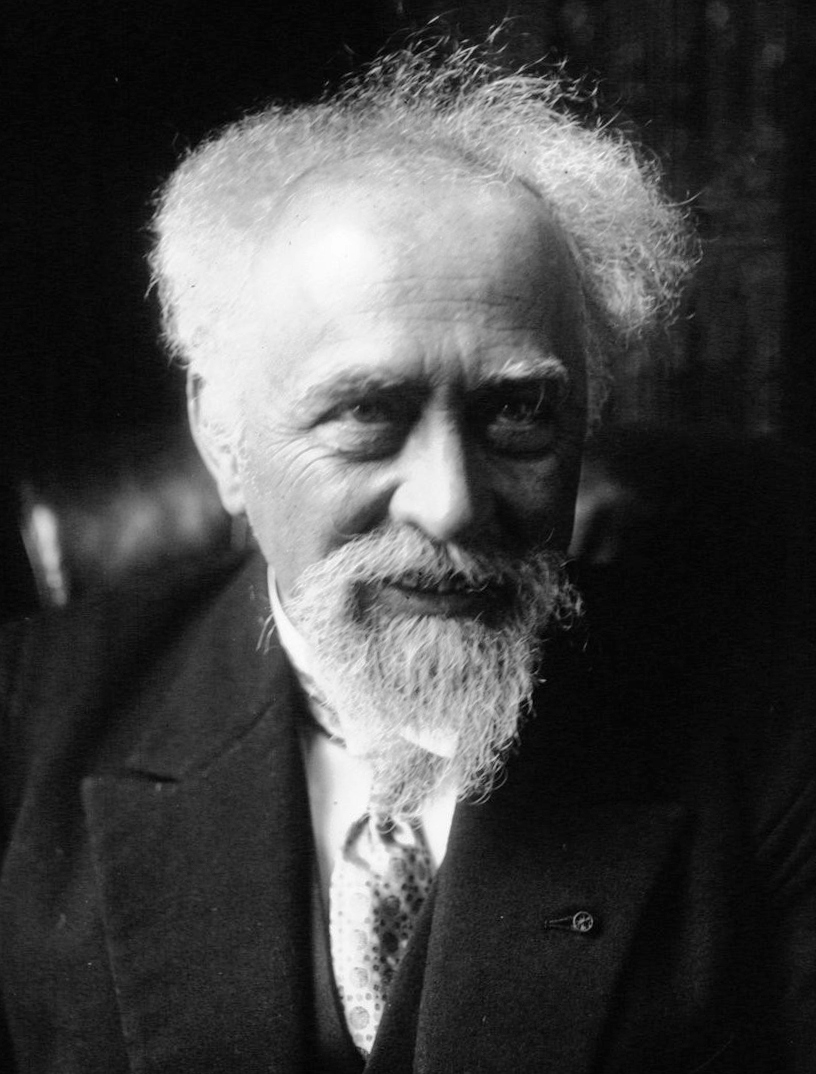
Between 1908 and 1913, a French physicist, Jean Perrin, carried out the experiments. At first, he did not even know of Einstein’s paper.
The work was tedious. Perfectly regular grains were needed, otherwise the measurements meant nothing. Perrin used gamboge, a yellow pigment taken from the latex of Asian trees, and he developed a method for obtaining grains of uniform size from it — a skill that almost nobody else had mastered.3
Then he counted, measured and started again.
From this he derived a number: how many molecules there are in a given quantity of matter. This is what is called Avogadro’s number.4
What won the argument
Perrin could have stopped there. He did something else, and that is the reason this page exists.
In his book Les Atomes, published in 1913, he brought together thirteen different ways of calculating this same number. Thirteen methods that have nothing to do with one another:5
- The viscosity of gases;
- Radioactivity;
- The radiation of heat;
- The charge of oil droplets;
- Brownian motion;
- And even — this is our favourite — the blue of the sky.
These phenomena have no connection with one another. They belong to different branches of physics. They are measured with different instruments, by different people.6
They give the same number. All thirteen values obtained lie between 60 × 10²² and 75 × 10²².7
Perrin marvels at this in his book, in terms that deserve to be quoted:
“One is seized with admiration before the miracle of such precise agreement arising from such different phenomena. That, first, the same magnitude should be found again for each of the methods, while varying the conditions of its application as much as possible, and then that the numbers thus defined without ambiguity by so many methods should coincide — this gives molecular reality a likelihood very close to certainty.”8
This sentence contains two arguments, not just one. First: each method, taken on its own, gives the same result when its conditions are changed as much as possible. Second: the methods, compared with one another, agree.
Finally, the last words are significant. Perrin does not write “certainty”. He writes “very close to certainty”.
Ostwald, one of the best-known opponents, declared himself convinced as early as 1909. Mach, for his part, never was. The proof did not convince everyone, and that is in the nature of things.9
Why this is the best possible proof
This reasoning is worth dwelling on, because it holds far beyond this case.
At the time, nobody had seen an atom. Nor had anyone found a method so good that it would make everyone agree.10
What was found was thirteen methods, none of which would have been enough on its own — and which agree.
Now, if atoms did not exist, each method would be measuring something else — a flaw peculiar to its instrument, to its subject, to its branch. Why would these flaws all give the same number?
There is only one simple explanation: they are all measuring the same real thing.
This reasoning turns up elsewhere on this site, a century later. To produce the first image of a black hole, the scientists were divided into four teams that worked for seven weeks without talking to one another, using different methods. The four images differed in their details. All of them contained the same ring (1.10).
The idea is exactly the same: if independent paths arrive at the same place, it is probably not the path that created it.
Molecules, or why arrangement matters
An isolated atom is rare. Most of the time, atoms are attached to one another, in small groups or in vast networks: these are molecules.
A surprising fact: the same atoms, put together differently, do not do the same thing.
Diamond and pencil lead are made of the same atom, carbon, and nothing else. In diamond, each atom is firmly bonded to four neighbours in all directions: it is the hardest natural material. In the graphite of a pencil, the atoms are bonded in sheets that slide over one another: that is what leaves a mark on paper.11
Same ingredient, two arrangements, two materials. What matters is not only what a thing is made of, but how it is made.
The drawing of the atom
The drawing is familiar: a ball in the centre, and little beads circling around it on rings. It appears in textbooks, logos, signs, on the covers of exercise books.
It corresponds to a model proposed in 1913 by Niels Bohr, and superseded as early as 1925-1926.12
What Bohr did, and why it was not foolish
We should not draw the wrong conclusion from this.
In 1913, this model was a considerable advance. Before it, classical physics predicted that an electron orbiting a nucleus should lose its energy and crash into it almost instantly. Yet atoms exist and endure.
Bohr solved the problem by imposing a new rule: the electron can only occupy certain tracks, not just any. It does not radiate as long as it stays on them; it emits or absorbs light only when it changes track.13
It was the first time that the idea that certain quantities come in packets rather than continuously had been brought into the atom. This model can be compared to a signpost on a footpath: it does not show the destination, it shows the direction.
It had its limits, which were known: it could not explain atoms with several electrons; it worked well only for hydrogen.14
What replaced it
In 1926, Erwin Schrödinger established an equation that describes the behaviour of the electron far better. What it states is disconcerting.15
The trajectory of the electron cannot be given. It is not that we do not yet know how to measure it: it is that there is none, in the usual sense of the term.
What can be calculated is the probability of finding it in one place rather than another. The result looks like a cloud: dense where the electron is very likely to be, thin elsewhere.
By convention, the region in which there is a 90% chance of finding it is often marked out, and it is this shape that is drawn.16
The right picture, then, is not a bead on a rail. It is a map of the places where the electron is likely to be.
And a word that still gives it away
One detail strikes us as remarkable.
Chemists call these regions of probability orbitals.17
The term can be misleading: to the ear, the word “orbital” suggests that the electron has an orbit. In other words, precisely what it does not have, as we have just seen.
The word has kept the ghost of the old model.
This mechanism often comes up on this site: a word that manufactures a fact. But this one is unusual, and that is why it is worth telling.
This time, the problem lies in the very vocabulary of chemists.
Should we abandon the drawing, then?
No. That is the conclusion of this page.
Bohr’s drawing remains useful: it makes it possible to count electrons, to understand why some atoms bond and others do not, to reason quickly. It is still taught deliberately, for its simplicity.
The problem is not that it is used. The problem is that nobody says what it is.
A drawing presented as a picture of the atom plants a false idea that dies hard. The same drawing presented as a tool for reasoning, which dates from 1913 and was superseded in 1926, plants nothing at all: it does its job and steps aside when it is no longer needed.
It is not the model that misleads. It is the silence about its status.
Note 1
However, it was not always the case, and the hypothesis of a continuous structure of matter was relentlessly defended until the end of the nineteenth century by famous names such as Duhem, Ostwald, and Mach.
Duplantier, Bertrand, “Brownian Motion, "Diverse and Undulating"”, in Damour, Thibault, Darrigol, Olivier, Duplantier, Bertrand and Rivasseau, Vincent (eds), Einstein, 1905-2005. Poincaré Seminar 2005, Progress in Mathematical Physics, vol. 47, Birkhäuser, Basel, 2006, p. 201-293
Note 2
In dieser Arbeit soll gezeigt werden, daß nach der molekularkinetischen Theorie der Wärme in Flüssigkeiten suspendierte Körper von mikroskopisch sichtbarer Größe infolge der Molekularbewegung der Wärme Bewegungen von solcher Größe ausführen müssen, daß diese Bewegungen leicht mit dem Mikroskop nachgewiesen werden können.
This paper will show that, according to the molecular-kinetic theory of heat, bodies of microscopically visible size suspended in liquids must, as a result of the molecular motion of heat, perform motions of such magnitude that these motions can easily be detected with a microscope.
Einstein, Albert, “Über die von der molekularkinetischen Theorie der Wärme geforderte Bewegung von in ruhenden Flüssigkeiten suspendierten Teilchen”, Annalen der Physik, vol. 322, 1905, p. 549-560
Note 3
En revanche, après quelques tâtonnements, j’ai pu faire des mesures sur des émulsions de gomme-gutte, puis (avec l’aide de M. Dabrowski) sur des émulsions de mastic. […] Il faut d’abord savoir préparer une émulsion où tous les grains aient à peu près le même rayon. […] pendant la centrifugation d’une émulsion pure⁴⁰ les parties d’abord sédimentées sont relativement plus riches en gros grains, et l’on conçoit qu’il y a là un moyen de séparer les grains selon leur taille.
Perrin, Jean, “Mouvement brownien et réalité moléculaire”, Annales de chimie et de physique, t. 18, 1909, p. 5-114
Note 4
The number N of the molecules constituting any gram-molecule is Avogadro's number. […] My most careful measurements made with an emulsion the rarefaction of which doubled with each rise of 6 microns, gave a value for N of 68 X 10²².
Perrin, Jean, “Discontinuous Structure of Matter”, Nobel lecture, Stockholm, 11 December 1926, Nobel Foundation
Note 5
[…] in conclusion the author compiles the values obtained by thirteen different methods for Avogadro's number.
“Les Atomes” (unsigned review of Perrin, Jean, Les Atomes, Félix Alcan, 1913), under “Atoms and Molecules”, Nature, vol. 91, 1913, p. 473, doi:10.1038/091473a0
Note 6
It defends the claim that Perrin used the multiple determination strategy to put forward an exceptionally strong no-coincidence argument, to argue for both the correctness of the values for the molecular magnitudes determined and the validity of the auxiliary assumptions upon which the different determinations were based.
Coko, Klodian, “Jean Perrin and the Philosophers’ Stories: The Role of Multiple Determination in Determining Avogadro’s Number”, HOPOS, vol. 10, no. 1, 2020, p. 143-193
Note 7
Parvenus au terme actuel de cette étude, si nous jetons un coup d’œil sur les divers phénomènes qui nous ont livré les grandeurs moléculaires, nous serons conduits à former le Tableau suivant : […] Opalescence critique 75,0 Bleu du ciel 60,0 (?) […] Énergie rayonnée 60,0 […] puis que les nombres ainsi définis sans ambiguïté par tant de méthodes coïncident, cela donne à la réalité moléculaire une vraisemblance bien voisine de la certitude.
Perrin, Jean, Les Atomes, Félix Alcan, 1913
Note 8
On est saisi d'admiration devant le miracle de concordances aussi précises à partir de phénomènes si différents […] cela donne à la réalité moléculaire une vraisemblance bien voisine de la certitude.
One is seized with admiration before the miracle of such precise agreement arising from such different phenomena […] this gives molecular reality a likelihood very close to certainty.
Perrin, Jean, Les Atomes, Félix Alcan, 1913
Note 9
Ich habe mich überzeugt, daß wir seit kurzer Zeit in den Besitz der experimentellen Nachweise für die diskrete oder körnige Natur der Stoffe gelangt sind, welche die Atomhypothese seit Jahrhunderten, ja Jahrtausenden vergeblich gesucht hatte.
I have become convinced that we have recently come into possession of the experimental proof of the discrete or granular nature of matter, which the atomic hypothesis had sought in vain for centuries, indeed for millennia.
Ostwald, Wilhelm, Grundriss der allgemeinen Chemie, 4e éd., Steinkopff, Dresde, 1909, préface, public domain
To historians of science, Mach is better known for denying the existence of atoms right up until his death in 1916 […] But not Mach.
Ashworth, William B., Jr., “Ernst Mach”, Scientist of the Day, Linda Hall Library, 18 February 2025
Note 10
Surface microscopy using vacuum tunneling is demonstrated for the first time. Topographic pictures of surfaces on an atomic scale have been obtained.
Binnig, Gerd et al., “Surface Studies by Scanning Tunneling Microscopy”, Physical Review Letters, vol. 49, 1982, p. 57-61
Note 11
You may be familiar with diamond and graphite, the two most common allotropes of carbon. (Allotropes are different structural forms of the same element.) Diamond is one of the hardest-known substances, whereas graphite is soft enough to be used as pencil lead. These very different properties stem from the different arrangements of the carbon atoms in the different allotropes.
Flowers, Paul, Theopold, Klaus, Langley, Richard and Robinson, William R., Chemistry 2e, OpenStax, 2019, section 10.5 “The Solid State of Matter”
Note 12
This paper is an attempt to show that the application of the above ideas to Rutherford’s atom-model affords a basis for a theory of the constitution of atoms.
Bohr, Niels, “On the Constitution of Atoms and Molecules”, Philosophical Magazine, vol. 26, 1913, p. 1-25
Note 13
According to the above considerations, we are led to assume that these configurations will correspond to states of the system in which there is no radiation of energy; states which consequently will be stationary as long as the system is not disturbed from outside.
Bohr, Niels, “On the Constitution of Atoms and Molecules”, Philosophical Magazine, vol. 26, 1913, p. 1-25
Note 14
The Bohr theory of the hydrogen atom suffered from a fatal weakness: It explained nothing except the hydrogen atom and any other combination of a nucleus and one electron.
Dickerson, Richard E., Gray, Harry B. and Haight, Gilbert P., Chemical Principles, 3e éd., Benjamin/Cummings, 1979, version en ligne sur Chemistry LibreTexts, chap. 8 “Quantum Theory and Atomic Structure”, section 8.1, open access
Note 15
The theory provided a good description of the spectrum created by the hydrogen atom, but needed to be developed to suit more complicated atoms and molecules. Assuming that matter (e.g., electrons) could be regarded as both particles and waves, in 1926 Erwin Schrödinger formulated a wave equation that accurately calculated the energy levels of electrons in atoms.
Nobel Foundation, “Erwin Schrödinger – Facts”, Nobel Prize in Physics 1933, NobelPrize.org
Note 16
Orbitals are generally drawn as three-dimensional surfaces that enclose 90% of the electron density
Farmer, Steven and Kennepohl, Dietmar, “1.2: Atomic Structure - Orbitals”, dans Organic Chemistry (Morsch et al.), Chemistry LibreTexts, open access
Note 17
A description of electronic structures of polyatomic molecules in terms of atomic and molecular orbitals (one-electron orbital wave functions) is suggested, as follows.
Mulliken, Robert S., “Electronic Structures of Polyatomic Molecules and Valence. II. General Considerations”, Physical Review, vol. 41, no. 1, 1932, p. 49-71
Notes and sources
- ↑
Passage two renowned scientists — Wilhelm Ostwald and Ernst Mach — refused to accept that atoms really exist
However, it was not always the case, and the hypothesis of a continuous structure of matter was relentlessly defended until the end of the nineteenth century by famous names such as Duhem, Ostwald, and Mach.
Source Duplantier, Bertrand, “Brownian Motion, "Diverse and Undulating"”, in Damour, Thibault, Darrigol, Olivier, Duplantier, Bertrand and Rivasseau, Vincent (eds), Einstein, 1905-2005. Poincaré Seminar 2005, Progress in Mathematical Physics, vol. 47, Birkhäuser, Basel, 2006, p. 201-293, p. 216 (pagination of the article in the volume).
Open access open the source · checked on 27 October 2026
- ↑
Passage In 1905, Einstein proposed a mathematical explanation: these grains are bombarded from all sides by water molecules
In dieser Arbeit soll gezeigt werden, daß nach der molekularkinetischen Theorie der Wärme in Flüssigkeiten suspendierte Körper von mikroskopisch sichtbarer Größe infolge der Molekularbewegung der Wärme Bewegungen von solcher Größe ausführen müssen, daß diese Bewegungen leicht mit dem Mikroskop nachgewiesen werden können.
Editors’ translation This paper will show that, according to the molecular-kinetic theory of heat, bodies of microscopically visible size suspended in liquids must, as a result of the molecular motion of heat, perform motions of such magnitude that these motions can easily be detected with a microscope.
Source Einstein, Albert, “Über die von der molekularkinetischen Theorie der Wärme geforderte Bewegung von in ruhenden Flüssigkeiten suspendierten Teilchen”, Annalen der Physik, vol. 322, 1905, p. 549-560, p. 549, 1st paragraph (introduction, before § 1).
Public domain open the source · checked on 27 October 2026
- ↑
Passage Perrin used gamboge […] and he developed a method for obtaining grains of uniform size from it
En revanche, après quelques tâtonnements, j’ai pu faire des mesures sur des émulsions de gomme-gutte, puis (avec l’aide de M. Dabrowski) sur des émulsions de mastic. […] Il faut d’abord savoir préparer une émulsion où tous les grains aient à peu près le même rayon. […] pendant la centrifugation d’une émulsion pure⁴⁰ les parties d’abord sédimentées sont relativement plus riches en gros grains, et l’on conçoit qu’il y a là un moyen de séparer les grains selon leur taille.
Source Perrin, Jean, “Mouvement brownien et réalité moléculaire”, Annales de chimie et de physique, t. 18, 1909, p. 5-114, § 15 (“Émulsions appropriées aux recherches”) and § 16 (“La centrifugation fractionnée. Réalisation d’une émulsion uniforme”), pp. 11-12 of the ENSAM digital edition (its own pagination, not that of the Annales).
Public domain open the source · checked on 27 October 2026
- ↑
Passage From this he derived a number: how many molecules there are in a given quantity of matter.
The number N of the molecules constituting any gram-molecule is Avogadro's number. […] My most careful measurements made with an emulsion the rarefaction of which doubled with each rise of 6 microns, gave a value for N of 68 X 10²².
Source Perrin, Jean, “Discontinuous Structure of Matter”, Nobel lecture, Stockholm, 11 December 1926, Nobel Foundation, “Introduction” (definition of N), then section “Law of the vertical distribution of an emulsion”.
Open access open the source · checked on 27 October 2026
- ↑
Passage In his book Les Atomes, published in 1913, he brought together thirteen different ways of calculating this same number.
[…] in conclusion the author compiles the values obtained by thirteen different methods for Avogadro's number.
Source “Les Atomes” (unsigned review of Perrin, Jean, Les Atomes, Félix Alcan, 1913), under “Atoms and Molecules”, Nature, vol. 91, 1913, p. 473, doi:10.1038/091473a0, review “Atoms and Molecules”, Nature of 10 July 1913, 4th paragraph (“The first two chapters are devoted to a historical survey…”).
Open access open the source · checked on 27 October 2026
- ↑
Passage These phenomena have no connection with one another. […] They give the same number.
It defends the claim that Perrin used the multiple determination strategy to put forward an exceptionally strong no-coincidence argument, to argue for both the correctness of the values for the molecular magnitudes determined and the validity of the auxiliary assumptions upon which the different determinations were based.
Source Coko, Klodian, “Jean Perrin and the Philosophers’ Stories: The Role of Multiple Determination in Determining Avogadro’s Number”, HOPOS, vol. 10, no. 1, 2020, p. 143-193, abstract.
Paywalled · checked on 25 October 2026
- ↑
Passage All thirteen values obtained lie between 60 × 10²² and 75 × 10²².
Parvenus au terme actuel de cette étude, si nous jetons un coup d’œil sur les divers phénomènes qui nous ont livré les grandeurs moléculaires, nous serons conduits à former le Tableau suivant : […] Opalescence critique 75,0 Bleu du ciel 60,0 (?) […] Énergie rayonnée 60,0 […] puis que les nombres ainsi définis sans ambiguïté par tant de méthodes coïncident, cela donne à la réalité moléculaire une vraisemblance bien voisine de la certitude.
Source Perrin, Jean, Les Atomes, Félix Alcan, 1913, Conclusions, § 119, “La convergence des déterminations”, table (thirteen values, from 60.0 to 75.0), pp. 289-291.
Domaine public open the source 1 open the source 2 · checked on 28 October 2026
- ↑
Passage One is seized with admiration before the miracle of such precise agreement arising from such different phenomena […] this gives molecular reality a likelihood very close to certainty.
On est saisi d'admiration devant le miracle de concordances aussi précises à partir de phénomènes si différents […] cela donne à la réalité moléculaire une vraisemblance bien voisine de la certitude.
Editors’ translation One is seized with admiration before the miracle of such precise agreement arising from such different phenomena […] this gives molecular reality a likelihood very close to certainty.
Source Perrin, Jean, Les Atomes, Félix Alcan, 1913, chapter “Conclusion”.
Public domain open the source · checked on 9 September 2026
- ↑
Passage Ostwald […] declared himself convinced as early as 1909.
Ich habe mich überzeugt, daß wir seit kurzer Zeit in den Besitz der experimentellen Nachweise für die diskrete oder körnige Natur der Stoffe gelangt sind, welche die Atomhypothese seit Jahrhunderten, ja Jahrtausenden vergeblich gesucht hatte.
Editors’ translation I have become convinced that we have recently come into possession of the experimental proof of the discrete or granular nature of matter, which the atomic hypothesis had sought in vain for centuries, indeed for millennia.
Source Ostwald, Wilhelm, Grundriss der allgemeinen Chemie, 4e éd., Steinkopff, Dresde, 1909, préface, public domain, Vorbericht (preface) of the 4th edition, end of the 1st page and start of the 2nd page (views 8-9 of the TIB digitisation).
Public domain · checked on 24 October 2026
Passage Mach, for his part, never was.
To historians of science, Mach is better known for denying the existence of atoms right up until his death in 1916 […] But not Mach.
Source Ashworth, William B., Jr., “Ernst Mach”, Scientist of the Day, Linda Hall Library, 18 February 2025, 2nd paragraph (sentence beginning “To historians of science”); 4th paragraph (“But not Mach.”).
Open access open the source · checked on 27 October 2026
- ↑
Passage At the time, nobody had seen an atom.
Surface microscopy using vacuum tunneling is demonstrated for the first time. Topographic pictures of surfaces on an atomic scale have been obtained.
Source Binnig, Gerd et al., “Surface Studies by Scanning Tunneling Microscopy”, Physical Review Letters, vol. 49, 1982, p. 57-61, abstract.
Paywalled · checked on 25 October 2026
- ↑
Passage Diamond and pencil lead are made of the same atom […] two arrangements, two materials.
You may be familiar with diamond and graphite, the two most common allotropes of carbon. (Allotropes are different structural forms of the same element.) Diamond is one of the hardest-known substances, whereas graphite is soft enough to be used as pencil lead. These very different properties stem from the different arrangements of the carbon atoms in the different allotropes.
Source Flowers, Paul, Theopold, Klaus, Langley, Richard and Robinson, William R., Chemistry 2e, OpenStax, 2019, section 10.5 “The Solid State of Matter”, § 10.5, “How Sciences Interconnect” box (“Graphene: Material of the Future”), 1st paragraph.
Open access open the source · checked on 27 October 2026
- ↑
Passage It corresponds to a model proposed in 1913 by Niels Bohr
This paper is an attempt to show that the application of the above ideas to Rutherford’s atom-model affords a basis for a theory of the constitution of atoms.
Source Bohr, Niels, “On the Constitution of Atoms and Molecules”, Philosophical Magazine, vol. 26, 1913, p. 1-25, Part I, introduction, pp. 2-3.
Paywalled · checked on 25 October 2026
- ↑
Passage the electron can only occupy certain tracks, not just any. It does not radiate as long as it stays on them
According to the above considerations, we are led to assume that these configurations will correspond to states of the system in which there is no radiation of energy; states which consequently will be stationary as long as the system is not disturbed from outside.
Source Bohr, Niels, “On the Constitution of Atoms and Molecules”, Philosophical Magazine, vol. 26, 1913, p. 1-25, Part I, § 1 “General Considerations”, p. 5.
Paywalled · checked on 25 October 2026
- ↑
Passage it could not explain atoms with several electrons
The Bohr theory of the hydrogen atom suffered from a fatal weakness: It explained nothing except the hydrogen atom and any other combination of a nucleus and one electron.
Source Dickerson, Richard E., Gray, Harry B. and Haight, Gilbert P., Chemical Principles, 3e éd., Benjamin/Cummings, 1979, version en ligne sur Chemistry LibreTexts, chap. 8 “Quantum Theory and Atomic Structure”, section 8.1, open access, ch. 8, subheading “The Need for a Better Theory” (page 8.1 “Introduction” of the LibreTexts version).
Open access open the source · checked on 24 October 2026
- ↑
Passage In 1926, Erwin Schrödinger established an equation that describes the behaviour of the electron far better.
The theory provided a good description of the spectrum created by the hydrogen atom, but needed to be developed to suit more complicated atoms and molecules. Assuming that matter (e.g., electrons) could be regarded as both particles and waves, in 1926 Erwin Schrödinger formulated a wave equation that accurately calculated the energy levels of electrons in atoms.
Source Nobel Foundation, “Erwin Schrödinger – Facts”, Nobel Prize in Physics 1933, NobelPrize.org, paragraph presenting the work (“In Niels Bohr’s theory of the atom…”), 2nd and 3rd sentences.
Open access open the source · checked on 27 October 2026
- ↑
Passage By convention, the region in which there is a 90% chance of finding it is often marked out
Orbitals are generally drawn as three-dimensional surfaces that enclose 90% of the electron density
Source Farmer, Steven and Kennepohl, Dietmar, “1.2: Atomic Structure - Orbitals”, dans Organic Chemistry (Morsch et al.), Chemistry LibreTexts, open access, section 1.2, main text (caption of figure 2: “Contour surfaces enclose 90% of the electron probability”).
Open access open the source · checked on 24 October 2026
- ↑
Passage Chemists call these regions of probability orbitals.
A description of electronic structures of polyatomic molecules in terms of atomic and molecular orbitals (one-electron orbital wave functions) is suggested, as follows.
Source Mulliken, Robert S., “Electronic Structures of Polyatomic Molecules and Valence. II. General Considerations”, Physical Review, vol. 41, no. 1, 1932, p. 49-71, abstract.
Paywalled · checked on 25 October 2026
Bibliography
19
- Ashworth, William B., Jr., “Ernst Mach”, Scientist of the Day, Linda Hall Library, 18 February 2025, open access (Mach, who denied the existence of atoms until his death in 1916). https://www.lindahall.org/about/news/scientist-of-the-day/ernst-mach/
- Atkins, Peter and Jones, Loretta, Principes de chimie, De Boeck, 2017, in libraries (diamond and graphite, same atoms and different arrangements).
- Binnig, Gerd et al., “Surface Studies by Scanning Tunneling Microscopy”, Physical Review Letters, vol. 49, 1982, p. 57-61, paywalled (the scanning tunnelling microscope).
- Bohr, Niels, “On the Constitution of Atoms and Molecules”, Philosophical Magazine, vol. 26, 1913, p. 1-25, paywalled (the model of allowed orbits and its limits).
- Coko, Klodian, “Jean Perrin and the Philosophers’ Stories: The Role of Multiple Determination in Determining Avogadro’s Number”, HOPOS, vol. 10, no. 1, 2020, p. 143-193, paywalled (the thirteen procedures and the role of their convergence in Perrin’s argument).
- Dickerson, Richard E., Gray, Harry B. and Haight, Gilbert P., Chemical Principles, 3e éd., Benjamin/Cummings, 1979, version en ligne sur Chemistry LibreTexts, chap. 8 “Quantum Theory and Atomic Structure”, section 8.1, open access (Bohr’s model, which explained only hydrogen and one-electron ions). https://chem.libretexts.org/Bookshelves/General_Chemistry/Chemical_Principles_(Dickerson)/08%3A_Quantum_Theory_and_Atomic_Structure/5.01%3A_Hydrogen_Oxygen_and_Water
- Duplantier, Bertrand, “Brownian Motion, "Diverse and Undulating"”, in Damour, Thibault, Darrigol, Olivier, Duplantier, Bertrand and Rivasseau, Vincent (eds), Einstein, 1905-2005. Poincaré Seminar 2005, Progress in Mathematical Physics, vol. 47, Birkhäuser, Basel, 2006, p. 201-293, open access (Duhem, Ostwald and Mach, defenders of continuous matter until the end of the nineteenth century). https://arxiv.org/abs/0705.1951
- Einstein, Albert, “Über die von der molekularkinetischen Theorie der Wärme geforderte Bewegung von in ruhenden Flüssigkeiten suspendierten Teilchen”, Annalen der Physik, vol. 322, 1905, p. 549-560, public domain (the theory of Brownian motion).
- Farmer, Steven and Kennepohl, Dietmar, “1.2: Atomic Structure - Orbitals”, dans Organic Chemistry (Morsch et al.), Chemistry LibreTexts, open access (orbitals drawn as surfaces enclosing 90% of the electron density). https://chem.libretexts.org/Bookshelves/Organic_Chemistry/Organic_Chemistry_(Morsch_et_al.)/01%3A_Structure_and_Bonding/1.02%3A_Atomic_Structure_-_Orbitals
- Flowers, Paul, Theopold, Klaus, Langley, Richard and Robinson, William R., Chemistry 2e, OpenStax, 2019, section 10.5 “The Solid State of Matter”, open access (diamond and the graphite of pencil lead, two different arrangements of the same carbon atoms). https://openstax.org/books/chemistry-2e/pages/10-5-the-solid-state-of-matter
- “Les Atomes” (unsigned review of Perrin, Jean, Les Atomes, Félix Alcan, 1913), under “Atoms and Molecules”, Nature, vol. 91, 1913, p. 473, doi:10.1038/091473a0, open access, digitised by the Dolnośląska Biblioteka Cyfrowa (the thirteen methods brought together in the book’s conclusion). https://dbc.wroc.pl//Content/29315/PDF/031612.pdf
- Mulliken, Robert S., “Electronic Structures of Polyatomic Molecules and Valence. II. General Considerations”, Physical Review, vol. 41, no. 1, 1932, p. 49-71, paywalled (the introduction of the word “orbital”).
- Nobel Foundation, “Erwin Schrödinger – Facts”, Nobel Prize in Physics 1933, NobelPrize.org, open access. https://www.nobelprize.org/prizes/physics/1933/schrodinger/facts/
- Nye, Mary Jo, Molecular Reality: A Perspective on the Scientific Work of Jean Perrin, Macdonald, 1972, in libraries (Ostwald, Mach, and the closing of the debate).
- Ostwald, Wilhelm, Grundriss der allgemeinen Chemie, 4e éd., Steinkopff, Dresde, 1909, préface, public domain (Ostwald’s conversion to atoms).
- Perrin, Jean, “Discontinuous Structure of Matter”, Nobel lecture, Stockholm, 11 December 1926, Nobel Foundation, open access (the value of Avogadro’s number derived from the vertical distribution of emulsion grains). https://www.nobelprize.org/prizes/physics/1926/perrin/lecture/
- Perrin, Jean, “Mouvement brownien et réalité moléculaire”, Annales de chimie et de physique, t. 18, 1909, p. 5-114, public domain (gamboge, the calibrated grains, the determination of Avogadro’s number).
- Perrin, Jean, Les Atomes, Félix Alcan, 1913, public domain (the thirteen methods brought together and the author’s conclusion on a likelihood close to certainty). https://fr.wikisource.org/wiki/Les_Atomes
- Schrödinger, Erwin, “Quantisierung als Eigenwertproblem”, Annalen der Physik, vol. 384, 1926, p. 361-376, paywalled (the equation that replaced the model of orbits).
Spotted an error or have a doubt? Write to us.