From the eighteenth century to the middle of the nineteenth, heat was believed to be an invisible fluid.
This idea is wrong. Yet at the time, it was the most cautious and the most rational hypothesis.
This paradox lies at the heart of the story that follows — and it is far more instructive than simply knowing who was right.
First, a kitchen experiment
Before turning to the history, we need to clarify a distinction that everyday language constantly blurs.
A freshly poured cup of tea is hotter than a bathtub of lukewarm water: its temperature is higher. Yet if both are left to cool in the same room, the bathtub will warm the surrounding air far more than the cup. It holds a much greater quantity of heat, simply because there is far more water.
- Temperature indicates the degree of agitation, or how hot something is.
- Heat measures the quantity of energy transferred from one body to another.1
A small, very hot object can therefore contain less heat than a large, lukewarm one. Everyone has experienced this.
This distinction is essential for what follows: the theory set out below confused these two notions — and the language we speak still bears its trace.
Caloric
As it was taught for more than a century, the theory ran as follows.
Heat was supposed to be a substance: an invisible fluid, whose molecules repel one another, and which flows naturally from hot bodies to cold bodies. It was called caloric. Temperature, in this model, simply represented its density — the quantity of caloric per unit of volume.2
The idea may seem far-fetched today. Yet this model accounted well for many observations of the time, and it even made it possible to calculate how heat spreads through solids, with results that still hold today.3
Why it was the most cautious theory
This is the heart of the matter.
The rival theory held that heat is motion: the particles that make up matter are agitated, and the more vigorous this agitation, the higher the temperature.
But this hypothesis, a much older one, lacked the quantitative successes of its rival.4
Caloric, by contrast, drew on the most recent chemistry — it was pictured as a gas of indestructible atoms — and it explained combustion and calorimetry very well. Its calculations gave most of the right results.5
In 1800, which approach was the more scientific? The one that gave figures that could be checked, or the one that stopped at an intuition?
The wrong model was the more rigorous one. A related debate, about what one may accept without seeing it, appears on the page devoted to atoms (4.2), where eminent scientists still refused to believe in them at the end of the nineteenth century.6
The experiment of 1798
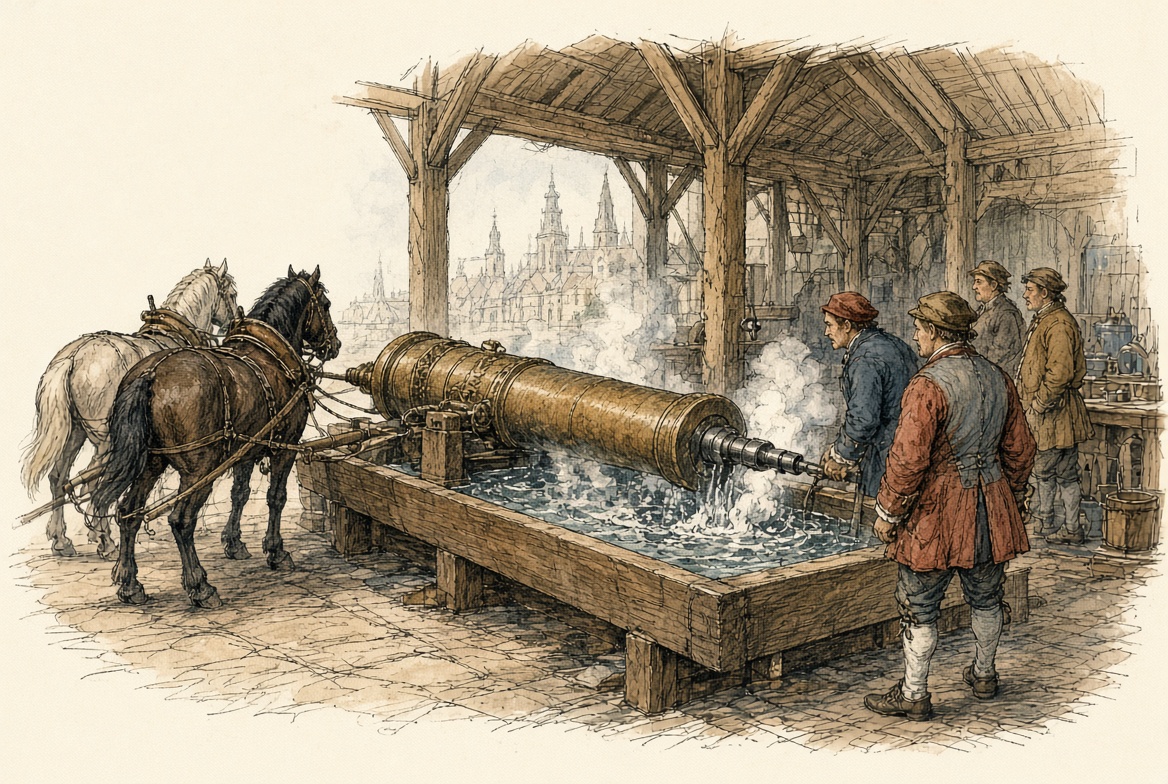
Benjamin Thompson, known as Count Rumford, was supervising the boring of cannon at the Munich arsenal — an operation that consisted of hollowing out solid bronze cylinders.7
He noticed that the friction of the tool produced an apparently inexhaustible supply of heat. But if heat were a fluid stored in the metal, this reservoir would eventually run dry.
To prove it, he surrounded the end of the cannon with a box filled with water and pressed a deliberately blunt borer against it while the cannon was turned: the borer rubbed without cutting into the material. Then he measured the rise in temperature.8
The water eventually boiled.
But the experiment would only be conclusive if Rumford ruled out the other explanations, and this is where it became exemplary. He collected the chips torn from the metal, and showed that they could not be the source of the heat. In the same way he ruled out the air, then the water surrounding the machine.9
Finally, he made a decisive observation: friction seemed able to produce heat endlessly, without ever being exhausted. But a substance exists in a limited quantity: it cannot be produced indefinitely out of nothing.10
Rumford concluded that heat was not a substance contained in the metal, but the manifestation of motion.
A qualification is needed, however. Rumford associated heat with motion, but there is no evidence that he subscribed to a precise theory of agitated particles. He showed what heat was not far more clearly than what it was.11
The reversal
One last twist illustrates the complexity of scientific progress.
In 1800, the astronomer William Herschel discovered the existence of thermal radiation lying beyond the red in the light spectrum: infrared. This advance is described in detail on the page devoted to the electromagnetic spectrum (4.14).12
This experiment is taught today as proof that our senses perceive only a fraction of reality. That is true — today.
But at the time, it had the opposite effect: it seemed to confirm the caloric theory.13
In that period, light was seen as a stream of corpuscles. Since Herschel had just shown that heat crossed empty space exactly as light did, physicists concluded that heat too was made up of particles: molecules of caloric.14
It was only in the 1820s, when the wave nature of light became established, that this argument lost its footing.15
An accurate observation and a rigorous measurement thus served to consolidate a false theory for more than twenty years.
Facts never interpret themselves: a fact speaks only in the theoretical language its era lends it.
We still speak the language of caloric
Caloric was abandoned more than a hundred and fifty years ago, but our everyday language still bears its stamp.
We still say that heat “flows”, that it “passes” from one body to another, or that it “escapes” from a poorly insulated house. More striking still: the unit of energy shown on our food packaging is still called the calorie — a word that appeared in lectures given in Paris between 1819 and 1824, at the height of caloric’s reign.16
This is the vocabulary of a fluid. It has outlived the theory that gave rise to it. Physicists are well aware of these nuances and carry out rigorous calculations, but these terms remain linguistic ghosts of obsolete ideas.
The direction of time
Thermodynamics introduces a concept that is unique in physics, and unsettling.
If you film the collision of two billiard balls and play the sequence backwards, the scene remains perfectly believable. Almost all the laws of classical mechanics are reversible with respect to time.
Heat is the exception. A cup of hot tea cools spontaneously in a lukewarm room; a lukewarm cup will never warm up of its own accord by cooling the air around it. Heat transfer always takes place from hot to cold, and never in the opposite direction without an external input of energy.17
With one exception known only to particle physicists, this is the only fundamental law of physics that distinguishes the past from the future — and it is this law that explains why energy inexorably degrades, as described on the page devoted to energy (4.8).18
Note 1
We also saw in Temperature, Kinetic Theory, and the Gas Laws that temperature is proportional to the (average) kinetic energy of atoms and molecules. […] Heat is the spontaneous transfer of energy due to a temperature difference.
Urone, Paul Peter and Hinrichs, Roger, College Physics 2e, OpenStax (Rice University), 2022, section 14.1 “Heat”
Note 2
Perhaps heat was another of these invisible fluids? […] For example, since it tended to flow from hot bodies into cold bodies and spread throughout the body, presumably its particles repelled each other, just like those of the electrical fluid.
Fowler, Michael, “Early Attempts to Understand Heat: Is It a Fluid, or What?”, lecture notes (Physics 152), University of Virginia
Note 3
But the caloric theory did much more: the whole theory of heat flow in solids, including important problems like the cooling of the earth over geological time, were analyzed quantitatively using sophisticated mathematical techniques developed in France (by Fourier and others) applied to the caloric theory, and these methods and results are all still good.
Fowler, Michael, “Teaching Heat: The Rise and Fall of the Caloric Theory”, lecture notes, University of Virginia
Note 4
indeed the mechanical theory of heat is by far the more ancient of the two. […] Then with the rise of the atomic theory and the discovery of oxygen, many quantitative things could be explained by the idea that heat was a gas of indestructible atoms. […] Thus, in contrast to the old-fashioned dynamical theory, the caloric theory of heat used a few basic ideas of the up-to-date atomic theory and could explain beautifully the facts of combustion and calorimetry.
Mendoza, Eric, “A Sketch for a History of Early Thermodynamics”, Physics Today, vol. 14, no. 2, February 1961, p. 32 ff.
Note 5
The mathematics predicted most of the correct results […] Then with the rise of the atomic theory and the discovery of oxygen, many quantitative things could be explained by the idea that heat was a gas of indestructible atoms. […] Thus, in contrast to the old-fashioned dynamical theory, the caloric theory of heat used a few basic ideas of the up-to-date atomic theory and could explain beautifully the facts of combustion and calorimetry.
Mendoza, Eric, “A Sketch for a History of Early Thermodynamics”, Physics Today, vol. 14, no. 2, February 1961, p. 32 ff.
Note 6
I have now the honour to present it with the results of the experiments I have made in order to determine the mechanical equivalent of heat with exactness.
Joule, James Prescott, “On the Mechanical Equivalent of Heat”, Philosophical Transactions of the Royal Society, vol. 140, 1850, p. 61-82
Kräfte sind Ursachen, mithin findet auf dieselben volle Anwendung der Grundsatz: causa aequat effectum. […] Kräfte sind also: unzerstörliche, wandelbare, imponderable Objecte.
Forces are causes; accordingly, the principle causa aequat effectum applies to them in full. […] Forces are therefore indestructible, convertible, imponderable objects.
Mayer, Julius Robert, “Bemerkungen über die Kräfte der unbelebten Natur”, Annalen der Chemie und Pharmacie, vol. 42, 1842, p. 233-240
Note 7
Being engaged, lately, in superintending the boring of cannon in the workshops of the military arsenal at Munich, I was struck with the very considerable degree of heat which a brass gun acquires, in a short time, in being bored
Thompson, Benjamin, comte Rumford, “An Inquiry Concerning the Source of the Heat Which Is Excited by Friction”, Philosophical Transactions of the Royal Society, vol. 88, 1798, p. 80-102
Note 8
This cylinder being designed for the express purpose of generating heat by friction, by having a blunt borer forced against its solid bottom at the same time that it should be turned round its axis […] on pouring water into the box, and filling it to the brim, the cylinder would be completely covered, and surrounded on every side, by that fluid. […] seeing so large a quantity of cold water heated, and actually made to boil, without any fire.
Thompson, Benjamin, comte Rumford, “An Inquiry Concerning the Source of the Heat Which Is Excited by Friction”, Philosophical Transactions of the Royal Society, vol. 88, 1798, p. 80-102
Note 9
From hence it is evident, that the heat produced could not possibly have been furnished at the expence of the latent heat of the metallic chips. […] Having taken away the borer, I now removed the metallic dust, or rather scaly matter, which had been detached from the bottom of the cylinder by the blunt steel borer […] Was it furnished by the air? This could not have been the case; […] Was it furnished by the water which surrounded the machinery? That this could not have been the case is evident;
Thompson, Benjamin, comte Rumford, “An Inquiry Concerning the Source of the Heat Which Is Excited by Friction”, Philosophical Transactions of the Royal Society, vol. 88, 1798, p. 80-102
Note 10
given off in a constant stream or flux, in all directions, without interruption or intermission, and without any signs of diminution, or exhaustion. […] the source of the heat generated by friction, in these experiments, appeared evidently to be inexhaustible.
Thompson, Benjamin, comte Rumford, “An Inquiry Concerning the Source of the Heat Which Is Excited by Friction”, Philosophical Transactions of the Royal Society, vol. 88, 1798, p. 80-102
Note 11
Though Rumford was to come to associate heat with motion, there is no evidence that he was committed to the kinetic theory
Young, John B., “Heat, Work and Subtle Fluids: A Commentary on Joule (1850)”, Philosophical Transactions of the Royal Society A, vol. 373, 20140348, 2015
Note 12
The first four experiments prove, that there are rays coming from the sun, which are less refrangible than any of those that affect the sight. […] The four last experiments prove, that the maximum of the heating power is vested among the invisible rays
Herschel, William, “Experiments on the Refrangibility of the Invisible Rays of the Sun”, Philosophical Transactions of the Royal Society, vol. 90, 1800, p. 284-292
Note 13
Around 1800, Herschel discovered that on passing sunlight through a prism, and detecting the heat corresponding to the different colors, in fact there was heat transmitted beyond the red. This suggested that radiant heat was caloric particles streaming through space, and no doubt very similar in character to light.
Fowler, Michael, “Teaching Heat: The Rise and Fall of the Caloric Theory”, lecture notes, University of Virginia
Note 14
Before the 1820's, almost everyone believed, following Newton, that light was a stream of particles. Around 1800, Herschel discovered that on passing sunlight through a prism, and detecting the heat corresponding to the different colors, in fact there was heat transmitted beyond the red. This suggested that radiant heat was caloric particles streaming through space, and no doubt very similar in character to light.
Fowler, Michael, “Teaching Heat: The Rise and Fall of the Caloric Theory”, lecture notes, University of Virginia
Note 15
But in the 1820's it was unambiguously established that light was really a wave. Did this mean heat was a wave too? Perhaps the caloric fluid was oscillations in the ether. Things were now very confused.
Fowler, Michael, “Teaching Heat: The Rise and Fall of the Caloric Theory”, lecture notes, University of Virginia
Note 16
However, Nicholas Clément introduced Calories in lectures on heat engines that were given in Paris between 1819 and 1824.
Clément, Nicolas, cours au Conservatoire des arts et métiers, 1824, cité dans Hargrove, James L., “History of the Calorie in Nutrition”, The Journal of Nutrition, vol. 136, 2006, p. 2957-2961
Note 17
We know from common personal experience that heat flows from a hotter object to a colder one. […] Heat never flows spontaneously from a colder object to a hotter object.
Ling, Samuel J., Moebs, William and Sanny, Jeff, University Physics, vol. 2, OpenStax, 2016, § 4.1 “Reversible and Irreversible Processes”
Note 18
There is a fourth version of the second law of thermodynamics stated in terms of entropy: The total entropy of a system either increases or remains constant in any process; it never decreases. […] When entropy increases, a certain amount of energy becomes permanently unavailable to do work.
Urone, Paul Peter and Hinrichs, Roger, College Physics 2e, OpenStax (Rice University), 2022, section 15.6 “Entropy and the Second Law of Thermodynamics: Disorder and the Unavailability of Energy”
Notes and sources
- ↑
Passage Temperature indicates the degree of agitation […] Heat measures the quantity of energy transferred from one body to another.
We also saw in Temperature, Kinetic Theory, and the Gas Laws that temperature is proportional to the (average) kinetic energy of atoms and molecules. […] Heat is the spontaneous transfer of energy due to a temperature difference.
Source Urone, Paul Peter and Hinrichs, Roger, College Physics 2e, OpenStax (Rice University), 2022, section 14.1 “Heat”, section 14.1 (“Heat”), 1st paragraph.
Open access open the source · checked on 27 October 2026
- ↑
Passage Heat was supposed to be a substance: an invisible fluid, whose molecules repel one another, and which flows naturally from hot bodies to cold bodies.
Perhaps heat was another of these invisible fluids? […] For example, since it tended to flow from hot bodies into cold bodies and spread throughout the body, presumably its particles repelled each other, just like those of the electrical fluid.
Source Fowler, Michael, “Early Attempts to Understand Heat: Is It a Fluid, or What?”, lecture notes (Physics 152), University of Virginia, section “Lavoisier’s Caloric Fluid Theory”, 1st paragraph (1st sentence) and 2nd paragraph (3rd sentence).
Open access open the source · checked on 27 October 2026
- ↑
Passage this model accounted well for many observations of the time, and it even made it possible to calculate how heat spreads through solids, with results that still hold today
But the caloric theory did much more: the whole theory of heat flow in solids, including important problems like the cooling of the earth over geological time, were analyzed quantitatively using sophisticated mathematical techniques developed in France (by Fourier and others) applied to the caloric theory, and these methods and results are all still good.
Source Fowler, Michael, “Teaching Heat: The Rise and Fall of the Caloric Theory”, lecture notes, University of Virginia, notes “Teaching Heat: the Rise and Fall of the Caloric Theory”, passage on the successes of the caloric theory (Newton, Fourier, before Carnot).
Open access open the source · checked on 24 October 2026
- ↑
Passage But this hypothesis, a much older one, lacked the quantitative successes of its rival.
indeed the mechanical theory of heat is by far the more ancient of the two. […] Then with the rise of the atomic theory and the discovery of oxygen, many quantitative things could be explained by the idea that heat was a gas of indestructible atoms. […] Thus, in contrast to the old-fashioned dynamical theory, the caloric theory of heat used a few basic ideas of the up-to-date atomic theory and could explain beautifully the facts of combustion and calorimetry.
Source Mendoza, Eric, “A Sketch for a History of Early Thermodynamics”, Physics Today, vol. 14, no. 2, February 1961, p. 32 ff., p. 32 (the two theories; rise of the atomic theory), then p. 33.
Open access open the source · checked on 28 October 2026
- ↑
Passage Caloric, by contrast, drew on the most recent chemistry — it was pictured as a gas of indestructible atoms — and it explained combustion and calorimetry very well. Its calculations gave most of the right results.
The mathematics predicted most of the correct results […] Then with the rise of the atomic theory and the discovery of oxygen, many quantitative things could be explained by the idea that heat was a gas of indestructible atoms. […] Thus, in contrast to the old-fashioned dynamical theory, the caloric theory of heat used a few basic ideas of the up-to-date atomic theory and could explain beautifully the facts of combustion and calorimetry.
Source Mendoza, Eric, “A Sketch for a History of Early Thermodynamics”, Physics Today, vol. 14, no. 2, February 1961, p. 32 ff., p. 32, then p. 33.
Open access open the source · checked on 27 October 2026
- ↑
For this whole section
Passage Fixed conversion ratio between the mechanical work supplied and the heat produced
I have now the honour to present it with the results of the experiments I have made in order to determine the mechanical equivalent of heat with exactness.
Source Joule, James Prescott, “On the Mechanical Equivalent of Heat”, Philosophical Transactions of the Royal Society, vol. 140, 1850, p. 61-82, introduction, p. 61.
Public domain · checked on 24 October 2026
Passage a first formulation of conservation
Kräfte sind Ursachen, mithin findet auf dieselben volle Anwendung der Grundsatz: causa aequat effectum. […] Kräfte sind also: unzerstörliche, wandelbare, imponderable Objecte.
Editors’ translation Forces are causes; accordingly, the principle causa aequat effectum applies to them in full. […] Forces are therefore indestructible, convertible, imponderable objects.
Source Mayer, Julius Robert, “Bemerkungen über die Kräfte der unbelebten Natur”, Annalen der Chemie und Pharmacie, vol. 42, 1842, p. 233-240, pp. 3-4 of the author’s reprint (Mayer, Die Mechanik der Wärme in gesammelten Schriften, J. G. Cotta, 1867), which refers to the original: Annalen, vol. XLII, May 1842 issue, p. 233 ff..
Public domain open the source · checked on 27 October 2026
- ↑
Passage Benjamin Thompson, known as Count Rumford, was supervising the boring of cannon at the Munich arsenal
Being engaged, lately, in superintending the boring of cannon in the workshops of the military arsenal at Munich, I was struck with the very considerable degree of heat which a brass gun acquires, in a short time, in being bored
Source Thompson, Benjamin, comte Rumford, “An Inquiry Concerning the Source of the Heat Which Is Excited by Friction”, Philosophical Transactions of the Royal Society, vol. 88, 1798, p. 80-102, p. 81, beginning of the 3rd paragraph of the paper.
Public domain open the source · checked on 24 October 2026
- ↑
Passage he surrounded the end of the cannon with a box filled with water and pressed a deliberately blunt borer against it while the cannon was turned […] The water eventually boiled.
This cylinder being designed for the express purpose of generating heat by friction, by having a blunt borer forced against its solid bottom at the same time that it should be turned round its axis […] on pouring water into the box, and filling it to the brim, the cylinder would be completely covered, and surrounded on every side, by that fluid. […] seeing so large a quantity of cold water heated, and actually made to boil, without any fire.
Source Thompson, Benjamin, comte Rumford, “An Inquiry Concerning the Source of the Heat Which Is Excited by Friction”, Philosophical Transactions of the Royal Society, vol. 88, 1798, p. 80-102, description of the cylinder and the blunt borer, of the water box (fig. 3-4), then account of the boiling.
Public domain open the source · checked on 9 September 2026
- ↑
Passage He collected the chips torn from the metal, and showed that they could not be the source of the heat. In the same way he ruled out the air, then the water surrounding the machine.
From hence it is evident, that the heat produced could not possibly have been furnished at the expence of the latent heat of the metallic chips. […] Having taken away the borer, I now removed the metallic dust, or rather scaly matter, which had been detached from the bottom of the cylinder by the blunt steel borer […] Was it furnished by the air? This could not have been the case; […] Was it furnished by the water which surrounded the machinery? That this could not have been the case is evident;
Source Thompson, Benjamin, comte Rumford, “An Inquiry Concerning the Source of the Heat Which Is Excited by Friction”, Philosophical Transactions of the Royal Society, vol. 88, 1798, p. 80-102, preliminary experiment on the chips, experiment no. 1, then final discussion.
Public domain open the source · checked on 9 September 2026
- ↑
Passage friction seemed able to produce heat endlessly, without ever being exhausted
given off in a constant stream or flux, in all directions, without interruption or intermission, and without any signs of diminution, or exhaustion. […] the source of the heat generated by friction, in these experiments, appeared evidently to be inexhaustible.
Source Thompson, Benjamin, comte Rumford, “An Inquiry Concerning the Source of the Heat Which Is Excited by Friction”, Philosophical Transactions of the Royal Society, vol. 88, 1798, p. 80-102, final discussion of the paper.
Public domain open the source · checked on 9 September 2026
- ↑
Passage Rumford associated heat with motion, but there is no evidence that he subscribed to a precise theory of agitated particles.
Though Rumford was to come to associate heat with motion, there is no evidence that he was committed to the kinetic theory
Source Young, John B., “Heat, Work and Subtle Fluids: A Commentary on Joule (1850)”, Philosophical Transactions of the Royal Society A, vol. 373, 20140348, 2015, historical commentary on the paper.
Open access · checked on 9 September 2026
- ↑
Passage In 1800, the astronomer William Herschel discovered the existence of thermal radiation lying beyond the red
The first four experiments prove, that there are rays coming from the sun, which are less refrangible than any of those that affect the sight. […] The four last experiments prove, that the maximum of the heating power is vested among the invisible rays
Source Herschel, William, “Experiments on the Refrangibility of the Invisible Rays of the Sun”, Philosophical Transactions of the Royal Society, vol. 90, 1800, p. 284-292, conclusions of the article, p. 290-291.
Public domain · checked on 24 October 2026
- ↑
Passage it seemed to confirm the caloric theory
Around 1800, Herschel discovered that on passing sunlight through a prism, and detecting the heat corresponding to the different colors, in fact there was heat transmitted beyond the red. This suggested that radiant heat was caloric particles streaming through space, and no doubt very similar in character to light.
Source Fowler, Michael, “Teaching Heat: The Rise and Fall of the Caloric Theory”, lecture notes, University of Virginia, paragraph beginning “In fact, by this time”, 3rd and 4th sentences (passage on Herschel).
Open access open the source · checked on 27 October 2026
- ↑
Passage physicists concluded that heat too was made up of particles
Before the 1820's, almost everyone believed, following Newton, that light was a stream of particles. Around 1800, Herschel discovered that on passing sunlight through a prism, and detecting the heat corresponding to the different colors, in fact there was heat transmitted beyond the red. This suggested that radiant heat was caloric particles streaming through space, and no doubt very similar in character to light.
Source Fowler, Michael, “Teaching Heat: The Rise and Fall of the Caloric Theory”, lecture notes, University of Virginia, paragraph beginning “In fact, by this time”, 2nd to 4th sentences (passage on the difficulties of caloric).
Open access open the source · checked on 27 October 2026
- ↑
Passage It was only in the 1820s, when the wave nature of light became established
But in the 1820's it was unambiguously established that light was really a wave. Did this mean heat was a wave too? Perhaps the caloric fluid was oscillations in the ether. Things were now very confused.
Source Fowler, Michael, “Teaching Heat: The Rise and Fall of the Caloric Theory”, lecture notes, University of Virginia, paragraph beginning “In fact, by this time”, 5th to 8th sentences (after the passage on Herschel).
Open access open the source · checked on 27 October 2026
Passage that this argument lost its footing.
But in the 1820's it was unambiguously established that light was really a wave. Did this mean heat was a wave too? Perhaps the caloric fluid was oscillations in the ether. Things were now very confused.
Source Fowler, Michael, “Teaching Heat: The Rise and Fall of the Caloric Theory”, lecture notes, University of Virginia, paragraph beginning “In fact, by this time”, 5th to 8th sentences (after the passage on Herschel).
Open access open the source · checked on 27 October 2026
- ↑
Passage the unit of energy shown on our food packaging is still called the calorie — a word that appeared in lectures given in Paris between 1819 and 1824
However, Nicholas Clément introduced Calories in lectures on heat engines that were given in Paris between 1819 and 1824.
Source Clément, Nicolas, cours au Conservatoire des arts et métiers, 1824, cité dans Hargrove, James L., “History of the Calorie in Nutrition”, The Journal of Nutrition, vol. 136, 2006, p. 2957-2961, abstract, 3rd sentence.
Open access · checked on 24 October 2026
- ↑
Passage Heat transfer always takes place from hot to cold, and never in the opposite direction without an external input of energy.
We know from common personal experience that heat flows from a hotter object to a colder one. […] Heat never flows spontaneously from a colder object to a hotter object.
Source Ling, Samuel J., Moebs, William and Sanny, Jeff, University Physics, vol. 2, OpenStax, 2016, § 4.1 “Reversible and Irreversible Processes”, § 4.1, paragraph on spontaneous heat transfer (after Figure 4.3) and the “Second Law of Thermodynamics (Clausius statement)” that follows it.
Open access open the source · checked on 27 October 2026
- ↑
Passage it is this law that explains why energy inexorably degrades
There is a fourth version of the second law of thermodynamics stated in terms of entropy: The total entropy of a system either increases or remains constant in any process; it never decreases. […] When entropy increases, a certain amount of energy becomes permanently unavailable to do work.
Source Urone, Paul Peter and Hinrichs, Roger, College Physics 2e, OpenStax (Rice University), 2022, section 15.6 “Entropy and the Second Law of Thermodynamics: Disorder and the Unavailability of Energy”, § 15.6, statement of the second law in terms of entropy (after Example 15.6) and subsection “Entropy and the Unavailability of Energy to Do Work” (after Figure 15.34).
Open access open the source · checked on 27 October 2026
Bibliography
15
- Atkins, Peter, The Laws of Thermodynamics: A Very Short Introduction, Oxford University Press, 2010, in libraries (the second law and the arrow of time).
- Chang, Hasok, Inventing Temperature: Measurement and Scientific Progress, Oxford University Press, 2004, in libraries (the slow construction of the distinction between heat and temperature).
- Clément, Nicolas, cours au Conservatoire des arts et métiers, 1824, cité dans Hargrove, James L., “History of the Calorie in Nutrition”, The Journal of Nutrition, vol. 136, 2006, p. 2957-2961, open access (the origin of the word “calorie”).
- Fowler, Michael, “Early Attempts to Understand Heat: Is It a Fluid, or What?”, lecture notes (Physics 152), University of Virginia, open access (Lavoisier’s caloric fluid, invisible, with mutually repelling particles, flowing from hot to cold). https://galileo.phys.virginia.edu/classes/152.mf1i.spring02/What%20is%20Heat.htm
- Fowler, Michael, “Teaching Heat: The Rise and Fall of the Caloric Theory”, lecture notes, University of Virginia, open access (why caloric explained the observations of its time well). https://galileoandeinstein.phys.virginia.edu/more_stuff/TeachingHeat.htm
- Fox, Robert, The Caloric Theory of Gases from Lavoisier to Regnault, Clarendon Press, 1971, in libraries (the standard history: the rationality of caloric, its strengthening by the discovery of infrared, its fall).
- Herschel, William, “Experiments on the Refrangibility of the Invisible Rays of the Sun”, Philosophical Transactions of the Royal Society, vol. 90, 1800, p. 284-292, public domain (the discovery of radiation beyond the red; see entry 4.14).
- Joule, James Prescott, “On the Mechanical Equivalent of Heat”, Philosophical Transactions of the Royal Society, vol. 140, 1850, p. 61-82, public domain (the mechanical equivalent of heat).
- Ling, Samuel J., Moebs, William and Sanny, Jeff, University Physics, vol. 2, OpenStax, 2016, § 4.1 “Reversible and Irreversible Processes”, open access (the Clausius statement: heat never flows spontaneously from cold to hot). https://openstax.org/books/university-physics-volume-2/pages/4-1-reversible-and-irreversible-processes
- Mayer, Julius Robert, “Bemerkungen über die Kräfte der unbelebten Natur”, Annalen der Chemie und Pharmacie, vol. 42, 1842, p. 233-240, public domain (a first formulation of conservation).
- Mendoza, Eric, “A Sketch for a History of Early Thermodynamics”, Physics Today, vol. 14, no. 2, February 1961, p. 32 ff., open access (caloric, grounded in atomic theory and quantitative, against an old and qualitative dynamical theory). https://aip.brightspotcdn.com/PTO.v14.i2.32_1.online.pdf
- Thompson, Benjamin, comte Rumford, “An Inquiry Concerning the Source of the Heat Which Is Excited by Friction”, Philosophical Transactions of the Royal Society, vol. 88, 1798, p. 80-102, public domain (the boring of cannon, the water box, the blunt borer, the elimination of rival explanations, the apparently inexhaustible heat). https://archive.org/details/philtrans03748212
- Urone, Paul Peter and Hinrichs, Roger, College Physics 2e, OpenStax (Rice University), 2022, section 14.1 “Heat”, open access (temperature, proportional to the average kinetic energy of atoms and molecules; heat, a transfer of energy due to a temperature difference). https://openstax.org/books/college-physics-2e/pages/14-1-heat
- Urone, Paul Peter and Hinrichs, Roger, College Physics 2e, OpenStax (Rice University), 2022, section 15.6 “Entropy and the Second Law of Thermodynamics: Disorder and the Unavailability of Energy”, open access (the second law in terms of entropy; energy made permanently unavailable to do work). https://openstax.org/books/college-physics-2e/pages/15-6-entropy-and-the-second-law-of-thermodynamics-disorder-and-the-unavailability-of-energy
- Young, John B., “Heat, Work and Subtle Fluids: A Commentary on Joule (1850)”, Philosophical Transactions of the Royal Society A, vol. 373, 20140348, 2015, open access (Rumford’s experiment, the objections of the supporters of caloric, Joule’s contribution).
Spotted an error or have a doubt? Write to us.