
What triggers the urge to breathe is not, first and foremost, a lack of oxygen.
It is mainly the build-up of carbon dioxide.
This may seem a detail. It is in fact a considerable difference, and it explains an experience everyone has had.
A familiar experience
When you hold your breath, the urge to breathe quickly becomes irresistible.
The instinctive assumption is that this is because oxygen is running out.
That is not the main signal the body monitors. What the chemoreceptors of the blood and brain mainly detect is the rise in the level of carbon dioxide (CO₂), which makes the blood more acidic. Oxygen (O₂), for its part, is generally far from exhausted at the moment the urge to breathe becomes unbearable.1
A vital warning
This mechanism explains why holding your breath underwater for a long time is dangerous, even in shallow water, especially after breathing very fast.2
Prior hyperventilation artificially lowers the level of CO₂ without significantly increasing the amount of oxygen in the blood. The result: the oxygen level can fall to the point of loss of consciousness before the urge to breathe is even felt. This is what specialists in breath-hold diving call hypoxic blackout, one of the main causes of drowning among experienced swimmers. (Not to be confused with “dry drowning”, a term that an international consensus of drowning experts recommended should no longer be used.)3
This page describes no breath-holding technique, gives no duration and suggests no exercise. If a fact cannot be written without risk, it is left out.
A lung is not a bag
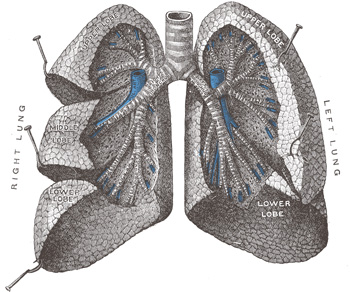
The lungs are often pictured as two bags that fill and empty.
But a simple bag would not provide a large enough exchange area. What matters is not the volume: it is the surface.
Air comes in through the trachea, then passes through the bronchi and bronchioles to a multitude of tiny cavities: the pulmonary alveoli.
How many? A direct count, in six adult lungs, gives an average of 480 million.4
But what matters most is the range: from 274 to 790 million. From one person to another, the number varies almost threefold.5
You may recognise the pattern from our page on the skeleton: the average is a calculation, the variation is the fact.
And as with bones, this number is not fixed at birth: alveoli continue to form after birth, and their multiplication goes on, more slowly, until adolescence.6
What varies, and what does not
Here is the elegant detail of this study.
Large lungs have many more alveoli than small ones. On the other hand, the size of an alveolus remains roughly constant — whatever the size of the lung.7
In other words: a large lung does not have larger alveoli. It has more of them.
A geometric explanation is often put forward: if the alveoli grew larger, the exchange surface would increase more slowly than the volume. By multiplying small cavities rather than enlarging them, the lung keeps a large surface for its volume.
One cubic millimetre of lung contains about one hundred and seventy alveoli.8
How much surface, exactly?
Unfolded, this exchange surface is immense — but the published figures vary widely: according to a recent review, the estimates range from seventy to one hundred and forty square metres.9
What there is consensus on is its thinness: between the air and the blood, the wall measures less than one micrometre in places — far less than the diameter of a red blood cell passing behind it.10
Two reminders from other pages
In space, there is nothing to hear — sound needs a material medium to travel.
At the altitude of the International Space Station (ISS), about 90% of Earth’s gravity remains (see Entry 1.4), but the atmosphere there is almost non-existent, which requires constant artificial pressurisation.11
A note on how this is written
This page describes the standard biological workings of breathing.
They are not a given for everyone. People living with asthma, COPD (chronic obstructive pulmonary disease) or on respiratory support experience this mechanism differently in their daily lives.
Note 1
The major factor that stimulates the medulla oblongata and pons to produce respiration is surprisingly not oxygen concentration, but rather the concentration of carbon dioxide in the blood. […] A central chemoreceptor is one of the specialized receptors that are located in the brain and brainstem, whereas a peripheral chemoreceptor is one of the specialized receptors located in the carotid arteries and aortic arch. […] increased carbon dioxide levels lead to increased levels of hydrogen ions, decreasing pH.
Betts, J. Gordon et al., Anatomy and Physiology, OpenStax, Rice University
PaO2 is normally around 100 mmHg in eupnea. The mean PaO2 at breakpoint is typically 62 ±4 mmHg for breath-holds from maximal lung inflation with air (Lin et al. 1974). This low PaO2 at breakpoint, however, is not constant. A breakpoint still occurs for breath-holds from maximal inflation with 100% O2, even though the PaO2 at breakpoint (Lin et al. 1974) is remarkably higher (553 ±16 mmHg).
Parkes, Michael, “Lack of a Role for Arterial Chemoreceptors in the Breakpoint of Breath-Holding”, Physiology News, no. 70, The Physiological Society, spring 2008, p. 34-35
Note 2
Hypoxic blackout is strongly associated with hyperventilation or a series of rapid breaths immediately before submersion. […] Shallow water blackout can occur in any body of water at any depth.
“Shallow Water Blackout”, dans StatPearls, StatPearls Publishing, 2026
Note 3
This removes the chemical (CO2) that makes you feel the need to breathe without significantly increasing the amount of oxygen in your blood stream.
Human Performance Resources by CHAMP (HPRC), Uniformed Services University, “Prevent shallow water blackout”, 29 April 2021
Hyperventilation before breath-holding reduces the arterial partial pressure of carbon dioxide (PaCO2) and delays the reemergence of the perceived need to breathe. Hyperventilation also modestly increases alveolar oxygen concentration, consequently raising the arterial partial pressure of oxygen (PaO2). However, this increase does not safely compensate for oxygen deficiency near the end of breath-holding limits.
“Shallow Water Blackout”, dans StatPearls, StatPearls Publishing, 2026
Pre-dive hyperventilation lowers carbon dioxide levels significantly. Thus, subsequent elevation in carbon dioxide during submersion may not trigger the breathing impulse before loss of consciousness from hypoxemia occurs.
“Shallow Water Blackout”, dans StatPearls, StatPearls Publishing, 2026
This behavior constitutes the leading cause of drowning among experienced swimmers.
“Shallow Water Blackout”, dans StatPearls, StatPearls Publishing, 2026
There was also consensus that the terms wet, dry, active, passive, silent, and secondary drowning should no longer be used.
van Beeck, E. F., Branche, C. M., Szpilman, D., Modell, J. H. and Bierens, J. J. L. M., “A New Definition of Drowning: Towards Documentation and Prevention of a Global Public Health Problem”, Bulletin of the World Health Organization, vol. 83, no. 11, 2005, p. 853-856
Note 4
In six adult human lungs, the mean alveolar number was 480 million
Ochs, Matthias et al., “The Number of Alveoli in the Human Lung”, American Journal of Respiratory and Critical Care Medicine, vol. 169, no. 1, 2004, p. 120-124
Note 5
range: 274-790 million; coefficient of variation: 37%
Ochs, Matthias et al., “The Number of Alveoli in the Human Lung”, American Journal of Respiratory and Critical Care Medicine, vol. 169, no. 1, 2004, p. 120-124
Note 6
However, alveoli continue to develop and mature into childhood. A full complement of functional alveoli does not appear until around 8 years of age.
Betts, J. Gordon et al., Anatomy and Physiology 2e, OpenStax, Rice University, section 22.7 “Embryonic Development of the Respiratory System”
The number of alveoli in the human lung increased exponentially during the first 2 yr of life but continued to increase albeit at a reduced rate through adolescence.
Herring, Matt J. et al., “Growth of Alveoli during Postnatal Development in Humans Based on Stereological Estimation”, American Journal of Physiology – Lung Cellular and Molecular Physiology, vol. 307, no. 4, 2014, p. L338-L344
Note 7
Alveolar number was closely related to total lung volume, with larger lungs having considerably more alveoli.
Ochs, Matthias et al., “The Number of Alveoli in the Human Lung”, American Journal of Respiratory and Critical Care Medicine, vol. 169, no. 1, 2004, p. 120-124
The mean size of a single alveolus was rather constant […] irrespective of the lung size.
Ochs, Matthias et al., “The Number of Alveoli in the Human Lung”, American Journal of Respiratory and Critical Care Medicine, vol. 169, no. 1, 2004, p. 120-124
Note 8
One cubic millimeter lung parenchyma would then contain around 170 alveoli.
Ochs, Matthias et al., “The Number of Alveoli in the Human Lung”, American Journal of Respiratory and Critical Care Medicine, vol. 169, no. 1, 2004, p. 120-124
Note 9
The physiological estimates for the pulmonary surface area ranged from 70 m2 to 140 m2 across our literature search
Rao, Amogh Ananda and Johncy, Smilee, “Tennis Courts in the Human Body: A Review of the Misleading Metaphor in Medical Literature”, Cureus, vol. 14, no. 1, e21474, 2022
Note 10
Taken together, the alveoli and capillary membranes form a respiratory membrane that is approximately 0.5 μm (micrometers) thick.
Betts, J. Gordon et al., Anatomy and Physiology, OpenStax, Rice University
Note 11
entrées 4.11 et 1.4
Entries 4.11 and 1.4
The facts concerning sound in space and gravity at the altitude of the International Space Station are established in Entries 4.11 and 1.4, with their sources
Notes and sources
- ↑
Passage What the chemoreceptors of the blood and brain mainly detect is the rise in the level of carbon dioxide (CO₂), which makes the blood more acidic.
The major factor that stimulates the medulla oblongata and pons to produce respiration is surprisingly not oxygen concentration, but rather the concentration of carbon dioxide in the blood. […] A central chemoreceptor is one of the specialized receptors that are located in the brain and brainstem, whereas a peripheral chemoreceptor is one of the specialized receptors located in the carotid arteries and aortic arch. […] increased carbon dioxide levels lead to increased levels of hydrogen ions, decreasing pH.
Source Betts, J. Gordon et al., Anatomy and Physiology, OpenStax, Rice University, chapter 22.3, “The Process of Breathing”, subheading “Factors That Affect the Rate and Depth of Respiration” (2nd ed.).
Open access open the source · checked on 27 October 2026
Passage Oxygen (O₂), for its part, is generally far from exhausted at the moment the urge to breathe becomes unbearable.
PaO2 is normally around 100 mmHg in eupnea. The mean PaO2 at breakpoint is typically 62 ±4 mmHg for breath-holds from maximal lung inflation with air (Lin et al. 1974). This low PaO2 at breakpoint, however, is not constant. A breakpoint still occurs for breath-holds from maximal inflation with 100% O2, even though the PaO2 at breakpoint (Lin et al. 1974) is remarkably higher (553 ±16 mmHg).
Source Parkes, Michael, “Lack of a Role for Arterial Chemoreceptors in the Breakpoint of Breath-Holding”, Physiology News, no. 70, The Physiological Society, spring 2008, p. 34-35, paragraph beginning “First, if the carotid chemoreceptors and Pa02 were crucial”.
Open access open the source · checked on 27 October 2026
- ↑
Passage holding your breath underwater for a long time is dangerous, even in shallow water, especially after breathing very fast
Hypoxic blackout is strongly associated with hyperventilation or a series of rapid breaths immediately before submersion. […] Shallow water blackout can occur in any body of water at any depth.
Source “Shallow Water Blackout”, dans StatPearls, StatPearls Publishing, 2026, overview of blackout.
Open access open the source · checked on 24 October 2026
- ↑
Passage Prior hyperventilation artificially lowers the level of CO₂ without significantly increasing the amount of oxygen in the blood.
This removes the chemical (CO2) that makes you feel the need to breathe without significantly increasing the amount of oxygen in your blood stream.
Source Human Performance Resources by CHAMP (HPRC), Uniformed Services University, “Prevent shallow water blackout”, 29 April 2021, section “Hyperventilation”.
Open access open the source · checked on 27 October 2026
Passage Prior hyperventilation artificially lowers the level of CO₂ without significantly increasing the amount of oxygen in the blood.
Hyperventilation before breath-holding reduces the arterial partial pressure of carbon dioxide (PaCO2) and delays the reemergence of the perceived need to breathe. Hyperventilation also modestly increases alveolar oxygen concentration, consequently raising the arterial partial pressure of oxygen (PaO2). However, this increase does not safely compensate for oxygen deficiency near the end of breath-holding limits.
Source “Shallow Water Blackout”, dans StatPearls, StatPearls Publishing, 2026, § “Pathophysiology”, 5th paragraph.
Open access open the source · checked on 27 October 2026
Passage the oxygen level can fall to the point of loss of consciousness before the urge to breathe is even felt
Pre-dive hyperventilation lowers carbon dioxide levels significantly. Thus, subsequent elevation in carbon dioxide during submersion may not trigger the breathing impulse before loss of consciousness from hypoxemia occurs.
Source “Shallow Water Blackout”, dans StatPearls, StatPearls Publishing, 2026, § “Pathophysiology”, 5th paragraph.
Open access open the source · checked on 27 October 2026
Passage hypoxic blackout, one of the main causes of drowning among experienced swimmers
This behavior constitutes the leading cause of drowning among experienced swimmers.
Source “Shallow Water Blackout”, dans StatPearls, StatPearls Publishing, 2026, introduction.
Open access open the source · checked on 24 October 2026
Passage “dry drowning”, a term that an international consensus of drowning experts recommended should no longer be used
There was also consensus that the terms wet, dry, active, passive, silent, and secondary drowning should no longer be used.
Source van Beeck, E. F., Branche, C. M., Szpilman, D., Modell, J. H. and Bierens, J. J. L. M., “A New Definition of Drowning: Towards Documentation and Prevention of a Global Public Health Problem”, Bulletin of the World Health Organization, vol. 83, no. 11, 2005, p. 853-856, abstract; the body of the article returns to the misleading terms.
Open access open the source · checked on 24 October 2026
- ↑
Passage A direct count, in six adult lungs, gives an average of 480 million.
In six adult human lungs, the mean alveolar number was 480 million
Source Ochs, Matthias et al., “The Number of Alveoli in the Human Lung”, American Journal of Respiratory and Critical Care Medicine, vol. 169, no. 1, 2004, p. 120-124, abstract.
Paywalled open the source · checked on 9 September 2026
- ↑
Passage from 274 to 790 million. From one person to another, the number varies almost threefold.
range: 274-790 million; coefficient of variation: 37%
Source Ochs, Matthias et al., “The Number of Alveoli in the Human Lung”, American Journal of Respiratory and Critical Care Medicine, vol. 169, no. 1, 2004, p. 120-124, abstract.
Paywalled open the source · checked on 9 September 2026
- ↑
Passage alveoli continue to form after birth
However, alveoli continue to develop and mature into childhood. A full complement of functional alveoli does not appear until around 8 years of age.
Source Betts, J. Gordon et al., Anatomy and Physiology 2e, OpenStax, Rice University, section 22.7 “Embryonic Development of the Respiratory System”, section 22.7, subsection “Weeks 24–Term”, 1st paragraph.
Open access open the source · checked on 27 October 2026
Passage their multiplication goes on, more slowly, until adolescence
The number of alveoli in the human lung increased exponentially during the first 2 yr of life but continued to increase albeit at a reduced rate through adolescence.
Source Herring, Matt J. et al., “Growth of Alveoli during Postnatal Development in Humans Based on Stereological Estimation”, American Journal of Physiology – Lung Cellular and Molecular Physiology, vol. 307, no. 4, 2014, p. L338-L344, abstract.
Open access open the source · checked on 27 October 2026
- ↑
Passage Large lungs have many more alveoli than small ones.
Alveolar number was closely related to total lung volume, with larger lungs having considerably more alveoli.
Source Ochs, Matthias et al., “The Number of Alveoli in the Human Lung”, American Journal of Respiratory and Critical Care Medicine, vol. 169, no. 1, 2004, p. 120-124, abstract.
Paywalled open the source · checked on 9 September 2026
Passage the size of an alveolus remains roughly constant — whatever the size of the lung
The mean size of a single alveolus was rather constant […] irrespective of the lung size.
Source Ochs, Matthias et al., “The Number of Alveoli in the Human Lung”, American Journal of Respiratory and Critical Care Medicine, vol. 169, no. 1, 2004, p. 120-124, abstract.
Paywalled open the source · checked on 9 September 2026
- ↑
Passage One cubic millimetre of lung contains about one hundred and seventy alveoli.
One cubic millimeter lung parenchyma would then contain around 170 alveoli.
Source Ochs, Matthias et al., “The Number of Alveoli in the Human Lung”, American Journal of Respiratory and Critical Care Medicine, vol. 169, no. 1, 2004, p. 120-124, abstract.
Paywalled open the source · checked on 9 September 2026
- ↑
Passage the published figures vary widely: according to a recent review, the estimates range from seventy to one hundred and forty square metres
The physiological estimates for the pulmonary surface area ranged from 70 m2 to 140 m2 across our literature search
Source Rao, Amogh Ananda and Johncy, Smilee, “Tennis Courts in the Human Body: A Review of the Misleading Metaphor in Medical Literature”, Cureus, vol. 14, no. 1, e21474, 2022, section “The alveoli”.
Open access open the source · checked on 26 October 2026
- ↑
Passage between the air and the blood, the wall measures less than one micrometre in places
Taken together, the alveoli and capillary membranes form a respiratory membrane that is approximately 0.5 μm (micrometers) thick.
Source Betts, J. Gordon et al., Anatomy and Physiology, OpenStax, Rice University, chapter 22.1, “Organs and Structures of the Respiratory System”, subheading “Alveoli”, 4th and last paragraph (2nd ed.).
Open access open the source · checked on 27 October 2026
- ↑
Passage In space, there is nothing to hear […] about 90% of Earth’s gravity remains
entrées 4.11 et 1.4
Editors’ translation Entries 4.11 and 1.4
Source The facts concerning sound in space and gravity at the altitude of the International Space Station are established in Entries 4.11 and 1.4, with their sources, facts established elsewhere, with their sources.
Established in other articles, with their sources · checked on 24 October 2026
Bibliography
14
- Betts, J. Gordon et al., Anatomy and Physiology 2e, OpenStax, Rice University, section 22.7 “Embryonic Development of the Respiratory System”, open access (alveoli continuing to develop after birth, until about age 8). https://openstax.org/books/anatomy-and-physiology-2e/pages/22-7-embryonic-development-of-the-respiratory-system
- Betts, J. Gordon et al., Anatomy and Physiology, OpenStax, Rice University, 2nd ed., open access (carbon dioxide, the main stimulus for breathing, detected by central and peripheral chemoreceptors; the respiratory membrane, about 0.5 µm thick). https://openstax.org/details/books/anatomy-and-physiology
- Craig, Alan B., “Causes of Loss of Consciousness during Underwater Swimming”, Journal of Applied Physiology, vol. 16, 1961, p. 583-586, paywalled (the first description of the mechanism of blackout linked to prior hyperventilation).
- Hall, John E., Guyton and Hall Textbook of Medical Physiology, Elsevier, 2020, in libraries (the mechanisms regulating ventilation).
- Herring, Matt J. et al., “Growth of Alveoli during Postnatal Development in Humans Based on Stereological Estimation”, American Journal of Physiology – Lung Cellular and Molecular Physiology, vol. 307, no. 4, 2014, p. L338-L344, open access (the formation of alveoli after birth, rapid in the first two years, then slower up to adolescence). https://doi.org/10.1152/ajplung.00094.2014
- Human Performance Resources by CHAMP (HPRC), Uniformed Services University, “Prevent shallow water blackout”, 29 April 2021, open access (hyperventilation removes CO₂ without significantly increasing the oxygen in the blood). https://hprc-online.org/physical-fitness/injury-prevention/prevent-shallow-water-blackout
- Parkes, Michael, “Lack of a Role for Arterial Chemoreceptors in the Breakpoint of Breath-Holding”, Physiology News, no. 70, The Physiological Society, spring 2008, p. 34-35, open access. https://doi.org/10.36866/pn.70.34
- The facts concerning sound in space and gravity at the altitude of the International Space Station are established in Entries 4.11 and 1.4, with their sources.
- Lindholm, Peter and Lundgren, Claes E. G., “The Physiology and Pathophysiology of Human Breath-Hold Diving”, Journal of Applied Physiology, vol. 106, 2009, p. 284-292, open access (hypoxic blackout in breath-hold divers, its causes and its prevention).
- Ochs, Matthias et al., “The Number of Alveoli in the Human Lung”, American Journal of Respiratory and Critical Care Medicine, vol. 169, no. 1, 2004, p. 120-124, paywalled (an average of 480 million alveoli, within a range of 274 to 790 million; the number proportional to lung volume while the size of an alveolus remains constant; about 170 alveoli per cubic millimetre). https://doi.org/10.1164/rccm.200308-1107OC
- Rao, Amogh Ananda and Johncy, Smilee, “Tennis Courts in the Human Body: A Review of the Misleading Metaphor in Medical Literature”, Cureus, vol. 14, no. 1, e21474, 2022, open access (the published estimates of the lung surface area, from 70 to 140 m²). https://pmc.ncbi.nlm.nih.gov/articles/PMC8863270/
- “Shallow Water Blackout”, dans StatPearls, StatPearls Publishing, 2026, updated 8 June 2026, open access (blackout linked to hyperventilation before submersion; the only modest rise in alveolar oxygen; the danger at any depth; drowning among experienced swimmers). https://www.statpearls.com/point-of-care/31580
- van Beeck, E. F., Branche, C. M., Szpilman, D., Modell, J. H. and Bierens, J. J. L. M., “A New Definition of Drowning: Towards Documentation and Prevention of a Global Public Health Problem”, Bulletin of the World Health Organization, vol. 83, no. 11, 2005, p. 853-856, open access (the international consensus to abandon the terms “dry”, “wet” or “secondary” drowning). https://scielosp.org/article/bwho/2005.v83n11/853-856
- West, John B. and Luks, Andrew M., West’s Respiratory Physiology: The Essentials, Wolters Kluwer, 2020, in libraries (chemoreceptors and the control of ventilation by carbon dioxide; the thinness of the barrier between air and blood).
Spotted an error or have a doubt? Write to us.