
In 2022, a statue was unveiled in Lyme Regis, on the English coast, after a campaign led by an eleven-year-old girl.1
She wanted Mary Anning to be recognised at last.
What remains to be understood is why it took two centuries.
First, the material circumstances
Mary Anning’s father was a carpenter. He supplemented his income by selling tourists the fossils that eroded out of the cliffs of Lyme Regis.2
He died in 1810. Mary was eleven.
Without this fossil trade and without charity, the family would have gone hungry.
She did not look for fossils out of scientific curiosity: she looked for them to make a living. She became one of the best in the world at this trade.
The first ichthyosaur (1811)
At around twelve, she found in a cliff the rest of a skeleton, the first part of which her brother Joseph had found a year earlier. She then spent months, alone, extracting a skeleton more than five metres long.3
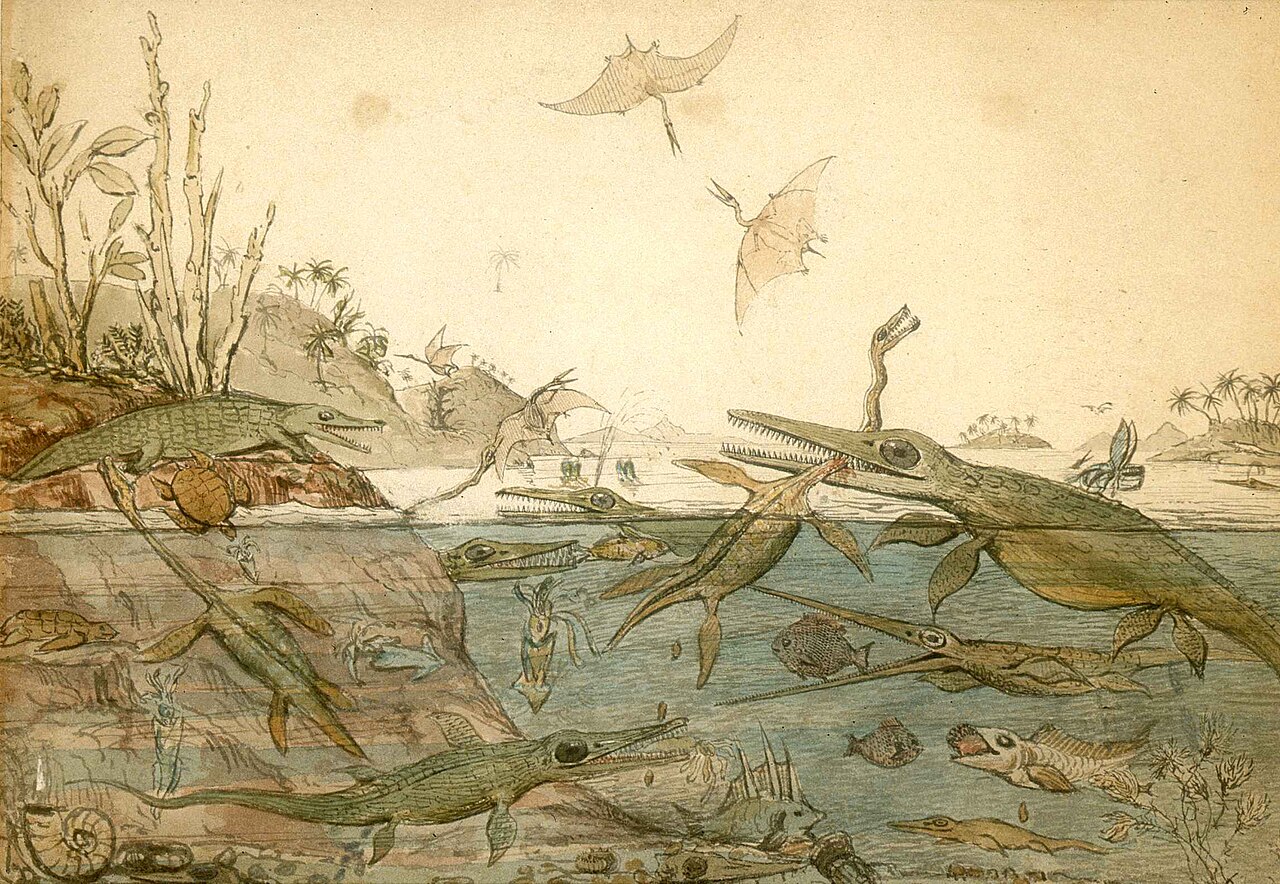
It was an ichthyosaur — a marine reptile resembling a dolphin.
As early as 1699, a scholar had drawn fossils that probably came from an ichthyosaur, but he had taken them for the remains of fish. Mary Anning’s find was the first specimen recognised by science as a marine reptile, and the first to be described scientifically. That is the difference between finding an object and understanding what it is.4
This fossil was described and published by the scholar Everard Home. Nowhere in his original writings does he mention Mary Anning.5
The plesiosaur and the scientific break (1823)
In December 1823, she uncovered the first complete plesiosaur skeleton — a marine reptile with a very long neck. In December 1828, she would also discover the first pterosaur outside Germany.6
Why the plesiosaur changed everything
When the fossil of an unknown animal was found, the usual explanation was: this species still lives somewhere, in an unexplored region. The world was vast, and many lands remained unknown.
The plesiosaur made this explanation untenable. It was so different from any living animal that it was no longer possible to imagine a herd hidden away somewhere.
Extinction was becoming impossible to deny. Cuvier had only just introduced this idea, and Darwin would not publish On the Origin of Species until thirty-six years later.
Reading the layers and dating the rocks
Mary Anning’s discoveries were not only about strange animals: they provided the keys to reading the Earth’s memory.
Stratigraphy in action
Lyme Regis is part of the Jurassic Coast. Its cliffs are made up of a strict alternation of layers of limestone and marl, deposited over millions of years.
Anning did not extract fossils at random: she had learned to associate each species with a precise stratigraphic level.
- The principle of superposition: Lower layers are older than upper layers.
- Index fossils: By observing that certain ammonites and certain reptiles appeared only in specific strata, Anning and her contemporaries made it possible to correlate the age of rocks from one region to another.
The discovery of coprolites
While examining skeletons, she noticed lumpy stones in the abdominal region. She broke them open and found fish bones and scales inside. She deduced that they were fossilised excrement.
She reported this to the geologist William Buckland, who gave them their scientific name: coprolites. These fossils paved the way for reconstructing the food chains and palaeoenvironments of the Jurassic.
The mechanics of erasure
The erasure of Mary Anning was not a coordinated conspiracy, but the product of an accumulation of institutional mechanisms.
- The initial dispute: The animal is so strange that Georges Cuvier, the most influential scientist of his day, thinks it is a fake, or two animals put together.
- Exclusion from the debates: A meeting of the Geological Society of London, on 20 February 1824, is devoted to the animal. Mary Anning is not invited.
- The appropriation of the work: A colleague presents Mary Anning’s drawings there. Cuvier is convinced and acknowledges his mistake, but Anning’s name is not mentioned.
- The commercialisation of science: because she sells her finds to make a living, she is classed as a supplier and not as a colleague. In her lifetime, no British palaeontologist names a species after her: only the Swiss Louis Agassiz does so, for two fossil fish.7
One counter-example, however, rules out treating this as inevitable. Not all the scholars of the time erased Mary Anning: in publishing his work on coprolites, William Buckland takes care to credit her by name and to praise the precision of her observations. Scientific credit was therefore possible. The erasure was not a custom of the time that no one could escape: it was a choice of academic practice.8
The material proof of the erasure
A historian of science has shown how this erasure can be measured, and his method is open to anyone.
To find out whether someone mattered in Victorian England, one consults the great national biographical dictionary. Mary Anning does indeed appear in it.9
But not in the dictionary. In its supplement.
This supplement, published in 1901, bore an explicit title: it gathered the “accidental omissions” and “people overlooked” in the main work.10
This is a material trace: it is not a matter of debating an impression, but of opening a volume and seeing under which heading she appears.
As for the epithet by which she is known today — “the greatest fossilist the world ever knew” — it comes from no official tribute: it is a handwritten annotation found on a North American document.11
Nor is the story closed: fossils found and sold by her are still unidentified in today’s museums. Their labels often bear the name of the donor, not hers.12
Three accumulated obstacles
- She was a woman — excluded from the official scientific community.
- She was poor — forced to sell her specimens to eat.
- She lived far from London — away from the places of power and decision-making.
Each of the rules seemed neutral. Together, they produced a systematic erasure.
Chronology of an opening: the truth about the dates
There is frequent confusion about the admission of women to the Geological Society of London. The exact date of admission is 21 May 1919, that is, 112 years after the founding of the society and 72 years after Anning’s death (in 1847).
On that day, eight women were elected at once.13
The method used is revealing. The statutes were not rewritten: an interpretative sentence was added to them. In the interpretation of these Bye-Laws words in the masculine gender only, shall include the feminine gender also.14
A simple grammatical note, and a century of refusal falls away.
The two other dates often cited correspond to intermediate stages:
- 1904: A woman is allowed for the first time to attend the reading of her own paper. (Present, but not a member.)
- 1908: A motion proposes to declare “that it is desirable that women should be admitted”. An advisory poll comes out in favour of it (342 votes out of 477). In 1909, however, it is rejected at a general meeting (50 votes to 40).15
It was a British law passed in 1918, on the representation of the people, that accelerated the opening of the Geological Society: in December 1918, its Council instructed a committee to find the quickest way to admit women.16
The Lyme Regis network: she was not alone
History has remembered Mary Anning as an isolated figure, but she moved within a local ecosystem.
The Philpot sisters (Mary, Margaret and Elizabeth), well-off women who had also settled in Lyme Regis, assembled a major collection of fossils. They worked in close collaboration with Anning, sharing observations, preparation techniques and a network of scholarly contacts.17
This female network on the Jurassic Coast was one of the invisible pillars of British palaeontology in the early nineteenth century.
Note 1
In 2022, a statue was unveiled of Mary and her dog in Lyme Regis after a campaign by 11-year-old Evie Swire, who was determined to see her hero recognised.
Natural History Museum (Londres), “Mary Anning: The Unsung Hero of Fossil Discovery”
Note 2
Her story starts with her father Richard Anning (c. 1766-1810) […] where his skills as cabinet maker and carpenter could be put to good use. […] Richard was an occasional fossil collector, selling them as curios to the seaside visitors now coming to Lyme Regis.
Torrens, Hugh S., “Mary Anning (1799-1847) of Lyme; "The Greatest Fossilist the World Ever Knew"”, The British Journal for the History of Science, vol. 28, no. 3, 1995, p. 257-284
Note 3
In addition, according to a well-informed source, Mary's brother Joseph had been the first to find the actual specimen in question, below Black Ven in 1811. It was Mary who located the remainder of the skeleton nearly twelve months later in 1812.
Torrens, Hugh S., “Mary Anning (1799-1847) of Lyme; "The Greatest Fossilist the World Ever Knew"”, The British Journal for the History of Science, vol. 28, no. 3, 1995, p. 257-284
Note 4
The first probable illustrations of ichthyosaur fossils were published by Edward Lhuyd in his Lithophylacii Brittannici Ichnographia, 1699. He attributed the fossils to fish.
Costantino, Grace, “Uncovering the "Fish Lizard": Ichthyosaurs and Home”, blog de la Biodiversity Heritage Library, 15 October 2015
Note 5
In the present instance, the pains that have been taken, and the skill which has been exerted in removing the surrounding stone, under the superintendance of Mr. Bullock, in whose Museum of Natural History the specimen is preserved, have brought the parts distinctly into view. This specimen was found upon an estate of Henry Host Henley, Esq. between Lyme and Charmouth, in Dorsetshire, in a cliff* thirty or forty feet above the level of the sea-shore.
Home, Everard, “Some Account of the Fossil Remains of an Animal More Nearly Allied to Fishes than Any of the Other Classes of Animals”, Philosophical Transactions of the Royal Society, vol. 104, 1814, p. 571-577
Note 6
In December 1823, Mary was the first to discover the complete skeleton of a Plesiosaurus which means ‘near to reptile’.
Natural History Museum (Londres), “Mary Anning: The Unsung Hero of Fossil Discovery”
Note 7
XXI.—On the Discovery of an almost perfect Skeleton of the Plesiosaurus. BY THE REV. W. D. CONYBEARE, F.R.S. M.G.S. [Read February 20, 1824.] […] there might have then appeared reasonable ground for the suspicion that, like the painter in Horace, I had been led to constitute a fictitious animal from the juxtaposition of incongruous members, referable in truth to different species.
Conybeare, William Daniel, “On the Discovery of an Almost Perfect Skeleton of the Plesiosaurus”, Transactions of the Geological Society of London, série 2, vol. 1, 1824, p. 381-389
Named Plesiosaurus dolichodeirus, it was purchased by the Duke of Buckingham for 150 guineas and quickly transported to the Geological Society for its meeting of 20 February 1824. […] The most influential scientist of his day, the French naturalist Georges Cuvier (1769-1832, Honorary Membership no.366) still thought that the plesiosaur was a fraud.
Geological Society of London, “Plesiosaurus dolichodeirus”, exposition en ligne Mary Anning and the Geological Society, section “Reconstruction of Life, 1819-1824”
If this was not quite true in 1969, it is certainly strange how no species were ever named after her in her lifetime by British palaeontologists. The only two British species that were — the fish Acrodus anningiae of 1841 and Belenostomus anningiae of 1844 - were both named by the Swiss palaeontologist Louis Agassiz.
Torrens, Hugh S., “Mary Anning (1799-1847) of Lyme; "The Greatest Fossilist the World Ever Knew"”, The British Journal for the History of Science, vol. 28, no. 3, 1995, p. 257-284
Note 8
[…] with many large skeletons of ichthyosauri and Plesiosauri, have been found in the cliffs at Lyme, and supplied to various collectors by the skill and industry of Miss Mary Anning.
Buckland, William, “On the Discovery of Coprolites, or Fossil Faeces, in the Lias at Lyme Regis and in Other Formations”, Transactions of the Geological Society of London, série 2, vol. 3, 1835, p. 223-236
Note 9
If we use these to explore Mary Anning, we find she appears in the DNB, but only in the Supplement, published in 1901
Torrens, Hugh S., “Mary Anning (1799-1847) of Lyme; "The Greatest Fossilist the World Ever Knew"”, The British Journal for the History of Science, vol. 28, no. 3, 1995, p. 257-284
Note 10
of 'accidental omissions or people overlooked in the main Dictionary'
Torrens, Hugh S., “Mary Anning (1799-1847) of Lyme; "The Greatest Fossilist the World Ever Knew"”, The British Journal for the History of Science, vol. 28, no. 3, 1995, p. 257-284
Note 11
the epithet, 'the greatest fossilist the world ever knew' in my title, comes from a North American manuscript source, and seems to be an annotation made there
Torrens, Hugh S., “Mary Anning (1799-1847) of Lyme; "The Greatest Fossilist the World Ever Knew"”, The British Journal for the History of Science, vol. 28, no. 3, 1995, p. 257-284
Note 12
Too often, as at Philadelphia, such material, although discovered, extracted and then sold by her, has since evaded recognition in modern collections. All too often it was the donors, not the discoverers, of specimens who got recorded.
Torrens, Hugh S., “Mary Anning (1799-1847) of Lyme; "The Greatest Fossilist the World Ever Knew"”, The British Journal for the History of Science, vol. 28, no. 3, 1995, p. 257-284
Note 13
21 May: Eight women are elected as Fellows of the Society
Geological Society of London, “Election of women”, exposition en ligne The First Women
Note 14
Article XXIII. Interpretation. – In the interpretation of these Bye-Laws words in the masculine gender only, shall include the feminine gender also.
Geological Society of London, “Election of women”, exposition en ligne The First Women
Note 15
Of the 477 answers received, 342 are in favour of admitting women […] Rejected by 50 votes to 40.
Geological Society of London, “Election of women”, exposition en ligne The First Women
Note 16
Eventually, the 1918 Representation of the People act led to an acceleration of the process, and in December 1918 the Council appointed a committee to consider ‘The most convenient and expeditious way of effecting the admission of women into the Society.’
Geological Society of London, “100 years of female Fellowship”, blog de la Geological Society, 21 May 2019
Note 17
If her role may seem marginal, it was in fact decisive: she not only collaborated with Mary but also curated a valuable collection of fossils. Elizabeth Philpot’s collection of around 400 fossils soon became a popular and valuable destination for geologists of the period, including William Buckland (1784‑1856) and Louis Agassiz (1807‑1873), who did not fail to mention it in their writings (Buckland, 1829a; Agassiz, 1833‑43). […] The importance of the Philpot sisters’ work was such that, even today, the Lyme Regis Natural Science Museum, built where the Anning Fossil Depot once stood, is named after them (Taylor, 1986).
Cofano, Antonia and De Ceglie, Rossella, “Monsters and dragons of the past: the ichthyosaur of Mary Anning”, Journal of Geoethics and Social Geosciences, vol. 3 (special issue), 2025
Notes and sources
- ↑
Passage In 2022, a statue was unveiled in Lyme Regis, on the English coast, after a campaign led by an eleven-year-old girl.
In 2022, a statue was unveiled of Mary and her dog in Lyme Regis after a campaign by 11-year-old Evie Swire, who was determined to see her hero recognised.
Source Natural History Museum (Londres), “Mary Anning: The Unsung Hero of Fossil Discovery”, museum page.
Open access open the source · checked on 9 September 2026
- ↑
Passage Mary Anning’s father was a carpenter. He supplemented his income by selling tourists the fossils […] He died in 1810.
Her story starts with her father Richard Anning (c. 1766-1810) […] where his skills as cabinet maker and carpenter could be put to good use. […] Richard was an occasional fossil collector, selling them as curios to the seaside visitors now coming to Lyme Regis.
Source Torrens, Hugh S., “Mary Anning (1799-1847) of Lyme; "The Greatest Fossilist the World Ever Knew"”, The British Journal for the History of Science, vol. 28, no. 3, 1995, p. 257-284, p. 258-259.
Open access open the source · checked on 9 September 2026
- ↑
Passage At around twelve, she found in a cliff the rest of a skeleton, the first part of which her brother Joseph had found a year earlier.
In addition, according to a well-informed source, Mary's brother Joseph had been the first to find the actual specimen in question, below Black Ven in 1811. It was Mary who located the remainder of the skeleton nearly twelve months later in 1812.
Source Torrens, Hugh S., “Mary Anning (1799-1847) of Lyme; "The Greatest Fossilist the World Ever Knew"”, The British Journal for the History of Science, vol. 28, no. 3, 1995, p. 257-284, p. 259.
Open access open the source · checked on 24 October 2026
- ↑
Passage As early as 1699, a scholar had drawn fossils that probably came from an ichthyosaur, but he had taken them for the remains of fish.
The first probable illustrations of ichthyosaur fossils were published by Edward Lhuyd in his Lithophylacii Brittannici Ichnographia, 1699. He attributed the fossils to fish.
Source Costantino, Grace, “Uncovering the "Fish Lizard": Ichthyosaurs and Home”, blog de la Biodiversity Heritage Library, 15 October 2015, BHL blog post, paragraph on the history of the discoveries.
Open access open the source · checked on 25 October 2026
- ↑
Passage This fossil was described and published by the scholar Everard Home. Nowhere in his original writings does he mention Mary Anning.
In the present instance, the pains that have been taken, and the skill which has been exerted in removing the surrounding stone, under the superintendance of Mr. Bullock, in whose Museum of Natural History the specimen is preserved, have brought the parts distinctly into view. This specimen was found upon an estate of Henry Host Henley, Esq. between Lyme and Charmouth, in Dorsetshire, in a cliff* thirty or forty feet above the level of the sea-shore.
Source Home, Everard, “Some Account of the Fossil Remains of an Animal More Nearly Allied to Fishes than Any of the Other Classes of Animals”, Philosophical Transactions of the Royal Society, vol. 104, 1814, p. 571-577, p. 572, beginning of the description of the specimen.
Public domain · checked on 24 October 2026
- ↑
Passage In December 1823, she uncovered the first complete plesiosaur skeleton
In December 1823, Mary was the first to discover the complete skeleton of a Plesiosaurus which means ‘near to reptile’.
Source Natural History Museum (Londres), “Mary Anning: The Unsung Hero of Fossil Discovery”, “Controversial find” section.
Open access open the source · checked on 24 October 2026
- ↑
Passage or two animals put together […] A meeting of the Geological Society of London, on 20 February 1824, is devoted to the animal.
XXI.—On the Discovery of an almost perfect Skeleton of the Plesiosaurus. BY THE REV. W. D. CONYBEARE, F.R.S. M.G.S. [Read February 20, 1824.] […] there might have then appeared reasonable ground for the suspicion that, like the painter in Horace, I had been led to constitute a fictitious animal from the juxtaposition of incongruous members, referable in truth to different species.
Source Conybeare, William Daniel, “On the Discovery of an Almost Perfect Skeleton of the Plesiosaurus”, Transactions of the Geological Society of London, série 2, vol. 1, 1824, p. 381-389, p. 381 (heading of the article and first paragraph).
Public domain open the source · checked on 25 October 2026
Passage Georges Cuvier, the most influential scientist of his day, thinks it is a fake […] A meeting of the Geological Society of London, on 20 February 1824, is devoted to the animal.
Named Plesiosaurus dolichodeirus, it was purchased by the Duke of Buckingham for 150 guineas and quickly transported to the Geological Society for its meeting of 20 February 1824. […] The most influential scientist of his day, the French naturalist Georges Cuvier (1769-1832, Honorary Membership no.366) still thought that the plesiosaur was a fraud.
Source Geological Society of London, “Plesiosaurus dolichodeirus”, exposition en ligne Mary Anning and the Geological Society, section “Reconstruction of Life, 1819-1824”, “Plesiosaurus dolichodeirus” page of the online exhibition.
Open access open the source · checked on 25 October 2026
Passage In her lifetime, no British palaeontologist names a species after her: only the Swiss Louis Agassiz does so, for two fossil fish.
If this was not quite true in 1969, it is certainly strange how no species were ever named after her in her lifetime by British palaeontologists. The only two British species that were — the fish Acrodus anningiae of 1841 and Belenostomus anningiae of 1844 - were both named by the Swiss palaeontologist Louis Agassiz.
Source Torrens, Hugh S., “Mary Anning (1799-1847) of Lyme; "The Greatest Fossilist the World Ever Knew"”, The British Journal for the History of Science, vol. 28, no. 3, 1995, p. 257-284, p. 281-282.
Open access open the source · checked on 24 October 2026
- ↑
Passage in publishing his work on coprolites, William Buckland takes care to credit her by name
[…] with many large skeletons of ichthyosauri and Plesiosauri, have been found in the cliffs at Lyme, and supplied to various collectors by the skill and industry of Miss Mary Anning.
Source Buckland, William, “On the Discovery of Coprolites, or Fossil Faeces, in the Lias at Lyme Regis and in Other Formations”, Transactions of the Geological Society of London, série 2, vol. 3, 1835, p. 223-236, beginning of the paper (view 244 of the digitised volume); further mentions of Miss Anning later on (views 249 and 252).
Public domain open the source · checked on 24 October 2026
- ↑
Passage Mary Anning does indeed appear in it. But not in the dictionary. In its supplement.
If we use these to explore Mary Anning, we find she appears in the DNB, but only in the Supplement, published in 1901
Source Torrens, Hugh S., “Mary Anning (1799-1847) of Lyme; "The Greatest Fossilist the World Ever Knew"”, The British Journal for the History of Science, vol. 28, no. 3, 1995, p. 257-284, introduction of the article.
Open access open the source · checked on 9 September 2026
- ↑
Passage it gathered the “accidental omissions” and “people overlooked” in the main work
of 'accidental omissions or people overlooked in the main Dictionary'
Source Torrens, Hugh S., “Mary Anning (1799-1847) of Lyme; "The Greatest Fossilist the World Ever Knew"”, The British Journal for the History of Science, vol. 28, no. 3, 1995, p. 257-284, introduction of the article.
Open access open the source · checked on 9 September 2026
- ↑
Passage the greatest fossilist the world ever knew […] it is a handwritten annotation found on a North American document
the epithet, 'the greatest fossilist the world ever knew' in my title, comes from a North American manuscript source, and seems to be an annotation made there
Source Torrens, Hugh S., “Mary Anning (1799-1847) of Lyme; "The Greatest Fossilist the World Ever Knew"”, The British Journal for the History of Science, vol. 28, no. 3, 1995, p. 257-284, introduction of the article.
Open access open the source · checked on 9 September 2026
- ↑
Passage fossils found and sold by her are still unidentified in today’s museums. Their labels often bear the name of the donor, not hers.
Too often, as at Philadelphia, such material, although discovered, extracted and then sold by her, has since evaded recognition in modern collections. All too often it was the donors, not the discoverers, of specimens who got recorded.
Source Torrens, Hugh S., “Mary Anning (1799-1847) of Lyme; "The Greatest Fossilist the World Ever Knew"”, The British Journal for the History of Science, vol. 28, no. 3, 1995, p. 257-284, p. 280.
Open access open the source · checked on 9 September 2026
- ↑
Passage On that day, eight women were elected at once.
21 May: Eight women are elected as Fellows of the Society
Source Geological Society of London, “Election of women”, exposition en ligne The First Women, amendment to the statutes, May 1919.
Open access open the source · checked on 24 October 2026
- ↑
Passage In the interpretation of these Bye-Laws words in the masculine gender only, shall include the feminine gender also.
Article XXIII. Interpretation. – In the interpretation of these Bye-Laws words in the masculine gender only, shall include the feminine gender also.
Source Geological Society of London, “Election of women”, exposition en ligne The First Women, amendment to the statutes, May 1919.
Open access open the source · checked on 24 October 2026
- ↑
Passage The exact date of admission is 21 May 1919 […] 1908 […] An advisory poll comes out in favour of it (342 votes out of 477). In 1909, however, it is rejected at a general meeting (50 votes to 40).
Of the 477 answers received, 342 are in favour of admitting women […] Rejected by 50 votes to 40.
Source Geological Society of London, “Election of women”, exposition en ligne The First Women, society documents.
Open access open the source · checked on 24 October 2026
- ↑
Passage It was a British law passed in 1918, on the representation of the people, that accelerated the opening of the Geological Society
Eventually, the 1918 Representation of the People act led to an acceleration of the process, and in December 1918 the Council appointed a committee to consider ‘The most convenient and expeditious way of effecting the admission of women into the Society.’
Source Geological Society of London, “100 years of female Fellowship”, blog de la Geological Society, 21 May 2019, body of the article.
Open access open the source · checked on 9 September 2026
- ↑
Passage The Philpot sisters […] assembled a major collection of fossils. They worked in close collaboration with Anning
If her role may seem marginal, it was in fact decisive: she not only collaborated with Mary but also curated a valuable collection of fossils. Elizabeth Philpot’s collection of around 400 fossils soon became a popular and valuable destination for geologists of the period, including William Buckland (1784‑1856) and Louis Agassiz (1807‑1873), who did not fail to mention it in their writings (Buckland, 1829a; Agassiz, 1833‑43). […] The importance of the Philpot sisters’ work was such that, even today, the Lyme Regis Natural Science Museum, built where the Anning Fossil Depot once stood, is named after them (Taylor, 1986).
Source Cofano, Antonia and De Ceglie, Rossella, “Monsters and dragons of the past: the ichthyosaur of Mary Anning”, Journal of Geoethics and Social Geosciences, vol. 3 (special issue), 2025, p. 5 of the PDF, section 2.
Open access open the source · checked on 27 October 2026
Bibliography
12
- Buckland, William, “On the Discovery of Coprolites, or Fossil Faeces, in the Lias at Lyme Regis and in Other Formations”, Transactions of the Geological Society of London, série 2, vol. 3, 1835, p. 223-236, public domain (the name “coprolite” and the explicit mention of Mary Anning).
- Burek, Cynthia V. and Higgs, Bettie (ed.), The Role of Women in the History of Geology, Geological Society, Special Publication 281, 2007, in libraries (the Philpot sisters and the female network of Lyme Regis).
- Burek, Cynthia V., “The First Female Fellows and the Status of Women in the Geological Society of London”, dans The Making of the Geological Society of London, Geological Society, Special Publication 317, 2009, p. 373-407, paywalled. https://doi.org/10.1144/SP317.21
- Cofano, Antonia and De Ceglie, Rossella, “Monsters and dragons of the past: the ichthyosaur of Mary Anning”, Journal of Geoethics and Social Geosciences, vol. 3 (special issue), 2025, open access (Elizabeth Philpot’s collection of around 400 fossils, visited by Buckland and Agassiz; her collaboration with Mary Anning; the Lyme Regis museum named after the sisters). https://doi.org/10.13127/jgsg-83
- Conybeare, William Daniel, “On the Discovery of an Almost Perfect Skeleton of the Plesiosaurus”, Transactions of the Geological Society of London, série 2, vol. 1, 1824, p. 381-389, lu le 20 February 1824, public domain (the presentation of the plesiosaur before the Geological Society, and the suspicion of a “fictitious animal” made of limbs from different species, to which Conybeare responds). https://doc.rero.ch/record/15076/files/PAL_E2236.pdf
- Costantino, Grace, “Uncovering the "Fish Lizard": Ichthyosaurs and Home”, blog de la Biodiversity Heritage Library, 15 October 2015, open access (the first probable illustrations of ichthyosaur fossils, published by Edward Lhuyd in 1699 and attributed to fish; accessed 24 October 2026). https://blog.biodiversitylibrary.org/2015/10/uncovering-fish-lizard-ichthyosaurs-and
- Geological Society of London, “100 years of female Fellowship”, blog de la Geological Society, 21 May 2019, open access (the 1918 Representation of the People Act, which accelerated the process; the committee appointed by the Council in December 1918). https://blog.geolsoc.org.uk/2019/05/21/100-years-of-female-fellowship/
- Geological Society of London, “Election of women”, exposition en ligne The First Women, open access (the 1908 motion and poll: 342 in favour out of 477; the 1909 vote: 50 votes to 40; the election of eight women on 21 May 1919; Article XXIII of the Bye-Laws). https://www.geolsoc.org.uk/the-library/online-exhibitions/the-first-women/margaret-crosfield/election-of-women/
- Geological Society of London, “Plesiosaurus dolichodeirus”, exposition en ligne Mary Anning and the Geological Society, section “Reconstruction of Life, 1819-1824”, open access (Mary Anning’s plesiosaur bought by the Duke of Buckingham and transported to the Geological Society for its meeting of 20 February 1824; Cuvier, who still believed it to be a fake; accessed 24 October 2026). https://geolsoc.org.uk/the-library/online-exhibitions/mary-anning-and-the-geological-society/reconstruction-of-life/plesiosaurus-dolichodeirus
- Home, Everard, “Some Account of the Fossil Remains of an Animal More Nearly Allied to Fishes than Any of the Other Classes of Animals”, Philosophical Transactions of the Royal Society, vol. 104, 1814, p. 571-577, public domain (the first scientific description, with no mention of Mary Anning).
- Natural History Museum (Londres), “Mary Anning: The Unsung Hero of Fossil Discovery”, open access (the 1823 plesiosaur, the 2022 statue). https://www.nhm.ac.uk/discover/mary-anning-unsung-hero.html
- Torrens, Hugh S., “Mary Anning (1799-1847) of Lyme; "The Greatest Fossilist the World Ever Knew"”, The British Journal for the History of Science, vol. 28, no. 3, 1995, p. 257-284, open access (the reference biography: the material circumstances, the exclusion, the species named after the buyers; the entry relegated to the 1901 supplement devoted to omissions and people overlooked; the handwritten origin of the epithet; her fossils unidentified in present-day collections). https://doi.org/10.1017/S0007087400033161
Spotted an error or have a doubt? Write to us.