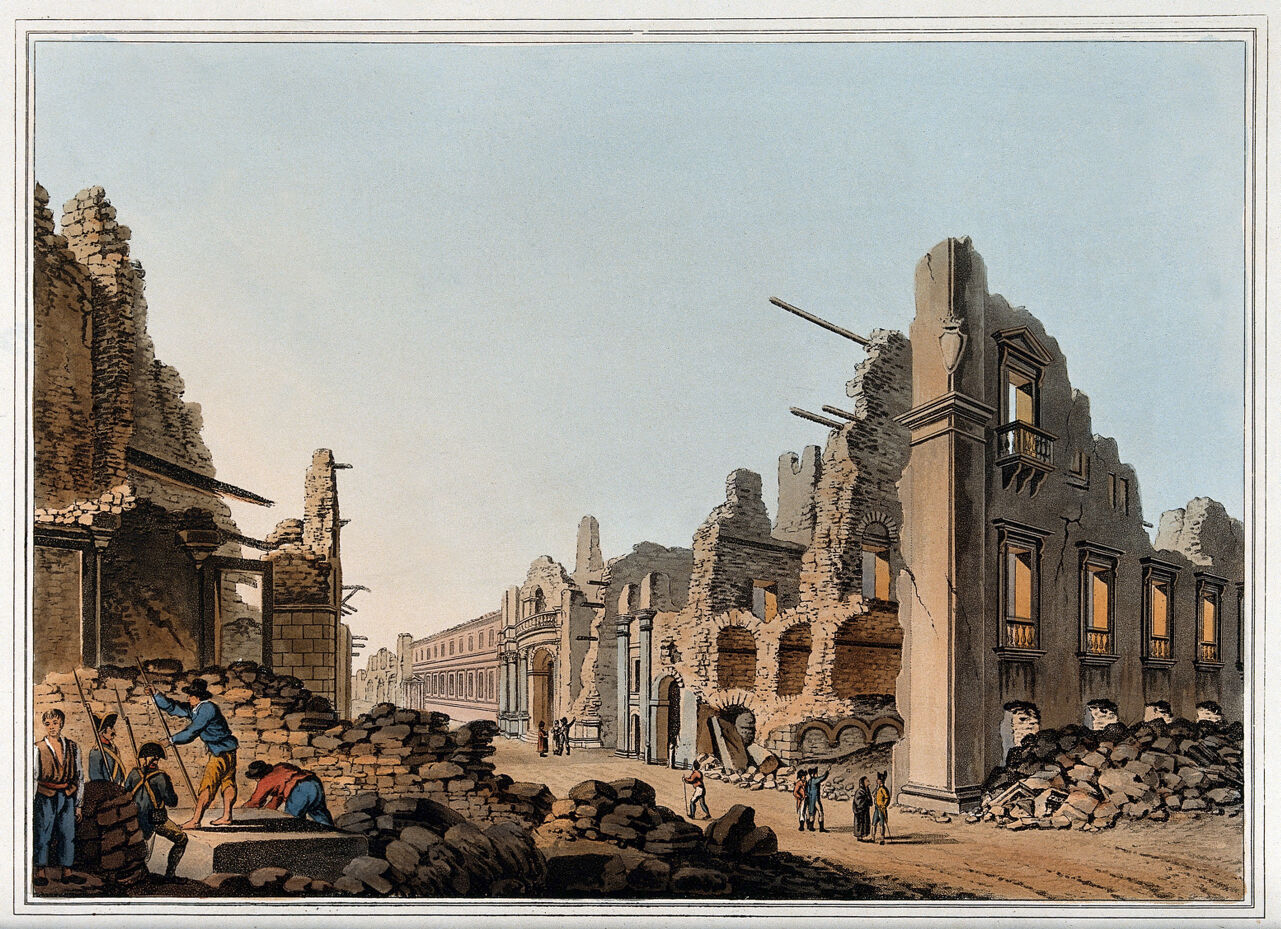
The death toll of an earthquake depends far less on its strength than on the way the buildings were constructed.
This is the most important fact on this page, and it shifts the question entirely.
Where earthquakes occur
Our page on tectonics tells how this was discovered, and by what stroke of luck: in the same room, two people were working on two different maps, for two unrelated reasons.
One was plotting the relief of the Atlantic floor. The other was mapping earthquake epicentres in order to choose the route of telephone cables.
The earthquakes followed exactly the notch spotted in the middle of the ocean.
This is how it came to be understood that earthquakes are distributed along the boundaries between plates — where the Earth’s crust pulls apart, comes together or slides.
The scale, and the same trap as elsewhere
A magnitude is not read like a graduated ruler. Going from 6 to 7 does not mean “a little stronger”. The scale is logarithmic, like the decibel scale discussed elsewhere on this site.
To interpret these numbers, three essential questions must be asked:
- Relative to what reference?
- Does the step on the scale measure the energy or the effect felt?
- What correction was applied before the number was published?
Two quantities must also be kept apart, as they do not change by the same factor for each unit of magnitude:
- Amplitude: the extent of the movement recorded by an instrument.
- Energy released: the strain energy that the rocks lose during the earthquake.1
Two earthquakes, the same year, two incomparable death tolls
- Haiti, January 2010: Magnitude 7.0 — tens of thousands dead, and the exact number is disputed.
- Chile, February 2010: Magnitude 8.8 — About 500 dead.2
The Haitian death toll deserves a closer look, because it illustrates everything this page says about figures. The Haitian government spoke of about 250,000 dead, then raised the total to more than 316,000 on the first anniversary. A 2011 report, commissioned by the US development agency and based on household surveys, settled on a range of 46,000 to 85,000. An independent academic study arrived at about 160,000 in Port-au-Prince. The official counts were made amid chaos, with no identification protocol, and with burials in mass graves. They also served to justify an appeal for international aid.3
That is why this page does not give a single number. One point, however, does not change: even taking the lowest estimate, Haiti has at the very least a hundred times as many dead as Chile. Yet the Chilean earthquake released about five hundred times more energy.4
The argument holds at any point in the range. That is the mark of sound reasoning: it does not depend on the disputed figure.
This is not an isolated case: Armenia and California, Iran and the United States, India and Japan show similar gaps. At similar magnitudes, death tolls vary enormously.
What makes the difference
An earthquake, in itself, kills very few people. It is collapsing buildings that kill. There are ways of building that withstand it — known and proven earthquake-resistant standards.5
The reason for the disparities
Earthquake-resistant construction costs more. This extra cost weighs much more heavily in a poor country than in a rich one: not because it costs more there in absolute terms, but because it represents a much larger share of the resources available there.6
The accurate way to put it is therefore this: building solidly costs money, and not everyone has the same means. It is not a question of knowledge or of negligence, but of economic resources.
The limit of the rule
“It is not earthquakes that kill, it is buildings” is a useful saying, but incomplete.
In Japan, in 2011, a magnitude 9.0 earthquake caused fewer than 600 deaths through building collapse — most recent buildings withstood the shaking. Yet the toll exceeded 18,000 dead and missing: in the three worst-affected prefectures, 90% of the victims drowned in the tsunami that followed.7
The building standards had worked. But the sea lay beyond the reach of those rules.
Predicting and anticipating
An earthquake is a natural phenomenon: it cannot be prevented and it cannot be predicted. Despite regular announcements, precise short-term prediction of earthquakes remains beyond the reach of current science.
While geology is beyond our control, the consequences depend directly on human decisions: urban planning choices, earthquake-resistant standards, financial means and public inspections. Confusing the earthquake with its damage amounts to presenting as natural fate what is in fact a matter of collective choice.
The role of oral memory
The best-documented case is striking.
The island of Simeulue, in Indonesia, lies a few tens of kilometres from the epicentre of the earthquake of 26 December 2004. Waves more than ten metres high arrived there less than ten minutes after the shaking ended. In the more populous south of the island, lower waves nevertheless destroyed entire villages.8
Out of a population of more than seventy-eight thousand, seven people died.9
The reason: a story handed down since a tsunami in 1907 said what to do: after significant shaking, run to the hills. It has a name on the island, smong. The researchers who interviewed the survivors report that all of them knew of this past event and of the necessary action.10
One sentence gives this case its full significance. The authors note that even a modern warning system, able to respond within a quarter of an hour, would have been of no help here: the wave arrived sooner than that.11
What saved these people could not have been replaced by technology. The only system fast enough was already in their memory.
This case also sheds light on the rest of the page: entire villages on Simeulue were destroyed all the same. The buildings did not hold, but the inhabitants were no longer inside.12
Counting the victims
This page applies a strict rule for counting the human toll: every figure is given with its source, its date and the scope of its calculation. Totals vary from one organisation to another, according to what is included (direct deaths, later injuries) and according to when the count stops.
Note on rigour: uncertainty about a total is never uncertainty about the reality of what happened.
Note 1
The conventional magnitude scale M suffers saturation when the rupture dimension of the earthquake exceeds the wavelength of the seismic waves used for the magnitude determination (usually 5–50 km). This saturation leads to an inaccurate estimate of energy released in great earthquakes. To circumvent this problem the strain energy drop W (difference in strain energy before and after an earthquake) in great earthquakes is estimated from the seismic moment M0.
Kanamori, Hiroo, “The Energy Release in Great Earthquakes”, Journal of Geophysical Research, vol. 82, 1977, p. 2981-2987
Note 2
M 7.0 - 10 km SE of Léogâne, Haiti […] M 8.8 - 2010 Maule, Chile Earthquake
United States Geological Survey, pages événement des séismes d’Haïti et du Chili de 2010
cifrando el total de fallecidos en 521 personas
putting the total number of deaths at 521 people
Ministère de l’Intérieur et de la Sécurité publique du Chili, “Actualización de fallecidos en el terremoto y maremoto del 27 de febrero”, 15 May 2010, open access
Note 3
Jean-Max Bellerive, the Haitian prime minister, revised the death toll upwards on Wednesday from previous estimates of around 250,000 to “over 316,000 people killed”, saying it was due to the recovery of additional bodies over the year.
Al Jazeera, “Haiti Marks Quake Anniversary”, 13 January 2011
The report, a copy of which was obtained Monday by The Associated Press, estimates that the death toll was between 46,000 and 85,000, far below the Haitian government's official figure of 316,000. The report was prepared for the U.S. Agency for International Development but has not yet been publicly released. […] Teams interviewed people face-to-face in almost 5,200 homes in densely populated neighborhoods in downtown Port-au-Prince, asking more than 100 questions, including how many people died in each building and where the survivors went. […] We estimate that 158,679 people in Port-au-Prince (95 per cent CI 136,813-180,545) died during the quake or in the six-week period afterwards owing to injuries or illness.
Kolbe, Athena R. et al., “Mortality, Crime and Access to Basic Needs before and after the Haiti Earthquake”, Medicine, Conflict and Survival, vol. 26, no. 4, 2010, p. 281-297
Note 4
A new magnitude scale Mw is defined in terms of W0 through the standard energy-magnitude relation log W0 = 1.5Mw + 11.8.
Kanamori, Hiroo, “The Energy Release in Great Earthquakes”, Journal of Geophysical Research, vol. 82, 1977, p. 2981-2987
Note 5
Findings from a systematic review of the literature indicate that the primary cause of earthquake-related death was trauma due to building collapse and, the very young and the elderly were at increased mortality risk, while gender was not consistently associated with mortality risk.
Doocy, Shannon, Daniels, Amy, Packer, Catherine, Dick, Anna and Kirsch, Thomas D., “The Human Impact of Earthquakes: A Historical Review of Events 1980-2009 and Systematic Literature Review”, PLOS Currents Disasters, vol. 5, 2013
Note 6
It is invariably a decision where increased safety of a building results in increasing its cost, but the assessment of what constitutes an acceptable risk varies significantly.
Bilham, Roger, “The Seismic Future of Cities”, Bulletin of Earthquake Engineering, vol. 7, 2009, p. 839-887
The wealthiest of nations afflicted by earthquakes can afford both to educate their populations and to purchase good-quality building materials. […] The statistics also support last year’s widely voiced opinions that the probability of earthquake-related deaths is less a function of geography and more the ability to afford earthquake-resistant construction and to enforce building codes.
Ambraseys, Nicholas and Bilham, Roger, “Corruption Kills”, Nature, vol. 469, 2011, p. 153-155
Note 7
Damage to RC buildings was relatively light in the most affected prefectures, with only a small fraction of them heavily damaged or collapsed. In general, damage was concentrated in pre-1970 buildings, buildings of less than ten stories, and in unusual buildings (long-span, flexible diaphragm).
Earthquake Engineering Research Institute (EERI), Performance of Engineered Structures in the Mw 9.0 Tohoku, Japan, Earthquake of March 11, 2011, EERI Special Earthquake Report, January 2012
Police Countermeasures and Damage Situation associated with 2011Tohoku district - off the Pacific Ocean Earthquake […] March 10, 2021 […] Killed […] Missing […] Total […] 15,899 2,526
National Police Agency of Japan, Emergency Disaster Countermeasures Headquarters, Police Countermeasures and Damage Situation associated with 2011 Tohoku district - off the Pacific Ocean Earthquake, mise à jour du 10 March 2021
90% of deaths in the Iwate, Miyagi, and Fukushima prefectures were due to drowning
Seto, Shuji, Imamura, Fumihiko and Suppasri, Anawat, “Challenge to Build the Science of Human Survival from Disaster Starting from Analysis for the 2011 Tohoku Tsunami”, Journal of Disaster Research, vol. 14, no. 9, 2019, p. 1323-1328
At 2:46PM Japan Standard Time (JST) on 11th March, 2011, a gigantic earthquake occurred […] The earthquake's magnitude was 9.0, the maximum ever recorded in Japan.
Mimura, Nobuo et al., “Damage from the Great East Japan Earthquake and Tsunami — A Quick Report”, Mitigation and Adaptation Strategies for Global Change, vol. 16, 2011, p. 803-818
Note 8
maximum wave heights exceeded 10 m less than 10 minutes after the shaking ceased
McAdoo, Brian G., Dengler, Lori, Prasetya, Gegar and Titov, Vasily, “Smong: How an Oral History Saved Thousands on Indonesia’s Simeulue Island during the December 2004 and March 2005 Tsunamis”, Earthquake Spectra, vol. 22, 2006, p. 661-669
Note 9
Of the island's population of 78,128, only 7 died on 26 December as a direct result
McAdoo, Brian G., Dengler, Lori, Prasetya, Gegar and Titov, Vasily, “Smong: How an Oral History Saved Thousands on Indonesia’s Simeulue Island during the December 2004 and March 2005 Tsunamis”, Earthquake Spectra, vol. 22, 2006, p. 661-669
Note 10
Oral histories recount a massive 1907 tsunami and advise running to the hills after "significant" shaking
McAdoo, Brian G., Dengler, Lori, Prasetya, Gegar and Titov, Vasily, “Smong: How an Oral History Saved Thousands on Indonesia’s Simeulue Island during the December 2004 and March 2005 Tsunamis”, Earthquake Spectra, vol. 22, 2006, p. 661-669
All the interviewed Simeulue survivors knew of this event and of the necessary action.
McAdoo, Brian G., Dengler, Lori, Prasetya, Gegar and Titov, Vasily, “Smong: How an Oral History Saved Thousands on Indonesia’s Simeulue Island during the December 2004 and March 2005 Tsunamis”, Earthquake Spectra, vol. 22, 2006, p. 661-669
Note 11
Simeulue's oral history provided an extraordinarily powerful mitigation tool that saved countless lives where even a high-tech warning system with a 15-minute response time would have been of no help.
McAdoo, Brian G., Dengler, Lori, Prasetya, Gegar and Titov, Vasily, “Smong: How an Oral History Saved Thousands on Indonesia’s Simeulue Island during the December 2004 and March 2005 Tsunamis”, Earthquake Spectra, vol. 22, 2006, p. 661-669
Note 12
In the more populous south, wave heights averaged 3m and caused significant structural damage, destroying entire villages.
McAdoo, Brian G., Dengler, Lori, Prasetya, Gegar and Titov, Vasily, “Smong: How an Oral History Saved Thousands on Indonesia’s Simeulue Island during the December 2004 and March 2005 Tsunamis”, Earthquake Spectra, vol. 22, 2006, p. 661-669
Notes and sources
- ↑
Passage Amplitude: the extent of the movement recorded by an instrument. […] Energy released: the strain energy that the rocks lose during the earthquake.
The conventional magnitude scale M suffers saturation when the rupture dimension of the earthquake exceeds the wavelength of the seismic waves used for the magnitude determination (usually 5–50 km). This saturation leads to an inaccurate estimate of energy released in great earthquakes. To circumvent this problem the strain energy drop W (difference in strain energy before and after an earthquake) in great earthquakes is estimated from the seismic moment M0.
Source Kanamori, Hiroo, “The Energy Release in Great Earthquakes”, Journal of Geophysical Research, vol. 82, 1977, p. 2981-2987, abstract (first three sentences).
Paywalled · checked on 25 October 2026
- ↑
Passage Haiti, January 2010: Magnitude 7.0 […] Chile, February 2010: Magnitude 8.8
M 7.0 - 10 km SE of Léogâne, Haiti […] M 8.8 - 2010 Maule, Chile Earthquake
Source United States Geological Survey, pages événement des séismes d’Haïti et du Chili de 2010, titles of the USGS event pages usp000h60h (12 January 2010, 21:53 UTC) and usp000h7rf (27 February 2010, 06:34 UTC): https://earthquake.usgs.gov/earthquakes/eventpage/usp000h60h and https://earthquake.usgs.gov/earthquakes/eventpage/usp000h7rf.
Open access open the source · checked on 24 October 2026
Passage About 500 dead.
cifrando el total de fallecidos en 521 personas
Editors’ translation putting the total number of deaths at 521 people
Source Ministère de l’Intérieur et de la Sécurité publique du Chili, “Actualización de fallecidos en el terremoto y maremoto del 27 de febrero”, 15 May 2010, open access, press release from the Subsecretaría del Interior, 15 May 2010.
Open access open the source · checked on 24 October 2026
- ↑
Passage The Haitian government spoke of about 250,000 dead, then raised the total to more than 316,000 on the first anniversary.
Jean-Max Bellerive, the Haitian prime minister, revised the death toll upwards on Wednesday from previous estimates of around 250,000 to “over 316,000 people killed”, saying it was due to the recovery of additional bodies over the year.
Source Al Jazeera, “Haiti Marks Quake Anniversary”, 13 January 2011, 9th paragraph of the article.
Open access open the source · checked on 9 September 2026
Passage A 2011 report, commissioned by the US development agency […] settled on a range of 46,000 to 85,000. An independent academic study arrived at about 160,000 in Port-au-Prince.
The report, a copy of which was obtained Monday by The Associated Press, estimates that the death toll was between 46,000 and 85,000, far below the Haitian government's official figure of 316,000. The report was prepared for the U.S. Agency for International Development but has not yet been publicly released. […] Teams interviewed people face-to-face in almost 5,200 homes in densely populated neighborhoods in downtown Port-au-Prince, asking more than 100 questions, including how many people died in each building and where the survivors went. […] We estimate that 158,679 people in Port-au-Prince (95 per cent CI 136,813-180,545) died during the quake or in the six-week period afterwards owing to injuries or illness.
Source Kolbe, Athena R. et al., “Mortality, Crime and Access to Basic Needs before and after the Haiti Earthquake”, Medicine, Conflict and Survival, vol. 26, no. 4, 2010, p. 281-297, AP: 2nd and 15th paragraphs; Kolbe et al.: abstract.
Paywalled and open access open the source · checked on 9 September 2026
- ↑
Passage Yet the Chilean earthquake released about five hundred times more energy.
A new magnitude scale Mw is defined in terms of W0 through the standard energy-magnitude relation log W0 = 1.5Mw + 11.8.
Source Kanamori, Hiroo, “The Energy Release in Great Earthquakes”, Journal of Geophysical Research, vol. 82, 1977, p. 2981-2987, abstract (magnitude-energy relation).
Paywalled · checked on 25 October 2026
- ↑
Passage It is collapsing buildings that kill.
Findings from a systematic review of the literature indicate that the primary cause of earthquake-related death was trauma due to building collapse and, the very young and the elderly were at increased mortality risk, while gender was not consistently associated with mortality risk.
Source Doocy, Shannon, Daniels, Amy, Packer, Catherine, Dick, Anna and Kirsch, Thomas D., “The Human Impact of Earthquakes: A Historical Review of Events 1980-2009 and Systematic Literature Review”, PLOS Currents Disasters, vol. 5, 2013, abstract, “Findings” section.
Open access open the source · checked on 27 October 2026
- ↑
Passage Earthquake-resistant construction costs more.
It is invariably a decision where increased safety of a building results in increasing its cost, but the assessment of what constitutes an acceptable risk varies significantly.
Source Bilham, Roger, “The Seismic Future of Cities”, Bulletin of Earthquake Engineering, vol. 7, 2009, p. 839-887, § 17 (“Acceptable risk: computations vs. human nature”), 2nd paragraph.
Open access open the source · checked on 27 October 2026
Passage This extra cost weighs much more heavily in a poor country
The wealthiest of nations afflicted by earthquakes can afford both to educate their populations and to purchase good-quality building materials. […] The statistics also support last year’s widely voiced opinions that the probability of earthquake-related deaths is less a function of geography and more the ability to afford earthquake-resistant construction and to enforce building codes.
Source Ambraseys, Nicholas and Bilham, Roger, “Corruption Kills”, Nature, vol. 469, 2011, p. 153-155, section “Geology’s accomplices” and final section, p. 154-155.
Open access open the source · checked on 27 October 2026
- ↑
Passage most recent buildings withstood the shaking
Damage to RC buildings was relatively light in the most affected prefectures, with only a small fraction of them heavily damaged or collapsed. In general, damage was concentrated in pre-1970 buildings, buildings of less than ten stories, and in unusual buildings (long-span, flexible diaphragm).
Source Earthquake Engineering Research Institute (EERI), Performance of Engineered Structures in the Mw 9.0 Tohoku, Japan, Earthquake of March 11, 2011, EERI Special Earthquake Report, January 2012, p. 1.
Open access open the source · checked on 25 October 2026
Passage the toll exceeded 18,000 dead and missing
Police Countermeasures and Damage Situation associated with 2011Tohoku district - off the Pacific Ocean Earthquake […] March 10, 2021 […] Killed […] Missing […] Total […] 15,899 2,526
Source National Police Agency of Japan, Emergency Disaster Countermeasures Headquarters, Police Countermeasures and Damage Situation associated with 2011 Tohoku district - off the Pacific Ocean Earthquake, mise à jour du 10 March 2021, page 1, table of human damage (“Total” row), situation as at 10 March 2021.
Open access open the source · checked on 24 October 2026
Passage in the three worst-affected prefectures, 90% of the victims drowned in the tsunami
90% of deaths in the Iwate, Miyagi, and Fukushima prefectures were due to drowning
Source Seto, Shuji, Imamura, Fumihiko and Suppasri, Anawat, “Challenge to Build the Science of Human Survival from Disaster Starting from Analysis for the 2011 Tohoku Tsunami”, Journal of Disaster Research, vol. 14, no. 9, 2019, p. 1323-1328, abstract (according to the National Police Agency, 2012).
Open access open the source · checked on 24 October 2026
Passage a magnitude 9.0 earthquake
At 2:46PM Japan Standard Time (JST) on 11th March, 2011, a gigantic earthquake occurred […] The earthquake's magnitude was 9.0, the maximum ever recorded in Japan.
Source Mimura, Nobuo et al., “Damage from the Great East Japan Earthquake and Tsunami — A Quick Report”, Mitigation and Adaptation Strategies for Global Change, vol. 16, 2011, p. 803-818, section 1 “Introduction”.
Open access · checked on 24 October 2026
- ↑
Passage Waves more than ten metres high arrived there less than ten minutes after the shaking ended.
maximum wave heights exceeded 10 m less than 10 minutes after the shaking ceased
Source McAdoo, Brian G., Dengler, Lori, Prasetya, Gegar and Titov, Vasily, “Smong: How an Oral History Saved Thousands on Indonesia’s Simeulue Island during the December 2004 and March 2005 Tsunamis”, Earthquake Spectra, vol. 22, 2006, p. 661-669, abstract.
Open access open the source · checked on 9 September 2026
- ↑
Passage Out of a population of more than seventy-eight thousand, seven people died.
Of the island's population of 78,128, only 7 died on 26 December as a direct result
Source McAdoo, Brian G., Dengler, Lori, Prasetya, Gegar and Titov, Vasily, “Smong: How an Oral History Saved Thousands on Indonesia’s Simeulue Island during the December 2004 and March 2005 Tsunamis”, Earthquake Spectra, vol. 22, 2006, p. 661-669, body of the article.
Open access open the source · checked on 9 September 2026
- ↑
Passage a story handed down since a tsunami in 1907 said what to do: after significant shaking, run to the hills
Oral histories recount a massive 1907 tsunami and advise running to the hills after "significant" shaking
Source McAdoo, Brian G., Dengler, Lori, Prasetya, Gegar and Titov, Vasily, “Smong: How an Oral History Saved Thousands on Indonesia’s Simeulue Island during the December 2004 and March 2005 Tsunamis”, Earthquake Spectra, vol. 22, 2006, p. 661-669, abstract.
Open access open the source · checked on 9 September 2026
Passage all of them knew of this past event and of the necessary action
All the interviewed Simeulue survivors knew of this event and of the necessary action.
Source McAdoo, Brian G., Dengler, Lori, Prasetya, Gegar and Titov, Vasily, “Smong: How an Oral History Saved Thousands on Indonesia’s Simeulue Island during the December 2004 and March 2005 Tsunamis”, Earthquake Spectra, vol. 22, 2006, p. 661-669, abstract.
Open access open the source · checked on 9 September 2026
- ↑
Passage even a modern warning system, able to respond within a quarter of an hour, would have been of no help here
Simeulue's oral history provided an extraordinarily powerful mitigation tool that saved countless lives where even a high-tech warning system with a 15-minute response time would have been of no help.
Source McAdoo, Brian G., Dengler, Lori, Prasetya, Gegar and Titov, Vasily, “Smong: How an Oral History Saved Thousands on Indonesia’s Simeulue Island during the December 2004 and March 2005 Tsunamis”, Earthquake Spectra, vol. 22, 2006, p. 661-669, abstract.
Open access open the source · checked on 9 September 2026
- ↑
Passage entire villages on Simeulue were destroyed all the same
In the more populous south, wave heights averaged 3m and caused significant structural damage, destroying entire villages.
Source McAdoo, Brian G., Dengler, Lori, Prasetya, Gegar and Titov, Vasily, “Smong: How an Oral History Saved Thousands on Indonesia’s Simeulue Island during the December 2004 and March 2005 Tsunamis”, Earthquake Spectra, vol. 22, 2006, p. 661-669, abstract.
Open access open the source · checked on 9 September 2026
For the whole article
Passage indigenous knowledge and sheltering behaviour
That number would have likely been considerably higher were it not for the appropriate reaction of the indigenous coastal populations and a helpful physical geography. […] Hills a short distance behind the coastal villages provided accessible havens. Despite this beneficial physiography, immigrant populations died at disproportionately high rates in comparably damaged areas because they did not recognize the signs of the impeding tsunami.
Source McAdoo, Brian G., Moore, Andrew and Baumwoll, Jennifer, “Indigenous Knowledge and the Near Field Population Response during the 2007 Solomon Islands Tsunami”, Natural Hazards, vol. 48, 2009, p. 73-82, abstract (2nd, 4th and 5th sentences).
Paywalled · checked on 25 October 2026
Bibliography
15
- Al Jazeera, “Haiti Marks Quake Anniversary”, 13 January 2011, open access (the official toll raised by the Prime Minister to more than 316,000 dead, compared with about 250,000 previously). https://www.aljazeera.com/news/2011/1/13/haiti-marks-quake-anniversary
- Ambraseys, Nicholas and Bilham, Roger, “Corruption Kills”, Nature, vol. 469, 2011, p. 153-155, open-access copy on the author’s page (the wealthiest nations can afford good building materials; the risk of dying in an earthquake depends less on geography than on the means to pay for earthquake-resistant construction). https://cires1.colorado.edu/~bilham/NatureCorruption/CorruptionNature2011.pdf
- Bilham, Roger, “Lessons from the Haiti Earthquake”, Nature, vol. 463, 2010, p. 878-879, paywalled (the gap in death tolls between Haiti and Chile, construction as the decisive factor).
- Bilham, Roger, “The Seismic Future of Cities”, Bulletin of Earthquake Engineering, vol. 7, 2009, p. 839-887, open access (the added safety of a building, which always raises its cost; the choice of acceptable risk). https://doi.org/10.1007/s10518-009-9147-0
- Doocy, Shannon, Daniels, Amy, Packer, Catherine, Dick, Anna and Kirsch, Thomas D., “The Human Impact of Earthquakes: A Historical Review of Events 1980-2009 and Systematic Literature Review”, PLOS Currents Disasters, vol. 5, 2013, open access (systematic review: building collapse as the primary cause of earthquake deaths). https://doi.org/10.1371/currents.dis.67bd14fe457f1db0b5433a8ee20fb833
- Earthquake Engineering Research Institute (EERI), Performance of Engineered Structures in the Mw 9.0 Tohoku, Japan, Earthquake of March 11, 2011, EERI Special Earthquake Report, January 2012, open access (buildings against the 2011 shaking: relatively light damage, concentrated in pre-1970 buildings). https://www.eeri.org/images/archived/wp-content/uploads/Tohoku_Japan_March_11_2011_EERI_LFE_Engineered_Structures.pdf
- Kanamori, Hiroo, “The Energy Release in Great Earthquakes”, Journal of Geophysical Research, vol. 82, 1977, p. 2981-2987, paywalled (the moment magnitude and the relation between magnitude and energy).
- Kolbe, Athena R. et al., “Mortality, Crime and Access to Basic Needs before and after the Haiti Earthquake”, Medicine, Conflict and Survival, vol. 26, no. 4, 2010, p. 281-297, paywalled (the survey); and Associated Press, “Report Questions Official Haiti Quake Death Toll”, NBC News, 2011, open access (the report commissioned by USAID, based on interviews in almost 5,200 households: from 46,000 to 85,000 dead). https://www.nbcnews.com/news/amp/wbna43218945
- McAdoo, Brian G., Dengler, Lori, Prasetya, Gegar and Titov, Vasily, “Smong: How an Oral History Saved Thousands on Indonesia’s Simeulue Island during the December 2004 and March 2005 Tsunamis”, Earthquake Spectra, vol. 22, 2006, p. 661-669, open access (seven dead out of more than 78,000 inhabitants; waves of more than ten metres less than ten minutes after the shaking; the 1907 story and the instruction to make for the hills; all the survivors interviewed knew it; the uselessness of a fifteen-minute warning system in this case). https://kamome.humboldt.edu/sites/default/files/smong_eqspectra_0.pdf
- McAdoo, Brian G., Moore, Andrew and Baumwoll, Jennifer, “Indigenous Knowledge and the Near Field Population Response during the 2007 Solomon Islands Tsunami”, Natural Hazards, vol. 48, 2009, p. 73-82, paywalled (indigenous knowledge and sheltering behaviour).
- Mimura, Nobuo et al., “Damage from the Great East Japan Earthquake and Tsunami — A Quick Report”, Mitigation and Adaptation Strategies for Global Change, vol. 16, 2011, p. 803-818, open access.
- Ministère de l’Intérieur et de la Sécurité publique du Chili, “Actualización de fallecidos en el terremoto y maremoto del 27 de febrero”, 15 May 2010, open access (the official toll: 521 dead, and 56 people still reported missing). https://www.interior.gob.cl/sitio-2010-2014/n5468_15-05-2010.html
- National Police Agency of Japan, Emergency Disaster Countermeasures Headquarters, Police Countermeasures and Damage Situation associated with 2011 Tohoku district - off the Pacific Ocean Earthquake, mise à jour du 10 March 2021, open access (the toll: 15,899 dead and 2,526 missing). https://www.npa.go.jp/news/other/earthquake2011/pdf/higaijokyo_e.pdf
- Seto, Shuji, Imamura, Fumihiko and Suppasri, Anawat, “Challenge to Build the Science of Human Survival from Disaster Starting from Analysis for the 2011 Tohoku Tsunami”, Journal of Disaster Research, vol. 14, no. 9, 2019, p. 1323-1328, open access (the 90% of deaths by drowning in the Iwate, Miyagi and Fukushima prefectures, according to the National Police Agency). https://doi.org/10.20965/jdr.2019.p1323
- United States Geological Survey, pages événement des séismes d’Haïti et du Chili de 2010, open access (magnitudes and parameters). https://earthquake.usgs.gov/
Spotted an error or have a doubt? Write to us.