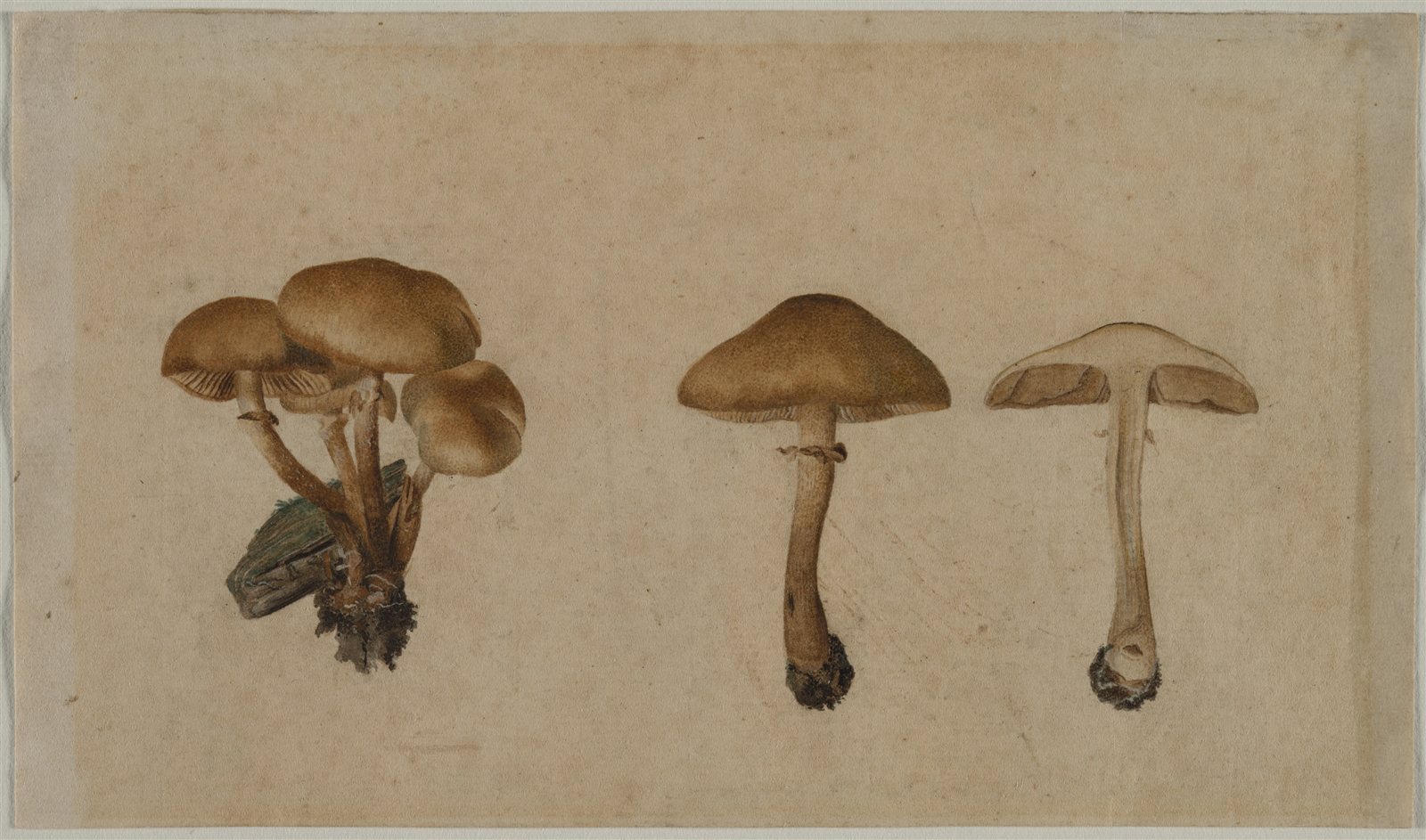
A fungus is not a plant. It is closer to us than to a tree.
This sentence sounds absurd. Yet it is rigorously established, as we shall see.
What was believed, and why it was reasonable
Fungi were long classed with plants.
The reasons are clear: they do not move about, they grow in the soil, they have no mouth, no eyes and no legs, and they spring up after rain like shoots in spring. Everything that could be observed with the naked eye pointed towards the plant world.
It was only in the twentieth century that they were given a kingdom of their own — the kingdom Fungi — and only later that their true place in the tree of life was discovered.1
The group’s name comes from a wonderful detail
Fungi and animals form a single phylogenetic group, called the opisthokonts.
This learned name comes from a microscopic observation: their flagellated cells bear a single flagellum located at the rear — a filament used for propulsion, placed behind rather than in front.2
This same rear flagellum today propels the spores of certain aquatic fungi (such as the chytrids) and the sperm cells of animals. A detail of locomotion preserved since a common ancestor that no one has ever seen.
How it was established: four separate paths
It was not a single isolated measurement that settled the question. Four different proteins, examined separately — actin, alpha-tubulin, beta-tubulin and elongation factor — all place animals and fungi together, to the exclusion of plants.3
Added to this is a decisive signature: an insertion of twelve amino acids in a key protein, shared only by animals and fungi, and absent from plants, protists and bacteria. A signature of this length does not occur twice by chance. One last clue, a metabolic one this time: fungi store their energy in the form of glycogen, like animals, whereas plants store starch.4
The approach is the same as Jean Perrin’s: he established the existence of atoms through thirteen distinct methods that all converged on the same value. If the result came from an artefact, why would four different methods produce exactly the same bias?
The consensus is solid, which does not mean that everything agrees: certain genes analysed in isolation place animals closer to plants, and certain datasets show accelerated rates of evolution that can be misleading. Science advances by integrating these anomalies rather than by hiding them.
Decomposition: who can break down wood?
A dead tree eventually disappears. This seems obvious, but it is not obvious at all.
Wood contains lignin, a complex molecule that gives it its rigidity and that is extremely difficult to break down. Very few organisms can do this: essentially the so-called “white rot” fungi. Brown rot fungi, for their part, slightly modify the lignin in order to attack the cellulose and hemicellulose of the wood.5
Without these saprotrophic organisms, dead organic matter would not be recycled. It would accumulate indefinitely, blocking the carbon and nutrient cycles.
An attractive thesis (2012)
There is a geological period, the Carboniferous, during which enormous quantities of plant matter did not decompose: they accumulated and formed the coal that we burn today.
A study published in 2012 proposed an elegant explanation: the ability to degrade lignin by means of peroxidases is thought to have appeared about 295 million years ago, roughly coinciding with the end of this period of accumulation. Before the decomposer fungi, wood piled up; after them, it rotted.6
A decisive refutation (2016)
In 2016, a team of palaeontologists and geologists reopened the case. It raised four objections, and they are worth following, because each one is of a different kind.7
First objection — the material was not what was thought. A large proportion of Carboniferous coal is made up of unlignified plant tissue. Lignin was therefore not the dominant component.8
Second objection — the natural experiment. Over the course of this period, the vegetation changed several times: lignin-poor plants gave way to lignin-rich plants, and vice versa. Yet coal continued to accumulate at the same rate through these shifts.9
This point is worth dwelling on. If lignin was the cause, the rate should have varied with it. It did not vary. Nature had carried out the experiment for us, and the result is negative.
Third objection — the traces. Marks of decay are present everywhere in the fossil record, on all organic matter exposed to the air during deposition. Organisms already knew how to break down wood.10
Fourth objection — reasoning by reductio ad absurdum, and it is the strongest. If lignin had accumulated for a hundred million years without ever decomposing, all the world’s carbon would have ended up buried. The authors calculate that a much smaller imbalance would have been enough to strip the atmosphere of its carbon dioxide in less than a million years. Nothing of the kind happened. The hypothesis is therefore untenable.11
One last fact, simple and decisive: coal is still forming today, wherever conditions allow.12
What, then, is the explanation? It is geographical and climatic: a constantly wet tropical climate, and vast areas where sediments accumulated, brought together at the time when the supercontinent Pangaea was forming.13
The coincidence of dates was real. It was not a cause.
A methodological bias as a bonus
Why did it take so long to map the history of fungi?
Fungal fossils are greatly under-represented in the records: at the Permian–Triassic boundary, for example, palynologists focused mainly on plant pollen and spores, and left fungal remains unidentified, or set aside. They were passed over because people were looking for something else. An absence in the data was simply an absence in the method.14
The safeguards: parasites, regulators and threats
While fungi are essential to the recycling of matter, they are also agents of regulation and formidable pathogens.
- Crop pathogens: microscopic fungi such as wheat stem rust (Puccinia graminis) can wipe out a large part of a harvest; a fungus-like organism, the agent of potato late blight, caused the Irish famine of the 1840s.
- The threat to biodiversity: the chytrid Batrachochytrium dendrobatidis causes chytridiomycosis, a skin disease that is decimating amphibian populations worldwide (see Entry 5.5).
- The danger of foraging: morphological confusion is common. The death cap (Amanita phalloides) resembles several edible species and causes severe, sometimes fatal liver damage. 15
How many species, and since when?
- How many species? A long-accepted estimate gave 1.5 million species; the 2017 reassessment, based on environmental sequencing, gives between 2.2 and 3.8 million, and others go as high as 5. In 2017, only about 120,000 had been described.
- Since when? Reliable fungal fossils went back only to the middle of the Palaeozoic era. Fossils from Canada, 900 million to 1 billion years old, may already be fungi, which is consistent with the molecular clocks (between 760 million and 1.06 billion years). The two methods do not measure the same thing: one dates the genetic separation, the other the presence of preserved physical structures.16
Medical and safety warning
⚠ A mushroom must never be eaten on the strength of a web illustration or an app. Some deadly species are almost identical to edible species. No general information page can replace the expertise of a pharmacist or a qualified mycologist in the field. No foraging guidance is provided on this site.
Note 1
For hundreds of years, all fungi were considered to be plants. […] It wasn’t until the mid-20th century that fungi were moved from the Plant Kingdom to their own new Kingdom […]
Johnston, Eddie, “What in earth? Understanding what fungi really are”, Royal Botanic Gardens, Kew, 7 October 2022
Note 2
The Opisthokonts are named for the single posterior flagellum seen in flagellated cells of the group.
Clark, Mary Ann, Douglas, Matthew and Choi, Jung, Biology 2e, OpenStax, 2018, section 23.3 “Groups of Protists”
Note 3
Maximum-parsimony trees were constructed from published data for four of the most broadly sequenced of the 25 proteins, actin, α-tubulin, β-tubulin, and elongation factor 1α, with the latter supplemented by three new outgroup sequences. All four proteins place animals and fungi together as a monophyletic group to the exclusion of plants and a broad diversity of protists.
Baldauf, Sandra L. and Palmer, Jeffrey D., “Animals and Fungi Are Each Other’s Closest Relatives: Congruent Evidence from Multiple Proteins”, Proceedings of the National Academy of Sciences, vol. 90, 1993, p. 11558-11562
Note 4
In the course of our work (18) on EF-1α (also known as EF-Tu), we discovered a gap of 12 amino acids in an otherwise highly conserved region of the protein which appears to be an insertion (Fig. 1A). This sequence is found in all animal and fungal EF-1α proteins but not in those of any other organism examined, including plants, six diverse protists, and archaebacteria (Fig. 1A).
Baldauf, Sandra L. and Palmer, Jeffrey D., “Animals and Fungi Are Each Other’s Closest Relatives: Congruent Evidence from Multiple Proteins”, Proceedings of the National Academy of Sciences, vol. 90, 1993, p. 11558-11562
Like animals, fungi also store carbohydrates as glycogen. […] As with animal cells, the polysaccharide of storage is glycogen, a branched polysaccharide, rather than amylopectin, a less densely branched polysaccharide, and amylose, a linear polysaccharide, as found in plants.
Clark, Mary Ann, Douglas, Matthew and Choi, Jung, Biology 2e, OpenStax, 2018, section 24.1 “Characteristics of Fungi”
Note 5
Wood is a major pool of organic carbon that is highly resistant to decay, owing largely to the presence of lignin. The only organisms capable of substantial lignin decay are white rot fungi in the Agaricomycetes
Floudas, Dimitrios et al., “The Paleozoic Origin of Enzymatic Lignin Decomposition Reconstructed from 31 Fungal Genomes”, Science, vol. 336, 2012, p. 1715-1719
Note 6
BEAST analyses of the POD genes, calibrated with the split between Ascomycota and Basidiomycota according to the organismal phylogeny, suggest that the first ligninolytic MnP arose ca. 295 mya (Fig. 1)
Floudas, Dimitrios et al., “The Paleozoic Origin of Enzymatic Lignin Decomposition Reconstructed from 31 Fungal Genomes”, Science, vol. 336, 2012, p. 1715-1719
Molecular clock analyses suggest that the origin of lignin degradation might have coincided with the sharp decrease in the rate of organic carbon burial around the end of the Carboniferous period.
Floudas, Dimitrios et al., “The Paleozoic Origin of Enzymatic Lignin Decomposition Reconstructed from 31 Fungal Genomes”, Science, vol. 336, 2012, p. 1715-1719, paywalled
Note 7
Here, we reject this evolutionary lag hypothesis, based on assessment of phylogenomic, geochemical, paleontological, and stratigraphic evidence.
Nelsen, Matthew P., DiMichele, William A., Peters, Shanan E. and Boyce, C. Kevin, “Delayed Fungal Evolution Did Not Cause the Paleozoic Peak in Coal Production”, Proceedings of the National Academy of Sciences, vol. 113, 2016, p. 2442-2447, open access
Note 8
a large proportion of Carboniferous coal horizons are dominated by unlignified lycopsid periderm
Nelsen, Matthew P., DiMichele, William A., Peters, Shanan E. and Boyce, C. Kevin, “Delayed Fungal Evolution Did Not Cause the Paleozoic Peak in Coal Production”, Proceedings of the National Academy of Sciences, vol. 113, 2016, p. 2442-2447
Note 9
with equivalent coal accumulation rates continuing through several transitions between floral dominance by lignin-poor lycopsids and lignin-rich tree ferns and seed plants. Thus, biochemical composition had little relevance to coal accumulation.
Nelsen, Matthew P., DiMichele, William A., Peters, Shanan E. and Boyce, C. Kevin, “Delayed Fungal Evolution Did Not Cause the Paleozoic Peak in Coal Production”, Proceedings of the National Academy of Sciences, vol. 113, 2016, p. 2442-2447
Note 10
Throughout the fossil record, evidence of decay is pervasive in all organic matter exposed subaerially during deposition
Nelsen, Matthew P., DiMichele, William A., Peters, Shanan E. and Boyce, C. Kevin, “Delayed Fungal Evolution Did Not Cause the Paleozoic Peak in Coal Production”, Proceedings of the National Academy of Sciences, vol. 113, 2016, p. 2442-2447
Note 11
much smaller imbalances would have resulted in the complete removal of atmospheric CO2 in less than a million years (90). Without evidence of such dire consequences, lignin production in the absence of lignin decay for more than 100 million years into the early Permian is untenable.
Nelsen, Matthew P., DiMichele, William A., Peters, Shanan E. and Boyce, C. Kevin, “Delayed Fungal Evolution Did Not Cause the Paleozoic Peak in Coal Production”, Proceedings of the National Academy of Sciences, vol. 113, 2016, p. 2442-2447
Note 12
high coal accumulation rates have continued to the present wherever environmental conditions permit
Nelsen, Matthew P., DiMichele, William A., Peters, Shanan E. and Boyce, C. Kevin, “Delayed Fungal Evolution Did Not Cause the Paleozoic Peak in Coal Production”, Proceedings of the National Academy of Sciences, vol. 113, 2016, p. 2442-2447
Note 13
Paleozoic coal abundance was likely the result of a unique combination of everwet tropical conditions and extensive depositional systems during the assembly of Pangea
Nelsen, Matthew P., DiMichele, William A., Peters, Shanan E. and Boyce, C. Kevin, “Delayed Fungal Evolution Did Not Cause the Paleozoic Peak in Coal Production”, Proceedings of the National Academy of Sciences, vol. 113, 2016, p. 2442-2447
Note 14
Palynological study of the Permian–Triassic boundary has typically focused on the pollen grain and spore content to reconstruct vegetation, with fungal remains either left unidentified or set aside for future research.
Gibson, Martha E., “First Report of Fungal Palynomorphs from the Zechstein Group (Lopingian): Implications for the Stratigraphic Completeness of the Earth’s Paleozoic Fungal Record”, PALAIOS, vol. 37, no. 6, 2022
Note 15
The skin-infecting amphibian fungus Batrachochytrium dendrobatidis was discovered in 1997 […] This spatiotemporal pattern has been broadly mirrored in other continents, and ongoing reductions in amphibian diversity owing to chytridiomycosis have contributed to nearly half of all amphibian species being in decline worldwide. […] Losses that are due to persistent and epidemic outbreaks of fungal and oomycete infection in rice (rice blast caused by Magnaporthe oryzae), wheat (rust caused by P. graminis), maize (smut caused by Ustilago maydis), potatoes (late blight caused by P. infestans) and soybean (rust caused by Phakospora pachyrizi) vary regionally but pose a current and growing threat to food security.
Fisher, Matthew C. et al., “Emerging Fungal Threats to Animal, Plant and Ecosystem Health”, Nature, vol. 484, 2012, p. 186-194
des personnes non averties peuvent cependant les confondre avec: […] Le foie constitue l’organe le plus touché (Trueb et al., 2013). […] Trois cas ont évolués vers des décès, trois autres vers des séquelles (greffe hépatique ou insuffisance rénale)
uninformed people may nevertheless confuse them with: […] The liver is the most affected organ (Trueb et al., 2013). […] Three cases resulted in death, three others in after-effects (liver transplant or kidney failure)
Anses, “Amanite phalloïde et autres champignons responsables du syndrome phalloïdien”, fiche de description de danger biologique transmissible par les aliments, September 2015
A stem rust epidemic in 1916 destroyed almost 300 million bushels of wheat in the United States and Canada.
U.S. Department of Agriculture, Agricultural Research Service, Cereal Disease Laboratory, “Cereal Rusts”
Phytophthora infestans is a member of the oomycetes, a group of organisms sometimes referred to as the "water molds". […] Late blight is the disease that caused the Irish potato famine of the 1840s
Ristaino, Jean, Schumann, Gail L. and D’Arcy, Cleora J., “Late Blight of Potato and Tomato”, The Plant Health Instructor, American Phytopathological Society, 2000, updated 2018
Note 16
We conclude that the commonly cited estimate of 1.5 million species is conservative and that the actual range is properly estimated at 2.2 to 3.8 million. With 120,000 currently accepted species, it appears that at best just 8%, and in the worst case scenario just 3%, are named so far.
Hawksworth, David L. and Lücking, Robert, “Fungal Diversity Revisited: 2.2 to 3.8 Million Species”, Microbiology Spectrum, vol. 5, no. 4, 2017
Nevertheless, fossils that can unambiguously be identified as fungi are absent from the fossil record until the middle of the Palaeozoic era. […] which dates to approximately 1,010–890 million years ago, have a fungal affinity. These microfossils are more than half a billion years older than previously reported unambiguous occurrences of fungi, a date which is consistent with data from molecular clocks for the emergence of this clade. […] As a result the origin of fungi was re-estimated at between 760 million and 1.06 billion y ago
Loron, Corentin C. et al., “Early Fungi from the Proterozoic Era in Arctic Canada”, Nature, vol. 570, 2019, p. 232-235, paywalled ; et Lücking, Robert et al., “Fungi Evolved Right on Track”, Mycologia, vol. 101, 2009, p. 810-822
Notes and sources
- ↑
Passage It was only in the twentieth century that they were given a kingdom of their own — the kingdom Fungi
For hundreds of years, all fungi were considered to be plants. […] It wasn’t until the mid-20th century that fungi were moved from the Plant Kingdom to their own new Kingdom […]
Source Johnston, Eddie, “What in earth? Understanding what fungi really are”, Royal Botanic Gardens, Kew, 7 October 2022, section “The family tree and fungi”, 1st and 3rd paragraphs.
Open access open the source · checked on 27 October 2026
- ↑
Passage their flagellated cells bear a single flagellum located at the rear
The Opisthokonts are named for the single posterior flagellum seen in flagellated cells of the group.
Source Clark, Mary Ann, Douglas, Matthew and Choi, Jung, Biology 2e, OpenStax, 2018, section 23.3 “Groups of Protists”, section 23.3, “Opisthokonta” subsection.
Open access open the source · checked on 27 October 2026
- ↑
Passage Four different proteins […] actin, alpha-tubulin, beta-tubulin and elongation factor — all place animals and fungi together
Maximum-parsimony trees were constructed from published data for four of the most broadly sequenced of the 25 proteins, actin, α-tubulin, β-tubulin, and elongation factor 1α, with the latter supplemented by three new outgroup sequences. All four proteins place animals and fungi together as a monophyletic group to the exclusion of plants and a broad diversity of protists.
Source Baldauf, Sandra L. and Palmer, Jeffrey D., “Animals and Fungi Are Each Other’s Closest Relatives: Congruent Evidence from Multiple Proteins”, Proceedings of the National Academy of Sciences, vol. 90, 1993, p. 11558-11562, abstract, p. 11558.
Open access · checked on 24 October 2026
- ↑
Passage an insertion of twelve amino acids in a key protein, shared only by animals and fungi
In the course of our work (18) on EF-1α (also known as EF-Tu), we discovered a gap of 12 amino acids in an otherwise highly conserved region of the protein which appears to be an insertion (Fig. 1A). This sequence is found in all animal and fungal EF-1α proteins but not in those of any other organism examined, including plants, six diverse protists, and archaebacteria (Fig. 1A).
Source Baldauf, Sandra L. and Palmer, Jeffrey D., “Animals and Fungi Are Each Other’s Closest Relatives: Congruent Evidence from Multiple Proteins”, Proceedings of the National Academy of Sciences, vol. 90, 1993, p. 11558-11562, “Results”, p. 11559.
Open access · checked on 24 October 2026
Passage fungi store their energy in the form of glycogen, like animals, whereas plants store starch
Like animals, fungi also store carbohydrates as glycogen. […] As with animal cells, the polysaccharide of storage is glycogen, a branched polysaccharide, rather than amylopectin, a less densely branched polysaccharide, and amylose, a linear polysaccharide, as found in plants.
Source Clark, Mary Ann, Douglas, Matthew and Choi, Jung, Biology 2e, OpenStax, 2018, section 24.1 “Characteristics of Fungi”, section 24.1, introduction; subsection “Nutrition”.
Open access open the source · checked on 9 September 2026
- ↑
Passage Very few organisms can do this: essentially the so-called “white rot” fungi
Wood is a major pool of organic carbon that is highly resistant to decay, owing largely to the presence of lignin. The only organisms capable of substantial lignin decay are white rot fungi in the Agaricomycetes
Source Floudas, Dimitrios et al., “The Paleozoic Origin of Enzymatic Lignin Decomposition Reconstructed from 31 Fungal Genomes”, Science, vol. 336, 2012, p. 1715-1719, abstract.
Paywalled · checked on 25 October 2026
- ↑
Passage the ability to degrade lignin by means of peroxidases is thought to have appeared about 295 million years ago
BEAST analyses of the POD genes, calibrated with the split between Ascomycota and Basidiomycota according to the organismal phylogeny, suggest that the first ligninolytic MnP arose ca. 295 mya (Fig. 1)
Source Floudas, Dimitrios et al., “The Paleozoic Origin of Enzymatic Lignin Decomposition Reconstructed from 31 Fungal Genomes”, Science, vol. 336, 2012, p. 1715-1719, results section, paragraph “To place the origin of lignin degradation…” (p. 9 of the OSTI copy).
Paywalled · checked on 25 October 2026
Passage A study published in 2012 proposed an elegant explanation
Molecular clock analyses suggest that the origin of lignin degradation might have coincided with the sharp decrease in the rate of organic carbon burial around the end of the Carboniferous period.
Source Floudas, Dimitrios et al., “The Paleozoic Origin of Enzymatic Lignin Decomposition Reconstructed from 31 Fungal Genomes”, Science, vol. 336, 2012, p. 1715-1719, paywalled, abstract.
Paywalled · checked on 25 October 2026
- ↑
Passage In 2016, a team of palaeontologists and geologists reopened the case
Here, we reject this evolutionary lag hypothesis, based on assessment of phylogenomic, geochemical, paleontological, and stratigraphic evidence.
Source Nelsen, Matthew P., DiMichele, William A., Peters, Shanan E. and Boyce, C. Kevin, “Delayed Fungal Evolution Did Not Cause the Paleozoic Peak in Coal Production”, Proceedings of the National Academy of Sciences, vol. 113, 2016, p. 2442-2447, open access, Abstract, p. 2442.
Open access open the source · checked on 24 October 2026
- ↑
Passage A large proportion of Carboniferous coal is made up of unlignified plant tissue.
a large proportion of Carboniferous coal horizons are dominated by unlignified lycopsid periderm
Source Nelsen, Matthew P., DiMichele, William A., Peters, Shanan E. and Boyce, C. Kevin, “Delayed Fungal Evolution Did Not Cause the Paleozoic Peak in Coal Production”, Proceedings of the National Academy of Sciences, vol. 113, 2016, p. 2442-2447, abstract.
Open access open the source · checked on 9 September 2026
- ↑
Passage coal continued to accumulate at the same rate through these shifts
with equivalent coal accumulation rates continuing through several transitions between floral dominance by lignin-poor lycopsids and lignin-rich tree ferns and seed plants. Thus, biochemical composition had little relevance to coal accumulation.
Source Nelsen, Matthew P., DiMichele, William A., Peters, Shanan E. and Boyce, C. Kevin, “Delayed Fungal Evolution Did Not Cause the Paleozoic Peak in Coal Production”, Proceedings of the National Academy of Sciences, vol. 113, 2016, p. 2442-2447, abstract.
Open access open the source · checked on 9 September 2026
- ↑
Passage Marks of decay are present everywhere in the fossil record, on all organic matter exposed to the air during deposition.
Throughout the fossil record, evidence of decay is pervasive in all organic matter exposed subaerially during deposition
Source Nelsen, Matthew P., DiMichele, William A., Peters, Shanan E. and Boyce, C. Kevin, “Delayed Fungal Evolution Did Not Cause the Paleozoic Peak in Coal Production”, Proceedings of the National Academy of Sciences, vol. 113, 2016, p. 2442-2447, abstract.
Open access open the source · checked on 9 September 2026
- ↑
Passage a much smaller imbalance would have been enough to strip the atmosphere of its carbon dioxide in less than a million years […] The hypothesis is therefore untenable.
much smaller imbalances would have resulted in the complete removal of atmospheric CO2 in less than a million years (90). Without evidence of such dire consequences, lignin production in the absence of lignin decay for more than 100 million years into the early Permian is untenable.
Source Nelsen, Matthew P., DiMichele, William A., Peters, Shanan E. and Boyce, C. Kevin, “Delayed Fungal Evolution Did Not Cause the Paleozoic Peak in Coal Production”, Proceedings of the National Academy of Sciences, vol. 113, 2016, p. 2442-2447, “Results and Discussion” section.
Open access open the source · checked on 9 September 2026
- ↑
Passage coal is still forming today, wherever conditions allow
high coal accumulation rates have continued to the present wherever environmental conditions permit
Source Nelsen, Matthew P., DiMichele, William A., Peters, Shanan E. and Boyce, C. Kevin, “Delayed Fungal Evolution Did Not Cause the Paleozoic Peak in Coal Production”, Proceedings of the National Academy of Sciences, vol. 113, 2016, p. 2442-2447, abstract.
Open access open the source · checked on 9 September 2026
- ↑
Passage a constantly wet tropical climate, and vast areas where sediments accumulated, brought together at the time when the supercontinent Pangaea was forming
Paleozoic coal abundance was likely the result of a unique combination of everwet tropical conditions and extensive depositional systems during the assembly of Pangea
Source Nelsen, Matthew P., DiMichele, William A., Peters, Shanan E. and Boyce, C. Kevin, “Delayed Fungal Evolution Did Not Cause the Paleozoic Peak in Coal Production”, Proceedings of the National Academy of Sciences, vol. 113, 2016, p. 2442-2447, abstract.
Open access open the source · checked on 9 September 2026
- ↑
Passage at the Permian–Triassic boundary, for example, palynologists focused mainly on plant pollen and spores, and left fungal remains unidentified, or set aside
Palynological study of the Permian–Triassic boundary has typically focused on the pollen grain and spore content to reconstruct vegetation, with fungal remains either left unidentified or set aside for future research.
Source Gibson, Martha E., “First Report of Fungal Palynomorphs from the Zechstein Group (Lopingian): Implications for the Stratigraphic Completeness of the Earth’s Paleozoic Fungal Record”, PALAIOS, vol. 37, no. 6, 2022, abstract.
Paywalled, abstract open access open the source · checked on 27 October 2026
- ↑
Passage wheat rust […] the chytrid Batrachochytrium dendrobatidis
The skin-infecting amphibian fungus Batrachochytrium dendrobatidis was discovered in 1997 […] This spatiotemporal pattern has been broadly mirrored in other continents, and ongoing reductions in amphibian diversity owing to chytridiomycosis have contributed to nearly half of all amphibian species being in decline worldwide. […] Losses that are due to persistent and epidemic outbreaks of fungal and oomycete infection in rice (rice blast caused by Magnaporthe oryzae), wheat (rust caused by P. graminis), maize (smut caused by Ustilago maydis), potatoes (late blight caused by P. infestans) and soybean (rust caused by Phakospora pachyrizi) vary regionally but pose a current and growing threat to food security.
Source Fisher, Matthew C. et al., “Emerging Fungal Threats to Animal, Plant and Ecosystem Health”, Nature, vol. 484, 2012, p. 186-194, introduction (paragraph on Batrachochytrium dendrobatidis and chytridiomycosis in amphibians); section “Fungal EIDs impact food security and ecosystem services” (author manuscript, PMC3821985).
Paywalled · checked on 9 September 2026
Passage The death cap (Amanita phalloides) resembles several edible species and causes severe, sometimes fatal liver damage.
des personnes non averties peuvent cependant les confondre avec: […] Le foie constitue l’organe le plus touché (Trueb et al., 2013). […] Trois cas ont évolués vers des décès, trois autres vers des séquelles (greffe hépatique ou insuffisance rénale)
Editors’ translation uninformed people may nevertheless confuse them with: […] The liver is the most affected organ (Trueb et al., 2013). […] Three cases resulted in death, three others in after-effects (liver transplant or kidney failure)
Source Anses, “Amanite phalloïde et autres champignons responsables du syndrome phalloïdien”, fiche de description de danger biologique transmissible par les aliments, September 2015, p. 2, “Risques de confusion” and “Maladie humaine d’origine alimentaire” headings; p. 3, “Épidémiologie” heading.
Open access open the source · checked on 27 October 2026
Passage microscopic fungi such as wheat stem rust (Puccinia graminis) can wipe out a large part of a harvest
A stem rust epidemic in 1916 destroyed almost 300 million bushels of wheat in the United States and Canada.
Source U.S. Department of Agriculture, Agricultural Research Service, Cereal Disease Laboratory, “Cereal Rusts”, whole page.
Open access open the source · checked on 26 October 2026
Passage a fungus-like organism, the agent of potato late blight, caused the Irish famine of the 1840s.
Phytophthora infestans is a member of the oomycetes, a group of organisms sometimes referred to as the "water molds". […] Late blight is the disease that caused the Irish potato famine of the 1840s
Source Ristaino, Jean, Schumann, Gail L. and D’Arcy, Cleora J., “Late Blight of Potato and Tomato”, The Plant Health Instructor, American Phytopathological Society, 2000, updated 2018, introduction.
Open access open the source · checked on 26 October 2026
- ↑
Passage the 2017 reassessment […] gives between 2.2 and 3.8 million […] In 2017, only about 120,000 had been described
We conclude that the commonly cited estimate of 1.5 million species is conservative and that the actual range is properly estimated at 2.2 to 3.8 million. With 120,000 currently accepted species, it appears that at best just 8%, and in the worst case scenario just 3%, are named so far.
Source Hawksworth, David L. and Lücking, Robert, “Fungal Diversity Revisited: 2.2 to 3.8 Million Species”, Microbiology Spectrum, vol. 5, no. 4, 2017, abstract.
Open access · checked on 24 October 2026
Passage Reliable fungal fossils went back only to the middle of the Palaeozoic era. Fossils from Canada, 900 million to 1 billion years old, may already be fungi, which is consistent with the molecular clocks (between 760 million and 1.06 billion years).
Nevertheless, fossils that can unambiguously be identified as fungi are absent from the fossil record until the middle of the Palaeozoic era. […] which dates to approximately 1,010–890 million years ago, have a fungal affinity. These microfossils are more than half a billion years older than previously reported unambiguous occurrences of fungi, a date which is consistent with data from molecular clocks for the emergence of this clade. […] As a result the origin of fungi was re-estimated at between 760 million and 1.06 billion y ago
Source Loron, Corentin C. et al., “Early Fungi from the Proterozoic Era in Arctic Canada”, Nature, vol. 570, 2019, p. 232-235, paywalled ; et Lücking, Robert et al., “Fungi Evolved Right on Track”, Mycologia, vol. 101, 2009, p. 810-822, abstract of Loron et al. 2019; abstract of Lücking et al. 2009.
Paywalled · checked on 9 September 2026
Bibliography
17
- Anses, “Amanite phalloïde et autres champignons responsables du syndrome phalloïdien”, fiche de description de danger biologique transmissible par les aliments, September 2015, open access (confusion with edible tricholomas, russulas and agarics; the liver as the most affected organ; deaths and liver transplants). https://www.anses.fr/en/system/files/BIORISK2014sa0232Fi.pdf
- Baldauf, Sandra L. and Palmer, Jeffrey D., “Animals and Fungi Are Each Other’s Closest Relatives: Congruent Evidence from Multiple Proteins”, Proceedings of the National Academy of Sciences, vol. 90, 1993, p. 11558-11562, open access (the four proteins and the twelve-amino-acid insertion).
- Bresinsky, Andreas and Besl, Helmut, A Colour Atlas of Poisonous Fungi, Wolfe, 1990, in libraries (the death cap and confusions).
- Cavalier-Smith, Thomas, “A Revised Six-Kingdom System of Life”, Biological Reviews, vol. 73, 1998, p. 203-266, paywalled (the name “opisthokonts” and the posterior flagellum).
- Clark, Mary Ann, Douglas, Matthew and Choi, Jung, Biology 2e, OpenStax, 2018, section 23.3 “Groups of Protists”, open access (the name of the opisthokonts and the single posterior flagellum of their flagellated cells). https://openstax.org/books/biology-2e/pages/23-3-groups-of-protists
- Clark, Mary Ann, Douglas, Matthew and Choi, Jung, Biology 2e, OpenStax, 2018, section 24.1 “Characteristics of Fungi”, open access (glycogen as the reserve, as in animals, and not the starch of plants). https://openstax.org/books/biology-2e/pages/24-1-characteristics-of-fungi
- Fisher, Matthew C. et al., “Emerging Fungal Threats to Animal, Plant and Ecosystem Health”, Nature, vol. 484, 2012, p. 186-194, paywalled (wheat rust, chytrid, emerging pathogens).
- Floudas, Dimitrios et al., “The Paleozoic Origin of Enzymatic Lignin Decomposition Reconstructed from 31 Fungal Genomes”, Science, vol. 336, 2012, p. 1715-1719, paywalled (the peroxidases that appeared about 295 million years ago).
- Gibson, Martha E., “First Report of Fungal Palynomorphs from the Zechstein Group (Lopingian): Implications for the Stratigraphic Completeness of the Earth’s Paleozoic Fungal Record”, PALAIOS, vol. 37, no. 6, 2022, abstract open access (at the Permian–Triassic boundary, palynology focused on pollen and spores, leaving fungal remains unidentified or set aside; fungal richness in the fossil record underestimated). https://doi.org/10.2110/palo.2021.064
- Hawksworth, David L. and Lücking, Robert, “Fungal Diversity Revisited: 2.2 to 3.8 Million Species”, Microbiology Spectrum, vol. 5, no. 4, 2017, open access (the estimates; about 120,000 described species).
- Johnston, Eddie, “What in earth? Understanding what fungi really are”, Royal Botanic Gardens, Kew, 7 October 2022, open access (fungi long classed as plants; their own kingdom in the mid-twentieth century, with Robert Whittaker). https://www.kew.org/read-and-watch/what-is-fungi
- Loron, Corentin C. et al., “Early Fungi from the Proterozoic Era in Arctic Canada”, Nature, vol. 570, 2019, p. 232-235, paywalled ; et Lücking, Robert et al., “Fungi Evolved Right on Track”, Mycologia, vol. 101, 2009, p. 810-822, paywalled (ancient fossils and molecular clocks).
- Nelsen, Matthew P., DiMichele, William A., Peters, Shanan E. and Boyce, C. Kevin, “Delayed Fungal Evolution Did Not Cause the Paleozoic Peak in Coal Production”, Proceedings of the National Academy of Sciences, vol. 113, 2016, p. 2442-2447, open access (coals dominated by unlignified tissue; accumulation rates unchanged through floral transitions; the pervasive traces of decay; the carbon-cycle argument; coal that is still forming; the wet climate and the basins of Pangaea). https://strata.geology.wisc.edu/reprints/Nelsen_etal.pdf
- Ristaino, Jean, Schumann, Gail L. and D’Arcy, Cleora J., “Late Blight of Potato and Tomato”, The Plant Health Instructor, American Phytopathological Society, 2000, updated 2018, open access (the late blight agent, an oomycete; the Irish famine of the 1840s). https://doi.org/10.1094/PHI-I-2000-0724-01
- Taylor, Thomas N., Krings, Michael and Taylor, Edith L., Fossil Fungi, Academic Press, 2015, in libraries (confirmed fossils and the biases of acid preparation).
- U.S. Department of Agriculture, Agricultural Research Service, Cereal Disease Laboratory, “Cereal Rusts”, open access (the great epidemics of wheat stem rust in North America). https://www.ars.usda.gov/main/docs.htm?docid=9854
- Whittaker, Robert H., “New Concepts of Kingdoms of Organisms”, Science, vol. 163, 1969, p. 150-160, paywalled (the five-kingdom classification, which separates the Fungi from plants). https://doi.org/10.1126/science.163.3863.150
Spotted an error or have a doubt? Write to us.