
What we eat comes from at least eleven places in the world, where communities domesticated plants entirely independently.
The foods now seen as the most “typical” of a regional cuisine very often come from another continent, and sometimes arrived far more recently than one might imagine.
What a domesticated plant is
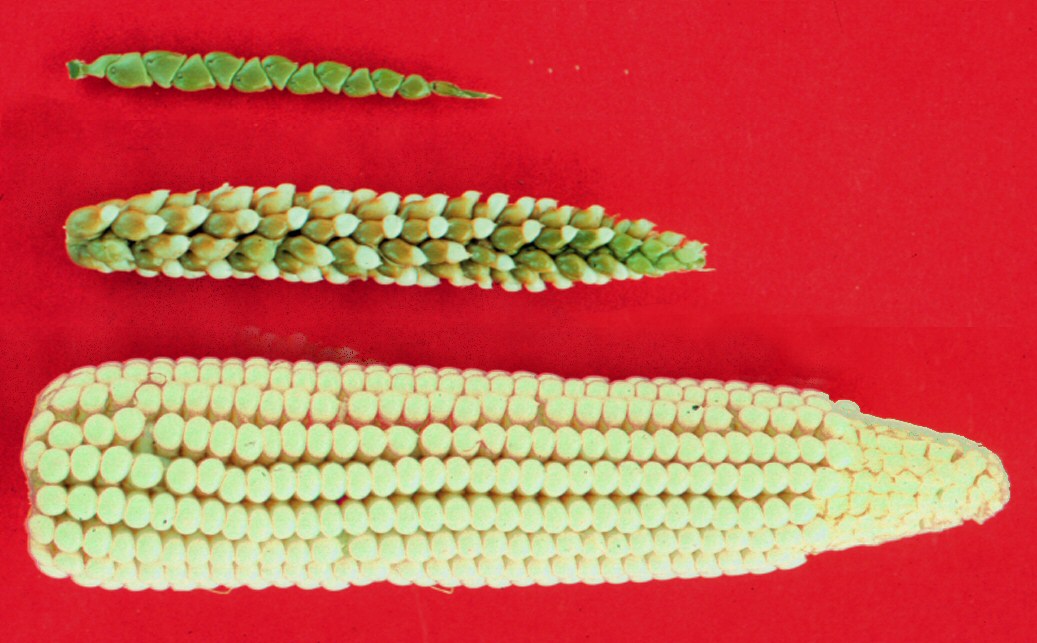
None of the plants we eat exists in the wild in this form. Maize, wheat, the banana and the cabbage are manufactured products — not in a laboratory, but by thousands of generations of farmers who, every year, kept for sowing the seeds of the plants that suited them best.
That is what domestication is: repeated selection, carried on long enough to transform the species. It always targets the same traits, because these are the ones that get in the way of a harvest.
- The seeds must no longer fall of their own accord. A wild cereal scatters its grains as soon as they are ripe — that is how it reproduces. A domesticated cereal keeps them on the ear until someone comes to harvest them. This single trait makes it incapable of surviving without us.
We now know what controls it. In einkorn, one of the first cereals to be domesticated, the shift from the brittle ear to the solid ear is explained by the change of a single amino acid in a single protein. In rice, another gene plays the same role. A tiny mutation, spotted and then preserved by farmers who knew nothing of it, was enough to tip a wild plant over into cultivation.1
- The seeds must all germinate at the same time. A wild plant spreads its germination over several years, as a precaution. A field demands the opposite.
- The part that is eaten must grow larger. The ear, the fruit, the root, the tuber — depending on what is sought.
- Bitterness and toxins must decrease. Almost all wild plants defend themselves chemically; to cultivate them is also to disarm them.2
The cabbage illustrates the process better than any other. Head cabbage, cauliflower, broccoli, Brussels sprouts, kohlrabi and kale are all the same species, Brassica oleracea. One and the same wild plant, selected sometimes for its buds, sometimes for its flowers, sometimes for its stem. They are not cousins, but variants.3
On a global scale, most of what humanity eats rests on a very small number of species. Cereals, above all rice, wheat and maize, on their own provide more than half of the calories consumed on the planet. The rest is shared among a few dozen other plants, even though thousands of edible species are known.4
Eleven centres, at least
The domestication of plants did not take place once, in a single place, and then spread across the planet.
It happened at least eleven times, on several continents, without any contact between these initial centres. Populations separated by oceans had the same idea, each with the plants it had to hand.5
The bones reveal an unexpected fact: in Central Europe, for example, the skeletons of the first farmers are smaller and lighter than those of the hunter-gatherers who preceded them.6
Agriculture is therefore not the great step forward it is often described as. Nor is it the tragic mistake one sometimes reads about. It is a complicated path, taken under pressure from the climate and from the number of mouths to feed.7
What travels
Two examples are enough to gauge the speed of these journeys:
- The chilli pepper left the Americas after 1492. It only reached inland China from the late seventeenth century onwards (in Hunan around 1684, in Sichuan around 1749). A culinary tradition perceived as thousands of years old is in fact less than three centuries old.
- The tomato, which arrived in Europe in the sixteenth century, remained mostly a curiosity there for more than a century — grown for study and for ornament, thought harmful by some, eaten only by a rare few, before reaching people’s plates.8
What is taken for an immemorial heritage is almost always recent.
The case of the Siege of Leningrad
This episode shows how far some people went to keep seeds.
During the Siege of Leningrad (1941-1944), more than twenty scientists and specialists of the Institute of Plant Industry — the largest seed collection in the world at the time, assembled by Nikolai Vavilov — starved to death while protecting the stocks of edible seeds. Vavilov himself, arrested in 1940, starved to death in prison in January 1943.9
The city was starving, and they had rice, potatoes and wheat to hand. They did not touch them. These seeds preserved unique lines, which were used to rebuild crops after the war and which are still in today’s seed banks.
The 75% figure: anatomy of a statistical myth
It is commonly claimed that 75% of the diversity of cultivated plants was lost during the twentieth century. This figure is frequently quoted to raise the alarm about genetic erosion.
A figure without an original citation
A critical analysis published by some fifteen researchers traced this claim back to its origins. They devote an entire box to it, whose title says it all: “The mysterious origins of the 75% narrative”.10
Their finding can be summed up in one phrase: the estimate is attributed to a major international organisation, “invariably without original citation”.11
It has been circulating since the 1990s. The number seems to come from efforts to gather scattered observations and anecdotes, as part of international work on genetic resources.12
And the sentence does indeed exist. It can be read, without a reference, in an atlas published in 1995 by that organisation: “Since 1900, however, about 75 percent of the genetic diversity of agricultural crops has been lost.” A clear-cut claim, without a source, in an official document.13
The authors of the analysis say it bluntly: how the jump was made from local findings to a global estimate remains a mystery.14
What one finds when one really looks
This is the most interesting result, because it is neither “it’s true” nor “it’s false”.
The authors reviewed the data available in four different settings: farmers’ varieties in the fields, modern varieties in agriculture, the wild relatives of cultivated plants in nature, and the collections held in seed banks.15
The result: marked losses are observed everywhere — but also stable situations, and even increases in diversity.16
The extent depends on the species, on the scale at which one looks, on the region — and on the method of analysis chosen.17
This last point deserves attention. It does not merely say that the answer varies from place to place. It says that it also varies according to the method of measurement. Two honest teams, in the same setting, can reach different conclusions.
So a single figure for the whole world could not exist. It is not that it has not been found yet: it is that the question, put this way, has no single answer.
What the factual data show
- No major cultivated species has disappeared worldwide over the last fifty years of agricultural data.
- The paradox of diets: at the national level, the variety of foods available has increased overall for individuals; but at the global level, diversity between countries has shrunk, leading to a homogenisation of food baskets across the planet.18
An essential distinction between two separate statistics
Two claims that are often merged in public debate should not be confused:
- “75% of genetic diversity lost” — a statistical claim whose accuracy and methodology are scientifically disputed.
- “12 plants and 5 animal species provide 75% of the world’s food” — a documented fact concerning the concentration of contemporary agricultural production (notably on wheat, rice and maize).19
Note 1
Re-sequencing of the Btr1 and Btr2 in a collection of 53 lines showed that a single non-synonymous amino acid substitution (alanine to threonine) at position 119 at btr1, is responsible for the non-brittle rachis trait in domesticated einkorn.
Pourkheirandish, Mohammad et al., “On the Origin of the Non-brittle Rachis Trait of Domesticated Einkorn Wheat”, Frontiers in Plant Science, vol. 8, 2031, 2018
Note 2
In plants, the syndrome is defined by a wide variety of traits that, depending on the species, may include: a reduced ability to disperse seeds without human intervention, reduction in physical and chemical defenses, reduction in unproductive side-shoots, reduction in seed dormancy, bigger seeds, more predictable and synchronous germination, and in some seed-propagated species, bigger and more inflorescences.
Larson, Greger et al., “Current Perspectives and the Future of Domestication Studies”, Proceedings of the National Academy of Sciences, vol. 111, 2014, p. 6139-6146
Note 3
Did you know that kale, collards, kohlrabi, cabbage, Brussels sprouts, broccoli and cauliflower are all considered one species? It's true. Scientists refer to them by a single scientific name: Brassica oleracea (B. oleracea).
University of Florida, IFAS Extension, “Cole Crop Confusion”, Gardening Solutions
Note 4
Around the world, rice, wheat, and maize, and to a lesser extent, sorghum and millets, are important staples critical to daily survival of billions of people. More than 50% of world daily caloric intake is derived directly from cereal grain consumption.
Awika, Joseph M., “Major Cereal Grains Production and Use around the World”, dans Advances in Cereal Science, American Chemical Society, 2011
Note 5
At least 11 regions of the Old and New World were involved as independent centers of origin, encompassing geographically isolated regions on most continents, but several more have been suggested (Fig. 1) (3, 7, 11, 15, 16).
Larson, Greger et al., “Current Perspectives and the Future of Domestication Studies”, Proceedings of the National Academy of Sciences, vol. 111, 2014, p. 6139-6146
Note 6
Results document significantly reduced mean stature, body mass, and crural index in Neolithic agriculturalists relative both to Late Mesolithic hunter-gatherer-fishers and to later farming populations. […] Overall, results suggest that the transition to agriculture in Central/Southeast Europe was challenging for early farming populations, but was followed by gradual amelioration across thousands of years, particularly among Central European women.
Macintosh, Alison A., Pinhasi, Ron and Stock, Jay T., “Early Life Conditions and Physiological Stress following the Transition to Farming in Central/Southeast Europe”, PLOS ONE, vol. 11, e0148468, 2016
Note 7
In particular, recent discoveries suggest that the adoption of agriculture, supposedly our most decisive step toward a better life, was in many ways a catastrophe from which we have never recovered. […] Archaeologists studying the rise of farming have reconstructed a crucial stage at which we made the worst mistake in human history.
Diamond, Jared, “The Worst Mistake in the History of the Human Race”, Discover, May 1987
Note 8
The first mention of "haijiao" is in Dayi xianzhi 大邑縣志 (comp. 1749), quoted in Yuren, Chuancai, note 86.
Wang, Hongjie, “Hot Peppers, Sichuan Cuisine and the Revolutions in Modern China”, World History Connected, vol. 12, no. 3, 2015
But the first consistent references to chili peppers in local Chinese gazettes start in China’s eastern coastal regions and move gradually inland toward the West—reaching Hunan in 1684 and Sichuan in 1749—data points that support the argument that the chili pepper arrived by sea, possibly via Portuguese traders who had founded a colony near the southern Chinese coast on the island of Macao.
Leonard, Andrew, “Why Revolutionaries Love Spicy Food”, Nautilus, 6 April 2016
The first examples of the tomato which arrived in the ‘old world’ on the ships of the Spanish Conquistadores […] Olivier De Serres (1539-1619) botanist at the French Court cites the tomato in his Treaty on Agriculture as an amusing curiosity to be used as an ornamental plant. […] Antonio Latini (1642-1696) from the Italian Marches cites the tomato for the first time in his Scalco alla moderna edited in Naples in 1694 where he describes its use in a recipe for stewed vegetables.
Musei del Cibo della provincia di Parma, Museo del Pomodoro, “Tomato Timeline”, web page
If I should eat of this fruit, cut in slices in a pan with butter and oil, it would be injurious and harmful to me
van Andel, Tinde, Vos, Rutger A., Michels, Ewout and Stefanaki, Anastasia, “Sixteenth-century tomatoes in Europe: who saw them, what they looked like, and where they came from”, PeerJ, vol. 10, e12790, 2022
Another species [of eggplant, Solanum melongena L.] has been brought to Italy in our time, […] which is eaten in the same manner [as the eggplant: fried in oil with salt and pepper, like mushrooms]
van Andel, Tinde, Vos, Rutger A., Michels, Ewout and Stefanaki, Anastasia, “Sixteenth-century tomatoes in Europe: who saw them, what they looked like, and where they came from”, PeerJ, vol. 10, e12790, 2022
Note 9
Hundreds of thousands of people died from hunger, including VIR’s employees, who kept seeds and tubers in the collections safe and intact. Only their heroic efforts saved the Institute’s collection from destruction and loss of viability. Such heroism cost the lives of more than 20 scientists and specialists, but as irreparable as that cost might be, VIR managed to survive the most dangerous period in its existence.
Loskutov, Igor G., Ukhatova, Yulia V. and Khlestkina, Elena K., “VIR: from a small Bureau in the Russian Empire to the present-day National Center for Plant Genetic Resources”, Genetic Resources, no. S2, 2024 (publié en 2025), p. 58-69
Vavilov died of starvation in prison in 1943 […] Mug shot of Vavilov after arrest in 1940. […] He died in prison on 26 Jan. 1943, of cardiovascular failure and dystrophy at the age of 55—undernourished and sick as a result of solitary confinement (Fig. 9).
Janick, Jules, “Nikolai Ivanovich Vavilov: Plant Geographer, Geneticist, Martyr of Science”, HortScience, vol. 50, no. 6, 2015, p. 772-776
Note 10
Box 1 Just how much crop diversity has disappeared worldwide? The mysterious origins of the 75% narrative
Khoury, Colin K., Brush, Stephen, Costich, Denise E. et al., “Crop Genetic Erosion: Understanding and Responding to Loss of Crop Diversity”, New Phytologist, vol. 233, 2022, p. 84-118
Note 11
The estimate is attributed to the FAO, invariably without original citation.
Khoury, Colin K., Brush, Stephen, Costich, Denise E. et al., “Crop Genetic Erosion: Understanding and Responding to Loss of Crop Diversity”, New Phytologist, vol. 233, 2022, p. 84-118
Note 12
Among the most common genetic erosion narratives, often repeated since the 1990s, is that three-quarters of crop diversity disappeared in the 20th century.
Khoury, Colin K., Brush, Stephen, Costich, Denise E. et al., “Crop Genetic Erosion: Understanding and Responding to Loss of Crop Diversity”, New Phytologist, vol. 233, 2022, p. 84-118
Note 13
Since 1900, however, about 75 percent of the genetic diversity of agricultural crops has been lost.
Organisation des Nations unies pour l’alimentation et l’agriculture, “Biological Diversity”, dans Loftas, Tony (dir.), Dimensions of Need: An Atlas of Food and Agriculture, Rome, FAO, 1995
Note 14
the questions of which other lines of evidence potentially contributed, which stakeholders were involved and how the jump from specific findings to a global estimation was made remain a mystery
Khoury, Colin K., Brush, Stephen, Costich, Denise E. et al., “Crop Genetic Erosion: Understanding and Responding to Loss of Crop Diversity”, New Phytologist, vol. 233, 2022, p. 84-118
Note 15
changes in the diversity of traditional crop landraces on farms, modern crop cultivars in agriculture, crop wild relatives in their natural habitats and crop genetic resources held in conservation repositories
Khoury, Colin K., Brush, Stephen, Costich, Denise E. et al., “Crop Genetic Erosion: Understanding and Responding to Loss of Crop Diversity”, New Phytologist, vol. 233, 2022, p. 84-118
Note 16
This evidence indicates that marked losses, but also maintenance and increases in diversity, have occurred in all these contexts
Khoury, Colin K., Brush, Stephen, Costich, Denise E. et al., “Crop Genetic Erosion: Understanding and Responding to Loss of Crop Diversity”, New Phytologist, vol. 233, 2022, p. 84-118
Note 17
the extent depending on species, taxonomic and geographic scale, and region, as well as analytical approach
Khoury, Colin K., Brush, Stephen, Costich, Denise E. et al., “Crop Genetic Erosion: Understanding and Responding to Loss of Crop Diversity”, New Phytologist, vol. 233, 2022, p. 84-118
Note 18
At the same time the number of measured crop commodities contributing to national food supplies increased, the relative contribution of these commodities within these supplies became more even, and the dominance of the most significant commodities decreased. As a consequence, national food supplies worldwide became more similar in composition, […]
Khoury, Colin K. et al., “Increasing Homogeneity in Global Food Supplies and the Implications for Food Security”, Proceedings of the National Academy of Sciences, vol. 111, 2014, p. 4001-4006
Note 19
Today, 75 percent of the world's food is generated from only 12 plants and five animal species.
Organisation des Nations unies pour l’alimentation et l’agriculture, “What Is Agrobiodiversity?”, Rome
Notes and sources
- ↑
Passage In einkorn […] the shift from the brittle ear to the solid ear is explained by the change of a single amino acid in a single protein.
Re-sequencing of the Btr1 and Btr2 in a collection of 53 lines showed that a single non-synonymous amino acid substitution (alanine to threonine) at position 119 at btr1, is responsible for the non-brittle rachis trait in domesticated einkorn.
Source Pourkheirandish, Mohammad et al., “On the Origin of the Non-brittle Rachis Trait of Domesticated Einkorn Wheat”, Frontiers in Plant Science, vol. 8, 2031, 2018, abstract.
Open access open the source · checked on 24 October 2026
- ↑
Passage The seeds must no longer fall of their own accord […] The seeds must all germinate at the same time […] Bitterness and toxins must decrease.
In plants, the syndrome is defined by a wide variety of traits that, depending on the species, may include: a reduced ability to disperse seeds without human intervention, reduction in physical and chemical defenses, reduction in unproductive side-shoots, reduction in seed dormancy, bigger seeds, more predictable and synchronous germination, and in some seed-propagated species, bigger and more inflorescences.
Source Larson, Greger et al., “Current Perspectives and the Future of Domestication Studies”, Proceedings of the National Academy of Sciences, vol. 111, 2014, p. 6139-6146, section “Early Domestication Stages”.
Open access open the source · checked on 27 October 2026
- ↑
Passage Head cabbage, cauliflower, broccoli, Brussels sprouts, kohlrabi and kale are all the same species
Did you know that kale, collards, kohlrabi, cabbage, Brussels sprouts, broccoli and cauliflower are all considered one species? It's true. Scientists refer to them by a single scientific name: Brassica oleracea (B. oleracea).
Source University of Florida, IFAS Extension, “Cole Crop Confusion”, Gardening Solutions, top of the page, 1st paragraph.
Open access open the source · checked on 27 October 2026
- ↑
Passage Cereals, above all rice, wheat and maize, on their own provide more than half of the calories consumed on the planet
Around the world, rice, wheat, and maize, and to a lesser extent, sorghum and millets, are important staples critical to daily survival of billions of people. More than 50% of world daily caloric intake is derived directly from cereal grain consumption.
Source Awika, Joseph M., “Major Cereal Grains Production and Use around the World”, dans Advances in Cereal Science, American Chemical Society, 2011, abstract.
Paywalled · checked on 9 September 2026
- ↑
Passage It happened at least eleven times, on several continents, without any contact between these initial centres.
At least 11 regions of the Old and New World were involved as independent centers of origin, encompassing geographically isolated regions on most continents, but several more have been suggested (Fig. 1) (3, 7, 11, 15, 16).
Source Larson, Greger et al., “Current Perspectives and the Future of Domestication Studies”, Proceedings of the National Academy of Sciences, vol. 111, 2014, p. 6139-6146, section “Spatial and Temporal Patterns of Domestication”.
Open access · checked on 24 October 2026
- ↑
Passage in Central Europe, for example, the skeletons of the first farmers are smaller and lighter than those of the hunter-gatherers who preceded them
Results document significantly reduced mean stature, body mass, and crural index in Neolithic agriculturalists relative both to Late Mesolithic hunter-gatherer-fishers and to later farming populations. […] Overall, results suggest that the transition to agriculture in Central/Southeast Europe was challenging for early farming populations, but was followed by gradual amelioration across thousands of years, particularly among Central European women.
Source Macintosh, Alison A., Pinhasi, Ron and Stock, Jay T., “Early Life Conditions and Physiological Stress following the Transition to Farming in Central/Southeast Europe”, PLOS ONE, vol. 11, e0148468, 2016, abstract.
Open access · checked on 24 October 2026
- ↑
Passage Nor is it the tragic mistake one sometimes reads about.
In particular, recent discoveries suggest that the adoption of agriculture, supposedly our most decisive step toward a better life, was in many ways a catastrophe from which we have never recovered. […] Archaeologists studying the rise of farming have reconstructed a crucial stage at which we made the worst mistake in human history.
Source Diamond, Jared, “The Worst Mistake in the History of the Human Race”, Discover, May 1987, 1st paragraph of the article, then near the end, paragraph beginning “At this point it’s instructive to recall” (pp. 64-66 in Discover).
Open access open the source · checked on 27 October 2026
- ↑
Passage in Sichuan around 1749
The first mention of "haijiao" is in Dayi xianzhi 大邑縣志 (comp. 1749), quoted in Yuren, Chuancai, note 86.
Source Wang, Hongjie, “Hot Peppers, Sichuan Cuisine and the Revolutions in Modern China”, World History Connected, vol. 12, no. 3, 2015, note 7.
Open access open the source · checked on 27 October 2026
Passage It only reached inland China from the late seventeenth century onwards (in Hunan around 1684 […])
But the first consistent references to chili peppers in local Chinese gazettes start in China’s eastern coastal regions and move gradually inland toward the West—reaching Hunan in 1684 and Sichuan in 1749—data points that support the argument that the chili pepper arrived by sea, possibly via Portuguese traders who had founded a colony near the southern Chinese coast on the island of Macao.
Source Leonard, Andrew, “Why Revolutionaries Love Spicy Food”, Nautilus, 6 April 2016, body of the article, 15th paragraph (counting from “In 1932”).
Open access open the source · checked on 27 October 2026
Passage The tomato […] remained mostly a curiosity there for more than a century — grown for study and for ornament
The first examples of the tomato which arrived in the ‘old world’ on the ships of the Spanish Conquistadores […] Olivier De Serres (1539-1619) botanist at the French Court cites the tomato in his Treaty on Agriculture as an amusing curiosity to be used as an ornamental plant. […] Antonio Latini (1642-1696) from the Italian Marches cites the tomato for the first time in his Scalco alla moderna edited in Naples in 1694 where he describes its use in a recipe for stewed vegetables.
Source Musei del Cibo della provincia di Parma, Museo del Pomodoro, “Tomato Timeline”, web page, timeline, “XVI century” and “XVII century” entries (De Serres, Latini).
Open access open the source · checked on 27 October 2026
Passage thought harmful by some
If I should eat of this fruit, cut in slices in a pan with butter and oil, it would be injurious and harmful to me
Source van Andel, Tinde, Vos, Rutger A., Michels, Ewout and Stefanaki, Anastasia, “Sixteenth-century tomatoes in Europe: who saw them, what they looked like, and where they came from”, PeerJ, vol. 10, e12790, 2022, Table 1 (“Sixteenth-century descriptions, specimens and illustrations of the tomato…”), Michiel row, “Names” column (McCue’s 1952 translation).
Open access open the source · checked on 28 October 2026
Passage eaten only by a rare few
Another species [of eggplant, Solanum melongena L.] has been brought to Italy in our time, […] which is eaten in the same manner [as the eggplant: fried in oil with salt and pepper, like mushrooms]
Source van Andel, Tinde, Vos, Rutger A., Michels, Ewout and Stefanaki, Anastasia, “Sixteenth-century tomatoes in Europe: who saw them, what they looked like, and where they came from”, PeerJ, vol. 10, e12790, 2022, section “The first mention of a tomato (1544)” (English translation of Matthioli’s text, 1544).
Open access open the source · checked on 28 October 2026
- ↑
Passage more than twenty scientists and specialists of the Institute of Plant Industry […] starved to death while protecting the stocks of edible seeds
Hundreds of thousands of people died from hunger, including VIR’s employees, who kept seeds and tubers in the collections safe and intact. Only their heroic efforts saved the Institute’s collection from destruction and loss of viability. Such heroism cost the lives of more than 20 scientists and specialists, but as irreparable as that cost might be, VIR managed to survive the most dangerous period in its existence.
Source Loskutov, Igor G., Ukhatova, Yulia V. and Khlestkina, Elena K., “VIR: from a small Bureau in the Russian Empire to the present-day National Center for Plant Genetic Resources”, Genetic Resources, no. S2, 2024 (publié en 2025), p. 58-69, section “Introduction and historical events”, passage on the Siege of Leningrad.
Open access open the source · checked on 9 September 2026
Passage Vavilov himself, arrested in 1940, starved to death in prison in January 1943.
Vavilov died of starvation in prison in 1943 […] Mug shot of Vavilov after arrest in 1940. […] He died in prison on 26 Jan. 1943, of cardiovascular failure and dystrophy at the age of 55—undernourished and sick as a result of solitary confinement (Fig. 9).
Source Janick, Jules, “Nikolai Ivanovich Vavilov: Plant Geographer, Geneticist, Martyr of Science”, HortScience, vol. 50, no. 6, 2015, p. 772-776, abstract, p. 772; caption of fig. 8 and text, p. 775.
Open access open the source · checked on 27 October 2026
- ↑
Passage The mysterious origins of the 75% narrative
Box 1 Just how much crop diversity has disappeared worldwide? The mysterious origins of the 75% narrative
Source Khoury, Colin K., Brush, Stephen, Costich, Denise E. et al., “Crop Genetic Erosion: Understanding and Responding to Loss of Crop Diversity”, New Phytologist, vol. 233, 2022, p. 84-118, Box 1.
Open access open the source · checked on 9 September 2026
- ↑
Passage the estimate is attributed to a major international organisation, “invariably without original citation”
The estimate is attributed to the FAO, invariably without original citation.
Source Khoury, Colin K., Brush, Stephen, Costich, Denise E. et al., “Crop Genetic Erosion: Understanding and Responding to Loss of Crop Diversity”, New Phytologist, vol. 233, 2022, p. 84-118, Box 1.
Open access open the source · checked on 9 September 2026
- ↑
Passage It has been circulating since the 1990s.
Among the most common genetic erosion narratives, often repeated since the 1990s, is that three-quarters of crop diversity disappeared in the 20th century.
Source Khoury, Colin K., Brush, Stephen, Costich, Denise E. et al., “Crop Genetic Erosion: Understanding and Responding to Loss of Crop Diversity”, New Phytologist, vol. 233, 2022, p. 84-118, Box 1.
Open access open the source · checked on 9 September 2026
- ↑
Passage Since 1900, however, about 75 percent of the genetic diversity of agricultural crops has been lost.
Since 1900, however, about 75 percent of the genetic diversity of agricultural crops has been lost.
Source Organisation des Nations unies pour l’alimentation et l’agriculture, “Biological Diversity”, dans Loftas, Tony (dir.), Dimensions of Need: An Atlas of Food and Agriculture, Rome, FAO, 1995, chapter “Biological diversity”.
Open access open the source · checked on 9 September 2026
- ↑
Passage how the jump was made from local findings to a global estimate remains a mystery
the questions of which other lines of evidence potentially contributed, which stakeholders were involved and how the jump from specific findings to a global estimation was made remain a mystery
Source Khoury, Colin K., Brush, Stephen, Costich, Denise E. et al., “Crop Genetic Erosion: Understanding and Responding to Loss of Crop Diversity”, New Phytologist, vol. 233, 2022, p. 84-118, Box 1.
Open access open the source · checked on 9 September 2026
- ↑
Passage farmers’ varieties in the fields, modern varieties in agriculture, the wild relatives of cultivated plants in nature, and the collections held in seed banks
changes in the diversity of traditional crop landraces on farms, modern crop cultivars in agriculture, crop wild relatives in their natural habitats and crop genetic resources held in conservation repositories
Source Khoury, Colin K., Brush, Stephen, Costich, Denise E. et al., “Crop Genetic Erosion: Understanding and Responding to Loss of Crop Diversity”, New Phytologist, vol. 233, 2022, p. 84-118, abstract.
Open access open the source · checked on 9 September 2026
- ↑
Passage marked losses are observed everywhere — but also stable situations, and even increases in diversity
This evidence indicates that marked losses, but also maintenance and increases in diversity, have occurred in all these contexts
Source Khoury, Colin K., Brush, Stephen, Costich, Denise E. et al., “Crop Genetic Erosion: Understanding and Responding to Loss of Crop Diversity”, New Phytologist, vol. 233, 2022, p. 84-118, abstract.
Open access open the source · checked on 9 September 2026
- ↑
Passage The extent depends on the species, on the scale at which one looks, on the region — and on the method of analysis chosen.
the extent depending on species, taxonomic and geographic scale, and region, as well as analytical approach
Source Khoury, Colin K., Brush, Stephen, Costich, Denise E. et al., “Crop Genetic Erosion: Understanding and Responding to Loss of Crop Diversity”, New Phytologist, vol. 233, 2022, p. 84-118, abstract.
Open access open the source · checked on 9 September 2026
- ↑
Passage at the national level, the variety of foods available has increased overall […] but at the global level, diversity between countries has shrunk
At the same time the number of measured crop commodities contributing to national food supplies increased, the relative contribution of these commodities within these supplies became more even, and the dominance of the most significant commodities decreased. As a consequence, national food supplies worldwide became more similar in composition, […]
Source Khoury, Colin K. et al., “Increasing Homogeneity in Global Food Supplies and the Implications for Food Security”, Proceedings of the National Academy of Sciences, vol. 111, 2014, p. 4001-4006, abstract.
Open access · checked on 24 October 2026
- ↑
Passage 12 plants and 5 animal species provide 75% of the world’s food
Today, 75 percent of the world's food is generated from only 12 plants and five animal species.
Source Organisation des Nations unies pour l’alimentation et l’agriculture, “What Is Agrobiodiversity?”, Rome, Box 5 “100 years of agricultural change: some trends and figures related to agrobiodiversity”.
Open access open the source · checked on 9 September 2026
Bibliography
21
- Awika, Joseph M., “Major Cereal Grains Production and Use around the World”, dans Advances in Cereal Science, American Chemical Society, 2011, paywalled (the share of cereals in global calorie intake).
- Diamond, Jared, “The Worst Mistake in the History of the Human Race”, Discover, May 1987, open access (the thesis discussed here).
- Dott, Brian R., The Chile Pepper in China: A Cultural Biography, Columbia University Press, 2020, in libraries (Hunan around 1684, Sichuan around 1749; see entry 2.10).
- Gentilcore, David, Pomodoro! A History of the Tomato in Italy, Columbia University Press, 2010, in libraries (the tomato, long a curiosity regarded with suspicion).
- Harlan, Jack R., Crops and Man, American Society of Agronomy, 1992, in libraries (the traits of domestication).
- Janick, Jules, “Nikolai Ivanovich Vavilov: Plant Geographer, Geneticist, Martyr of Science”, HortScience, vol. 50, no. 6, 2015, p. 772-776, open access (Vavilov’s arrest in 1940; his death from starvation in prison on 26 January 1943). https://www.hort.purdue.edu/NEWCROP/pdfs/772.full.pdf
- Khoury, Colin K. et al., “Increasing Homogeneity in Global Food Supplies and the Implications for Food Security”, Proceedings of the National Academy of Sciences, vol. 111, 2014, p. 4001-4006, open access (diversity increasing within each country and decreasing between countries).
- Khoury, Colin K., Brush, Stephen, Costich, Denise E. et al., “Crop Genetic Erosion: Understanding and Responding to Loss of Crop Diversity”, New Phytologist, vol. 233, 2022, p. 84-118, open access (the box on the origins of the 75% narrative; the attribution “invariably without original citation”; circulation since the 1990s; the four settings reviewed; marked losses but also maintenance and increases, depending on species, scale, region and method of analysis). https://doi.org/10.1111/nph.17733
- Larson, Greger et al., “Current Perspectives and the Future of Domestication Studies”, Proceedings of the National Academy of Sciences, vol. 111, 2014, p. 6139-6146, open access (at least eleven independent centres; see entries 2.9 and 3.2).
- Leonard, Andrew, “Why Revolutionaries Love Spicy Food”, Nautilus, 6 April 2016, open access (the first consistent mentions of the chilli in local gazetteers, from the coast inland: Hunan in 1684, Sichuan in 1749). https://nautil.us/why-revolutionaries-love-spicy-food-235885
- Loskutov, Igor G., Ukhatova, Yulia V. and Khlestkina, Elena K., “VIR: from a small Bureau in the Russian Empire to the present-day National Center for Plant Genetic Resources”, Genetic Resources, no. S2, 2024 (publié en 2025), p. 58-69, open access (the Siege of Leningrad: more than twenty of the institute’s scientists and specialists starved to death while keeping the seeds and tubers intact). https://doi.org/10.46265/genresj.EVEF5522
- Loskutov, Igor G., Vavilov and His Institute: A History of the World Collection of Plant Genetic Resources in Russia, IPGRI, Rome, 1999, open access.
- Macintosh, Alison A., Pinhasi, Ron and Stock, Jay T., “Early Life Conditions and Physiological Stress following the Transition to Farming in Central/Southeast Europe”, PLOS ONE, vol. 11, e0148468, 2016, open access (the skeletons of the first farmers; see entry 2.9).
- Musei del Cibo della provincia di Parma, Museo del Pomodoro, “Tomato Timeline”, web page, open access. https://pomodoro.museidelcibo.it/en/timeline/
- Nabhan, Gary Paul, Where Our Food Comes From: Retracing Nikolay Vavilov’s Quest to End Famine, Island Press, 2009, in libraries (Vavilov, the institute, the Siege of Leningrad).
- Organisation des Nations unies pour l’alimentation et l’agriculture, “Biological Diversity”, dans Loftas, Tony (dir.), Dimensions of Need: An Atlas of Food and Agriculture, Rome, FAO, 1995, open access (the 75% sentence as it circulates, stated without a reference). https://www.fao.org/4/U8480E/U8480E0K.HTM
- Organisation des Nations unies pour l’alimentation et l’agriculture, “What Is Agrobiodiversity?”, Rome, open access (75% of the world’s food derived from 12 plants and 5 animal species). https://www.fao.org/4/y5609e/y5609e02.htm
- Pourkheirandish, Mohammad et al., “On the Origin of the Non-brittle Rachis Trait of Domesticated Einkorn Wheat”, Frontiers in Plant Science, vol. 8, 2031, 2018, open access (the substitution of a single amino acid behind the non-brittle ear of domesticated einkorn). https://doi.org/10.3389/fpls.2017.02031
- University of Florida, IFAS Extension, “Cole Crop Confusion”, Gardening Solutions, open access (kale, kohlrabi, cabbage, Brussels sprouts, broccoli and cauliflower: a single species, Brassica oleracea). https://gardeningsolutions.ifas.ufl.edu/plants/edibles/vegetables/cole-crop-confusion/
- van Andel, Tinde, Vos, Rutger A., Michels, Ewout and Stefanaki, Anastasia, “Sixteenth-century tomatoes in Europe: who saw them, what they looked like, and where they came from”, PeerJ, vol. 10, e12790, 2022, open access (the first mention of the tomato in Europe, by Matthioli in 1544, who says it was eaten fried like aubergine). https://doi.org/10.7717/peerj.12790
- Wang, Hongjie, “Hot Peppers, Sichuan Cuisine and the Revolutions in Modern China”, World History Connected, vol. 12, no. 3, 2015, open access. https://doi.org/10.13021/whc.v12i3.4424
Spotted an error or have a doubt? Write to us.