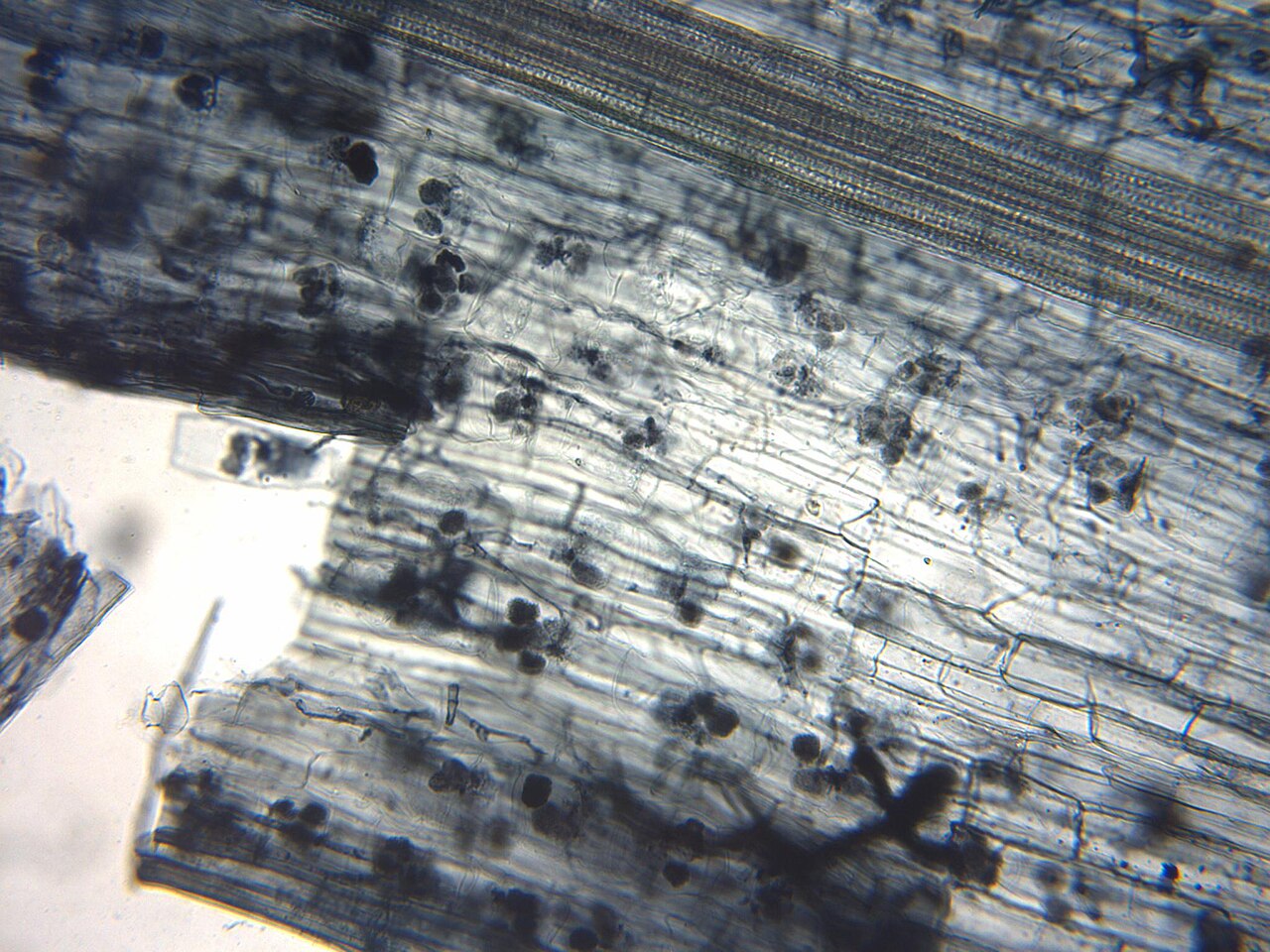

The fungal networks that connect the roots of trees exist. This is not in dispute.
We must start there, because the rest of this page will correct a great many things, and it is important not to draw the wrong conclusion.
What is established
Underground, fungal filaments do indeed connect the roots of several plants — of the same species or of different species. This is called a common mycorrhizal network.1
Their existence has been demonstrated. No one disputes it.
It is what is said about them that is the problem. The researchers put it this way: recent claims in the popular media about these networks are disconnected from evidence.23
The three claims, and their three verdicts
In February 2023, three researchers — Justine Karst, Melanie Jones and Jason Hoeksema — published in a major journal a review of what is being said about these networks. They took three popular claims and looked at what supported them.4
First claim: these networks are widespread in forests.
Second claim: resources flow through them and improve the survival of seedlings.
For these two, the verdict is the same: insufficiently supported. The authors give three distinct reasons, which it is important to tell apart:
- field results vary too much from one place to another;
- the observations have other possible explanations;
- the studies are too few to allow generalisation.5
These criticisms are not the same. The first says that the phenomenon is not consistent; the second, that the competing explanations have not been ruled out; the third, that not enough is known. All three can be remedied, but not in the same way.
Third claim: mature trees preferentially send resources and defence signals to their own offspring.6
Verdict: no peer-reviewed, published evidence.
None.
What makes this study exceptional
The authors did not simply say “it is exaggerated”. They went and counted.
They examined how the results of this research are cited by subsequent articles. Their finding: unsupported claims have doubled in twenty-five years.7
They also name the mechanism, and this is where the matter becomes instructive. What they describe is a positive citation bias: of all the results available, it is those that go in the expected direction that are cited most. The others exist, but they are taken up less often. No one is lying; the sorting happens by itself, article after article.8
This bias, they say, risks ultimately obscuring our understanding of how these networks really work.9
This point is worth dwelling on, because it matters for this whole site.
We have been saying from the start that a claim becomes distorted as it travels: nuance falls away, precision is lost. We have shown this some ten times, with examples to back it up.
This is the first time we have come across someone who has measured it.
What is a tree?
The question seems childish. It has no single answer, and that is what makes it interesting.
The main fact is this: “tree” is not a category in the classification of living things.10
It is not like “mammal” or “insect”, which denote groups of related organisms. There is no tree family. An oak is a much closer relative of a nettle than of a pine.
Four competing definitions
Depending on which one is adopted, the list of trees changes.
- By form — a single, elongated stem bearing leaves and branches. This definition includes the banana plant and the papaya, which nevertheless have no wood.
- By wood — a plant that produces wood as it thickens year after year. This definition excludes the banana plant.
- By use — a plant that can be exploited as timber. This is an economic definition, and it changes with technology.
- By size — above a certain height. But which one? The published minimum heights for a plant to be a tree range from 3 metres to more than 10 metres, more than a threefold difference.11
What this means
Two serious botanists can count the number of tree species in a region and get different results without either of them being wrong.
They simply did not use the same dictionary.
And wood itself is a repeated invention
One last fact completes the demonstration that “tree” denotes a form and not a family.
Wood has appeared independently many times in the history of plants, in lineages with no close kinship. Herbaceous plants began to produce wood, separately, at different times.
On one archipelago, the number of times can even be counted.
On the Canary Islands, wood appeared at least thirty-eight times independently, from herbaceous ancestors. These thirty-eight transitions produced 220 woody species, spread across 34 genera and 15 families — about a fifth of the archipelago’s native flowering plants excluding monocots.12
Thirty-eight times the same solution, in the same place, by lineages that have nothing to do with one another.
There is even a tested explanation: drought. Woodier stems are better at resisting the gas bubbles that block the flow of water. Worldwide, species that have become woody are more numerous on islands exposed to drought. For 60 to 65% of the lineages studied on the Canaries, wood appeared within the last 3.2 million years, when summer droughts became established.13
A detail that sets things straight
All woody plants start out herbaceous. An oak three centimetres tall is a soft plant. The wood comes later.
Conversely: the potato produces wood in its roots.
“Tree” therefore describes what a plant does with its life, not what it is. It is a trade, not a family.
How does a forest work?
If the tree is not a taxonomic category, the forest is not a mere collection of trees either. It is a dynamic system of interactions and competition.
Far from the mythologised image of universal mutual aid, the forest works first and foremost through competition for two critical resources: light (above ground) and water or minerals (in the soil).
The dynamics of cycles and disturbances
A natural forest never stands still. Its functioning relies on regular disturbances (falling trees, fires, storms, insect attacks) that create gaps.
- Regeneration — light reaching the ground activates dormant seeds or speeds up the growth of seedlings previously held back in the shade.
- Ecological succession — fast-growing pioneer species establish themselves first, modify the microclimate and the structure of the soil, then gradually give way to climax species that grow more slowly.
- Soil micro-biodiversity — the real engine for recycling dry matter (dead wood, leaves) lies in the soil fauna (bacteria, insects, worms and decomposer fungi), which is indispensable for releasing nutrients for the next generation.14
The safeguards: beware of false forests
Just as with the word “tree”, the definition of the word “forest” poses a major problem of measurement and of political interpretation.
The trap of the official definition
According to the FAO (Food and Agriculture Organization of the United Nations), a forest is an area of more than 0.5 hectares, with trees reaching more than 5 metres in height at maturity and a canopy cover of more than 10%.15
This strictly morphological definition leads to analytical distortions:
- Field of trees vs ecosystem — in many assessments, an industrial monoculture of eucalyptus or maritime pine, planted in rows and felled every fifteen years, is counted in the same way as a natural forest.
- Misleading reforestation figures — when a state announces millions of hectares of “forests gained”, these are often even-aged industrial plantations (trees of the same age), biologically poor and highly vulnerable to fires and diseases.16
A forest is not merely a carbon stock or a cover of trees: it is the simultaneous presence of structural complexity, temporal continuity of the soil and a network of ecological interactions.
What must above all not be concluded
We now come to the dangerous part of this page.
It must not be concluded that trees do not communicate. Nor that all this is false, invented, or that scientists talk nonsense.
The networks exist. The researcher who led the study says so herself: it is excellent that this research has sparked public interest in forest fungi.
The problem lies elsewhere. Many popular ideas have got ahead of the science.
That is not the same thing as being false. It means that they are presented as established when they are, at best, under examination.
How to read this kind of case
The method this site uses every time can be useful elsewhere.
Three questions, in this order.
What is established? Here: the networks exist.
What is being told? Here: mutual aid, signals, the nurturing mother that recognises her young.
What do we know about the gap between the two? Here, exceptionally: it has been measured. Unsupported claims have doubled in twenty-five years.
Most of the time, the third question remains unanswered. But simply asking it already changes everything: it prevents us from confusing what is demonstrated with what is repeated.
Note 1
A common mycorrhizal network (CMN) is formed when mycorrhizal fungal hyphae connect the roots of multiple plants of the same or different species belowground.
Karst, Justine, Jones, Melanie D. and Hoeksema, Jason D., “Positive Citation Bias and Overinterpreted Results Lead to Misinformation on Common Mycorrhizal Networks in Forests”, Nature Ecology & Evolution, vol. 7, 2023, p. 501-511
Note 2
recent claims in the popular media about CMNs in forests are disconnected from evidence
Karst, Justine, Jones, Melanie D. and Hoeksema, Jason D., “Positive Citation Bias and Overinterpreted Results Lead to Misinformation on Common Mycorrhizal Networks in Forests”, Nature Ecology & Evolution, vol. 7, 2023, p. 501-511
Note 3
Here we use reciprocal isotope labelling in the field to demonstrate bidirectional carbon transfer between the ectomycorrhizal tree species Betula papyrifera and Pseudotsuga menziesii, resulting in net carbon gain by P. menziesii.
Simard, Suzanne W. et al., “Net Transfer of Carbon between Ectomycorrhizal Tree Species in the Field”, Nature, vol. 388, 1997, p. 579-582
We conclude that evidence of a significant net C transfer via common mycorrhizal networks that benefits the recipients is still lacking.
Henriksson, Nils et al., “Re-examining the Evidence for the Mother Tree Hypothesis”, New Phytologist, vol. 239, 2023, p. 19-28
Note 4
Recently, CMNs have captured the interest of broad audiences, especially with respect to forest function and management. […] We first evaluated the evidence supporting three common claims.
Karst, Justine, Jones, Melanie D. and Hoeksema, Jason D., “Positive Citation Bias and Overinterpreted Results Lead to Misinformation on Common Mycorrhizal Networks in Forests”, Nature Ecology & Evolution, vol. 7, 2023, p. 501-511, paywalled
Note 5
insufficiently supported because results from field studies vary too widely, have alternative explanations or are too limited to support generalizations
Karst, Justine, Jones, Melanie D. and Hoeksema, Jason D., “Positive Citation Bias and Overinterpreted Results Lead to Misinformation on Common Mycorrhizal Networks in Forests”, Nature Ecology & Evolution, vol. 7, 2023, p. 501-511
Note 6
The claim that mature trees preferentially send resources and defence signals to offspring through CMNs has no peer-reviewed, published evidence.
Karst, Justine, Jones, Melanie D. and Hoeksema, Jason D., “Positive Citation Bias and Overinterpreted Results Lead to Misinformation on Common Mycorrhizal Networks in Forests”, Nature Ecology & Evolution, vol. 7, 2023, p. 501-511
Note 7
We next examined how the results from CMN research are cited and found that unsupported claims have doubled in the past 25 years
Karst, Justine, Jones, Melanie D. and Hoeksema, Jason D., “Positive Citation Bias and Overinterpreted Results Lead to Misinformation on Common Mycorrhizal Networks in Forests”, Nature Ecology & Evolution, vol. 7, 2023, p. 501-511
Note 8
bias towards citing positive effects of CMNs has developed in the scientific literature
Karst, Justine, Jones, Melanie D. and Hoeksema, Jason D., “Positive Citation Bias and Overinterpreted Results Lead to Misinformation on Common Mycorrhizal Networks in Forests”, Nature Ecology & Evolution, vol. 7, 2023, p. 501-511
Note 9
a bias towards citing positive effects may obscure our understanding of the structure and function of CMNs in forests
Karst, Justine, Jones, Melanie D. and Hoeksema, Jason D., “Positive Citation Bias and Overinterpreted Results Lead to Misinformation on Common Mycorrhizal Networks in Forests”, Nature Ecology & Evolution, vol. 7, 2023, p. 501-511
Note 10
Woody growth is evolutionarily ancient, yet has been gained and lost multiple times in plant evolution and is readily enhanced or minimized in eudicot speciation. […] forest trees constitute a contrived group of plants that have more in common with herbaceous relatives than we foresters like to admit.
Groover, Andrew T., “What Genes Make a Tree a Tree?”, Trends in Plant Science, vol. 10, 2005, p. 210-214
Note 11
Several sources refer to the minimum size of a tree, e.g. a height of 3 m (Delijska and Manoilov 2004), or a diameter of 12.7 cm and a height of 4.6 m (Helms 1998). Allaby (1998) gives a minimum height of more than 10 m.
Gschwantner, Thomas et al., “Common Tree Definitions for National Forest Inventories in Europe”, Silva Fennica, vol. 43, 2009, p. 303-321
Note 12
In total, at least 220 native Canary Island species of flowering plants, from 34 genera representing 15 families, are truly insular woody. […] The Canary Island flora is characterized by at least 38 independent shifts toward insular woodiness, representing an important portion of the endemic angiosperms on the archipelago.
Lens, Frederic et al., “Insular Woodiness on the Canary Islands: A Remarkable Case of Convergent Evolution”, International Journal of Plant Sciences, vol. 174, no. 7, 2013, p. 992-1013
Note 13
Our single, broad-scale dating analysis shows that woodiness in 60%–65% of the insular woody lineages studied originated within the last 3.2 Myr, during which Mediterranean seasonality (yearly summer droughts) became established on the Canaries.
Hooft van Huysduynen, A. et al., “Temporal and Palaeoclimatic Context of the Evolution of Insular Woodiness in the Canary Islands”, Ecology and Evolution, vol. 11, no. 17, 2021, p. 12220-12231
In combination with global data on island species composition, climate, and environment conditions, we test multiple longstanding hypotheses regarding the origins of insular woodiness and find that the absence of herbivores and traits related to drought stress are best correlated with the occurrence of insular woody species across all islands.
Zizka, Alexander et al., “The Evolution of Insular Woodiness”, Proceedings of the National Academy of Sciences, vol. 119, no. 37, e2208629119, 2022
Note 14
Thus, the first plants to grow back are usually annual plants followed within a few years by quickly growing and spreading grasses and other pioneer species. […] Eventually, over 150 years, the forest will reach its equilibrium point where species composition is no longer changing and resembles the community before the fire. This equilibrium state is referred to as the climax community, which will remain stable until the next disturbance.
Clark, Mary Ann, Douglas, Matthew and Choi, Jung, Biology 2e, OpenStax, section 45.6 “Community Ecology”
Note 15
Land spanning more than 0.5 hectares with trees higher than 5 meters and a canopy cover of more than 10 percent, or trees able to reach these thresholds in situ.
FAO, Global Forest Resources Assessment: Terms and Definitions, Rome
Note 16
In many cases, forest assessments do not distinguish between land covered by natural and planted forests (Sasaki and Putz 2009).
Chazdon, Robin L. et al., “When Is a Forest a Forest? Forest Concepts and Definitions in the Era of Forest and Landscape Restoration”, Ambio, vol. 45, 2016, p. 538-550
Notes and sources
- ↑
Passage fungal filaments do indeed connect the roots of several plants — of the same species or of different species. This is called a common mycorrhizal network.
A common mycorrhizal network (CMN) is formed when mycorrhizal fungal hyphae connect the roots of multiple plants of the same or different species belowground.
Source Karst, Justine, Jones, Melanie D. and Hoeksema, Jason D., “Positive Citation Bias and Overinterpreted Results Lead to Misinformation on Common Mycorrhizal Networks in Forests”, Nature Ecology & Evolution, vol. 7, 2023, p. 501-511, abstract.
Paywalled open the source · checked on 9 September 2026
- ↑
Passage recent claims in the popular media about these networks are disconnected from evidence
recent claims in the popular media about CMNs in forests are disconnected from evidence
Source Karst, Justine, Jones, Melanie D. and Hoeksema, Jason D., “Positive Citation Bias and Overinterpreted Results Lead to Misinformation on Common Mycorrhizal Networks in Forests”, Nature Ecology & Evolution, vol. 7, 2023, p. 501-511, abstract.
Paywalled open the source · checked on 9 September 2026
- ↑
For this whole section
Passage the founding article from which the “network” story began
Here we use reciprocal isotope labelling in the field to demonstrate bidirectional carbon transfer between the ectomycorrhizal tree species Betula papyrifera and Pseudotsuga menziesii, resulting in net carbon gain by P. menziesii.
Source Simard, Suzanne W. et al., “Net Transfer of Carbon between Ectomycorrhizal Tree Species in the Field”, Nature, vol. 388, 1997, p. 579-582, abstract.
Paywalled · checked on 25 October 2026
Passage a second, convergent critical review
We conclude that evidence of a significant net C transfer via common mycorrhizal networks that benefits the recipients is still lacking.
Source Henriksson, Nils et al., “Re-examining the Evidence for the Mother Tree Hypothesis”, New Phytologist, vol. 239, 2023, p. 19-28, summary.
Open access · checked on 24 October 2026
- ↑
Passage In February 2023, three researchers — Justine Karst, Melanie Jones and Jason Hoeksema
Recently, CMNs have captured the interest of broad audiences, especially with respect to forest function and management. […] We first evaluated the evidence supporting three common claims.
Source Karst, Justine, Jones, Melanie D. and Hoeksema, Jason D., “Positive Citation Bias and Overinterpreted Results Lead to Misinformation on Common Mycorrhizal Networks in Forests”, Nature Ecology & Evolution, vol. 7, 2023, p. 501-511, paywalled, abstract.
Paywalled open the source · checked on 25 October 2026
- ↑
Passage field results vary too much from one place to another […] the observations have other possible explanations […] the studies are too few to allow generalisation
insufficiently supported because results from field studies vary too widely, have alternative explanations or are too limited to support generalizations
Source Karst, Justine, Jones, Melanie D. and Hoeksema, Jason D., “Positive Citation Bias and Overinterpreted Results Lead to Misinformation on Common Mycorrhizal Networks in Forests”, Nature Ecology & Evolution, vol. 7, 2023, p. 501-511, abstract.
Paywalled open the source · checked on 9 September 2026
- ↑
Passage mature trees preferentially send resources and defence signals to their own offspring […] no peer-reviewed, published evidence
The claim that mature trees preferentially send resources and defence signals to offspring through CMNs has no peer-reviewed, published evidence.
Source Karst, Justine, Jones, Melanie D. and Hoeksema, Jason D., “Positive Citation Bias and Overinterpreted Results Lead to Misinformation on Common Mycorrhizal Networks in Forests”, Nature Ecology & Evolution, vol. 7, 2023, p. 501-511, abstract.
Paywalled open the source · checked on 9 September 2026
- ↑
Passage They examined how the results of this research are cited […] unsupported claims have doubled in twenty-five years
We next examined how the results from CMN research are cited and found that unsupported claims have doubled in the past 25 years
Source Karst, Justine, Jones, Melanie D. and Hoeksema, Jason D., “Positive Citation Bias and Overinterpreted Results Lead to Misinformation on Common Mycorrhizal Networks in Forests”, Nature Ecology & Evolution, vol. 7, 2023, p. 501-511, abstract.
Paywalled open the source · checked on 9 September 2026
- ↑
Passage a positive citation bias: of all the results available, it is those that go in the expected direction that are cited most
bias towards citing positive effects of CMNs has developed in the scientific literature
Source Karst, Justine, Jones, Melanie D. and Hoeksema, Jason D., “Positive Citation Bias and Overinterpreted Results Lead to Misinformation on Common Mycorrhizal Networks in Forests”, Nature Ecology & Evolution, vol. 7, 2023, p. 501-511, abstract.
Paywalled open the source · checked on 9 September 2026
- ↑
Passage risks ultimately obscuring our understanding of how these networks really work
a bias towards citing positive effects may obscure our understanding of the structure and function of CMNs in forests
Source Karst, Justine, Jones, Melanie D. and Hoeksema, Jason D., “Positive Citation Bias and Overinterpreted Results Lead to Misinformation on Common Mycorrhizal Networks in Forests”, Nature Ecology & Evolution, vol. 7, 2023, p. 501-511, abstract.
Paywalled open the source · checked on 9 September 2026
- ↑
Passage “tree” is not a category in the classification of living things […] There is no tree family.
Woody growth is evolutionarily ancient, yet has been gained and lost multiple times in plant evolution and is readily enhanced or minimized in eudicot speciation. […] forest trees constitute a contrived group of plants that have more in common with herbaceous relatives than we foresters like to admit.
Source Groover, Andrew T., “What Genes Make a Tree a Tree?”, Trends in Plant Science, vol. 10, 2005, p. 210-214, abstract (first and last sentences).
Paywalled · checked on 25 October 2026
- ↑
Passage The published minimum heights for a plant to be a tree range from 3 metres to more than 10 metres
Several sources refer to the minimum size of a tree, e.g. a height of 3 m (Delijska and Manoilov 2004), or a diameter of 12.7 cm and a height of 4.6 m (Helms 1998). Allaby (1998) gives a minimum height of more than 10 m.
Source Gschwantner, Thomas et al., “Common Tree Definitions for National Forest Inventories in Europe”, Silva Fennica, vol. 43, 2009, p. 303-321, section 3.1 “Definition of Tree and Shrub”, p. 305.
Open access · checked on 24 October 2026
- ↑
Passage On the Canary Islands, wood appeared at least thirty-eight times independently […] 220 woody species, spread across 34 genera and 15 families
In total, at least 220 native Canary Island species of flowering plants, from 34 genera representing 15 families, are truly insular woody. […] The Canary Island flora is characterized by at least 38 independent shifts toward insular woodiness, representing an important portion of the endemic angiosperms on the archipelago.
Source Lens, Frederic et al., “Insular Woodiness on the Canary Islands: A Remarkable Case of Convergent Evolution”, International Journal of Plant Sciences, vol. 174, no. 7, 2013, p. 992-1013, abstract (“Pivotal results” and “Conclusions”).
Paywalled · checked on 25 October 2026
- ↑
Passage For 60 to 65% of the lineages studied on the Canaries, wood appeared within the last 3.2 million years, when summer droughts became established.
Our single, broad-scale dating analysis shows that woodiness in 60%–65% of the insular woody lineages studied originated within the last 3.2 Myr, during which Mediterranean seasonality (yearly summer droughts) became established on the Canaries.
Source Hooft van Huysduynen, A. et al., “Temporal and Palaeoclimatic Context of the Evolution of Insular Woodiness in the Canary Islands”, Ecology and Evolution, vol. 11, no. 17, 2021, p. 12220-12231, abstract.
Open access open the source · checked on 9 September 2026
Passage Worldwide, species that have become woody are more numerous on islands exposed to drought
In combination with global data on island species composition, climate, and environment conditions, we test multiple longstanding hypotheses regarding the origins of insular woodiness and find that the absence of herbivores and traits related to drought stress are best correlated with the occurrence of insular woody species across all islands.
Source Zizka, Alexander et al., “The Evolution of Insular Woodiness”, Proceedings of the National Academy of Sciences, vol. 119, no. 37, e2208629119, 2022, “Significance” box.
Open access · checked on 24 October 2026
- ↑
Passage fast-growing pioneer species establish themselves first […] then gradually give way to climax species
Thus, the first plants to grow back are usually annual plants followed within a few years by quickly growing and spreading grasses and other pioneer species. […] Eventually, over 150 years, the forest will reach its equilibrium point where species composition is no longer changing and resembles the community before the fire. This equilibrium state is referred to as the climax community, which will remain stable until the next disturbance.
Source Clark, Mary Ann, Douglas, Matthew and Choi, Jung, Biology 2e, OpenStax, section 45.6 “Community Ecology”, section 45.6, subsection “Community Dynamics”, “Secondary succession” heading, 2nd paragraph (forest after a fire).
Open access open the source · checked on 27 October 2026
- ↑
Passage a forest is an area of more than 0.5 hectares, with trees reaching more than 5 metres in height at maturity and a canopy cover of more than 10%
Land spanning more than 0.5 hectares with trees higher than 5 meters and a canopy cover of more than 10 percent, or trees able to reach these thresholds in situ.
Source FAO, Global Forest Resources Assessment: Terms and Definitions, Rome, FRA 2020, “Terms and definitions”, category 1a “Forest”.
Open access open the source · checked on 24 October 2026
- ↑
Passage in many assessments, an industrial monoculture of eucalyptus or maritime pine […] is counted in the same way as a natural forest
In many cases, forest assessments do not distinguish between land covered by natural and planted forests (Sasaki and Putz 2009).
Source Chazdon, Robin L. et al., “When Is a Forest a Forest? Forest Concepts and Definitions in the Era of Forest and Landscape Restoration”, Ambio, vol. 45, 2016, p. 538-550, “Forest definitions and policy” section.
Open access · checked on 24 October 2026
Bibliography
12
- Chazdon, Robin L. et al., “When Is a Forest a Forest? Forest Concepts and Definitions in the Era of Forest and Landscape Restoration”, Ambio, vol. 45, 2016, p. 538-550, open access (plantations and primary forests counted in the same way).
- Clark, Mary Ann, Douglas, Matthew and Choi, Jung, Biology 2e, OpenStax, section 45.6 “Community Ecology”, open access (secondary succession after a forest fire: fast-growing pioneer species, then the climax community). https://openstax.org/books/biology-2e/pages/45-6-community-ecology
- FAO, Global Forest Resources Assessment: Terms and Definitions, Rome, open access (0.5 hectare, 5 metres, 10% cover). https://www.fao.org/forest-resources-assessment/
- Groover, Andrew T., “What Genes Make a Tree a Tree?”, Trends in Plant Science, vol. 10, 2005, p. 210-214, paywalled (“tree” as a growth form, not as a kinship group).
- Gschwantner, Thomas et al., “Common Tree Definitions for National Forest Inventories in Europe”, Silva Fennica, vol. 43, 2009, p. 303-321, open access (the height thresholds between shrub and tree).
- Henriksson, Nils et al., “Re-examining the Evidence for the Mother Tree Hypothesis”, New Phytologist, vol. 239, 2023, p. 19-28, open access (a second, convergent critical review).
- Hooft van Huysduynen, A. et al., “Temporal and Palaeoclimatic Context of the Evolution of Insular Woodiness in the Canary Islands”, Ecology and Evolution, vol. 11, no. 17, 2021, p. 12220-12231, open access (wood appearing in 60 to 65% of lineages within the last 3.2 million years, with summer droughts). https://doi.org/10.1002/ece3.7986
- Karst, Justine, Jones, Melanie D. and Hoeksema, Jason D., “Positive Citation Bias and Overinterpreted Results Lead to Misinformation on Common Mycorrhizal Networks in Forests”, Nature Ecology & Evolution, vol. 7, 2023, p. 501-511, paywalled (the definition of the network; the gap between media claims and the evidence; the three claims and their verdicts; the three grounds of insufficiency; the total absence of peer-reviewed evidence for the third; the doubling of unsupported claims in twenty-five years; positive citation bias and what it risks obscuring). https://doi.org/10.1038/s41559-023-01986-1
- Lens, Frederic et al., “Insular Woodiness on the Canary Islands: A Remarkable Case of Convergent Evolution”, International Journal of Plant Sciences, vol. 174, no. 7, 2013, p. 992-1013, paywalled (thirty-eight appearances of wood, 220 species, 34 genera, 15 families).
- Oliver, Chadwick D. and Larson, Bruce C., Forest Stand Dynamics, Wiley, 1996, in libraries (disturbances, regeneration, succession, climax).
- Simard, Suzanne W. et al., “Net Transfer of Carbon between Ectomycorrhizal Tree Species in the Field”, Nature, vol. 388, 1997, p. 579-582, paywalled (the founding article from which the “network” story began).
- Zizka, Alexander et al., “The Evolution of Insular Woodiness”, Proceedings of the National Academy of Sciences, vol. 119, no. 37, e2208629119, 2022, open access (drought as the driver, on a global scale).
Spotted an error or have a doubt? Write to us.