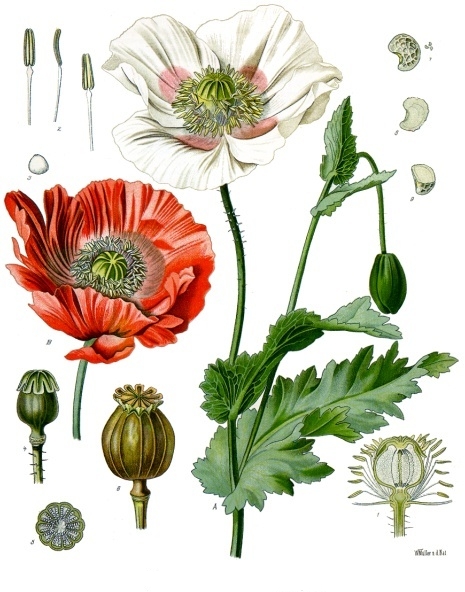

A plant does not make medicines: it makes defence molecules.
⚠ This page is not for treating yourself.
It provides no uses, no preparations and no dosages, and it does not enable anyone to identify plants. Any health question is a matter for a qualified health professional.
Why plants heal
A plant does not make medicines. It makes defence molecules — substances meant to keep insects away, to slow down fungi, to deter herbivores. It has no interest in healing us, and the fact that one of these molecules acts on the human body is a happy accident.
This accident can be explained. Living things have shared a common chemistry for hundreds of millions of years: a molecule designed to disrupt a caterpillar’s nervous system can disrupt ours, sometimes usefully. Any substance becomes a poison if the dose is too high; some, at low doses, can heal. This is a central idea in pharmacology, but it never says which dose is safe.
In a plant, this active substance amounts to almost nothing — often a very small fraction of the mass — and its quantity varies with the individual plant, the season, the soil and the part used. This is what makes the whole plant a hazardous remedy: one does not know exactly what dose one is taking. The pharmacist’s work has consisted of identifying the molecule responsible, then isolating it so that it can be dosed.
Two examples tell the story of this journey.
Willow bark had been used since antiquity against pain and fever. In the nineteenth century, salicin was extracted from it; chemists derived salicylic acid from it, then a modified form, developed in an attempt to irritate the stomach less: aspirin. The poppy, for its part, produces a latex, opium, from which morphine was isolated around 1804 — it is often seen as the first pure active substance extracted from a plant.1
The move from plant to molecule is not a technical detail. It is what turns a use into a medicine, because it makes possible what no traditional preparation allows: giving exactly the same quantity every time.
“Natural” does not mean “safe”
Many plants are toxic, some fatally so. Others interact with medical treatments and can make them ineffective or dangerous.
A plant cannot run away: it defends itself through chemistry. The molecules it synthesises exist for its own survival against predators, not to be useful to us.
What heals and what poisons is often simply a question of dose.
What medicine owes to ancient knowledge
The aim is not to repeat that other cultures “knew things”, but to identify what modern medicine still makes use of.
Artemisinin: from a Chinese text to the Nobel Prize
The clearest example of this approach is the discovery of artemisinin, a major treatment for malaria.
- The researcher: Tu Youyou, at the Academy of Traditional Chinese Medicine, in Beijing.
- The project: Project 523, a Chinese research programme launched in 1967.
- The recognition: Nobel Prize in Physiology or Medicine, in 2015.2
The story is valuable above all for the way it began — and it did not begin with an inspired reading.
An extract of sweet wormwood (Artemisia annua) had shown promising inhibition of the parasite. Then the result could not be reproduced. It even contradicted what the literature said.3
That is the real starting point: a result that refuses to come back.
To understand why, the team undertook an exhaustive review of the ancient literature. It found a single mention of this plant against the symptoms of malaria, in Ge Hong, in the fourth century:4
“A handful of qinghao immersed with 2 liters of water, wring out the juice and drink it all.”5
An ordinary sentence. But Tu Youyou noticed what was missing in it: there is no boiling.
Hence the hypothesis: the heat used in their own extraction method was perhaps destroying the active substance.6
They started again at low temperature. The activity became much better.7
They finally obtained an extract 100% effective against the parasite, in mice as in monkeys.8
The sequence of events deserves a pause. The ancient text did not provide the remedy: it provided a clue about method. And that clue was only useful because a team kept stumbling over a result it could not reproduce, and refused to ignore it.
This case brings together a researcher, an ancient clue and a measurable molecule: Ge Hong’s recipe, for its part, is not a treatment.
Cinchona: dismantling a received idea
The word “quinine” comes from the Quechua kina, meaning bark. The name of the medicine preserves a trace of the language of those who knew the tree (Cinchona).
A widespread account
The Andean peoples had always treated malaria with this bark, and the Europeans supposedly stole this knowledge from them.
What historians debate
- Absence of the disease: The Indigenous populations of the Americas do not carry the genetic adaptations to malaria at significant frequencies: the disease has either always been absent there or has been present for less than several centuries.
- A different initial use: The earliest Spanish accounts document a use of the bark against fevers and various ailments; its precise link with malaria is still debated by historians.
- Post-contact hypothesis: For these historians, the antimalarial use is thought to have arisen from the encounter between the imported disease and the local pharmacopoeia.9
The indispensable Andean contribution
There are more than twenty species in the genus Cinchona, whose concentrations of active principles (quinine and cinchonine) vary from one species to another, and even from one population to another.10
Without the expertise of Andean botanists and healers, the Europeans were unable to distinguish the effective species from the inactive varieties. In this reading, the contribution of Andean knowledge lies above all in the classification and identification of the effective species.11
The decision of 1820
In 1820, the French pharmacists Pierre-Joseph Pelletier and Joseph Bienaimé Caventou isolated pure quinine from the bark.12
They chose not to patent their manufacturing process, publishing their work so that global public health could benefit from it.
Benefit-sharing and intellectual property
Access to biological resources and traditional knowledge raises the question of how the economic benefits are shared between industrialised countries and Indigenous populations.
This area is now regulated, for the states that have ratified it, by the Nagoya Protocol (2010) on access to genetic resources and the fair and equitable sharing of benefits arising from their utilisation.13
Plant origin of medicines: getting the facts right
A frequent claim holds that a fixed proportion (e.g. 50% or 80%) of all medicines are directly derived from plants.
The reference survey is that of David Newman and Gordon Cragg, who reviewed nearly forty years of approved medicines. For small-molecule anticancer drugs approved from 1981 to 2019, they count 33.5% natural substances (not only plant-derived ones) or direct derivatives, and 64.9% if synthetic molecules built on a natural model are added. Classic, older examples: aspirin, morphine; a more recent one: paclitaxel, an anticancer drug.14
The gap is a matter of definition, not of uncertainty: depending on whether one counts only molecules of natural origin and their direct derivatives, or also molecules merely inspired by a natural model, the proportion goes from about a third to nearly two thirds. One must always know what a figure counts before comparing it with another.15
Note 1
Säure im Opium ; An Account of the Success of the Bark of the Willow in the Cure of Agues
Acid in Opium ; An Account of the Success of the Bark of the Willow in the Cure of Agues
Sertürner, Friedrich, “Säure im Opium”, Journal der Pharmacie, 1805-1806
first refined willow bark into yellow crystals and named it Salicin […] produced a stronger compound from the crystals isolated from willow bark, which he named salicylic acid […] decided to develop a form of salicylate that did not cause gastric irritation
Desborough, M. J. R. and Keeling, D. M., “The Aspirin Story – from Willow to Wonder Drug”, British Journal of Haematology, vol. 177, 2017, p. 674-683
Note 2
A national office for malaria control, known as the 523 Office (for purposes of confidentiality, the project was named for May 23, the date when it was initiated; the Office was terminated in March 1980) was established in 1967 with a mission of organizing and coordinating antimalarial drug research activities in seven provinces and cities across the country.
Tu, Youyou, “Artemisinin—A Gift from Traditional Chinese Medicine to the World”, Nobel Lecture, 7 December 2015, in The Nobel Prizes 2015, Nobel Foundation, p. 283-313
The Nobel Assembly at Karolinska Institutet has today decided to award the 2015 Nobel Prize in Physiology or Medicine with one half jointly to William C. Campbell and Satoshi Ōmura […] and the other half to Tu Youyou for her discoveries concerning a novel therapy against Malaria
Comité Nobel de physiologie ou médecine, communiqué du 5 October 2015
Note 3
The turning point came when an Artemisia annua L. extract showed a promising degree of inhibition against parasite growth. However, this observation was not reproducible in subsequent experiments and appeared to be contradictory to what was recorded in the literature.
Tu, Youyou, “The Discovery of Artemisinin (Qinghaosu) and Gifts from Chinese Medicine”, Nature Medicine, vol. 17, no. 10, 2011, p. 1217-1220
[…] I further pondered the sentence 青蒿一握, 以水二升渍, 绞取汁, 尽服之 (A handful of Qinghao immersed in two liters of water, wring out the juice and drink it all) […] This unique way of using Qinghao suddenly gave me the idea that heating might need to be avoided during extraction, in order to preserve the herb's activity.
Tu, Youyou, “Artemisinin—A Gift from Traditional Chinese Medicine to the World”, Nobel Lecture, 7 December 2015, in The Nobel Prizes 2015, Nobel Foundation, p. 283-313
Note 4
Seeking an explanation, we carried out an intensive review of the literature. The only reference relevant to use of qinghao […] for alleviating malaria symptoms appeared in Ge Hong's A Handbook of Prescriptions for Emergencies
Tu, Youyou, “The Discovery of Artemisinin (Qinghaosu) and Gifts from Chinese Medicine”, Nature Medicine, vol. 17, no. 10, 2011, p. 1217-1220
Note 5
A handful of qinghao immersed with 2 liters of water, wring out the juice and drink it all
Tu, Youyou, “The Discovery of Artemisinin (Qinghaosu) and Gifts from Chinese Medicine”, Nature Medicine, vol. 17, no. 10, 2011, p. 1217-1220
Note 6
This sentence gave me the idea that the heating involved in the conventional extraction step we had used might have destroyed the active components, and that extraction at a lower temperature might be necessary to preserve antimalarial activity.
Tu, Youyou, “The Discovery of Artemisinin (Qinghaosu) and Gifts from Chinese Medicine”, Nature Medicine, vol. 17, no. 10, 2011, p. 1217-1220
Note 7
Indeed, we obtained much better activity after switching to a lower-temperature procedure.
Tu, Youyou, “The Discovery of Artemisinin (Qinghaosu) and Gifts from Chinese Medicine”, Nature Medicine, vol. 17, no. 10, 2011, p. 1217-1220
Note 8
a non-toxic, neutral extract that was 100% effective against parasitemia in mice infected with Plasmodium berghei and in monkeys
Tu, Youyou, “The Discovery of Artemisinin (Qinghaosu) and Gifts from Chinese Medicine”, Nature Medicine, vol. 17, no. 10, 2011, p. 1217-1220
Note 9
Human polymorphisms which meet some or all of the expectations of the malaria hypothesis are found in elevated frequencies usually only in populations which have been exposed to malaria for at least several hundred years. Thus, the indigenous populations of northern Europe (with the exception of part of The Netherlands), northern parts of Asia, Australia, and all but the westernmost islands of the Pacific Ocean, and the Americas, from which malaria either has always been absent or has been present for less than this time, are all without these polymorphisms in significant frequencies.
Carter, Richard and Mendis, Kamini N., “Evolutionary and Historical Aspects of the Burden of Malaria”, Clinical Microbiology Reviews, vol. 15, 2002, p. 564-594
The Indians have the bark in abundance, and use it in all kinds of xamaras, whether with or without blood. The Spaniards, weary of this disease, on the advice of the Indians, have used this bark and have healed many of them with it. […] Haggis, Calancha, and Bado indicate that the natives used Cinchona bark as a remedy for fevers (3,11,12). […] In terms of who discovered Cinchona’s value as an antimalarial, 2 basic assumptions exist: the natives discovered both its febrifuge and antimalarial properties consciously, and Jesuits discovered its antimalarial value after learning of its febrifuge use by the natives.
Rojas-Jaimes, Jesús, Rodríguez-Gómez, Stephanie and Lombardi, Guido P., “Discovery of Cinchona as Antimalarial, Viceroyalty of Peru, Circa 1630”, Emerging Infectious Diseases, vol. 32, no. 7, 2026, p. 1141-1149
Note 10
C. calisaya is one of 23 species of trees in the genus Cinchona described to date, which produce varying amounts of alkaloids. The four major Cinchona alkaloids (quinine, quinidine, cinchonine, and cinchonidine) […] Quinine content does not only vary among species (Nair, 2010), but also among populations from different sites, complicating the identification of the most productive Cinchona barks (Townley, 1922; Holland, 1932).
Maldonado, Carla et al., “Phylogeny Predicts the Quantity of Antimalarial Alkaloids within the Iconic Yellow Cinchona Bark (Rubiaceae: Cinchona calisaya)”, Frontiers in Plant Science, vol. 8, 2017, art. 391
Note 11
Once a stand of trees was located, a bark collector had to be able to identify which of the trees had the best bark for harvesting, based on various factors including the age of the tree and its local environment. […] Unsurprisingly, the expeditions relied heavily on Andean knowledge of cinchona. […] Without the benefit of the knowledge of these local experts, scientific travellers from Europe would have been at a loss to gather, understand and classify specimens.
Crawford, Matthew James, “Cinchona”, in Thurner, Mark and Pimentel, Juan (ed.), New World Objects of Knowledge: A Cabinet of Curiosities, University of London Press, 2021, chap. 16
Note 12
Quinine was isolated in 1820 by two French pharmacists, Pierre Joseph Pelletier and Joseph Caventou, after which quinine replaced the bark as the standard treatment for malaria (20, 27). […] Unlike other scientists, they made their process freely available, that is, they did not patent it (29).
Jovanović, Aleksandar and Krajnović, Dušanka, “The Developmental Path of Quinine: What Can We Learn from History?”, Acta Medica Medianae, vol. 62, no. 2, 2023, p. 61-70
Note 13
Le Protocole de Nagoya sur l’accès aux ressources génétiques et le partage juste et équitable des avantages découlant de leur utilisation relatif à la Convention sur la diversité biologique a été adopté à la dixième réunion de la Conférence des Parties, le 29 octobre 2010, à Nagoya, au Japon, après six ans de négociations. […] Le présent Protocole entre en vigueur pour un État ou une organisation régionale d’intégration économique qui le ratifie, l’accepte, l’approuve ou y adhère après le dépôt du cinquantième instrument […]
The Nagoya Protocol on Access to Genetic Resources and the Fair and Equitable Sharing of Benefits Arising from their Utilization to the Convention on Biological Diversity was adopted at the tenth meeting of the Conference of the Parties, on 29 October 2010, in Nagoya, Japan, after six years of negotiation. […] This Protocol shall enter into force for a State or a regional economic integration organization that ratifies, accepts or approves it or accedes to it after the deposit of the fiftieth instrument […]
Secrétariat de la Convention sur la diversité biologique, Protocole de Nagoya sur l’accès aux ressources génétiques et le partage juste et équitable des avantages découlant de leur utilisation, Montréal, 2011
Note 14
in the area of cancer […] 62, or 33.5%, […] bringing the figure to 64.9%.
Newman, David J. and Cragg, Gordon M., “Natural Products as Sources of New Drugs over the Nearly Four Decades from 01/1981 to 09/2019”, Journal of Natural Products, vol. 83, 2020, p. 770-803
Note 15
As in the 2012 and 2016 reviews, we have continued to utilize our secondary subdivision of a "natural product mimic", or "NM", to join the original primary divisions […] For example, in the area of cancer, over the time frame from 1946 to 1980, of the 75 small molecules, 40, or 53.3%, are N or ND. In the 1981 to date time frame the equivalent figures for the N* compounds of the 185 small molecules are 62, or 33.5%, though to these can be added the 58 S* and S*/NMs, bringing the figure to 64.9%.
Newman, David J. and Cragg, Gordon M., “Natural Products as Sources of New Drugs over the Nearly Four Decades from 01/1981 to 09/2019”, Journal of Natural Products, vol. 83, 2020, p. 770-803
Notes and sources
- ↑
Passage Willow bark had been used […] against pain and fever. […] The poppy, for its part, produces a latex, opium, from which morphine was isolated around 1804
Säure im Opium ; An Account of the Success of the Bark of the Willow in the Cure of Agues
Editors’ translation Acid in Opium ; An Account of the Success of the Bark of the Willow in the Cure of Agues
Source Sertürner, Friedrich, “Säure im Opium”, Journal der Pharmacie, 1805-1806, original papers (Stone for willow bark, Sertürner for morphine).
Public domain · checked on 24 October 2026
Passage In the nineteenth century, salicin was extracted from it; chemists derived salicylic acid from it, then a modified form, developed in an attempt to irritate the stomach less: aspirin.
first refined willow bark into yellow crystals and named it Salicin […] produced a stronger compound from the crystals isolated from willow bark, which he named salicylic acid […] decided to develop a form of salicylate that did not cause gastric irritation
Source Desborough, M. J. R. and Keeling, D. M., “The Aspirin Story – from Willow to Wonder Drug”, British Journal of Haematology, vol. 177, 2017, p. 674-683, body of the article (Buchner, 1828; Piria, 1838; Eichengrün and Hoffmann, 1897).
In libraries open the source · checked on 24 October 2026
- ↑
Passage Project 523, a Chinese research programme launched in 1967
A national office for malaria control, known as the 523 Office (for purposes of confidentiality, the project was named for May 23, the date when it was initiated; the Office was terminated in March 1980) was established in 1967 with a mission of organizing and coordinating antimalarial drug research activities in seven provinces and cities across the country.
Source Tu, Youyou, “Artemisinin—A Gift from Traditional Chinese Medicine to the World”, Nobel Lecture, 7 December 2015, in The Nobel Prizes 2015, Nobel Foundation, p. 283-313, p. 289.
Open access open the source · checked on 27 October 2026
Passage Nobel Prize in Physiology or Medicine, in 2015
The Nobel Assembly at Karolinska Institutet has today decided to award the 2015 Nobel Prize in Physiology or Medicine with one half jointly to William C. Campbell and Satoshi Ōmura […] and the other half to Tu Youyou for her discoveries concerning a novel therapy against Malaria
Source Comité Nobel de physiologie ou médecine, communiqué du 5 October 2015, press release, first sentence (dated 2015-10-05).
Open access open the source · checked on 27 October 2026
- ↑
Passage An extract of sweet wormwood (Artemisia annua) had shown promising inhibition of the parasite. Then the result could not be reproduced. It even contradicted what the literature said.
The turning point came when an Artemisia annua L. extract showed a promising degree of inhibition against parasite growth. However, this observation was not reproducible in subsequent experiments and appeared to be contradictory to what was recorded in the literature.
Source Tu, Youyou, “The Discovery of Artemisinin (Qinghaosu) and Gifts from Chinese Medicine”, Nature Medicine, vol. 17, no. 10, 2011, p. 1217-1220, body of the article.
Paywalled open the source · checked on 9 September 2026
Passage the preparation of sweet wormwood without boiling
[…] I further pondered the sentence 青蒿一握, 以水二升渍, 绞取汁, 尽服之 (A handful of Qinghao immersed in two liters of water, wring out the juice and drink it all) […] This unique way of using Qinghao suddenly gave me the idea that heating might need to be avoided during extraction, in order to preserve the herb's activity.
Source Tu, Youyou, “Artemisinin—A Gift from Traditional Chinese Medicine to the World”, Nobel Lecture, 7 December 2015, in The Nobel Prizes 2015, Nobel Foundation, p. 283-313, p. 302 (quotation from Ge Hong) and p. 304.
Open access open the source · checked on 27 October 2026
- ↑
Passage the team undertook an exhaustive review of the ancient literature. It found a single mention of this plant against the symptoms of malaria, in Ge Hong
Seeking an explanation, we carried out an intensive review of the literature. The only reference relevant to use of qinghao […] for alleviating malaria symptoms appeared in Ge Hong's A Handbook of Prescriptions for Emergencies
Source Tu, Youyou, “The Discovery of Artemisinin (Qinghaosu) and Gifts from Chinese Medicine”, Nature Medicine, vol. 17, no. 10, 2011, p. 1217-1220, body of the article.
Paywalled open the source · checked on 9 September 2026
- ↑
Passage A handful of qinghao immersed with 2 liters of water, wring out the juice and drink it all.
A handful of qinghao immersed with 2 liters of water, wring out the juice and drink it all
Source Tu, Youyou, “The Discovery of Artemisinin (Qinghaosu) and Gifts from Chinese Medicine”, Nature Medicine, vol. 17, no. 10, 2011, p. 1217-1220, Ge Hong’s sentence as quoted in the article.
Paywalled open the source · checked on 9 September 2026
- ↑
Passage the heat used in their own extraction method was perhaps destroying the active substance
This sentence gave me the idea that the heating involved in the conventional extraction step we had used might have destroyed the active components, and that extraction at a lower temperature might be necessary to preserve antimalarial activity.
Source Tu, Youyou, “The Discovery of Artemisinin (Qinghaosu) and Gifts from Chinese Medicine”, Nature Medicine, vol. 17, no. 10, 2011, p. 1217-1220, body of the article.
Paywalled open the source · checked on 9 September 2026
- ↑
Passage They started again at low temperature. The activity became much better.
Indeed, we obtained much better activity after switching to a lower-temperature procedure.
Source Tu, Youyou, “The Discovery of Artemisinin (Qinghaosu) and Gifts from Chinese Medicine”, Nature Medicine, vol. 17, no. 10, 2011, p. 1217-1220, body of the article.
Paywalled open the source · checked on 9 September 2026
- ↑
Passage an extract 100% effective against the parasite, in mice as in monkeys
a non-toxic, neutral extract that was 100% effective against parasitemia in mice infected with Plasmodium berghei and in monkeys
Source Tu, Youyou, “The Discovery of Artemisinin (Qinghaosu) and Gifts from Chinese Medicine”, Nature Medicine, vol. 17, no. 10, 2011, p. 1217-1220, body of the article.
Paywalled open the source · checked on 9 September 2026
- ↑
Passage The Indigenous populations of the Americas do not carry the genetic adaptations to malaria at significant frequencies: the disease has either always been absent there or has been present for less than several centuries.
Human polymorphisms which meet some or all of the expectations of the malaria hypothesis are found in elevated frequencies usually only in populations which have been exposed to malaria for at least several hundred years. Thus, the indigenous populations of northern Europe (with the exception of part of The Netherlands), northern parts of Asia, Australia, and all but the westernmost islands of the Pacific Ocean, and the Americas, from which malaria either has always been absent or has been present for less than this time, are all without these polymorphisms in significant frequencies.
Source Carter, Richard and Mendis, Kamini N., “Evolutionary and Historical Aspects of the Burden of Malaria”, Clinical Microbiology Reviews, vol. 15, 2002, p. 564-594, § “How long does it take malaria to select for human polymorphisms?”, 1st paragraph.
Open access open the source · checked on 27 October 2026
Passage The earliest Spanish accounts document a use of the bark against fevers and various ailments; its precise link with malaria is still debated by historians.
The Indians have the bark in abundance, and use it in all kinds of xamaras, whether with or without blood. The Spaniards, weary of this disease, on the advice of the Indians, have used this bark and have healed many of them with it. […] Haggis, Calancha, and Bado indicate that the natives used Cinchona bark as a remedy for fevers (3,11,12). […] In terms of who discovered Cinchona’s value as an antimalarial, 2 basic assumptions exist: the natives discovered both its febrifuge and antimalarial properties consciously, and Jesuits discovered its antimalarial value after learning of its febrifuge use by the natives.
Source Rojas-Jaimes, Jesús, Rodríguez-Gómez, Stephanie and Lombardi, Guido P., “Discovery of Cinchona as Antimalarial, Viceroyalty of Peru, Circa 1630”, Emerging Infectious Diseases, vol. 32, no. 7, 2026, p. 1141-1149, section “Discovery of Cinchona’s Value as an Antimalarial”, 4th paragraph (quotation from Monardes); section “Discussion”, 2nd paragraph; section “Discovery of Cinchona’s Value as an Antimalarial”, 1st paragraph.
Open access open the source · checked on 27 October 2026
- ↑
Passage There are more than twenty species in the genus Cinchona, whose concentrations of active principles (quinine and cinchonine) vary from one species to another, and even from one population to another.
C. calisaya is one of 23 species of trees in the genus Cinchona described to date, which produce varying amounts of alkaloids. The four major Cinchona alkaloids (quinine, quinidine, cinchonine, and cinchonidine) […] Quinine content does not only vary among species (Nair, 2010), but also among populations from different sites, complicating the identification of the most productive Cinchona barks (Townley, 1922; Holland, 1932).
Source Maldonado, Carla et al., “Phylogeny Predicts the Quantity of Antimalarial Alkaloids within the Iconic Yellow Cinchona Bark (Rubiaceae: Cinchona calisaya)”, Frontiers in Plant Science, vol. 8, 2017, art. 391, introduction, 2nd and 4th paragraphs.
Open access open the source · checked on 27 October 2026
- ↑
Passage In this reading, the contribution of Andean knowledge lies above all in the classification and identification of the effective species.
Once a stand of trees was located, a bark collector had to be able to identify which of the trees had the best bark for harvesting, based on various factors including the age of the tree and its local environment. […] Unsurprisingly, the expeditions relied heavily on Andean knowledge of cinchona. […] Without the benefit of the knowledge of these local experts, scientific travellers from Europe would have been at a loss to gather, understand and classify specimens.
Source Crawford, Matthew James, “Cinchona”, in Thurner, Mark and Pimentel, Juan (ed.), New World Objects of Knowledge: A Cabinet of Curiosities, University of London Press, 2021, chap. 16, chap. 16, “Cinchona”, 4th paragraph (7th sentence) and 7th paragraph (2nd and last sentences).
Open access open the source · checked on 27 October 2026
- ↑
Passage In 1820, the French pharmacists Pierre-Joseph Pelletier and Joseph Bienaimé Caventou isolated pure quinine […] They chose not to patent their manufacturing process
Quinine was isolated in 1820 by two French pharmacists, Pierre Joseph Pelletier and Joseph Caventou, after which quinine replaced the bark as the standard treatment for malaria (20, 27). […] Unlike other scientists, they made their process freely available, that is, they did not patent it (29).
Source Jovanović, Aleksandar and Krajnović, Dušanka, “The Developmental Path of Quinine: What Can We Learn from History?”, Acta Medica Medianae, vol. 62, no. 2, 2023, p. 61-70, p. 63, paragraph beginning “As a medicine that saved many lives”.
Open access open the source · checked on 27 October 2026
- ↑
Passage This area is now regulated, for the states that have ratified it, by the Nagoya Protocol (2010)
Le Protocole de Nagoya sur l’accès aux ressources génétiques et le partage juste et équitable des avantages découlant de leur utilisation relatif à la Convention sur la diversité biologique a été adopté à la dixième réunion de la Conférence des Parties, le 29 octobre 2010, à Nagoya, au Japon, après six ans de négociations. […] Le présent Protocole entre en vigueur pour un État ou une organisation régionale d’intégration économique qui le ratifie, l’accepte, l’approuve ou y adhère après le dépôt du cinquantième instrument […]
Editors’ translation The Nagoya Protocol on Access to Genetic Resources and the Fair and Equitable Sharing of Benefits Arising from their Utilization to the Convention on Biological Diversity was adopted at the tenth meeting of the Conference of the Parties, on 29 October 2010, in Nagoya, Japan, after six years of negotiation. […] This Protocol shall enter into force for a State or a regional economic integration organization that ratifies, accepts or approves it or accedes to it after the deposit of the fiftieth instrument […]
Source Secrétariat de la Convention sur la diversité biologique, Protocole de Nagoya sur l’accès aux ressources génétiques et le partage juste et équitable des avantages découlant de leur utilisation, Montréal, 2011, introduction, p. 1, first sentence; Article 33 (“Entry into force”), para. 2, p. 23.
Open access open the source · checked on 27 October 2026
- ↑
Passage For small-molecule anticancer drugs approved from 1981 to 2019, they count 33.5% natural substances (not only plant-derived ones) or direct derivatives, and 64.9% if synthetic molecules built on a natural model are added.
in the area of cancer […] 62, or 33.5%, […] bringing the figure to 64.9%.
Source Newman, David J. and Cragg, Gordon M., “Natural Products as Sources of New Drugs over the Nearly Four Decades from 01/1981 to 09/2019”, Journal of Natural Products, vol. 83, 2020, p. 770-803, abstract (categories N and ND, then S* and S*/NM).
Open access · checked on 24 October 2026
- ↑
Passage depending on whether one counts only molecules of natural origin and their direct derivatives, or also molecules merely inspired by a natural model, the proportion goes from about a third to nearly two thirds
As in the 2012 and 2016 reviews, we have continued to utilize our secondary subdivision of a "natural product mimic", or "NM", to join the original primary divisions […] For example, in the area of cancer, over the time frame from 1946 to 1980, of the 75 small molecules, 40, or 53.3%, are N or ND. In the 1981 to date time frame the equivalent figures for the N* compounds of the 185 small molecules are 62, or 33.5%, though to these can be added the 58 S* and S*/NMs, bringing the figure to 64.9%.
Source Newman, David J. and Cragg, Gordon M., “Natural Products as Sources of New Drugs over the Nearly Four Decades from 01/1981 to 09/2019”, Journal of Natural Products, vol. 83, 2020, p. 770-803, abstract.
Open access open the source · checked on 27 October 2026
Bibliography
17
- Andersson, Lennart, “A Revision of the Genus Cinchona (Rubiaceae-Cinchoneae)”, Memoirs of the New York Botanical Garden, vol. 80, 1998, in libraries (the species of the genus and their contents).
- Carter, Richard and Mendis, Kamini N., “Evolutionary and Historical Aspects of the Burden of Malaria”, Clinical Microbiology Reviews, vol. 15, 2002, p. 564-594, open access (the absence of genetic adaptations to malaria among the Indigenous populations of the Americas). https://doi.org/10.1128/CMR.15.4.564-594.2002
- Comité Nobel de physiologie ou médecine, communiqué du 5 October 2015, open access (the prize awarded half to Tu Youyou). https://www.nobelprize.org/prizes/medicine/2015/press-release/
- Crawford, Matthew James, The Andean Wonder Drug: Cinchona Bark and Imperial Science in the Spanish Atlantic, 1630-1800, University of Pittsburgh Press, 2016, in libraries (Andean uses, the identification of the effective species, the questioning of the account of “stolen” knowledge).
- Crawford, Matthew James, “Cinchona”, in Thurner, Mark and Pimentel, Juan (ed.), New World Objects of Knowledge: A Cabinet of Curiosities, University of London Press, 2021, chap. 16, open access (the knowledge of Andean experts, without which Europeans could neither gather nor classify cinchona specimens). https://read.uolpress.co.uk/read/new-world-objects-of-knowledge/section/955a6d49-53ab-41e5-8633-5193a5bfc10a
- Desborough, M. J. R. and Keeling, D. M., “The Aspirin Story – from Willow to Wonder Drug”, British Journal of Haematology, vol. 177, 2017, p. 674-683, in libraries (salicin obtained from willow bark, salicylic acid, then the acetylation sought to reduce stomach irritation). https://doi.org/10.1111/bjh.14520
- Ge Hong, Zhouhou beiji fang [Manuel des prescriptions pour les traitements d’urgence], vers 340, public domain (the preparation of sweet wormwood without boiling).
- Jovanović, Aleksandar and Krajnović, Dušanka, “The Developmental Path of Quinine: What Can We Learn from History?”, Acta Medica Medianae, vol. 62, no. 2, 2023, p. 61-70, open access (the isolation of quinine by Pelletier and Caventou in 1820; their process left free, unpatented). https://doi.org/10.5633/amm.2023.0208
- Maldonado, Carla et al., “Phylogeny Predicts the Quantity of Antimalarial Alkaloids within the Iconic Yellow Cinchona Bark (Rubiaceae: Cinchona calisaya)”, Frontiers in Plant Science, vol. 8, 2017, art. 391, open access (23 described Cinchona species; alkaloid content varying by species and population). https://doi.org/10.3389/fpls.2017.00391
- Miller, Louis H. and Su, Xinzhuan, “Artemisinin: Discovery from the Chinese Herbal Garden”, Cell, vol. 146, 2011, p. 855-858, open access (the history of Project 523).
- Newman, David J. and Cragg, Gordon M., “Natural Products as Sources of New Drugs over the Nearly Four Decades from 01/1981 to 09/2019”, Journal of Natural Products, vol. 83, 2020, p. 770-803, open access (the real share of medicines derived from or based on natural substances, and what each category covers).
- Pelletier, Pierre-Joseph and Caventou, Joseph Bienaimé, “Recherches chimiques sur les quinquinas”, Annales de chimie et de physique, t. 15, 1820, p. 289-318 et 337-365, public domain (the isolation of quinine, published without a patent).
- Rojas-Jaimes, Jesús, Rodríguez-Gómez, Stephanie and Lombardi, Guido P., “Discovery of Cinchona as Antimalarial, Viceroyalty of Peru, Circa 1630”, Emerging Infectious Diseases, vol. 32, no. 7, 2026, p. 1141-1149, open access (the earliest accounts, from Monardes to Calancha and Bado, of the bark used against fluxes and fevers; the two hypotheses on the discovery of its antimalarial value). https://doi.org/10.3201/eid3207.260042
- Secrétariat de la Convention sur la diversité biologique, Protocole de Nagoya sur l’accès aux ressources génétiques et le partage juste et équitable des avantages découlant de leur utilisation, Montréal, 2011, open access (adopted in 2010, entered into force in 2014).
- Sertürner, Friedrich, “Säure im Opium”, Journal der Pharmacie, 1805-1806, public domain (the isolation of morphine) ; et Stone, Edward, “An Account of the Success of the Bark of the Willow in the Cure of Agues”, Philosophical Transactions of the Royal Society, vol. 53, 1763, p. 195-200, public domain (willow bark).
- Tu, Youyou, “Artemisinin—A Gift from Traditional Chinese Medicine to the World”, Nobel Lecture, 7 December 2015, in The Nobel Prizes 2015, Nobel Foundation, p. 283-313, open access (Ge Hong’s recipe, the wormwood steeped rather than boiled, and the idea of extraction without heating; the 523 Office established in 1967). https://www.nobelprize.org/uploads/2018/06/tu-lecture.pdf
- Tu, Youyou, “The Discovery of Artemisinin (Qinghaosu) and Gifts from Chinese Medicine”, Nature Medicine, vol. 17, no. 10, 2011, p. 1217-1220, paywalled (the non-reproducible result that started the investigation; the review of the ancient literature; Ge Hong’s sentence; the hypothesis about destructive heat; the much better activity at low temperature; the extract 100% effective in mice and monkeys). https://doi.org/10.1038/nm.2471
Spotted an error or have a doubt? Write to us.