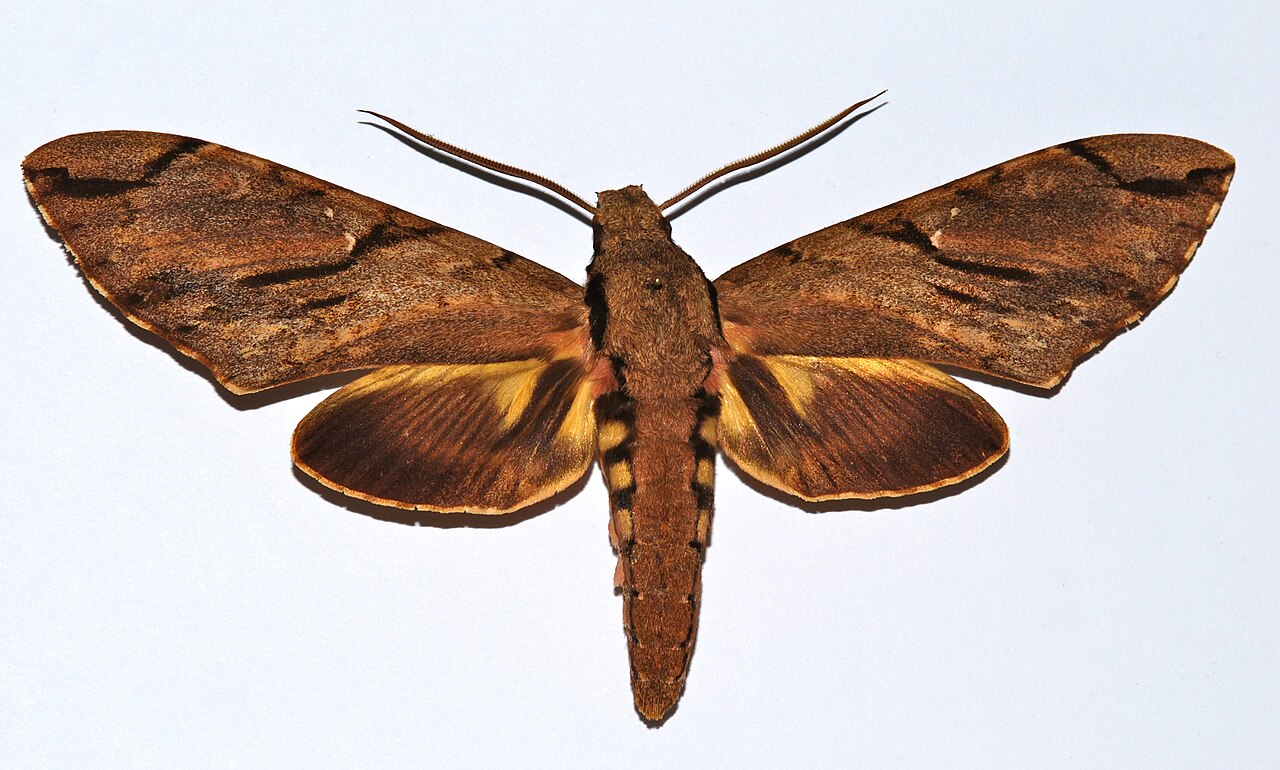

In 1862, Darwin announced the existence of a moth that no one had ever seen.1
It was discovered in 1903. It was named “the predicted one”.
The story usually told about it is wrong on two points — one of which changes everything.
What Darwin saw
Darwin was studying orchids and the way insects fertilise them. He was sent flowers of a species from Madagascar: Angraecum sesquipedale.
This orchid has a spur: a long, thin tube hanging below the flower, which produces the nectar.
He measured it: about twenty-nine centimetres.
He then noted a decisive detail: only the last four centimetres contain nectar.2
The reasoning
Darwin asked the fundamental question: what is a tube of such disproportionate length for?
A logical chain of reasoning follows:
- If this flower exists, it must reproduce.
- If it reproduces, some insect must reach its nectar.
- To reach the nectar at the bottom of a twenty-nine-centimetre tube, this insect must have a proboscis twenty-five to twenty-eight centimetres long.
So he wrote: there must be a moth in Madagascar with a proboscis of such a length.3
No one had ever seen anything like it.
The astronomical comparison
Five years later, in 1867, Alfred Russel Wallace took up the prediction and made it more precise. His method deserves to be set out in detail, because it is within anyone’s reach.4
He did not guess. He went to measure moths in a museum.5
He measured the proboscis of a South American hawk moth: just over twenty-three centimetres. That of a hawk moth from tropical Africa: about nineteen centimetres.6
He then did a simple subtraction. A species whose proboscis exceeded these by five to eight centimetres would reach the nectar of the orchid’s largest flowers.7
In other words: the moth being sought is not an impossible monster. It is barely longer than those that already exist. That is what makes the prediction reasonable — and it is what Darwin had not shown.
He went on to write that such a moth may be safely predicted, and urged naturalists visiting Madagascar to search for it with as much confidence as astronomers searched for the planet Neptune — and they will be equally successful.8
Astronomers had calculated where an unknown planet must be, pointed their telescope, and found it.
This is neither a hunch nor a guess, but a falsifiable prediction.
The 1903 discovery
In 1903, two naturalists described a large hawk moth from Madagascar with an enormous proboscis that can exceed twenty-five centimetres.9
The animal was identified twenty-one years after Darwin’s death.
They named it Xanthopan morganii praedicta (“the predicted one”), as a mere subspecies of a hawk moth already known from mainland Africa.
A recent twist: in 2021, a team reopened the case by combining anatomy and DNA barcoding, and concluded that the Madagascar moth is not a subspecies but a species in its own right. It is now called Xanthopan praedicta. The predictive name, for its part, has been kept — one hundred and eighteen years after it was given.10
Two common errors in this story
1. The name does not pay tribute to Darwin
The epithet praedicta honours the prediction made by Wallace in 1867. It was he who, by comparison with real specimens, had put a figure on the proboscis being sought and identified the precise group — the hawk moths — whereas Darwin had spoken of a moth in general terms.
2. The moth was not “verified” in 1903
In 1903, the researchers described a dead specimen in a museum. The insect’s existence was proved, but not its role as a pollinator.
For nearly a century, the scientific community assumed that this hawk moth pollinated the orchid. Experimental confirmation took more than a century:
- 1992: first observations of the hawk moth visiting the orchid, by the German biologist Lutz T. Wasserthal.
- 1993-1997: publication of direct observations, infra-red films and photographs showing the moth visiting the flower.
- 2004: video footage showing the moth visiting the flower and carrying off its pollinia (pollen sacs).11
142 years passed between the theoretical prediction and its direct proof.12
Summary: the scientific method in 4 stages
| Stage | Date | Actor | Scientific contribution |
|---|---|---|---|
| Formulation | 1862 | Charles Darwin | Deduction of the existence of a long-tongued pollinator |
| Refinement | 1867 | Alfred Russel Wallace | Measurement of real proboscises, quantification of the gap, identification of hawk moths, comparison with Neptune |
| Description | 1903 | Rothschild & Jordan | Morphological identification of the museum insect |
| Observation | 1992–2004 | Wasserthal et al. | Visual and material proof of pollen transfer |
The rules of pollination and of living things
A prediction is not a guess
A scientific prediction rests on a mechanical or evolutionary constraint. It is falsifiable: if thorough exploration had shown that the orchid reproduced by self-fertilisation without any insect, the hypothesis would have collapsed.
The fallacy of the exclusive pair
The popular account often sums up the situation as “one plant = one moth”. The ecological reality is a network of interactions:
- Madagascar has about 30 species of long-spurred orchids.
- It also has 7 species of long-tongued hawk moths, which probably form, together with these orchids, a network of linked species.13
Beyond the Darwin case: the second orchid
Another Malagasy species, Solenangis impraedicta — “the unpredicted one”, described in 2024 — has a spur that can reach 33 centimetres: relative to the size of its flower, it is the longest known.14
Two hypotheses remain for experiment to decide between:
- The specialised mutualism hypothesis: an unknown hawk moth with an even longer proboscis exists.
- The deceptive mimicry hypothesis: the flower offers no nectar and exploits the learning of moths that visit Angraecum sesquipedale. This strategy requires the deceptive flower to remain rare in its habitat so as not to educate the insects.
The general framework: flowers, seeds and population dynamics
The relationship between the orchid and the hawk moth is one instance of the general mechanisms of reproduction in angiosperms.
From flower to seed
- Pollination: transport of pollen (which carries the male gametes) to the stigma (female organ) by wind, water or an animal vector (zoophily).
- Fertilisation: germination of the pollen grain and union of the gametes within the ovule.
- Maturation: transformation of the ovule into a seed (containing the embryo and food reserves) and of the ovary into a fruit.
- Dispersal: movement of the seed away from the parent plant — carried by wind, water, or an animal that transports it in its fur or eats it and expels it elsewhere.15
This fourth stage is the exact counterpart of the first. Pollination makes pollen travel to another flower; dispersal makes the seed travel to another patch of ground. A plant is rooted to the spot, and yet everything in its reproduction is organised so that something leaves.
A plant does not bet on an individual
This is where the case of the orchid takes on its full meaning again.
A predator–prey pair or a parent–offspring pair can be described at the level of individuals. Plant reproduction cannot: it is played out in numbers. A plant produces an enormous number of seeds, the vast majority of which will never germinate — wrong place, wrong season, eaten, dried out.
What the specialisation of Angraecum buys is therefore not the survival of a flower. It is a rate: pollen deposited in the right place more often, over thousands of attempts, for thousands of generations.
The vocabulary here calls for a warning, as elsewhere on this site. People readily say that a flower “wants” to attract an insect, or that a seed “looks for” soil. These expressions are convenient, but wrong. What happens is simpler, and less reassuring: the combinations that succeeded more often left more descendants than the others. No one was aiming at anything.
Note 1
It is, however, surprising that any insect should be able to reach the nectar : our English sphinxes have probosces as long as their bodies; but in Madagascar there must be moths with probosces capable of extension to a length of between ten and eleven inches!
Darwin, Charles, On the Various Contrivances by Which British and Foreign Orchids Are Fertilised by Insects, John Murray, 1862, public domain
Note 2
In several flowers sent me by Mr. Bateman I found the nectaries eleven and a half inches long, with only the lower inch and a half filled with very sweet nectar. […] but in Madagascar there must be moths with probosces capable of extension to a length of between ten and eleven inches!
Darwin, Charles, On the Various Contrivances by Which British and Foreign Orchids Are Fertilised by Insects, John Murray, 1862
Note 3
It is, however, surprising that any insect should be able to reach the nectar: our English sphinxes have probosces as long as their bodies; but in Madagascar there must be moths with probosces capable of extension to a length of between ten and eleven inches!
Darwin, Charles, On the Various Contrivances by Which British and Foreign Orchids Are Fertilised by Insects, John Murray, 1862
Note 4
I have carefully measured the proboscis of a specimen of Macrosila cluentius from South America in the collection of the British Museum, and find it to be nine inches and a quarter long! One from tropical Africa (Macrosila morganii) is seven inches and a half. A species having a proboscis two or three inches longer could reach the nectar in the largest flowers of Angræcum sesquipedale, whose nectaries vary in length from ten to fourteen inches. That such a moth exists in Madagascar may be safely predicted
Wallace, Alfred Russel, “Creation by Law”, Quarterly Journal of Science, vol. 4, October 1867, p. 471-488, public domain
Note 5
I have carefully measured the proboscis of a specimen of Macrosila cluentius from South America in the collection of the British Museum, and find it to be nine inches and a quarter long! One from tropical Africa (Macrosila morganii) is seven inches and a half.
Wallace, Alfred Russel, “Creation by Law”, Quarterly Journal of Science, vol. 4, October 1867, p. 471-488
Note 6
I have carefully measured the proboscis of a specimen of Macrosila cluentius from South America in the collection of the British Museum, and find it to be nine inches and a quarter long! One from tropical Africa (Macrosila morganii) is seven inches and a half.
Wallace, Alfred Russel, “Creation by Law”, Quarterly Journal of Science, vol. 4, October 1867, p. 471-488
Note 7
A species having a proboscis two or three inches longer could reach the nectar in the largest flowers of Angræcum sesquipedale, whose nectaries vary in length from ten to fourteen inches.
Wallace, Alfred Russel, “Creation by Law”, Quarterly Journal of Science, vol. 4, October 1867, p. 471-488
Note 8
That such a moth exists in Madagascar may be safely predicted; and naturalists who visit that island should search for it with as much confidence as astronomers searched for the planet Neptune,—and they will be equally successful!
Wallace, Alfred Russel, “Creation by Law”, Quarterly Journal of Science, vol. 4, October 1867, p. 471-488
Note 9
b. X. morgani praedicta subsp. nov. […] As the tongue of X. morgani praedicta is long enough — about 225 mm. = 8 inches — to reach the honey in short and medium-sized nectaries of Angraecum, the moths will not abandon the flowers with especially long nectary without trying to reach the fluid, which fills up, in hot-house specimens of Angraecum, about one-fourth of the nectary.
Rothschild, Walter and Jordan, Karl, “A Revision of the Lepidopterous Family Sphingidae”, Novitates Zoologicae, vol. 9, supplément, 1903
While there are many hundreds of species of hawkmoths found throughout the tropics, Darwin’s hawkmoth, with its 9- to 14-inch-long coiled proboscis, is found only in Madagascar.
California Academy of Sciences, “Darwin’s Hawkmoth”, Explore Science, open access
Note 10
The taxonomic status of the famous Malagasy hawkmoth known as “Darwin’s Moth” or “Wallace’s Sphinx Moth” is revised after a thorough integrative study combining comparative analyses of morphological characters (“habitus”, genitalia, proboscis length, etc.) and molecular data (DNA barcoding essentially). […] We propose to raise the taxon praedicta to species rank
Minet, Joël et al., “A New Taxonomic Status for Darwin’s "Predicted" Pollinator: Xanthopan praedicta stat. nov.”, Antenor, vol. 8, no. 1, 2021, p. 69-86
Note 11
However, it was not until 1992, a good ninety years later, that Lutz Wasserthal, a German biologist, observed X. morganii visiting the flowers of A. sesquipedale in real life.
Bawa, Kamaljit S., “The Intertwined Attractions of Plants, Moths, and People”, Arnoldia, vol. 78, no. 5-6, 2021, p. 62-67, open access
Direct observations, infra-red cinematography and photographs published between 1993 and 1997 and a video made in 2004, all of which show X. morganii praedicta visiting A. sesquipedale flowers and removing pollinia, proved that Darwin's prediction was accurate.
Arditti, Joseph, Elliott, John, Kitching, Ian J. and Wasserthal, Lutz T., “"Good Heavens What Insect Can Suck It" — Charles Darwin, Angraecum sesquipedale and Xanthopan morganii praedicta*”, *Botanical Journal of the Linnean Society, vol. 169, 2012, p. 403-432
Note 12
And so began a forty-year story that illustrated the power of evolution by natural selection, created a controversy regarding creation, and predicted the existence of a "gigantic moth."
Kritsky, Gene, “Darwin’s Madagascan Hawk Moth Prediction”, American Entomologist, vol. 37, 1991, p. 206-210
Note 13
However, Madagascar harbours c. 30 species of long-spurred orchids and seven species of long-tongued hawkmoths, and mutualisms between moths and ‘Angraecum and other deep tubular flowers’ (Darwin, 1862: p. 202) probably involve a network of interacting species.
Netz, Christoph and Renner, Susanne S., “Long-Spurred Angraecum Orchids and Long-Tongued Sphingid Moths on Madagascar”, Biological Journal of the Linnean Society, vol. 122, no. 2, 2017, p. 469-478
Note 14
It bears the longest spur of any flowering plant, relative to flower diameter, reaching 33 cm.
Farminhão, João et al., “A New Orchid Species Expands Darwin’s Predicted Pollination Guild in Madagascar”, Current Biology, vol. 34, no. 5, 2024, p. R189-R190
Note 15
In angiosperms, pollination is defined as the placement or transfer of pollen from the anther to the stigma of the same flower or another flower. […] Together, these two fertilization events in angiosperms are known as double fertilization […] As the fruit matures, the seeds also mature. […] The fruit has a single purpose: seed dispersal.
Clark, Mary Ann, Douglas, Matthew and Choi, Jung, Biology 2e, OpenStax, chapter 32.2 “Pollination and Fertilization”
Notes and sources
- ↑
Passage In 1862, Darwin announced the existence of a moth that no one had ever seen
It is, however, surprising that any insect should be able to reach the nectar : our English sphinxes have probosces as long as their bodies; but in Madagascar there must be moths with probosces capable of extension to a length of between ten and eleven inches!
Source Darwin, Charles, On the Various Contrivances by Which British and Foreign Orchids Are Fertilised by Insects, John Murray, 1862, public domain, chapter V (Vandeae), passage on Angraecum sesquipedale (scan 212 of the archive.org digitised copy).
Open access · checked on 24 October 2026
- ↑
Passage This orchid has a spur […] He measured it: about twenty-nine centimetres […] only the last four centimetres contain nectar
In several flowers sent me by Mr. Bateman I found the nectaries eleven and a half inches long, with only the lower inch and a half filled with very sweet nectar. […] but in Madagascar there must be moths with probosces capable of extension to a length of between ten and eleven inches!
Source Darwin, Charles, On the Various Contrivances by Which British and Foreign Orchids Are Fertilised by Insects, John Murray, 1862, chapter V, passage on Angræcum sesquipedale (scans 214-215 of the digitised copy).
Public domain open the source · checked on 24 October 2026
- ↑
Passage there must be a moth in Madagascar with a proboscis of such a length
It is, however, surprising that any insect should be able to reach the nectar: our English sphinxes have probosces as long as their bodies; but in Madagascar there must be moths with probosces capable of extension to a length of between ten and eleven inches!
Source Darwin, Charles, On the Various Contrivances by Which British and Foreign Orchids Are Fertilised by Insects, John Murray, 1862, chap. V, p. 198.
Public domain open the source · checked on 9 September 2026
- ↑
Passage Five years later, in 1867, Alfred Russel Wallace took up the prediction and made it more precise
I have carefully measured the proboscis of a specimen of Macrosila cluentius from South America in the collection of the British Museum, and find it to be nine inches and a quarter long! One from tropical Africa (Macrosila morganii) is seven inches and a half. A species having a proboscis two or three inches longer could reach the nectar in the largest flowers of Angræcum sesquipedale, whose nectaries vary in length from ten to fourteen inches. That such a moth exists in Madagascar may be safely predicted
Source Wallace, Alfred Russel, “Creation by Law”, Quarterly Journal of Science, vol. 4, October 1867, p. 471-488, public domain, note 2 of the article (passage on Angræcum sesquipedale), transcription S140 of “Creation by Law”.
Open access open the source · checked on 24 October 2026
- ↑
Passage He did not guess. He went to measure moths in a museum.
I have carefully measured the proboscis of a specimen of Macrosila cluentius from South America in the collection of the British Museum, and find it to be nine inches and a quarter long! One from tropical Africa (Macrosila morganii) is seven inches and a half.
Source Wallace, Alfred Russel, “Creation by Law”, Quarterly Journal of Science, vol. 4, October 1867, p. 471-488, note 2 of the original (note reference on p. 477).
Public domain open the source · checked on 9 September 2026
- ↑
Passage the proboscis of a South American hawk moth: just over twenty-three centimetres. That of a hawk moth from tropical Africa: about nineteen centimetres.
I have carefully measured the proboscis of a specimen of Macrosila cluentius from South America in the collection of the British Museum, and find it to be nine inches and a quarter long! One from tropical Africa (Macrosila morganii) is seven inches and a half.
Source Wallace, Alfred Russel, “Creation by Law”, Quarterly Journal of Science, vol. 4, October 1867, p. 471-488, p. 477, note 2.
Public domain open the source · checked on 9 September 2026
- ↑
Passage A species whose proboscis exceeded these by five to eight centimetres would reach the nectar of the orchid’s largest flowers.
A species having a proboscis two or three inches longer could reach the nectar in the largest flowers of Angræcum sesquipedale, whose nectaries vary in length from ten to fourteen inches.
Source Wallace, Alfred Russel, “Creation by Law”, Quarterly Journal of Science, vol. 4, October 1867, p. 471-488, p. 477, note 2.
Public domain open the source · checked on 9 September 2026
- ↑
Passage such a moth may be safely predicted […] with as much confidence as astronomers searched for the planet Neptune — and they will be equally successful
That such a moth exists in Madagascar may be safely predicted; and naturalists who visit that island should search for it with as much confidence as astronomers searched for the planet Neptune,—and they will be equally successful!
Source Wallace, Alfred Russel, “Creation by Law”, Quarterly Journal of Science, vol. 4, October 1867, p. 471-488, p. 477, note 2.
Public domain open the source · checked on 9 September 2026
- ↑
Passage two naturalists described a large hawk moth from Madagascar with an enormous proboscis […] They named it Xanthopan morganii praedicta
b. X. morgani praedicta subsp. nov. […] As the tongue of X. morgani praedicta is long enough — about 225 mm. = 8 inches — to reach the honey in short and medium-sized nectaries of Angraecum, the moths will not abandon the flowers with especially long nectary without trying to reach the fluid, which fills up, in hot-house specimens of Angraecum, about one-fourth of the nectary.
Source Rothschild, Walter and Jordan, Karl, “A Revision of the Lepidopterous Family Sphingidae”, Novitates Zoologicae, vol. 9, supplément, 1903, systematic part, genus Xanthopan, p. 32 (index: “praedicta (Xanthopan), 32”).
Open access · checked on 24 October 2026
Passage that can exceed twenty-five centimetres
While there are many hundreds of species of hawkmoths found throughout the tropics, Darwin’s hawkmoth, with its 9- to 14-inch-long coiled proboscis, is found only in Madagascar.
Source California Academy of Sciences, “Darwin’s Hawkmoth”, Explore Science, open access, body of the page (9 to 14 inches, i.e. about 23 to 36 cm).
Open access open the source · checked on 27 October 2026
- ↑
Passage in 2021, a team reopened the case by combining anatomy and DNA barcoding, and concluded […] a species in its own right
The taxonomic status of the famous Malagasy hawkmoth known as “Darwin’s Moth” or “Wallace’s Sphinx Moth” is revised after a thorough integrative study combining comparative analyses of morphological characters (“habitus”, genitalia, proboscis length, etc.) and molecular data (DNA barcoding essentially). […] We propose to raise the taxon praedicta to species rank
Source Minet, Joël et al., “A New Taxonomic Status for Darwin’s "Predicted" Pollinator: Xanthopan praedicta stat. nov.”, Antenor, vol. 8, no. 1, 2021, p. 69-86, abstract, first sentence and beginning of the fourth.
Paywalled · checked on 25 October 2026
- ↑
Passage 1992: first observations of the hawk moth visiting the orchid, by the German biologist Lutz T. Wasserthal.
However, it was not until 1992, a good ninety years later, that Lutz Wasserthal, a German biologist, observed X. morganii visiting the flowers of A. sesquipedale in real life.
Source Bawa, Kamaljit S., “The Intertwined Attractions of Plants, Moths, and People”, Arnoldia, vol. 78, no. 5-6, 2021, p. 62-67, open access, body of the article.
Open access open the source · checked on 27 October 2026
Passage 1993-1997: publication of direct observations, infra-red films and photographs showing the moth visiting the flower.
Direct observations, infra-red cinematography and photographs published between 1993 and 1997 and a video made in 2004, all of which show X. morganii praedicta visiting A. sesquipedale flowers and removing pollinia, proved that Darwin's prediction was accurate.
Source Arditti, Joseph, Elliott, John, Kitching, Ian J. and Wasserthal, Lutz T., “"Good Heavens What Insect Can Suck It" — Charles Darwin, Angraecum sesquipedale and Xanthopan morganii praedicta*”, *Botanical Journal of the Linnean Society, vol. 169, 2012, p. 403-432, abstract, fifth sentence.
Paywalled · checked on 27 October 2026
Passage 2004: video footage showing the moth visiting the flower and carrying off its pollinia
Direct observations, infra-red cinematography and photographs published between 1993 and 1997 and a video made in 2004, all of which show X. morganii praedicta visiting A. sesquipedale flowers and removing pollinia, proved that Darwin's prediction was accurate.
Source Arditti, Joseph, Elliott, John, Kitching, Ian J. and Wasserthal, Lutz T., “"Good Heavens What Insect Can Suck It" — Charles Darwin, Angraecum sesquipedale and Xanthopan morganii praedicta*”, *Botanical Journal of the Linnean Society, vol. 169, 2012, p. 403-432, abstract, fifth sentence.
Paywalled · checked on 25 October 2026
- ↑
Passage the history of the prediction and its reception
And so began a forty-year story that illustrated the power of evolution by natural selection, created a controversy regarding creation, and predicted the existence of a "gigantic moth."
Source Kritsky, Gene, “Darwin’s Madagascan Hawk Moth Prediction”, American Entomologist, vol. 37, 1991, p. 206-210, first paragraph (reused as an abstract).
Paywalled · checked on 25 October 2026
- ↑
Passage Madagascar has about 30 species of long-spurred orchids. […] It also has 7 species of long-tongued hawk moths, which probably form, together with these orchids, a network of linked species
However, Madagascar harbours c. 30 species of long-spurred orchids and seven species of long-tongued hawkmoths, and mutualisms between moths and ‘Angraecum and other deep tubular flowers’ (Darwin, 1862: p. 202) probably involve a network of interacting species.
Source Netz, Christoph and Renner, Susanne S., “Long-Spurred Angraecum Orchids and Long-Tongued Sphingid Moths on Madagascar”, Biological Journal of the Linnean Society, vol. 122, no. 2, 2017, p. 469-478, abstract.
Paywalled open the source · checked on 25 October 2026
- ↑
Passage Solenangis impraedicta […] has a spur that can reach 33 centimetres: relative to the size of its flower, it is the longest known
It bears the longest spur of any flowering plant, relative to flower diameter, reaching 33 cm.
Source Farminhão, João et al., “A New Orchid Species Expands Darwin’s Predicted Pollination Guild in Madagascar”, Current Biology, vol. 34, no. 5, 2024, p. R189-R190, abstract (PubMed record 38471443, read via Europe PMC).
Open access open the source · checked on 9 September 2026
- ↑
Passage Pollination […] Fertilisation […] Maturation […] Dispersal
In angiosperms, pollination is defined as the placement or transfer of pollen from the anther to the stigma of the same flower or another flower. […] Together, these two fertilization events in angiosperms are known as double fertilization […] As the fruit matures, the seeds also mature. […] The fruit has a single purpose: seed dispersal.
Source Clark, Mary Ann, Douglas, Matthew and Choi, Jung, Biology 2e, OpenStax, chapter 32.2 “Pollination and Fertilization”, chapter 32.2 “Pollination and Fertilization”: introduction to the section; subsections “Double Fertilization”, “Development of Fruit and Fruit Types” and “Fruit and Seed Dispersal”.
Open access open the source · checked on 27 October 2026
Bibliography
14
- Arditti, Joseph, Elliott, John, Kitching, Ian J. and Wasserthal, Lutz T., “"Good Heavens What Insect Can Suck It" — Charles Darwin, Angraecum sesquipedale and Xanthopan morganii praedicta*”, *Botanical Journal of the Linnean Society, vol. 169, 2012, p. 403-432, paywalled (the complete synthesis: Darwin, Wallace, the 1903 name, the observations, films and photographs published between 1993 and 1997, the 2004 video).
- Bawa, Kamaljit S., “The Intertwined Attractions of Plants, Moths, and People”, Arnoldia, vol. 78, no. 5-6, 2021, p. 62-67, open access (Lutz Wasserthal’s first observations in 1992). https://arboretum.harvard.edu/stories/the-intertwined-attractions-of-plants-moths-and-people/
- California Academy of Sciences, “Darwin’s Hawkmoth”, Explore Science, open access (a proboscis 9 to 14 inches long, i.e. about 23 to 36 cm). https://calacademy.org/explore-science/darwin’s-hawkmoth
- Clark, Mary Ann, Douglas, Matthew and Choi, Jung, Biology 2e, OpenStax, open access (reproduction in angiosperms: pollination, double fertilisation, ripening of fruit and seeds, dispersal). https://openstax.org/details/books/biology-2e
- Darwin, Charles, On the Various Contrivances by Which British and Foreign Orchids Are Fertilised by Insects, John Murray, 1862, public domain (the spur of about eleven and a half inches, the nectar in the last inch and a half, the prediction of a long-tongued moth).
- Evert, Ray F. and Eichhorn, Susan E., Raven Biology of Plants, W. H. Freeman, 2013, in libraries (reproduction in angiosperms: pollination, fertilisation, maturation, dispersal).
- Farminhão, João et al., “A New Orchid Species Expands Darwin’s Predicted Pollination Guild in Madagascar”, Current Biology, vol. 34, no. 5, 2024, p. R189-R190, open access (the 33 cm spur, the longest relative to the diameter of the flower, and the two hypotheses). https://doi.org/10.1016/j.cub.2024.01.012
- Kitching, Ian J., “The Phylogenetic Relationships of Morgan’s Sphinx, Xanthopan morganii (Walker)”, Zoological Journal of the Linnean Society, vol. 135, 2002, p. 471-527, paywalled (the length of the proboscis).
- Kritsky, Gene, “Darwin’s Madagascan Hawk Moth Prediction”, American Entomologist, vol. 37, 1991, p. 206-210, paywalled (the history of the prediction and its reception).
- Minet, Joël et al., “A New Taxonomic Status for Darwin’s "Predicted" Pollinator: Xanthopan praedicta stat. nov.”, Antenor, vol. 8, no. 1, 2021, p. 69-86, paywalled (the elevation to species rank, through morphology and DNA barcoding).
- Netz, Christoph and Renner, Susanne S., “Long-Spurred Angraecum Orchids and Long-Tongued Sphingid Moths on Madagascar”, Biological Journal of the Linnean Society, vol. 122, no. 2, 2017, p. 469-478, paywalled (the network: some thirty long-spurred orchids, seven large long-tongued hawk moths). https://doi.org/10.1093/biolinnean/blx086
- Rothschild, Walter and Jordan, Karl, “A Revision of the Lepidopterous Family Sphingidae”, Novitates Zoologicae, vol. 9, supplément, 1903, open access (the description of Xanthopan morganii praedicta).
- Wallace, Alfred Russel, “Creation by Law”, Quarterly Journal of Science, vol. 4, October 1867, p. 471-488, public domain (the proboscises measured at the British Museum, the gap of two or three inches deemed sufficient, the prediction safely announced and the comparison with Neptune). https://people.wku.edu/charles.smith/wallace/
- Wasserthal, Lutz T., “The Pollinators of the Malagasy Star Orchids”, Botanica Acta, vol. 110, 1997, p. 343-359, paywalled (the pollination of Angraecum sesquipedale by Xanthopan morganii praedicta, documented from captured moths and from visits filmed and photographed in large flight tents).
Spotted an error or have a doubt? Write to us.