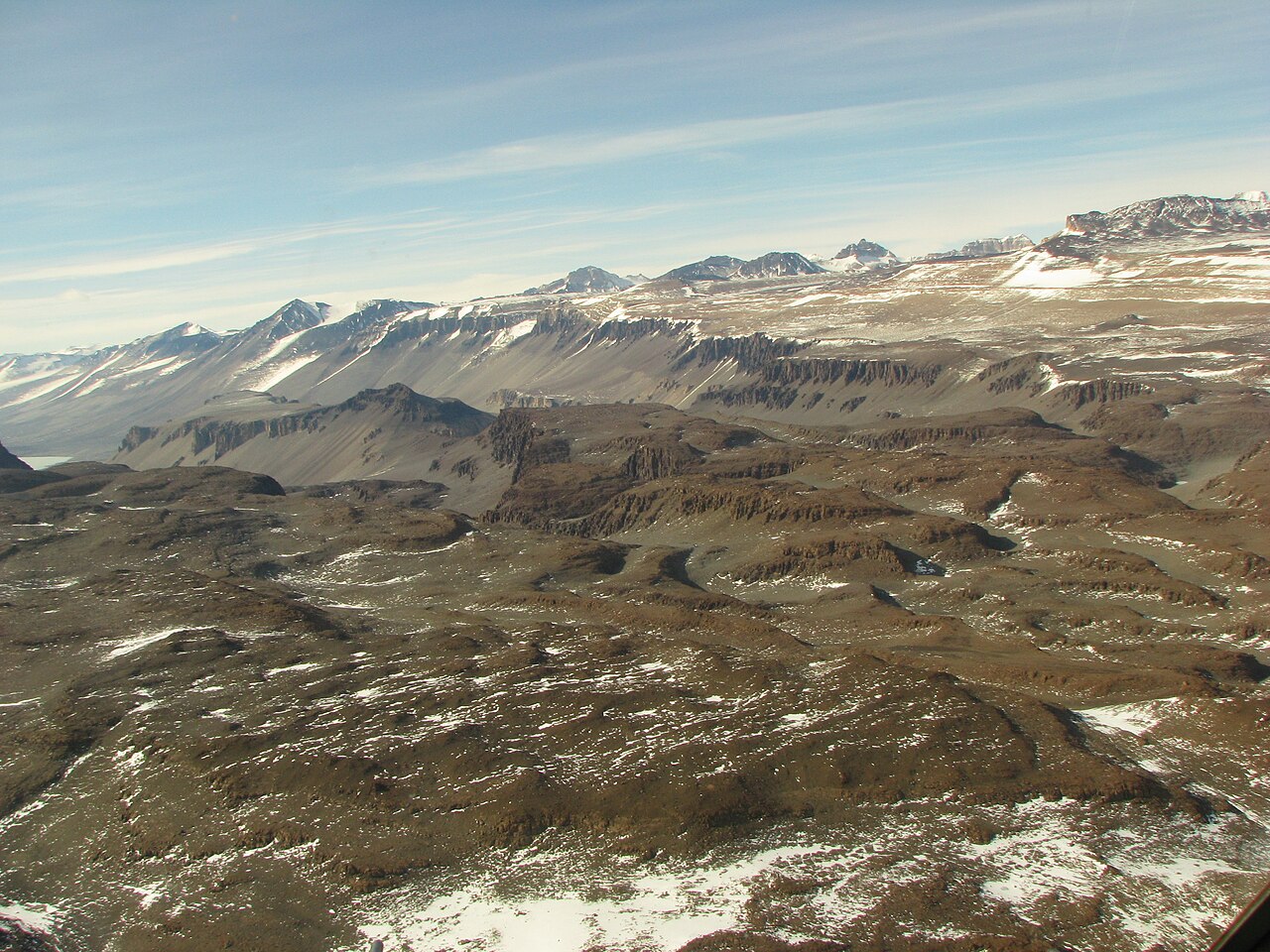

Antarctica is a desert. Antarctica is not a desert.
Both sentences are true: they simply do not refer to the same place — and this is the best illustration of how scientific categories are drawn.
What defines a desert
Not sand, not heat, not dunes.
It is the lack of water.
The threshold commonly used by climatologists is about 250 millimetres of precipitation per year. Below it, the term is a true desert; between 250 and 500 mm, a semi-arid or semi-desert environment.1
Essential note: there is no single or universal definition of desert. This is not a cautious caveat: it is a fact accepted by all reference works.
Antarctica, from two angles
If the 250 mm threshold is applied:
- The interior of the continent receives less than 50 millimetres per year (water equivalent), almost entirely in the form of snow. That is more than five times less than the threshold: it is a hyper-arid desert.
- The coastal fringe receives up to about 400 millimetres in some places. That is well above the threshold: the edge is therefore not a desert.2
So is Antarctica a desert? The centre, yes. The edges, no.
What changes is not the nature of the continent, but where one decides to look and to set the boundary.
Why a single figure is not enough
Take two geographical areas that both receive less than 250 millimetres of water per year:
- Phoenix, in Arizona: classed without hesitation among the deserts.
- The North Slope of the Brooks Range, in Alaska: generally excluded from desert classifications.
Same rainfall, two distinct categories. Why?
Because the real water balance compares rainfall with evapotranspiration, that is, with the water demanded by plants and the air. In Alaska, the extreme cold prevents water from evaporating: the little moisture available remains stored in the soil. In Arizona, the heat immediately dissipates what little precipitation falls.3
A figure for the water that falls is not enough: one has to look at what the ecosystem does with it.
How a plant survives in a desert
A desert plant faces two difficulties at the same time: finding water, and not losing it. Yet the very mechanism by which a plant feeds makes it transpire. To capture carbon dioxide from the air, it must open tiny pores on the surface of its leaves, the stomata — and through these same pores, its water vapour escapes. Feeding and drying out are one and the same act.4
There are three strategies, very different from one another.
Storing. The cactus, the aloe and the agave thicken their stems or leaves into reservoirs — they are called succulents. The compact, often spherical, shape is not decorative at all: it is the one that offers the least surface for the most volume, and therefore the least evaporation. The spines are leaves reduced to almost nothing, which no longer transpire, protect against herbivores and slow the wind right at the surface of the plant.5
Many of these plants have also reversed their timetable. Often, they open their stomata only at night, when the air is cool and humid, store the carbon dioxide in the form of malic acid, and use it the next day with the shutters closed. This process has a name, CAM metabolism — and it changes not the place of the exchange, but its timing. It is slow — many of these plants grow slowly — but no land plant uses water as efficiently.6
Seeking it out. Others store nothing and rely on their roots. Some deploy a very extensive network at shallow depth: the roots of a saguaro spread out about as far as the cactus is tall, but rarely go deeper than ten centimetres. They absorb the slightest shower within a few hours, before it evaporates. Others, like certain acacias, send a single root down tens of metres to the water table. These two tactics are mutually exclusive: it is impossible to be everywhere at once.7
Waiting. The third strategy is simply not to be there. Many desert plants spend most of their time as a seed, in a dormancy that can last for years. Sufficient rain is needed — and some seeds germinate only above a precise rainfall threshold — for them to sprout, flower and produce seeds again within a few weeks. This explains the spectacular blooms that sometimes follow a storm in a desert that looks dead.8
These three responses have nothing in common, and yet two unrelated plants often end up with the same form. That is the subject of the next section.
Evolutionary convergence: two plants, one answer
A North American cactus and an African cactus-like euphorbia, placed side by side, show the same silhouette: a green, fleshy mass, full of water, leafless and covered in spines.
Yet they are not related. Their lineages separated a very long time ago, and an ocean has kept them isolated for a long time.
They did not inherit these traits from a common ancestor: they independently solved the same problem — surviving drought under extreme sunlight — by developing the same structures. This is the phenomenon of evolutionary convergence.
More remarkable still: a simultaneous evolution
Cacti are often assumed to be very ancient. They are not. Their lineage separated from its closest relatives about thirty-five million years ago, and the groups that have the most species today only really diversified between ten and five million years ago.9
Here is the surprising result. The major diversifications of the cacti of the Americas, the ice plants of South Africa and the agaves of North America are contemporaneous.10
Three continents. Unrelated lineages. The same moment.
This is not a coincidence, but the trace of a common cause, on a global scale — a cooling and drying of the world’s climate at that time. Plants did not invent succulence whenever they could. They invented it when the world demanded it, and everywhere at once.
How to tell them apart with certainty
There is an infallible anatomical criterion, visible to the naked eye: the areoles.
These are small felted or downy cushions on the surface of the stem, from which the spines emerge. They are exclusive to cacti (Cactaceae); no other plant family has them.11
- A downy cushion at the base of the spines → It is a cactus. Its spines are modified leaves, borne on a very short shoot.
- Spines emerging directly from the stem (often in pairs) → It is a euphorbia. Its spines are modified stipules or shoots.
From a distance, the strategy looks the same. Up close, the organs used are entirely different.
⚠ Safety warning: the sap must never be tested
One sometimes reads that it is enough to cut the plant to see whether a white liquid flows out. This must be avoided at all costs. The latex of euphorbias is toxic and can be extremely irritating. Mere contact followed by rubbing the eye can cause severe keratitis or temporary loss of sight. The visual criterion of the areoles is more than enough.12
The geographical exception
Cacti are strictly native to the Americas, with one exception: Rhipsalis baccifera, found naturally in tropical Africa and Madagascar. Carried by migratory birds or transported by early ships, it illustrates the rule that biology always leaves a margin for exceptions.13
The safeguards: desertification and greening
Two contemporary subjects are frequently oversimplified when the dynamics of arid environments are discussed:
1. Desertification: a debated notion
Desertification does not refer to the natural advance of existing deserts, but to land degradation in arid, semi-arid and dry sub-humid areas, mainly as a result of human activities and climatic variations.14
The global extent and severity of this process are the subject of major methodological debates among researchers: the boundaries between multi-year rainfall fluctuation (temporary drought) and irreversible degradation of plant cover remain difficult to draw from satellite imagery alone.15
2. Greening projects and “great green walls”
Many initiatives seek to halt aridification through massive reforestation (such as the Great Green Wall in the Sahel). While the stated aim is to stabilise soils and support agriculture, ecologists point out several conditions for effectiveness:
- Planting non-native monocultures often consumes more groundwater than it regenerates.
- One of the finest successes comes from the natural regeneration of trees led by the farmers themselves (FMNR), as in Niger, with local agreements between farmers and herders on livestock routes.16
An inhabited and shaped environment
A desert is not an empty or dead space.
Arid zones are inhabited by specialised flora and fauna, as well as by human societies that have spent millennia developing sophisticated techniques for collecting and conserving water (qanats, foggaras, terraces, impluvia).
Describing these environments as virgin or sterile lands masks the technical history of local populations and the fine adaptation of plant species to scarcity.
Note 1
There are almost as many definitions of deserts and classification systems as there are deserts in the world. […] In this now widely accepted system, extremely arid lands have at least 12 consecutive months without rainfall, arid lands have less than 250 millimeters of annual rainfall, and semiarid lands have a mean annual precipitation of between 250 and 500 millimeters.
U.S. Geological Survey, “What Is a Desert?”, in Deserts: Geology and Resources, USGS, page last modified 18 December 2001
Note 2
Precipitation is usually snow in the form of ‘diamond dust’ – tiny ice crystals formed from the sublimation of water vapour in a clear, but intensely cold atmosphere – averaging less than 50mm (water equivalent) per year. […] Hence, annual precipitation is much higher than inland, reaching levels of around 400mm in some coastal locations, and skies are often cloudy.
Royal Geographical Society (with IBG) and British Antarctic Survey, “Regional Climate Variation and Weather”, Discovering Antarctica
Note 3
Aridity Index represent the ratio between precipitation and ET0, thus rainfall over vegetation water demand (aggregated on annual basis).
Trabucco, Antonio and Zomer, Robert J., Global Aridity Index and Potential Evapotranspiration Database, CGIAR-CSI, 2019
Note 4
The stems and leaves of most species have waxy cuticles that render them nearly waterproof when the stomates are closed. […] CAM plants open their stomates for gas exchange at night and store carbon dioxide. […] Most water loss is from transpiration through leaf surfaces, so dropping leaves conserves water in the stems.
Arizona-Sonora Desert Museum, “How Plants Cope with the Desert Climate”, Sonorensis
Note 5
The areole is usually interpreted as a rudimentary shoot, and the spines are reduced leaves borne on this shoot.
University of Illinois Urbana-Champaign, Digital Flowers, “Cactaceae”, plate 5 “Areoles of Cactaceae”
Note 6
This often means that CAM plants open their stomata for gas exchange at night when the temperature is lower and the relative humidity is higher — significantly reducing the rate of water loss due to evapotranspiration. […] Rather, it is converted to malate, a four-carbon compound, and transported into the vacuole where it accumulates overnight as malic acid (Figure 2). Then, during the day, as stomata close to limit water loss, malate exits the vacuole and is decarboxylated, […] CAM species exhibit the greatest water use efficiency (WUE) of all land plants, […] This decreased photosynthetic rate ultimately causes many desert lineages to be slow-growing and long-lived.
Gilman, Ian S. and Edwards, Erika J., “Crassulacean Acid Metabolism”, Current Biology, vol. 30, no. 2, 2020, p. R57-R62
Note 7
The roots of a saguaro extend horizontally about as far as the plant is tall but are rarely more than four inches (10 cm) deep.
Arizona-Sonora Desert Museum, “How Plants Cope with the Desert Climate”, Sonorensis
Note 8
They mature in a single season, then die after channeling all of their life energy into producing seeds instead of reserving some for continued survival. […] During this window of opportunity there must be a soaking rain of at least one inch for most species.
Arizona-Sonora Desert Museum, “How Plants Cope with the Desert Climate”, Sonorensis
Note 9
we estimated that the cactus lineage diverged from its closest relatives ≈35 million years ago
Arakaki, Mónica et al., “Contemporaneous and Recent Radiations of the World’s Major Succulent Plant Lineages”, Proceedings of the National Academy of Sciences, vol. 108, 2011, p. 8379-8384
major diversification events in cacti were more recent, with most species-rich clades originating in the late Miocene, ≈10–5 Ma
Arakaki, Mónica et al., “Contemporaneous and Recent Radiations of the World’s Major Succulent Plant Lineages”, Proceedings of the National Academy of Sciences, vol. 108, 2011, p. 8379-8384
Note 10
Major cactus radiations were contemporaneous with those of South African ice plants and North American agaves, revealing a simultaneous diversification of several of the world's major succulent plant lineages across multiple continents.
Arakaki, Mónica et al., “Contemporaneous and Recent Radiations of the World’s Major Succulent Plant Lineages”, Proceedings of the National Academy of Sciences, vol. 108, 2011, p. 8379-8384
Note 11
The most useful diagnostic characteristic of the family is the areole, which occurs in all cacti and no other plants.
Socha, Aaron M., “From Areoles to Zygocactus: An Evolutionary Masterpiece. A Synopsis of the Family Cactaceae”, New York Botanical Garden
Note 12
The genus is also known for many succulent species that resemble cacti. All, however, emit a toxic milky latex when cut and have varying degrees of toxicity. […] The milky white latex sap found in all plant parts can cause mild to severe contact dermatitis.
North Carolina State University Extension, “Euphorbia”, North Carolina Extension Gardener Plant Toolbox, page consulted on 27 October 2026
Note 13
The native range of this species is Tropical & Subtropical America, Tropical Africa, Madagascar.
Royal Botanic Gardens, Kew, “*Rhipsalis baccifera* (J.S.Muell.) Stearn”, Plants of the World Online
Note 14
(a) “desertification” means land degradation in arid, semi-arid and dry sub-humid areas resulting from various factors, including climatic variations and human activities;
Nations unies, Convention des Nations unies sur la lutte contre la désertification, Paris, 1994, article 1er
Note 15
A fundamental and continuing debate has been over whether desertification actually exists and, if so, how it might be defined, measured and assessed. […] We consider four contexts that frame much of the debate and consider what impact each has had: (1) changes in our understanding of climate variability; (2) changes in our understanding of vegetation responses to perturbation;
Herrmann, Stefanie M. and Hutchinson, Charles F., “The Changing Contexts of the Desertification Debate”, Journal of Arid Environments, vol. 63, 2005, p. 538-555
The multiplicity and complexity of the processes of desertification make its quantification difficult. […] Available assessments of the global extent and severity of desertification are relatively crude approximations with considerable uncertainties
Mirzabaev, Alisher, Wu, Jianguo et al., “Desertification”, in IPCC, Climate Change and Land: IPCC Special Report on Climate Change, Desertification, Land Degradation, Sustainable Land Management, Food Security, and Greenhouse Gas Fluxes in Terrestrial Ecosystems, Cambridge University Press, 2022, p. 249-344
Note 16
One spectacular example of resilience building in the Sahel context is how farmer-led natural generation of trees in the Maradi and Zinder regions of Niger transformed a downward spiral poverty, reduction in crop productivity, and heightened food insecurity in the mid-1980s, into a positive development trajectory of enhanced tree cover, improved outcomes for livelihoods, and increased drought resilience. […] There was also room to build more inclusive local governance that could make agreements between farmers and herders around transhumance corridors for seasonal livestock migration.
Goffner, Deborah, Sinare, Hanna and Gordon, Line J., “The Great Green Wall for the Sahara and the Sahel Initiative as an Opportunity to Enhance Resilience in Sahelian Landscapes and Livelihoods”, Regional Environmental Change, vol. 19, 2019, p. 1417-1428
Notes and sources
- ↑
Passage The threshold commonly used by climatologists is about 250 millimetres of precipitation per year. Below it, the term is a true desert; between 250 and 500 mm, a semi-arid or semi-desert environment. […] there is no single or universal definition of desert
There are almost as many definitions of deserts and classification systems as there are deserts in the world. […] In this now widely accepted system, extremely arid lands have at least 12 consecutive months without rainfall, arid lands have less than 250 millimeters of annual rainfall, and semiarid lands have a mean annual precipitation of between 250 and 500 millimeters.
Source U.S. Geological Survey, “What Is a Desert?”, in Deserts: Geology and Resources, USGS, page last modified 18 December 2001, page “What Is a Desert?”, 3rd paragraph.
Open access open the source · checked on 27 October 2026
- ↑
Passage The interior of the continent receives less than 50 millimetres per year (water equivalent) […] The coastal fringe receives up to about 400 millimetres in some places.
Precipitation is usually snow in the form of ‘diamond dust’ – tiny ice crystals formed from the sublimation of water vapour in a clear, but intensely cold atmosphere – averaging less than 50mm (water equivalent) per year. […] Hence, annual precipitation is much higher than inland, reaching levels of around 400mm in some coastal locations, and skies are often cloudy.
Source Royal Geographical Society (with IBG) and British Antarctic Survey, “Regional Climate Variation and Weather”, Discovering Antarctica, “Warm up” section, 2nd and 3rd paragraphs.
Open access open the source · checked on 27 October 2026
- ↑
Passage the real water balance compares rainfall with evapotranspiration, that is, with the water demanded by plants and the air
Aridity Index represent the ratio between precipitation and ET0, thus rainfall over vegetation water demand (aggregated on annual basis).
Source Trabucco, Antonio and Zomer, Robert J., Global Aridity Index and Potential Evapotranspiration Database, CGIAR-CSI, 2019, dataset description (version 2, 18 January 2019) on figshare.
Open access · checked on 24 October 2026
- ↑
Passage To capture carbon dioxide from the air, it must open tiny pores […] and through these same pores, its water vapour escapes
The stems and leaves of most species have waxy cuticles that render them nearly waterproof when the stomates are closed. […] CAM plants open their stomates for gas exchange at night and store carbon dioxide. […] Most water loss is from transpiration through leaf surfaces, so dropping leaves conserves water in the stems.
Source Arizona-Sonora Desert Museum, “How Plants Cope with the Desert Climate”, Sonorensis, “Succulence” and “Drought Tolerance” sections.
Open access open the source · checked on 24 October 2026
- ↑
Passage The spines are leaves reduced to almost nothing […] borne on a very short shoot
The areole is usually interpreted as a rudimentary shoot, and the spines are reduced leaves borne on this shoot.
Source University of Illinois Urbana-Champaign, Digital Flowers, “Cactaceae”, plate 5 “Areoles of Cactaceae”, “5 - Areoles of Cactaceae” page, caption text, 2nd sentence.
Open access open the source · checked on 27 October 2026
- ↑
Passage Often, they open their stomata only at night […] store the carbon dioxide in the form of malic acid, and use it the next day with the shutters closed. This process has a name, CAM metabolism […] It is slow — many of these plants grow slowly — but no land plant uses water as efficiently.
This often means that CAM plants open their stomata for gas exchange at night when the temperature is lower and the relative humidity is higher — significantly reducing the rate of water loss due to evapotranspiration. […] Rather, it is converted to malate, a four-carbon compound, and transported into the vacuole where it accumulates overnight as malic acid (Figure 2). Then, during the day, as stomata close to limit water loss, malate exits the vacuole and is decarboxylated, […] CAM species exhibit the greatest water use efficiency (WUE) of all land plants, […] This decreased photosynthetic rate ultimately causes many desert lineages to be slow-growing and long-lived.
Source Gilman, Ian S. and Edwards, Erika J., “Crassulacean Acid Metabolism”, Current Biology, vol. 30, no. 2, 2020, p. R57-R62, p. R58-R59.
Paywalled open the source 1 open the source 2 · checked on 25 October 2026
- ↑
Passage the roots of a saguaro spread out about as far as the cactus is tall, but rarely go deeper than ten centimetres
The roots of a saguaro extend horizontally about as far as the plant is tall but are rarely more than four inches (10 cm) deep.
Source Arizona-Sonora Desert Museum, “How Plants Cope with the Desert Climate”, Sonorensis, “Succulence” section.
Open access open the source · checked on 24 October 2026
- ↑
Passage Many desert plants spend most of their time as a seed […] some seeds germinate only above a precise rainfall threshold
They mature in a single season, then die after channeling all of their life energy into producing seeds instead of reserving some for continued survival. […] During this window of opportunity there must be a soaking rain of at least one inch for most species.
Source Arizona-Sonora Desert Museum, “How Plants Cope with the Desert Climate”, Sonorensis, “Drought Avoidance” section.
Open access open the source · checked on 24 October 2026
- ↑
Passage Their lineage separated from its closest relatives about thirty-five million years ago
we estimated that the cactus lineage diverged from its closest relatives ≈35 million years ago
Source Arakaki, Mónica et al., “Contemporaneous and Recent Radiations of the World’s Major Succulent Plant Lineages”, Proceedings of the National Academy of Sciences, vol. 108, 2011, p. 8379-8384, abstract.
Open access open the source · checked on 9 September 2026
Passage the groups that have the most species today only really diversified between ten and five million years ago
major diversification events in cacti were more recent, with most species-rich clades originating in the late Miocene, ≈10–5 Ma
Source Arakaki, Mónica et al., “Contemporaneous and Recent Radiations of the World’s Major Succulent Plant Lineages”, Proceedings of the National Academy of Sciences, vol. 108, 2011, p. 8379-8384, abstract.
Open access open the source · checked on 9 September 2026
- ↑
Passage The major diversifications of the cacti of the Americas, the ice plants of South Africa and the agaves of North America are contemporaneous.
Major cactus radiations were contemporaneous with those of South African ice plants and North American agaves, revealing a simultaneous diversification of several of the world's major succulent plant lineages across multiple continents.
Source Arakaki, Mónica et al., “Contemporaneous and Recent Radiations of the World’s Major Succulent Plant Lineages”, Proceedings of the National Academy of Sciences, vol. 108, 2011, p. 8379-8384, abstract.
Open access open the source · checked on 9 September 2026
- ↑
Passage the areoles […] are exclusive to cacti (Cactaceae); no other plant family has them
The most useful diagnostic characteristic of the family is the areole, which occurs in all cacti and no other plants.
Source Socha, Aaron M., “From Areoles to Zygocactus: An Evolutionary Masterpiece. A Synopsis of the Family Cactaceae”, New York Botanical Garden, section “Taxonomy and Reproduction”.
Open access open the source · checked on 27 October 2026
- ↑
Passage The latex of euphorbias is toxic and can be extremely irritating.
The genus is also known for many succulent species that resemble cacti. All, however, emit a toxic milky latex when cut and have varying degrees of toxicity. […] The milky white latex sap found in all plant parts can cause mild to severe contact dermatitis.
Source North Carolina State University Extension, “Euphorbia”, North Carolina Extension Gardener Plant Toolbox, page consulted on 27 October 2026, “Description” heading; “Poisonous to Humans” heading, “Poison Symptoms”.
Open access open the source · checked on 27 October 2026
- ↑
Passage Rhipsalis baccifera, found naturally in tropical Africa and Madagascar
The native range of this species is Tropical & Subtropical America, Tropical Africa, Madagascar.
Source Royal Botanic Gardens, Kew, “*Rhipsalis baccifera* (J.S.Muell.) Stearn”, Plants of the World Online, species page, native range.
Open access open the source · checked on 27 October 2026
- ↑
Passage land degradation in arid, semi-arid and dry sub-humid areas
(a) “desertification” means land degradation in arid, semi-arid and dry sub-humid areas resulting from various factors, including climatic variations and human activities;
Source Nations unies, Convention des Nations unies sur la lutte contre la désertification, Paris, 1994, article 1er, Article 1 “Use of terms”, paragraph (a).
Open access open the source · checked on 24 October 2026
- ↑
Passage the boundaries between multi-year rainfall fluctuation […] and irreversible degradation of plant cover remain difficult to draw
A fundamental and continuing debate has been over whether desertification actually exists and, if so, how it might be defined, measured and assessed. […] We consider four contexts that frame much of the debate and consider what impact each has had: (1) changes in our understanding of climate variability; (2) changes in our understanding of vegetation responses to perturbation;
Source Herrmann, Stefanie M. and Hutchinson, Charles F., “The Changing Contexts of the Desertification Debate”, Journal of Arid Environments, vol. 63, 2005, p. 538-555, abstract.
Paywalled · checked on 25 October 2026
Passage The global extent and severity of this process are the subject of major methodological debates
The multiplicity and complexity of the processes of desertification make its quantification difficult. […] Available assessments of the global extent and severity of desertification are relatively crude approximations with considerable uncertainties
Source Mirzabaev, Alisher, Wu, Jianguo et al., “Desertification”, in IPCC, Climate Change and Land: IPCC Special Report on Climate Change, Desertification, Land Degradation, Sustainable Land Management, Food Security, and Greenhouse Gas Fluxes in Terrestrial Ecosystems, Cambridge University Press, 2022, p. 249-344, chapter 3, executive summary, then section 3.1.
Open access open the source · checked on 27 October 2026
- ↑
Passage One of the finest successes comes from the natural regeneration of trees led by the farmers themselves (FMNR), as in Niger, with local agreements between farmers and herders on livestock routes
One spectacular example of resilience building in the Sahel context is how farmer-led natural generation of trees in the Maradi and Zinder regions of Niger transformed a downward spiral poverty, reduction in crop productivity, and heightened food insecurity in the mid-1980s, into a positive development trajectory of enhanced tree cover, improved outcomes for livelihoods, and increased drought resilience. […] There was also room to build more inclusive local governance that could make agreements between farmers and herders around transhumance corridors for seasonal livestock migration.
Source Goffner, Deborah, Sinare, Hanna and Gordon, Line J., “The Great Green Wall for the Sahara and the Sahel Initiative as an Opportunity to Enhance Resilience in Sahelian Landscapes and Livelihoods”, Regional Environmental Change, vol. 19, 2019, p. 1417-1428, “The role of woody vegetation for resilience building in the Sahel” section.
Open access · checked on 24 October 2026
Bibliography
19
- Anderson, Edward F., The Cactus Family, Timber Press, 2001, in libraries (cactus spines as leaves borne on a short shoot; Rhipsalis baccifera, the only cactus native outside the Americas).
- Arakaki, Mónica et al., “Contemporaneous and Recent Radiations of the World’s Major Succulent Plant Lineages”, Proceedings of the National Academy of Sciences, vol. 108, 2011, p. 8379-8384, open access (the cactus lineage separating about 35 million years ago; the major diversifications between 10 and 5 million years ago; their simultaneity with those of South African ice plants and North American agaves). https://doi.org/10.1073/pnas.1100628108
- Arizona-Sonora Desert Museum, “How Plants Cope with the Desert Climate”, Sonorensis, open access (the shallow roots of cacti, waxy cuticles, CAM metabolism and avoidance strategies). https://www.desertmuseum.org/members/sonorensis/week1.php
- Behnke, Roy and Mortimore, Michael (ed.), The End of Desertification? Disputing Environmental Change in the Drylands, Springer, 2016, in libraries (the methodological debates on measurement).
- Eggli, Urs and Nyffeler, Reto (ed.), Dicotyledons: Rosids, coll. “Illustrated Handbook of Succulent Plants”, 2e éd., Springer, 2023, in libraries (euphorbias: toxic latex, spines of different origin).
- Gilman, Ian S. and Edwards, Erika J., “Crassulacean Acid Metabolism”, Current Biology, vol. 30, no. 2, 2020, p. R57-R62, paywalled (CAM metabolism: stomata open at night, carbon dioxide stored as malic acid in the vacuole and used during the day with stomata closed; the highest water use efficiency of all land plants; slow growth). https://doi.org/10.1016/j.cub.2019.11.073
- Goffner, Deborah, Sinare, Hanna and Gordon, Line J., “The Great Green Wall for the Sahara and the Sahel Initiative as an Opportunity to Enhance Resilience in Sahelian Landscapes and Livelihoods”, Regional Environmental Change, vol. 19, 2019, p. 1417-1428, open access (the conditions for effectiveness, assisted natural regeneration).
- Herrmann, Stefanie M. and Hutchinson, Charles F., “The Changing Contexts of the Desertification Debate”, Journal of Arid Environments, vol. 63, 2005, p. 538-555, paywalled (rainfall fluctuation versus lasting degradation).
- Mirzabaev, Alisher, Wu, Jianguo et al., “Desertification”, in IPCC, Climate Change and Land: IPCC Special Report on Climate Change, Desertification, Land Degradation, Sustainable Land Management, Food Security, and Greenhouse Gas Fluxes in Terrestrial Ecosystems, Cambridge University Press, 2022, p. 249-344, open access (the difficulty of quantifying desertification; global estimates of its extent and severity described as relatively crude approximations). https://doi.org/10.1017/9781009157988.005
- Nations unies, Convention des Nations unies sur la lutte contre la désertification, Paris, 1994, article 1er, open access (the definition of desertification as land degradation, and not as the advance of deserts).
- North Carolina State University Extension, “Euphorbia”, North Carolina Extension Gardener Plant Toolbox, page consulted on 27 October 2026, open access (all euphorbias, including the cactus-like succulents, have toxic latex; mild to severe dermatitis, possible damage to the cornea). https://plants.ces.ncsu.edu/plants/euphorbia/
- Nyffeler, Reto and Eggli, Urs, “An Up-to-date Familial and Suprafamilial Classification of Succulent Plants”, Bradleya, vol. 28, 2010, p. 125-144, paywalled (areoles, a character exclusive to the Cactaceae).
- Programme des Nations unies pour l’environnement, World Atlas of Desertification, 2e éd., 1997, in libraries ; et Middleton, Nick, Deserts: A Very Short Introduction, Oxford University Press, 2009, in libraries (the 250 mm threshold, the absence of a single definition, aridity as the ratio between precipitation and evapotranspiration).
- Royal Botanic Gardens, Kew, “*Rhipsalis baccifera* (J.S.Muell.) Stearn”, Plants of the World Online, open access (native range: tropical and subtropical America, tropical Africa, Madagascar). https://powo.science.kew.org/taxon/urn:lsid:ipni.org:names:219250-2
- Royal Geographical Society (with IBG) and British Antarctic Survey, “Regional Climate Variation and Weather”, Discovering Antarctica, open access (Antarctic precipitation: less than 50 mm a year water equivalent in the interior, around 400 mm in some coastal locations). https://discoveringantarctica.org.uk/oceans-atmosphere-landscape/atmosphere-weather-and-climate/regional-climate-variation-and-weather/
- Socha, Aaron M., “From Areoles to Zygocactus: An Evolutionary Masterpiece. A Synopsis of the Family Cactaceae”, New York Botanical Garden, open access (the areole, found in all cacti and in no other plant). https://www.nybg.org/bsci/herb/cactaceae1.html
- Trabucco, Antonio and Zomer, Robert J., Global Aridity Index and Potential Evapotranspiration Database, CGIAR-CSI, 2019, open access (why the same total precipitation does not produce the same climate depending on temperature).
- U.S. Geological Survey, “What Is a Desert?”, in Deserts: Geology and Resources, USGS, page last modified 18 December 2001, open access (almost as many definitions as there are deserts; Meigs’s “widely accepted” system: less than 250 mm of rain per year for arid lands, 250 to 500 mm for semi-arid lands). https://pubs.usgs.gov/gip/deserts/what/
- University of Illinois Urbana-Champaign, Digital Flowers, “Cactaceae”, plate 5 “Areoles of Cactaceae”, open access (the areole, a rudimentary shoot; the spines, reduced leaves borne on this shoot). https://www.life.illinois.edu/help/digitalflowers/Cactaceae/5.htm
Spotted an error or have a doubt? Write to us.