
A plant cannot run away.
Everything this page recounts follows from that sentence.
Defending oneself without moving
A threatened animal has options: run, hide, bite, cry out.
A plant has none. It is there, in that precise spot, for its whole life. Whatever comes to eat it will find it.
Its defences are therefore of another kind. They are chemical — bitter, irritant, toxic or indigestible substances — and mechanical: thorns, hairs, bark, silica in the leaves.
A striking link emerges from this: what defends the plant is often what heals us, or what poisons us, depending on the dose.
Many medicines derive from substances that plants make so as not to be eaten. That is the subject of another page on this site.
A question of wording
We have just written “so as not to be eaten”.
That is exactly the wording that should not be used, and we used it on purpose, to show how readily it comes to mind.
“So as” implies an intention. It implies that the plant has a plan. It has none.
This site has adopted a rule, explained in our page on animal defences, and here we apply it:1
Wrong version: this plant makes a bitter substance so as not to be eaten.
Right version: among these plants, those that made the most bitter substances were grazed less, and left more descendants.
Three more words. No intention attributed. The mechanism stated instead of named.
Living together: the three cases
The word symbiosis denotes a lasting association between two different species. On its own, it says nothing about who gains from it — and that is precisely where precision is needed, because three very different situations hide behind it.
- Mutualism: both gain. A bee gathers nectar; the flower has its pollen carried away. Neither does the other a favour out of kindness; each gets something out of it, and that is what makes the arrangement stable.
- Commensalism: one gains, the other loses nothing. An epiphytic orchid grows clinging to a trunk to reach the light, without taking anything at all from the tree.
- Parasitism: one gains at the other’s expense. Mistletoe sinks its roots into a tree’s branches and takes its sap.
The most important of these associations is invisible and plays out underground. The roots of the great majority of land plants are wrapped in microscopic fungi: these are mycorrhizae. The fungus, whose filaments explore a volume of soil far greater than the roots would reach on their own, supplies the plant with water and minerals — phosphorus above all. In exchange, the plant gives it a share of the sugars it makes.2
This association has existed for more than four hundred million years — fossilised structures very similar to today’s are found in rocks in Scotland — and it is thought to have made possible the conquest of dry land by plants. Wood, for its part, would not appear until seventy million years later. A tree cut off from its fungi grows poorly; most of the planet’s plants do not live alone, and have never lived alone.3
An exception, because it is instructive. A few families do entirely without mycorrhizae, notably the cabbage family — cabbage, broccoli, oilseed rape, mustard — as well as spinach and beetroot. They lost this association in the course of their evolution and manage on their own. A rule that holds for the vast majority is not a universal law, and it is more honest to name the exceptions.4
The boundary, however, is not clear-cut. The same association can tip from one category to another depending on conditions: a fungus that helps a plant could become harmful to it if the surrounding forest declines, but this remains debated, and some orchids take from mycorrhizae without ever giving anything back. These are not three boxes but a gradient, and classifying them means choosing a threshold — something this site comes up against everywhere.5
Associations: proof by experiment
Some plants do not defend themselves alone: they house animals that do it for them.
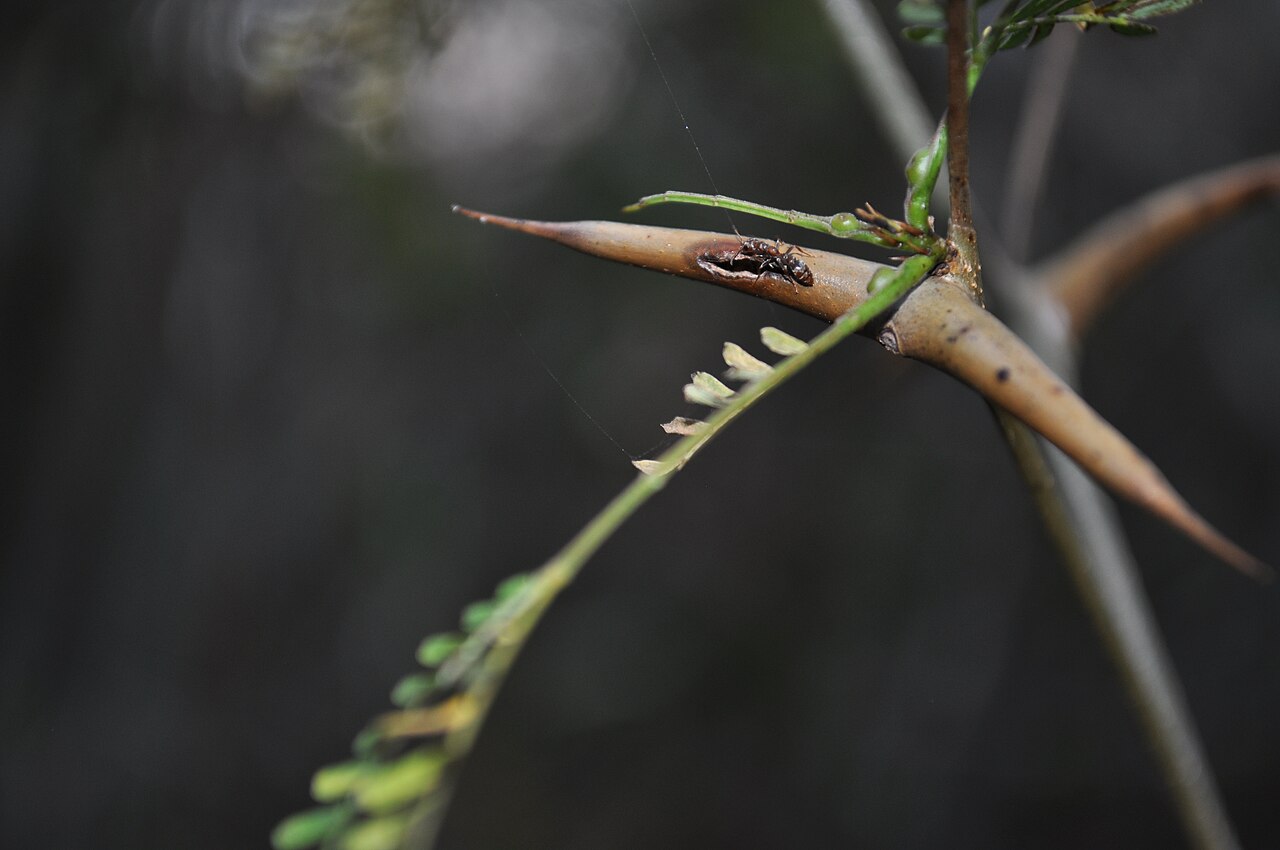
The best-documented example is that of the acacia Vachellia cornigera and the ants of the genus Pseudomyrmex. The tree provides lodging (hollow thorns) and dedicated food (protein-rich Beltian bodies); the ants patrol constantly and attack herbivores.
A historic experiment by Janzen (1966) made it possible to verify the reality of this exchange:6
- Set-up: on the same site, the researchers removed the ant colonies from one group of acacias, while keeping an intact control group.
- Measured result: without ants, tree mortality soared, stem growth collapsed, and attack by plant-eating insects exploded.7
This is the fundamental method: remove the partner to verify the nature of the relationship.
When a plant is attacked, something is released into the air
A caterpillar starts eating a maize leaf.
The plant then emits volatile compounds — odorous molecules that spread through the air. These compounds attract parasitoid wasps, which lay their eggs in that caterpillar.8
The result is measurable: the caterpillar is attacked in turn.
What triggers the emission
This is the most interesting point, and it rules out the simplest explanation.
It is not the mechanical wound. A leaf cut with scissors does not trigger the same response.9
It is the caterpillar’s saliva. The plant does not react to being damaged: it reacts to specific molecules that tell it by whom it is being damaged.
The same mechanism underground
The signal does not pass only through the air: it also passes through the roots.
When the larvae of a pest beetle attack its roots, maize releases into the soil a molecule that strongly attracts a microscopic worm, which attacks those larvae.10
The effect of modern breeding
By comparing varieties, the researchers made a discovery.
Most North American maize lines no longer emit this molecule. European lines, for their part, do — and so does the wild ancestor of maize.11
It is this last point that settles the matter: if the wild plant has the capacity and the modern variety no longer has it, it was indeed lost during breeding. The authors say so plainly.12
Nobody had removed it deliberately: breeders were selecting for something else, and it disappeared along the way.
The field measurement that closes the case
One might think this mechanism too subtle to count in a real field. Two measurements show the opposite.
- On a variety that produces the signal, the pest’s larvae are infected by the worms five times more often than on a variety that does not produce it.
- If one adds the molecule oneself to the soil, near the silent variety, the number of adult pests that emerge from it falls by more than half.13
The second experiment deserves attention. It does not merely observe a difference: it restores the missing factor, and checks whether the effect returns. It does. This is the strongest proof that can be given — one has not merely noted the correlation, one has switched the cause back on.
A strict precaution over vocabulary
One reads everywhere that plants “communicate”, that they “warn their neighbours”, that they “call for help”.
This page will use none of these words.
Not because the phenomenon is doubtful — it is measured and replicated. But because these words add something the measurement does not show: an intention.14
What is established: an attacked plant emits molecules; these molecules attract insects; these insects attack the aggressor. That is quite enough to be remarkable.
To say that it “calls for help” is to slide from what has been measured to a story that resembles our own. Once that story is in place, one no longer looks for the mechanism: one believes one has it.
This is the third time this site has run into the same problem: with “instinct” in animals, with “memory” for the immune system, and here. Each time, a word borrowed from human life that covers up a mechanism instead of describing it.
An honest caveat
The authors point it out themselves: most of these demonstrations were first carried out in the laboratory or under controlled conditions. What happens in a field, with wind, dozens of species and smells everywhere, is harder to establish.15
The phenomenon holds up well when two aggressors attack at the same time. But between “it works under our conditions” and “it works everywhere”, there is a step that the researchers do not take — and neither does this page.
That said, the underground signal of maize has indeed been measured in the open field. Not all of this research is at the same stage, and that must be said too.
What we will not repeat here
The question of underground networks between trees is dealt with in our page on trees and the forest. We do not take it up again here, and that is no accident.
It is precisely in a page like this one — symbioses, mutual aid, exchanges — that the temptation to tell it again, a little more enthusiastically, would be strongest.
We cross-refer. We do not rewrite.
It is one of the rules this site is built on, and it serves exactly that purpose: to prevent a fact from becoming distorted as it circulates within the encyclopaedia itself.
Note 1
entrée 5.13
Entry 5.13
The wording rule applied here is set out in Entry 5.13, with its sources
Note 2
It is estimated that more than 80% of living plant species form symbioses with horizontally-transmitted filamentous fungi […] In return, plants supply their fungal symbionts with carbohydrates fixed from atmospheric carbon dioxide
Field, Katie J. et al., “Symbiotic Options for the Conquest of Land”, Trends in Ecology & Evolution, vol. 30, no. 8, 2015, p. 477-486
Note 3
It is widely thought that symbiotic soil fungi facilitated the colonisation of the terrestrial environment by plants. […] Firstly, the incredibly well preserved early-Devonian Rhynie chert macrofossils show individual vascular plant cells harbouring fungal structures that are strikingly similar to those formed by arbuscular mycorrhizal (AM) fungi of the phylum Glomeromycota within living cells of modern vascular plants [18,19] (see Box 1).
Field, Katie J. et al., “Symbiotic Options for the Conquest of Land”, Trends in Ecology & Evolution, vol. 30, no. 8, 2015, p. 477-486
The 400 million-year-old Rhynie chert has provided a wealth of information not only of early land plants, but also of the fungi that inhabited this paleoecosystem. […] Collection locality. Rhynie, Aberdeenshire, Scotland. […] Nevertheless, the demonstration that modern appearing endophytes existed at least 400 million years ago provides a critical source of information
Taylor, T. N., Remy, W., Hass, H. and Kerp, H., “Fossil Arbuscular Mycorrhizae from the Early Devonian”, Mycologia, vol. 87, no. 4, 1995, p. 560-573
Note 4
Certaines plantes ne mycorhizent jamais et même sont défavorables aux champignons du sol. Les crucifères (brassicacées : colza, choux, moutarde…) et les chénopodiacées (épinard, betterave) sont connues pour être défavorables aux champignons mycorhiziens
Some plants never form mycorrhizae and are even unfavourable to soil fungi. Crucifers (Brassicaceae: oilseed rape, cabbages, mustard…) and chenopods (spinach, beetroot) are known to be unfavourable to mycorrhizal fungi
Viaux, Philippe, “Interactions sol-plante”, Encyclopédie de l’Académie d’agriculture de France, fiche “Questions sur…” no. 01.08.Q06, série “Fertilité des sols agricoles”, June 2024, open access
Besides Brassicales, the AM symbiosis has been lost independently in several lineages of flowering plants [19]. […] We first tested the presence of these genes, either 'conserved' or 'symbiosis-specific', in the genomes of sugar beet and spinach (Beta vulgaris and Spinacia oleracea, Amaranthaceae, Caryophyllales [20]), […] that are all well-characterized non-hosts for AM fungi.
Delaux, Pierre-Marc et al., “Comparative Phylogenomics Uncovers the Impact of Symbiotic Associations on Host Genome Evolution”, PLoS Genetics, vol. 10, no. 7, e1004487, 2014
Note 5
Specifically, Pec et al. concluded that CMNs switch from being a benefit to a detriment to seedlings growing in stands with high tree mortality caused by insect attack. Thus, an alternative explanation is that in stands with high tree mortality, seedlings grown in mesh bags that prevent hyphal ingress were protected from surrounding pathogens, and as a result had higher survival than seedlings with supposed access to a CMN.
Karst, Justine, Jones, Melanie D. and Hoeksema, Jason D., “Positive Citation Bias and Overinterpreted Results Lead to Misinformation on Common Mycorrhizal Networks in Forests”, Nature Ecology & Evolution, vol. 7, 2023, p. 501-511
Note 6
This system has recently been described in detail in respect to one species of plant, Acacia cornigera L. […] and shown experimentally to be a case of mutualism (Janzen, 1966a). In this species pair, the ant is dependent upon the acacia for food and domicile, and the acacia is dependent upon the ant for protection from phytophagous insects and neighboring plants.
Janzen, Daniel H., “Coevolution of Mutualism between Ants and Acacias in Central America”, Evolution, vol. 20, no. 3, 1966, p. 249-275, paywalled
Note 7
Janzen selected a population of acacia trees and designated some of them as untreated controls and the others as experimental subjects. To the experimental subjects, he fumigated the trees with insecticide to remove all of the resident ants. […] He found that the control trees with the ants had considerably higher survival rates.
Sadava, David et al., Life: The Science of Biology, 11th ed., Sinauer/Macmillan, 2016, animation 55.1 “Mutualism”, publisher’s online script
Note 8
Corn seedlings release large amounts of terpenoid volatiles after they have been fed upon by caterpillars. […] Females of the parasitic wasp Cotesia marginiventris (Cresson) learn to take advantage of those plant-produced volatiles to locate hosts when exposed to these volatiles in association with hosts or host by-products.
Turlings, Ted C. J., Tumlinson, James H. and Lewis, W. Joe, “Exploitation of Herbivore-Induced Plant Odors by Host-Seeking Parasitic Wasps”, Science, vol. 250, 1990, p. 1251-1253
Note 9
The compound N-(17-hydroxylinolenoyl)-L-glutamine (named here volicitin) was isolated from oral secretions of beet armyworm caterpillars. When applied to damaged leaves of corn seedlings, volicitin induces the seedlings to emit volatile compounds that attract parasitic wasps, natural enemies of the caterpillars. Mechanical damage of the leaves, without application of this compound, did not trigger release of the same blend of volatiles.
Alborn, Hans T. et al., “An Elicitor of Plant Volatiles from Beet Armyworm Oral Secretion”, Science, vol. 276, 1997, p. 945-949
Note 10
Here we report the first identification of an insect-induced belowground plant signal, (E)-β-caryophyllene, which strongly attracts an entomopathogenic nematode. Maize roots release this sesquiterpene in response to feeding by larvae of the beetle Diabrotica virgifera virgifera
Rasmann, Sergio et al., “Recruitment of Entomopathogenic Nematodes by Insect-Damaged Maize Roots”, Nature, vol. 434, 2005, p. 732-737
Note 11
Most North American maize lines do not release (E)-β-caryophyllene, whereas European lines and the wild maize ancestor, teosinte, readily do so in response to D. v. virgifera attack.
Rasmann, Sergio et al., “Recruitment of Entomopathogenic Nematodes by Insect-Damaged Maize Roots”, Nature, vol. 434, 2005, p. 732-737
Note 12
North American maize lines must have lost the signal during the breeding process.
Rasmann, Sergio et al., “Recruitment of Entomopathogenic Nematodes by Insect-Damaged Maize Roots”, Nature, vol. 434, 2005, p. 732-737
Note 13
Field experiments showed a fivefold higher nematode infection rate of D. v. virgifera larvae on a maize variety that produces the signal than on a variety that does not
Rasmann, Sergio et al., “Recruitment of Entomopathogenic Nematodes by Insect-Damaged Maize Roots”, Nature, vol. 434, 2005, p. 732-737
whereas spiking the soil near the latter variety with authentic (E)-β-caryophyllene decreased the emergence of adult D. v. virgifera to less than half
Rasmann, Sergio et al., “Recruitment of Entomopathogenic Nematodes by Insect-Damaged Maize Roots”, Nature, vol. 434, 2005, p. 732-737
Note 14
Heil, Martin and Karban, Richard, “Explaining Evolution of Plant Communication by Airborne Signals”, Trends in Ecology & Evolution, vol. 25, 2010, p. 137-144
Note 15
Most early work was laboratory-based, but recent studies have explored the role of these volatiles in more natural ecological settings and have shown that they can influence the community of insects colonizing plants (Aartsma et al. 2017, 2020; Kaplan 2012).
Frago, Enric et al., “Herbivore-Induced Plant Volatiles, Not Natural Enemies, Mediate a Positive Indirect Interaction between Insect Herbivores”, Oecologia, vol. 198, 2022, p. 443-456
Notes and sources
- ↑
Passage wording rule applied here
entrée 5.13
Editors’ translation Entry 5.13
Source The wording rule applied here is set out in Entry 5.13, with its sources, rule established with its sources.
Established in other articles, with their sources · checked on 9 September 2026
- ↑
Passage The roots of the great majority of land plants are wrapped in microscopic fungi: these are mycorrhizae […] the plant gives it a share of the sugars it makes
It is estimated that more than 80% of living plant species form symbioses with horizontally-transmitted filamentous fungi […] In return, plants supply their fungal symbionts with carbohydrates fixed from atmospheric carbon dioxide
Source Field, Katie J. et al., “Symbiotic Options for the Conquest of Land”, Trends in Ecology & Evolution, vol. 30, no. 8, 2015, p. 477-486, section “The current paradigm”.
Open access open the source · checked on 24 October 2026
- ↑
Passage fossilised structures very similar to today’s are found in rocks in Scotland — and it is thought to have made possible the conquest of dry land by plants
It is widely thought that symbiotic soil fungi facilitated the colonisation of the terrestrial environment by plants. […] Firstly, the incredibly well preserved early-Devonian Rhynie chert macrofossils show individual vascular plant cells harbouring fungal structures that are strikingly similar to those formed by arbuscular mycorrhizal (AM) fungi of the phylum Glomeromycota within living cells of modern vascular plants [18,19] (see Box 1).
Source Field, Katie J. et al., “Symbiotic Options for the Conquest of Land”, Trends in Ecology & Evolution, vol. 30, no. 8, 2015, p. 477-486, abstract; accepted manuscript p. 3, section “The current paradigm”.
Open access open the source · checked on 24 October 2026
Passage This association has existed for more than four hundred million years — fossilised structures very similar to today’s are found in rocks in Scotland
The 400 million-year-old Rhynie chert has provided a wealth of information not only of early land plants, but also of the fungi that inhabited this paleoecosystem. […] Collection locality. Rhynie, Aberdeenshire, Scotland. […] Nevertheless, the demonstration that modern appearing endophytes existed at least 400 million years ago provides a critical source of information
Source Taylor, T. N., Remy, W., Hass, H. and Kerp, H., “Fossil Arbuscular Mycorrhizae from the Early Devonian”, Mycologia, vol. 87, no. 4, 1995, p. 560-573, abstract, p. 560; “Taxonomy”, p. 561; “Discussion”, p. 571.
Open access open the source · checked on 25 October 2026
- ↑
Passage A few families do entirely without mycorrhizae, notably the cabbage family […] as well as spinach and beetroot
Certaines plantes ne mycorhizent jamais et même sont défavorables aux champignons du sol. Les crucifères (brassicacées : colza, choux, moutarde…) et les chénopodiacées (épinard, betterave) sont connues pour être défavorables aux champignons mycorhiziens
Editors’ translation Some plants never form mycorrhizae and are even unfavourable to soil fungi. Crucifers (Brassicaceae: oilseed rape, cabbages, mustard…) and chenopods (spinach, beetroot) are known to be unfavourable to mycorrhizal fungi
Source Viaux, Philippe, “Interactions sol-plante”, Encyclopédie de l’Académie d’agriculture de France, fiche “Questions sur…” no. 01.08.Q06, série “Fertilité des sols agricoles”, June 2024, open access, p. 2, section “Les champignons”.
Open access open the source · checked on 25 October 2026
Passage They lost this association in the course of their evolution and manage on their own.
Besides Brassicales, the AM symbiosis has been lost independently in several lineages of flowering plants [19]. […] We first tested the presence of these genes, either 'conserved' or 'symbiosis-specific', in the genomes of sugar beet and spinach (Beta vulgaris and Spinacia oleracea, Amaranthaceae, Caryophyllales [20]), […] that are all well-characterized non-hosts for AM fungi.
Source Delaux, Pierre-Marc et al., “Comparative Phylogenomics Uncovers the Impact of Symbiotic Associations on Host Genome Evolution”, PLoS Genetics, vol. 10, no. 7, e1004487, 2014, Results, subsection “Convergent loss of ’symbiosis-specific’ genes”, beginning.
Open access open the source · checked on 25 October 2026
- ↑
Passage a fungus that helps a plant could become harmful to it if the surrounding forest declines, but this remains debated
Specifically, Pec et al. concluded that CMNs switch from being a benefit to a detriment to seedlings growing in stands with high tree mortality caused by insect attack. Thus, an alternative explanation is that in stands with high tree mortality, seedlings grown in mesh bags that prevent hyphal ingress were protected from surrounding pathogens, and as a result had higher survival than seedlings with supposed access to a CMN.
Source Karst, Justine, Jones, Melanie D. and Hoeksema, Jason D., “Positive Citation Bias and Overinterpreted Results Lead to Misinformation on Common Mycorrhizal Networks in Forests”, Nature Ecology & Evolution, vol. 7, 2023, p. 501-511, section “Resources are transferred through CMNs and increase seedling performance (claim 2)”.
Paywalled · checked on 25 October 2026
- ↑
Passage A historic experiment by Janzen (1966) made it possible to verify the reality of this exchange
This system has recently been described in detail in respect to one species of plant, Acacia cornigera L. […] and shown experimentally to be a case of mutualism (Janzen, 1966a). In this species pair, the ant is dependent upon the acacia for food and domicile, and the acacia is dependent upon the ant for protection from phytophagous insects and neighboring plants.
Source Janzen, Daniel H., “Coevolution of Mutualism between Ants and Acacias in Central America”, Evolution, vol. 20, no. 3, 1966, p. 249-275, paywalled, p. 249, introduction.
Paywalled · checked on 9 September 2026
- ↑
Passage the researchers removed the ant colonies from one group of acacias, while keeping an intact control group […] tree mortality soared
Janzen selected a population of acacia trees and designated some of them as untreated controls and the others as experimental subjects. To the experimental subjects, he fumigated the trees with insecticide to remove all of the resident ants. […] He found that the control trees with the ants had considerably higher survival rates.
Source Sadava, David et al., Life: The Science of Biology, 11th ed., Sinauer/Macmillan, 2016, animation 55.1 “Mutualism”, publisher’s online script, script of animation 55.1 (“Mutualism”), 4th and 5th paragraphs.
Open access open the source · checked on 27 October 2026
- ↑
Passage The plant then emits volatile compounds […] These compounds attract parasitoid wasps
Corn seedlings release large amounts of terpenoid volatiles after they have been fed upon by caterpillars. […] Females of the parasitic wasp Cotesia marginiventris (Cresson) learn to take advantage of those plant-produced volatiles to locate hosts when exposed to these volatiles in association with hosts or host by-products.
Source Turlings, Ted C. J., Tumlinson, James H. and Lewis, W. Joe, “Exploitation of Herbivore-Induced Plant Odors by Host-Seeking Parasitic Wasps”, Science, vol. 250, 1990, p. 1251-1253, abstract.
Paywalled · checked on 25 October 2026
- ↑
Passage It is not the mechanical wound […] It is the caterpillar’s saliva.
The compound N-(17-hydroxylinolenoyl)-L-glutamine (named here volicitin) was isolated from oral secretions of beet armyworm caterpillars. When applied to damaged leaves of corn seedlings, volicitin induces the seedlings to emit volatile compounds that attract parasitic wasps, natural enemies of the caterpillars. Mechanical damage of the leaves, without application of this compound, did not trigger release of the same blend of volatiles.
Source Alborn, Hans T. et al., “An Elicitor of Plant Volatiles from Beet Armyworm Oral Secretion”, Science, vol. 276, 1997, p. 945-949, abstract (first three sentences).
Paywalled · checked on 25 October 2026
- ↑
Passage When the larvae of a pest beetle attack its roots, maize releases into the soil a molecule that strongly attracts a microscopic worm
Here we report the first identification of an insect-induced belowground plant signal, (E)-β-caryophyllene, which strongly attracts an entomopathogenic nematode. Maize roots release this sesquiterpene in response to feeding by larvae of the beetle Diabrotica virgifera virgifera
Source Rasmann, Sergio et al., “Recruitment of Entomopathogenic Nematodes by Insect-Damaged Maize Roots”, Nature, vol. 434, 2005, p. 732-737, abstract.
Paywalled open the source · checked on 9 September 2026
- ↑
Passage Most North American maize lines no longer emit this molecule. European lines, for their part, do — and so does the wild ancestor of maize.
Most North American maize lines do not release (E)-β-caryophyllene, whereas European lines and the wild maize ancestor, teosinte, readily do so in response to D. v. virgifera attack.
Source Rasmann, Sergio et al., “Recruitment of Entomopathogenic Nematodes by Insect-Damaged Maize Roots”, Nature, vol. 434, 2005, p. 732-737, abstract.
Paywalled open the source · checked on 9 September 2026
- ↑
Passage it was indeed lost during breeding
North American maize lines must have lost the signal during the breeding process.
Source Rasmann, Sergio et al., “Recruitment of Entomopathogenic Nematodes by Insect-Damaged Maize Roots”, Nature, vol. 434, 2005, p. 732-737, abstract.
Paywalled open the source · checked on 9 September 2026
- ↑
Passage the pest’s larvae are infected by the worms five times more often than on a variety that does not produce it
Field experiments showed a fivefold higher nematode infection rate of D. v. virgifera larvae on a maize variety that produces the signal than on a variety that does not
Source Rasmann, Sergio et al., “Recruitment of Entomopathogenic Nematodes by Insect-Damaged Maize Roots”, Nature, vol. 434, 2005, p. 732-737, abstract.
Paywalled open the source · checked on 9 September 2026
Passage If one adds the molecule oneself to the soil, near the silent variety, the number of adult pests that emerge from it falls by more than half
whereas spiking the soil near the latter variety with authentic (E)-β-caryophyllene decreased the emergence of adult D. v. virgifera to less than half
Source Rasmann, Sergio et al., “Recruitment of Entomopathogenic Nematodes by Insect-Damaged Maize Roots”, Nature, vol. 434, 2005, p. 732-737, abstract.
Paywalled open the source · checked on 9 September 2026
- ↑
Passage these words add something the measurement does not show: an intention
Source Heil, Martin and Karban, Richard, “Explaining Evolution of Plant Communication by Airborne Signals”, Trends in Ecology & Evolution, vol. 25, 2010, p. 137-144.
Paywalled · checked on 9 September 2026
- ↑
Passage most of these demonstrations were first carried out in the laboratory or under controlled conditions
Most early work was laboratory-based, but recent studies have explored the role of these volatiles in more natural ecological settings and have shown that they can influence the community of insects colonizing plants (Aartsma et al. 2017, 2020; Kaplan 2012).
Source Frago, Enric et al., “Herbivore-Induced Plant Volatiles, Not Natural Enemies, Mediate a Positive Indirect Interaction between Insect Herbivores”, Oecologia, vol. 198, 2022, p. 443-456, introduction, 2nd paragraph (“The last decade has seen…”).
Open access open the source · checked on 27 October 2026
For the whole article
Passage the gene involved and its silencing in most American varieties
The gene encoding TPS23 is active in teosinte species and European maize lines, but decreased transcription in most North American lines resulted in the loss of (E)-β-caryophyllene production.
Source Köllner, Tobias G. et al., “A Maize (E)-β-Caryophyllene Synthase Implicated in Indirect Defense Responses against Herbivores Is Not Expressed in Most American Maize Varieties”, The Plant Cell, vol. 20, 2008, p. 482-494, abstract.
Open access · checked on 24 October 2026
Bibliography
16
- Alborn, Hans T. et al., “An Elicitor of Plant Volatiles from Beet Armyworm Oral Secretion”, Science, vol. 276, 1997, p. 945-949, paywalled (it is not the mechanical wound, it is a molecule in the caterpillar’s saliva).
- Delaux, Pierre-Marc et al., “Comparative Phylogenomics Uncovers the Impact of Symbiotic Associations on Host Genome Evolution”, PLoS Genetics, vol. 10, no. 7, e1004487, 2014, open access (the mycorrhizal symbiosis lost in the course of evolution by the cabbage lineage, the Brassicales, and independently by other lineages, including that of beetroot and spinach). https://doi.org/10.1371/journal.pgen.1004487
- Field, Katie J. et al., “Symbiotic Options for the Conquest of Land”, Trends in Ecology & Evolution, vol. 30, no. 8, 2015, p. 477-486, open access (the antiquity of mycorrhizae and the diversity of associations available to the first land plants). https://doi.org/10.1016/j.tree.2015.05.007
- Frago, Enric et al., “Herbivore-Induced Plant Volatiles, Not Natural Enemies, Mediate a Positive Indirect Interaction between Insect Herbivores”, Oecologia, vol. 198, 2022, p. 443-456, open access (Wageningen University repository; early work on herbivore-induced plant volatiles mostly laboratory-based, recent studies in more natural settings). https://edepot.wur.nl/563642
- Heil, Martin and Karban, Richard, “Explaining Evolution of Plant Communication by Airborne Signals”, Trends in Ecology & Evolution, vol. 25, 2010, p. 137-144, paywalled (why the vocabulary of communication is a problem).
- Janzen, Daniel H., “Coevolution of Mutualism between Ants and Acacias in Central America”, Evolution, vol. 20, no. 3, 1966, p. 249-275, paywalled (mutualism established by the ant-removal experiment, for the details of which the article refers to “Janzen, 1966a”).
- Janzen, Daniel H., “Interaction of the Bull’s-Horn Acacia (Acacia cornigera L.) with an Ant Inhabitant (Pseudomyrmex ferruginea F. Smith) in Eastern Mexico”, The University of Kansas Science Bulletin, vol. 47, no. 6, 1967, p. 315-558, open access (the detailed account, announced as “Janzen, 1966a”). https://biodiversitylibrary.org/part/386253
- Karban, Richard, Plant Sensing and Communication, University of Chicago Press, 2015, in libraries (the critical assessment: what is measured, what is not, and the limits of moving from the laboratory to the field).
- Karst, Justine, Jones, Melanie D. and Hoeksema, Jason D., “Positive Citation Bias and Overinterpreted Results Lead to Misinformation on Common Mycorrhizal Networks in Forests”, Nature Ecology & Evolution, vol. 7, 2023, p. 501-511, paywalled (see Entry 6.4).
- Köllner, Tobias G. et al., “A Maize (E)-β-Caryophyllene Synthase Implicated in Indirect Defense Responses against Herbivores Is Not Expressed in Most American Maize Varieties”, The Plant Cell, vol. 20, 2008, p. 482-494, open access (the gene involved and its silencing in most American varieties).
- Rasmann, Sergio et al., “Recruitment of Entomopathogenic Nematodes by Insect-Damaged Maize Roots”, Nature, vol. 434, 2005, p. 732-737, paywalled (the first underground signal identified; the North American lines that no longer emit it, as against the European lines and the wild ancestor; the fivefold higher infection rate in the field; the addition of the molecule that more than halves the emergence of adults; the loss attributed to breeding). https://doi.org/10.1038/nature03451
- Sadava, David et al., Life: The Science of Biology, 11th ed., Sinauer/Macmillan, 2016, animation 55.1 “Mutualism”, publisher’s online script, open access (Janzen’s experiment: untreated control trees, ants removed from the others with insecticide, much higher survival of the controls). https://digfir-published.macmillanusa.com/life_11e_animation/asset/sinauer_life11e_animation_scripts/life11e_5501_mutualism_scr.html
- Taylor, T. N., Remy, W., Hass, H. and Kerp, H., “Fossil Arbuscular Mycorrhizae from the Early Devonian”, Mycologia, vol. 87, no. 4, 1995, p. 560-573, open access (the fossil mycorrhizae of the Rhynie chert, in Scotland, 400 million years old). https://kuscholarworks.ku.edu/bitstream/1808/17992/1/Taylor_1995.pdf
- Turlings, Ted C. J., Tumlinson, James H. and Lewis, W. Joe, “Exploitation of Herbivore-Induced Plant Odors by Host-Seeking Parasitic Wasps”, Science, vol. 250, 1990, p. 1251-1253, paywalled (the volatile compounds of maize and parasitoid wasps).
- Viaux, Philippe, “Interactions sol-plante”, Encyclopédie de l’Académie d’agriculture de France, fiche “Questions sur…” no. 01.08.Q06, série “Fertilité des sols agricoles”, June 2024, open access (plants that never form mycorrhizae: crucifers such as oilseed rape, cabbages and mustard, and chenopods such as spinach and beetroot). https://academie-agriculture.fr/sites/default/files/publications/encyclopedie/interactions_sol-plante.pdf
- The wording rule applied here is set out in Entry 5.13, with its sources.
Spotted an error or have a doubt? Write to us.