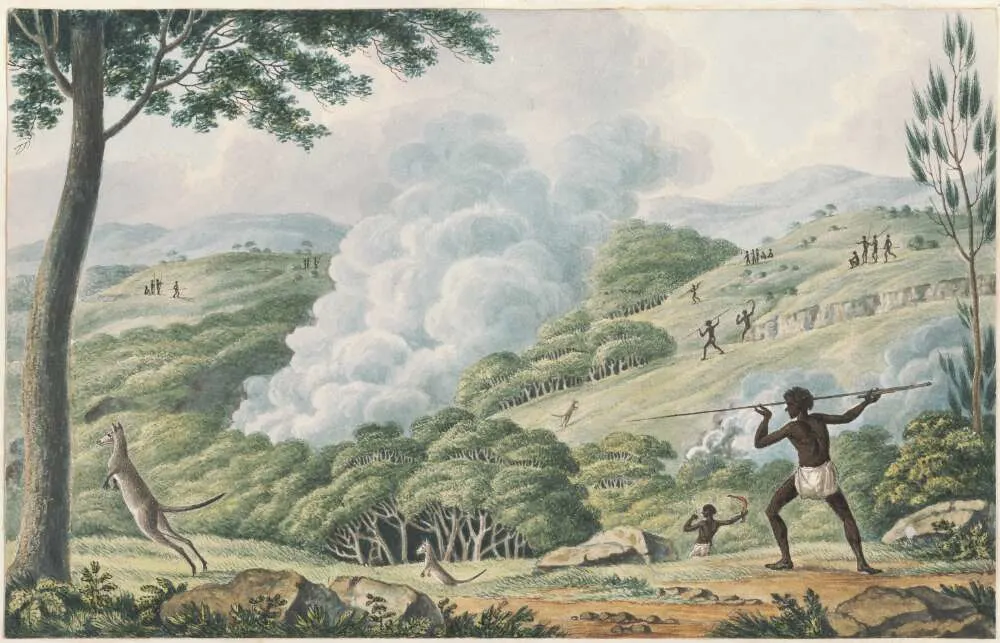

Some of the world’s great grasslands and savannas have been maintained by humans, using fire, for a very long time.
They are therefore not exactly “natural” environments in the usual sense of the term — which changes the way we should regard them.
Fire as a tool
Our page on food and agriculture establishes a fact that is worth recalling here: hunter-gatherers shaped their environment with controlled fire.1
The process is simple and effective:
- An area is burnt at the right season to clear away scrub and old dry grass.
- Tender shoots appear soon afterwards, far more nourishing for wildlife.
- The herbivores come, drawn by the freshness of the plant cover.
This is not luck but a technique passed on, refined and practised over generations.2
What this does to words
We commonly use two verbs to describe the life of hunter-gatherers: to wander and to gather.
Both suggest the absence of any plan: one wanders for lack of a destination, one gathers whatever one finds. Yet burning an area at the right season to attract game requires knowing where one is, what will grow, when to return and why.
These verbs deny them an obvious intentionality. It is a typical case of linguistic bias: a word that decides while believing it merely describes.
How old are grasslands?
The question seems simple, but it calls for three distinct answers, or else one goes wrong:
- When did grasses appear? At least 66 million years ago, and perhaps more than 100 million according to genetic analyses. We know this in particular from phytoliths (grains of silica made by plants) found in fossilised dinosaur droppings in India.
- When did they dominate the landscape? Much later. In North America, during the Eocene and Oligocene, open-habitat grasses were still only rare or marginal members of forest communities; they did not dominate there until the Late Oligocene or Early Miocene.
- When were today’s great grasslands born? Only between 8 and 3 million years ago.3
Existing, dominating and forming a landscape are three stages separated by tens of millions of years.
A revised timeline
It was thought that tropical grasses — those described as C4 — had become dominant in Africa only after ten million years ago. The problem: older plant records were sparse, so the hypothesis remained impossible to test.4
In 2023, a team filled this gap by combining several independent methods at nine sites in East Africa.5
The results show that between twenty-one and sixteen million years ago, these grasses were already locally abundant. The oldest known date is thus pushed back by more than ten million years — in Africa, and worldwide.6
But the most interesting result is not the date. These environments were not uniform: they contained forests as well as wooded grasslands, side by side. A mosaic landscape, not a switch from one setting to another.7
The authors draw a conclusion that goes beyond botany: we need to revise the interpretations previously given of mammalian evolution — including our own. Many accounts rested on the idea that our ancestors left a forest to enter a savanna. If the two already coexisted, the question has to be framed differently.8
A methodological bias
The fossil record of grasses is very poor for most of the Cenozoic. All the dates obtained are therefore minimum dates: a date in palaeontology indicates how far back a fossil is attested, not the exact moment of its appearance.9
The self-sustaining loop
The spread of grasslands is explained by the fall in atmospheric CO₂, marked seasonality and the role of fire:
Fire kills young trees but spares the base of the grasses. This favours the spread of grasses, which produces more fuel, which in turn feeds future fires.10
⚠ Note: some 20 million years elapse between the fall in CO₂ and the actual spread of grasslands. This lag remains partly unexplained.11
How does grass survive damage?
After fire or herbivores have passed through, how does grass grow back so quickly?
Unlike a tree, whose growth zone (the apical meristem) is high up, the meristem of grasses lies at or near ground level. Grazing the top of the plant does not destroy its ability to grow.12
The role of large herbivores
Grasslands do not depend on fire alone. Large herbivores graze, trample, open up paths and carry seeds. Climate alone does not explain these environments: where forests could grow, fire, herbivores or soils hostile to trees can keep them open.13
Consequences of fire-suppression policies and conversions
The systematic banning of traditional bush fires in the twentieth century often had the opposite effect to the one intended: the vegetation grew back denser, and fires that used to stay on the ground climbed up into the tree crowns. In addition, the large-scale conversion of grasslands into farmland has fragmented these ecosystems, reducing their species diversity.14
Note 1
Aboriginal burning in Australia has long been assumed to be a "resource management" strategy. […] Anthropogenic landscapes contain a greater diversity of successional stages than landscapes under a lightning fire regime, and differences are of scale, not of kind.
Bliege Bird, Rebecca et al., “The "Fire Stick Farming" Hypothesis: Australian Aboriginal Foraging Strategies, Biodiversity, and Anthropogenic Fire Mosaics”, Proceedings of the National Academy of Sciences, vol. 105, 2008, p. 14796-14801
Note 2
Fire has influenced the way Australian Indigenous people live on, with and through their land for millennia. Over this time, Indigenous Australians have skilfully used fire to adaptively manage their local environments. […] For Indigenous people this material significance is complemented by a cultural and symbolic significance that is passed on from generation to generation.
Cranney, Kate, “Three Practical Ways to Support Indigenous Landscape Burning in Australia”, CSIRO, 25 February 2020
Note 3
Silicified plant tissues (phytoliths) preserved in Late Cretaceous coprolites from India show that at least five taxa from extant grass (Poaceae) subclades were present on the Indian subcontinent during the latest Cretaceous.
Prasad, Vandana, Strömberg, Caroline A. E., Alimohammadian, Habib and Sahni, Ashok, “Dinosaur Coprolites and the Early Evolution of Grasses and Grazers”, Science, vol. 310, 2005, p. 1177-1180
Analyses of these assemblages show that open-habitat grasses had undergone considerable taxonomic diversification by the earliest Oligocene (34 million years ago) but that they did not become ecologically dominant in North America until 7–11 million years later (Late Oligocene or Early Miocene). […] The Eocene and Oligocene phytolith record, which suggests that open-habitat grasses occurred as rare or marginal members of forest communities, contrasts strongly with this scenario.
Strömberg, Caroline A. E., “Decoupled Taxonomic Radiation and Ecological Expansion of Open-Habitat Grasses in the Cenozoic of North America”, Proceedings of the National Academy of Sciences, vol. 102, no. 34, 2005, p. 11980-11984
The evolution of grasses using C4 photosynthesis and their sudden rise to ecological dominance 3 to 8 million years ago is among the most dramatic examples of biome assembly in the geological record.
Edwards, Erika J. et al., “The Origins of C4 Grasslands: Integrating Evolutionary and Ecosystem Science”, Science, vol. 328, 2010, p. 587-591
Silicified plant tissues (phytoliths) preserved in Late Cretaceous coprolites from India show that at least five taxa from extant grass (Poaceae) subclades were present on the Indian subcontinent during the latest Cretaceous.
Prasad, Vandana, Strömberg, Caroline A. E., Alimohammadian, Habib and Sahni, Ashok, “Dinosaur Coprolites and the Early Evolution of Grasses and Grazers”, Science, vol. 310, 2005, p. 1177-1180, paywalled
The estimated age of the Poaceae inferred herein range from 107Ma (new fossils excluded) to 129Ma (preferred placement of fossils), compared with published ages of ~70–95Ma (refs 16–18,40).
Prasad, Vandana et al., “Late Cretaceous Origin of the Rice Tribe Provides Evidence for Early Diversification in Poaceae”, Nature Communications, vol. 2, 480, 2011
Note 4
C4 grasses are thought to have become ecologically dominant in Africa only after 10 million years ago (Ma). However, paleobotanical records older than 10 Ma are sparse, limiting assessment of the timing and nature of C4 biomass expansion.
Peppe, Daniel J. et al., “Oldest Evidence of Abundant C4 Grasses and Habitat Heterogeneity in Eastern Africa”, Science, vol. 380, 2023, p. 173-177
Note 5
This study uses a multiproxy design to document vegetation structure from nine Early Miocene mammal site complexes across eastern Africa.
Peppe, Daniel J. et al., “Oldest Evidence of Abundant C4 Grasses and Habitat Heterogeneity in Eastern Africa”, Science, vol. 380, 2023, p. 173-177
Note 6
Results demonstrate that between ~21 and 16 Ma, C4 grasses were locally abundant
Peppe, Daniel J. et al., “Oldest Evidence of Abundant C4 Grasses and Habitat Heterogeneity in Eastern Africa”, Science, vol. 380, 2023, p. 173-177
These data push back the oldest evidence of C4 grass–dominated habitats in Africa—and globally—by more than 10 million years
Peppe, Daniel J. et al., “Oldest Evidence of Abundant C4 Grasses and Habitat Heterogeneity in Eastern Africa”, Science, vol. 380, 2023, p. 173-177
Note 7
contributing to heterogeneous habitats ranging from forests to wooded grasslands
Peppe, Daniel J. et al., “Oldest Evidence of Abundant C4 Grasses and Habitat Heterogeneity in Eastern Africa”, Science, vol. 380, 2023, p. 173-177
Note 8
calling for revised paleoecological interpretations of mammalian evolution
Peppe, Daniel J. et al., “Oldest Evidence of Abundant C4 Grasses and Habitat Heterogeneity in Eastern Africa”, Science, vol. 380, 2023, p. 173-177
Note 9
However, for most of the Cenozoic, the fossil record of grasses is extremely poor, providing little insight into taxonomic diversification patterns within the family (1). […] some taxonomic diversification within these groups must have occurred before they were first recorded by phytoliths and macrofossils in the Great Plains (that is, by ≥34 Ma).
Strömberg, Caroline A. E., “Decoupled Taxonomic Radiation and Ecological Expansion of Open-Habitat Grasses in the Cenozoic of North America”, Proceedings of the National Academy of Sciences, vol. 102, no. 34, 2005, p. 11980-11984
Note 10
[…] the grass-fire feedback: increasing fire frequency leads to more grass that, in turn, results in a higher frequency of fire. […] results in greater mortality of savanna trees (primarily of juveniles; […]) […] Trees, but not grasses, are negatively affected by fire: increasing/decreasing fire frequency should decrease/increase tree densities, but it should not directly affect grasses (e.g., Setterfield 2002).
Beckage, Brian, Platt, William J. and Gross, Louis J., “Vegetation, Fire, and Feedbacks: A Disturbance-Mediated Model of Savannas”, The American Naturalist, vol. 174, no. 6, 2009, p. 805-818
For grass resprouters, tolerance of frequent fire is enabled by resprouting from basal meristems.
Simpson, Kimberley J. et al., “Resprouting Grasses Are Associated with Less Frequent Fire than Seeders”, New Phytologist, vol. 230, no. 2, 2021, p. 832-844
Note 11
Nevertheless, CO2 does seem to have fallen below the upper bound of the threshold 20 My before the origin of C4 grasslands, provoking a reappraisal of the ecological context and environmental drivers of C4 grassland expansion.
Edwards, Erika J. et al., “The Origins of C4 Grasslands: Integrating Evolutionary and Ecosystem Science”, Science, vol. 328, 2010, p. 587-591
Note 12
In this example, the growing point (apical meristem) is at or near the soil surface and is protected from large grazing animals. Grazing, therefore, removes leaf tissue but, in most cases, will not harm the growing point that produces the leaves.
Cranshaw, W., “Grass Growth and Response to Grazing”, Colorado State University Extension, June 2007
Note 13
They occur in climates that can support closed forest ecosystems and often form mosaics with forest patches. […] It examines hypotheses for their maintenance in climate zones favouring the development of forests, including fire, vertebrate herbivory, and soils hostile for tree growth.
Bond, William J., Open Ecosystems: Ecology and Evolution beyond the Forest Edge, Oxford University Press, 2019
Note 14
Fire protection, by contrast, promotes dense regrowth and closed woodlands. In the southwestern United States, this has led to an associated switch from surface to crown fires
Bowman, David M. J. S. et al., “Fire in the Earth System”, Science, vol. 324, 2009, p. 481-484
Notes and sources
- ↑
Passage hunter-gatherers shaped their environment with controlled fire
Aboriginal burning in Australia has long been assumed to be a "resource management" strategy. […] Anthropogenic landscapes contain a greater diversity of successional stages than landscapes under a lightning fire regime, and differences are of scale, not of kind.
Source Bliege Bird, Rebecca et al., “The "Fire Stick Farming" Hypothesis: Australian Aboriginal Foraging Strategies, Biodiversity, and Anthropogenic Fire Mosaics”, Proceedings of the National Academy of Sciences, vol. 105, 2008, p. 14796-14801, abstract, p. 14796 (read on the Penn State portal).
Open access open the source · checked on 25 October 2026
- ↑
Passage This is not luck but a technique passed on, refined and practised over generations.
Fire has influenced the way Australian Indigenous people live on, with and through their land for millennia. Over this time, Indigenous Australians have skilfully used fire to adaptively manage their local environments. […] For Indigenous people this material significance is complemented by a cultural and symbolic significance that is passed on from generation to generation.
Source Cranney, Kate, “Three Practical Ways to Support Indigenous Landscape Burning in Australia”, CSIRO, 25 February 2020, introduction to the article.
Open access open the source · checked on 25 October 2026
- ↑
Passage We know this in particular from phytoliths (grains of silica made by plants) found in fossilised dinosaur droppings in India.
Silicified plant tissues (phytoliths) preserved in Late Cretaceous coprolites from India show that at least five taxa from extant grass (Poaceae) subclades were present on the Indian subcontinent during the latest Cretaceous.
Source Prasad, Vandana, Strömberg, Caroline A. E., Alimohammadian, Habib and Sahni, Ashok, “Dinosaur Coprolites and the Early Evolution of Grasses and Grazers”, Science, vol. 310, 2005, p. 1177-1180, abstract, 1st sentence.
Paywalled · checked on 25 October 2026
Passage In North America, during the Eocene and Oligocene, open-habitat grasses were still only rare or marginal members of forest communities; they did not dominate there until the Late Oligocene or Early Miocene.
Analyses of these assemblages show that open-habitat grasses had undergone considerable taxonomic diversification by the earliest Oligocene (34 million years ago) but that they did not become ecologically dominant in North America until 7–11 million years later (Late Oligocene or Early Miocene). […] The Eocene and Oligocene phytolith record, which suggests that open-habitat grasses occurred as rare or marginal members of forest communities, contrasts strongly with this scenario.
Source Strömberg, Caroline A. E., “Decoupled Taxonomic Radiation and Ecological Expansion of Open-Habitat Grasses in the Cenozoic of North America”, Proceedings of the National Academy of Sciences, vol. 102, no. 34, 2005, p. 11980-11984, abstract; then “Results and Discussion”, passage on Eocene and Oligocene habitats.
Open access open the source · checked on 27 October 2026
Passage When were today’s great grasslands born? Only between 8 and 3 million years ago.
The evolution of grasses using C4 photosynthesis and their sudden rise to ecological dominance 3 to 8 million years ago is among the most dramatic examples of biome assembly in the geological record.
Source Edwards, Erika J. et al., “The Origins of C4 Grasslands: Integrating Evolutionary and Ecosystem Science”, Science, vol. 328, 2010, p. 587-591, abstract.
Paywalled open the source · checked on 25 October 2026
Passage When did grasses appear? At least 66 million years ago
Silicified plant tissues (phytoliths) preserved in Late Cretaceous coprolites from India show that at least five taxa from extant grass (Poaceae) subclades were present on the Indian subcontinent during the latest Cretaceous.
Source Prasad, Vandana, Strömberg, Caroline A. E., Alimohammadian, Habib and Sahni, Ashok, “Dinosaur Coprolites and the Early Evolution of Grasses and Grazers”, Science, vol. 310, 2005, p. 1177-1180, paywalled, abstract, 1st sentence.
Paywalled · checked on 25 October 2026
Passage and perhaps more than 100 million according to genetic analyses
The estimated age of the Poaceae inferred herein range from 107Ma (new fossils excluded) to 129Ma (preferred placement of fossils), compared with published ages of ~70–95Ma (refs 16–18,40).
Source Prasad, Vandana et al., “Late Cretaceous Origin of the Rice Tribe Provides Evidence for Early Diversification in Poaceae”, Nature Communications, vol. 2, 480, 2011, “Discussion”, paragraph “Two sets of dates inferred from our dating analysis…” (age of the grass family); see also Table 2.
Open access open the source · checked on 27 October 2026
- ↑
Passage It was thought that tropical grasses […] had become dominant in Africa only after ten million years ago. The problem: older plant records were sparse
C4 grasses are thought to have become ecologically dominant in Africa only after 10 million years ago (Ma). However, paleobotanical records older than 10 Ma are sparse, limiting assessment of the timing and nature of C4 biomass expansion.
Source Peppe, Daniel J. et al., “Oldest Evidence of Abundant C4 Grasses and Habitat Heterogeneity in Eastern Africa”, Science, vol. 380, 2023, p. 173-177, abstract.
Paywalled open the source · checked on 9 September 2026
- ↑
Passage a team filled this gap by combining several independent methods at nine sites in East Africa
This study uses a multiproxy design to document vegetation structure from nine Early Miocene mammal site complexes across eastern Africa.
Source Peppe, Daniel J. et al., “Oldest Evidence of Abundant C4 Grasses and Habitat Heterogeneity in Eastern Africa”, Science, vol. 380, 2023, p. 173-177, abstract.
Paywalled open the source · checked on 9 September 2026
- ↑
Passage between twenty-one and sixteen million years ago, these grasses were already locally abundant
Results demonstrate that between ~21 and 16 Ma, C4 grasses were locally abundant
Source Peppe, Daniel J. et al., “Oldest Evidence of Abundant C4 Grasses and Habitat Heterogeneity in Eastern Africa”, Science, vol. 380, 2023, p. 173-177, abstract.
Paywalled open the source · checked on 9 September 2026
Passage The oldest known date is thus pushed back by more than ten million years — in Africa, and worldwide.
These data push back the oldest evidence of C4 grass–dominated habitats in Africa—and globally—by more than 10 million years
Source Peppe, Daniel J. et al., “Oldest Evidence of Abundant C4 Grasses and Habitat Heterogeneity in Eastern Africa”, Science, vol. 380, 2023, p. 173-177, abstract.
Paywalled open the source · checked on 9 September 2026
- ↑
Passage they contained forests as well as wooded grasslands, side by side
contributing to heterogeneous habitats ranging from forests to wooded grasslands
Source Peppe, Daniel J. et al., “Oldest Evidence of Abundant C4 Grasses and Habitat Heterogeneity in Eastern Africa”, Science, vol. 380, 2023, p. 173-177, abstract.
Paywalled open the source · checked on 9 September 2026
- ↑
Passage we need to revise the interpretations previously given of mammalian evolution
calling for revised paleoecological interpretations of mammalian evolution
Source Peppe, Daniel J. et al., “Oldest Evidence of Abundant C4 Grasses and Habitat Heterogeneity in Eastern Africa”, Science, vol. 380, 2023, p. 173-177, abstract.
Paywalled open the source · checked on 9 September 2026
- ↑
Passage The fossil record of grasses is very poor for most of the Cenozoic. All the dates obtained are therefore minimum dates
However, for most of the Cenozoic, the fossil record of grasses is extremely poor, providing little insight into taxonomic diversification patterns within the family (1). […] some taxonomic diversification within these groups must have occurred before they were first recorded by phytoliths and macrofossils in the Great Plains (that is, by ≥34 Ma).
Source Strömberg, Caroline A. E., “Decoupled Taxonomic Radiation and Ecological Expansion of Open-Habitat Grasses in the Cenozoic of North America”, Proceedings of the National Academy of Sciences, vol. 102, no. 34, 2005, p. 11980-11984, introduction, 1st paragraph; “Results and Discussion”, 6th paragraph.
Open access open the source · checked on 27 October 2026
- ↑
Passage Fire kills young trees […] which produces more fuel, which in turn feeds future fires
[…] the grass-fire feedback: increasing fire frequency leads to more grass that, in turn, results in a higher frequency of fire. […] results in greater mortality of savanna trees (primarily of juveniles; […]) […] Trees, but not grasses, are negatively affected by fire: increasing/decreasing fire frequency should decrease/increase tree densities, but it should not directly affect grasses (e.g., Setterfield 2002).
Source Beckage, Brian, Platt, William J. and Gross, Louis J., “Vegetation, Fire, and Feedbacks: A Disturbance-Mediated Model of Savannas”, The American Naturalist, vol. 174, no. 6, 2009, p. 805-818, p. 810, “Results”, subsection “Grass Feedbacks on Fire Frequency”; pp. 814-815, “Discussion”.
Open access open the source · checked on 27 October 2026
Passage spares the base of the grasses
For grass resprouters, tolerance of frequent fire is enabled by resprouting from basal meristems.
Source Simpson, Kimberley J. et al., “Resprouting Grasses Are Associated with Less Frequent Fire than Seeders”, New Phytologist, vol. 230, no. 2, 2021, p. 832-844, p. 840, discussion.
Open access open the source · checked on 27 October 2026
- ↑
Passage some 20 million years elapse between the fall in CO₂ and the actual spread of grasslands. This lag remains partly unexplained.
Nevertheless, CO2 does seem to have fallen below the upper bound of the threshold 20 My before the origin of C4 grasslands, provoking a reappraisal of the ecological context and environmental drivers of C4 grassland expansion.
Source Edwards, Erika J. et al., “The Origins of C4 Grasslands: Integrating Evolutionary and Ecosystem Science”, Science, vol. 328, 2010, p. 587-591, p. 588, section « Reconstructing a Botanical Revolution ».
Open access open the source · checked on 9 September 2026
- ↑
Passage the meristem of grasses lies at or near ground level
In this example, the growing point (apical meristem) is at or near the soil surface and is protected from large grazing animals. Grazing, therefore, removes leaf tissue but, in most cases, will not harm the growing point that produces the leaves.
Source Cranshaw, W., “Grass Growth and Response to Grazing”, Colorado State University Extension, June 2007, section « Vegetative Growth » (vegetative growth of tillers).
Open access open the source · checked on 25 October 2026
- ↑
Passage Climate alone does not explain these environments: where forests could grow, fire, herbivores or soils hostile to trees can keep them open.
They occur in climates that can support closed forest ecosystems and often form mosaics with forest patches. […] It examines hypotheses for their maintenance in climate zones favouring the development of forests, including fire, vertebrate herbivory, and soils hostile for tree growth.
Source Bond, William J., Open Ecosystems: Ecology and Evolution beyond the Forest Edge, Oxford University Press, 2019, publisher’s description of the book (Oxford University Press, OUP Japan website).
In libraries; publisher’s description open access open the source · checked on 27 October 2026
- ↑
Passage the vegetation grew back denser, and fires that used to stay on the ground climbed up into the tree crowns
Fire protection, by contrast, promotes dense regrowth and closed woodlands. In the southwestern United States, this has led to an associated switch from surface to crown fires
Source Bowman, David M. J. S. et al., “Fire in the Earth System”, Science, vol. 324, 2009, p. 481-484, p. 482, section « Distribution and Diversity of Fire ».
Paywalled · checked on 25 October 2026
Bibliography
14
- Beckage, Brian, Platt, William J. and Gross, Louis J., “Vegetation, Fire, and Feedbacks: A Disturbance-Mediated Model of Savannas”, The American Naturalist, vol. 174, no. 6, 2009, p. 805-818, paywalled; author’s version open access (the grass–fire feedback; fire killing mainly young trees and sparing grasses). https://www.uvm.edu/~bbeckage/Manuscripts/Beckage_etal.AmNat.2009.pdf
- Bliege Bird, Rebecca et al., “The "Fire Stick Farming" Hypothesis: Australian Aboriginal Foraging Strategies, Biodiversity, and Anthropogenic Fire Mosaics”, Proceedings of the National Academy of Sciences, vol. 105, 2008, p. 14796-14801, open access (fire as a tool for shaping the environment: landscapes more varied than under lightning fires alone; see Entry 2.9). https://pure.psu.edu/en/publications/the-fire-stick-farming-hypothesis-australian-aboriginal-foraging-/
- Bond, William J., Woodward, F. Ian and Midgley, Guy F., “The Global Distribution of Ecosystems in a World without Fire”, New Phytologist, vol. 165, 2005, p. 525-538, paywalled (the grass–fire loop and what the world would be like without fire).
- Bond, William J., Open Ecosystems: Ecology and Evolution beyond the Forest Edge, Oxford University Press, 2019, in libraries (grasslands and savannas as maintained systems, not as degraded forests).
- Bowman, David M. J. S. et al., “Fire in the Earth System”, Science, vol. 324, 2009, p. 481-484, paywalled (the counterproductive effects of fire-suppression policies).
- Cranney, Kate, “Three Practical Ways to Support Indigenous Landscape Burning in Australia”, CSIRO, 25 February 2020, open access (fire, a tool of Australia’s Indigenous peoples for millennia, used skilfully to manage their environment adaptively, and whose significance is passed on from generation to generation; accessed 24 October 2026). https://www.csiro.au/en/news/all/articles/2020/february/three-practical-ways-to-support-indigenous-landscape-burning-in-australia
- Cranshaw, W., “Grass Growth and Response to Grazing”, Colorado State University Extension, June 2007, revu par Beth Hayes en July 2025, open access (in a growing grass, the apical meristem lies at or near ground level, out of reach of large grazing animals; grazing removes leaves without reaching this growing point; accessed 24 October 2026). https://extension.colostate.edu/resource/grass-growth-and-response-to-grazing
- Edwards, Erika J. et al., “The Origins of C4 Grasslands: Integrating Evolutionary and Ecosystem Science”, Science, vol. 328, 2010, p. 587-591, paywalled, authors’ copy open access (the spread of today’s grasslands between 8 and 3 million years ago, and the lag of some 20 million years after the fall in CO₂). https://www.brown.edu/Research/Edwards_Lab/reprints/Edwards_etal_Science2010.pdf
- Peppe, Daniel J. et al., “Oldest Evidence of Abundant C4 Grasses and Habitat Heterogeneity in Eastern Africa”, Science, vol. 380, 2023, p. 173-177, paywalled (the supposed dominance after 10 million years ago and the sparseness of earlier records; the nine sites and the multiproxy method; C4 grasses locally abundant between 21 and 16 million years ago; mosaic habitats, from forests to wooded grasslands; the push-back of more than ten million years; the call to revise interpretations of mammalian evolution). https://doi.org/10.1126/science.abq2834
- Prasad, Vandana et al., “Late Cretaceous Origin of the Rice Tribe Provides Evidence for Early Diversification in Poaceae”, Nature Communications, vol. 2, 480, 2011, deposited copy, open access. https://www.evolution.ac.cn/PDF/Prasad%20et%20al-2011.pdf
- Prasad, Vandana, Strömberg, Caroline A. E., Alimohammadian, Habib and Sahni, Ashok, “Dinosaur Coprolites and the Early Evolution of Grasses and Grazers”, Science, vol. 310, 2005, p. 1177-1180, paywalled (grass phytoliths in dinosaur coprolites, in India).
- Simpson, Kimberley J. et al., “Resprouting Grasses Are Associated with Less Frequent Fire than Seeders”, New Phytologist, vol. 230, no. 2, 2021, p. 832-844, open access (grasses resprouting from their basal meristems after fire). https://escholarship.org/uc/item/2v4993wz
- Strömberg, Caroline A. E., “Decoupled Taxonomic Radiation and Ecological Expansion of Open-Habitat Grasses in the Cenozoic of North America”, Proceedings of the National Academy of Sciences, vol. 102, no. 34, 2005, p. 11980-11984, open access (open-habitat grasses, rare or marginal in North American forests in the Eocene and Oligocene, dominant only in the Late Oligocene or Early Miocene; a very poor fossil record and minimum dates of appearance). https://doi.org/10.1073/pnas.0505700102
- Strömberg, Caroline A. E., “Evolution of Grasses and Grassland Ecosystems”, Annual Review of Earth and Planetary Sciences, vol. 39, 2011, p. 517-544, paywalled (existing, dominating, forming a landscape: the three stages).
Spotted an error or have a doubt? Write to us.