Interjections et onomatopées : quand les langues font du bruit différemment
Chapitres
Transcription
0:00 Imagine you just stubbed your toe on the leg of a chair — what's the very first sound out of your mouth?
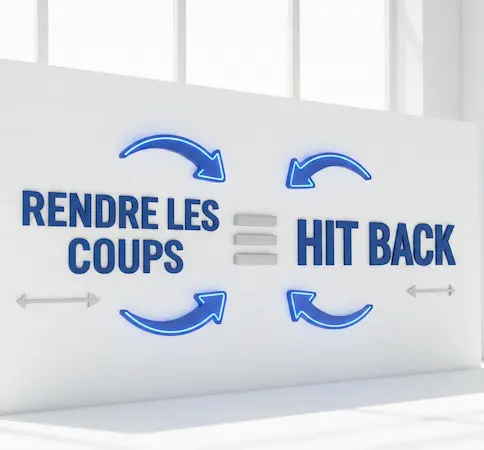
If you're an English speaker, you yelled "Ouch!"; a French speaker would have cried "Aïe!". And if the chair gives way and collapses, in English it goes "Thud!" or "Crash!". Here's the mind-bending part: the physical reality is identical. Same nerves firing in your toe, same soundwaves hitting your ears. So why doesn't humanity make — or hear — the same noise?
Because even our most primal biological reactions, and the way we copy the world around us, are hijacked by our native language before they ever hit the air. The sounds you'd swear are pure human instinct or raw physics turn out to be quietly learned.
Today, we're diving into interjections and onomatopoeia: the words language uses when it's pretending not to be language. And spoiler alert — they are lying to you.
0:53 Let's untangle two things that get mixed up all the time.
Interjections are short bursts of sound that voice an instant emotion — pain, joy, surprise, disgust. "Ouch!" "Yuck!" "Wow!" They feel like biological reflexes, escaping your lips before any thought forms — but they're actually cultural habits we absorbed in childhood, not hardwired human cries.
Onomatopoeia are fundamentally different: they're words built to mimic non-vocal sounds from the world itself — a slamming door, crashing objects, a buzzing bee. "Bang!" "Crash!" "Buzz!"
Both feel like raw noise that bypasses language entirely. Both are, in fact, shaped from top to bottom by the specific language producing them. That contradiction is the whole puzzle we're cracking today.
1:40 To see this in action, open up the English toolkit for interjections.
English keeps a massive, incredibly diverse wardrobe of them, each meticulously tailored to a precise shade of human feeling. Instead of relying on a single, generic cry for everything, we use completely different words for clear-cut, distinct emotions.
If you stub your toe, you yell "Ouch!" for physical pain. If you see something repulsive, you say "Yuck!" for disgust. If you're suddenly amazed, it's "Wow!" for surprise.
But the precision goes deeper than these basic emotional pillars. Once those primary boundaries are set, we select highly specific tools for subtle variations of those feelings. Within that same wardrobe, "Yikes" captures a sudden spike of mild alarm, "Blimey" rolls out for pure, jaw-dropping astonishment, "Oh boy" acts as a heavy sigh for incoming trouble, while "Dear me" anchors a sense of polite, old-fashioned dismay.
It's a system built on lexical precision, mapping out the emotional landscape by giving every single shift in mood its very own name.
2:44 Now things get even more interesting: onomatopoeia don't stay raw sounds forever.
They slip into sentences and take on full-time jobs, working as ordinary nouns and verbs. A word born from mimicking a noise can cross over into grammar, transforming into a standard noun or verb of onomatopoeic origin.
Take "Bang!" — it slides effortlessly into a noun ("I heard a loud bang") or a verb ("He banged the door shut"). The same thing happens to "Crash!" ("The cars crashed") and "Whir!" ("The engine whirred to life").
It's no longer really an onomatopoeia at all — it's just ordinary language wearing the costume of a sound.
3:23 Interjections and onomatopoeia are both words that stand on their own rather than serving a grammatical function within a sentence.
The difference is that an interjection is a short word or phrase spoken suddenly to express a strong feeling or emotion — think "Ouch!" and "Wow!" — whereas onomatopoeia is the use of words whose sounds imitate or resemble the noises they describe, such as "buzz," "bang," and "hiss." Though strictly speaking, the moment such a word functions as a noun or verb, it's no longer onomatopoeia but onomatopoeic in origin.
In short: interjections express what we feel; onomatopoeia imitate what we hear.
So, even at the very edge of language — the yelps, the crashes, the buzzes, the sounds we might consider too primal to be words — language is already there, quietly running the show. Even when you think you're just making noise, you're speaking English.
4:13 Now over to you, and let's stay with the most charming case of all: animal sounds.
A French rooster crows "Cocorico"; an English one belts out "Cock-a-doodle-doo." A French dog says "Ouaf"; an English dog says "Woof." Same animal, same throat, wildly different word.
So what about the languages you speak? How do dogs, cats, and roosters sound to your ears? Drop your favorites in the comments — I genuinely collect these, and the weirder the better.
You'll find more examples in the companion article over on the Erosophia blog, along with plenty of free resources to sharpen your English and get ready for an exam. That's all for today — keep listening to the world in more than one language, and catch you in the next one.