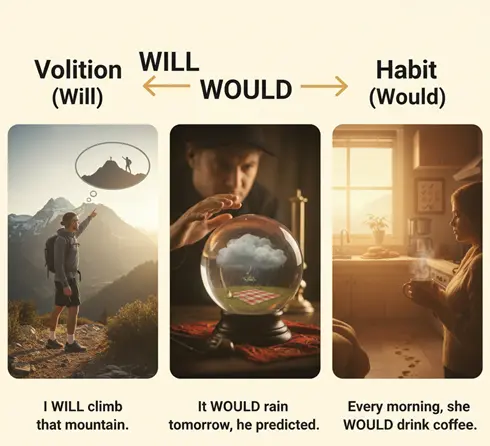
Will and would aren't limited to expressing the future. Will expresses volition, prediction, spontaneous decision, and habitual repetition. Would expresses past refusal, politeness, unreality, past habit, and future-in-the-past. These two modals aren't simple temporal markers — they reveal the subject's attitude and the speaker's perspective. Welcome to the world of will and would — where the future meets volition, imagination, and memory.
WILL: Six Main Functions
1. Subject's volition (affirmation)
The subject wants to do something, expresses an intention.
- Tomorrow, I'll go to the shops.
- Yes, I will.
Will marks the subject's decision or determination.
2. Subject's refusal (negation)
With negation, will not (won't) expresses categorical refusal.
- I won't answer. → = I refuse to answer.
The subject doesn't want to do something.
3. A request (question)
In a question, will appeals to the subject's willingness.
- Will you please call me when you arrive at the airport?
This is a request that solicits the other person's willingness.
4. Prediction of an event
The speaker predicts what will happen.
- She'll be here any minute now.
Will expresses a forecast based on what the speaker thinks or knows.
5. Spontaneous decision (on-the-spot)
The subject makes an immediate decision, at the moment of speaking.
- This traffic is terrible; I'll take the side streets to get there faster.
The decision wasn't planned in advance — it's made on the spot.
6. Repetition of an event ("frequentative" will)
Will expresses a general habit, a truth about what happens regularly.
- Cats will meow loudly when they're hungry.
This is called frequentative will: a characteristic habit of a subject.
WOULD: Six Main Functions
1. Past refusal (negation)
With negation, would not (wouldn't) expresses past refusal.
- Yesterday, my car wouldn't start.
The car refused to start — as if it had its own will.
2. Polite/mitigated request (question)
In a question, would softens the request, making it more polite than will.
- Would you please call me when you arrive at the airport?
Would creates polite distance by using the past form (even though the request concerns the present/future).
3. Polite offer
Would you like...? is a polite formula for proposing something.
- Would you like to go for a walk in the park?
This is much more polite than "Do you want to go for a walk?"
4. Unreal, imaginary, fictitious
Would expresses an unreal or hypothetical situation.
- If I won the lottery, I wouldn't have to work for a living anymore.
The event is not real — it's a hypothesis.
5. Past habit ("frequentative" would in the past)
Would expresses a repeated action in the past.
- Every summer, we would visit our grandparents at their beach house.
This is frequentative will applied to the past: a bygone habit.
6. "Future-in-the-past" (prolepsis)
Would expresses an upcoming event relative to a past moment.
- In 2002, I moved to a city where I would raise my family for the next decade.
At the moment of 2002, raising the family was in the future. But from the narrative perspective (now), it's in the past. Would often translates to the imperfect in French: "où j'allais élever ma famille."
Past Habit: WOULD vs USED TO vs BE USED TO
To express a past habit, three structures are possible, each with nuances:
WOULD (for repeated actions in the past)
Expresses a repeated past action in narration.
- Every summer, we would visit our grandparents.
Would is often used to recount memories, with a nostalgic touch. Limitation: Would is NOT used for states (state verbs). You can't say "I would be happy" for a past habit.
USED TO (for contrast between past and present)
Expresses a contrast between what was true before and what is no longer true now.
- I used to smoke, but I quit.
Used to emphasizes that the habit no longer exists. Advantage: Used to works for both actions AND states.
- I used to live in Paris. (state)
- I used to play tennis. (action)
BE USED TO + V-ING (to be accustomed to)
Expresses that the subject has acquired the habit of doing something, is accustomed to a situation.
- I was used to waking up early.
Nuance: This isn't "I did something habitually," but "I was accustomed to doing it" (the habit was integrated). Summary:
- WOULD: repeated past action (narration, memories)
- USED TO: past/present contrast (what's no longer true)
- BE USED TO + V-ING: to be accustomed, to have acquired the habit
WILL vs WOULD: Key Differences
WILL (present/future):
- Volition: I will do it.
- Refusal: I won't answer.
- Request: Will you help?
- Prediction: It will rain.
- Spontaneous decision: I'll take the bus.
- General habit: Cats will meow when hungry.
WOULD (past or unreal/polite):
- Past refusal: The car wouldn't start.
- Polite request: Would you help? (more polite than will)
- Polite offer: Would you like some tea?
- Unreal: I would go if I could.
- Past habit: We would visit them every summer.
- Future-in-the-past: I knew I would regret it.
Politeness nuance:
- Will you help? = direct request
- Would you help? = polite, mitigated request
Habit nuance:
- Cats will meow = general truth (present)
- We would visit = past habit (bygone)
Conclusion
Will and would aren't simple future markers. Will expresses:
- Subject's volition or refusal
- Speaker's prediction
- Spontaneous decision
- General habit (frequentative)
Would expresses:
- Past refusal
- Politeness (requests, offers)
- Unreality (hypotheses)
- Past habit (past frequentative)
- Future-in-the-past (prolepsis)
For past habits, three tools exist:
- WOULD for repeated actions (narration)
- USED TO for past/present contrast
- BE USED TO + V-ING for accustomedness
Mastering will and would means understanding that English doesn't just say "what will happen" — it expresses who wants it to happen, how likely it is, and from what temporal perspective we're viewing it.