TONGUE TWISTER: THE TH MARATHON
Thought, throw, three, through, throat, though: this story is a workout for the two TH sounds, with the added difficulty of TH followed by R — one of the hardest consonant clusters in English. Most languages have no TH at all, so expect your tongue to resist at first; it is being asked to do something it has never done. Listen to the audio above, then train with the guide below. The reward is large: TH appears in "the", "this", "that", "they", "there", "think", "thing" — some of the most frequent words in the language — so fixing it improves every sentence you say.
Two Different TH Sounds
Voiceless /θ/ (as in THOUGHT):
- Tongue tip lightly between the teeth, or touching the back of the upper teeth
- Air flows through the narrow gap, producing a soft hiss
- Vocal cords do NOT vibrate — hand on throat, nothing moves
- Examples: THOUGHT, THROW, THREE, THROUGH, THROAT, THICK, THING
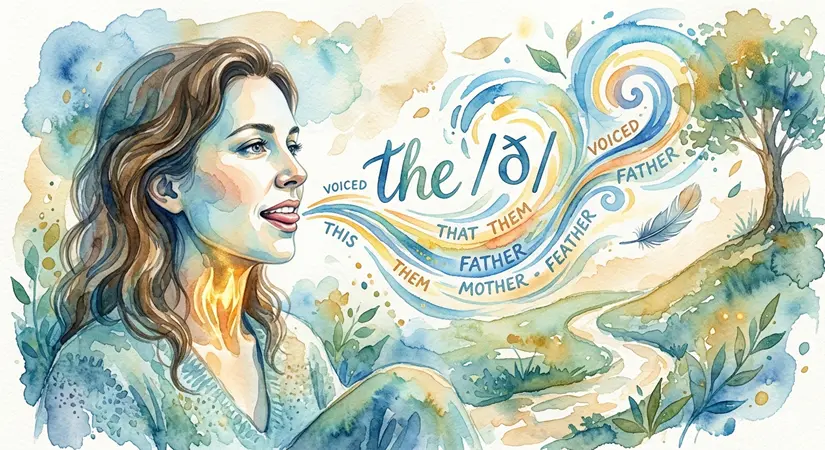
Voiced /ð/ (as in THOUGH):
- Exactly the same tongue position
- Vocal cords DO vibrate — you feel a buzz in the throat and on the tongue tip
- Softer, lower, shorter sound; in fast speech the tongue barely reaches the teeth
- Examples: THOUGH, THAT, THIS, THESE, THEN, BROTHER
How to Produce TH
- Place the tip of your tongue between your upper and lower teeth — it should be visible in a mirror. If in doubt, push it out further than feels natural.
- Keep the teeth slightly apart, do not bite down
- Blow air through for /θ/; add your voice for /ð/
- Pull the tongue back quickly into the next sound — the TH is brief
The most common failure is the tongue staying behind the teeth, which produces /s/ or /t/ instead. The second is biting the tongue, which blocks the air completely. Aim for a light contact with the edge of the upper teeth.
Which TH Is It? A Rule of Thumb
The spelling does not tell you, but the type of word usually does:
- Function words are voiced /ð/: the, this, that, these, those, they, them, their, there, then, than, though, thus, with
- Content words at the start are voiceless /θ/: think, thing, three, thank, thick, thin, thought, Thursday, theatre, thousand
- Between vowels, usually voiced /ð/: mother, father, brother, other, weather, either, rather, together
- At the end of a noun or adjective, voiceless /θ/: bath, breath, mouth, tooth, north, cloth, health, truth
- At the end of a verb, voiced /ð/: bathe, breathe, clothe, soothe — the spelling adds an -e, and the vowel usually lengthens too
This last pattern is worth memorising: breath /breθ/ (noun) vs. breathe /briːð/ (verb), bath /bɑːθ/ vs. bathe /beɪð/, cloth /klɒθ/ vs. clothe /kləʊð/, teeth /tiːθ/ vs. teethe /tiːð/.
The Hardest Case: TH + R
In "three", "throw", "through", "throat" and "thrilled", the tongue must go from between the teeth (TH) to pulled back and touching nothing (R) almost instantly — two positions as far apart as the mouth allows. Practise it in two steps: "th... ree", "th... row", with a pause, then close the gap over several repetitions. Do not let the TH become /t/, /s/ or /f/ to make the transition easier — "tree", "free" and "three" are different words, and "I have free children" is a strange thing to say.
Common Mistakes to Avoid
- "T-ree" or "free" instead of THREE /θriː/
- "Tought" or "sought" instead of THOUGHT /θɔːt/
- "Dough" or "zough" instead of THOUGH /ðəʊ/
- "Sink" instead of THINK /θɪŋk/ — "I sink so" is a classic
- "Dat" or "zat" instead of THAT /ðæt/
- "Wiz" or "wid" instead of WITH /wɪð/
Each substitution is the learner's native language showing through: /s, z/ for French and German speakers, /t, d/ for many Asian and some European languages, /f, v/ for others. Knowing your own default helps you catch it.
Word List by TH Type
Voiceless /θ/:
- Beginning: think, thank, thick, thin, Thursday, theatre, thumb, thunder, thirty, thousand
- Middle: nothing, birthday, bathtub, toothbrush, healthy, wealthy, author, method
- End: math, bath, tooth, worth, mouth (noun), north, both, faith, month
Voiced /ð/:
- Beginning: this, that, these, those, then, there, the, they, than, though
- Middle: mother, father, brother, weather, either, other, rather, further, leather
- End: breathe, clothe, smooth, with, bathe, soothe
Minimal Pairs
- thank /θ/ → than /ð/
- breath /θ/ → breathe /ð/
- teeth /θ/ → teethe /ð/
- mouth (noun) /θ/ → mouth (verb) /ð/
- three /θ/ → tree /t/ → free /f/
- thin /θ/ → sin /s/ → tin /t/ → fin /f/
- they /ð/ → day /d/ → zay /z/
Practice Sentences
- "I thought about throwing three things through the window."
- "These are the things I think about on Thursdays."
- "My throat hurts when I say 'three thousand things'."
- "Though I thought it through, the theory was wrong."
- "That's the thing about thinking — it's harder than you think!"
- "Both brothers bathe in the bath on their birthday."
The Famous TH Tongue Twister
"The thirty-three thieves thought that they thrilled the throne throughout Thursday."
- Voiceless /θ/: thirty-three, thieves, thought, thrilled, throne, throughout, Thursday
- Voiced /ð/: the, that, they
Daily Practice Routine
- Say "th-th-th-th" 20 times with the tongue between the teeth — first unvoiced, then voiced
- Voiceless drill: think, thank, thought, three, through (5× each), tongue visible
- Voiced drill: this, that, these, those, then (5× each)
- Noun–verb pairs: breath/breathe, bath/bathe, cloth/clothe (5× each)
- Read the story slowly, then faster, keeping every TH intact
- Record yourself and compare with the audio — mark every TH that slipped into s, z, t, d or f