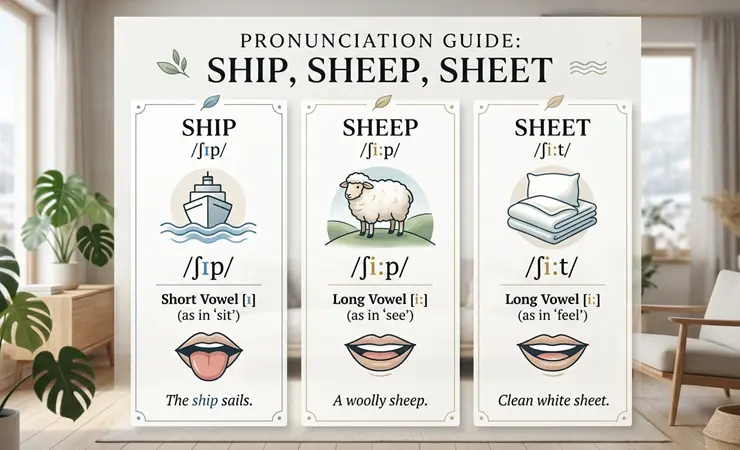
TONGUE TWISTER: THE MARITIME MISTAKE
One vowel, one small change in tongue tension, and "sheet" becomes something you should not say in polite company. The short /ɪ/ and the long /iː/ are the most consequential vowel pair in English — the one whose confusion causes the most embarrassment — and this story is designed to make you hear the difference. Listen to the audio above, and notice how the narrator has to stop and correct himself.
Short /ɪ/ vs. Long /iː/
Short /ɪ/ (as in "sit"):
- Tongue relaxed and slightly lower in the mouth
- Jaw a little more open, lips neutral
- Sound is brief and lax — closer to the vowel in "bed" than most learners expect
- Examples: SHIP /ʃɪp/, DIP /dɪp/, SLIP /slɪp/, SIT /sɪt/
Long /iː/ (as in "see"):
- Tongue tense and high, pressed towards the roof of the mouth
- Lips spread, almost a smile
- Sound is longer and held
- Examples: SHEEP /ʃiːp/, DEEP /diːp/, SHEET /ʃiːt/, SEAT /siːt/
The key is tension, not just length. A relaxed /ɪ/ stretched out still sounds like /ɪ/, and a tense /iː/ said quickly still sounds like /iː/ — natives will hear the quality of the vowel before its duration. Smile for /iː/; let go for /ɪ/. If you put a finger under your chin, you should feel the muscles engage for "sheep" and release for "ship".
Why Learners Merge Them
Most languages have a single "i" vowel, and it is usually tense — close to English /iː/. Speakers of those languages use it for both English sounds, so "ship" comes out as "sheep", "bit" as "beat", "live" as "leave". The problem is not that the learner cannot say /ɪ/: it is that they do not perceive it as a separate sound, because their ear has never needed the category. This is why training starts with listening. Until you can hear "ship" and "sheep" as clearly different words, you cannot reliably produce them.
Critical Minimal Pairs
- SHIP /ʃɪp/ vs. SHEEP /ʃiːp/ → "The ship carries sheep"
- SHEET /ʃiːt/ vs. SH*T /ʃɪt/ → the pair that causes the most embarrassment (vulgar)
- BEACH /biːtʃ/ vs. B*TCH /bɪtʃ/ → equally important (vulgar)
- PEACE /piːs/ vs. P*SS /pɪs/ → another one to get right (vulgar)
- DEEP /diːp/ vs. DIP /dɪp/ → "Take a deep breath before you dip"
The Third Vowel in the Story
The narrator, trying to avoid the vulgar word, says "shut" — and that introduces a third vowel, /ʌ/ as in "cup": SHUT /ʃʌt/. So the story actually contrasts three sounds: sheet /iː/, sh*t /ɪ/, shut /ʌ/. The /ʌ/ is made with the tongue low and central and the lips relaxed; it is the vowel of "but", "cut", "sun". Practise the triplet: sheet – ship – shut, seat – sit – sun, beat – bit – but.
More Practice Pairs
- sit → seat
- live (verb) → leave
- fill → feel
- chip → cheap
- slip → sleep
- hit → heat
- fit → feet
- bin → bean
- list → least
- will → wheel
- his → he's
- it → eat
Spelling Patterns
The spelling is a reasonably good guide here — better than for most English vowels:
- /iː/ is usually written ee (see, sheep), ea (sea, beach), ie (field, piece), e at the end of a stressed syllable (me, be, even), or e_e (these, complete). Also i in words from French or Italian: machine, police, ski, pizza.
- /ɪ/ is usually written i (ship, sit) or y (gym, myth). Watch out for exceptions: e in pretty, English, women (!), ui in build, o in women, u in busy.
- Final -y (happy, city, very) is a short /i/ — tense in quality but brief. It counts as neither "ship" nor "sheep"; do not lengthen it.
A Subtlety: Length Before Voiced Consonants
Both vowels are held longer before a voiced consonant than before a voiceless one. "Seed" has a longer /iː/ than "seat"; "bid" has a longer /ɪ/ than "bit". This means a long /ɪ/ in "bid" can actually last as long as a short /iː/ in "seat" — proof that duration alone cannot tell the vowels apart. Quality does.
Why This Matters
Confusing /ɪ/ and /iː/ can lead to misunderstanding or, worse, accidental vulgarity. English listeners will hear whichever word the context suggests, which is not always the one you meant:
- "I need new sheets" (correct) vs. "I need new sh*ts" (embarrassing)
- "Let's go to the beach" vs. "Let's go to the b*tch" (offensive)
- "The ship is big" vs. "The sheep is big" (simply confusing)
- "I live here" vs. "I leave here" (opposite meaning)
Practice Sentences
- "The sheep slipped on the ship and fell on a sheet."
- "I need to sleep, but I keep slipping on this slippery floor."
- "The deep pool has a small dip at the end."
- "Can you feel the difference when you fill the cup?"
- "Please leave before you live to regret it."
- "He hit the heat switch and sat on the seat."
Tongue Twister Challenge
Repeat this 5 times fast:
"Six ships with sixty sheep and sixty clean sheets sailed into the deep sea without a single slip or dip!"