TONGUE TWISTER: THE KITCHEN NIGHTMARE
Everything in this story happens in a kitchen, and every key word breaks the link between spelling and sound: silent letters inherited from Old English, French letters that were never pronounced in English, and words that sound identical yet mean completely different things. Listen to the audio above while reading the transcript, then work through the breakdown. The aim is not only to say the story, but to understand why each word sounds the way it does — because that understanding transfers to hundreds of other words.
Key Pronunciation Challenges
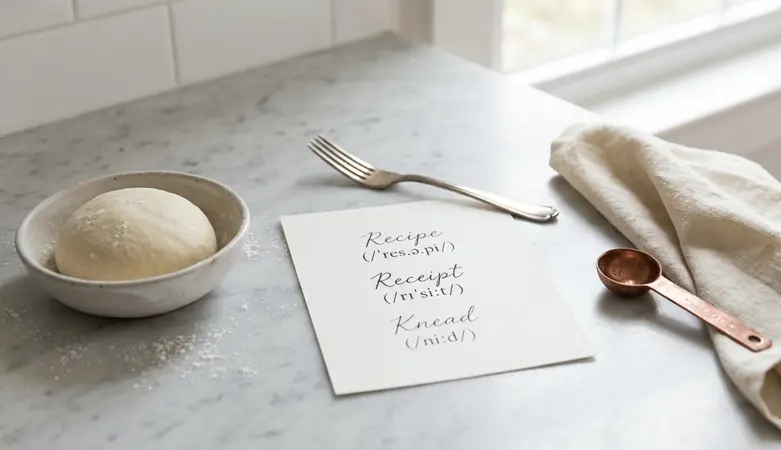
- RECIPE /ˈre-sə-pi/ vs. RECEIPT /rɪ-ˈsiːt/ → The first has three syllables and stress at the start; the second has two, stress at the end, and a silent 'p'. Never say "re-SIPE" — a very common error, because the final "e" looks like the silent "e" of "ripe" or "wipe".
- KNEAD /niːd/ vs. KNEES /niːz/ → Both begin with a silent 'k'. The only difference is the final consonant: /d/ vs. /z/. And "knead" is a perfect homophone of "need".
- FLOUR /ˈflaʊ-ə/ vs. FLOWER /ˈflaʊ-ə/ → True homophones: identical in sound, distinguished only by context. Both are two syllables, with the diphthong /aʊ/ gliding into a schwa.
- KNOTTY /ˈnɒ-ti/ vs. NOT /nɒt/ → Silent 'k' again; "knotty" (full of knots, hence "complicated") simply adds a syllable to "not". "Knot" and "not" are homophones too.
The Silent K and Its Family
Every English word beginning with "kn" has a silent 'k': knead, knee, knife, knock, know, knot, knight, knowledge, knuckle. The 'k' was pronounced in Old English — "cniht" for knight — and quietly dropped out around the seventeenth century, because the /kn/ cluster was awkward to say. The spelling never caught up. The rule is absolute: read "kn" as a plain /n/, always.
The same fate befell several other initial clusters, and it is worth learning them as a set:
- gn- → silent 'g': gnome, gnaw, gnat, gnash
- wr- → silent 'w': write, wrong, wrist, wrap, wreck
- ps-, pn-, pt- → silent 'p': psychology, psalm, pneumonia, pterodactyl
- -mb at the end → silent 'b': lamb, thumb, comb, climb, bomb, dumb
- -bt → silent 'b': debt, doubt, subtle
The Silent P of "Receipt"
"Receipt" is a different story. It came from Old French "receite", with no 'p' at all — and was pronounced that way. In the fifteenth and sixteenth centuries, scholars who admired Latin inserted a 'p' to make the word look like its Latin ancestor "recepta". Nobody ever pronounced it. The same "etymological respelling" gave us the 'b' in "debt" and "doubt" (Latin debitum, dubitare) and the 's' in "island" (wrongly linked to Latin insula). The spelling is a fossil of a fashion, not a guide to the sound.
"Recipe", meanwhile, is the Latin imperative "take!" — the first word of old medical prescriptions — and kept its three Latin syllables. Two words, one Latin root (recipere, to receive), two completely different pronunciations.
More Kitchen Words That Betray Their Spelling
- Salmon /ˈsæ-mən/ → silent 'l'; likewise almond /ˈɑː-mənd/, half /hɑːf/, calm /kɑːm/
- Yolk /jəʊk/ → silent 'l'; a homophone of "yoke"
- Cupboard /ˈkʌ-bəd/ → the 'p' vanished and the 'oa' collapsed to schwa: "cubbard"
- Vegetable /ˈvedʒ-tə-bəl/ → three syllables, not four; the second 'e' is lost
- Sauce /sɔːs/ and sausage /ˈsɒ-sɪdʒ/ → the "au" spelling gives two different vowels
- Dough /dəʊ/ → the "ough" that rhymes with "go" (see the Tough Woodsman article)
- Oven /ˈʌ-vən/ → the 'o' is /ʌ/ as in "cup", not /ɒ/ as in "hot"; same in "onion", "dozen", "honey"
- Sugar /ˈʃʊ-gə/ → the 's' is /ʃ/, as in "sure"
Why This Is Difficult
English spelling was fixed by the first printers in the fifteenth century and has barely changed since, while the pronunciation has moved on for five hundred years. Words borrowed from French kept their French letters, Old English words kept consonants that fell silent, and Renaissance scholars added letters that were never spoken. The result is a writing system that records the history of each word rather than its sound. The only reliable guide is the ear — which is why listening comes before reading in this lesson.
Practice Tips
- Read the story slowly at first, pausing on each highlighted word and saying it in isolation
- Drill the minimal pairs aloud: knead/need, knees/niece, not/knot, recipe/receipt, flour/flower
- Focus on the silent letters: no /k/ in knead or knotty, no /p/ in receipt, no 'w' in the sound of flour
- Write the four key words in phonetic transcription from memory, then check
- Record yourself and compare with the audio, then gradually increase speed
Challenge Mode
Say this three times fast:
"I knead the flour, not the flower, on my knees for the recipe, but I lost the receipt!"