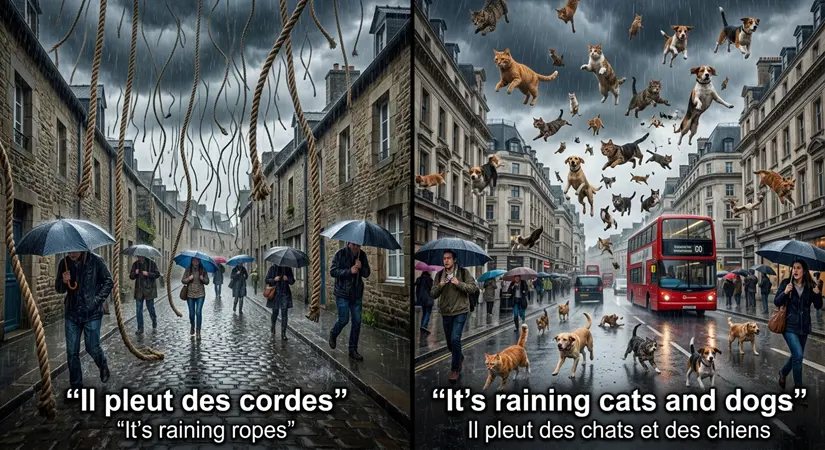
English says It's raining cats and dogs. French says Il pleut des cordes. Same downpour, animals on one side, ropes on the other.
But image change covers far more than fixed expressions. Sometimes you swap one metaphor for another; sometimes you drop the figure altogether and state the thing plainly; sometimes you add a figure the source did not have. This is modulation through image change, and it is the point where translation starts asking you to write.
Article 4 of this series dealt with proverbs and idioms — expressions stored whole. Here we are working one level down, on the figurative layer of ordinary language: the metaphors nobody notices, the comparisons everybody uses, and the occasional metaphor an author has invented on the spot.
What image change covers
- Changing the metaphor — one image replaces another.
- De-figuring — the image gives way to plain statement.
- Figuring — plain statement gives way to an image.
- Changing the comparison — the term of comparison is swapped for another.
The trigger is always the same: the source image does not work in the target language, culturally, lexically or stylistically.
The distinction that decides everything: dead or alive
Before touching any metaphor, ask whether it is lexicalised or authorial. The answer changes the rules completely.
A dead metaphor has been absorbed into the dictionary and nobody perceives the image any more — the leg of a table, the foot of the mountain, a branch of government. You translate it with whatever the other language happens to have lexicalised, and you do not try to keep the picture:
- the foot of the mountain ↔ le pied de la montagne (same image, by luck)
- the mouth of the river ↔ l'embouchure (the mouth survives, but buried in a technical noun)
- the hands of a clock ↔ les aiguilles d'une montre (hands become needles)
A live metaphor is one the author built. It belongs to a voice, it is meant to be noticed, and it should normally be kept even if it sounds unfamiliar in the target language — the strangeness is the point. Replacing an author's original image with a ready-made French expression is one of the commonest ways of flattening a literary text.
Most translation errors on this front come from treating the two as one: reviving a dead metaphor (translating the hands of the clock as les mains) or killing a live one.
Type 1: changing the metaphor
It's raining cats and dogs. ↔ Il pleut des cordes.
The English image does not exist in French culture, so it is replaced by one that does. Two absurd pictures, one meaning.
To be feeling blue ↔ Avoir le cafard.
English colours sadness; French reaches for a cockroach. No overlap at all.
A white lie ↔ Un pieux mensonge.
English makes it colourless, French makes it pious. The excuse changes register entirely.
And yet — and this matters — a great many metaphors do transfer intact, because they rest on conceptual patterns the two cultures share: to be in the red ↔ être dans le rouge, green with envy ↔ vert de jalousie, time is money ↔ le temps, c'est de l'argent. The claim that images are never universal is as wrong as the claim that they always travel. Check, then decide.
Type 2: adding or removing the figure
From image to plain statement
He's always making speeches a yard long. ↔ Il fait toujours des discours qui n'en finissent plus.
English measures duration in physical length; French drops the spatial picture and says outright that the speeches never end. The effect — exasperation, hyperbole — survives; the image does not.
This is the right move when the target language has no comparable figure and any attempt at one would be laboured. The cost is real: a text de-figured throughout becomes duller than its original, which is exactly the situation compensation was invented for.
From plain statement to image
The reverse is legitimate too, and often necessary to keep the overall density of figuration constant. Where English says he refused outright, French may well offer il refusa tout net; where English states she was very tired, French idiom may supply elle était à bout. You are not inventing content, you are restoring texture.
Shifting metonymy
She was working hard, her head bent over her desk. ↔ Elle travaillait dur, le front courbé sur son travail.
Two shifts here. The synecdoche moves from head to front — a narrower, more literary part — and the concrete desk becomes the abstract travail. The image is neither kept nor dropped; it is re-aimed.
Type 3: changing the comparison
Comparisons are the most culturally loaded material in the language, because each one names a shared reference.
- as proud as a peacock ↔ fier comme un coq — the bird changes with the country
- to sleep like a log ↔ dormir comme un loir — the object becomes an animal
- as fit as a fiddle ↔ être en pleine forme — the comparison disappears entirely
- as easy as pie ↔ simple comme bonjour — food becomes a greeting
That last option — dropping the comparison — is worth noticing. French frequently answers an English simile with a plain intensifier, and forcing a simile into place where none exists produces the heaviness that marks amateur translation.
The trap: the mixed metaphor
Substituting an image has a downstream cost. If a paragraph develops a metaphor over several sentences and you change the picture in the first one, the rest of the paragraph no longer follows. English speaks of the tide turning and then of being swept away; if you replace the tide with a wind, the sweeping has to become a gust.
Rule: translate the metaphorical network, not the isolated metaphor. Read to the end of the passage before committing to an image.
How to decide, in order
- Keep the image if it works in the target language, and always if it is the author's own.
- Substitute an equivalent image if the original is opaque and the target language offers a conventional one.
- De-figure if nothing fits — state the meaning, and note the loss.
- Compensate by re-figuring somewhere nearby, so the text does not lose its overall colour.
And at every step, check the register: an image can be right in meaning and wrong in tone. Fier comme Artaban and fier comme un coq say the same thing about very different speakers.
Conclusion
Image change is a creative modulation. It shows that translating does not consist in carrying images across a border, but in recreating their effect with whatever the target culture keeps in stock.
Sometimes cats and dogs become ropes. Sometimes peacocks become roosters. Sometimes the metaphor dissolves into plain speech — and sometimes it must be left exactly as the author wrote it, strangeness included.
Because in English it rains animals.
In French it rains ropes.
Same downpour, imagery reinvented.