La contre-culture des années 60 : quand San Francisco et Londres réinventaient le monde
Chapitres
Transcription
It's 1967. You're 19. Your government wants to send you to Vietnam. Your parents want you to get a stable job, get married, and shut up. And somewhere in San Francisco, someone's handing you a flower and saying: "What if we just... didn't?" That's the 1960s. Let's get into it.
But first — why the 60s? Why did everything explode then? After World War II, society ran on one operating system: work, obey, repeat. But the baby boomers — the first generation that was both educated and comfortable enough to question things — looked at the Vietnam war, segregation, and the nuclear threat, and said: hard pass. They saw their parents' world as built on materialism and blind conformity. And that tension created what became known as the generation gap — one of the defining phrases of the entire decade. The break was inevitable.
So let's start on the West Coast. San Francisco, 1967. The San Francisco neighborhood of Haight-Ashbury was the center of the world for the hippie movement during the summer of 1967. Tens of thousands of hippies flood in — long hair, colourful clothes, Volkswagen vans covered in peace signs. They're rejecting a society of materialism, competition, labelled as "the rat race" — and intend to replace it with community, peace, and a lot of psychedelics.
Have you ever heard "Make love, not war"? That's their slogan. Their message was clear: Embrace the heart, not the sword. Prioritize human connection over military destruction. And the music matched the energy: long, improvised, mind-bending. Jefferson Airplane. The Grateful Dead. Janis Joplin. These weren't just pop songs. They were experiences.
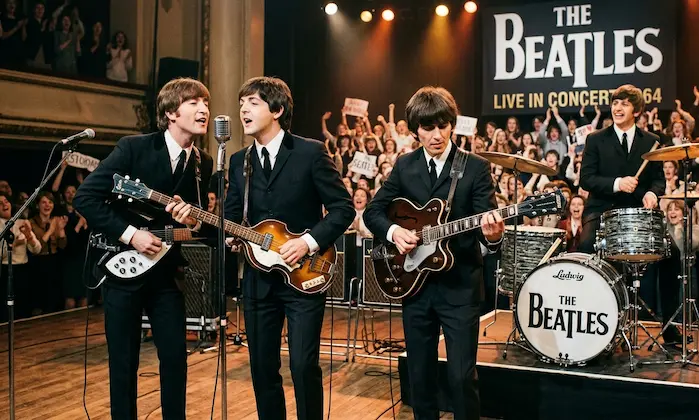
Now let's cross the Atlantic — because something equally massive but completely different was happening in London. Forget grey, post-war Britain — this was Swinging London. Mary Quant invented the miniskirt on Carnaby Street — not just fashion, a political statement about female autonomy. And British bands were dominating American charts. The Who’s 'My Generation' provided the ultimate 60s manifesto; its line 'I hope I die before I get old' captured a youth culture that prioritized raw energy over long-term stability. For the first time, cultural influence was flowing east to west — a complete reversal of how it had always worked.
And while all of this was happening, a whole new vocabulary was being invented — and a lot of it, you still use today. Cool, groovy, the Establishment, Flower Power — all stemmed from the 1960s. Few individuals defined the 60s divide like Timothy Leary . A psychologist turned psychedelic advocate , his influence was so potent it earned him the title of 'most dangerous man in America' from the President himself, Richard Nixon. Timothy Leary's simple directive — 'Turn on, tune in, drop out' — became the defining command for a generation of seekers.
In the context of the 1960s, "seekers" refers to people — mostly young adults — who were looking for deeper meaning, spiritual truth, or a different way of living outside of mainstream society.
But here's where I have to be honest — because no revolution is perfect. Let's fast-forward to August 1969: Woodstock. 400,000 people, three days of music, a moment of collective euphoria . December 1969: Altamont . A concertgoer was fatally stabbed during a Rolling Stones performance. One journalist later wrote that this moment shattered the dream of a countercultural utopia — and he wasn't wrong. Drug use destroyed many lives. The 27 Club as we call them — Joplin, Hendrix, and Morrison — all died at age 27 within a single ten-month period between 1970 and 71.
And the final irony? The music and fashion industries looked at this rebellion and said: "Great. How do we sell this?" and Revolution was processed into a marketing strategy.
So after all of that — the idealism, the music, the chaos, and the contradictions — why does this decade still matter? Because Rather than mere nostalgia , the 1960s counterculture serves as a vital origin point for the modern world. From the birth of mass anti-war protests to the inaugural Earth Day in 1970 — which is a tradition we still uphold — the era’s influence is undeniable. The foundational struggles for civil rights, women’s liberation, and environmental protection all found their voice here.
Ultimately, the revolutionary idea that culture itself could be a form of resistance traces its roots directly back to the streets of San Francisco and London. And if you want to go deeper — the vocabulary, the key concepts, the full breakdown — it's all in the article on erosophia.eu. See you in the next one