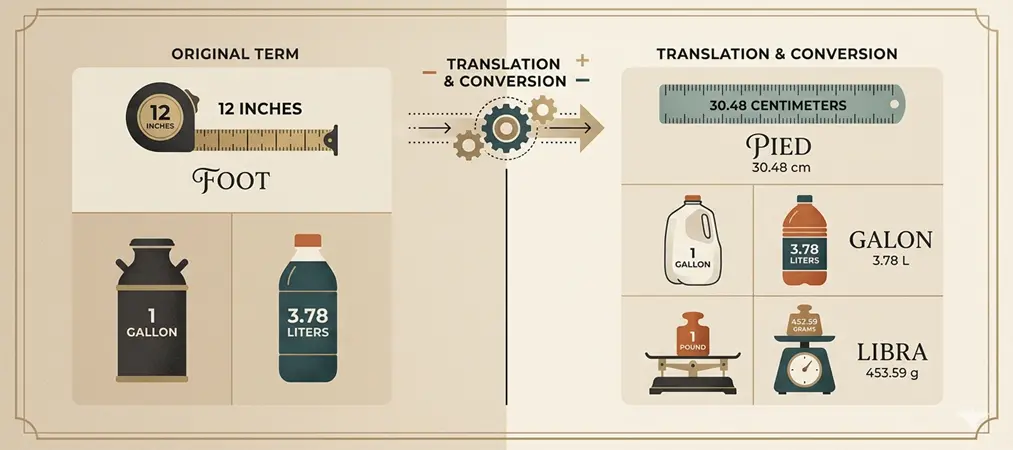
An American character says He is 6 feet tall. You write Il mesure 6 pieds and your French reader has no idea how tall the man is. They would have to stop reading and calculate.
The right version is Il mesure 1,83 m, or better still Il mesure 1 mètre 83.
Units of measurement are not like place names or traditions, which can be left alone. They pose a cognitive problem: an unconverted unit forces the reader out of the text.
The general principle
Convert, so the reader can picture the thing immediately. The purpose is not arithmetic accuracy but readability: your reader should see a height, a distance, a temperature, without doing mental maths and without leaving the page.
The exceptions — fixed expressions, historical colour, culturally identified objects — are real and are covered below, but they are exceptions. The default is conversion.
The rule runs both ways. Translating French into American English means turning metres into feet and kilos into pounds, with one caveat worth remembering: the United Kingdom is a mixed system, where distances are in miles, beer in pints, body weight in stones, but food packaging in grams and school science entirely metric.
The conversions you actually need
Length and distance
- 1 inch = 2,54 cm
- 1 foot (12 inches) ≈ 30 cm
- 1 yard (3 feet) ≈ 0,91 m — near enough to a metre for most purposes
- 1 mile ≈ 1,6 km
- 1 acre ≈ 0,4 hectare (about 4 000 m²)
A quick mental shortcut for miles: multiply by 8 and divide by 5. Fifty miles becomes eighty kilometres, exactly.
Weight
- 1 ounce ≈ 28 g
- 1 pound (16 ounces) ≈ 454 g — roughly half a kilo
- 1 stone (14 pounds, British only) ≈ 6,35 kg
She weighs 120 pounds. ↔ Elle pèse 55 kilos.
Volume — and the UK/US gap
This is where careless conversion goes wrong, because the two systems disagree with each other.
- 1 pint UK ≈ 57 cl — the pub pint
- 1 pint US ≈ 47 cl — noticeably smaller
- 1 gallon UK ≈ 4,5 L
- 1 gallon US ≈ 3,8 L
- 1 fluid ounce ≈ 3 cl (US) or 2,8 cl (UK)
Before converting any volume, establish whether the source is British or American. A gallon differs by nearly a litre between the two.
Temperature
- 0 °C = 32 °F (freezing)
- 20 °C = 68 °F (a comfortable room)
- 37 °C = 98,6 °F (body temperature)
- 100 °C = 212 °F (boiling)
It's 95°F outside! ↔ Il fait 35 °C dehors ! — and note the French typography: a space between the number and the unit.
Speed and fuel consumption
Speed is straightforward: 60 mph ≈ 100 km/h, a conveniently memorable pair.
Fuel economy is not, and this is the conversion most often botched, because the two systems are inverse to each other. Miles per gallon measures distance per unit of fuel; litres per 100 km measures fuel per unit of distance. You cannot multiply by a constant — you have to divide.
- 30 mpg (US) ≈ 7,8 L/100 km
- 40 mpg (US) ≈ 5,9 L/100 km
A higher mpg is a better car; a higher L/100 km is a worse one. Reversing that turns an economical vehicle into a gas-guzzler.
Cooking: the one where volume becomes weight
American recipes measure dry ingredients by volume (cups), French recipes by weight (grams). There is no single conversion factor, because a cup of flour and a cup of sugar do not weigh the same:
- 1 cup of flour ≈ 125 g
- 1 cup of granulated sugar ≈ 200 g
- 1 cup of butter ≈ 225 g
- 1 cup of liquid = 24 cl
Oven temperatures matter just as much: 350 °F ≈ 180 °C, which French recipes also write as thermostat 6. A recipe converted with a single blanket factor does not work, and the reader finds out only after baking it.
Sizes
Shoe sizes, clothing sizes and paper formats have no formulas, only conversion tables — and shoe tables differ for men and women.
What size are you? Size 9. (UK) ↔ Quelle est votre pointure ? Du 43.
Paper is worth a mention because it silently breaks layouts: American Letter (216 × 279 mm) is not A4 (210 × 297 mm).
The number trap that is not a unit at all
One false friend costs more money than any measurement error: the English billion is the French milliard, not billion. English trillion is French billion.
A French billion is a thousand times larger than an English one. In financial, economic or journalistic translation, this is the single most consequential mistake available, and it is entirely silent — the sentence reads perfectly.
Rounding intelligently
Exact conversion produces absurd numbers. The principle: round to the same level of precision as the source.
- He is 6 feet tall. → not 1,8288 mètre but 1 mètre 83
- It's about 5 miles away. → not 8,04672 km but environ 8 kilomètres
- She weighs around 130 pounds. → not 58,967 kg but dans les 60 kilos
A vague source stays vague and a precise source stays precise. About five miles converted to 8,05 km invents an exactness the original refused — the classic error of false precision, which makes a character sound like a surveyor.
The converted number should also be one a speaker of the target language would produce spontaneously. French heights are given as 1 mètre 83 in speech and 1,83 m in writing, never as 183 centimètres.
When not to convert
Fixed expressions
A thousand leagues away, for miles around, an inch from disaster: the unit here is rhetoric, not measurement. Convert it and you get arithmetic where there was hyperbole. French has its own stock — à cent lieues de, à des kilomètres — and those are the equivalents to reach for.
Strong historical or period context
In a Victorian novel, feet, pounds and miles are part of the setting. Keep them, and where comprehension genuinely suffers, add the metric figure in a translator's note rather than inside the sentence.
Culturally identified objects
A British pint of beer stays a pint: French readers know what a pub pint is, and allons boire une pinte is perfectly idiomatic. An American gallon of milk does not enjoy the same recognition and is better rendered as roughly four litres — unless the whole point of the sentence is the American supermarket.
Sport
Do not convert the units of a codified sport. The hundred-yard dash, the four-minute mile, a par-four of 380 yards: these are the names of things, not measurements, and metric versions read as errors.
Worked examples
- I drove 50 miles to get here. ↔ J'ai fait 80 kilomètres pour venir.
- She's about 5 foot 4 and weighs around 110 pounds. ↔ Elle mesure environ 1 mètre 63 et pèse dans les 50 kilos.
- The temperature dropped to 15°F overnight. ↔ La température est descendue à -9 °C pendant la nuit.
- Add 8 fluid ounces of milk. ↔ Ajoutez 25 cl de lait.
The four pitfalls
- False precision. Decimals the source never had.
- Ignoring the UK/US split. Pints, gallons and fluid ounces are not the same on both sides of the Atlantic.
- Translating without converting. Six pieds tells a French reader nothing at all.
- Converting what should stay. Idioms, sporting distances and period colour lose their point in metric.
Conclusion
Converting units is not arithmetic. It is a question of readability and immersion: the reader should see the height, the distance, the heat, without calculating and without leaving the story.
The goal is not to preserve numbers. It is to preserve the reading experience.
Which is why six feet becomes one metre eighty-three — simple, clear, immediate.