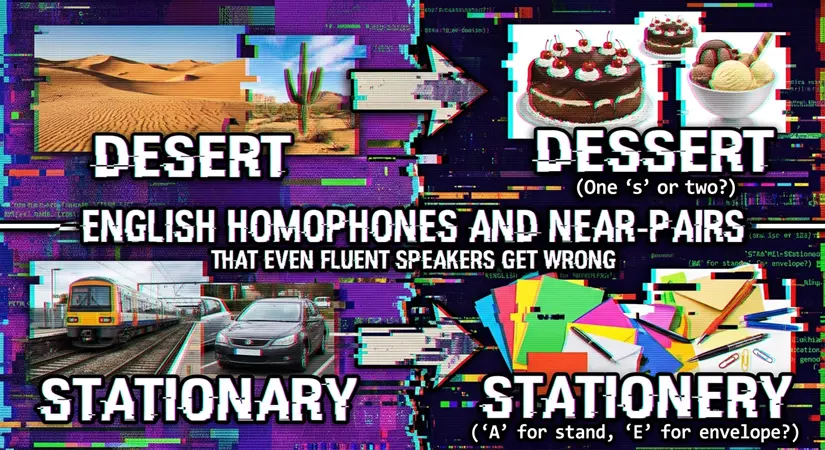
TONGUE TWISTER: THE DESERT DESSERT
Desert or dessert? Lose or loose? These pairs trip up native speakers in writing and learners in speech. The difference is small — one stressed syllable, one final consonant — but it separates a sandy landscape from a slice of cake, and a lost game from a loose belt. Behind the confusion lie two of the most useful patterns in English pronunciation: stress that shifts between noun and verb, and the /s/–/z/ contrast that separates nouns from verbs. Listen to the audio above and follow the breakdown.
DESERT vs. DESSERT
- DESERT (noun) /ˈde-zət/ → stress on the FIRST syllable: "DEH-zert" — a dry, sandy place
- DESERT (verb) /dɪ-ˈzɜːt/ → stress on the SECOND syllable: "dih-ZERT" — to abandon
- DESSERT /dɪ-ˈzɜːt/ → stress on the SECOND syllable: "dih-ZERT" — the sweet course
So the verb "desert" and the noun "dessert" sound identical; only context tells them apart. The noun "desert" is the odd one out, with stress at the front and a different vowel in the first syllable: /e/ instead of the reduced /ɪ/. This follows a general pattern in English: two-syllable nouns lean on the first syllable, verbs on the second. The same shift produces REcord/reCORD, PREsent/preSENT, OBject/obJECT, PERmit/perMIT, CONduct/conDUCT, INsult/inSULT — dozens of pairs where the letters stay and the weight moves.
One more relative: "deserts" in the phrase "just deserts" (what someone deserves) is pronounced like "desserts", /dɪ-ˈzɜːts/ — which is why so many people misspell it.
LOSE vs. LOOSE
- LOSE /luːz/ → a verb (to misplace, to be defeated); ends in a voiced /z/, rhymes with "choose", "news", "shoes"
- LOOSE /luːs/ → an adjective (not tight, free); ends in a voiceless /s/, rhymes with "goose", "juice", "moose"
Same vowel, different final consonant. Hold the last sound and check for vibration: buzz = lose, hiss = loose. Note also that the vowel in "lose" is slightly longer, because vowels stretch before voiced consonants — another small cue natives use without noticing.
The spelling is counter-intuitive: "lose" has one O but a long vowel and a voiced ending; "loose" has two O's, the same vowel, and a voiceless ending. There is no logic to it, only memory.
The Noun–Verb /s/–/z/ Pattern
Lose/loose is one example of a pattern that runs through the language. When a word exists as both noun (or adjective) and verb, the noun often ends in a voiceless sound and the verb in a voiced one — sometimes with a spelling change, sometimes without:
- advice /əd-ˈvaɪs/ (noun) → advise /əd-ˈvaɪz/ (verb)
- device /dɪ-ˈvaɪs/ (noun) → devise /dɪ-ˈvaɪz/ (verb)
- use /juːs/ (noun: "no use") → use /juːz/ (verb: "use it")
- excuse /ɪk-ˈskjuːs/ (noun) → excuse /ɪk-ˈskjuːz/ (verb)
- house /haʊs/ (noun) → house /haʊz/ (verb: to accommodate)
- close /kləʊs/ (adjective: near) → close /kləʊz/ (verb: to shut)
- breath /breθ/ (noun) → breathe /briːð/ (verb) — same pattern with TH
- bath /bɑːθ/ (noun) → bathe /beɪð/ (verb)
- belief /bɪ-ˈliːf/ (noun) → believe /bɪ-ˈliːv/ (verb) — same pattern with F/V
The rule of thumb: the noun is the "hard" form (/s/, /θ/, /f/), the verb the "soft" one (/z/, /ð/, /v/). Learn the pattern once and a dozen pairs fall into place.
AFFECT vs. EFFECT
- AFFECT /ə-ˈfekt/ → usually a verb, "to influence": "The weather affects my mood."
- EFFECT /ɪ-ˈfekt/ → usually a noun, "the result": "The weather has an effect on my mood."
In fast speech the first syllables of both reduce to a schwa and the words become near-homophones — which is exactly why native speakers confuse them in writing. In careful speech, keep the first vowel distinct.
Memory Tricks
For DESERT vs. DESSERT:
- "Dessert has two S's because you always want seconds"
- "The desert is sandy — one S, like sand"
- "Stressed spelled backwards is desserts" — and dessert is what you eat when stressed
For LOSE vs. LOOSE:
- "Lose has lost an O"
- "Loose has room for two"
- "You can lose your loose change"
Common Errors
- ❌ "I will loose the game" → ✅ "I will lose the game"
- ❌ "My shoes are lose" → ✅ "My shoes are loose"
- ❌ "Don't dessert me!" → ✅ "Don't desert me!"
- ❌ "I want desert after dinner" → ✅ "I want dessert after dinner"
- ❌ "Can you give me an advise?" → ✅ "Can you give me some advice?"
Practice Sentences
- "In the desert, don't desert your dessert — you might lose it to a loose camel."
- "I will lose my mind if my loose tooth falls into my dessert!"
- "Don't desert your friend in the desert just because you want dessert."
- "If you desert your post, you'll lose your dessert privileges."
- "My advice: I advise you to close the door, it's too close to the road."
More Confusing Pairs to Master
Homophones (identical sound, different spelling):
- there / their / they're — all /ðeə/
- to / too / two — all /tuː/ (but "to" is usually weak /tə/)
- your / you're — both /jɔː/
- its / it's — both /ɪts/
- principle / principal — both /ˈprɪn-sə-pəl/
- stationary / stationery — both /ˈsteɪ-ʃə-nə-ri/
- complement / compliment — both /ˈkɒm-plɪ-mənt/
Near-homophones (one sound apart):
- then /ðen/ vs. than /ðæn/ — though both reduce to /ðən/ in fast speech
- quite /kwaɪt/ vs. quiet /ˈkwaɪ-ət/ — one syllable vs. two
- accept /ək-ˈsept/ vs. except /ɪk-ˈsept/
- desert /ˈde-zət/ vs. dessert /dɪ-ˈzɜːt/ — you know this one now
Ultimate Challenge
Repeat this 5 times fast:
"Don't desert your dessert in the desert or you'll lose it to the loose sand!"