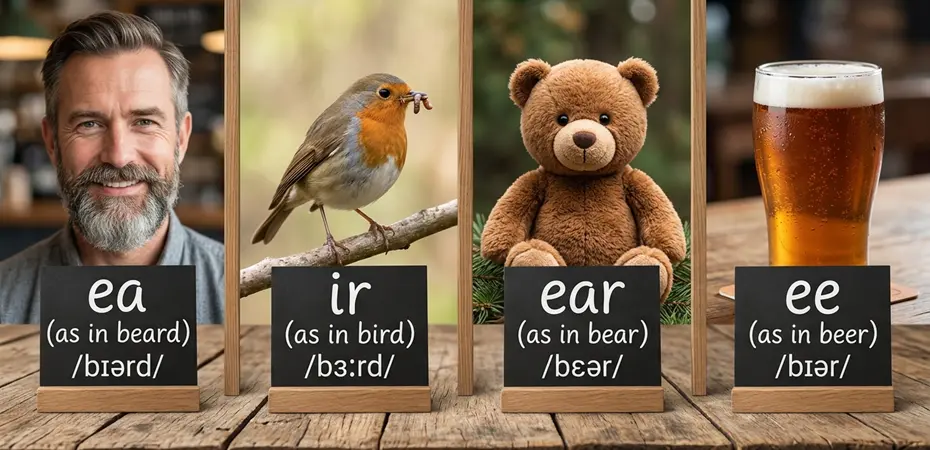
TONGUE TWISTER: THE BIRD-WATCHER'S CRISIS
Beard, bird, bear, beer: four words, one consonant frame (b...r), and four different vowels in the middle. For many learners these all collapse into one sound — which is how a bird-watcher ends up describing a bear with a beard drinking beer. The story targets the vowels that come before R, a family that English treats in a particularly confusing way. Listen to the audio above and follow the vowel map below.
Vowel Sound Breakdown
- BEER /bɪə/ → the /ɪə/ sound, like "ear" or "here"
- BEARD /bɪəd/ → same vowel as "beer", plus a final /d/
- BIRD /bɜːd/ → the /ɜː/ sound, a long central vowel, like "her" or "word"
- HEARD /hɜːd/ → same vowel as "bird" — despite the "ear" spelling
- BEAR /beə/ → the /eə/ sound, like "air" or "care"
Transcriptions are British; in American English each of these ends with an audible /r/ and the vowel before it is shorter: /bɪr/, /bɪrd/, /bɜːrd/, /ber/.
Why "ear" Is Such a Bad Guide
The story's difficulty is really a spelling problem. The three letters "ear" represent five different vowels in English:
- /ɪə/ → beard, hear, near, fear, clear, year
- /ɜː/ → heard, learn, earth, early, search, pearl
- /eə/ → bear, wear, tear (to rip), pear, swear
- /ɑː/ → heart, hearth
- /ɪə/ or /eə/ → tear: /tɪə/ from the eye, /teə/ to rip — same spelling, two words
There is no rule that predicts which. Each word must be learned by ear, and the vowel before R is one area where checking a dictionary transcription genuinely pays off.
Three Distinct Vowel Groups
1. The /ɪə/ group (BEER):
- A diphthong: starts high and front, like /ɪ/, and glides down to a neutral /ə/
- Words: beer, beard, fear, dear, near, here, cheer, year, idea, tear (from crying)
- Spellings: -eer, -ear, -ere, -ier (pier, fierce)
2. The /ɜː/ group (BIRD):
- A single, steady long vowel in the very centre of the mouth — no glide, no movement
- Lips relaxed and slightly spread, tongue neither high nor low, front nor back
- Words: bird, heard, word, work, first, nurse, turn, her, learn, girl, journey
- Spellings: -ir, -ur, -er, -ear, -or (after w), -our — five spellings, one sound
3. The /eə/ group (BEAR):
- A diphthong: starts mid-open, like /e/, and glides to /ə/
- Words: bear, wear, care, hair, fair, share, scared, there, their, where
- Spellings: -ear, -are, -air, -ere, -eir
Tip: the /ɜː/ of "bird" is the one that does not exist in most languages, and the one learners most often replace — with /ɪə/ ("beard"), /eə/ ("bared"), or /ɑː/ ("bard"). Say a long, lazy, bored "uhhh" with the tongue flat in the middle of the mouth and the lips loose. That is the sound. It is also the sound of the schwa, only longer and stressed.
Two More Vowels Before R
To complete the set, the story's frame also fits two other words:
- BARD /bɑːd/ → /ɑː/, long and open, like "car", "heart", "hard"
- BORED / BOARD /bɔːd/ → /ɔː/, long and rounded, like "door", "war", "four"
So the complete ladder is: beer /ɪə/ – bear /eə/ – bird /ɜː/ – bard /ɑː/ – board /ɔː/. Run through it slowly and feel the tongue move from high-front to central to low-back.
Minimal Pairs Practice
- beard → bird → bear → bard → board
- fear → fur → fair → far → four
- hear → her → hair → hard → horde
- tear (cry) → turn → tear (rip) → tar → tore
- dear → dirt → dare → dark → door
Common Mistakes
- "bird" said like "beard" → "I saw a beard" (facial hair, not an animal)
- "bear" said like "beer" → "I drank a bear" (impressive, but wrong)
- "heard" said like "hard" → the vowel drifts too far back and open: "I hard you"
- "work" said like "walk" → /ɜː/ replaced by /ɔː/, a very common confusion
- Rolling or scraping the R in any of these — in British English it is silent; in American it is soft and vowel-like
Rhotic vs. Non-Rhotic Accents
American English (rhotic): the R is always pronounced, and the vowel before it is shorter — the R itself carries much of the identity → BEARD /bɪrd/, BIRD /bɜːrd/, BEAR /ber/ British English (non-rhotic): the R is silent after a vowel; the vowel lengthens or becomes a diphthong to compensate, and does all the work → BEARD /bɪəd/, BIRD /bɜːd/, BEAR /beə/
This is why British listeners depend entirely on vowel quality to tell these words apart, and why the distinction is even more critical if your target accent is British.
Practice Sentences
- "The bird with the beard drank beer near the bear."
- "I heard the bird, but I was scared of the bear's beard."
- "Fear the bear if you hear a bird with a beard!"
- "We shared beer and stared at the bear we heard in the woods."
- "The bored bard with the beard heard a bird on the board."
Ultimate Challenge
Say this 3 times fast:
"A bearded bird on a beer-bearing bear was heard by the scared man who shared his beard care tips!"