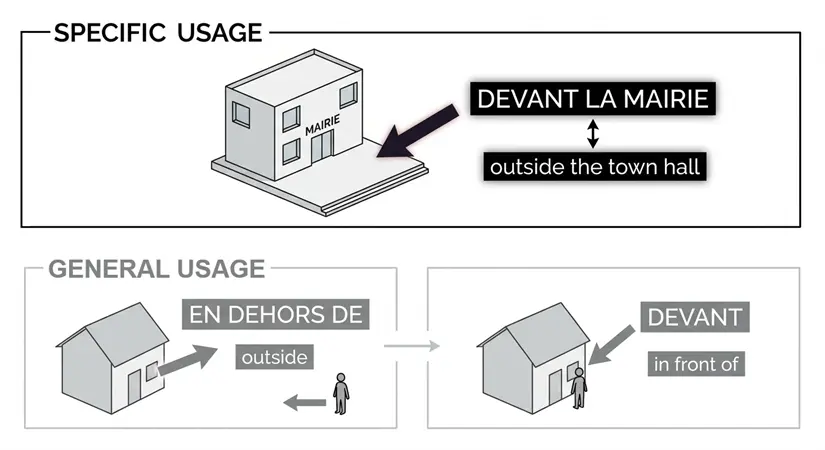
English says Let's meet outside the town hall. French says On se retrouve devant la mairie.
But outside is not devant. English places itself inside the building and looks out; French stands in the street and looks at the façade. Same pavement, opposite vantage points.
This is modulation through point of view change: keeping the facts and moving the camera.
What point of view change is
It reorganises the perspective from which a fact is described. The information does not change; the position of the observer does.
Three axes cover most cases:
- space — inside or outside, above or below, from where;
- time and quantity — counted from which end, in what unit;
- participants — described from the side of whoever gives, or whoever receives.
Unlike the other modulations in this series, this one is easy to miss: the literal translation is usually grammatical and merely sounds slightly displaced, like a photograph taken one step to the left.
Type 1: spatial reference
Let's meet outside the town hall. ↔ On se retrouve devant la mairie.
À l'extérieur de la mairie is not wrong; it is simply not what anyone says. English measures from the interior, French from the street.
The same shift recurs constantly:
- across the street ↔ de l'autre côté de la rue (English describes the crossing, French the resulting position)
- He looked out of the window. ↔ Il regarda par la fenêtre. (a trajectory versus a means of passage)
- the second floor ↔ le premier étage (the two languages start counting from different places — a classic source of real-world confusion)
- the shallow end ↔ le petit bain (depth on one side, size on the other)
Type 2: counting and measuring
Every other week ↔ Une semaine sur deux.
English thinks in alternation: one yes, one no. French thinks in proportion: one out of two. Chaque autre semaine does not exist.
A fortnight ↔ Quinze jours.
English counts fourteen nights, French counts fifteen days, and both mean the same two weeks. Nobody is miscounting: the two languages include the endpoints differently. The same logic gives a week today ↔ aujourd'hui en huit.
6 in 10 women ↔ 6 femmes sur 10.
English puts the number in a container; French places it on a total, and repeats the noun where English does not. The structural habit matters more than the metaphor: in French the noun belongs with the first figure.
Two further cases worth knowing, because the literal version is always wrong:
- the last three pages ↔ les trois dernières pages (the order of the two elements inverts)
- in the foreseeable future ↔ dans un avenir proche (English looks forward as far as it can see; French measures from now)
Type 3: whose side you stand on
This is the most revealing family, and it is missing from most accounts of the procedure. The same transaction can be described from either participant.
- You can have it for ten euros. ↔ Je vous le laisse à dix euros. (the buyer acquires; the seller lets go)
- Thank you. — You're welcome. ↔ Merci. — Je vous en prie. (English grants a welcome; French requests, almost apologetically)
- He stayed at home for want of money. ↔ Il resta chez lui faute d'argent. (a lack described as a need, then as a fault)
- Life imprisonment ↔ la perpétuité (the place on one side, the duration on the other)
Public signage lives almost entirely on this shift, because each language states whichever half of the situation it finds natural:
- No vacancies ↔ Complet (empty rooms versus a full hotel)
- No parking ↔ Stationnement interdit
- Mind the step ↔ Attention à la marche
- Wet paint ↔ Peinture fraîche (wet on one side, fresh on the other)
Why the two languages diverge
Nothing here is a matter of grammar. These are conceptual defaults: the position each language habitually adopts when it has to describe a scene, a quantity or an exchange.
English tends to describe from the point where the speaker already is — inside the building, counting nights, taking the buyer's side. French tends to describe the object as it presents itself to an observer — from the street, counting days, from the seller's side.
Neither is more logical. They are two stable camera positions, and a translation that keeps the source position produces a sentence that is correct and vaguely foreign — the most difficult error to diagnose, because nothing is wrong with it.
When to apply this modulation
Signals that the camera needs moving:
- a preposition of position or direction (outside, across, out of, through);
- any expression of frequency, proportion or interval;
- a short formula — a sign, a greeting, a price, a set phrase — where both languages have their own ready-made version;
- a translation that is grammatical and yet reads as though the writer were standing in the wrong place.
The test is simple and reliable: describe the scene to yourself in the target language without looking at the source. If the sentence you produce differs from your translation only in its vantage point, your translation needs the modulation.
Conclusion
Point of view change is the quietest of the modulations, and one of the most decisive. It shows that translating is not only choosing words but occasionally choosing where to stand.
Because in English you meet outside, seen from within.
In French you meet devant, seen from the street.
Same town hall, opposite gaze.