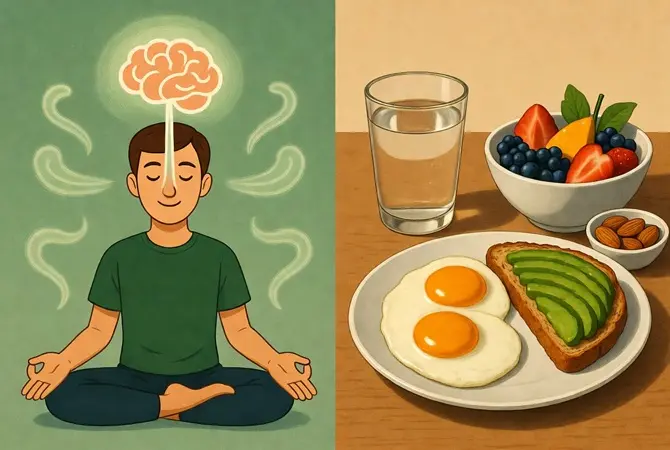
Exam Day Is Not Like Other Days
Breathing and nutrition: the winning combination for staying calm until the last minute.
You've revised, taken notes, gone over everything one last time. And yet, that morning, something happens in your body that you can't quite control. Your heart races, your jaw clenches, your stomach knots. You look at the first question, and your mind seems to have emptied overnight.
Théo, sitting the TOEIC for the second time, had failed the first on a morning he describes like this: three coffees, no breakfast, an hour of feverish revision in the lobby. He lost sixty points on the second half of the test. The second time, he changed exactly two things — breakfast, and five minutes of breathing before going in — and nothing else.
This isn't weakness. It's biology.
Under stress, your body releases cortisol and adrenaline. These hormones are built to prepare you to run or fight — not to write an essay. They speed up your heart rate, tense your muscles and reduce blood flow to the prefrontal cortex, precisely the area of the brain in charge of reasoning, planning and working memory. In other words, unmanaged stress temporarily makes you worse at everything an exam demands. This is not a figure of speech: Arnsten (2009) described precisely how the catecholamines released under acute stress switch off prefrontal networks and hand control back to the brain's more primitive structures.
The good news is that you can act on it. Not with esoteric techniques — with basic physiology.
Breathing: Your Most Powerful Tool, and Your Most Discreet
Breathing is the only automatic function of the body you can steer consciously. It is your direct lever on the nervous system.
By breathing slowly and deeply, you activate the vagus nerve, which stimulates the parasympathetic system — the one in charge of calm, recovery and rest. Within a few cycles, your heart rate slows, your blood pressure drops, and your prefrontal cortex regains access to the cognitive resources you need.
A review of the literature (Zaccaro et al., 2018) confirms that slow-breathing techniques — around six cycles per minute — increase heart-rate variability, reduce anxiety and improve attention, including in untrained subjects. Here are the three most useful techniques in an exam setting.
Coherent breathing: breathe in for five seconds, out for five seconds, steadily and continuously — the six-cycles-per-minute rhythm on which heart-rate-variability biofeedback is based (Lehrer & Gevirtz, 2014). Ten cycles are enough to produce a clear effect. It's the simplest of the three, and you can do it the moment you sit down — pen down, before you even turn over the paper.
The 4-7-8 method, popularised by physician Andrew Weil (1999), is more powerful but takes a little practice. Breathe in through your nose for four seconds, hold your breath for seven, then breathe out slowly through your mouth for eight. The long exhale strongly triggers the parasympathetic response. Two or three cycles are enough in a moment of acute panic.
Diaphragmatic breathing is less a technique than a baseline posture. Most stressed people breathe with the upper chest — short, fast, shallow breaths that keep the state of alert going. Breathing from the belly — letting the diaphragm drop on the inhale, the stomach expand, then release on the exhale — tells your nervous system it can start to decompress. You can do it discreetly at your desk, without anyone noticing.
One last point on breathing: it works better as prevention than as repair. Five minutes of conscious breathing on the morning of the exam, before you leave the house, are worth more than ten minutes of damage control once panic has set in.
What You Put in Your Body That Morning Really Matters
Nutrition on exam day is often neglected: some eat nothing out of anxiety, others eat anything out of habit. Both are mistakes.
Your brain makes up about 2% of your body weight but burns nearly 20% of your energy (Raichle & Gusnard, 2002), and it runs almost exclusively on glucose. Giving it a stable, lasting fuel supply for three hours is as much a strategic decision as a nutritional one.
Eat, even without appetite. Anxiety often kills hunger. Forcing down a full breakfast can backfire if stress is blocking your digestion. But skipping the meal is worse: low blood sugar mid-exam means trouble concentrating, shakiness, irritability and cognitive fatigue that can cost you dearly in the final hour.
Favour complex carbohydrates. Oats, wholegrain bread, rice, banana: these foods release glucose gradually, without the spike and sharp crash of fast sugars. Porridge with a few dried fruits is one of the best pre-exam breakfasts there is.
Avoid fast sugar on an empty stomach. A pastry, a chocolate bar or a fruit juice taken on their own send blood sugar up fast, then down in a reactive dip — exactly the opposite of what you're after. If you want something sweet, always pair it with protein or fat to slow absorption.
Protein stabilises. Eggs, Greek yoghurt, cottage cheese, peanut butter: protein slows the absorption of carbohydrates and supports the production of neurotransmitters, including dopamine and serotonin, which play a part in motivation and emotional regulation.
Coffee: ally or enemy? Caffeine improves alertness and concentration, but it also amplifies the stress response and can bring on anxiety, palpitations and scattered focus in people who are already tense. Caffeine's effects on alertness are real but modest, and depend heavily on habit (Smith, 2002). If you drink coffee every morning, keep going: cutting it on exam day would create a counterproductive withdrawal effect. If you don't usually drink it, this isn't the moment to start.
Hydration is underrated. Mild dehydration — barely 1 to 2% water loss — is enough to degrade vigilance and working memory, and to increase anxiety and fatigue (Ganio et al., 2011). Drink water before the exam and, if the rules allow, bring a bottle. A few sips when your concentration dips is a simple, effective reflex.
Lasting Three Hours: Managing Your Energy Like an Endurance Effort
A three-hour exam is a test of cognitive endurance, not a sprint. Many students set off too fast, burn through their resources in the first hour and reach the final stretch exhausted and panicked.
Take two or three minutes at the start to read the whole paper without writing anything. That time isn't wasted: it lets your brain activate the right memory networks, rank the questions and plan your time. Those who skip this step, out of impatience or anxiety, often get unpleasant surprises at the end.
If your energy fades mid-exam, put your pen down for thirty seconds, close your eyes and do three cycles of coherent breathing. That brief reset can be enough to give you back your concentration for another half-hour.
If you're allowed to bring a snack, go for a small handful of nuts, a few almonds or a square of dark chocolate above 70% cocoa — dense foods that release their energy gradually and won't make you drowsy.
What Not to Do on the Morning of the Exam
Don't revise in the two hours beforehand. Nothing new will be consolidated into long-term memory in that time, and it keeps you in a state of alert that makes it harder to switch into calm, settled concentration. If you have to do something, reread a page of notes you already know — for reassurance, not for learning.
Avoid anxious conversations with the other candidates outside the room. Anxiety is contagious. The "did you revise chapter 7?" and "I hope it's not on…" only amplify your stress, with no benefit at all.
Don't radically change what you eat the night before or that morning. This is not the moment to try a new diet, skip a meal or test a supplement. Consistency is your ally.
In Summary
Managing stress on exam day is not a matter of willpower but of method. Your body obeys precise physiological mechanisms, and you have the tools to influence them: breathing to regulate your nervous system in real time, nutrition to give your brain a stable fuel supply over the long haul, and a few simple habits to approach the exam in the best possible shape.
Théo gained a hundred and ten points between his two sittings. His English had not changed in six weeks; his conditions had. You did the work to be there. You may as well give yourself every chance to be fully present when it counts.
References
- Arnsten, A. F. T. (2009). Stress signalling pathways that impair prefrontal cortex structure and function. Nature Reviews Neuroscience, 10(6), 410–422. https://doi.org/10.1038/nrn2648
- Ganio, M. S., Armstrong, L. E., Casa, D. J., McDermott, B. P., Lee, E. C., Yamamoto, L. M., Marzano, S., Lopez, R. M., Jimenez, L., Le Bellego, L., Chevillotte, E., & Lieberman, H. R. (2011). Mild dehydration impairs cognitive performance and mood of men. British Journal of Nutrition, 106(10), 1535–1543. https://doi.org/10.1017/S0007114511002005
- Lehrer, P. M., & Gevirtz, R. (2014). Heart rate variability biofeedback: How and why does it work? Frontiers in Psychology, 5, 756. https://doi.org/10.3389/fpsyg.2014.00756
- Raichle, M. E., & Gusnard, D. A. (2002). Appraising the brain's energy budget. Proceedings of the National Academy of Sciences, 99(16), 10237–10239. https://doi.org/10.1073/pnas.172399499
- Smith, A. (2002). Effects of caffeine on human behavior. Food and Chemical Toxicology, 40(9), 1243–1255. https://doi.org/10.1016/S0278-6915(02)00096-0
- Weil, A. (1999). Breathing: The master key to self healing [Audio programme]. Sounds True.
- Zaccaro, A., Piarulli, A., Laurino, M., Garbella, E., Menicucci, D., Neri, B., & Gemignani, A. (2018). How breath-control can change your life: A systematic review on psycho-physiological correlates of slow breathing. Frontiers in Human Neuroscience, 12, 353. https://doi.org/10.3389/fnhum.2018.00353