The Paradox of the Good Student Who Doesn't Believe They're Good
Learn to bring your confidence up to the level of your real skills.
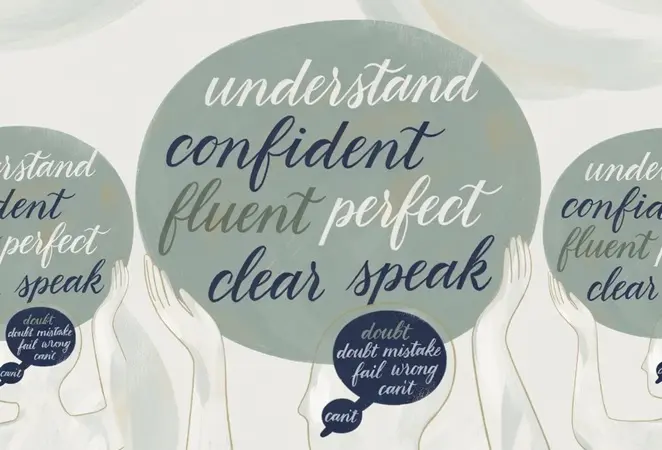
You sat the TOEFL, the IELTS or the Cambridge exam. Your score is objectively strong — enough to get into the programme you were aiming for, enough for the university to accept it without argument. And yet, when someone speaks to you in English in a corridor, something tightens. When you have to speak up in class or in a meeting, a small voice whispers: you're going to give yourself away. They'll see you're not really at this level.
Sofia scored 5.5 on the TOEFL — a C1 level. She wrote to me three weeks after arriving in Edinburgh to tell me her score was "a mistake": in seminars she understood "maybe 60%," and she hadn't opened her mouth since term started. When I asked how her last meeting with her dissertation supervisor had gone, she said it had gone very well — in English, for an hour. She hadn't counted that as evidence.
This feeling has a name: impostor syndrome. And in language learning, it takes a particularly stubborn form, because it draws on real elements to convince you it's right.
What Impostor Syndrome Really Is
The term was coined in 1978 by psychologists Pauline Clance and Suzanne Imes (Clance & Imes, 1978) to describe a phenomenon observed among high-achieving academic women: despite objective evidence of competence, they attributed their success to luck, to other people's mistakes or to a knack for "seeming capable" — and lived in permanent fear of being "found out".
Since then, research has shown the phenomenon to be far more widespread: the often-quoted figure of 70% of people affected at some point in their lives (Sakulku & Alexander, 2011) varies widely between studies — from 9% to 82% in the systematic review by Bravata et al. (2020) — but it concerns both sexes, every field and every actual level. It is especially common in periods of transition — a new programme, a new university, a new professional environment — and among those operating in a language that isn't their own.
The central mechanism is a dissociation between external proof of competence and an internal sense of legitimacy. In other words: the evidence exists, but you don't believe it.
Why English Is Such Fertile Ground
Language is a vehicle for identity before it is a tool for communication. In your mother tongue, you have the full palette of who you are: your humour, your nuances, your register, your precision. You can be subtle, ironic, eloquent.
In English, even at a good level, that palette narrows. You search for words. You simplify complex ideas because you haven't yet found how to express them in their full depth. You laugh at jokes a beat too late. You get the feeling that others see you as less intelligent, less interesting, less yourself.
This gap between who you are and how you come across in a foreign language is real. The problem is that impostor syndrome turns that gap — temporary, normal, inherent to all learning — into definitive proof of inadequacy.
On top of that comes a frequent confusion between two very different kinds of competence. A test like the TOEFL measures codified academic skills: reading comprehension, listening comprehension in formal contexts, structured writing, speaking on prepared topics. What it doesn't measure is spontaneous ease in informal conversation, the ability to catch humour and cultural references, the art of interrupting politely, or of following four people talking at once around a table.
When you land in a real English-speaking environment and find those things hard, you conclude that your score was lying. That's a reasoning error. Your score measured what it was meant to measure, and it measured it accurately. What you lack belongs to another category of skills, acquired through exposure, not through revision.
How It Shows Up in an Anglophone Context
Linguistic impostor syndrome can be recognised by some very characteristic signs.
You understand almost everything, but you pretend to understand everything so as not to have to ask for clarification — because asking would confirm, in your mind, that you don't belong here.
You avoid speaking up in class or in meetings, not because you have nothing to say, but because you fear your accent, your hesitations or your imperfect phrasing will reveal something you're trying to hide.
You compare your spoken English to native speakers' and conclude you're not at the level — forgetting that you're really comparing it to your own level in your mother tongue, which makes no sense.
You read every grammar mistake as confirmation of incompetence, not as a normal piece of learning data.
You got a good score, so you tell yourself the test was too easy, badly calibrated, or that you just had a good day.
Each of these thoughts comes from the same mechanism: your brain looks for the evidence that confirms the belief it already holds, and ignores the evidence that contradicts it.
What Cognitive Psychology Says About This Bias
Impostor syndrome is a classic case of confirmation bias, combined with what Daniel Kahneman (2011) calls question substitution: instead of answering "am I competent in English?", your brain answers "do I feel competent in English?" — and confuses the two.
There is also a well-documented effect, sometimes described as the inverse of the Dunning-Kruger effect (Kruger & Dunning, 1999), or the "competence paradox": the further you progress in a discipline, the more aware you become of everything you don't yet know, which can lower your sense of competence even as your real level rises. A beginner who knows a hundred words sometimes feels they've got English down. A solid B2 speaker, who grasps just how vast the language is, can feel more inadequate than ever.
Real progress and perceived confidence don't follow the same curve. That's normal. And it says nothing about your objective level.
How to Work on This Syndrome in Practice
Naming the mechanism is already an intervention. When the thought "my English is terrible" comes up, don't accept it as a fact; treat it as a hypothesis to test. What's the evidence? Your score says otherwise. The fact that you're following a course or getting by in a new environment says otherwise. The last conversation you handled without a hitch says otherwise.
Separate facts from interpretations. "I searched for a word for three seconds" is a fact. "My English is terrible" is an interpretation — and a remarkably sweeping, final one, drawn from a minuscule piece of data.
Keep a log of your linguistic wins. It may seem trivial, but the technique rests on positive psychology research — Seligman et al.'s (2005) "three good things" exercise showed measurable effects on well-being up to six months after one week of practice: noting each day one successful exchange, one well-turned sentence, one document understood without a dictionary, gradually rebalances the negativity bias that feeds impostor syndrome.
Seek community rather than comparison. In any English-speaking environment, you'll find other non-native speakers going through exactly the same thing. Talk about it. Discovering that other competent people feel the same way is one of the most effective interventions against impostor syndrome — it was, in fact, one of Clance and Imes's first findings.
Accept the temporary asymmetry. Your spoken level in informal settings will eventually catch up with your academic level — but not right away. That gap is a phase, not a permanent state. Every week of real exposure to English shrinks it. It's a matter neither of talent nor of intelligence. It's a matter of time and exposure.
What Your Score Really Says About You
A strong TOEFL or IELTS score doesn't mean you're a native speaker. It means you demonstrated, under controlled conditions and in front of expert assessors, a level of academic English sufficient to succeed at an English-speaking university. That is exactly what it's designed to show. No more, no less.
The rest — ease in conversation, humour, speed of reaction, cultural references — comes with time and exposure. Those skills aren't the ones your score measures, and their absence today contradicts nothing of what your score states.
You're not an impostor who got lucky on a test. You're someone who has mastered certain dimensions of a language and is in the process of acquiring others. That is the exact description of any learner, at any stage.
In Summary
Linguistic impostor syndrome thrives on the confusion between two distinct realities: what a test measures and what real life in that language demands. Closing that gap takes time — and in the meantime, your brain tends to read it as proof of incompetence rather than as a normal phase of learning.
The next time the small voice tells you you're not really at this level, ask it for its evidence. It has nothing solid. You do. Sofia has kept her log ever since. The first entry read: "One hour with my supervisor, in English, no problem." It had been true all along.
References
- Bravata, D. M., Watts, S. A., Keefer, A. L., Madhusudhan, D. K., Taylor, K. T., Clark, D. M., Nelson, R. S., Cokley, K. O., & Hagg, H. K. (2020). Prevalence, predictors, and treatment of impostor syndrome: A systematic review. Journal of General Internal Medicine, 35(4), 1252–1275. https://doi.org/10.1007/s11606-019-05364-1
- Clance, P. R., & Imes, S. A. (1978). The imposter phenomenon in high achieving women: Dynamics and therapeutic intervention. Psychotherapy: Theory, Research & Practice, 15(3), 241–247. https://doi.org/10.1037/h0086006
- Kahneman, D. (2011). Thinking, fast and slow. Farrar, Straus and Giroux.
- Kruger, J., & Dunning, D. (1999). Unskilled and unaware of it: How difficulties in recognizing one's own incompetence lead to inflated self-assessments. Journal of Personality and Social Psychology, 77(6), 1121–1134. https://doi.org/10.1037/0022-3514.77.6.1121
- Sakulku, J., & Alexander, J. (2011). The impostor phenomenon. International Journal of Behavioral Science, 6(1), 75–97.
- Seligman, M. E. P., Steen, T. A., Park, N., & Peterson, C. (2005). Positive psychology progress: Empirical validation of interventions. American Psychologist, 60(5), 410–421. https://doi.org/10.1037/0003-066X.60.5.410