If you have ever translated from English into French, you will have noticed something odd: your French is almost always longer than the English you started from.
You are not being wordy, and you are not translating badly. French structurally tends to expand where English stays compact — and, in the other direction, English demands that you reduce to sound natural.
These two movements have names — expansion (étoffement) and reduction (dépouillement) — and they are what make a translation fit its target language.
What is expansion?
Expansion means adding words to a literal translation, most often going from English into French.
English can be extremely concise, sometimes elliptical. French prefers to make relations explicit, to develop, to state. What fits into one English word occasionally needs a whole phrase in French.
This is not redundancy. It is a structural requirement: without those extra words the French sentence sounds unfinished.
What is reduction?
Reduction is the opposite movement: removing words from a literal translation, most often going from French into English.
What French spells out, English compresses. Translating word for word from French produces heavy, over-explained English.
Reduction is the art of trimming back to the density English expects.
The measurable fact: expansion rate
This is not an impression. Professional practice puts the expansion rate from English into French at roughly 10 to 20% in word or character count, depending on the register — technical texts at the low end, marketing and legal prose higher.
That figure has practical consequences that go well beyond style:
- Subtitles. Reading speed is capped, so the French version of a line frequently does not fit and has to be rewritten shorter rather than translated longer.
- Interfaces and software. A button labelled Save becomes Enregistrer — more than twice the width, in a box that does not grow.
- Layout and packaging. Any translated document laid out in the original template will overflow unless the expansion was anticipated.
Knowing the rate lets you plan for it instead of discovering it at the proofing stage.
Mandatory or optional?
Mandatory when the structure of the target language leaves no choice: without the addition or the cut, the sentence is wrong or unnatural.
Optional when it is a stylistic decision:
- an optional expansion is an explicitation — you state something the source left implied;
- an optional reduction is a stylistic lightening — you drop what the target language considers redundant.
The distinction matters, because mandatory moves are never negotiable and optional ones always have to be justified.
Expansion in practice
English prepositions expand
English prepositions are formidably economical, and they are the single largest source of expansion.
According to a report in European Policy Analyst ↔ Selon un rapport publié dans European Policy Analyst.
English says in; French supplies the verb publié to make the relation explicit.
A campaign by Microsoft ↔ Une campagne orchestrée par Microsoft.
By alone leaves the French sentence hollow; the participle gives it a frame.
The charge against him ↔ L'accusation portée contre lui.
Trips from Dover ↔ Excursions au départ de Douvres. (three words for one)
Stephen King writing as Richard Bachman ↔ Stephen King écrivant sous le pseudonyme de Richard Bachman.
English leaves the notion of a pseudonym implicit inside as; French names it.
They insisted on drinks. ↔ Ils insistèrent pour prendre un apéritif.
English names the object; French supplies the verb governing it.
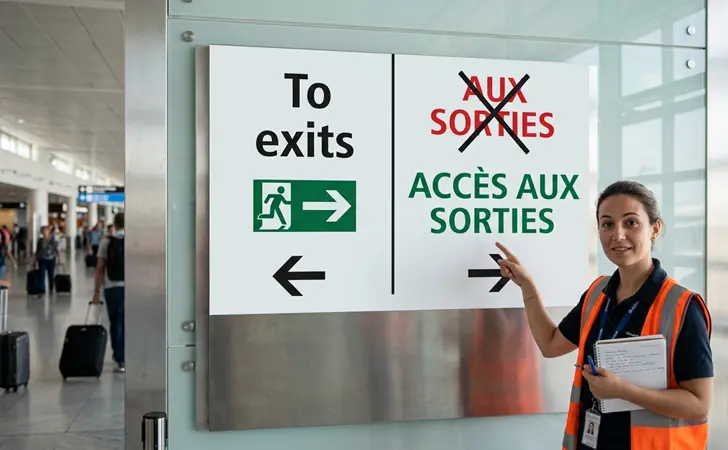
To exits (on a sign) ↔ Accès aux sorties.
Relative adverbs expand
He arrived at 8 o'clock, when traffic is at its peak. ↔ Il arriva à 8 heures, heure à laquelle la circulation est la plus dense.
When becomes heure à laquelle: French reconstructs the noun that the relative refers back to.
I came back to where I had first met him. ↔ Je revins à l'endroit où je l'avais rencontré la première fois.
Where becomes à l'endroit où. French wants a noun to anchor the relative clause; English does not.
Compound noun strings unfold
English stacks nouns into strings that French has to unpack with prepositions and articles, from the last word backwards.
- oil price rise ↔ la hausse du prix du pétrole (3 words → 6)
- road safety campaign ↔ une campagne de sécurité routière
- government spending cuts ↔ la réduction des dépenses publiques
This is mandatory expansion in its purest form: French has no way of juxtaposing bare nouns like that.
Other frequent cases
To my surprise, he didn't say a word. ↔ À ma grande surprise, il ne dit pas un mot.
The added grande is an optional expansion — an idiomatic intensification French expects in this formula.
Phrasal verbs and modals expand in the same way: he can swim ↔ il sait nager requires no extra words, but he managed to get in ↔ il réussit à entrer shows how English particles regularly become French verbs and complements.
Reduction in practice
Going the other way, French offers whole families of phrases that English simply does not carry:
- dans le cadre de ce projet ↔ for this project / under this project
- en ce qui concerne les délais ↔ as for deadlines — or simply deadlines at the head of the sentence
- procéder à une analyse des données ↔ to analyse the data
- avoir la possibilité de choisir ↔ to be able to choose / can choose
- il s'agit d'un problème technique ↔ this is a technical problem
- excursions au départ de Douvres ↔ trips from Dover
Word-for-word translation here produces English that is not wrong but visibly foreign: excursions from the departure of Dover is unusable.
Reduction means distinguishing what is information from what is French syntactic scaffolding, and keeping only the first.
The line not to cross
Expansion has a limit, and it has a name: over-translation. Adding a word the target language requires is expansion; adding information the source did not contain is a mistake.
- Legitimate: a campaign by Microsoft → une campagne orchestrée par Microsoft. The participle carries no new fact.
- Illegitimate: a campaign by Microsoft → une vaste campagne publicitaire orchestrée par Microsoft. Two facts have appeared that nobody wrote.
The same test applies to reduction: cutting French scaffolding is legitimate, cutting a nuance the author chose is not. Ask each time whether you are removing a word or removing a meaning.
When expansion is not available
Sometimes the space is fixed and French has to be as short as English anyway. Subtitles, buttons, column widths and packaging all impose it. In that case expansion is replaced by a different construction rather than by a literal squeeze: a noun instead of a verb phrase, an imperative instead of a periphrasis, a shorter synonym. Knowing this in advance is what separates a translator from a text-length problem.
The art of dosage
Mastering both movements means building a practical intuition:
- knowing when English genuinely needs developing in French;
- knowing when French needs condensing in English;
- sensing where the added words belong, and where the cuts should fall;
- understanding that fidelity to a text is not fidelity to its word count.
Translating to exits as vers sorties is technically possible and idiomatically poor. Accès aux sorties is longer — and it is the right length for French.
Conclusion
When your French comes out longer than the English, do not panic: it is normal, and often necessary. French needs those words to breathe and to feel complete.
When your English comes out shorter than the French, that is equally normal. English does not want all that explicitation; it prefers suggestion to exposition.
Expanding is not padding. Reducing is not impoverishing. It is speaking each language at its own rhythm and its own density.
Because a good translation is not one with the same number of words. It is one that sounds right in the language it arrives in.