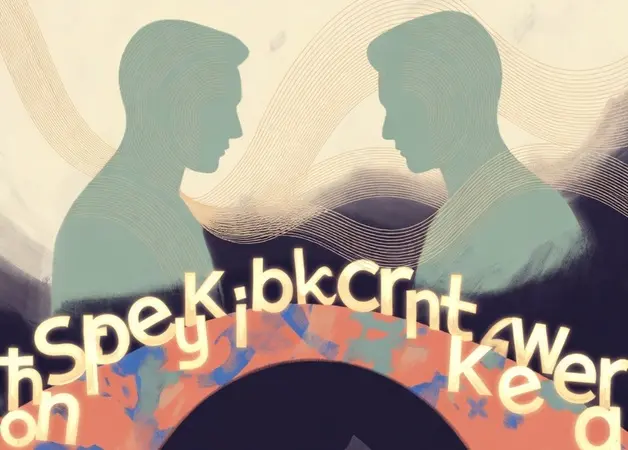
The biggest mistake you can make when learning English is not making any.
Why putting real exchange before grammatical perfection changes everything in English.
Not a grammar slip. Not a mispronunciation. Not a badly chosen word. The costliest mistake — the one that holds back thousands of learners year after year — is silence. That unconscious decision not to speak, not to write, not to put yourself out there, for fear of getting it wrong.
Yanis had a solid B2 and a personal rule: never speak in a meeting without having formed the whole sentence in his head first. As a result he spoke once per meeting, on average, and always too late — the topic had moved on. The day he decided to speak three times per meeting whatever it cost, he made more mistakes in a month than in the previous year. And his manager told him, for the first time, that he was "bringing something."
And yet it's precisely by getting it wrong that we learn. This isn't a motivational speech. It's neurology.
What Your Brain Does With Your Mistakes
When you produce an incorrect sentence and get a response — a correction, a puzzled look, a reformulation from the person you're talking to — your brain registers a prediction error signal. That signal — the "error-related negativity" measurable by EEG (Holroyd & Coles, 2002) — activates the anterior cingulate cortex and triggers a revision: your brain updates its model of the language. It learns, in the most literal sense of the word. Moser et al. (2011) even showed that this signal is larger, and the correction more effective, in people who treat a mistake as a chance to learn rather than as a verdict.
Conversely, when you avoid speaking to avoid mistakes, your brain gets no corrective signal. It stays with its approximate representations, its grammatical fossils, its never-questioned pronunciation habits. Contrary to what we think, silence doesn't protect: it freezes.
Perfectionism: A Well-Disguised Trap
Linguistic perfectionism is particularly insidious because it looks like rigour. Work some more before speaking. Be sure before expressing yourself. Wait until you've mastered the basics. These attitudes seem reasonable, almost virtuous — and yet they are among the leading causes of failure in learning a foreign language.
Linguists call this the affective filter hypothesis, formulated by researcher Stephen Krashen (1982): when language anxiety is high, the brain raises a barrier that blocks the assimilation of new structures, even in the face of high-quality input. In other words, fear of mistakes doesn't just make you silent; it makes you impermeable to learning.
Horwitz, Horwitz and Cope (1986) gave this fear a name and a measurement scale — foreign language anxiety — and dozens of studies have since confirmed its negative correlation with results. In TOEIC or TOEFL preparation, that impermeability therefore has a direct, measurable cost to your score.
Connection Before Perfection
Think back to how you learned your mother tongue. You said things wrong before you said them right. You piled up errors of tense, agreement and vocabulary for years. Nobody around you concluded that you were unfit to communicate. They understood you. They answered you. The connection was there — and that's what made correction possible and natural.
Learn English the same way. Speak before you feel ready. Write before you're sure. Dare the clumsy sentence, the approximate word, the wobbly construction. The person in front of you — colleague, friend or examiner — is trying to understand you, not to catch you out.
Putting connection before perfection isn't lowering your standards. It's adopting a superior learning strategy.
What This Changes Concretely in the Exam
The TOEIC and TOEFL don't test perfection. They test communication. The TOEFL Speaking section, for instance, is scored on coherence, fluency and relevance of content — not on the total absence of grammar mistakes. Raters are trained to assess what you communicate, not to hunt for what you miss.
A candidate who speaks with assurance, builds their ideas clearly and owns their approximations will almost always score higher than one paralysed by fear of error, whose sentences stay short, hesitant and flat.
Fluency is not the absence of mistakes. It's the ability to keep going in spite of them.
Three Practices for Unlearning the Fear of Mistakes
The first: keep an error journal — not to punish yourself, but to turn every mistake into useful data. Note the recurring errors, look for patterns, fix the cause rather than the symptom. One mistake consciously analysed is worth ten abstract grammar lessons.
The second: look for low-stakes environments to practise in. A language exchange partner, a conversation group, an app that puts you in touch with native speakers. Spaces where mistakes are normal, expected, even welcome. The more you expose yourself to them, the more your tolerance for imperfection grows — and your ease with it.
The third: set yourself production goals rather than perfection goals. Not "speak for five minutes without a mistake", but "contribute three times in this meeting" or "write two paragraphs in English today without obsessively rereading myself". Shifting attention from quality to volume of exposure is, counter-intuitively, what improves quality in the long run.
A Final Word
The best speakers of a foreign language are not the ones who made the fewest mistakes. They're the ones who made the most — and kept going anyway.
Error is not the opposite of progress. It's its engine. Yanis now speaks without a prepared sentence. He still makes mistakes. People listen.
References
- Holroyd, C. B., & Coles, M. G. H. (2002). The neural basis of human error processing: Reinforcement learning, dopamine, and the error-related negativity. Psychological Review, 109(4), 679–709. https://doi.org/10.1037/0033-295X.109.4.679
- Horwitz, E. K., Horwitz, M. B., & Cope, J. (1986). Foreign language classroom anxiety. The Modern Language Journal, 70(2), 125–132. https://doi.org/10.2307/327317
- Krashen, S. D. (1982). Principles and practice in second language acquisition. Pergamon Press.
- Moser, J. S., Schroder, H. S., Heeter, C., Moran, T. P., & Lee, Y.-H. (2011). Mind your errors: Evidence for a neural mechanism linking growth mind-set to adaptive posterror adjustments. Psychological Science, 22(12), 1484–1489. https://doi.org/10.1177/0956797611419520